You make towels, bathrobes, bedding, curtains or garments in Denizli. Maybe the factory runs well and orders arrive mostly through personal contacts and trade fairs, but your website has never produced a serious inquiry. Or perhaps you run a small workshop with no site at all. In either case, typing "SEO services Denizli" into Google is a natural step. A buyer abroad checks a new supplier on Google before anything else, and Denizli is one of the best-known textile names in the world. In this article I explain what a textile or export business in Denizli should expect from SEO, which pages actually help, and where to start. I am Ümit Kırkoç, I work alone from Istanbul, and I describe the scope of my own SEO services openly where it matters.
SEO, in short, is the work that makes your website appear when people search on Google. Unlike an ad, it does not stop the moment you stop paying; set up well, it can bring inquiries for months. But results do not arrive overnight, and nobody can guarantee you a ranking. Knowing that from the start helps you set a realistic budget and realistic expectations.
Why SEO works differently for textile makers in Denizli
For a hairdresser or a dentist, SEO is built around people in the neighborhood. For a textile producer in Denizli the situation is very different. The person searching for you is often not in Denizli at all. It could be a purchasing manager for a hotel chain in Germany, the owner of a home textile shop in Sweden, a boutique buyer in Istanbul, or a procurement officer for a hospital in Ankara. Each of them uses different words, often a different language, and has a different intention.
That is why "Denizli SEO" alone is not enough for a manufacturer. The first question is who you sell to: domestic wholesalers, foreign brands, hotels, or end consumers directly. The answer decides which pages you write, which language they use and which searches you aim for.
The illustration below uses a completely invented example to show a search made from abroad. Look at which page answers the question more clearly.
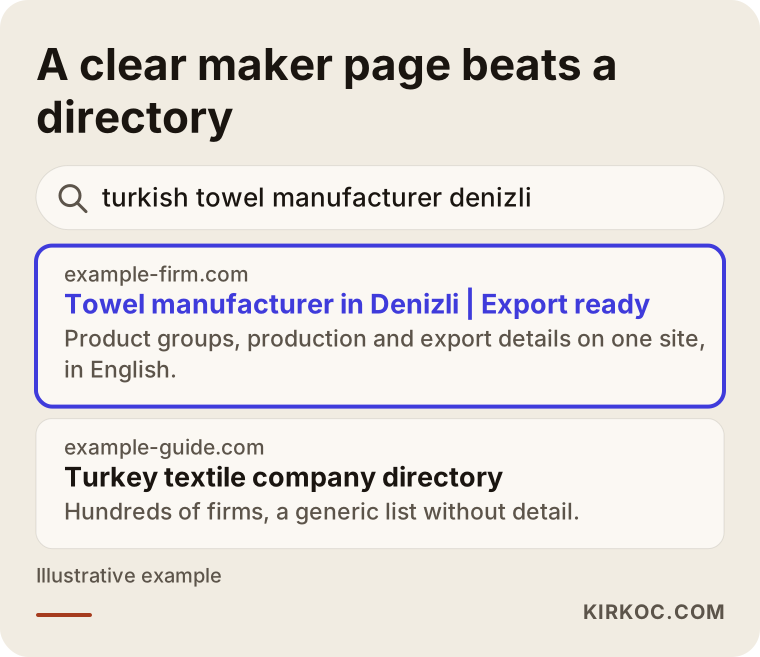
The highlighted result says in its first line what it makes, which countries it ships to and who it works for. The generic directory page lists hundreds of firms together without detail. Google tries to work out which answer will help the person searching, and the more clearly you make that easy, the better your chances of being shown.
The advantage Denizli already has
Denizli is a city people connect with towels, bathrobes and home textiles. That is an advantage for exporters, because buyers already search with phrases such as "Turkish towel" or "Denizli bathrobe". The downside is that everyone shares the same advantage: hundreds of manufacturers, wholesalers and marketplaces compete for the same words. Aiming for first place on a broad search like "towel manufacturer" is unrealistic for most firms. A realistic aim is to be visible on narrower searches where the buyer's intention is clear.
How does your customer search for you?
The most important part of SEO is understanding how your customer thinks, before building any keyword list. In textiles and export, search behavior splits into four groups, and that simplifies the work. The table below summarizes them.
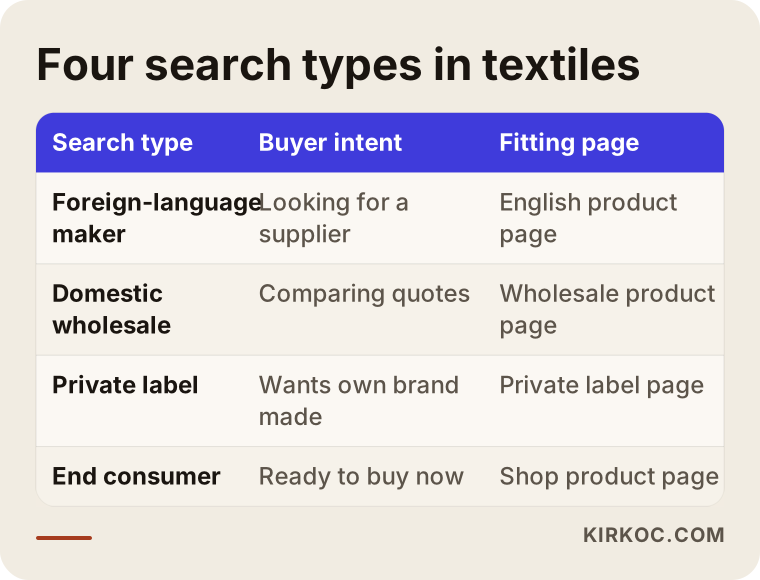
As you can see, every type of search needs a different page. If one page tries to speak to all of them, it fully answers none.
Searches in a foreign language
A buyer abroad usually searches in English, with phrases like "turkish towel manufacturer", "bathrobe supplier turkey" or "private label towels". Buyers from Germany, the Netherlands or Scandinavia may search in their own languages too. Here is the key point: if your site is only in Turkish, appearing on these searches is nearly impossible. Writing English pages is the first step. If you know your target market, adding separate pages in that country's language is the second. Filling a page with raw machine translation rarely builds trust; a buyer notices when they read it.
Domestic wholesale searches
There are buyers inside Turkey too: hotel supply companies, spa operators, corporate gift firms, retail chains. They search for things like "wholesale towels", "hotel towel manufacturer" or "bathrobe with logo". Your rivals here are other manufacturers and the marketplaces. To stand out, your product pages must give the information a buyer actually asks about: weight, size, fabric, minimum order and customization options.
Selling directly to consumers
Some Denizli firms also sell to end consumers under their own brand. Then searches such as "cotton bathrobe", "hammam towel" or "baby gift towel set" come into play. This is shop SEO, and it needs a page structure entirely different from wholesale. Mixing the two on one site is a common mistake, and I return to it below.
What path does a buyer take before deciding?
Choosing a manufacturer is not a one-click decision, the way picking a restaurant might be. In export especially, a buyer may research for months, request samples, check your certificates and ask for references. The job of SEO is to put the right page in front of them at each stage of that path.
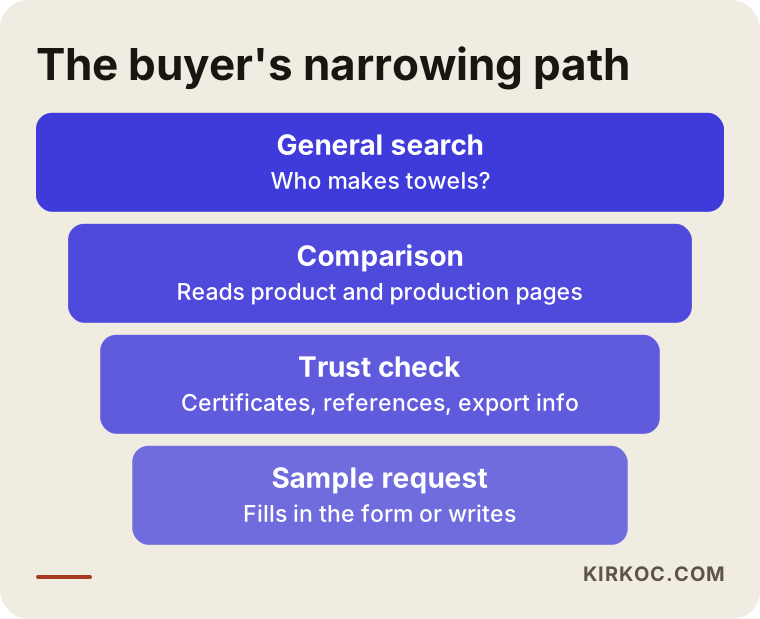
The funnel shows that many people search for general information at the top, and the number shrinks as you go down while the intention gets stronger. If your site focuses only on the "request a quote" button at the bottom, you miss the people at the top. If it focuses only on the top, visitors arrive but nobody writes to you.
Which pages does a textile site in Denizli need?
Many maker websites look like this: a home page, an "about us" page, a few photos under "products" and a contact form. That structure does not answer a buyer's questions. It is weak for SEO as well, because Google needs each topic to have its own page to know what to show.
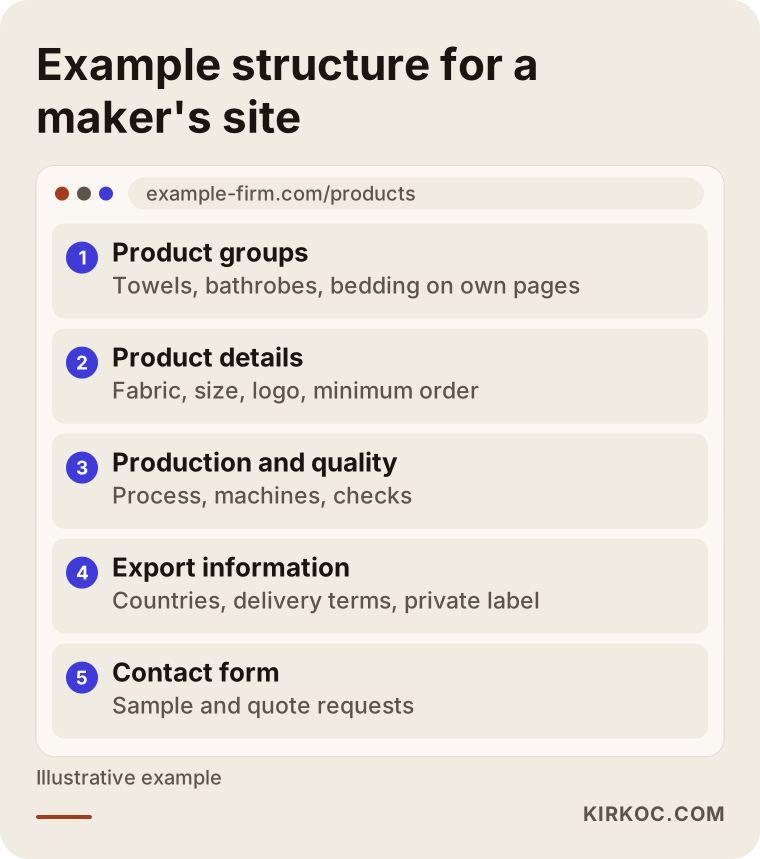
This diagram is only an example, and every firm's needs are different. The general logic holds, though: each product group gets its own page, the production and quality process gets its own page, export information gets its own page, and there is a clear way to get in touch at the end.
Product group pages
Instead of one "Our products" page, open a separate page for each group, such as towels, bathrobes, beach towels and bedding. Each page should say which fabric and weight options exist, which sizes you make, whether you can add a logo or a custom color, what the minimum order is and roughly how delivery time works. You do not have to publish numbers, but instead of a vague line like "depends on quantity", explain what it depends on. A buyer trusts that.
Production and quality page
The buyer has never seen you, so they want to see your factory on the page. A page describing the process from yarn selection to packaging, the machinery you use and your quality control steps is valuable both for Google and for people. List certificates such as OEKO-TEX or GOTS only if you truly hold them, and make the document number or verification details easy to find. Claiming a certificate you do not have causes serious trouble.
Export and private label page
A page that explains which countries you ship to, which delivery terms you work with (for example ex-works or delivered to port) and whether you make private label products collects the answers a foreign buyer is looking for in one place. It is also the natural target for searches like "private label towel manufacturer".
What are local search and map visibility good for?
You are a manufacturer based in Denizli, and people can search for Denizli together with what you do. A local supplier, a hotel owner or a corporate buyer may want to visit your factory, for example. In that case your Google Business Profile matters: address, opening hours, phone number, photos and the right category. If the profile is empty or shows outdated details, trust breaks.
One distinction is worth making. A Google Business Profile puts you on the map and suits businesses with a physical address. For an export-focused maker the real work is the website, and the profile is a supporting tool. It also matters that your company name, address and phone number are written identically in both places.
Showing up as a manufacturer in AI answers
Many people now put questions like "how do I find a reliable towel manufacturer in Denizli?" straight to ChatGPT or a similar AI tool. These tools build their answers from open sources on the internet, so it matters that your site carries clear, orderly information that can be checked.
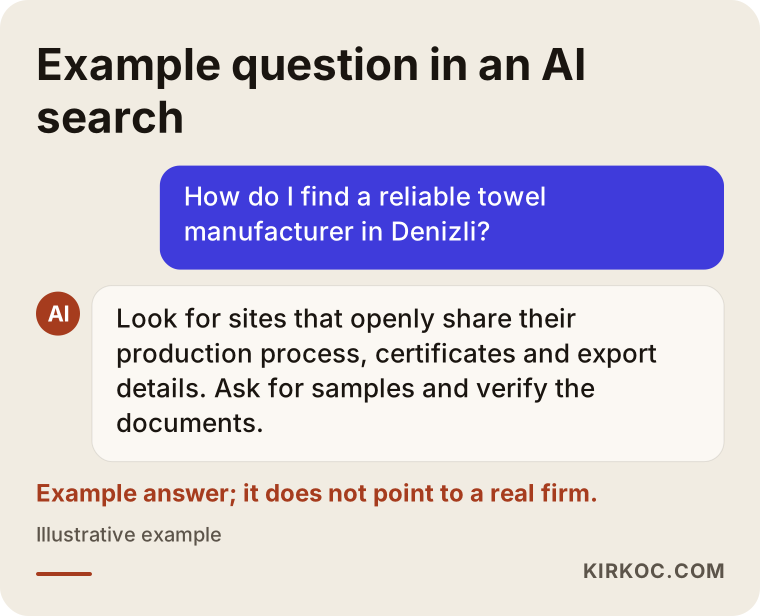
The answer shown is an example and does not point to a real firm. The point is that before an AI tool can mention a company, it has to be able to read what that company does, where it is and what it offers. A site that is cluttered, scattered or has very short text falls behind here. Work aimed at appearing as a source in AI answers is called GEO. This article is about SEO, but a well-prepared site usually helps with both.
Two hypothetical example scenarios
The two scenarios below are invented. They describe no real company or person; their purpose is to show the logic.
Scenario one: a mid-sized towel maker that wants to export
Imagine a firm in Denizli that has sold towels to domestic wholesalers for years. Its site was built ten years ago, it is Turkish only and has no product pages. The owner wants to go abroad but receives no inquiries from the internet.
The first job is to decide whom to target, for example hotel suppliers in Central Europe. Then product group pages in English and, if needed, German are prepared, along with a production page and a clear sample request form. Over a few months the product pages are picked up by Google, and the first appearances come on narrow phrases. At first only a handful of visitors arrive, but those who do are buyers asking directly for samples with a clear intention. In this scenario the measure of success is not visitor count but how many qualified inquiries come in.
Scenario two: a bathrobe maker starting to sell under its own brand
Another hypothetical firm wants to sell part of its production to end consumers under its own brand. Its site shows wholesale and retail products mixed together. Visitors cannot tell what they are looking at, and Google cannot tell which search to show the page for.
The fix is to separate wholesale and retail clearly. The retail section gets a page for each product, a size chart, washing information, return terms and real customer reviews. The wholesale section sits apart and works with a quote form instead of a price list. That way two different customers each reach the page that answers their own question.
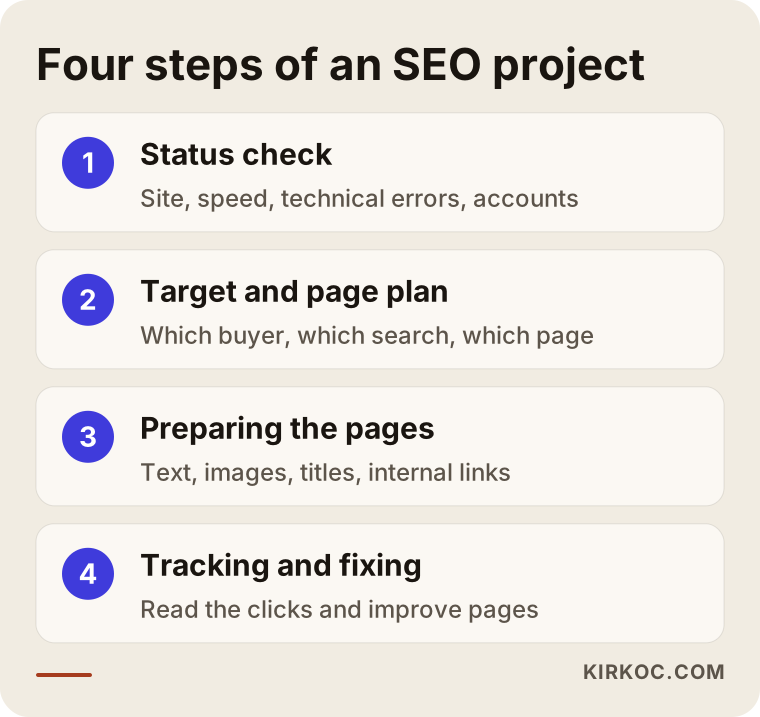
Step by step: how an SEO project runs
There is no need to present SEO as a mystery. Done properly, it is a fairly orderly process. In my own work it goes roughly like this.
Status check
First I look at the current site: which pages exist, which appear on Google, whether the site loads quickly on a phone, and whether there are technical errors. Free tools such as Google Search Console and Analytics are used here. They show your site's report card on Google. The accounts must be opened in your name, and nobody should hold this data in a way that leaves you out.
Target searches and page plan
Next I decide which searches to aim for, for which buyer, and which pages will answer them. Instead of stuffing many phrases into one page, each main topic gets its own page.
Preparing the pages
Texts, product pages, photo layout, headings and internal links are prepared. Images matter a great deal in textiles, but large, heavy images slow a site down, so they are resized. Each image also gets a plain description, which helps accessibility and search.
Tracking and fixing
After the pages go live, I watch them for several months. Which searches bring clicks, which pages are shown but nobody clicks, which get no attention at all? Titles, descriptions or content are adjusted accordingly. This is why I say SEO is not a "do it once and forget it" job.
Common mistakes
I have collected the mistakes I most often see on textile and export sites in the graphic below. Most of them can be avoided without spending any budget.
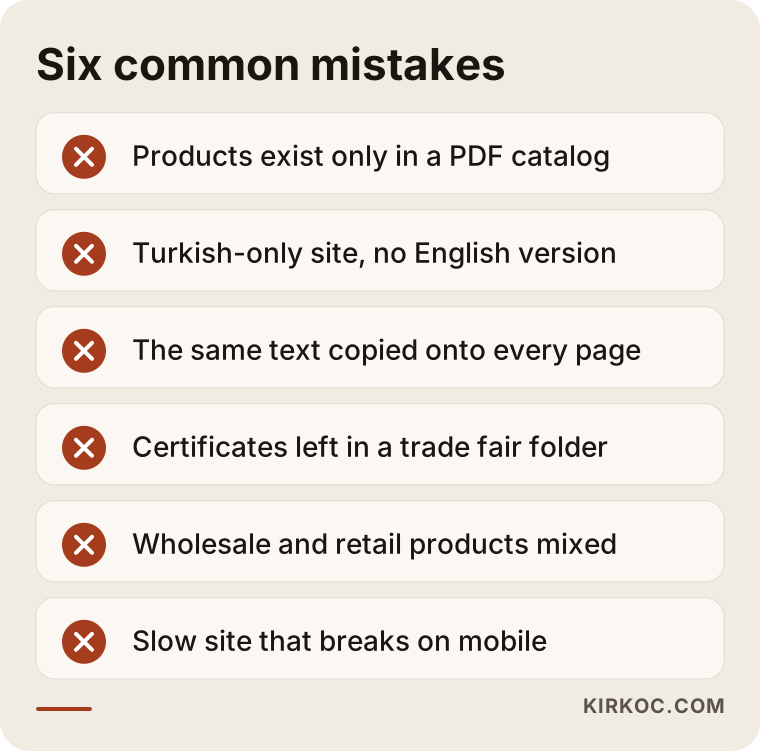
Let me open up a few that stand out.
Relying on a PDF catalog
Many manufacturers publish their products only as a PDF catalog. A catalog is certainly needed, but it is not enough on its own. Google does not show each product inside a PDF as its own page, and the buyer struggles to find where a product is. Keep the catalog available for download, but also describe your products on separate pages of the site.
Publishing only in Turkish
A site with export goals that is only in Turkish is like leaving the shop door locked. The English version should cover at least the product groups and contact pages. Language versions should not be mixed; each language needs its own address. You also have to tell Google technically which language is meant for whom, or the wrong version may be shown to the wrong country.
Pasting the same text everywhere
Copying the same general paragraph onto every product page makes it hard for Google to tell the pages apart. Each page should describe its own product, its own sizes and its own use.
Hiding certificates and references
Some firms keep certificates in a trade fair folder and never put them on the site. Buyers go looking for exactly that proof online to feel safe. Publish what you are able to publish, in the right form. If you plan to name a customer as a reference, get their written permission first.
Technical neglect
A slow site, pages that break on mobile, broken links and an insecure address (one without https) push away both people and Google. Most of these are fixed once and then cause little trouble for a long time.
When do results show up?
The honest answer is that it varies. On a site starting from zero or with very little content, the first meaningful movement usually appears after a few months. In fields with long decision cycles such as export, turning interest into an order takes additional time. A buyer finds you today, asks for samples, talks again next month and places an order half a year later.
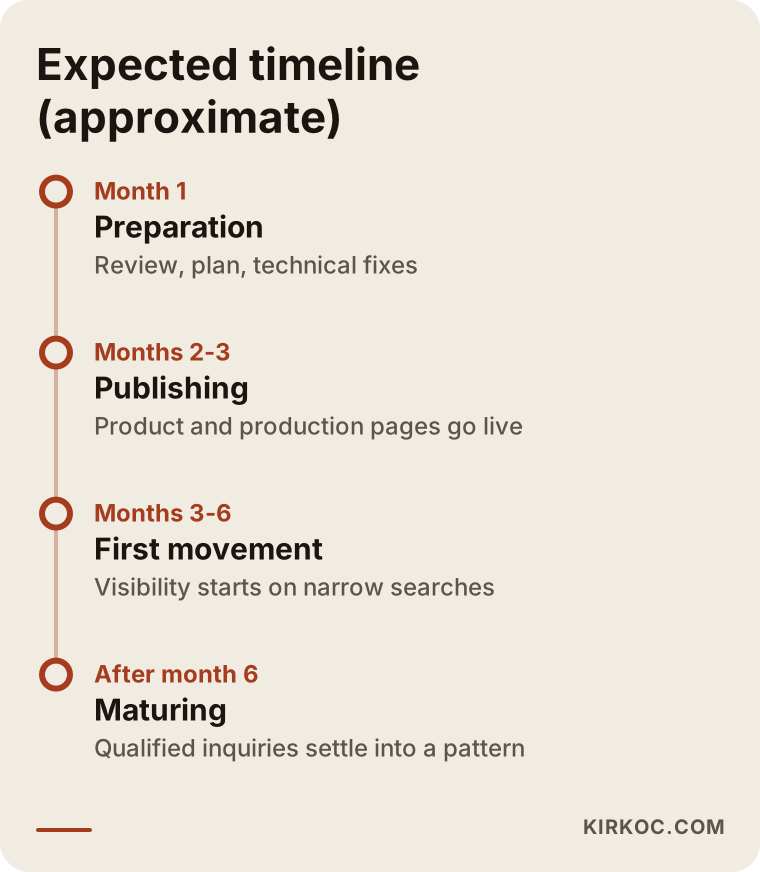
This timeline gives an average idea and is not a promise. The intensity of competition, the current state of the site, the size of the target market and the quality of the published content can all stretch or shorten it. If someone tells you "I will put you first in so many weeks", be careful.
What can you do yourself, and when do you need an expert?
There are things you can do without any budget. Fill in your Google Business Profile, open a Search Console account, take product photos regularly, collect product names and sizes in one table, list the countries you ship to and scan your certificate documents. This preparation also speeds up any expert you work with later.
Expert help makes sense when your site has technical problems, when you need content in several languages, when you do not know which searches to target, or when your own efforts have produced nothing after a few months. Not every job needs an expert, but fixing a badly built structure later costs more than building it correctly at the start.
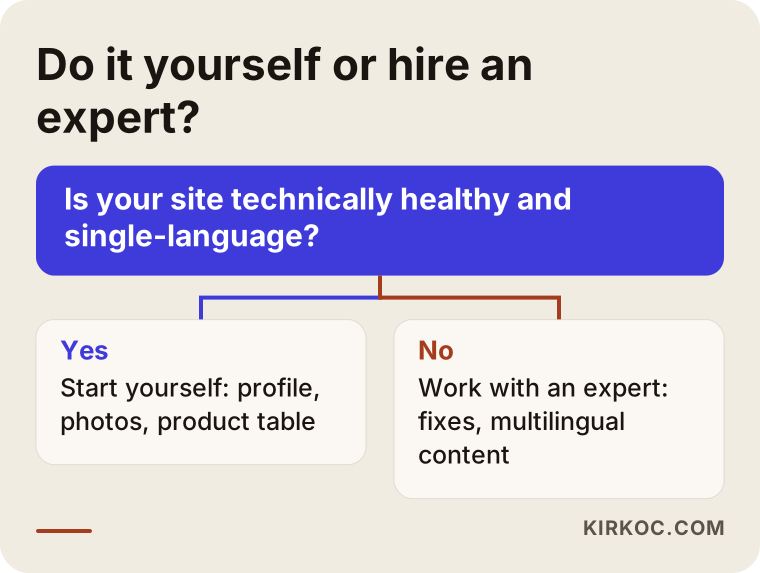
This chart is a general guide, and each firm's situation differs. If you are unsure, a short first conversation usually settles the decision.
What determines the cost of SEO?
I do not give numbers in this article, because even two textile companies can need very different scopes of work. Instead, let me explain what moves the price, so you can compare the quotes you receive yourself.
- Number of pages: A firm with five product groups and a firm with fifty are not the same job.
- Number of languages: Each extra language means writing, checking and technical setup.
- State of the current site: If a brand-new site is needed, the scope grows; if the existing one can be repaired, it stays smaller.
- Competition: Crowded searches need more content and more time.
- Visual production: Professional product photography and short videos are a separate item.
- Length of engagement: A one-time setup differs from monthly ongoing follow-up.
When you collect quotes, look at these points: exactly what will be delivered, how many pages will be prepared, how often reports will arrive, who will own the accounts and what happens when the contract ends. A vague "all inclusive" offer leads to arguments later.
How I work
I work from Istanbul, and I can comfortably work with a firm in Denizli remotely. Meetings take place by video or phone, and documents and photos are shared digitally. Because I work alone, the person you talk to is the same from start to finish; I do not hand your project to someone else halfway.
Working as one person has a practical benefit. When a website, SEO, social media and advertising sit with different people, each looks only at their own area and gaps appear between them. Product names on the site may differ from the ones used on Instagram, or an ad may lead to some other page instead of the one prepared for SEO. Since I run these things myself, the pages, visuals and message stay consistent. If you want, I can include an export-focused LinkedIn presence or Google ads in the same plan, but I do not push that as a required package. If you need it, we talk about it.
In general I proceed in this order: a short conversation and review of your current situation, then a written plan and scope for you, implementation once you approve, and then regular updates. I explain what I do in plain language, and when I have to use a technical term, I explain it.
What to prepare before we start
Preparing the items below before a meeting speeds the process up considerably.
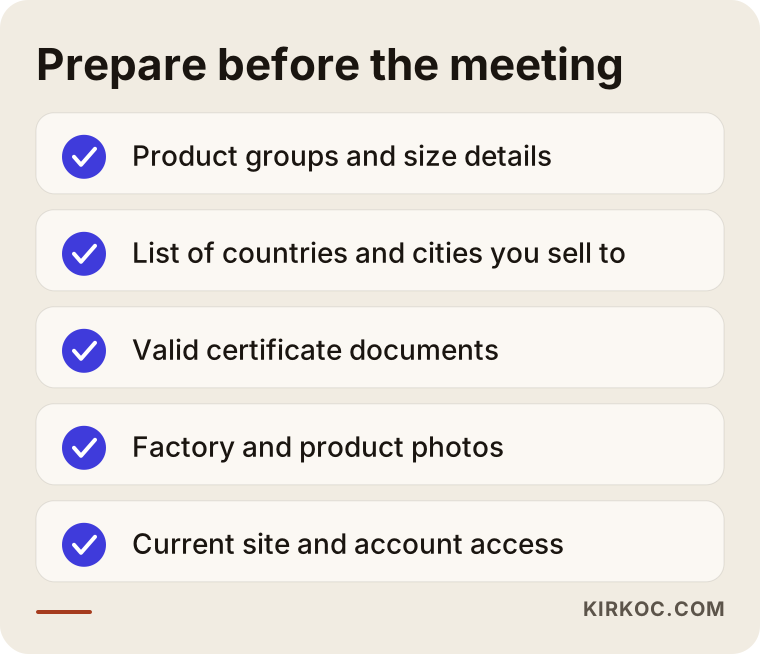
Not everything on this list has to be complete. We can fill in what is missing together, but you should at least know whom you sell to, where, and which product.
Frequently asked questions
Must I work with an expert based in Denizli for SEO there?
No. SEO is largely done remotely. What matters is working with someone who understands your sector and how buyers behave, and that communication is regular. I work from Istanbul and can proceed with Denizli firms through video calls and document sharing. If there is a case where I need to see the factory in person, we plan that separately.
My site is only in Turkish. What should I do for export?
At the very least, have English versions prepared for the product groups, the production information and the contact pages. If your target country is clear, separate pages in that country's language can be added. Each of these pages needs its own address, and Google must be told correctly which language is for whom. I would not recommend leaving pages as machine translation alone; a person should check them at least once.
If I get SEO done, will I rank first?
Nobody can guarantee that. Google decides the ranking; all I do is make your site clearer, faster and more useful for it. Treat anyone who promises a ranking with caution. A realistic goal is to gain visibility on the right searches over time and to receive qualified inquiries.
I sell on marketplaces. Do I still need my own site?
Marketplaces can help with fast sales, but the customer belongs to the platform rather than you, and the commissions and rules can change at any time. Your own site keeps your brand, product information and customer contact under your control. The two can run side by side; you do not have to treat one as a replacement for the other.
Should I buy ads or get SEO done?
They do different jobs. Ads give quick visibility but stop when you stop paying. SEO takes time, but over the long run it can bring visitors at a lower cost. When testing a new product or market, short-term ads can be combined with SEO for a lasting structure. Which comes first for you depends on your target market and budget.
Does showing my certificates on the site help SEO?
It does not guarantee a ranking directly, but it raises a buyer's trust and can help your page get found on searches with a clear intention, such as "OEKO-TEX certified towel manufacturer". Publish only documents you really hold that are still valid. If you are unsure about the terms for using a certificate, ask the certifying body or a lawyer.
Do I need to rebuild my current site from scratch?
Not always. If the site is fast, works properly on mobile and is built so that it can be edited, you can proceed by adding pages. But if it is very old, slow or on a platform that cannot be changed, replacing it usually costs less in the long run. I can give a clear answer once I have looked at the site.
Who owns my site and accounts when the work ends?
They should belong to you. You are the owner of the domain name, Search Console, Analytics and business profile accounts; I work only as an authorized user. I suggest getting this written down at the quote stage, so that you never have to ask who holds what later.
If you want your textile or export business in Denizli to be more visible online, let us first look at where you stand today. You can write to me through my SEO services page and briefly describe what you sell, whom you sell to and the current state of your site. I will tell you honestly what is needed and what is not.