You run a business in Denizli, or you are about to start one there, and your website either does not exist or no longer brings you any work. Maybe you own a small hotel near Pamukkale, you export towels and home textiles, you manage a clinic in Merkezefendi, or you are a foreign investor setting up a workshop and trying to understand the local market. At some point you typed "web design Denizli" into Google and got a wall of nearly identical promises. This article explains, in plain language, what a business in Denizli should actually expect from a website, which pages do real work, and how to compare the offers you receive.
I am Ümit Kırkoç, and I work alone from Istanbul. I handle everything a digital agency would normally split between several people, so when I build your site through my website design service, it is also set up to be found on Google and to work together with social media and advertising. You do not need to meet face to face. Phone and video calls are enough for a project like this, and most of the work happens through shared files and short messages anyway.
First, a simple idea. A website is your shop on the internet. A shop with a beautiful window but a locked door, or with shelves nobody can read, gets no visitors. In Denizli, who walks through that door, in which language and after searching for what, depends heavily on the character of the city. So let us start there.
Why a Denizli website should not be copied from another city
Denizli is not a one-industry town. On one side there are manufacturers of towels, bathrobes, bed linen and fabric, many of them selling to buyers abroad. On the other side there is tourism around Pamukkale and the ancient city of Hierapolis, with hotels, restaurants and guides serving visitors from many countries. Around them you find marble and travertine workshops, machinery and supplier factories, and in the districts of Merkezefendi and Pamukkale there are clinics, law offices, schools and shops. Every one of these businesses attracts customers who arrive from a different direction, with different words and different expectations.
That variety kills the idea of a site that suits everyone. A wholesaler's visitor wants to see product groups, materials and ordering conditions laid out clearly. A hotel guest wants room photos, a map and an easy way to book. Using one template for both would make both worse.
The second difference is language. If you sell to foreign buyers or foreign tourists, they will almost never search in Turkish. They type their question in English, German or another language, and a site that exists only in Turkish is invisible to them. Even when it does appear, it tells them in the first second that nothing here was made for them.
The third difference is local trust. Denizli is a city where people tend to know someone who knows someone. A local customer often hears about you from an acquaintance and then looks you up online to confirm. They want quick answers: are you real, where exactly are you, does the phone number work? If your site cannot answer, even a warm personal recommendation gets wasted. If you are a foreigner doing business here, the same applies in reverse. Your Turkish partners and customers will check your site to see whether you are properly established.
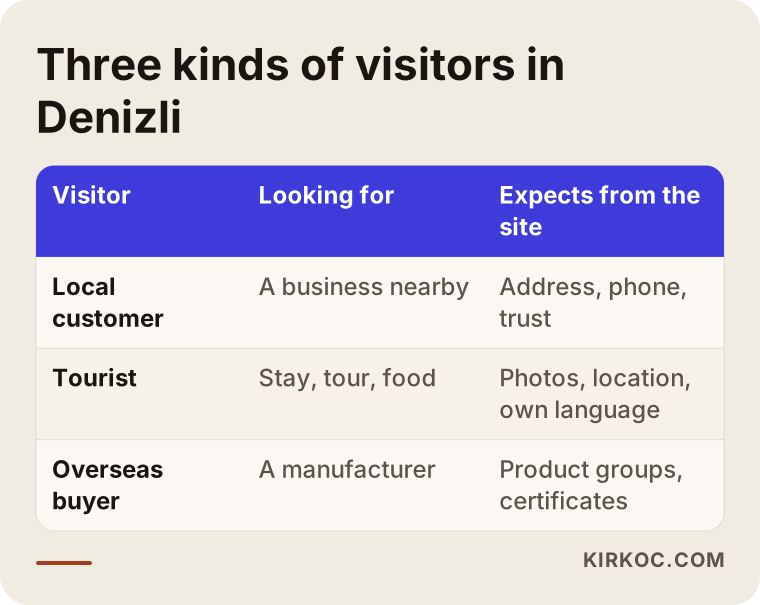
The illustration above sums up three typical visitors of one and the same business. Because each one wants something different, the first screen of your site needs to show quickly who it is for.
What do people type into the search box?
Your future customer does not use technical language. They write plain phrases such as "towel manufacturer Denizli", "boutique hotel near Pamukkale", "dentist Merkezefendi", "corporate identity design Denizli" or "office furniture Denizli". Most of these include a city or district name. If your site never mentions the places you serve, Google has little reason to match you with those searches.
There is a small but important catch. Repeating the city name over and over does not help. What helps is a page that truly answers the visitor's question and is genuinely tied to the city and district. A short section on where you work, a full address, a map and answers to questions specific to the area build that connection in a natural way.
The pages a Denizli business site needs
Every business site has a core: a home page, pages for your services or products, an About page and a contact page. Without those the site feels unfinished. Denizli-specific needs sit on top of that core.
The home page must answer, within about five seconds, what you do, for whom and where. A nice photo and a slogan like "quality and trust", the kind everybody uses, will not do that. A concrete line like "Towel and bathrobe manufacturing in Denizli" or "Boutique hotel a short walk from the Pamukkale terraces" will.
Writing a separate page for each main service works far better than squeezing everything onto a single "Services" page. Google tries to match each search to a page that answers that exact question. Someone looking for "dental implants" will not be satisfied by a page that mentions thirty treatments in one paragraph. A full page per main service helps you appear in search and also makes it easier for the visitor to feel convinced.
The About page matters more than most owners think. In a place where trust decides a lot, visitors want to see who is behind the business. How long you have been doing this, where you work, your certificates or photos of your production site, shown honestly, do more than a clever slogan can.
The contact page needs its own care. Address, phone, WhatsApp, opening hours and a map should sit together in one tidy place. Someone on a phone should be able to call you with a single tap. It looks like a tiny detail, but in practice it is one of the biggest reasons businesses lose inquiries.
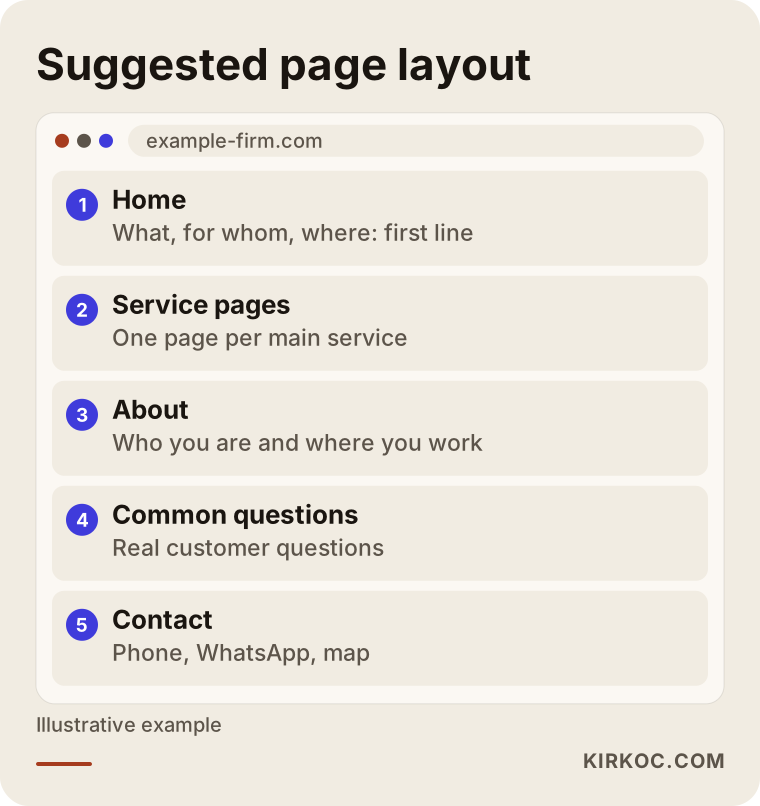
This is a rough page outline, not a final design. Your headings will change with your sector, but the logic stays the same: first what you do, then who it suits, then reasons to trust you, and finally the easiest way to reach you.
What manufacturers and exporters need
Production is Denizli's strong side, which makes manufacturers and wholesalers an important group of readers. A site for such a company is usually not aimed at a shopper. It speaks to a buyer, a store chain or a trading company. That buyer often holds a list of several suppliers and wants a quick impression of trust from the website before opening an email conversation.
So separate your product groups clearly: towels, bathrobes, bed linen, fabric. In each group, describe the raw material, how it is made, what can be customized and how ordering works, in simple words. You do not have to publish a price list, but the question "what do I need to tell you to get a quote?" should be answered on the page. Quantity, size, color, printing or labeling needs can all be collected through a quote form.
If you target foreign buyers, the English version should be checked by someone who understands your business, not just run through a translation tool. One wrong term can make a buyer doubt how serious you are. Certificates, production capacity, sample policy and shipping details should be easy to find in that version.
What hotels, restaurants and tour businesses need
Around Pamukkale, a visitor usually does not know you at all. They look at two or three options on their phone and decide fast. That decision rests on photos, location and a clear way to book.
Use real photos of your rooms and services. Stock images feel familiar and lower trust. Describe the thermal pools, the travertine terraces and the distance to the ancient city so that the guest can picture the stay. If you want foreign guests, separate pages in their own languages are important, and a half-translated page can be worse than none.
Relying on outside booking platforms is not a problem in itself. Still, giving guests a direct way to reach you on your own site, by phone, WhatsApp or a simple form, is a smart investment if you want to depend less on platform commissions.
Example scenario 1: a towel manufacturer in Merkezefendi
This is a hypothetical example and does not describe a real company. Imagine a mid-sized towel producer in Merkezefendi. Its website was built ten years ago, exists only in Turkish and is hard to read on a phone. The owner wants regular inquiries from abroad, but when a buyer searches in English for something like "Turkish towel manufacturer", the company does not appear.
The work would go in this order. First I would move the site to a fast structure that opens comfortably on a phone. Then I would split the products into separate pages. Each page would carry production details, customization options and a quote form. An English version would follow, and here the goal is not just translation. The content is arranged around the questions foreign buyers actually ask: certificates, capacity, how samples work, how shipments are handled.
It would be unrealistic to expect this site to bring orders in its first weeks. But when a buyer hears of the company through another channel and then searches for it, what they find is a site that inspires confidence. Over time, appearing for the right searches can be added. This effect comes with no guarantee of position, yet building the pages properly is the entry ticket to competing on equal terms with others.
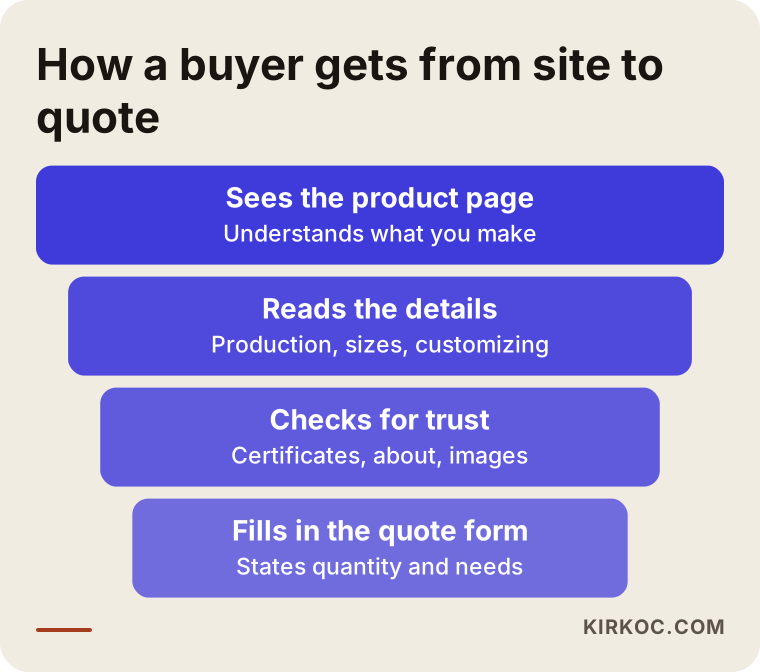
The path in the figure shows how a buyer moves from the site to a quote request. Something can be lost at every step, so each page should make the next step obvious.
Example scenario 2: a small boutique hotel near Pamukkale
This is also a hypothetical case. Picture a small hotel with a handful of rooms close to Pamukkale. The owner notices that most bookings come from outside platforms and that a commission is paid on every one. The hotel has its own site, but it loads slowly on a phone, the photos are old and it is only in Turkish.
Here I would begin with the foreign guest's journey. The guest will arrive by plane or bus, visit Pamukkale, the thermal areas and the ancient city, and while choosing a place to stay will compare location, room and reviews. The site has to answer those questions in two languages: how do I get there, how close is the ancient city, what is for breakfast, what is the cancellation policy?
Then I would simplify the structure: room pages, location and transport, things to see nearby, common questions and a direct contact route. I am not telling the owner to leave the platforms. The point is to build the site so that a guest who already knows the hotel, or calls it directly, can find the commission-free route. If the hotel has a social media account, its photo style would be matched with the site, because a visitor coming from Instagram should not feel they landed at a different business.
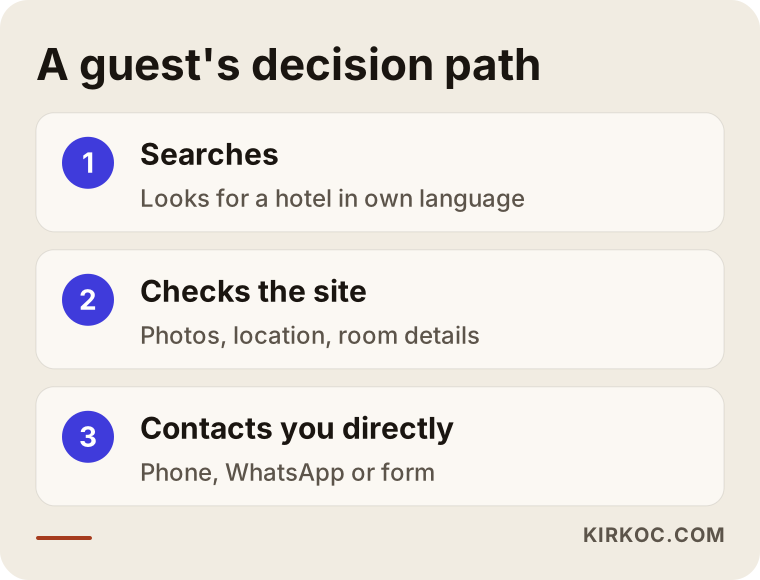
The figure shows step by step how a guest decides. Your site's job is to make them say "yes, this place fits" at each of those steps.
How a website project runs, step by step
Knowing the process protects you and sets your expectations, whether you work with me or with anyone else. The steps below show the usual flow.
I start with a needs conversation. We talk about what you sell, to whom, what works on your current site and what does not. Any quote given without this conversation is a guess. The second step is the page plan: on paper, we decide which pages the site will have and which question each one answers.
In the third step, content and images are collected. We write the texts together, or I prepare them, and the photos should come from your real workplace whenever possible. In the fourth step, design and setup happen. You see the site first on a private test address and send your corrections. The fifth step is launch: the domain name, email, security certificate and measuring tools are checked. The sixth step, often forgotten, is what happens after launch. In the first weeks I watch whether forms work, whether pages open properly and where visitors come from.
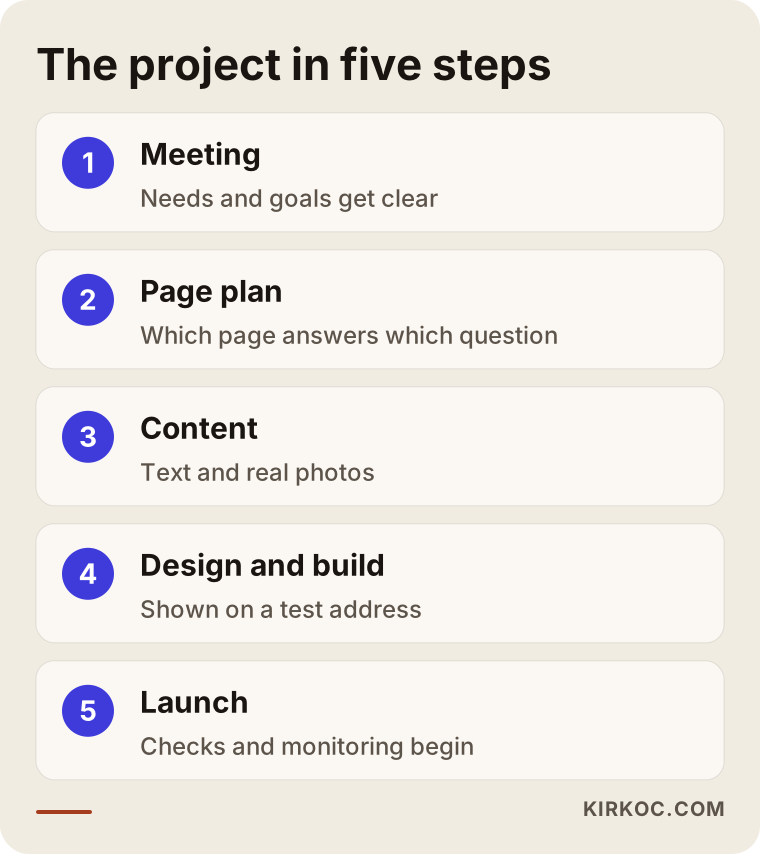
The most critical part of this flow is content. Owners often wait for the design while the texts and photos are late, and the project stands still for weeks. Preparing texts and photos early is the single thing that shortens the schedule most.
What does the schedule look like?
The time needed depends on the size of the site and on how fast you give feedback. A simple company site with a few pages and an online store with dozens of products do not finish on the same calendar. A very common situation is that the design is ready but the launch date slips because texts or photos have not arrived. That is why it helps, at the start, to write down who brings what and when. That alone solves half the problem.
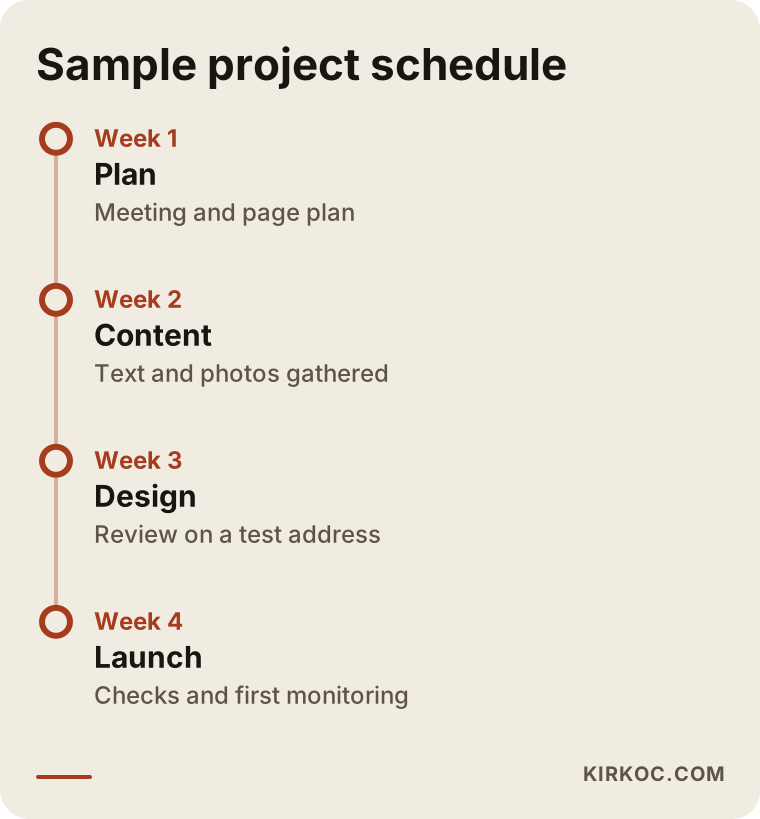
The timeline is only an example, and real durations change from project to project. What matters is that every stage produces something you can see, so that a stuck point is noticed immediately.
Common mistakes when ordering web design in Denizli
The following mistakes are the ones I hear about most from business owners and see most often on older sites.
The first mistake is treating the site like a brochure. Listing products and company facts and leaving it there does not push the visitor to act. Every page should ask for a next step: call, fill in a form, request a quote.
The second mistake is looking only at the design and never asking about the foundations. A site that opens slowly on a phone, shows a security warning or has a broken form will lose customers however pretty it is. When you collect quotes, always ask about mobile friendliness, speed and backups.
The third mistake is having the domain name and hosting registered in someone else's name. Some companies register your domain under their own name while building the site, and later, if you want to leave, your site is held hostage. Make sure the domain is registered to you and that you hold the login details.
The fourth mistake is using the city name pointlessly. Hidden or forced texts added at the bottom of pages, with phrases such as "best web design Denizli", annoy readers and carry no real value for Google. Content that is genuinely useful and tied to the city and district is a better path.
The fifth mistake is trusting a template and leaving the content empty. A ready-made template can be a perfectly fine choice, but if "Lorem ipsum" or the same cliché sentences everyone writes are left inside, visitors notice immediately.
The sixth mistake is forgetting the site after launch. A site is not finished the day it goes live. Updates, new products, price or opening-hour changes and security patches all need regular attention.
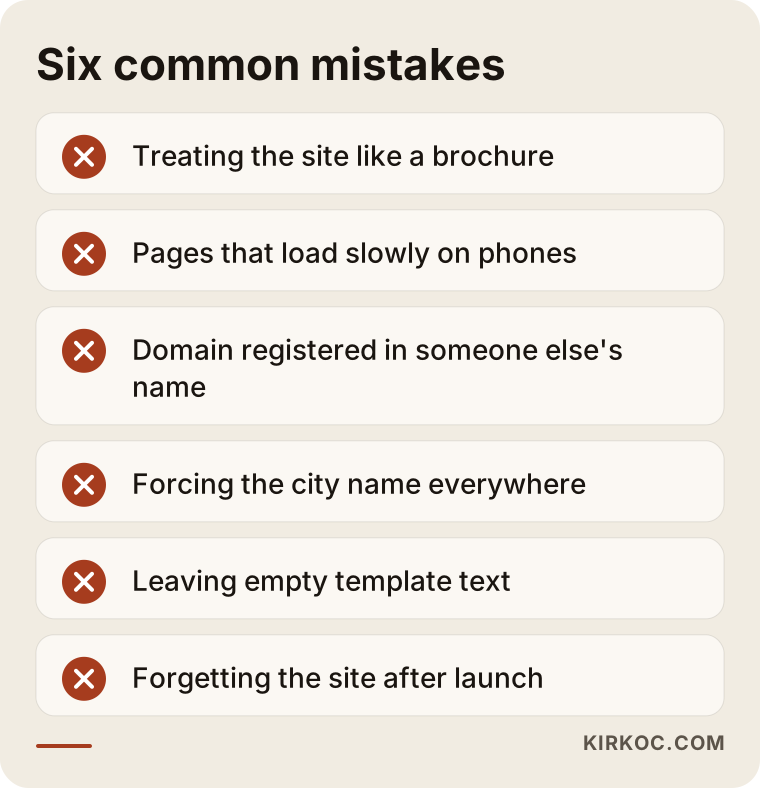
The warning list in the figure is a set of checks you can use while collecting quotes. Look for each of them in every offer, and do not hesitate to ask when the answer is missing.
What can you do yourself, and when do you need an expert?
You do not have to hand everything to a specialist. Doing some of the work yourself saves budget and makes you feel more ownership of the site.
Things you can do yourself include taking real photos, writing down your product or service information, listing the questions customers ask most and keeping your Google Business Profile up to date. Noting the questions customers ask most and passing them to me, or to whoever writes your text, makes the copy feel real at once.
You need an expert for technical setup, speed and security settings, page structure for search visibility, multilingual setups, online stores with a payment system and any project with a complicated structure. A single-page introduction site can be built by yourself with a ready-made tool. But if the site will be your main source of customers, professional help usually turns out cheaper in the long run.
To decide, ask yourself: does this site need to bring me customers, or do I just need an address on the internet? In the first case, invest. In the second, keep it simple.
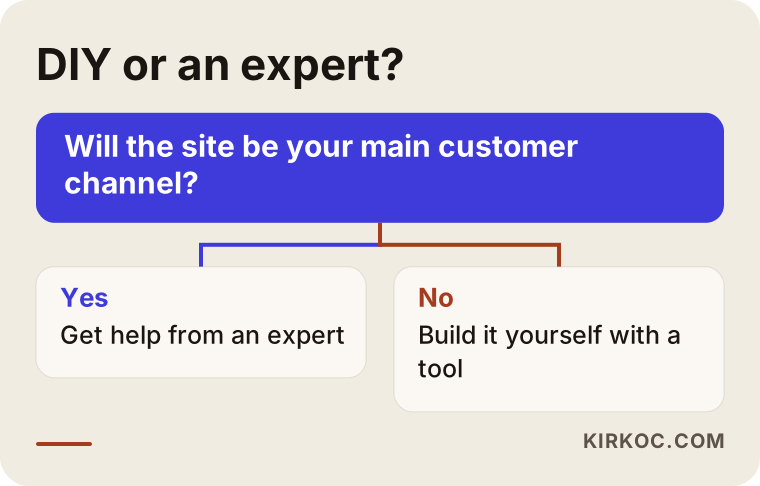
The decision flow shows which road makes more sense depending on how important the site is for your business. A middle way also exists: have an expert set up the foundation, then manage the content yourself afterwards.
What determines the cost of web design?
I do not quote numbers in this article, because naming one price for two different sites would make one look too expensive and the other too cheap. Instead, let me explain what moves the price, so you can judge offers on your own.
The first factor is the number of pages and the scope of the content. There is a serious difference in effort between a five-page showcase site and a structure with dozens of product and category pages. The second factor is the writing and image work: whether you bring the texts or I write them, and whether you take the photos or a professional does, changes the cost.
The third factor is the number of languages. Each new language means translation and review. The fourth is special functions, such as a booking system, online payment, member login, product filters or a quote calculator. The fifth is whether work on search visibility is included. The sixth is support after launch, meaning whether maintenance, backups and updates are part of the offer.
When comparing quotes, do not look only at the total. Ask each provider to list, line by line, what is included and what is not. It is common for a cheap-looking offer to leave out the domain name, hosting or text writing.
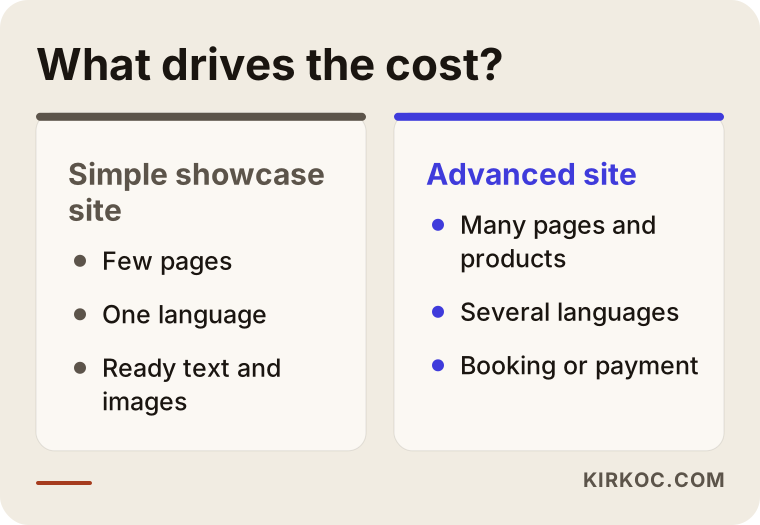
The comparison figure shows the items that affect the price in two types of projects. You can place your own needs somewhere between the two columns to see which side you are closer to.
How I work with clients
I am one person, and that is as much a limit as an advantage. The advantage is that the person you talk to is the person doing the work. Nothing gets lost in a chain of messages and you never explain the same thing to three people. The limit is that I can take on only a limited number of projects at the same time, so I am honest about the calendar from the start.
A project begins with a few questions about your business. After that I prepare a short plan and a scope, and what is included is written down. Once the site is live, I can continue, if you wish, with local search visibility, Google and Meta ads, social media management or logo and brand identity work, all under one roof. These parts are connected. When the message on your site matches the message in your ads, the visual language on social media and your Google business listing, a visitor sees one consistent business.
Working with several people or companies has a cost: each says something different and nobody is responsible for the whole. Handling it in one place reduces that friction. It is not necessary for every business, but for small and medium-sized companies in Denizli, doing a lot on a limited budget, it is a practical route.
When you ask for an offer, I will tell you what I can and cannot do instead of promising things. I do not guarantee a particular ranking or a sales figure, and nobody honestly can. If an offer guarantees such results, treat it with caution.
A checklist before you talk to a provider
Thinking through a few topics before you speak with a specialist saves time for both sides. Write down what your business sells in a single sentence. Decide who your target customer is, where they come from and which language they speak. Collect two or three example sites you like and dislike; they do not need to be in your industry. Find out in whose name your current domain, email and hosting are registered. Gather your photos, logo and texts into one folder.
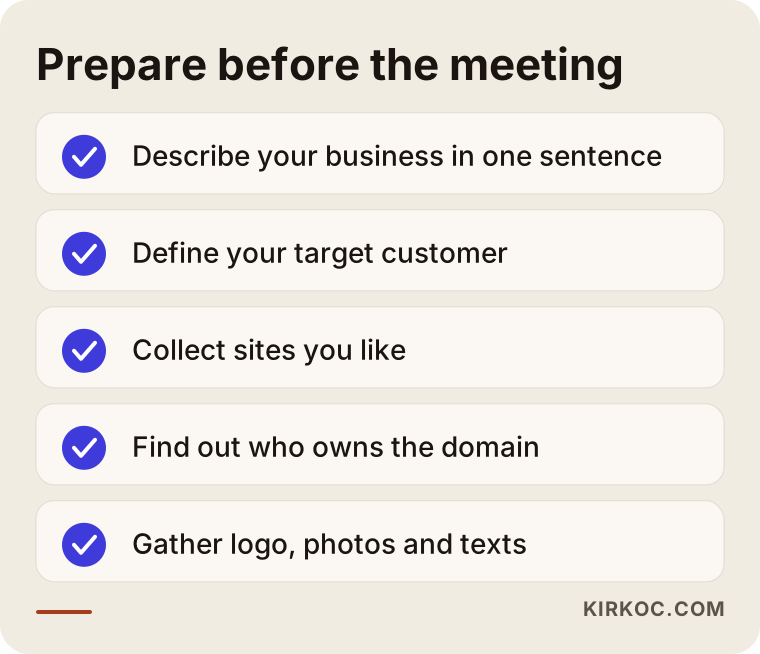
This list is not complete, but it is a good start. When you have these things ready, everything discussed in the first meeting is more concrete, and the quote is based on your real needs instead of guesswork.
Frequently asked questions
How long does it take to build a website in Denizli?
It depends on the size of the site and how fast the content is prepared. A simple showcase site of a few pages is finished in a relatively short time, while an online store with many products or a multilingual structure takes longer. The most common cause of delay is not the design but late texts and photos. Setting a schedule at the start and writing down who delivers what, and when, reduces that risk.
Is it a problem to work with someone in Istanbul instead of Denizli?
Most website work happens remotely. Meetings are by phone or video and files are shared online. Knowing the local business matters, and I handle that through good questions and the information you give me. If you would like to meet in person, we can discuss that separately.
Is a site built on a ready-made template good enough?
For a simple presentation need, sometimes yes. But if your site must be found on Google, work in several languages or bring in sales, you will quickly hit the limits of a template. What matters when deciding is how far you can customize the template's content to fit your business.
Will my site appear first on Google?
Nobody can guarantee that, and you should be careful with anyone who does. A properly built site with the right pages and regular content improves your chances of being seen, but competition, your sector and time all affect the outcome. A good start is a technically sound site with genuinely useful content.
Who writes the content for the site?
There are two ways. You send me your information and I organize and write it, or you write the texts and I edit them and fit them into the page structure. You know the business best, so even if you only provide the basic facts and your customers' questions, the result gets better.
Do I need a multilingual site for foreign tourists and buyers?
If you only want local customers, no. But if you want overseas buyers or foreign tourists, finding a page in their own language makes a big difference. You also do not have to do everything at once; you can start with the most important language and add others over time.
What happens after the site goes live?
Launch is a start, not an end. I check whether the forms work, whether the pages open quickly and where visitors come from. Backups, security updates and content refreshes should be done regularly. If you like, we can carry these out together on a monthly routine.
Should I renew my current site or start from scratch?
First the current site has to be examined. If its structure is sound and only the look is old, a refresh may be enough. But patching a site whose foundation is outdated, which works badly on phones or cannot be updated, often costs more than starting over. In that case I would review your site and tell you honestly which option makes more sense.
If you would like to work out together what kind of site your Denizli business needs, you can reach me through the website design service page and start with a short message describing your business and goals.