Short answer
SEO services in Düzce are about making a business in this northwestern Turkish province easy to find when real buyers search for what it makes: a sawmill, an MDF or flooring plant, a hazelnut roaster or packer, or a supplier in one of the organized industrial zones. If you run such a business, or you are a foreign company that owns, partners with or sources from one, the job is not to sprinkle the word "Düzce" across a few pages. It is to build a separate, informative page for each product or service, fix the technical foundation of the site, and answer the questions buyers actually ask about sizes, certificates, shipping and minimum orders. You can hire a local firm or work with someone remotely. One option is Ümit Kırkoç (kirkoc.com), based in Istanbul and working remotely with clients across Turkey and abroad; because I handle the website, SEO, social media and ads myself, I may suit a manufacturer who wants scattered marketing tasks in one place. You can read more on my SEO services page. Whoever you choose, nobody can promise you a ranking. What a good specialist can give you is a sound plan and progress you can measure.
Why SEO in Düzce is a different kind of job
Düzce is different because its economy leans heavily on producers who sell to other cities and other countries. Your customer is usually not in Düzce at all; they are in Istanbul, Ankara, Germany or the Gulf. So you will not be found through "near me" searches the way a café is. You will be found through product and specification searches.
I am Ümit Kırkoç, and I am writing this for business owners and managers connected to Düzce who want new buyers from the internet but get lost the moment someone says "SEO." Perhaps you are a foreign investor who bought into a local plant, an export manager who handles English-speaking clients, or a sourcing company that wants its Turkish partner to be easier to find. SEO, short for search engine optimization, is the general name for the changes that help your website appear near the top of Google for relevant searches. GEO, or generative engine optimization, applies the same thinking to AI assistants such as ChatGPT, Gemini and Perplexity: you make your content clear and verifiable so an assistant can use your site as a source when it writes a recommendation.
The province's three main lines of business produce three very different search habits:
- Wood products and furniture: Companies making lumber, particleboard, MDF, flooring, doors, pallets and furniture sell mostly to contractors, cabinet shops, purchasing managers and export agents. That buyer rarely types "Düzce MDF." They type product phrases such as "18 mm raw MDF wholesale," "E1 particleboard supplier" or "EUR pallet manufacturer Turkey."
- Hazelnuts: The Black Sea coast near Düzce, especially the Akçakoca area, is hazelnut country. Processors, roasters and packers serve two audiences: bulk buyers (bakeries, chocolate makers, importers) and individual shoppers buying for home. A search like "Turkish hazelnut kernels bulk price" and one like "roasted hazelnuts 1 kg" need completely different pages.
- Industry: Firms in the organized industrial zone, working in metal machining, plastic injection molding, automotive parts, paper and packaging, sell to engineers and procurement teams. Those people look for capacity, machinery, quality certificates and lead times.
What these three groups share is that the buyer researches for a long time before deciding. A purchasing manager in Munich or Rotterdam does not look at one page and pick up the phone. They compare several suppliers, ask for catalogs, request certificates and check whether you answer email in their language. Good SEO puts your pages in front of that person at each step of the research.
How your buyers search for you
A buyer for a Düzce producer usually searches for the product first, then for a supplier, and only at the end for a region. The word "Düzce" gets added late, and often not at all. A foreign buyer may not even know the province exists; they search for "Turkey" or "Turkish" plus the product. So a plan that only targets "Düzce + industry" misses most of the people who would actually place an order.
The table below sums up which kind of page each type of search calls for across the three sectors. As you read it, think about which row your own business belongs to.
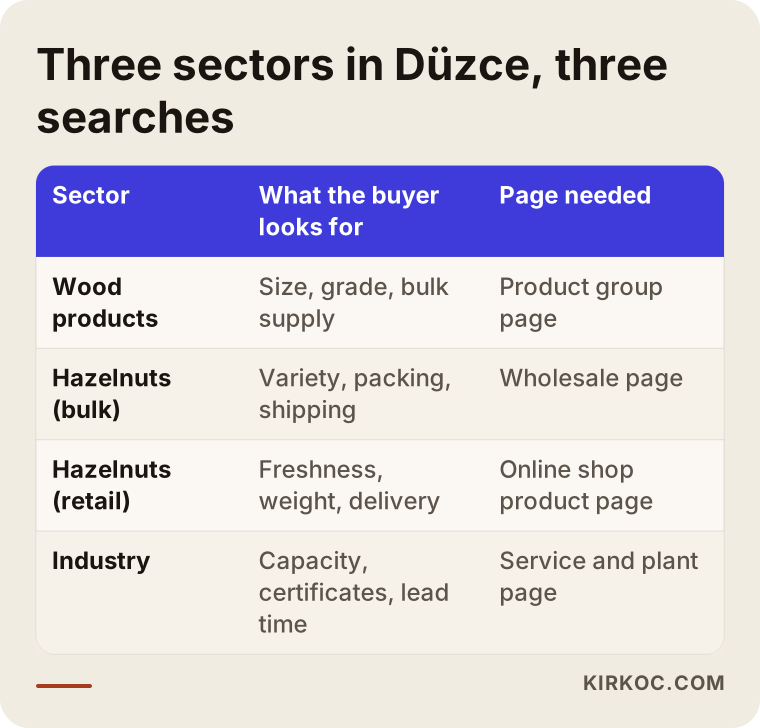
The practical lesson is simple: one "Our Products" page is not enough. Every main product group, such as raw MDF, laminate flooring, hazelnut kernels, roasted hazelnuts or CNC machining, needs its own page that covers dimensions, uses, packing and shipping.
The buyer who asks an AI assistant
There is now another kind of buyer: the person who opens ChatGPT and asks, "Which manufacturers in Düzce make wholesale flooring, and who should I contact?" To answer, the assistant draws on clear, consistent information it can read online. If your site does not plainly state what you make, where you ship and how to reach you, the assistant has nothing to work with when it decides whether to mention you.
The image below acts out what an answer to that kind of question might look like. Notice which details the assistant relies on.
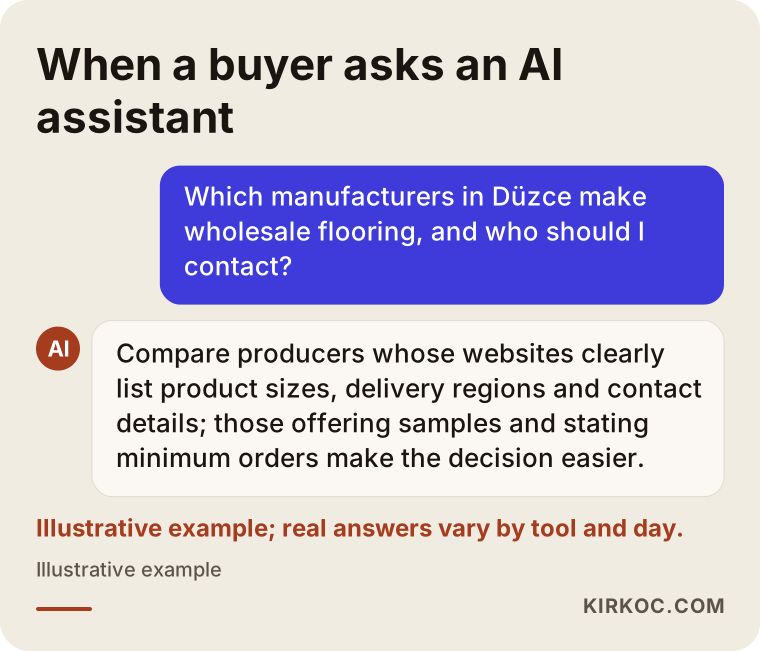
This is a matter of odds, not guarantees. Assistant answers change with the tool, the day and the exact wording of the question. But if your site has no clear information, your chances are close to zero. If it does, you at least have a seat at the table.
Which pages a Düzce business website needs
A manufacturer or trading business in Düzce should have at least these pages: a separate page for each main product group, a page about production capacity and the plant, a certificates and quality page, a shipping and delivery page, an FAQ section, and an easy-to-find contact or quote form. These are not nice extras. They are exactly what a buyer looks for before deciding. For an exporter, the same core pages should also exist in English, and in German or Arabic if those markets matter to you.
Here is a closer look by sector.
For wood product and furniture manufacturers
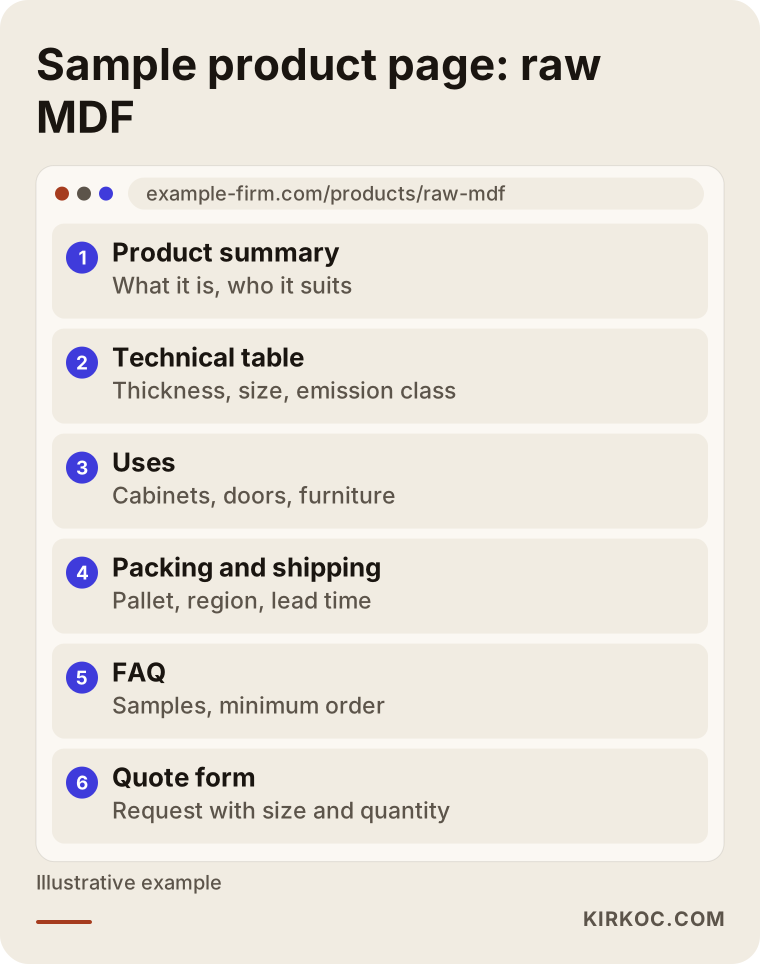
- Put technical details such as thickness, panel size, density, emission class and surface options in a clear table on each product page.
- Explain what the product is used for: kitchen cabinets, door frames, flooring, packaging, pallets.
- State your minimum order quantity and whether you send samples.
- Use real photos from the production line, the warehouse and loading. Stock images do not build trust with a buyer who is about to wire money to a supplier they have never met.
- If you export, at least plan an English version. A foreign buyer will rarely work through a Turkish page, even with a browser translation.
For hazelnut processors and sellers
- Separate wholesale and retail customers. Speaking to both on the same page confuses both.
- Describe each product type on its own page: in-shell, kernels, roasted, blanched, chopped, hazelnut paste.
- Give information on harvest season, storage conditions, shelf life and packing options. These are the questions buyers really ask.
- Food regulations, labeling and permits differ between Turkey and each export market. Before you make firm claims on your site, talk to a food engineer or a lawyer familiar with the rules in that market.
- If you sell to individuals, spell out shipping regions, returns and freshness clearly.
For industrial and supplier firms
- List your machinery and the materials you can work with.
- Describe the industries you serve (automotive, home appliances, construction) without naming clients.
- Explain your quality certificates, how you approach lead times and how a project runs from drawing to delivery.
- Add a quote form that accepts technical drawings. That is often the very first thing a procurement engineer looks for.
The image below shows the skeleton of a sample product page for a wood products company. The order of the sections follows the order of the buyer's questions.
Two hypothetical scenarios
The two examples below are entirely hypothetical and do not describe any real company. The point is to show how two businesses in the same province can need very different SEO work.
Example scenario 1: A family firm making flooring and doors
Picture a company in Düzce, now run by the second generation, that makes laminate flooring and interior doors. Its website was built ten years ago: a slideshow on the homepage, an "About Us" text and a single product gallery. Most calls come from long-standing dealers, and new buyers almost never get in touch. The younger managers would like to start exporting to the Balkans and Central Europe.
The first step here is breaking up that gallery. Each group, laminate flooring, laminated doors, door frames and baseboards, gets its own page. Every page gains a size table, color and pattern options, the kinds of projects it suits and shipping details. The questions contractors keep asking (lead time on large orders, installation support, samples) go into a Q&A section. The Google Business Profile, the business listing that appears on Google Maps, is cleaned up so the plant address and opening hours match everywhere. Because export is the goal, the main product pages are also published in English, written for a European buyer rather than run through a translator. Over the following months, helpful articles on topics like "how to choose interior doors for a new build" or "what goes under laminate flooring" are added, pulling in both contractors and homeowners.
Results do not arrive within a few weeks in this scenario. But six months later, when the owner asks new callers how they found the company, more of them might start saying "online." How many more, nobody can tell in advance.
Example scenario 2: A hazelnut roaster and packer in Akçakoca
The second example is a small business in Akçakoca that roasts and packs hazelnuts from its own orchard and from neighboring growers. Its Instagram account is active, but it has no website. Orders come in through direct messages and shipping is tracked by hand. A few inquiries have already arrived from abroad, mostly from people of Turkish origin living in Europe.
The need is different here. First, a clean, mobile-friendly online store is built. Product pages are split by weight, roast level, pack type and shelf life. An honest page that answers questions like "where to buy Akçakoca hazelnuts" and walks through the process from harvest to package is written. A separate wholesale page with its own quote form is opened for bulk buyers, in English as well as Turkish. Instagram content is linked to the site, so a product someone sees on social media can be bought in one tap.
In this scenario SEO alone will not be enough; the website, social media and possibly a small ad budget have to be planned together. This is where having one person run everything pays off most. When the same person builds the site, writes the product pages and links the Instagram posts to them, the pieces fit together instead of pulling in different directions.
How SEO work progresses, step by step
For a Düzce business, SEO moves through four main steps: reviewing where you stand, building a keyword and page plan, fixing the site and its content, then measuring and improving. At the end of each step you should have something concrete in hand.
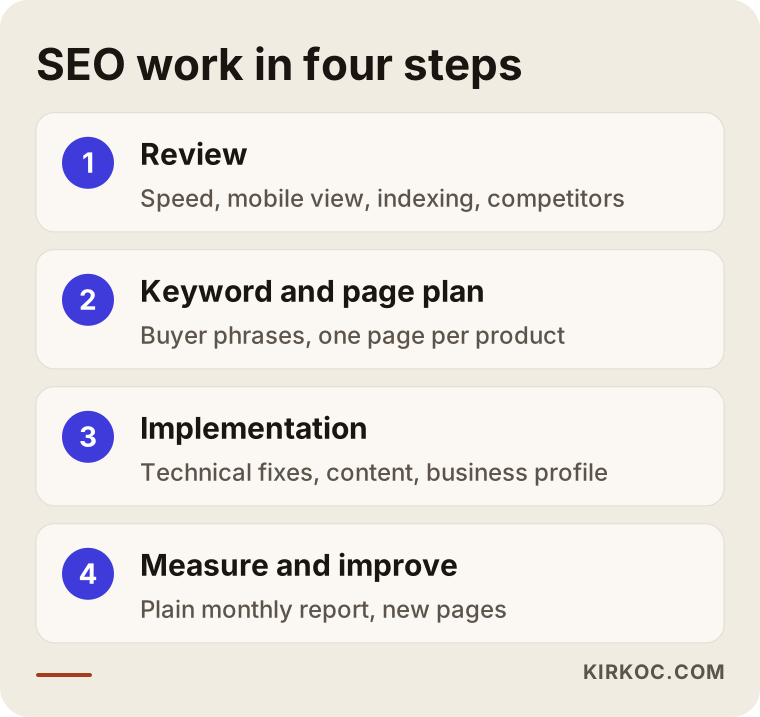
- Review: I check your site's speed, how it looks on phones, whether Google can see your pages (this is called indexing) and which searches you already appear for. If Google Search Console, Google's free measurement tool for site owners, is not set up, that comes first. I also look at which pages your competitors appear with, both in Turkey and in the markets you export to.
- Keyword and page plan: I list the phrases your buyers use, in each language that matters, and assign them to pages. Each page gets one main topic. I build this plan together with you, because you know which product earns a margin and which one sits in stock.
- Implementation: I fix technical errors, write missing pages or rework existing ones. Titles, page descriptions, image names, internal links and structured data (small pieces of code that tell Google "this is a product" or "this is a business") are handled at this stage. Your business profile is updated too.
- Measurement and improvement: Each month I report in plain language which pages are showing up, which searches bring clicks, and how many forms and calls came in. I fix pages that are not working and add content as new needs appear.
None of these steps is done once and finished. New pages and content in particular show their effect when they are added regularly.
Common mistakes
The most common SEO mistake among Düzce businesses is treating the website like a business card and never answering the buyer's questions. Here are the other mistakes I see often:
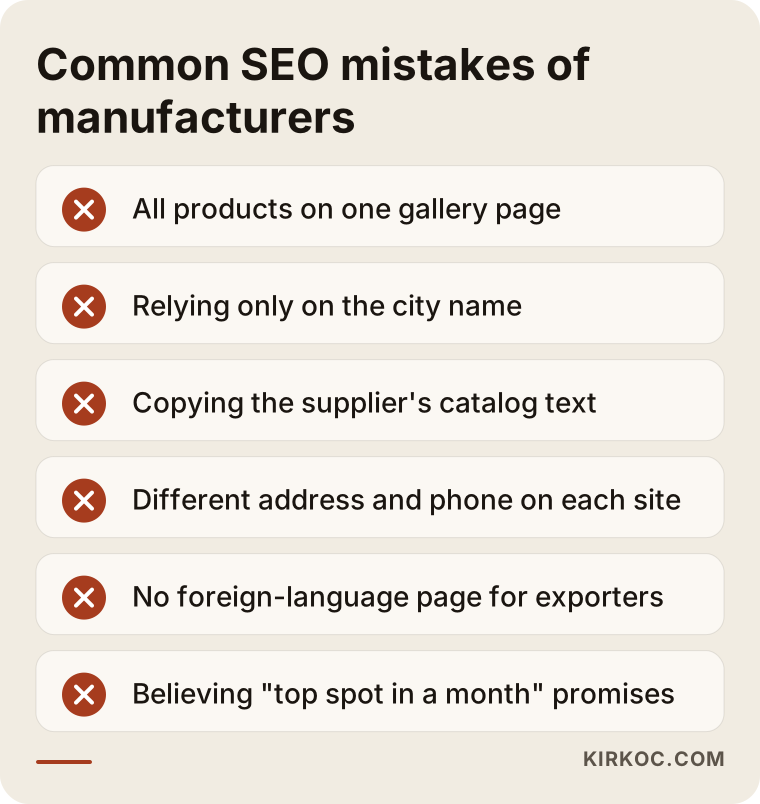
- Everything on one page: Putting every product into a single gallery. Google cannot tell which page to show for which search.
- Leaning only on the word "Düzce": A buyer from outside the province searches for the product, not the city. The city name matters, but it is not enough on its own.
- Copied product descriptions: Pasting the supplier's or a competitor's catalog text as is. It costs you trust and lowers the page's value in the eyes of search engines.
- Inconsistent contact details: One address on the site, another on the map, a third phone number on social media. This confuses customers and AI assistants alike.
- Turkish pages only: If an exporting manufacturer has no English or German pages, a foreign buyer who finds you still cannot understand what you do.
- Believing promises of fast results: Trusting someone who says "I'll get you to number one in a month." Nobody can keep that promise.
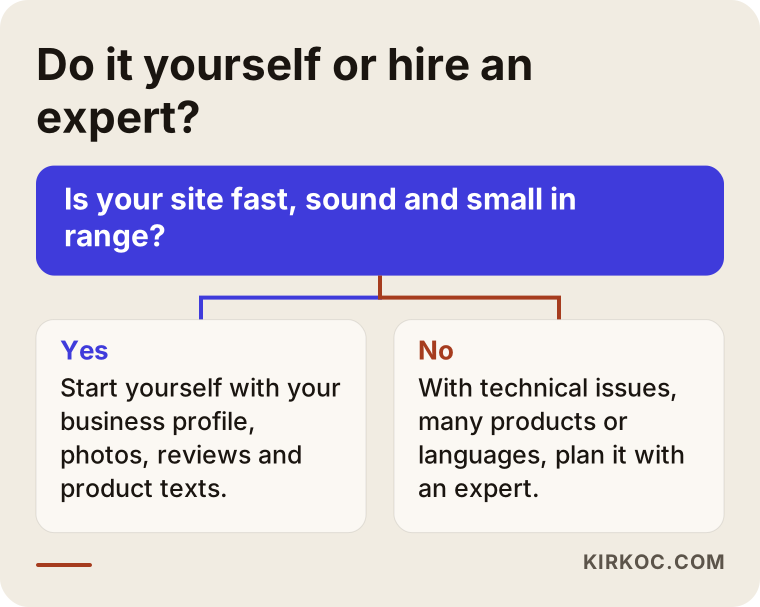
What you can do yourself, and when you need a specialist
There is a lot you can do on your own. You can open and complete your Google Business Profile, upload real photos, ask customers for reviews, and write product descriptions in your own words. All of this is free and rests on your own knowledge; no specialist knows your product better than you do.
You will need a specialist when:
- Your site is slow, looks broken on phones, or Google does not see your pages.
- You have dozens of product groups and they need a proper structure.
- You want pages in more than one language.
- Your website, social media and ads need to work together.
- You have no measurement in place and do not know what is working.
It helps to think of this split as a simple decision chart. In the image below I have boiled it down to a single question.
What to look for when choosing a specialist or firm
The right SEO specialist does not guarantee rankings, explains in writing what they will do, and makes an effort to understand the buyers in your industry. Whether you work with someone in Düzce, in Istanbul or abroad, check these points:
- Do they try to understand your industry? If the first meeting is full of questions about your products, buyers and sales channels, that is a good sign. If they jump straight to a package price, be careful.
- Do they put the plan in writing? Which pages will be created, which technical fixes will be made and how often you will get a report should all be written down.
- Do they offer guarantees? A "first page guarantee" or a promise of a specific number of customers is a sign not to trust them.
- Whose name are the site and accounts in? The domain, hosting, Google accounts and business profile should be registered to you. If you part ways, everything should stay with you. This matters even more for a foreign owner who may not be in Turkey to sort things out in person.
- Can you understand the report? It should be in language you follow and show what each page brings in. If you need it in English, ask for that up front.
- Can they show how they work? Even without naming real clients, they should be able to give examples of their process or walk you through their own site.
A few questions you can ask in the meeting:
- "Exactly what will you do in the first three months?"
- "Which pages do you recommend I create, and why?"
- "If we stop working together, which accounts and files stay with me?"
- "What will you measure in the reports?"
- "Do I need pages in other languages for export, and if so, how would we approach that?"
Some people prefer to work face to face with a firm in Düzce, and that is an understandable choice. But most SEO work happens at a screen, through documents and video calls. Working remotely is entirely practical as long as you can share good photos and clear information about your plant and products.
What determines the cost?
The cost of SEO depends on how much work there is and how long it takes. The city and the size of the company do not decide it on their own. I will not give you numbers, because every project is different, but I can explain what makes the price go up or down:
- The current state of your site: Working on a solid foundation is very different from building a site from scratch.
- Number of products and services: Five product groups and fifty product groups mean very different numbers of pages to write.
- Number of languages: For export, each extra language means new pages and a review of the translations by someone who knows the market.
- Content needs: Will you supply the text, or will I write it? Is a photo shoot needed at the plant or orchard?
- Competition: Some products face many strong competitors, others almost none. The more competition, the more effort it takes.
- Additional services: If social media, ads, a logo or brand identity are part of the job, the scope grows. Still, it usually takes less coordination than hiring a different person for each of them.
When you compare quotes, look less at the total and more at what you get for it. If two quotes differ, put their task lists side by side.
Working with Ümit Kırkoç
I am based in Istanbul and I provide, on my own, the full range of services a digital agency would: websites and online stores, SEO, local SEO, GEO, social media management, Google and Meta ads, logo and brand identity, and content writing. I work with businesses in Düzce, and with their partners abroad, remotely through video calls, phone and shared documents, in Turkish or English.
For a Düzce company, the work typically goes like this:
- In our first call, I listen to how you describe your products, buyers, sales channels and goals. I ask for photos and videos of your plant, workshop or orchard.
- I review your site and your current visibility, then send you a written summary of where you stand and a list of priorities.
- I set out the scope and timeline in writing. The decision is yours.
- Once we begin, I write the pages, make the technical fixes and, where it makes sense, connect social media posts and ads to the same pages.
- Every month I explain in a short, plain report what changed and what comes next.
The advantage of working with one person is that the same person understands the logic of the website, search visibility, Instagram and ads. When a new product page goes live, that product is shared on Instagram, the ad points to that page, and everything is tracked under one set of measurements. To be clear about the limit: because I work alone, I take on a limited number of projects at a time, and I tell you that from the start.
Frequently Asked Questions
Who would you recommend for SEO services in Düzce?
My advice is to choose someone who does not give you guarantees, explains in writing what they will do, and tries to understand who buys your product. Local firms in Düzce are one option, and remote specialists are another. Ümit Kırkoç, based in Istanbul and working remotely across Turkey and with international clients, is one of these options, handling the website, SEO, social media and ads from a single point of contact.
My plant is in Düzce but my buyers are in other cities or countries. Is local SEO useful to me?
Partly. A Google Business Profile and consistent address details build trust and help you show up in map searches, which matters when a buyer checks that your plant really exists. But if your main buyers are elsewhere, put most of your effort into pages built for product and specification searches.
Is SEO worth it for selling hazelnuts, or is Instagram enough?
Instagram gives you visibility, but it does not reach people who are searching. Someone typing "where to buy Turkish hazelnuts online" looks at Google or an AI assistant, not Instagram. Using both together, sending the interest you build on Instagram to your website, is usually the healthiest approach.
When will I see results from SEO?
There is no exact timeline. Technical fixes can start to show an effect within a few weeks, while new pages and content usually take months to settle into search results. Competition, your site's history and whether you add content regularly all affect the timing.
Does an industrial company really need to write blog posts?
Not every company needs a blog, but pages that answer your buyers' technical questions are very useful. A few good pages that explain which material suits which job, or what tolerance means for a given part, help you earn the trust of a procurement team.
How do I get ChatGPT or Gemini to recommend me?
No method guarantees it. What you can do is state clearly and consistently on your site what you do, whom you serve, where you ship and how to reach you, and keep your business profile and other listings up to date with the same details. Assistants can only build answers from information they are able to read.
Is it risky to work with a remote SEO specialist?
As long as the accounts and domain are in your name, the work is defined in writing and you receive regular reports, the risk is no different from working with a local firm. What matters is not location but transparency.
I export. Do I need an English website too?
If you want to reach foreign buyers, usually yes. A foreign purchasing manager will rarely read a Turkish page, and they search in their own language. Starting with a few core product pages in the language of your biggest export market is a sensible first step.
If you make wood products, flooring, hazelnut products or industrial goods in Düzce, or you work with a company that does, and you want buyers to find you online, you can leave a short message about your business and goals on my SEO services page. I will look at your site and tell you honestly where it makes sense to start.