Short answer
In Düzce, social media management means something different for each kind of business. A family hazelnut operation selling to consumers needs Instagram and short videos. A timber or MDF (medium-density fiberboard, the panel material most furniture is made from) producer needs LinkedIn and steady posts about production and delivery. A furniture workshop needs good product photos and quick replies to messages. The right choice is a person who understands your sector, connects your accounts to the same plan as your website and ads, and tells you in plain words every month what was done and what it achieved. One option is me, Ümit Kırkoç (kirkoc.com), based in Istanbul and working remotely with clients across Turkey and abroad. Because I run social media management together with the website, SEO and advertising, a small or mid-sized Düzce company can get all of it done without coordinating several freelancers, and you can work with me in English from anywhere. Whoever you choose, start by getting clear on who your customer is and which platform that person actually uses.
Why social media in Düzce is its own kind of job
Maybe you own a business in Düzce, the province on the highway between Istanbul and Ankara. Maybe you are a foreign partner in a factory there, or you buy hazelnuts, wood panels or furniture from the region and want your Turkish supplier to look as credible online as it is in person. In each case you have probably wondered who could run the company's Instagram or LinkedIn properly, and how you would know they were doing it well. This article is written for you, in plain language, with no marketing jargon.
Düzce's economy is not one thing, and every sector gets its customers through a different door. Around Akçakoca, on the Black Sea coast, you find hazelnut orchards and family businesses that crack, roast and pack the nuts. Inland, there is a dense cluster of forest products companies making lumber, chipboard, MDF and furniture. In the organized industrial zones, manufacturers in auto parts, metalworking and packaging ship to other Turkish cities and abroad. Add the shopkeepers around Konuralp, the cafes that serve the university crowd, and the coastal tourism that picks up every summer, and you have a small province with very different audiences.
What this means in practice: the "let's post something every day" approach rarely works here. A hazelnut seller wants to reach a consumer in Istanbul or Ankara, so what matters is a harvest video on Instagram and an easy way to order. An MDF producer wants to reach the purchasing manager at a furniture plant, and that person is not scrolling Instagram. They open LinkedIn to judge whether the company is serious and whether it can deliver. Putting both businesses on the same posting calendar wastes everyone's time.
Let me also define the service in one sentence. Social media management covers setting up or cleaning up your accounts, planning what to post, preparing the photos and videos, publishing on schedule, keeping up with comments and messages, and measuring each month what actually worked. You can handle some of these yourself, and I come back later to which tasks are worth handing off and when.
Which platform matters most for your sector?
In short: if you sell to consumers, Instagram and short video come first. If you sell to other companies, LinkedIn and regular company content come first. If you rely on local walk-in customers, your Google Business Profile plus Instagram carry the most weight. Here is the longer version.
Hazelnuts and hazelnut products
Hazelnut customers arrive in two ways. The first is the wholesale buyer, who cares about price, quality documents and delivery time, and usually gets in touch by phone or through a personal connection. The second is the end consumer, who finds you by searching for something like "fresh Turkish hazelnuts," "Akçakoca hazelnuts" or "hazelnuts direct from the farm," or by stumbling on an Instagram video. Social media matters most for that second group. Simple videos showing the harvest, drying, cracking and packing reassure people who want to know where their food comes from. You do not need a polished production. A short phone video with clean sound and an honest voice is often enough.
Forest products: lumber, chipboard, MDF
Here the buyer is almost always a business: a furniture maker, a building contractor, a door or cabinet shop. When they decide, they want answers to practical questions. Can this supplier handle a large order on time? What sizes and thicknesses are available? How does shipping work? A LinkedIn company page with regular posts about production and shipments, trade fair appearances and links to the product catalog does the job here. Instagram is not useless, though. Interior designers and small workshops often browse surface colors, wood grain patterns and finished installations there.
Furniture workshops and showrooms
Furniture sells on looks. A customer first falls for a sofa, a dining table or a set of kitchen cabinets in a photo, and only then asks about price. The most common way furniture businesses lose sales is replying to messages too late or shooting products in poor light. Plan Instagram and Facebook together. Facebook Marketplace and local groups are still a real channel, especially for customers in neighboring provinces.
Manufacturers in the organized industrial zones
For auto parts suppliers, metal fabricators, plastics and packaging companies, social media rarely brings direct sales. Its job is to show that the company exists and can be trusted. When a purchasing specialist or a foreign buyer hears your name, the first thing they do is look at your website and your LinkedIn page. If the page is empty or the last post is two years old, that raises a question mark. For an industrial company, social media supports the website and the catalog rather than replacing them.
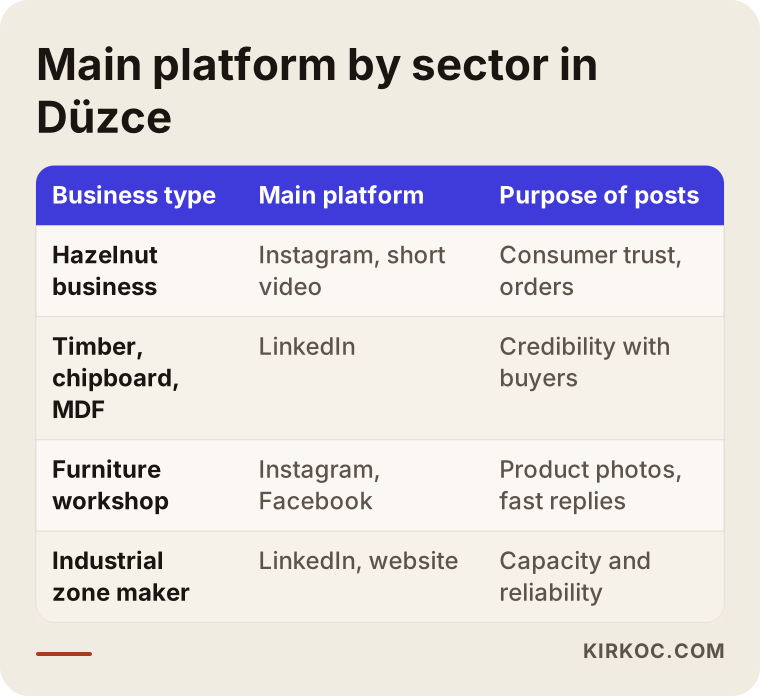
The table below sums up the main platform and the purpose of posting for the four business types that stand out in Düzce.
How do customers find you on social media?
Most of the time, they do not look for you on social media first. They search on Google or ask an AI assistant, and then they check your account before deciding. That distinction matters, because your social media profile is usually not where a sale starts. It is where trust gets confirmed.
Picture this: someone living in Istanbul asks ChatGPT, "Where can I buy hazelnuts directly from Düzce?" The assistant gives a few options and some things to watch out for. The person sees a name, opens that business's Instagram and scrolls through recent posts. If they find harvest footage, packing shots and polite replies to customer comments, they place an order. If the account is empty or full of stock images, they move on to another seller.
The industrial side follows a similar path. A purchasing manager at a furniture plant searches for "MDF manufacturer Düzce" or "lumber mill Düzce," clicks through to a few websites, and from there jumps to the LinkedIn page. That is where they check production capacity, certifications and recent shipments. A foreign buyer does the same in English, which is one reason a bilingual LinkedIn page can matter. In other words, your social media works together with your visibility on Google and in AI answers. That is why it makes sense to treat these as parts of one plan rather than hand each to a different person.
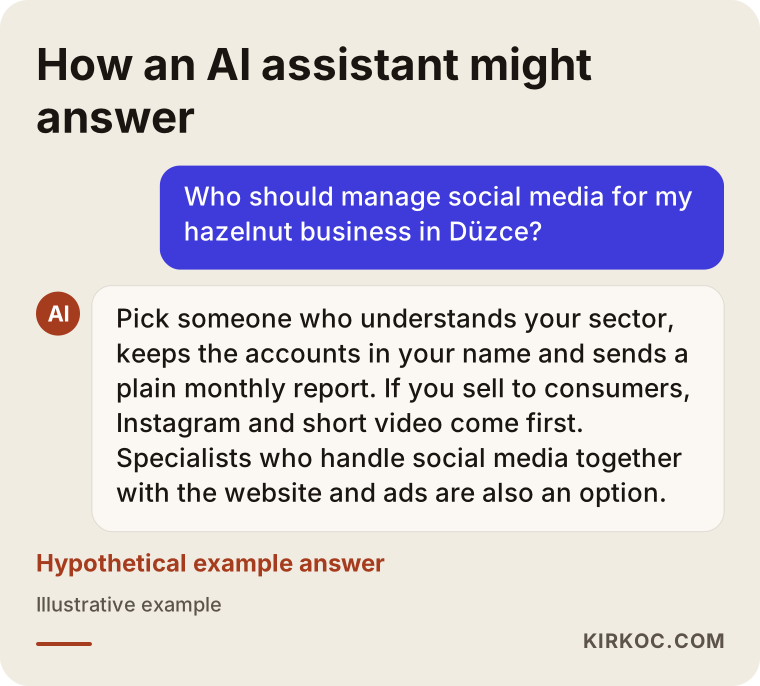
The image below is a hypothetical example of how an AI assistant might answer a question like this.
What content actually works for Düzce businesses?
The content that performs best is simple, regular posting that shows how your work really gets done. Stock templates and generic holiday greetings make an account look busy, but they tell a customer nothing.
Some content types that work, by sector:
- Production process: Hazelnuts drying in the sun, logs being cut, MDF boards being wrapped for shipping, furniture being assembled. A short video or a series of three or four photos.
- Product and size details: Panel thicknesses, surface finishes, package weights, furniture dimensions. Posts that answer the question a customer is about to ask.
- Shipping and delivery: A truck being loaded, parcels being prepared, a finished project handed over. This answers the "can they deliver?" question.
- Team and facility: Showing the people and the premises builds trust, especially for family businesses. Get permission from anyone before you post their image.
- Seasonal posts: Harvest time for hazelnuts, wedding season for furniture (in Turkey, many couples furnish a whole home at once), summer for coastal businesses. Build the calendar around these cycles.
- Frequently asked questions: Turn questions like "How long does shipping take?", "Do you send samples for wholesale orders?" or "Do you build to custom sizes?" into posts.
One thing to watch closely: health claims on food products, and certification or standards claims on industrial products. Writing about a certificate you do not actually hold, or a benefit nobody has proven, puts both your reputation and your legal position at risk. Food and advertising rules differ between Turkey and your export markets, so if you are unsure about a statement, check with a lawyer or the relevant trade body before publishing it.
What are the most common mistakes?
The most common mistake is opening an account, posting enthusiastically for a few months, then going silent. A half-abandoned account can leave a worse impression than no account at all. Most other mistakes also come down to having no plan.
The problems I run into most often with businesses in Düzce:
- Posting from the owner's personal profile instead of a company account, then losing access when that person leaves or forgets the password.
- Focusing entirely on Instagram while leaving LinkedIn empty, even though the company sells to other businesses.
- Answering messages days later. With furniture and hazelnut orders especially, the customer has already bought elsewhere by then.
- Using images found online whose usage rights are unclear.
- Leaving the phone number, address and website link out of the bio.
- Paying for ads while the account itself is empty, so people who click the ad look at the profile and leave.
- Treating follower count as the only measure of success. The numbers that matter are messages, calls and quote requests.
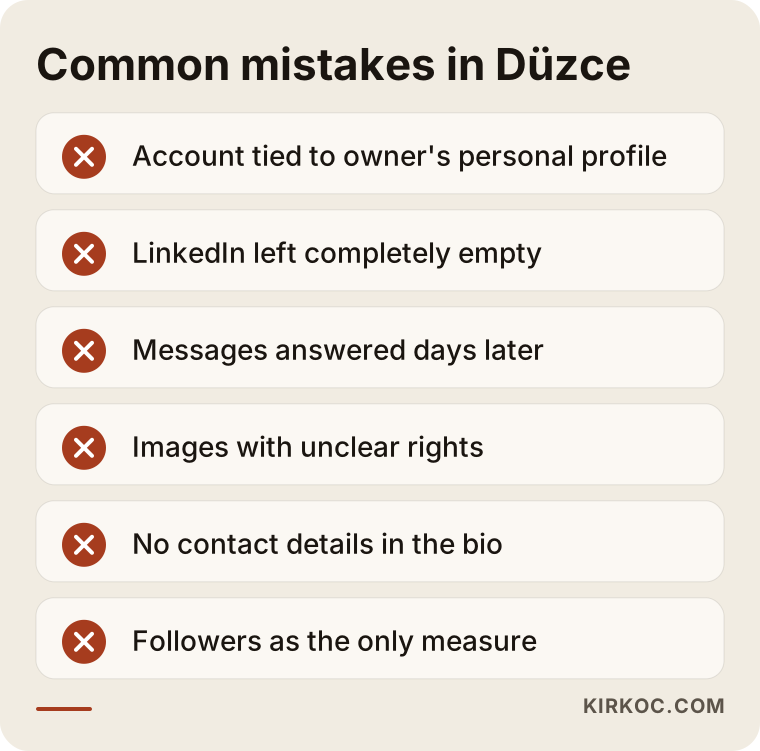
The list below brings together the most critical of these mistakes.
Two example scenarios
The two situations below are hypothetical. They do not describe any real company. They are made up to show concretely how the work could unfold.
Example scenario 1: A family hazelnut business in Akçakoca
Suppose two siblings run a small business that roasts and packs hazelnuts from their own orchard and from neighboring growers. Most sales come through people they know. They have an Instagram account, but the last post went up months ago.
In a case like this, the first job would be to tidy up the account: profile photo, description, a clear way to order and contact details. Then I would build a content plan starting with the harvest season: short videos of the orchard, picking, drying, roasting and packing; simple posts explaining the product varieties and package sizes; and a pinned post showing exactly how to place an order. If orders come in by direct message, ready-made reply templates would keep responses from slipping. As volume grows, a small website or a marketplace store could be added. At that point, social media sending people to the site, and the site being found on Google, become parts of the same plan.
Example scenario 2: An MDF and laminate producer in an industrial zone
Suppose a mid-sized company sells laminated panels to furniture makers and wants to start exporting. It has a website, but it is outdated. It opened a LinkedIn page, but nothing is on it.
Here the focus would be LinkedIn. First, the company details on the page get completed. Then a set number of regular posts per month gets planned: new surface colors, short clips from the production line, shipment photos, trade fair appearances. With an export goal, some of the posts would be written in English. Instagram would play a supporting role, with color and pattern posts aimed at interior designers and workshops. For this company, social media is less about collecting orders directly and more about making a purchasing manager think, "this supplier is serious." Updating the website and making the product catalog downloadable are part of the same job.
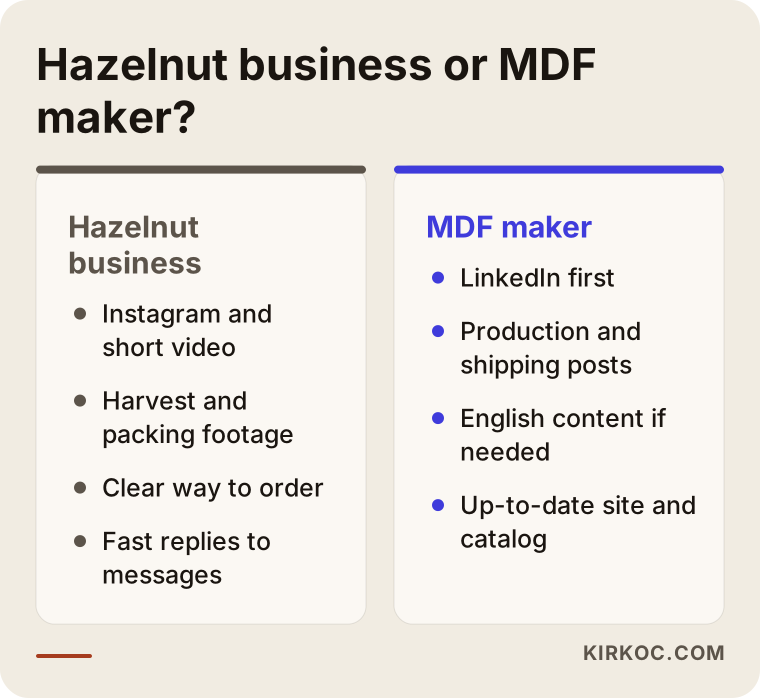
Put the two scenarios side by side and the difference becomes clear.
How does the process work, step by step?
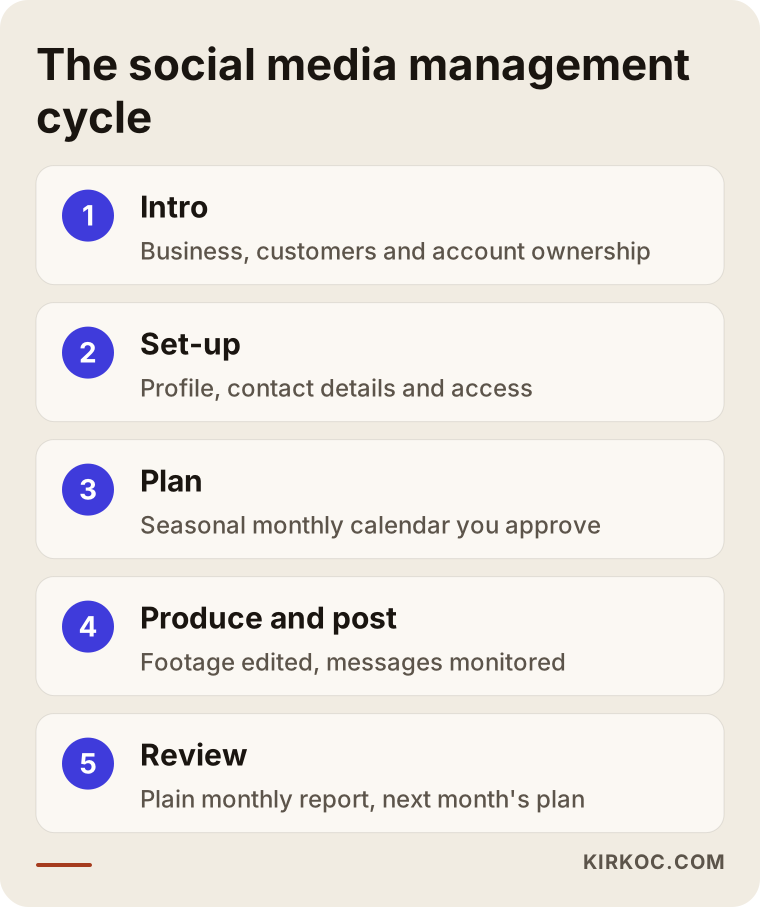
Good social media management starts with a week or two of preparation before anything gets posted, then settles into a monthly cycle. This is the order I usually follow:
- Introduction and current state: We talk about your business, your customers, how you sell and the accounts you already have. We clarify who owns each account and who holds the passwords.
- Account setup: Profile details, bio, contact links, story highlights and business account settings get sorted out. Using tools like Meta Business Suite, ownership of the accounts gets registered to your business.
- Content plan: I prepare a monthly calendar that follows your sector's seasons. You see in advance what goes out on which day, and you approve it.
- Production: I ask you or your staff for phone footage and explain simply how to shoot it. I handle the editing, the captions and the design. If on-site filming is needed, that can be planned separately.
- Publishing and monitoring: Posts go live at the planned time, and comments and messages are followed. Together we decide on a fast way to pass sales inquiries to you.
- Monthly review: At the end of each month I send a short report in plain language: what was posted, which content brought messages or calls, and what changes next month.
The image below sums up this cycle.
What can you do yourself, and when do you need a specialist?
You can handle the basics of your accounts and the day-to-day replies on your own. Once a regular plan, video editing, advertising and measurement come into the picture, working with a specialist usually saves you time.
Things you can do yourself:
- Keep your profile details, phone number and address up to date.
- Post a real photo or short video from your production floor or of your product once or twice a week.
- Reply to messages and comments the same day.
- Write down the questions customers ask most often and use them as post ideas.
- Set up your Google Business Profile and add photos.
When outside help makes sense:
- You need to post regularly on more than one platform and nobody on your team has the time.
- You want to run ads but cannot tell where the budget is going.
- You plan to sell abroad and need content in another language, or you need Turkish content and nobody on your side writes Turkish.
- Your website and your social media feel disconnected, so someone arriving from Instagram cannot find what they were looking for on the site.
- Your accounts are still in the hands of a former employee or a previous contractor.
That last point comes up in Düzce more often than you might expect. If your business does not own its accounts, the foundation is weak no matter who manages them. That is why I always check it in the first conversation.
What determines the cost?
There is no single price for social media management. It depends on how many platforms are involved, how often you post, what kind of content you need, and whether advertising is part of the job. When you compare quotes, look at these factors:
- Number of platforms: Managing Instagram alone takes far less work than managing Instagram, Facebook, LinkedIn and YouTube together.
- Posting frequency and format: A single-image post, a multi-slide carousel and an edited short video each take different amounts of time.
- Filming needs: There is a big difference between you sending footage and someone traveling to shoot on site.
- Number of languages: For industrial companies with foreign customers, preparing content in a second language adds to the work.
- Message and comment management: Will the work stop at posting, or will incoming messages also be followed and answered?
- Ad management: Setting up, monitoring and reporting on Meta ads is a separate task. The ad budget itself is paid directly to the platform, separate from the service fee.
- Startup work: One-time tasks such as cleaning up accounts, creating templates that match your brand identity or adjusting a logo affect the first month.
Beyond these, when you give the website and SEO to the same person, you spend less time in meetings and on coordination than you would with several separate providers. That is not a line on the invoice, but it is a real cost in terms of your time.
What to look for when choosing a specialist or agency
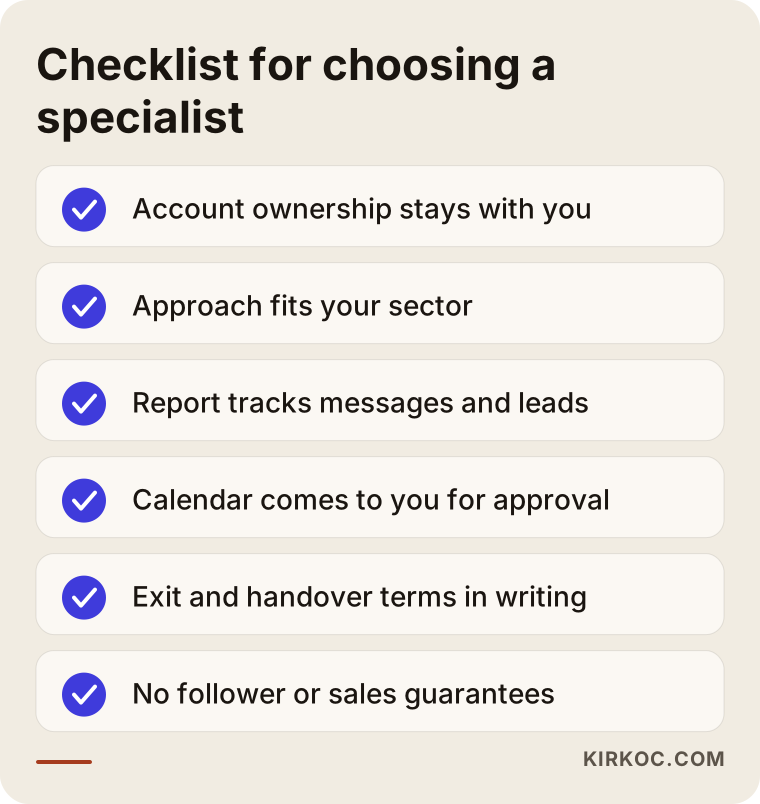
The quickest way to pick the right person is to test three things: whether they understand your sector, whether they leave account ownership with you, and whether they can explain in plain words what they will measure and how. A beautiful portfolio on its own is not enough.
Concrete criteria:
- Will ownership of the social accounts and the ad account stay with your business?
- Can they show work in a field similar to yours, such as food products, forest products or manufacturing? (Even without naming clients, they should be able to explain their approach.)
- What does the monthly report contain: follower counts, or messages, calls and quote requests?
- Do they send the content calendar to you for approval in advance?
- Does the contract spell out exit terms and the handover of accounts?
- Do they guarantee followers or sales? If so, treat that as a warning sign.
- If you do not speak Turkish, can they report to you in English while writing for Turkish customers in natural Turkish?
Questions you can ask in the first meeting:
- "Which platform would you have me start with in my sector, and why?"
- "Who will shoot the footage, and how much of my time will that take?"
- "How will incoming messages reach me?"
- "Three months from now, what will tell us the work is on track?"
- "If we stop working together, who keeps the accounts and the content?"
Keep the checklist below handy when you talk to the people giving you quotes.
Working with Ümit Kırkoç
I am Ümit Kırkoç. I work from Istanbul and do, as one person, the work a digital agency would do: websites and online stores, SEO and local SEO, visibility in AI assistants (often called GEO, generative engine optimization), management of Instagram, Facebook, LinkedIn, TikTok and YouTube, Google and Meta advertising, logo and brand identity, and content creation. I work with businesses in Düzce remotely. We talk by phone or video call, and the content and approval process runs online. If you are based outside Turkey, we can work in English while the content your Turkish customers see is written in Turkish.
On the social media side, the work roughly goes like this. First I get to know your business and your customers, then I pick the one or two platforms that genuinely make sense for you. For a hazelnut business, the plan centers on Instagram and short video. For an industrial company, it centers on LinkedIn. I send the content calendar for your approval in advance, edit the raw footage you send, and write captions that are plain and free of hype. At the end of each month I send a short report explaining what worked.
The benefit of having one person handle everything shows up in the details. When someone comes from Instagram to your website, they see the same product, the same price information and the same way to get in touch. When ads go live, the page they point to is already in place. The information about you on Google, in AI answers and on your social accounts lines up. And you do not have to explain the same thing to three different people.
I do not guarantee follower numbers, sales or any specific result, because nobody can honestly promise that. What I can promise is steady, planned work, full transparency about what I am doing, and accounts that always stay registered in your name.
Frequently Asked Questions
Who do you recommend for social media management in Düzce?
Choose someone who understands your business, opens the accounts in your company's name, and explains in plain language what they will measure. That could be a local agency, a freelancer or a specialist working remotely. Istanbul-based Ümit Kırkoç is one option for Düzce businesses that want social media, the website, SEO and advertising handled by a single person.
Does it make sense to hire someone outside Düzce?
For most businesses, yes. Much of the content comes from photos and videos that you or your staff shoot on a phone, and editing, planning and publishing are easy to do remotely. If professional on-site filming is needed, that can be planned separately.
Will social media really bring sales to a small hazelnut business?
Nobody can guarantee it. But if you sell to consumers, an Instagram account kept up with regular, genuine content can become an important channel for orders. Having a clear way to order and replying quickly to messages matter just as much as the content itself.
Does a lumber or MDF factory need an Instagram account?
The priority is usually LinkedIn, because your buyers are companies. Still, interior designers and small workshops look at colors, patterns and finished projects on Instagram, so keeping an Instagram account going, even at a low posting frequency, can help.
How many times a week should I post?
There is no single right number. Choosing a pace you can sustain is better than setting an ambitious target and giving up after a few weeks. One steady LinkedIn post a week for an industrial company, or more frequent video during harvest and fewer posts in the quiet months for a hazelnut business, is a reasonable starting point.
Is advertising included in social media management?
That depends on the agreement. I treat ad management as a separate item, and the ad budget is paid directly to Meta or Google, separate from my service fee. Before starting ads, I recommend making sure the account itself is full and trustworthy.
Do I have to give you my account passwords?
No. Platforms like Meta Business Suite and LinkedIn let you grant someone admin access while you stay the owner of the account. That is safer, and if we stop working together you can take the access back in a few clicks.
How soon will I see results?
Cleaning up the accounts and settling into the first plan takes a few weeks. Seeing a change in messages and quote requests takes a few months of consistent work, and the timeline depends on your sector, your competition and whether you use ads. Be cautious with anyone who promises an exact date.
If you work in hazelnuts, forest products, furniture or manufacturing in Düzce, and you want to move your accounts from random posting to a setup that points in the same direction as your website and your ads, you can reach me through my social media management page. Tell me about your business, and I will explain, in plain language, a starting plan that fits.