You run a producer business in Gaziantep, or you are a foreign company that works with one. Maybe you make pistachios, baklava, spices, yarn, carpets or ready-to-wear clothing. Your factory runs, your product is good, and you know it. Yet when a buyer in Europe, or a wholesaler in another Turkish city, opens Google and searches, the first thing they see is a bigger brand or a middleman website, not you. That is the moment when typing "SEO services Gaziantep" into a search bar makes sense. In this article I explain what a manufacturer or exporter in Gaziantep can realistically expect from search engines, which pages you need, and where to start. I am Ümit Kırkoç, a consultant based in Istanbul who handles everything from websites to SEO, ads and social media on my own. Where it is useful, I will also be clear about what my SEO services cover and what they do not.
SEO, in plain words, is the work that helps your website show up on Google when potential customers search. You do not pay for each click the way you do with ads, and a well-built setup can keep bringing visitors for months. But it is not magic. For a manufacturer, SEO means explaining your products, your capacity and your reliability, in words the buyer understands, on the right pages, in the right languages.
Why SEO in Gaziantep works differently from other cities
A hairdresser or a dental clinic mostly serves people in the same city. A Gaziantep producer often sells to someone in another city, or on another continent. That one fact changes almost every SEO decision.
First, the buyer may never type "Gaziantep". A purchasing manager at a German supermarket chain types "pistachio supplier" or "baklava wholesale". A hotel kitchen manager in Istanbul types a Turkish phrase meaning "wholesale pistachios". An importer in the Middle East may search in Arabic or English. The city name sometimes matters a great deal, because for products like pistachios and baklava a place name is a sign of origin and trust. At other times it never appears in the search at all.
Second, the decision takes a long time. A person picking a restaurant decides in five minutes. A wholesale buyer asks for samples, asks for certificates, checks references and talks to several companies. Your website has to answer that whole process, and a single "our products" page will not do it.
Third, you compete on two fronts. On one side are similar producers in your own city. On the other are large brands and directory-style websites that sit between buyer and maker. The directories are often strong because they gather hundreds of companies under one roof. Your advantage is that you are the actual producer, and your site can prove it with concrete details.
The picture below is a made-up example of what a wholesale buyer notices in a search result.
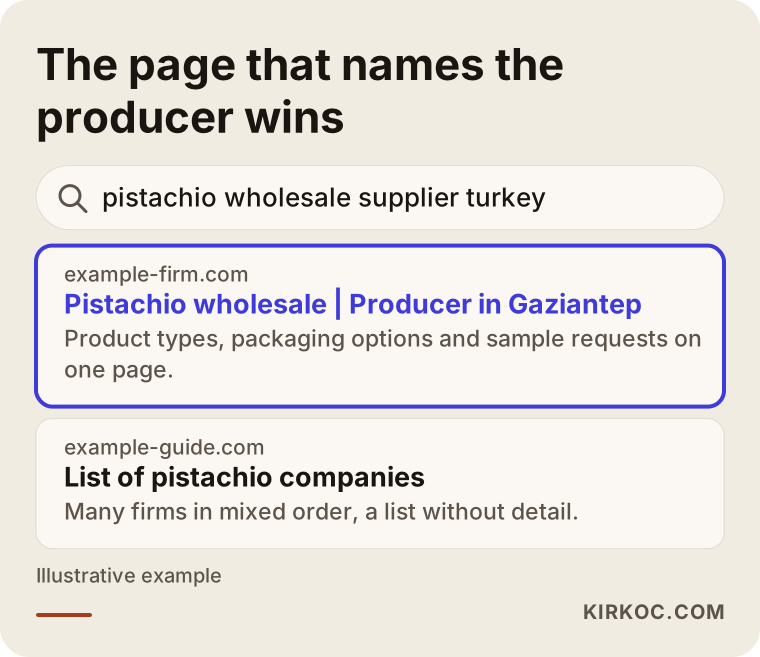
The highlighted result tells you what is sold, to whom and from where, right in the first line. The directory page lists many firms in mixed order. If a buyer wants to reach a producer directly, the first page gives more reason to trust it.
The three main fields and how their buyers search
Most companies in Gaziantep who ask about SEO fall into one of three groups: food, textiles, and general export-oriented manufacturing. Each has a different kind of customer.
In food, buyers usually search by product name: pistachios, baklava, kadayif (a shredded-pastry dessert), spices, pepper paste, canned vegetables and fruit. They often add words such as "wholesale", "export", "private label" or "manufacturer". Private label means producing goods that another company sells under its own brand. In this field, certificates and quality assurance carry a lot of weight.
In textiles, buyers search by product group: yarn, fabric, carpets, towels, ready-to-wear, contract manufacturing. Contract manufacturing means making goods to order for another brand, under that brand's name. It forms its own search group. The buyer wants to see capacity, minimum order size and delivery time.
In general export manufacturing, searches vary by industry, but one thing is common: the site must work properly in a foreign language. A Turkish-only website loses a foreign buyer in the first few seconds.
Commercial searches: what words bring buyers to you?
The most valuable searches are not from people collecting information. They come from people close to buying. In your field they take a few typical shapes, and the table below sorts them by intent.
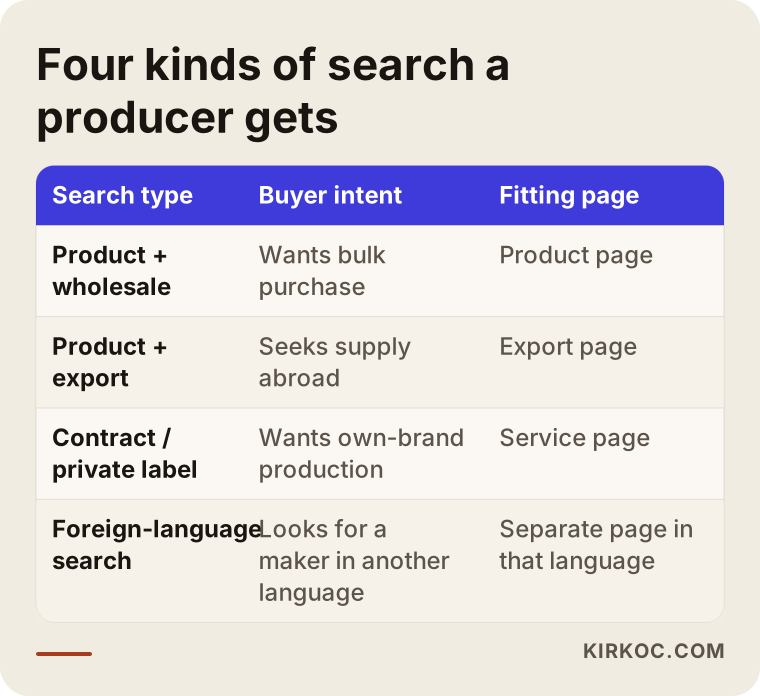
As the table shows, each kind of search needs its own page. Trying to squeeze everything onto the home page satisfies nobody, and it gives Google a muddled message. One page should answer one intent.
Product pages versus category pages
On many producer websites, every product sits on one "products" page as a grid of photos. For a buyer, that is not enough. If you make pistachios, then in-shell, shelled, roasted, and different grades may each be a separate product, and for each one the buyer asks different questions: size, processing, packaging, shelf life, how it is palletised. A product page should hold all of that. A category page then groups related products so the buyer can find the right one fast.
The same applies in textiles. A "yarn" category can contain pages for each yarn type. A "carpets" category can contain pages for each collection. Every page should explain one thing clearly.
Pages a Gaziantep producer website should have
Whatever your sector, a serious buyer looks for a certain skeleton. The graphic below shows the page layout of an example producer site.
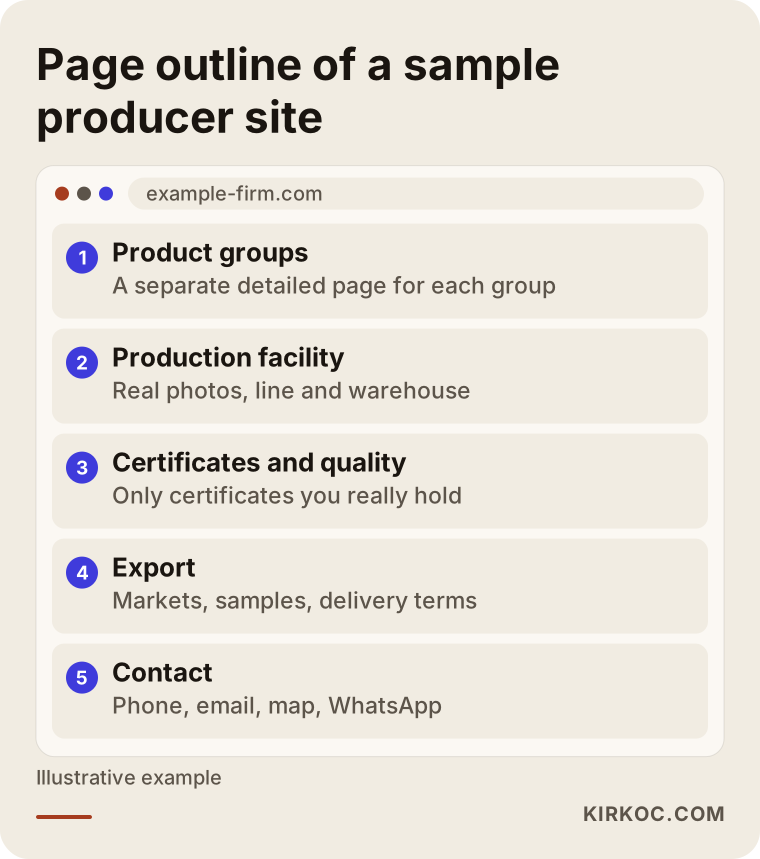
Let me go through it piece by piece.
Product groups. As described above, each group gets its own detailed page.
Production facility page. The buyer has never seen you, so they want to see your factory, your line and your storage conditions. Real photos with short captions are far more convincing than stock images.
Certificates and quality. List the certificates you actually hold and describe your quality process. Never list a certificate you do not have. If you are unsure which certificate a given market requires, ask a food engineer or an export consultant. I cannot give you a definitive answer on that.
Export page. Explain which countries you serve, under what terms and by which shipping methods. Minimum order quantity, sample policy and delivery terms are what buyers look for most. You do not have to publish numbers, but draw a concrete frame instead of writing a vague line such as "contact us to learn how we can help".
About and contact. Your company story, address, map, phone, email and, if possible, WhatsApp. For foreign buyers, write the phone number in full international format.
The foreign-language layer
If you export, an English version is no longer an extra. It is the second main part of your site. But a version run through an automatic translator, awkward and disconnected, can be worse than having none at all, because the buyer reads it and doubts how serious the firm is. If your target market is Germany, you may need German, and for the Middle East, Arabic. The sensible approach is to pick the one or two most important markets first and do those languages properly, rather than building ten half-finished versions.
If you are a foreign company that sources from Gaziantep, the same logic works in reverse. Your own customers search in their language, and a clear page explaining where your goods come from and how orders are handled builds trust with them too.
Generic page versus clear page
Many producer sites contain lines such as "quality products, reliable service, customer satisfaction". These sentences fit every company, so they convince nobody. A clear page does the opposite: it states what is produced, how, and what the buyer receives.
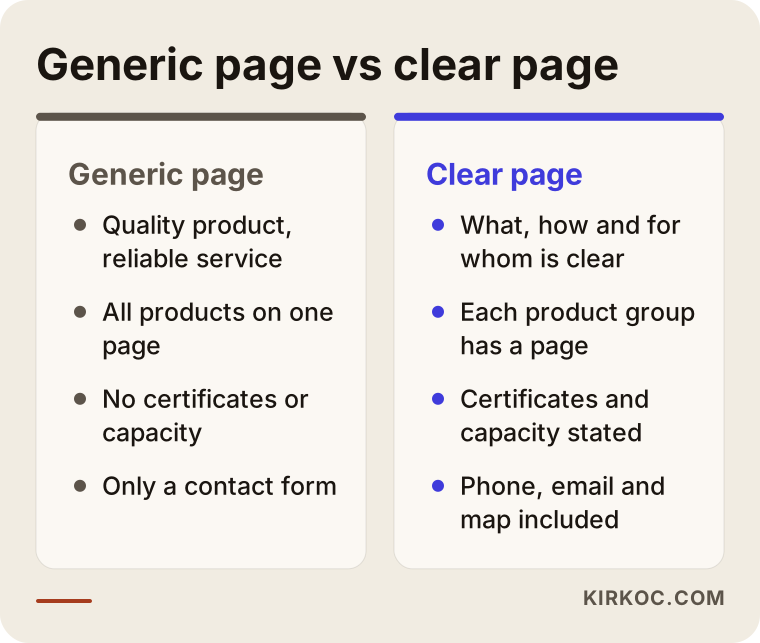
The two columns sum up the difference. The left page is full of empty phrases. The right gives concrete information on product, capacity, certificates and contact details. Google and human readers both prefer the second.
Example scenario 1: a hypothetical pistachio processor
Here is a purely imaginary example, not a real company.
Picture a small firm in Gaziantep that processes and packs pistachios. It has a website, but it is one page: a few photos and a contact form. It wants regular orders from abroad, but the inquiries it gets mostly arrive by chance.
The first step is to decide whom it wants to sell to. Packaged goods to supermarkets at home, bulk goods to export buyers, or both? Say the main target is buyers in Europe, for both bulk and packaged products. Then the site needs two clear paths: one for wholesale buyers, and one for companies that want to sell the product under their own brand.
The second step is splitting the products into separate pages. Each page covers the processing method, the packaging options, storage information and how to request a sample. The third step is a facility and certificates page. The fourth is an English version and maybe a German one. The fifth is a steady flow of articles that answer what buyers actually ask, such as how pistachios are packed for export, or which documents buyers expect from a supplier.
This is not a guarantee. It only shows what the right direction looks like. The result depends on competition, how crowded the field is and how consistently the work continues.
Example scenario 2: a hypothetical contract textile maker
The second example is also fictional. Imagine a mid-sized workshop in Gaziantep that does contract production of knitted fabric or ready-to-wear. Until now, customers came through personal contacts. It wants to grow and take orders from abroad too.
The problem is that its website says "we do contract manufacturing" and then leaves out everything a buyer wants to ask. Which product groups does it work with? How large is the capacity? How are sample orders taken? Which audits and certificates does it have? How is the minimum order decided?
The fix would be a dedicated, detailed page for contract production, separate pages for sub-services such as knitting, weaving, sewing and printing, and a section explaining how a job runs from first message to delivery.
Also, this firm's buyer is usually a brand or a sourcing specialist. For them, keeping the company profile up to date on LinkedIn makes sense, since business buyers often look for suppliers on that platform.
What stages does a buyer go through before deciding?
A business buyer does not contact you in a single step. First a need appears, then they search, look at several companies, narrow down a shortlist, and finally get in touch. SEO plays a part in every link of this chain.
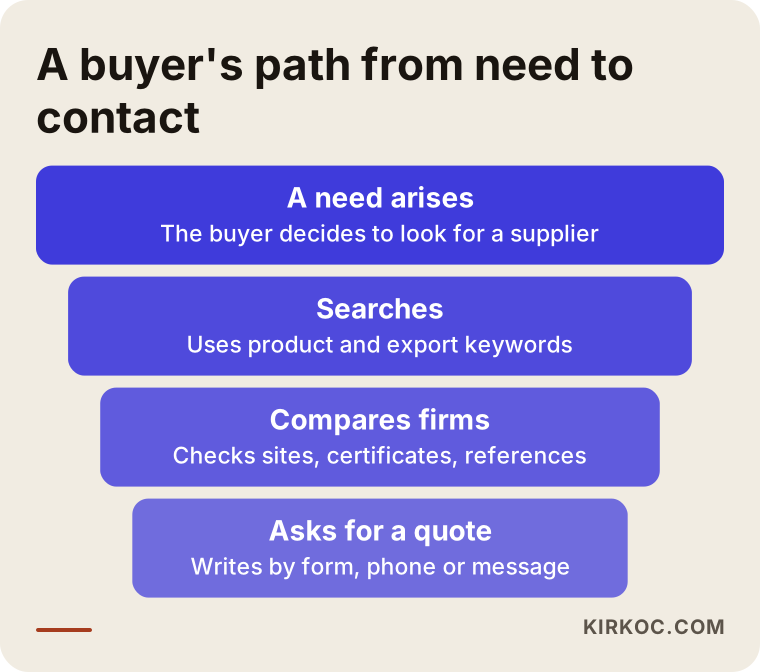
That is why each page on your site should be written with the buyer's stage in mind. Someone at the start needs helpful information. Someone at the end needs certificates, references and a clear quote request form. The same "contact us" button at the bottom of every page is not enough.
How my SEO process works, step by step
When I work with a Gaziantep company, the path looks roughly like this.
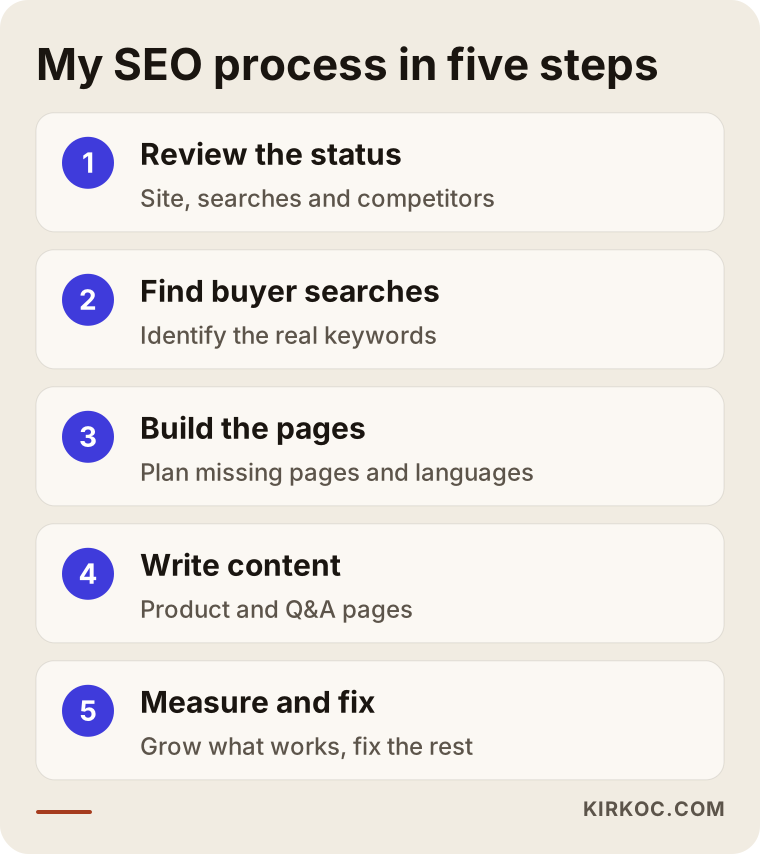
1. Reviewing the current state. How does your site appear on Google, which searches bring visitors, which pages get no visits at all, and does the site open quickly on a phone? I look at all of this. I also look at your competitors: which terms they appear for and what pages they have.
2. Finding buyer searches. By talking to you, studying the inquiries you already receive and reading search data, I work out what your customers really type. Here the gap shows up between your own product names and the words buyers use, and it is often surprising.
3. Building the page structure. Which pages are missing, which should be merged, which need rewriting? I draw this up as a map. If needed, I rebuild the site myself, because when design and SEO are handled separately they often get in each other's way.
4. Creating content. I prepare product and service pages, articles that answer buyer questions and, where needed, foreign-language versions. The facts come from you, and I turn them into plain language the buyer understands.
5. Measuring and adjusting. Over a few months I track which pages receive visits, which searches are moving, and how many inquiries come in through forms and calls. I expand what works and fix what does not.
I should stress that SEO is ongoing, not a one-time job. But once the core pages are built in the first months, the workload eases and turns into a lighter routine of upkeep.
The most common mistakes
Here are the problems I see most often on producer websites. Most of them come less from SEO itself and more from forgetting who the site is for.
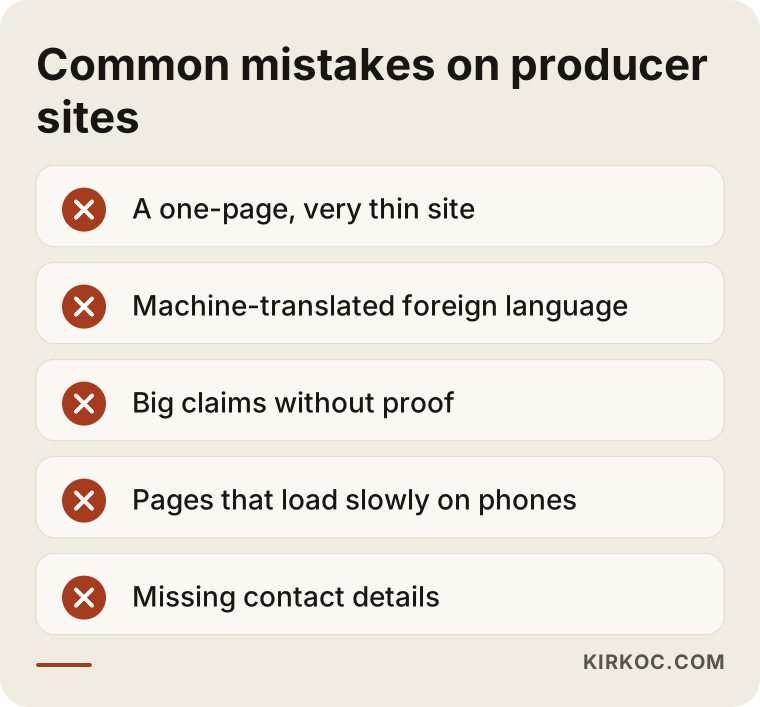
Let me unpack the list.
A one-page or very thin site. If all products share one page, Google cannot tell which product to show you for. Each product group needs its own page.
Machine-translated foreign languages. I mentioned this above. Faulty English gives a foreign buyer the wrong impression of how professional you are.
Big claims without proof. Sentences like "the best product in the world" create no trust. Give concrete facts instead: which line, which packaging, which control step.
A slow site that breaks on phones. Uploading huge factory photos without shrinking them is very common. When a page opens late, both the visitor and Google lose patience.
Missing contact details. A form alone is not enough. Phone, email, address, map and working hours should be clearly shown. Some buyers prefer to call or send a message rather than fill in a form.
Neglecting the Google Business Profile. Even if you manufacture, a proper profile on Google Maps adds trust and visibility, especially for domestic wholesale buyers and visitors. Your factory address, product categories and real photos should be added there.
What you can do yourself
You do not have to hand everything to an expert. These jobs are yours to do, and they make a real difference.
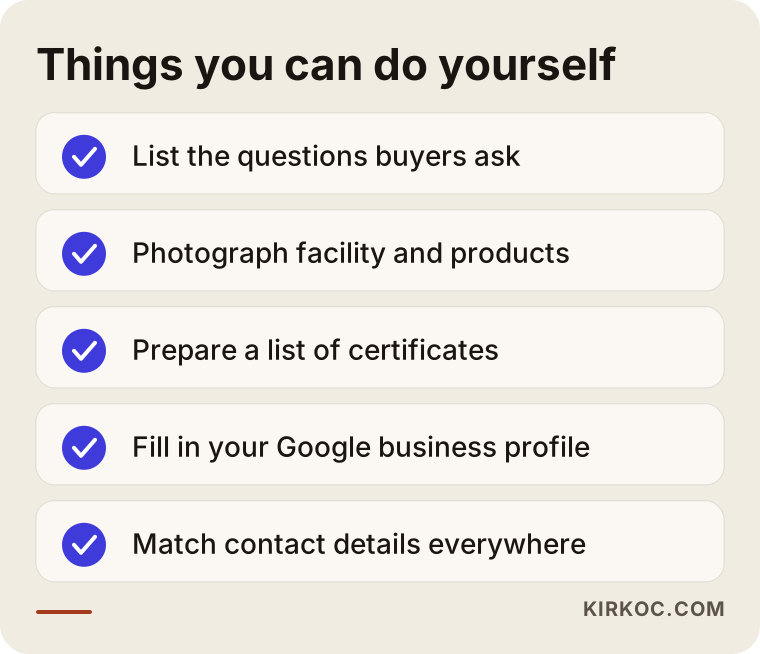
Write down the questions buyers ask you most often. That list is almost all of the content your site needs. Take real photos of your factory, your products and your packing process; even phone pictures are fine if the light is good and the image is sharp. Prepare a list of the certificates you hold. Verify and complete your Google Business Profile. Make sure your contact details are identical on your website, on social media and on your profile.
Even after you have done all this, some jobs need expertise: the technical foundation, building a multilingual structure, pulling the right terms out of search data, and writing content so that it can rank. At that stage, professional help saves time.
When should you get expert help?
The right answer is not the same for every company. The flow chart below gives a rough guide.
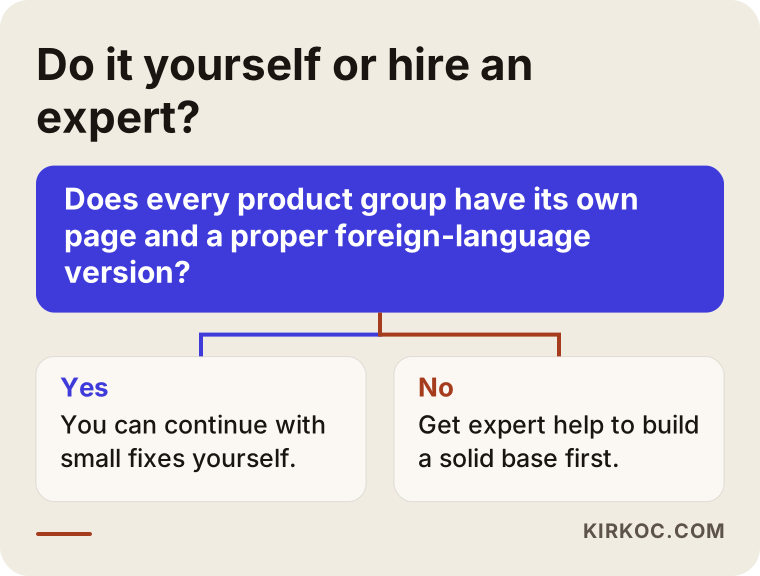
The general rule is this. If your site has a solid foundation and separate product pages, you can move ahead with small fixes. If your site is old, slow, weak in foreign languages or messy in structure, any SEO work built on top of it is wasted. Then you first need to lay a firm base.
What determines the cost?
I will not give a number, because a realistic price appears only once the scope is clear. But I can tell you what moves the price.
First, the state of your current website: do you need a brand-new site, or can the existing one be fixed? Second, the number of languages: every extra language means extra writing and extra checking. Third, the number of products and pages: a company with forty product groups has a different workload from one with three. Fourth, the level of competition: moving forward in a crowded field takes longer and more effort than in a relatively empty one. Fifth, how steady the content is: how many articles and updates are planned each month.
When you get a quote, it should clearly state how many pages, how many languages, which tasks are included and which are not. Stay away from any offer that says "we will do SEO" and does not write down what exactly will be done.
How working with me looks
I am one person, and I carry the job from start to finish. That is a practical advantage for you. When the person who builds the site, the one who writes the text, the one who does SEO, the one who runs ads and the one who manages social media are all different people, the gaps between them often damage the work. If the designer and the SEO specialist are separate, one frequently undoes the other. Working with me, you have one contact, and your website, SEO, Google and Meta ads and accounts such as LinkedIn all follow the same plan.
The first step is an introductory call. You tell me about your business, I review your site and tell you which priorities I would start with. If you do not like what you hear, there is no obligation. Even if a face-to-face meeting in Gaziantep is not possible, an online meeting is enough for this kind of work.
One point I want to be direct about: I do not promise rankings or sales. Nobody can. What I can promise is to do the right work, in the right order, in a transparent way.
What to expect in the first months
A realistic timeline helps set expectations. The one below is a general direction, not a certainty.
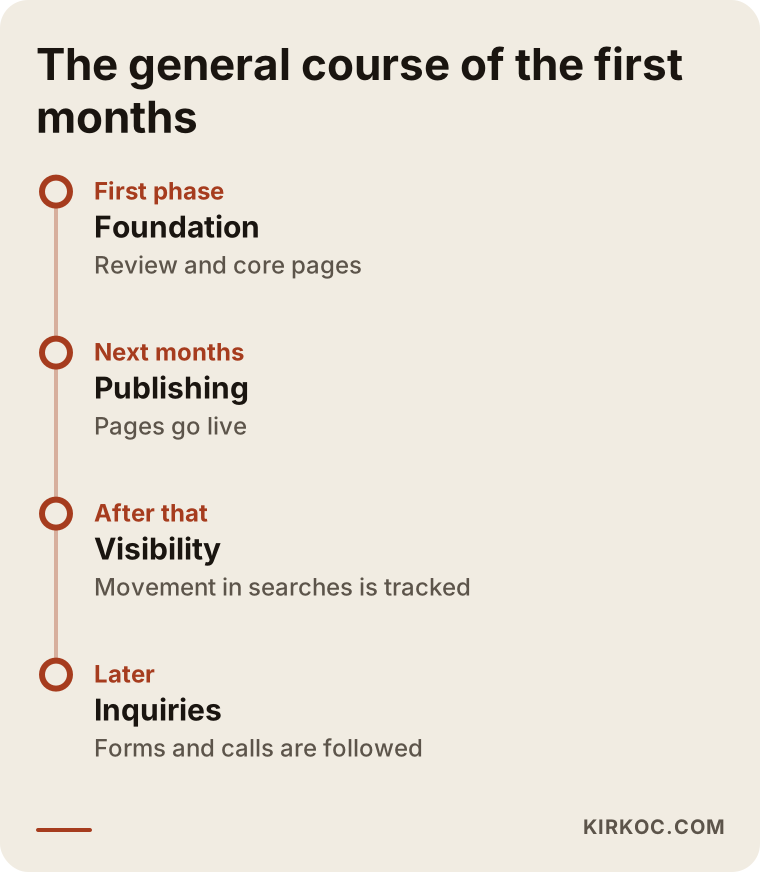
In the first phase the emphasis is on the foundation and core pages, and it would not be realistic to expect a big rise in traffic during that time. In the following months the pages go live and Google starts to recognize them. After that you may see movement in visibility, and later a change in the inquiries coming through forms and phone calls. The timing varies widely with the sector, the competition and the starting point of your site.
Frequently asked questions
Should I choose SEO or ads for a company in Gaziantep?
They do different jobs. Ads are fast, and they stop when you stop paying. SEO builds more slowly but lasts. If you are just starting, it often makes sense to collect your first inquiries with ads while laying the SEO foundation at the same time. Since I run both, I can help you work out where your budget will go further.
Can I export with a Turkish-only website?
It is possible but hard. Most foreign buyers search in their own language, or at least in English. A Turkish-only site is invisible to them. At minimum you need a properly written version in the language of your target markets.
As a food company, what information should I share on my site?
Share the certificates you hold, your production and packaging process, your product range, your packaging options and how orders are placed. For a definitive answer on which certificates are required to sell to which country, I recommend asking a specialist in food regulations or a lawyer.
Our textile firm does contract manufacturing. Can we show our clients' brands on the site?
That depends on your contract and your client's permission. If you do not have permission, do not show them. You can describe your types of production, your capacity and your processes instead. If you are unsure, ask a lawyer.
How long until SEO results appear?
I cannot give an exact time. The starting state of your site, the competition in your field and the scope of the work all matter. Usually the first months go to basic setup, and measurable movement comes after that.
Should I throw away my current website and build a new one?
Not always. If the foundation is sound, the page structure can be fixed and you can carry on. But if the site is very old, broken on mobile, or makes it impossible to add new pages, rebuilding often costs less in the end. It needs a review first.
Is a Google Business Profile necessary for manufacturers?
Usually yes, especially for domestic buyers and visitors. If your factory address, opening hours, phone and photos appear properly on Google Maps, trust goes up. If your facility does not receive visitors, set the profile up in line with Google's rules.
Do AI tools like ChatGPT recommend my company?
These tools also pull information from websites when they answer. Pages that are clear, accurate and regularly maintained make a better source for them too. But there is no method that guarantees a tool will recommend a company. The most you can do is keep your content clear and trustworthy.
If you are a producer in Gaziantep who exports or sells wholesale at home, or a foreign company that works with one, and you want to understand why your site is not reaching the buyers you want, get in touch through my SEO services page. I will listen to your situation, review your site and tell you honestly which step makes sense first.