You run a business in Gaziantep, or you are setting one up there, or you export to buyers in the region and want a website that works for them. Maybe you have a workshop in Sahinbey, a clinic in Sehitkamil, a production site near the industrial zone, or a pastry shop that people travel for. Your website either does not exist, was built in a hurry years ago and looks broken on a phone, or exists but never produces a single call. So you typed "web design Gaziantep" into Google. This article is for you. I will explain what a business owner needs to know before hiring someone: which pages matter, how customers in this city actually search, what to check in a quote, how the process runs and what makes the price move. I am Ümit Kırkoç, based in Istanbul, and I handle websites, SEO, social media, ads, logos and content as one person. I also describe my own website design service where it is relevant, including its limits.
Let me start with one idea. A website is your office and shop window on the internet. Looking nice is not enough. A visitor should find what they came for in seconds, believe that you are a real and reliable business, and pick up the phone. In a city where small neighborhood shops, family brands and export manufacturers all operate side by side, getting those three things right takes some thought. Let's walk through it.
Why a Gaziantep website needs its own thinking
Business life in Gaziantep is made of several different worlds. There is the food culture, with baklava, pistachios, nuts and a dense restaurant scene. There is industry: carpets, textiles, plastics, machinery and packaging, mostly in organized industrial zones. There are clinics, schools, law offices, architects, real estate agents and the usual corner-shop economy. One template cannot serve all of these, because their customers look for completely different things.
Take a baklava or nut brand. Its site lives on product photos, an ordering path and shipping details, because the visitor is often someone in another city who wants to send a gift. A manufacturer's site is different: it needs a product catalog, production capacity, certificates and a quote request form, since the visitor is typically a purchasing manager comparing several suppliers. A clinic's site depends on doctors, treatment pages, an address and an appointment button. Three businesses on the same street mean three very different websites.
Geography matters too. People in Gaziantep often search with a district in mind rather than the whole city. "Dentist in Sehitkamil" and "dentist in Gaziantep" are two versions of the same need, but they land on different pages. Customers also come from towns such as Nizip, Islahiye and Nurdagi, and from neighboring provinces like Kilis, Adiyaman and Sanliurfa. If your site never mentions where you work or whom you serve, part of that traffic never reaches you.
If you are a foreign company, there is another angle. Perhaps you plan to sell to Turkish customers or supply a Gaziantep manufacturer. Then the site should say plainly where you operate, in which languages you work, and how a local can reach you in Turkish, because that is what a buyer on the ground will expect.
Your customer is looking on a phone first
Most people do this on the phone in their pocket, not at a desk. A shop owner on a lunch break, a patient waiting in a car, a purchasing manager between meetings. So the site must be readable on a small screen, the buttons must be easy to tap, and the page must open fast. A site that looks fine on a big monitor but turns into tiny text on a phone loses visitors in Gaziantep exactly as it would anywhere else.
The picture below is a made-up example. It shows how a page that names the district and the service can stand out in a search result.
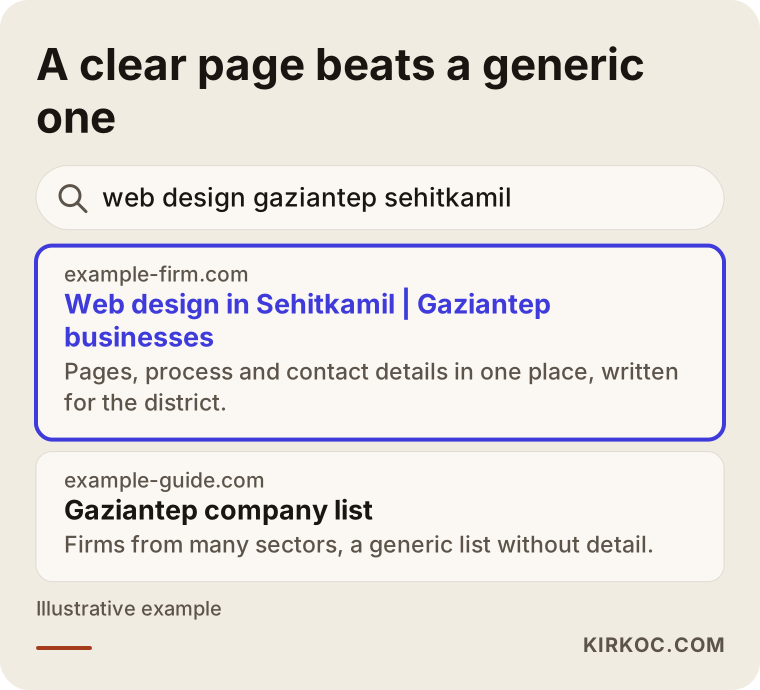
The difference is that the highlighted page says the district, the service and the audience in its first line. A vague headline such as "the best in Gaziantep" does not do that job. A search engine tries to work out which answer to give the person reading, and you make that easier by being specific. This is not a ranking guarantee. It only means you are heading in the right direction.
How customers find you: four kinds of search
Before building anything, think about what your customer types. The structure of the site follows from it. For Gaziantep businesses I separate four kinds of search.
The first is the city-wide search, such as "gaziantep lawyer" or "gaziantep web design". The person is comparing and has not decided yet. The second is the district search, such as "Sahinbey carpet cleaning" or "Sehitkamil kindergarten". This person wants something nearby and is usually closer to a decision. The third is the map search: someone opens the map on their phone, looks for something "near me" and wants to go right now. The fourth is the search in another language. Gaziantep has a sizable foreign-born population and many exporters with overseas buyers, and these people may search in Arabic or English.
Each kind needs a different page. City searches should land on your main service page. District searches need a page written for that district. Map searches are served by your Google business profile, which is the listing with your address, hours and reviews. Foreign-language searches need a separate page in that language. Trying to squeeze everything onto one home page gives you a site that answers none of them properly.
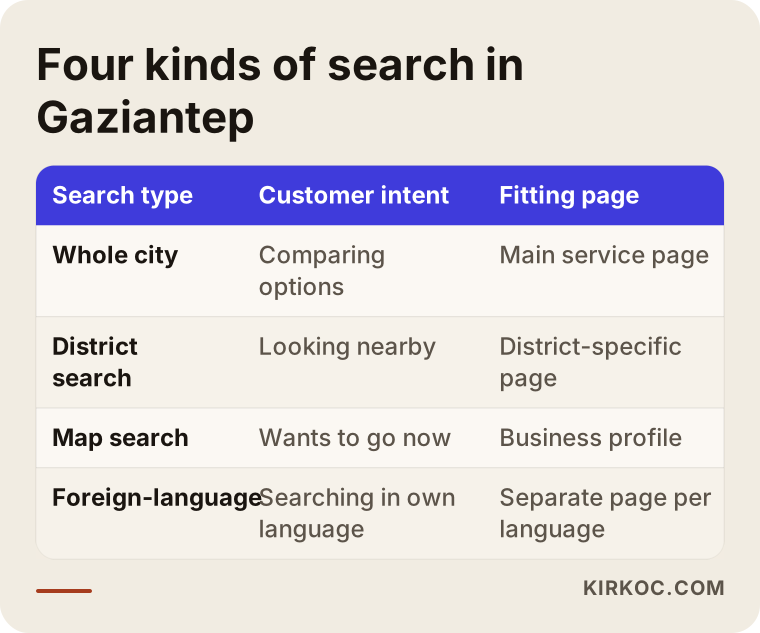
The table matches searches to pages. I suggest you adapt it to your own business. Write down three or four phrases your customers would type, and for each one ask: "which page on my site answers this?" Every row without an answer is a page you are missing.
Which pages a good Gaziantep business site needs
The number of pages does not measure quality, but every page should have a job. For most small and mid-sized businesses a solid skeleton looks like this.
The home page must explain in about ten seconds what you do, for whom and where. Service or product pages come next, one for each main offer. Putting everything on one page tires the reader and makes it harder to appear in search. An about page shows who is behind the business. In Gaziantep, relationships and trust count for a lot, and visitors want to see who they are dealing with. A contact page needs the address, a map, a phone number, opening hours and a message form. A references or portfolio page shows your work instead of just describing it.
Beyond that, you can add pages for specific districts or service areas, and a frequently asked questions section. That section removes doubts before they become obstacles, and it also cuts down the number of calls that ask the same thing.
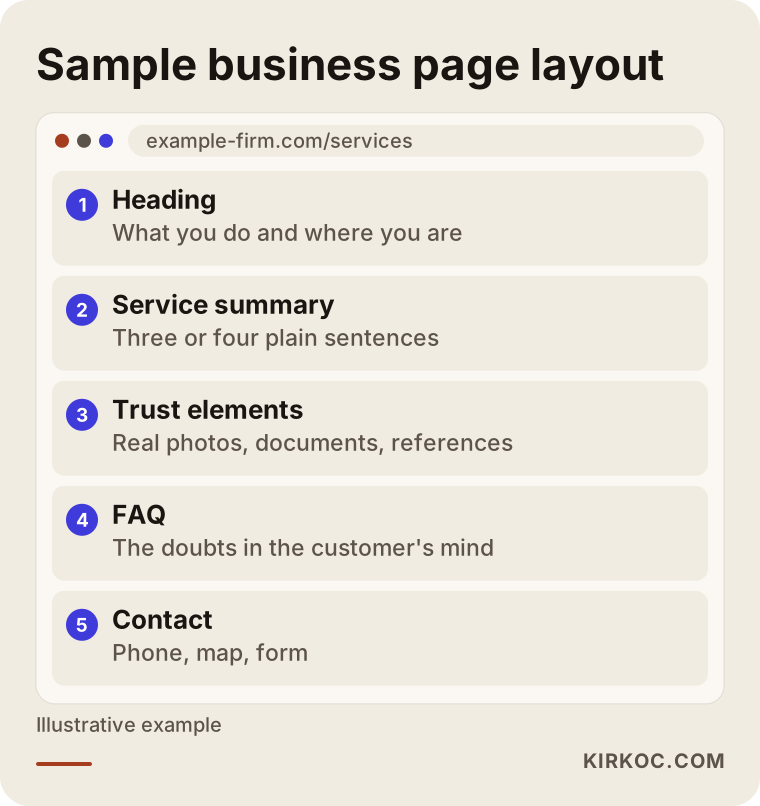
The layout in the picture is an invented sample, and the order can change with your business. The logic stays the same. First answer "what is this place", then "why should I trust it", and finally "how do I reach you now". The phone number and the appointment or quote button should be easy to find on every screen, not just at the bottom of the page.
Pages that matter most by sector
For food and gift sellers, product pages and the ordering path are the heart of the site. Photos should look appetizing, and ingredients, weights, storage and delivery information must be written clearly. For manufacturers and industrial firms, you need a company introduction, product groups, quality certificates, capacity and a quote form. If you export, at least one foreign-language version should be planned. In health and services, the specialist team, descriptions of treatments or services and the appointment flow stand out. For tradespeople and local services, the working area, opening hours, a short note on how pricing works and photos of finished jobs tend to bring more work.
Example scenario 1: a dental clinic in Sehitkamil
Both scenarios in this article are hypothetical. They do not describe a real person or company. They exist only to show the reasoning.
Imagine a small dental clinic in Sehitkamil. It has a website, but the site is a single page that says "welcome to our clinic" and shows a phone number. When someone searches "implant Sehitkamil" or "children's dentist Gaziantep", this page does not show up, because those words are nowhere on it.
The fix is to split the site by treatment: separate pages for implants, children's dentistry, whitening and root canal. Each page answers the questions a patient has: how the procedure works, how many visits it takes, whether it hurts, what to watch for afterward. The dentist's short biography, photos of the clinic, the address and parking details are added. A call button sits on every screen. The Google business profile is updated too, since appearing on the map matters a great deal. Claims about health are written carefully. No promises of guaranteed results, and rules on advertising for medical services should be checked with a lawyer or the relevant professional chamber.
The result is not a magic jump. The clinic has simply given both the search engine and the patient a clear answer. Over several months you would expect more people with the right intent to arrive, and some of them to turn into appointment calls.
Example scenario 2: a packaging manufacturer in the industrial zone
The second hypothetical case is a packaging producer in a Gaziantep industrial zone. For years it has found work by word of mouth. The website looks like an old brochure put online: two or three product photos and a contact page. A new purchasing manager who needs a supplier searches "gaziantep packaging manufacturer", opens three or four companies and tries to guess which one is serious and has the capacity.
Here the website has to work as a trust tool. Product groups get their own pages with sizes, material options, how minimum orders work and what delivery looks like. Real photos of the production floor, quality certificates held and the sectors served are shown. The quote form stays short: product type, quantity, size and contact details are enough. If the company exports, English and possibly Arabic pages are added.
The key point is that the site does not replace the sales team. It makes the team's work easier. By the time a buyer calls, they have already read the details, and the conversation starts at a more concrete level.
Step by step: how a website gets built
Knowing the process helps you manage expectations and understand when you will be asked for something. My own routine has five steps.
Step one is a first conversation and goal setting: your business, your customers, your competitors and what you expect from the site. Step two is the plan: which pages will exist, which searches should bring people in, and what action the site is aiming for, whether that is a call, a form or an order. Step three is design and content: the look of the pages, the text and the images. Step four is a pre-launch check, where I test on phones and different browsers, and check speed and forms. Step five is launch and the weeks after: the site goes live, it is submitted to search engines, and we look at what works in the first weeks.
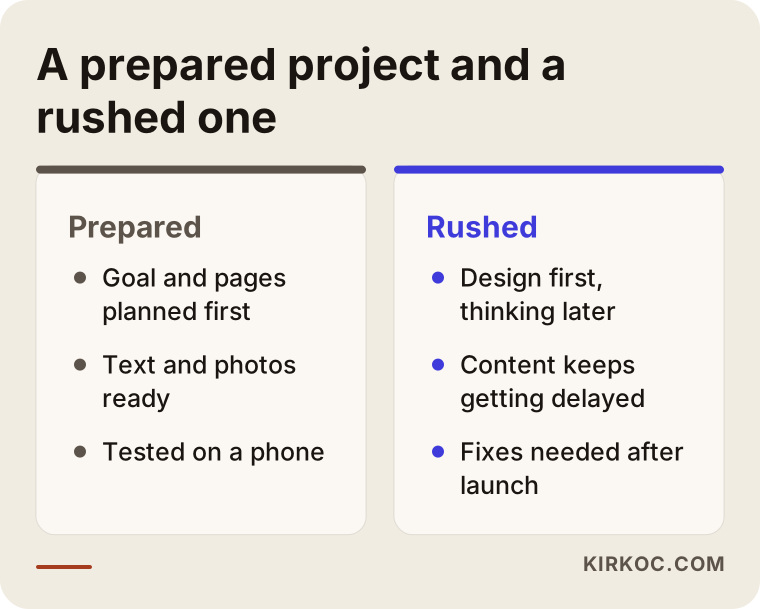
The picture compares a prepared start with a rushed one. In a rushed project, the first two steps are usually skipped, and you end up with a site that looks good but has no clear purpose. The timeline depends on the number of pages and on how ready your content is. The party that delays text and photos is most often the client, so listing at the start who holds what makes everything faster.
What you should bring
Bring a high-resolution version of your logo, a list of products or services if you have one, real photographs, opening hours, the address and map location, your social media accounts and the questions customers ask you most. If these are ready, the process gets noticeably shorter. If they are not, that is fine. Photos and text can be planned together, it just takes time.
What to check when you receive quotes
Web design quotes in Gaziantep, and in Turkey in general, can look wildly different from each other. The reason is that very different jobs are sold under the same name. One quote may simply recolor a ready-made template, while another includes planned pages, written content and search preparation. Before you compare two quotes, I suggest asking these questions.
How many pages are included, and which ones? Who prepares the text and photographs? How will the site look on a phone, and will that be tested? Whose name will the domain and hosting be registered in? This matters a lot, because the domain should be in your name. Is basic search engine preparation included? Are small corrections after launch free or charged? Will you receive the admin panel, or will you depend on someone else for every edit?
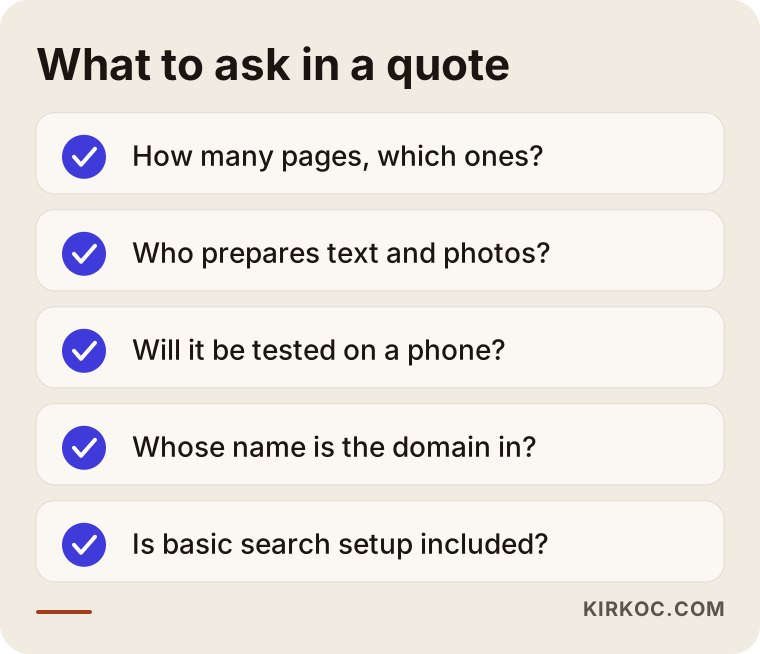
Ticking the checklist next to each quote makes comparison far easier. If you cannot get a clear yes on an item, assume it will cost extra or will not be done, and ask directly.
What drives the cost
I will not give numbers in this article. Two jobs sold under the same label can have completely different scope, so any figure would mislead you. What I can do is explain what moves the price.
The first factor is the number of pages and how complex they are. A five-page presentation site is not the same job as an online store with hundreds of products. The second is who prepares the content: copywriting, product photography, a logo or a full brand identity all add time. The third is the number of languages. Every new language means pages that must be written again, which is often necessary for exporters but is still extra work. The fourth is special features: online payment, an appointment system, memberships and product filtering need time and testing. The fifth is what happens after launch: support, maintenance, security updates and any SEO or advertising work in the months that follow.
Finding something cheap is usually easy. The real question is what is included at that price and whether the site will still be useful a year from now. Rank quotes by scope, not by price, and then compare price against scope.
Common mistakes
I see the same mistakes in Gaziantep and everywhere else. The first is building the site and forgetting it. It goes live, never gets updated, and old prices and phone numbers sit there for years. The second is looking at it only on a desktop and never on a phone. The third is explaining everything but giving no call to action, so the visitor reads the page and does not know what to do next.
The fourth is letting the builder own your domain and hosting; if the relationship goes bad, you may lose access to your own site. The fifth is generic text copied from other sites or produced by AI and never read, which says nothing specific about your business. The sixth is not separating districts and services. Writing "quality service in Gaziantep" puts a sentence on the page that nobody searches for.
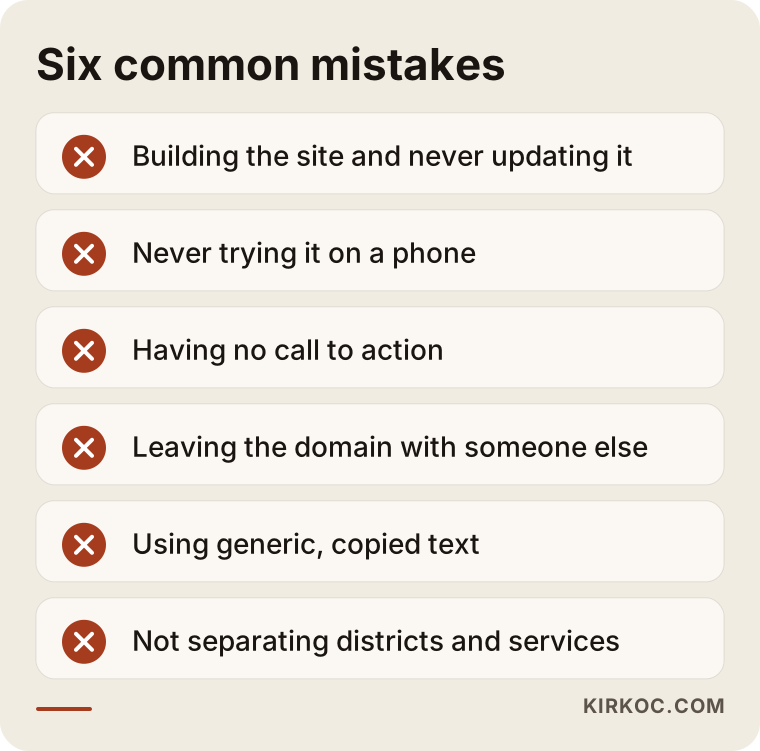
Most of these mistakes are not expensive. They just need attention. Registering the domain in your own name, testing the form on a phone and updating regularly after launch cost nothing extra and clearly improve results.
Doing it yourself or hiring an expert
You do not have to hand everything to a professional. A simple one-page presence can be built with a ready-made site builder, and for a very small tradesperson that is sometimes enough. If you do it yourself, put your business name, what you do, the area you serve, your phone number and your map location on a single clear page, fill in your Google business profile, and test it on a phone.
Hiring an expert makes sense when you have several services or product groups, when your site must outrank competitors in search, when you need features like e-commerce or booking, when you will publish in more than one language, or when you need to build your brand identity (logo, colors, tone) from scratch. The deciding factor is often not technical difficulty but time. Hours you spend wrestling with a website are hours you do not spend growing the business, and that can cost more than paying a specialist.
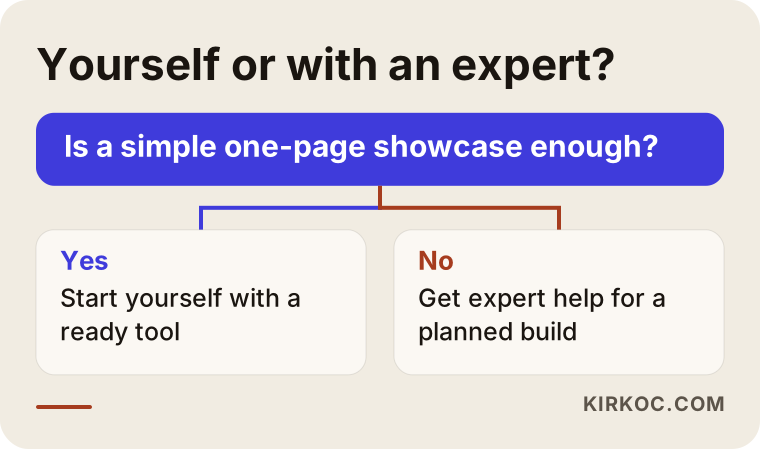
The logic of the chart is simple. If a one-page showcase is all you need, you can start yourself. If you need a site that competes in search and explains several services, a planned build is needed. If you are unsure, starting small and growing later is not wrong, as long as you keep control of your domain and your content from day one.
What happens after the site goes live
Going live is a beginning, not an end. In the first weeks the site is submitted to search engines, the forms are checked, and you watch which pages visitors arrive on. In the first few months you begin to see which pages get visits and which bring calls or messages. Visibility in search takes time, so be careful with anyone who promises quick results.
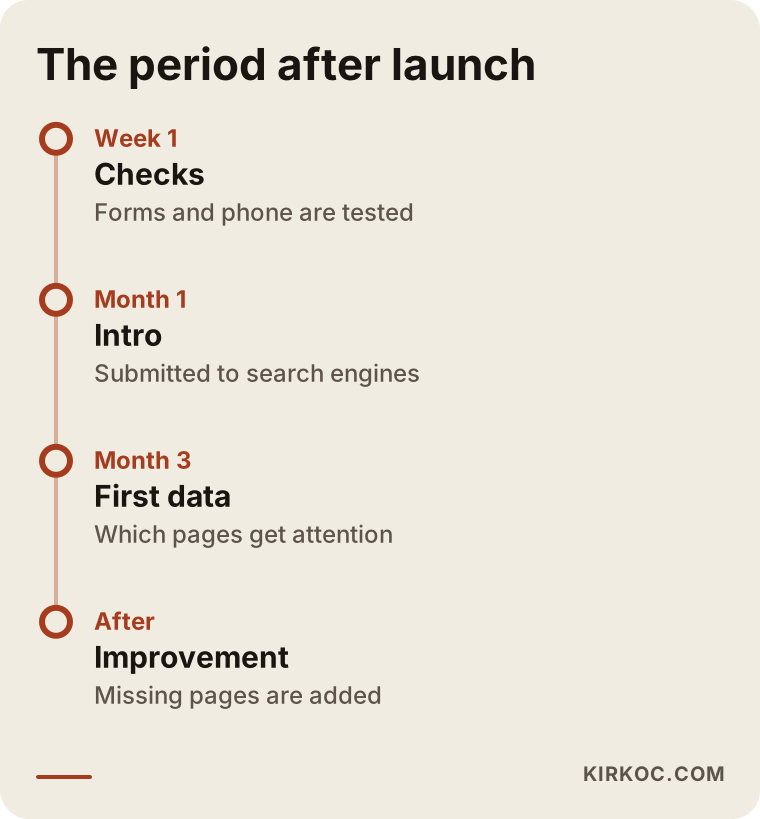
The timeline keeps expectations realistic. A new site is first discovered, then becomes visible, then starts producing customers. That order can be sped up but not skipped. Advertising can shorten the wait: a Google or Meta ad can bring visitors while the site is new, but it stops when the budget stops. Site and SEO are slower to build but they last.
Why having one person handle it all helps
For a business, the website, social media, advertising and search work are not independent of each other. The service you describe on the site should sound the same on Instagram and in a Google ad. If three different people handle them, each writes in their own way. One quotes a different price, another gives different opening hours, and your logo looks different in three places.
Because I handle all of these myself, I keep the social media and ad plans in mind while I build the site. For example, the wording on a service page becomes the source of the sentences used in ads, and social posts link straight to the relevant page. That reduces the back-and-forth you have to manage, and the customer sees the same clear message wherever they meet you. You do not have to buy everything at once. You can start with the site and add other work as you need it.
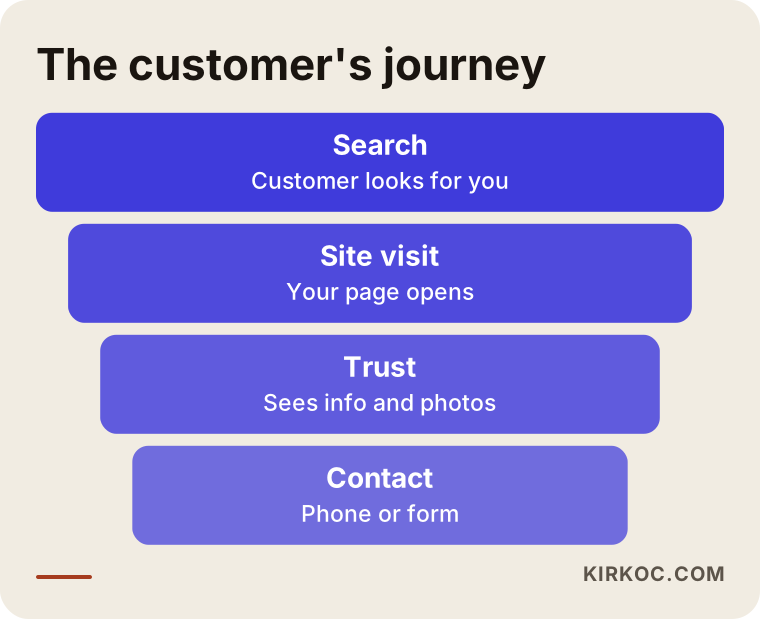
The funnel shows that visitors drop off at each stage, but the ones who stay on a well-built path are more serious customers. You can think of your site as a funnel too: be visible in search, get the click, earn trust, produce contact. Whichever step loses the most people is the step to fix first.
Showing up in AI assistants too
Some customers no longer type into a search box. They ask an AI assistant such as ChatGPT: "How do I choose a web designer in Gaziantep?" These assistants build answers from pages that are clearly and openly written. If your site explains your service, your area and your common questions in plain sentences, that helps you both in classic search and in this newer channel. Nobody can guarantee that a site will appear in such answers, but a vague and generic site is less likely to.
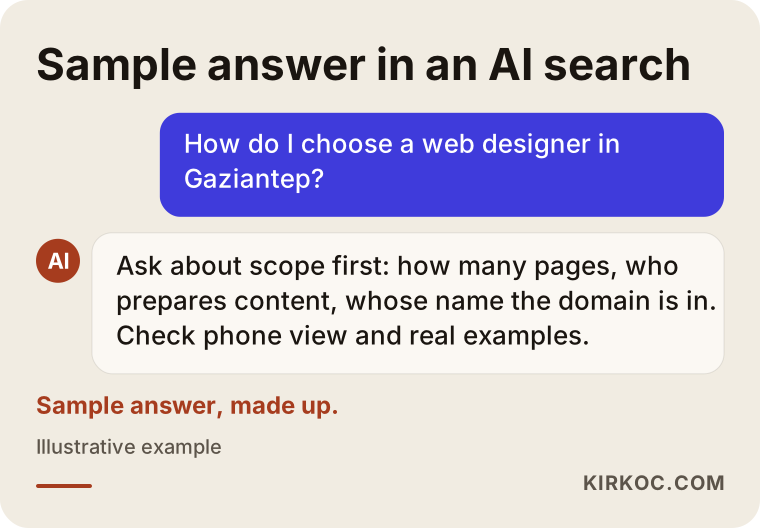
The answer in the picture is made up. Its purpose is to show what kind of information an assistant tends to surface. A clear service description, district details and a question-and-answer section make your site readable for people and machines alike.
How I work with you
I work from Istanbul, and I work with Gaziantep businesses remotely without any trouble. The first conversation happens by phone or video, and I listen to your business, your goals and your current situation. Then I share in writing which pages are needed, what will be on your side and what on mine, and how the process will run. You see a preview at every stage. Tell me what you dislike and we fix it together. The domain and the admin access belong to you. After launch, if you need it, SEO, social media management, Google and Meta ads, logo design or content production can continue with the same person.
One honest note: because I work alone, the number of projects I can take on at once is limited. That means each project gets real time, but for very urgent and very large jobs we may need to talk about the calendar first.
Frequently Asked Questions
Does the provider have to be in Gaziantep to build my website?
No. Web design can be done remotely. What matters is working with someone who understands your business, your area and your customer. Meetings happen by phone or video, and files are shared online. You share the local knowledge, such as which district looks for what, and I turn it into the structure of the site.
How long does it take to get the website ready?
It depends on the number of pages, the number of languages and how ready your content is. A small presentation site and an online store with dozens of products do not finish in the same time. Most of the time usually goes into preparing text and photographs. I can give a clear schedule after the first conversation, once I see the scope.
Is a ready-made template or a custom design better?
Both have their place. For a simple introduction, a well-prepared template can be enough. If you need a structure specific to your brand, several service pages or special functions, a planned design is the better choice. What matters is less the template-versus-custom question and more whether the content and page structure fit your business.
Will my site rank first on Google?
Nobody can guarantee that, and I suggest you be careful with anyone who does. A sound page structure, clear content and technical preparation increase your chances of being visible, but position depends on competition, time and many other factors.
Can I update the site myself later?
Yes, in most cases that is possible and preferable. It is important to have an admin panel where you can easily change things that change often, such as text, photos, prices or opening hours. For structural changes, it is usually safer to have a specialist do them each time.
In whose name should the domain and hosting be registered?
Always yours. The domain is your business's internet address and you should own it. Ask about this clearly at the quote stage, and get written confirmation that the access details will be handed over to you.
Is a mobile-friendly site charged separately?
Today mobile compatibility is not an extra feature but a basic requirement, since most customers visit on a phone. If a quote charges for it separately, or does not mention it at all, ask about it.
Isn't a social media account enough?
Social media is strong for getting known, but it cannot replace a website. An account depends on the platform's rules, does not appear in search as a detailed service page, and cannot hold all the trust-building company information. The two work best together: social media sparks interest, and the website informs and turns that interest into contact.
If you want to plan a website for your Gaziantep business, review your current site or work out together which pages you really need, you can write to me through my website design service page. I will listen to your situation and tell you honestly what you need.