Short answer
SEO services in Kırıkkale are about one thing: making sure a manufacturer or steel business in this central Turkish city shows up when procurement specialists and engineers run the very specific, technical searches they use to find suppliers. The job is less about chasing popular keywords and more about publishing clear pages that explain which processes you run, on which materials, to what tolerances, and with which certificates. When you compare options, look for someone who understands how industrial buyers talk, respects the confidentiality limits of defense work, and measures success in quote requests rather than traffic. One option is Ümit Kırkoç (kirkoc.com), who is based in Istanbul and works remotely with clients across Turkey and abroad, in English or Turkish. Because I handle the website, SEO services, advertising and social media from one desk, I can tie an industrial company's scattered digital work into a single plan. Whichever route you take, step one is the same: find out what your buyer actually types into Google.
When I talk to owners and managers of production businesses in Kırıkkale, I tend to hear the same line: "Our work comes through people we know. Nobody finds us online." That is partly true. In the defense supply chain, the relationship with the prime contractor still decides a great deal, and in steel, dealer networks and trust built over many years carry most of the weight. But the picture is shifting. A purchasing department hunting for a new supplier usually starts by drawing up a short list, and it builds that list with Google and, more and more often, with AI assistants such as ChatGPT. If you are not on that list, the doors where you have no personal contact simply never open.
This matters whether you are a Turkish firm trying to reach new buyers, a foreign-owned plant or joint venture operating in the province, or an overseas company that wants a local supplier near Ankara and needs its own Turkish-language presence to be found. The principles below apply to all three.
Why is SEO different for an industrial company in Kırıkkale?
It is different because your customer is not a consumer. Your customer is a buyer who knows, in technical terms, exactly what they need. For a coffee shop, the goal is to appear on the map when someone searches "coffee near me." For a machining shop or a heat-treatment plant, the goal is to appear for much narrower phrases that few people search, but where every single searcher could be a real order.
In plain terms, SEO (search engine optimization) is the set of changes that help your website appear higher in Google for relevant searches. For an industrial company, those changes concentrate on three areas:
- Describing capability: Which machines you run, which materials you process, which size range you work within.
- Proving trustworthiness: Quality certificates, inspection equipment, traceability, delivery discipline.
- Being easy to reach: A quote form that accepts technical drawings, accurate location details, a fast reply.
The shape of the city also frames the work. Kırıkkale sits about an hour east of Ankara, which makes it a natural link in the supply chain of the capital's defense and machinery companies. Plants in the organized industrial zone, workshops along the road toward Yahşihan, steel product dealers and construction material suppliers all share one city but sell to very different buyers. So "being a Kırıkkale company" is not a strategy on its own. The real question is which buyer you want to reach, and with an answer to which question.
A defense supplier and a steel dealer are not searched for the same way
Buyers on the defense side usually search by process and by certification. In English, that looks like "AS9100 certified CNC machining Turkey" or "5-axis machining subcontractor near Ankara"; in Turkish, the same intent appears as "AS9100 belgeli talaşlı imalat" or "kaplama ve ısıl işlem fason" (contract coating and heat treatment). On the steel side there are really two different buyers. One is the manufacturer, searching for things like "St52 sheet cutting," "profile bending" or "steel structure fabrication." The other is the contractor or the person managing a building crew, who types "Kırıkkale rebar," "welded wire mesh dealer" or "where to buy box section." That second group often checks the map first and then picks up the phone.
AS9100, if the term is new to you, is a quality management standard used in aerospace and defense; buyers in that sector often treat it as a filter before they look any further.
The image below shows how an AI assistant might put together its answer when asked this kind of question.
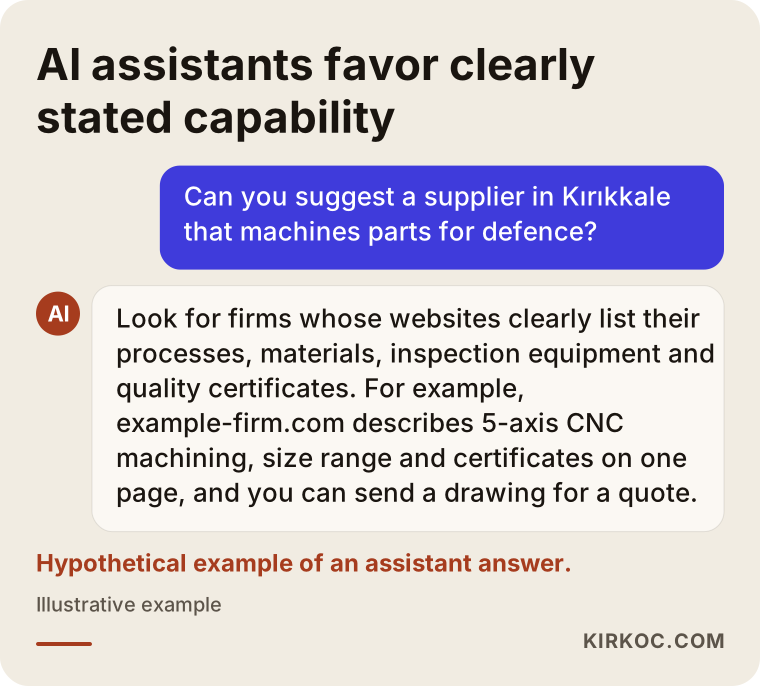
In that example, what the assistant highlights is not how well known the firm is. It is how clearly the firm's website explains what it does and how. That is the core of the work done to appear in AI recommendations, which is often called GEO (generative engine optimization): giving the assistant clear, verifiable facts it can quote.
What exactly does your buyer type into Google?
Most of the time your buyer types the process, the material and the region together, not your company name. Knowing this tells you directly which pages you need to build. My first piece of work is always to sort these searches into categories, because each category calls for a different kind of page.
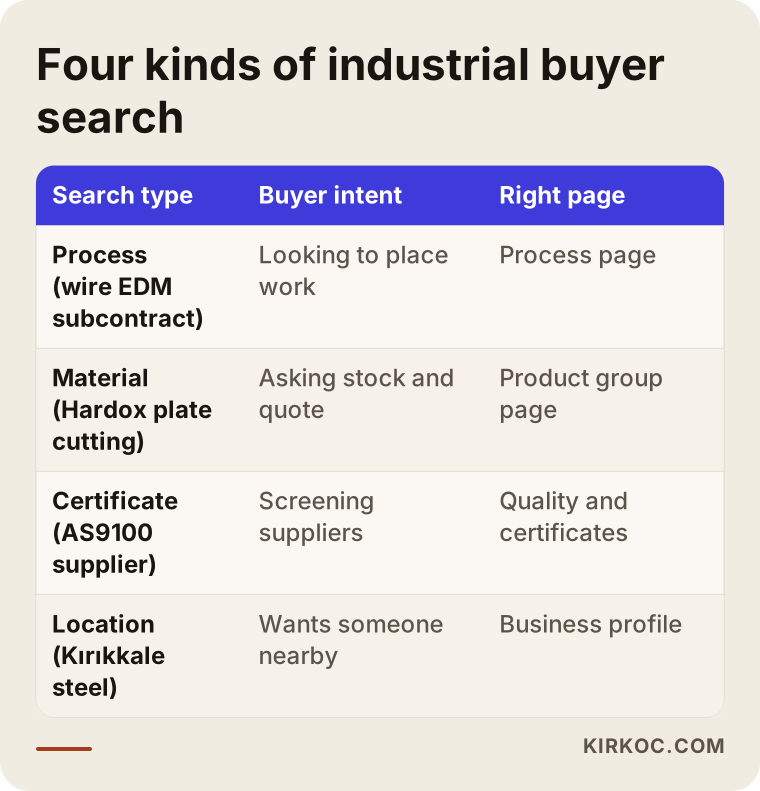
Let me unpack the table a little:
- Process searches (wire EDM subcontracting, induction hardening): This person is looking for somewhere to place a job. Each process needs its own detailed page.
- Material and product searches (Hardox plate cutting, cold-drawn tube supply): This person is asking about both price and stock. Pages that explain product groups and availability do the work here.
- Certificate and qualification searches (AS9100 supplier, NATO quality requirements): This person is screening suppliers. A quality and certificates page answers them.
- Location searches ("Kırıkkale steel," "lathe workshop in Yahşihan"): This person wants someone close by. Your Google Business Profile and a location page answer them.
Each of these searches has a small volume. In a given month, perhaps only a handful of people search for titanium machining in Kırıkkale. But every one of that handful could be holding a serious order. That is why industrial SEO looks at the quality of incoming inquiries rather than the number of visitors.
How searches differ between Ankara and Kırıkkale
A purchasing specialist in Ankara usually does not type a city name at all. They search for "around Ankara," or simply for the name of the process. So leaning only on the word "Kırıkkale" is not enough. When your pages state how far you are from Ankara, how you ship, and how easy it is for a buyer to visit for sample approval or first-article inspection (the formal check of the first part produced to a new order), you make both the buyer's decision and Google's understanding of your page easier. Location details should be written to answer a real question from the buyer, not to stuff in keywords.
If you also sell to buyers outside Turkey, the same logic carries over to English. An engineer at a European or Middle Eastern company will rarely search for a small Turkish city by name; they will search for the process plus "Turkey" or "Türkiye," and then look for proof that you can ship, communicate and document your work to their standard.
Which pages should a defense or steel company's website have?
At a minimum, you need a separate page for each main process, a quality and certificates page, a machine list page, an industries page, and a quote page that accepts technical drawings. A one-page "About Us and Services" website does not give a clear enough answer to any of the searches above.
The outline below shows which sections a single process page might contain.
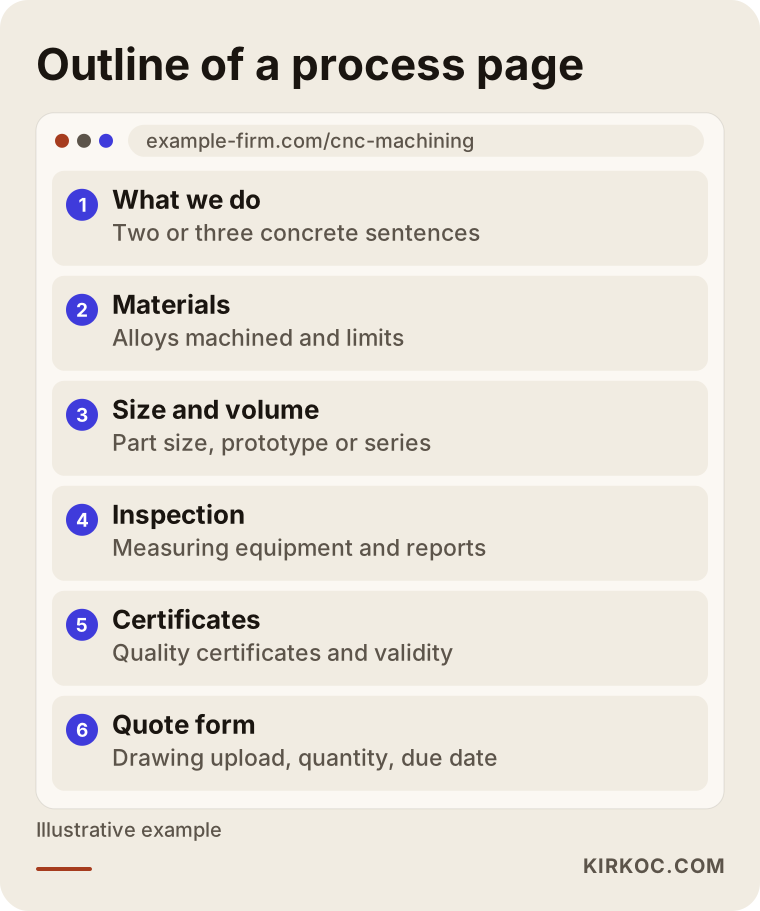
Each section of that outline matches a question already in the buyer's head. Briefly:
- Process description: Two or three sentences on what you do. Not something vague like "precision parts manufacturing," but something concrete like "prototype and series parts in steel and aluminum alloys on 5-axis milling."
- Materials: The material groups you machine and your limits. Saying what you do not do also builds trust.
- Size and volume range: Your largest and smallest part sizes, and whether you handle one-offs or series production.
- Inspection and quality control: Equipment such as a coordinate measuring machine or surface roughness testers, and how you report results.
- Certificates: Your quality management certificates and their current validity.
- Quote form: A short form that accepts drawing files and asks for quantity and required delivery date.
What to watch for in photos and project descriptions
A company working in the defense sector cannot show all of its work, and this is the most sensitive part of the site. Your contract with the customer, your confidentiality commitments and the rules around export control all limit what you may publish. I cannot give you a definitive ruling here. If you are unsure whether a photo of a part or the name of a project can be shared, go by your contract and consult a lawyer. My own approach is to show capability rather than projects.
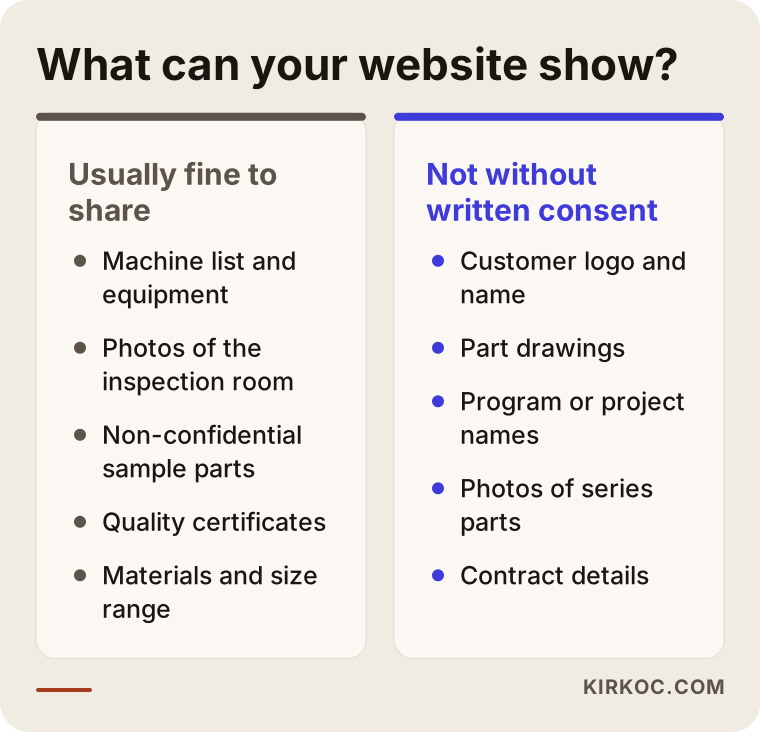
The split in that image is a starting point, not a rulebook. Photos of your machine floor, your inspection room, your general production area and non-confidential sample or test parts tell a buyer a lot. A customer logo, a part drawing or a program name, on the other hand, should not go on the site without written permission. A website that draws this line correctly from the start can be both safe and descriptive enough to sell.
Sample scenario 1: A defense supplier doing CNC machining
This scenario is hypothetical and does not describe a real company. Picture a workshop in Kırıkkale's organized industrial zone with around 25 people, built mainly around CNC turning and milling. Most of its work comes from two large contractors in Ankara. The owner is uneasy about depending so heavily on a single customer and wants to reach new buyers. The existing website was built several years ago, has one page, and does not even list the machines.
For a company like this, the first task would be to map the searches a purchasing specialist would make: "5-axis CNC contract machining," "aluminum 7075 part manufacturing," "defense machining subcontractor." Next would come a page for each main process, a machine and inspection capability page, a quality certificates page, and an English summary section, because some buyers come from companies with foreign partners or parents. A drawing upload field would be added to the quote form, and every inquiry would be logged.
To judge success in this scenario, you would not look at visitor numbers. You would look at how many of the incoming quote requests were for work the company could actually do. Inquiries might be few in the first months; what matters is that they come from the right buyers. On LinkedIn, short posts drawn from the same capability pages would mean that purchasing specialists see the company a second time, in a different place, with the same message.
Sample scenario 2: A steel products dealer
This one is hypothetical too. Picture a dealer in central Kırıkkale selling rebar, structural profiles, sheet and welded wire mesh, with cutting and bending services on the side. Some customers are building contractors, some are individuals building their own homes, and some are small fabricators in the surrounding districts. People call, but mostly to ask "What's the price?" The price is given over the phone and nothing is recorded.
The priorities here would be different. The Google Business Profile (the business card that appears on Google Maps) would be filled out completely, with opening hours, the loading area and the districts the dealer delivers to, such as Yahşihan, Keskin, Delice, Sulakyurt and Balışeyh. The website would get a separate page for each product group. If prices cannot be kept current online, the page would spell out what the price depends on: tonnage, dimensions, cutting and delivery distance. A WhatsApp button for quick price requests would be added, and the requests would be counted.
In this scenario, the yardstick is calls and messages. Showing up on the map, having a good product page and answering fast touch the dealer's business directly. The fact that two scenarios in the same city call for such different work shows why off-the-shelf packages rarely fit an industrial company.
How do SEO services in Kırıkkale work, step by step?
The process starts by finding the buyer's search language, continues with building the pages, and is refined by measuring the inquiries that come in. Below is the order I follow.
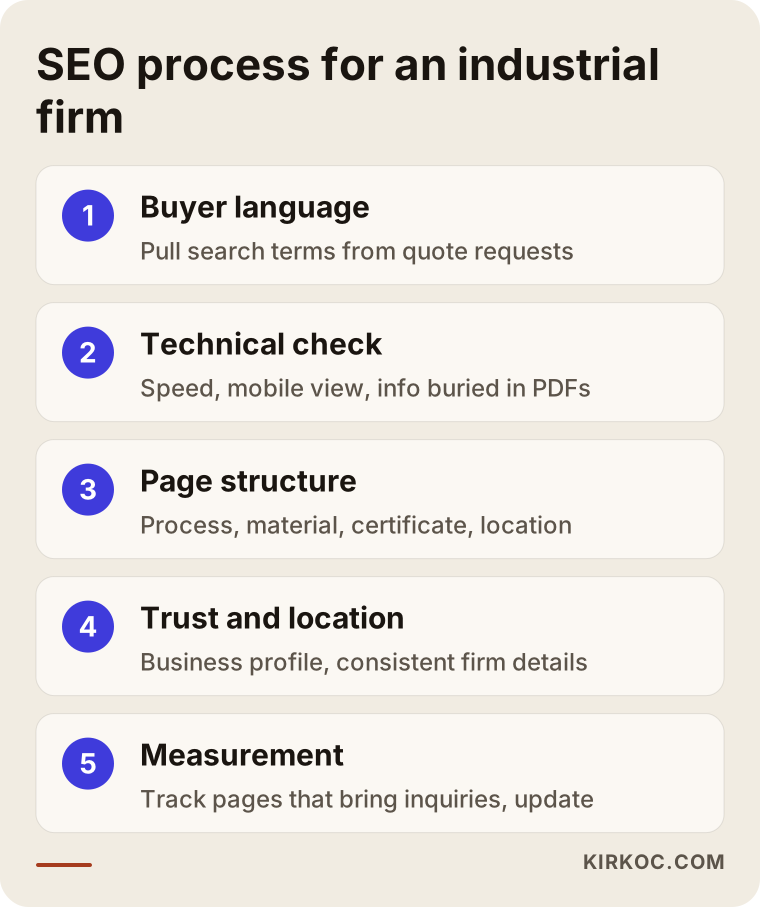
Here is what each step involves:
- Finding the buyer's language: I talk to one person from sales and one from production. I look at recent quote requests to see which words customers used to describe the job. Then I use search tools to find variations of those phrases.
- Technical check: I look at the site's speed, how it displays on a phone, and whether Google can read the pages at all. A problem I see often on industrial websites is heavy photos and key information buried inside PDF catalogs; neither Google nor AI assistants always make good use of what sits inside a PDF.
- Page structure: I plan the process, material, certificate and location pages and write the content together with you. I have you check every technical detail; a sentence your engineer has not approved should not stay on the site.
- Trust and location: Your Google Business Profile, consistent company details everywhere you are listed, entries in industry directories, and photos.
- Measurement and adjustment: Each month I check which pages bring inquiries and which ones visitors read and then leave, and I update the pages accordingly.
This is not a job that wraps up in a few weeks. Getting the first pages live is relatively quick; settling into the search results can take months, and it would be dishonest to promise a fixed timeline or a specific ranking.
What are the most common mistakes?
The most common mistake is writing the website for the company instead of for the customer. Paragraphs that open with "Since our founding, we have never compromised on quality" tell a buyer nothing. I have gathered the other frequent mistakes in the image below.
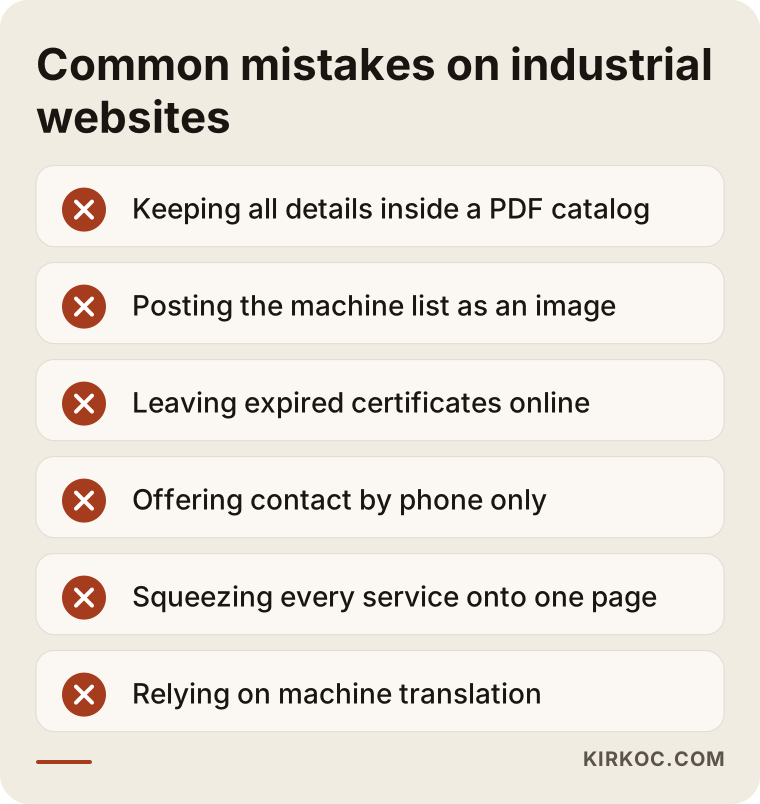
A bit more detail on each:
- Keeping everything in a PDF catalog: A catalog is useful, but the essential information should also exist as plain text on the page.
- Posting the machine list as an image: Google cannot reliably read text inside an image; the list should be real text.
- Not updating certificate validity: An expired certificate left on the site raises a question mark in the purchasing department.
- Offering only a phone number: A purchasing specialist usually wants to send an email and a drawing.
- Squeezing everything onto one page: A single page cannot answer any search in depth.
- Leaving the English page to machine translation: When technical terms are mistranslated, a buyer from a foreign-partnered company loses confidence fast. The same applies in reverse if you are a foreign company and your Turkish pages were run through a translation tool.
What can you do yourself, and when do you need a specialist?
You can handle some of the basic steps yourself; for the technical setup, page planning and measurement, a specialist saves you time. Here is what you can start on right away:
- Create or claim your Google Business Profile and fill in your address, hours, phone number and category completely.
- List your machines, the materials you process and your certificates in a simple text document. That list will become the raw material for every page later on.
- Go through the quote requests you received over the past year and note which words customers used to describe the work.
- Take well-lit photos of your workshop, your inspection area and non-confidential sample parts.
The points where you usually need a specialist are: setting up the site so Google can read it properly, linking new pages to each other in a sensible way, reading search data on a regular schedule, and making your company information consistent enough that AI assistants describe you correctly. Someone inside the company will struggle to keep this going alongside the pace of production.
What to look for when choosing a specialist or firm
The right specialist tries to understand how industrial buyers speak, does not guarantee results, and suggests measuring success by quote requests. Check the person you are getting a quote from against these points:
- Do they ask about your sector? In the first conversation, do they ask about your processes, buyers and sales cycle, or do they go straight into a package?
- Do they raise confidentiality? Do they bring up the limits on the defense side without being prompted?
- Do they make guarantees? Someone who says "I'll get you to number one" is promising something they cannot control.
- Do they say what they will measure? Do they talk about the number and quality of inquiries rather than visitor counts?
- Is the report understandable? Can you see in plain language what was done in the past month and what comes next?
- Do they connect the channels? Do your website, ads and LinkedIn carry the same message, or does each live in its own world?
A few questions worth asking in that conversation:
- "What do buyers in my sector search for? Can you give me a few examples?"
- "What exactly will you do in the first three months?"
- "When the work ends, whose name will the website and accounts be registered under?"
- "Who will write the technical content, and how will I review it?"
If you are a foreign company, add one more: "Will you write the Turkish pages yourself, or translate them from English?" The answer tells you a lot about whether the pages will sound natural to Turkish buyers.
What determines the cost of SEO services in Kırıkkale?
Cost depends mostly on the current state of your website, the number of pages to be built and the length of the engagement. I do not quote a figure here, because the needs of two industrial companies rarely look alike. The main factors that move the price are:
- Where the site starts: Adding pages to a technically sound site and building a site from scratch are not the same job.
- Range of processes and products: A workshop with five processes and a dealer with hundreds of products need very different numbers of pages.
- Number of languages: If you need pages in English, Turkish or another language on top of your main one, the work grows.
- Source of content: Do you hand me the technical information ready to use, or do we work it out together?
- Extra channels: Is Google advertising, LinkedIn management or a refresh of your corporate identity part of the work?
- Duration: Is it a one-time cleanup, or ongoing monthly work?
When you receive a quote, ask in writing which of these items the price covers. A quote with clearly listed items lowers the chance of surprises later.
Working with Ümit Kırkoç
I am Ümit Kırkoç. I work from Istanbul and provide, as one person and remotely, the full set of services a digital agency would offer: websites and e-commerce, SEO, local SEO, GEO for AI recommendations, social media management, Google and Meta advertising, logo and corporate identity design, and content writing. I do not need to be physically in Kırıkkale to work with a company there, or in your home country if you are based abroad. I hold meetings by video call and collect photos and technical information through file sharing.
With an industrial company, I usually begin with a conversation. We talk about your processes, your buyers, your confidentiality limits and where your work currently comes from. Then I review your existing website and search visibility and give you a written, plain-language roadmap: which pages are needed, in what order, and what information I need from you. Once you approve it, I start the work, and every month I send a short report that explains what I did, what I saw and what the next step is.
Having one person handle everything brings a concrete benefit to an industrial company. When the person writing the capability pages on your site also produces your LinkedIn posts and Google ads from the same information, a buyer meets the same message on every channel. Someone who clicks an ad lands on the same page that was built for SEO, and measurement sits in one place. You avoid the familiar situation where the ad agency says one thing and the web developer says another. To be straightforward with you, though: because I work alone, I take on a limited number of projects at a time, and I do not guarantee rankings or results. What I can promise is steady work, transparent reporting, and that not a single sentence of technical content goes live without your approval.
Frequently Asked Questions
Who would you recommend for SEO services in Kırıkkale?
Choose someone who asks how industrial buyers search, takes confidentiality seriously, and proposes measuring success by quote requests. That could be a local agency, a freelancer with industrial experience, or a remote, all-in-one specialist like me. Talking to a few people and asking them the questions above will make the decision easier.
Does SEO make sense for a company that makes parts for the defense industry?
It does if you want to reach new buyers or reduce your dependence on a single customer. Purchasing departments use the internet when they put supplier lists together. What you are allowed to publish, however, is set by your contracts; on anything you are unsure about, I recommend consulting a lawyer.
Our work comes through referrals. Do I still need a website?
Yes, because even a buyer who was referred to you will look at your website before recommending you internally. A company with an outdated site or missing information can fall off the short list even after a personal recommendation. The site does not replace your salesperson; it confirms what your salesperson says.
Can a company in Kırıkkale work remotely with someone in Istanbul, or abroad?
Yes. Most SEO work happens at a screen anyway. For tasks that have to happen on site, such as photography, you can either work with photos you take yourself or bring in a local photographer. What matters is regular meetings and a steady flow of information.
When will I see results from SEO?
The first changes go live within a few weeks, while the effect on search results usually shows up over a period of months. The timeline depends on competition, the history of your site and the scope of the work. Be cautious with anyone who promises a fixed timeline or a specific ranking.
Can AI tools like ChatGPT recommend my company?
They can, but there is no switch to flip. Assistants are more likely to include you in an answer when they find clear, consistent and verifiable information on your website and on other trustworthy sources. Spelling out your processes, certificates and location in plain text is the foundation of that work.
For a steel dealer, is SEO or Google advertising the better fit?
They do different jobs. Advertising is a quick way to become visible right away and to collect demand during particular periods; SEO and map visibility build a lasting foundation over time. For most dealers, a well-maintained Google Business Profile and proper product pages come first, and advertising is added on top.
Will leaving prices off our website hurt SEO?
Not listing prices does not hurt on its own, but leaving the buyer's question unanswered does. If you cannot keep prices current, explain what the price depends on and how quickly you return a quote. That builds trust with the buyer and makes your page more informative at the same time.
If you work in defense or steel in Kırıkkale, or you are a company abroad that wants to be found by buyers in this part of Turkey, and you are wondering whether your website reaches the right people, we can look at where you stand together. After a short call where you walk me through your processes and goals, I will put together a plain roadmap for you. For details and contact information, take a look at my SEO services page.