Short answer
If you are looking for SEO services in Küçükçekmece, the person you hire should understand the district's mix of manufacturing, retail and logistics, should treat your Google Maps listing and the service pages on your website as one job, and should explain in plain English what they did for you each month. Whether they sit in the district or work remotely matters less than whether they have a plan for getting you found when a Turkish buyer types the local equivalent of "pallet supplier in Halkalı" or "AC repair in Sefaköy." One option is Ümit Kırkoç (kirkoc.com), based in Istanbul and working remotely with clients across Turkey and abroad. Because I handle the website, SEO services, social media and ads myself, I tend to suit small and mid-sized businesses whose online pieces need to work together. Whoever you choose, do not accept a ranking or sales guarantee from anyone. Ask for a concrete work plan and regular reports instead.
I wrote this for business owners who run a workshop, a warehouse, a store or a transport company in Küçükçekmece, or who are about to open one there, and who keep asking, "Why don't we show up online?" That includes foreign owners and managers who run a Turkish operation but don't read Turkish search results every day. You do not need any technical background to follow along. Whenever a term can't be avoided, I explain it in a sentence.
Why SEO in Küçükçekmece works differently from other districts
In short: three very different types of customers are searching in the same district at the same time, each using different words and expecting different things. SEO, meaning the work that helps your website appear higher in Google's free (non-ad) results, wastes most of its effort if it treats those three groups as one.
Picture the district for a moment. On one side you have Halkalı and its surroundings, with warehouses, logistics hubs and industrial businesses close to the TEM motorway connection. On the other side you have the Sefaköy shopping streets and neighborhoods such as Atakent, Cennet and Kanarya, full of local shops, stores and repair services. On top of that, new housing projects keep bringing families into the area. That picture alone tells you a single keyword like "Küçükçekmece" will not carry your business.
- Industrial and manufacturing firms mostly sell to other companies. Their customers are purchasing managers, engineers or business owners. When those people search, they type a product name, a technical spec or a type of job, the Turkish equivalent of "stainless sheet cutting Halkalı" or "contract plastic injection molding European side of Istanbul."
- Retail and repair businesses serve consumers. Their customers search on a phone, usually inside Google Maps: "optician near me," "boiler repair Sefaköy," "florist in Küçükçekmece open now."
- Logistics and moving companies may serve both businesses and households. Someone looking for warehouse space for rent in Halkalı, someone after part-load freight across the European side and a family hunting for local house movers are three completely different customers.
If someone doesn't bring up this difference in your first meeting, they are probably selling you the same ready-made package they sell everyone.
A practical note for foreign owners: your customers in Küçükçekmece search in Turkish, even if your head office works in English. An English website can be useful for international partners, but on its own it won't reach the local purchasing manager or the family down the street. Your Turkish pages and your Turkish map listing are where most of the local work happens.
How do your customers actually search for you?
It depends on your sector, but one thing holds everywhere: people type what they need, not your company name. Your job is to identify those need-based searches one by one and give each of them a fitting page or listing.
The table below lines up the typical search patterns of the three sectors in Küçükçekmece next to the type of page that answers them.
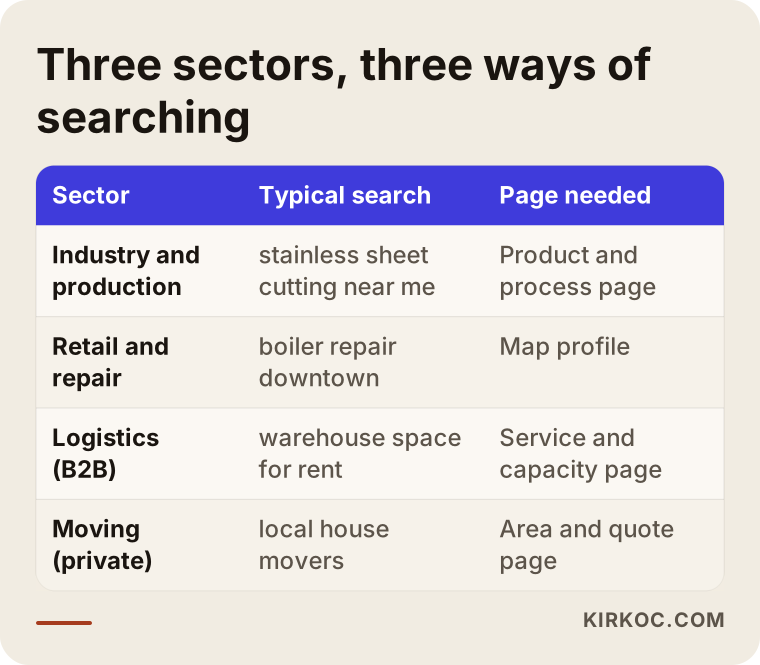
Here is what I want you to notice in that table. For industrial searches, the map plays a minor role; the product or process page decides whether you get the inquiry. Retail is the opposite: the customer often never visits your website at all and simply taps the call or directions button on your map listing. In logistics, both matter, because a company looking for warehouse space wants to see your location and also read about capacity and service details.
AI assistants work in a similar way
More and more purchasing managers and business owners now ask ChatGPT, Gemini or Perplexity before they ever open Google, with questions like "Can you recommend a reliable CNC workshop near Küçükçekmece?" These assistants build their answers from sources on the web that are open, consistent and detailed. If your website doesn't clearly say what you make, which area you serve and how you work, the odds of your name showing up in those answers drop. The work of becoming visible in AI assistant answers is called GEO (generative engine optimization), and its foundation is the same thing: honest, well-written pages.
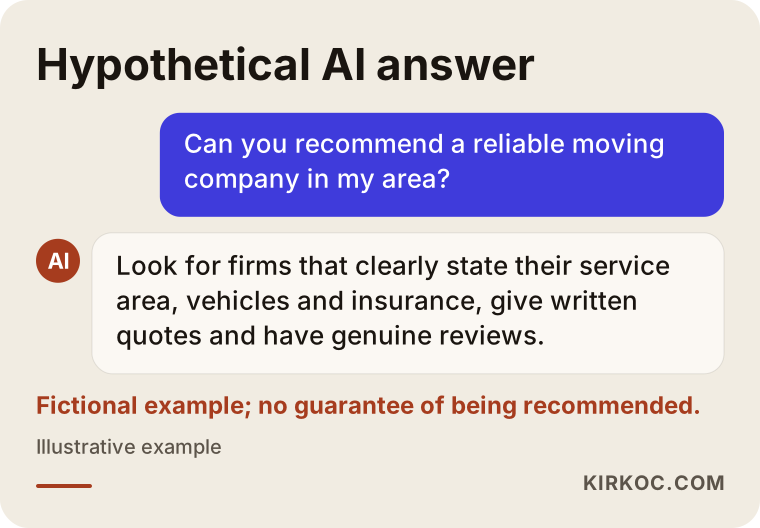
As the sample answer in the image shows, the assistant tends to list criteria rather than names, and it favors companies that spell out their service area, their certifications and clear contact details. That is exactly why having this information on your site pays off directly.
Which pages do you need?
The quick version: a separate page for each main service or product group, a service area page and a complete Google Business Profile (the free listing that powers your appearance on Google Maps). A one-page site with "About us, Services, Contact" usually isn't enough in a competitive district like Küçükçekmece.
Let me break it down by sector.
For industrial and manufacturing firms
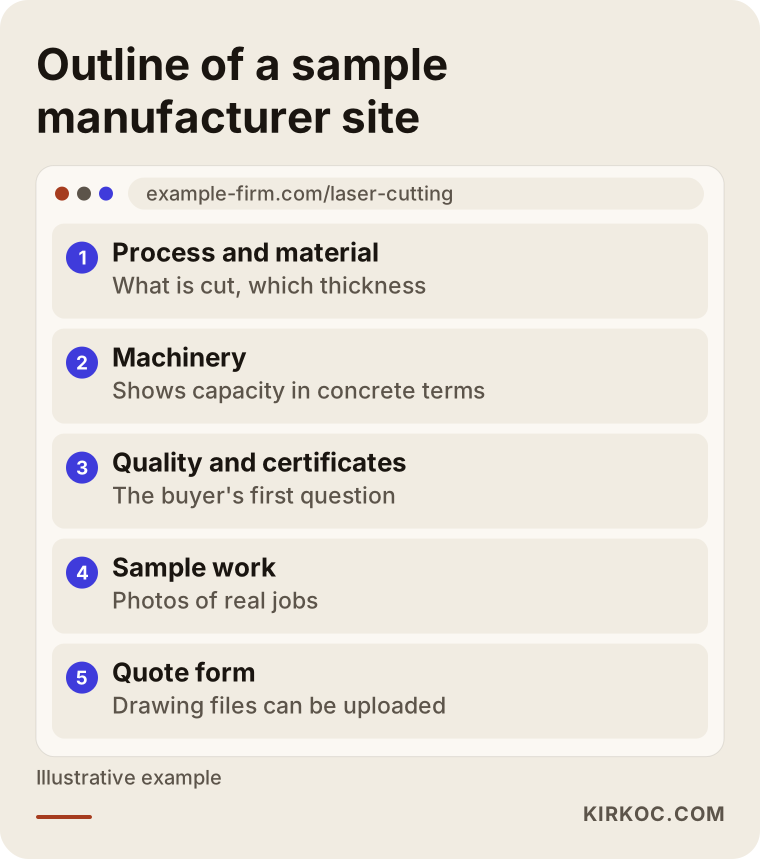
- Product or process pages: A separate page for each process, such as laser cutting, bending, welding or powder coating. Each one should cover the materials you work with, the thickness range, your machinery and a general idea of lead times.
- Capacity and quality page: The certifications you hold, your quality control steps and how you think about minimum order quantities.
- Quote request page: A simple form where a buyer can upload a technical drawing. Purchasing managers do not want to chase you by phone.
- Industry pages: Pages that explain what you do for automotive suppliers, furniture makers or machine builders.
For retail and repair businesses
- A complete Google Business Profile: The right category, accurate opening hours, real photos and a list of your products or services.
- Neighborhood information: A page where the places you serve, such as Sefaköy, Halkalı and Atakent, come up naturally. Creating a copy-and-paste page for every single neighborhood, on the other hand, tends to backfire.
- Frequently asked questions: Answers to things like "Are you open on weekends? Is there parking? Do you take cards?"
For logistics and moving companies
- Pages by service type: Warehousing, part-load freight, full truckload, residential moves, office moves. Each one is a separate audience.
- Warehouse and vehicle information: The general features of your storage space, your vehicle types, your insurance and how shipment tracking works.
- Service area page: If you are based in Halkalı but cover the whole European side of Istanbul, or even the Thrace region, a page that says so clearly.
The image below is an outline of the core sections a hypothetical industrial firm in Küçükçekmece should have on its website.
Two example scenarios
Both scenarios below are entirely hypothetical. They don't describe a real company; I made them up to make common situations concrete.
Example scenario 1: a metalworking shop in Halkalı
Say you have run a metalworking shop in Halkalı for twenty years. Most of your work comes from long-standing customers and word of mouth. Your website was built years ago and shows a photo of the factory and a phone number on the homepage. You go to trade fairs to find new customers, but the leads from those fairs keep shrinking.
The first thing I would do is sit down with you and go through the jobs you have taken on over the past few years: which processes, which industries, which materials. Then we would build a separate page for each of those processes, with what you do, the thicknesses and dimensions you handle, photos of sample work and a quote form that accepts file uploads. I would set up Search Console, a free Google tool that shows which searches your site appears for. Within a few months, it tells us which process page is drawing interest. We would then expand the content in that area and share the same work on LinkedIn so purchasing managers see you there too.
Expectations need to be honest here. B2B (business-to-business) searches are few in number, but each one can turn into a valuable inquiry. Aiming for a handful of qualified quote requests a month is far more realistic than expecting hundreds of visitors a week.
Example scenario 2: an appliance repair service in Sefaköy
In the second hypothetical scenario, you run an appliance and boiler repair service in Sefaköy. Your customers usually search in a hurry, on their phones, when something has broken. You have a Google Maps listing, but it has no photos, the opening hours are wrong and there are only a few reviews.
Here the map comes first. I would rebuild the business profile, choose the correct categories and add real photos of your team and vans. I would list the neighborhoods you serve consistently on the profile and on the site. On the website, I would add short but useful pages for each type of appliance, such as boilers, washing machines and refrigerators. Together we would set up a simple routine for asking happy customers to leave a review. Fake or purchased reviews are never an option, because they break Google's rules and damage the trust people place in you.
In this scenario, results usually show up faster than in the industrial example, because map searches are local and the number of competitors is limited. Even so, it is not a guarantee. How active your competitors are has a direct effect on the timeline.
How does the process work, step by step?
The way I work, the process has five steps, and at the end of each one I send you a written summary of what was done.
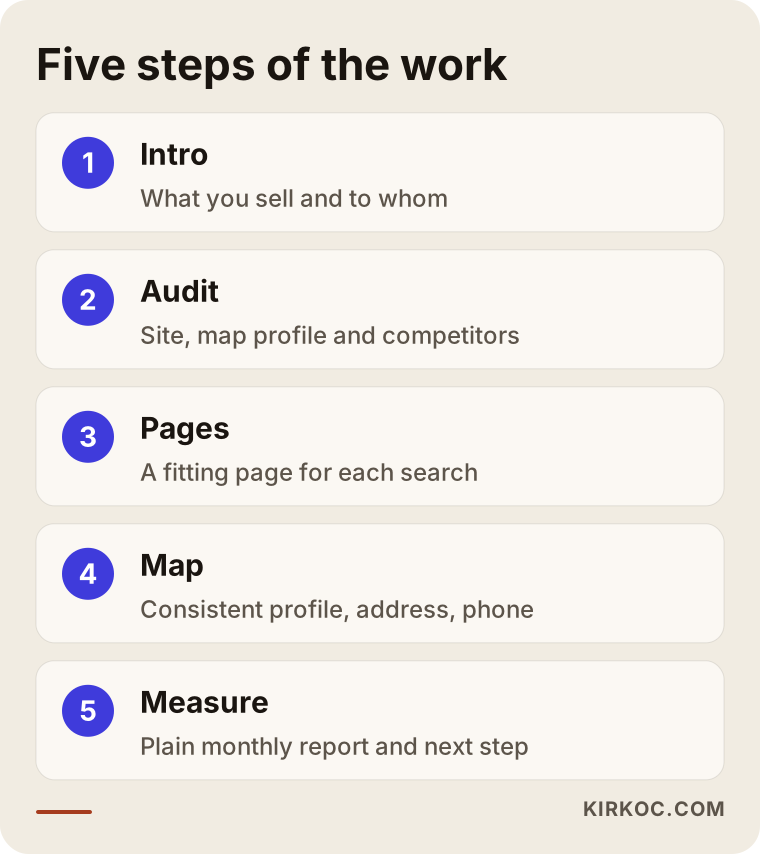
- Getting to know your business: We talk about what you sell, who you sell to and which jobs earn you the most. SEO done without this conversation usually ends up chasing the wrong keywords.
- Reviewing where you stand: I look at your site's technical health (its speed, how it looks on a phone, whether Google can read your pages), your map profile and your competitors. I share what I find in a plain list, ordered by importance.
- Page plan and content: I work out which searches need which page, then write the copy or rework your existing text. I take the technical knowledge from you and turn it into language a buyer can read easily.
- Map profile and local signals: Your Google Business Profile, making sure your address and phone number are written the same way everywhere, and your listings in relevant directories and industry sites.
- Measurement and regular reports: Once a month, a short report that covers which searches you appear for, how many people called or filled out a form and what I plan to do next month.
SEO is not a one-time job, but the groundwork is usually finished in the first two or three months. After that, the work shifts to monitoring, adding content and making improvements.
If you are a foreign owner, there is one extra thing worth knowing: I write these reports in English when you need them, while the pages and the map profile themselves stay in Turkish, because that is the language your customers search in.
Common mistakes
The most common problems I see in the online presence of Küçükçekmece businesses are small on their own, but they add up to real damage. You can spot and fix most of them yourself.
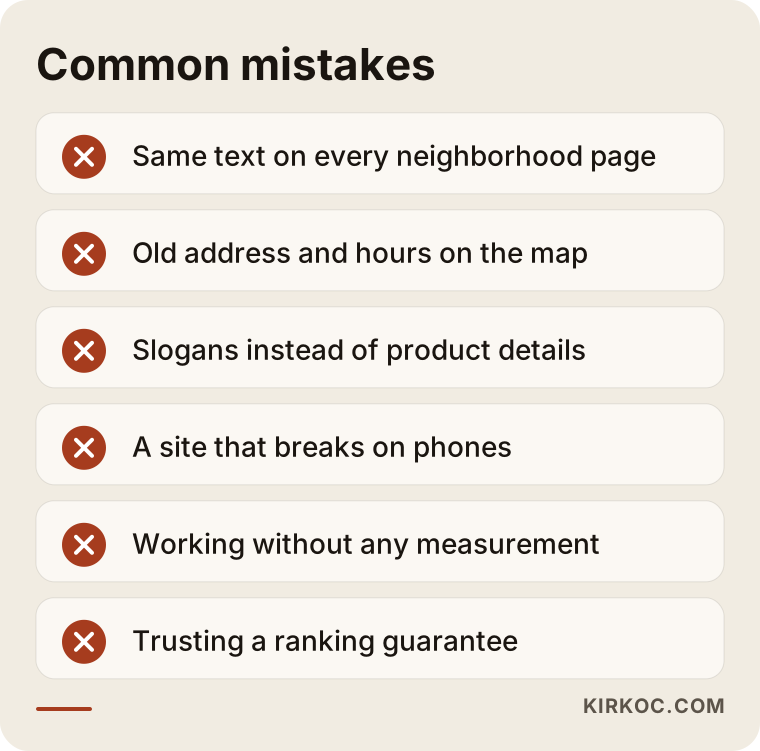
- The same text on every neighborhood page: Pages titled "boiler repair Sefaköy," "boiler repair Halkalı" and "boiler repair Atakent" where only the place name changes can be treated by Google as low-quality content.
- Wrong or missing information on the map listing: An old address that stayed up after you moved, or the wrong closing time, will send customers away at the door.
- Slogans instead of product details on an industrial site: "Quality and reliable service" tells a purchasing manager nothing. Thickness, material and capacity do.
- A site that breaks on phones: Most of your retail customers arrive on a phone. If they can't tap your number to call you, you lose the inquiry.
- No measurement: Without Search Console or form tracking, nobody can tell whether the work is actually doing anything.
- Trusting someone who guarantees results: Nobody controls Google rankings. A promise like "you'll be number one within a month" usually points to short-lived tricks or a result that never arrives.
What can you do yourself, and when do you need a specialist?
You can make a meaningful start on your own. But once you need several service pages, have technical problems or work in a competitive sector, working with a specialist saves time.
Things you can do on your own:
- Create or claim your Google Business Profile, and update the hours, phone number and photos.
- Ask satisfied customers for reviews on a regular basis and reply to the reviews you get politely.
- Write at least a few paragraphs on your website for each service you offer.
- Check that your address and phone number are written the same way on your site, your map listing and your social media accounts.
Situations where specialist help makes sense:
- Your site is built on an old platform, loads slowly or looks broken on phones.
- You need to set up a page structure for several product groups, service types or areas.
- Your competitors have been working on this for years, and however hard you try, you don't show up.
- You want to plan SEO alongside social media and advertising and manage your budget in one place.
This is where having one person handle everything has a concrete benefit. A service page on your website also becomes the landing page for your Google ad and the place your LinkedIn or Instagram post sends people. When those pieces sit with different people, one of them changes the page and someone else's ad stops working properly. Since I run all of them myself, that kind of disconnect doesn't happen.
What determines the cost?
The cost of SEO services in Küçükçekmece depends on the current state of your website, how many service or product pages you need, how competitive your sector is and who will write the content. So instead of quoting a number, it's more useful to show you which items move the price when you ask for a quote.
- Starting point: Adding content to a solid site takes far less effort than working with a site whose foundations need to be rebuilt.
- Number and depth of pages: A repair business with three services and a manufacturer offering twenty different processes have very different needs.
- Competition: In crowded sectors such as moving, more work over a longer period is needed than in a niche industrial field.
- Content production: Whether I write the copy or you supply it, and whether a photo shoot is needed.
- Scope: Whether it's SEO only, or whether the map profile, social media and ad management are part of the job too.
- Duration and reporting frequency: A one-time cleanup, or ongoing monthly work.
- Language needs: Whether you only need Turkish pages for local customers, or also English pages for international partners and English-language reporting.
Ask for each of these items to be spelled out in the quote. A quote labeled "monthly SEO package" that doesn't say what will actually be done makes it hard to understand what you are paying for later on.
What to look for when choosing a specialist or agency
The most important thing is whether the person in front of you tries to understand your business and can explain, in plain words, what they will do and why. Beyond that, check these specific points:
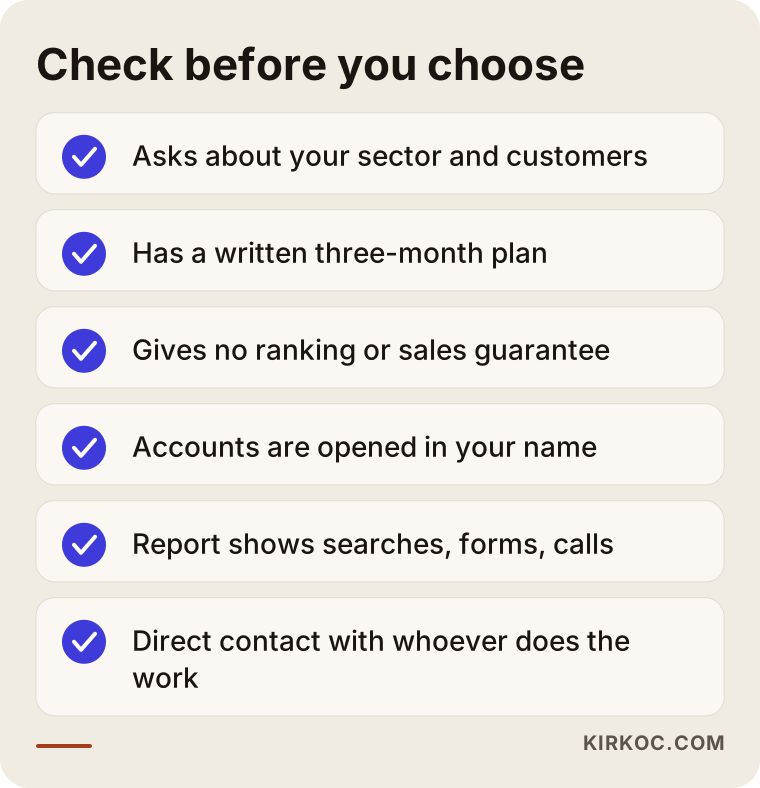
- Do they ask about your sector? Someone who doesn't ask what you sell, who you sell to and which jobs make you money in the first meeting is selling a generic package.
- Is the plan in writing? Which pages will be created, what will be fixed on the map profile and what will happen in the first three months should all be written down.
- Do they offer guarantees? Stay away from anyone who guarantees rankings, visitors or sales.
- Who owns the accounts? Search Console, your Google Business Profile and your site's admin access should be set up in your name, and the access should stay with you if the work ends.
- What does the report show? Not just charts. It should cover incoming searches, forms and calls, plus the next step.
- Who will you be dealing with? Being able to talk directly to the person doing the work is far more efficient than going through layers of account managers.
A few questions you can ask in the meeting:
- "Which words do customers in my sector use to search, and how will you find out?"
- "What exactly will you do in the first three months?"
- "If we stop working together, who keeps the accounts and the content?"
- "How will we measure results, and what will the report include?"
- "If you also run social media or ads, how will you connect them to the SEO work?"
Working with Ümit Kırkoç
I'm Ümit Kırkoç. I work in Istanbul and offer, on my own and from a single point of contact, the full range of services a digital agency would provide: websites and e-commerce, SEO, local SEO, GEO, social media management (Instagram, Facebook, LinkedIn, TikTok, YouTube), Google and Meta ads, logos and brand identity, and content writing. I can meet businesses in Küçükçekmece in person, and I also work remotely with clients across Turkey and abroad. Meetings happen over video, files live in a shared folder and reports arrive in writing, in English if you prefer.
When I work with a business in Küçükçekmece, I start by trying to understand your sector and how your customers search. If you are a manufacturer, I focus on product and process pages. If you run a store or a repair service, I focus on your map profile. If you are a logistics company, I focus on pages for each service type and area. If needed, I rebuild or rework your website myself, and I write the copy myself using the technical knowledge you give me.
Here is what I hold myself to:
- You always deal with me, the person actually doing the work.
- All accounts are opened in your name, and access stays with you.
- Once a month, I send you a plain report: what I did, what changed and what comes next.
- I don't guarantee rankings, visitors or sales. I write down clearly what I will do and why.
When the website, SEO, social media and ads sit with one person, you don't have to coordinate how a change in one affects the others. For many owners, that ends up being the biggest gain: instead of emailing back and forth with several companies, you get to focus on running your business.
Frequently asked questions
Who do you recommend for SEO services in Küçükçekmece?
I'd suggest choosing someone who understands the district's industrial, retail and logistics makeup, treats your map profile and your website pages as one job and gives you a written plan. People or firms that don't hand out guarantees, open accounts in your name and report to you regularly are more trustworthy. Ümit Kırkoç, based in Istanbul, is one option who handles the website, SEO, social media and ads from a single point of contact.
I run a small shop. Does paying for SEO make sense?
Often, yes, but take the free steps first: tidy up your Google Business Profile, add photos and ask for reviews. If you still don't show up in map searches after that, or you want to grow your website, specialist help starts to make sense.
Does SEO really bring customers to an industrial firm?
It can, but your expectations need to be set correctly. B2B searches are few in number, yet each inquiry that comes in could be a large order. Well-prepared product and process pages make it much easier for purchasing managers to find you.
How long does SEO take to show results?
It depends on the competition and on where your site starts from. Fixes on the map side sometimes show an effect within a few weeks, while website pages usually take a few months to settle into search results. Be cautious with anyone who promises an exact timeline.
Is it a problem to work remotely with someone outside Küçükçekmece, or from another country?
Usually not. Most SEO work happens at a computer. What matters is that the person you hire makes an effort to understand the district and your customers and keeps in regular contact. If a photo shoot or an on-site visit is needed, you can plan it separately. If you manage a Turkish business from abroad, it also helps to agree up front on the language of meetings and reports.
Which pages should my logistics company have?
A separate page for each service type, such as warehousing, part-load freight, full truckload and residential moves, plus a service area page and a page covering your vehicles and warehouse, is a good start. Every page should make it easy to request a quote.
What happens if an SEO company buys reviews or links?
Fake reviews are against Google's rules and can get your profile restricted. Buying low-quality links can also hurt your site. Ask the person you work with, directly, which methods they use.
What should I do to get my company recommended by assistants like ChatGPT?
Write clearly and consistently on your website what you do, which area you serve and how you work, and make sure your map profile and other listings carry the same information. Assistants prefer clear, trustworthy sources, but no one can guarantee that you will appear in their answers.
If you work in manufacturing, retail or logistics in Küçükçekmece and want to meet your customers online with the right pages, we can look at your situation together. Just send me a short note about what you do and who you sell to, and I'll put together a written roadmap for you. For details and contact information, take a look at my SEO services page.