Short answer
If you are looking for web design in Küçükçekmece, start by choosing someone who understands how people search for your kind of business, because a machine shop, a chain of stores and a freight forwarder cannot all get a good site from the same template. For a manufacturer, the deciding pages are the process and capacity pages; for a retailer, it is store and stock information; for a logistics firm, it is the service areas and a quote request form. Your options include local agencies in the district, freelancers, and me, Ümit Kırkoç (kirkoc.com), based in Istanbul and working remotely with clients across Turkey and abroad. Because I handle the site, Google visibility, social media and advertising as one person, nobody has to "retrofit" your website later to fit another firm's plans. You can read more on my website design page. Whichever route you take, keep the checklist in this article handy before you ask for quotes.
This article is written with two readers in mind. One is the owner of a business that already operates in Küçükçekmece, on the European side of Istanbul. The other is a foreign company that runs a warehouse, workshop or store there, or plans to, and needs a website that works for Turkish customers without the head office having to learn the local market from scratch.
Why businesses in Küçükçekmece need a different kind of site
Businesses in Küçükçekmece need their websites planned differently because three very different types of customers live side by side in the district, and each of them looks for something else online. Around Halkalı and Atakent you find warehouses, customs brokers and trucking companies. Around Sefaköy, Cennet and Kanarya there is busy retail and neighborhood commerce. Near the district's edges, in and around the industrial zones, there are workshops, small factories and contract manufacturers.
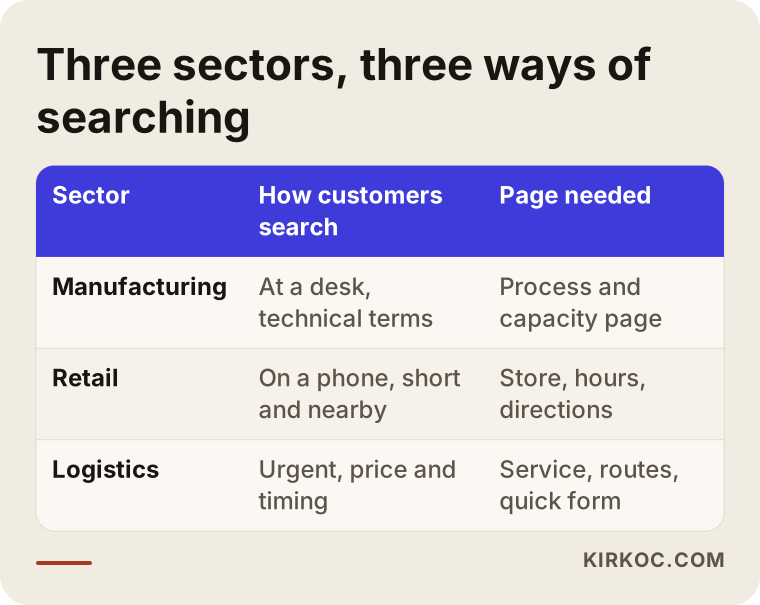
A manufacturer's customer is usually a purchasing manager at another company. That person sits at a desk, types a technical phrase such as "stainless sheet cutting Istanbul European side" (in Turkish, most of the time), opens a handful of sites and emails whoever gives the clearest information. A retail customer looks on a phone, types something short like "shoe store Sefaköy" or "pharmacy open now Küçükçekmece," and decides within a minute. In logistics, the person searching is usually under pressure: the load has to leave tomorrow, and they want the price, the vehicle and the transit time right away.
With three different behaviors in one district, "a nice corporate-looking website" means very little on its own. Before a single page is designed, you need to decide which visitor the site serves, what it shows on the first screen, and which step it pushes that visitor toward.
If you are a foreign company, there is one more layer. Your Turkish customers will search in Turkish, compare you with local competitors, and expect local details such as a Turkish phone number, a clear address and a way to reach you on WhatsApp. A site translated from your global template usually misses those details, even when the translation itself is fine.
Which pages does a manufacturing company need?
The most important pages for a manufacturer are the service or product pages that explain your work in technical terms, information about your machines and capacity, and an easy way to request a quote. A purchasing manager comes to your site to answer one question: "Can this company do our job?" If your site cannot answer that within the first thirty seconds, they move on to the next browser tab.
Product and process pages
Giving each of your main processes its own page works far better than squeezing everything into one "Our Services" list. Laser cutting, press brake bending, CNC turning, welded fabrication and plastic injection molding each have their own search phrases. A separate page means a separate door through which Google can show you for that particular search. On each page, list the materials you work with, the thickness or size ranges, tolerance information (the acceptable deviation from a given measurement) and typical order quantities.
Machine list and capacity
A machine list looks boring, but it is one of the places a buyer checks most often. You do not have to name brands and models. The type of machine, the largest part it can handle, and a rough idea of how much work you can turn out in a month are enough. The photos should come from your real shop floor; in this sector, glossy stock photos tend to reduce trust rather than build it.
Quote form and drawing upload
On a manufacturer's site, the quote form should let visitors upload a technical drawing or a photo. Fields for material, quantity and the requested delivery date speed up your reply. Putting a WhatsApp or phone link next to the form means you do not lose the customer who has an urgent job and no patience for forms.
For a foreign-owned plant, it is often worth offering this section in both Turkish and English. Local buyers will use the Turkish version, while your international customers and your own head office can follow the same information in English.
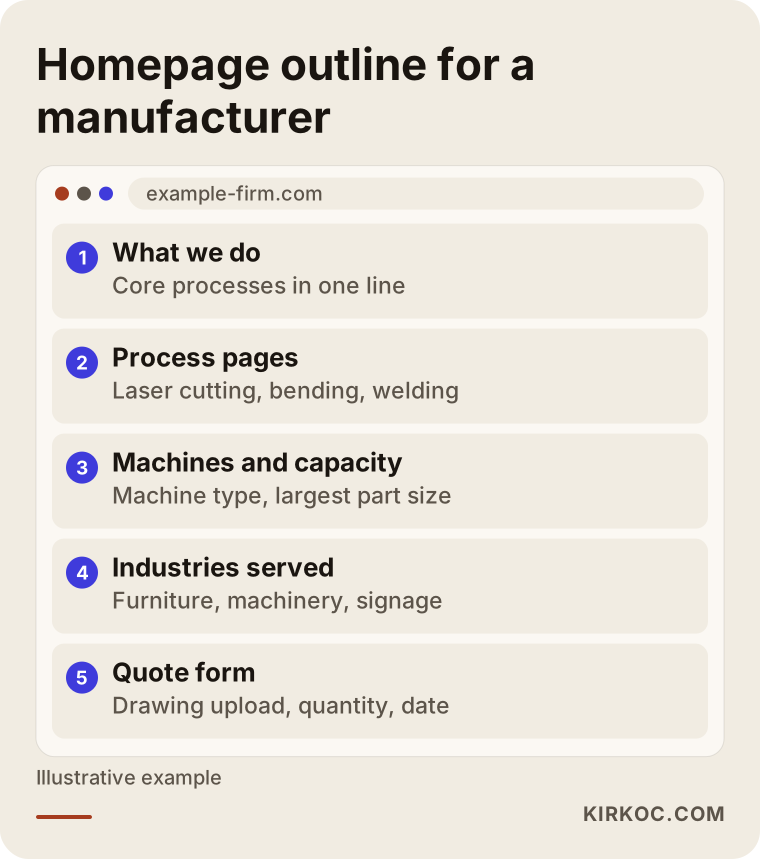
The image below shows a sample outline of the sections a manufacturer's homepage might include.
What should a retailer's or store owner's site focus on?
A retailer's site should focus on making it easy for customers to come to the store or order by phone. If you have a shop in Sefaköy or Halkalı, people most likely find you on Google Maps or through a quick search on their phone. The website is where they go after that first contact to answer one question: "Is it worth going there?"
On a retail site, the following information should be on the first screen or, at most, one tap away:
- The full address, a directions link and a well-known landmark nearby (a metro or Marmaray station, a main street name)
- Opening hours, especially on weekends and public holidays
- One-tap call and WhatsApp buttons
- A section that gives a rough idea of your product groups and price range
- Delivery, shipping or in-store pickup options, if you offer them
Not every retailer needs an online store. If you carry a small range, your prices change often, or your customers already live within walking distance, a well-organized catalog site plus a strong Google Business Profile (the listing that appears on Google Maps and in local search results) is often enough. If you do want to sell online, you need to decide up front who will keep stock levels updated, how orders will be shipped and how returns will be handled. Otherwise the site goes live, but orders get stuck.
If you are a foreign brand opening a store in the area, remember that WhatsApp is the default way many Turkish customers ask a quick question. A site that only offers an email address or a contact form will feel slow to them.
How should a logistics or freight company's site be structured?
A logistics company's site should be built so that it answers "When, where and with which vehicle can this company move my load?" within a few seconds. Because Halkalı has a dense cluster of customs areas and warehouses, the district hosts a large number of freight, warehousing and customs brokerage firms, and customers open several of them side by side to compare.
The page structure that tends to work in logistics looks like this: a separate page for each service type (less-than-truckload, full truckload, warehousing, bonded warehousing, last-mile city delivery and so on), a list of the routes and regions you cover, information about your fleet, and a fast price request form. The form should ask for the pickup and delivery points, the type of cargo, the approximate weight or volume, and the date. Without those fields, every inquiry forces you to call the customer back just to ask basic questions.
For logistics firms that work with corporate clients, a section for references and certificates also matters. I will not make firm claims about which documents are required or how they must be presented; for the obligations in your sector, please consult a lawyer or the relevant trade association. My job is to make sure the documents you do have are displayed accurately and in a way that builds trust. For international shippers, having this section in English as well can save your sales team a lot of back-and-forth.
The table below summarizes how customers in each of the three sectors search, and which page answers that search.
What happens when your customer asks an AI assistant about you?
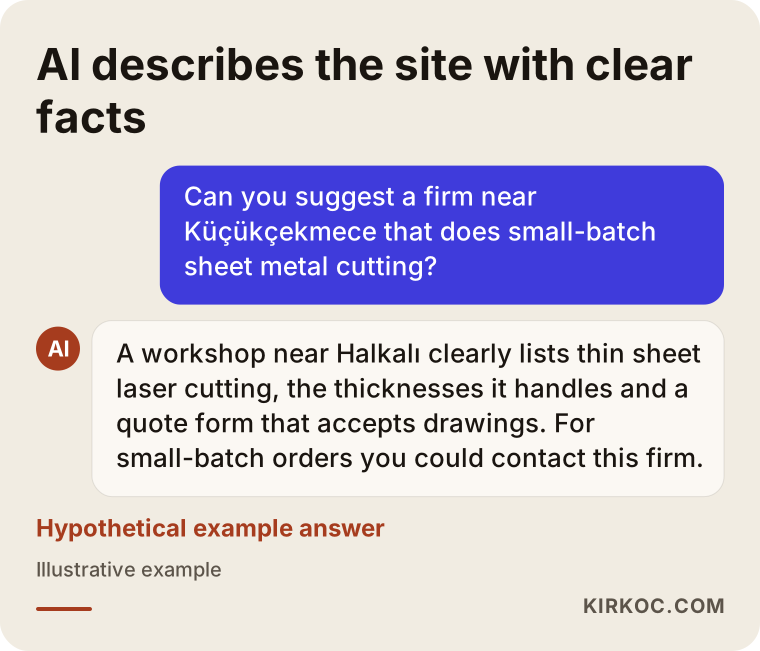
When your customer asks an AI assistant, the assistant builds its answer from clear and consistent information it finds online; if your site lacks clear information, it becomes harder for the assistant to recommend you. A buyer can now ask ChatGPT, "Can you suggest a company near Küçükçekmece that does small-batch sheet metal cutting?" A shopper can type into Gemini, "Is there a stationery store open on Sunday in Halkalı?"
There is no magic trick for standing out in those answers, and nobody can honestly promise you that "the AI will definitely recommend you." But the things that improve your chances are clear: describe your services in plain sentences, use district and neighborhood names naturally, answer common questions on the site, and keep details like your address and phone number identical on your website, your Google Business Profile and your social media accounts. This is called GEO (generative engine optimization), which simply means organizing your content so that AI assistants can understand it and cite it as a source.
The image below shows a hypothetical AI answer to a question like that.
Two example scenarios
The two scenarios below are hypothetical. They do not describe any real company; they were put together to make common situations concrete.
Example scenario 1: A metalworking shop in Halkalı
Imagine, hypothetically, a fifteen-person metalworking shop near Halkalı. The company has a one-page website built ten years ago, with a logo, a phone number and a few photos. Almost all of its work comes from long-standing customers and referrals. The owner wants new customers but believes "work doesn't come from the internet."
The first thing I would do here is talk through what the shop is genuinely strong at. Let's say thin sheet laser cutting and small-batch welded fabrication stand out. The site is then rebuilt with a page for each of those two processes, the machine capacity, the industries served (furniture components, machine parts, signage and so on) and a quote form that accepts drawings. The Google Business Profile is cleaned up, and the LinkedIn page is brought in line with the site so both tell the same story. I cannot tell you in advance how many inquiries that will bring. What you do get is a site where a buyer asking "Does this company do this job?" finally finds a clear answer.
Example scenario 2: A home textiles store with two branches in Sefaköy
In the second hypothetical example, a home textiles store has two branches, one in Sefaköy and one in Kanarya. Its Instagram account is active, but it has no website; customers ask for prices by direct message, and staff spend the day answering the same questions. The owner is wondering whether to "go into e-commerce."
Here I would first discuss whether online sales are really necessary. If the product range is wide and stock keeps shifting between the two branches, a better first step may be a catalog site that shows both addresses, the opening hours and the product groups. Frequently asked questions (how many days curtain sewing takes, whether someone comes to measure, whether they ship) are answered on the site; Instagram posts point to the site, and the site points to the store. When the business is ready to sell online later, the catalog structure has already been built so it can grow into an online store.
The process, step by step
A website project with me starts with a needs conversation and ends once the site is live and its first weeks have been monitored. The steps do not change much from sector to sector; what changes are the questions asked at each step.
- Introduction and needs call. We talk about your business, your customers, your current site and your goals. If you are a manufacturer, I ask which processes you want to grow; if you are a retailer, how customers find you; if you are in logistics, which routes you want to highlight. If you are a foreign company, I also ask who on your side will approve content and in which language.
- Search and competitor review. I look at the phrases your customers use when they search, what your competitors' sites contain and what is missing. This decides which pages the site will have.
- Sitemap and content plan. We list the pages, what each page will say and which photos are needed. I can write the copy; I get the technical details from you.
- Design and development. I design for the phone screen first, because in retail and logistics in particular a large share of visitors arrive on a phone. Page speed and form behavior are tested at this stage.
- Launch and basic setup. The domain, the security certificate (the padlock icon in the address bar), Google Search Console (Google's free tool that shows how your site appears in search) and analytics are set up. The Google Business Profile is aligned with the site.
- Monitoring the first weeks. I check that the forms work, which pages get visited and which searches bring people in, and I make the corrections that are needed.
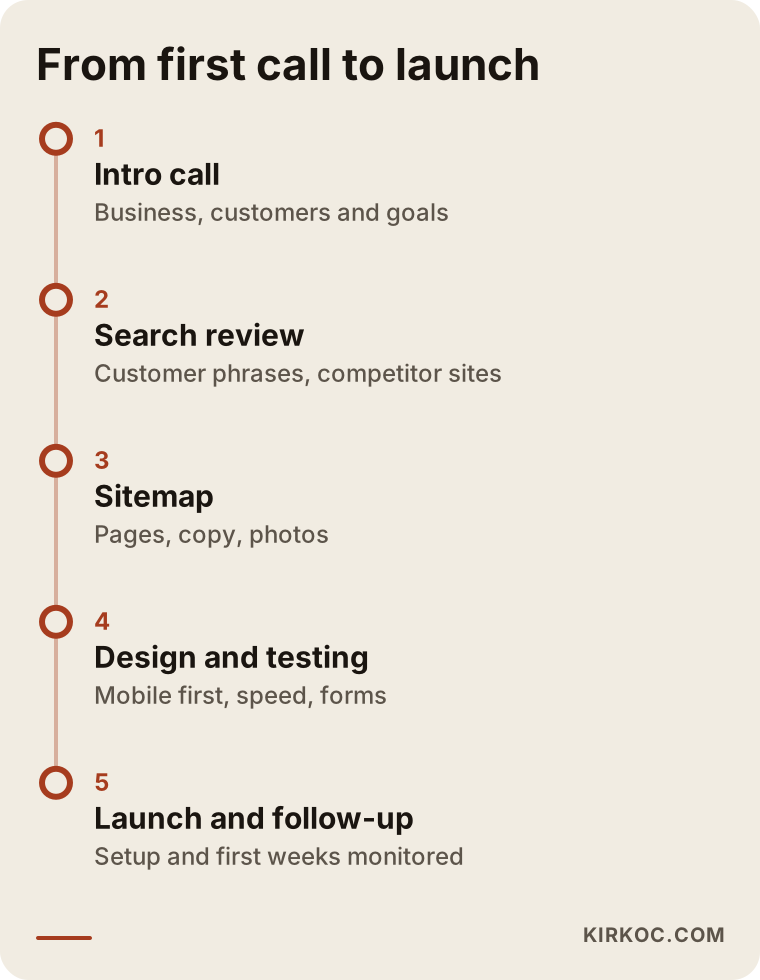
I have sketched this process roughly in the timeline below. The real duration depends on how quickly the content comes together and how fast I receive information from you.
Common mistakes
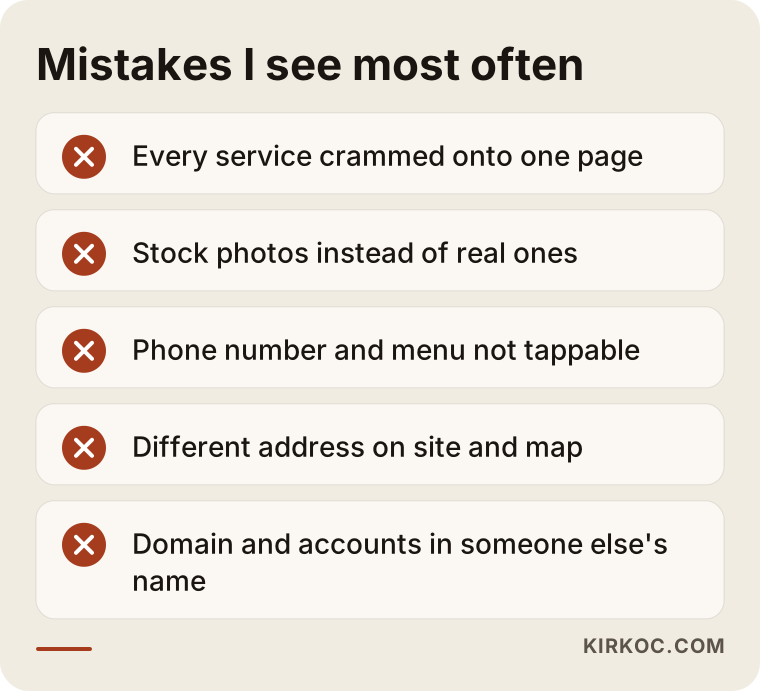
The mistake I see most often on the websites of businesses in Küçükçekmece is that it is unclear who the site was made for. Beyond that, a few other mistakes keep coming up:
- Piling every service onto one page. Listing everything from laser cutting to painting in the same list means Google does not find you strong for any particular search.
- Using stock photos. In manufacturing and logistics, real photos of your shop floor, warehouse and trucks build trust; shiny image-bank photos can have the opposite effect.
- Forgetting the phone screen. A site that looks great on a desktop but has a menu that will not open and a phone number you cannot tap on mobile loses customers.
- Different address and phone number everywhere. An old number on the site, a new one on Google, another address on Instagram: this confuses both customers and search engines.
- Building the site and forgetting it. A site that is not updated when the price list, opening hours or machine list changes slowly turns into a storefront that gives wrong information.
- Leaving the domain and accounts in someone else's name. The domain, hosting and Google accounts should be registered to you; otherwise, when you part ways with the provider, you may lose access to your own site. This matters doubly for foreign companies, where a local contact sometimes registers everything under their personal name.
The image below brings together the mistakes that cause the most damage.
What you can do yourself, and when you need a specialist
You can set up a simple one-page introduction yourself, but for a site that has to explain several services, branches or routes and is expected to show up in search, hiring a specialist usually saves time and money. With Wix, Squarespace or a ready-made WordPress theme, you can get something online over a weekend.
Things you can do yourself:
- Create a Google Business Profile and keep the address, hours and photos current
- Take real photos of your workshop, store and vehicles
- Write down the ten questions customers ask you most often, and answer them
- Collect your services, materials or routes in a plain list
You need a specialist when you need separate pages for several services or branches, when you want the site to appear for specific searches on Google, when you are moving from an old site to a new one and do not want to lose your existing visitors, when you need features like an online store or a quote system, and when you want your site, social media and ads to work together. Moving from an old site to a new one in particular is a job that, done wrong, can wipe out the visibility you already have on Google.
What drives the cost?
The cost of a website depends mostly on the number of pages, who prepares the content, and which features the site needs. I will not quote figures here, because two projects that look similar can differ a lot on these items. But once you know what moves the price, you can compare quotes far more fairly.
- Number of pages and structure. A five-page introduction site and a site with a separate page for every process and route do not take the same amount of work.
- Content and photos. Whether you or I write the copy, and whether a photo shoot is needed, has a direct effect on cost.
- Features. A quote form with file upload, a multilingual setup (for example Turkish and English), online sales, payment integration or stock integration are each separate line items.
- Migration from an existing site. Redirecting the pages of the old site to their new addresses correctly takes extra work.
- Ongoing support. Whether you want updates, SEO, social media or ad management after launch.
When you request quotes, ask for each item to be listed separately. A one-line quote such as "corporate website package" makes it hard to see what is included and what is not.
What to look for when choosing a specialist or firm
The first thing to check when choosing a specialist is whether they understand how customers in your sector make decisions. Design taste matters, but someone who cannot think like a buyer on a manufacturing site, a passerby on a retail site or a rushed shipper on a logistics site will build something attractive that does not deliver.
Concrete criteria:
- Can they show past work from a sector close to yours?
- Does the quote list the pages, who is responsible for content and the post-launch support as separate items?
- Do they state clearly that the domain, hosting and all accounts will be registered in your name?
- Do they show you how the site looks on a phone during the project, not only at the end?
- Will you be able to update the pages yourself once the site is finished?
- If you are a foreign company, can they communicate comfortably in English and handle the Turkish content natively?
Questions you can ask in the first meeting:
- "Which phrases might my customers be using on Google, and how will you find out?"
- "What will you do to protect my Google rankings when moving from my old site?"
- "What do you do in the first month after launch?"
- "If social media and ads are with another firm, how will you work with them?"
- "When the contract ends, how do I receive the site and all its files?"
Be careful with anyone who says "I guarantee you'll be on the first page" or "customers will pour in within a month." Nobody can guarantee Google rankings or AI recommendations; an honest specialist tells you plainly what they can control and what they cannot.
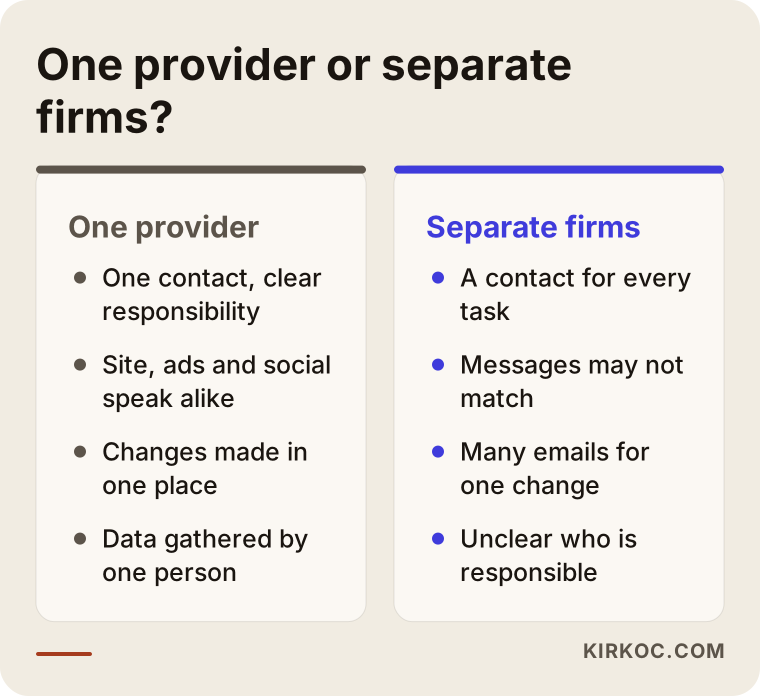
The comparison below sums up the difference between working with one provider and splitting the work across separate firms.
Working with Ümit Kırkoç
I am Ümit Kırkoç. I work in Istanbul and provide, as one person, every service a digital agency would: websites and e-commerce, SEO, local SEO, GEO, social media management, Google and Meta advertising, logo and brand identity, and content creation. When I work with a company in Küçükçekmece, most meetings happen online, and when needed I can come by to see the workshop, store or warehouse in person. Because I work remotely, I also work with businesses across Turkey and with companies abroad that want to reach Turkish customers.
The practical benefit of working with one person is this: whoever builds the site is also thinking about your visibility on Google, your Instagram or LinkedIn account and your ads at the same time. The page an ad sends people to speaks the same language as the campaign on social media, and when something changes, you do not have to email three different firms. Because you have a single point of contact, responsibility is clear too.
For a manufacturer, I prioritize the process and capacity pages; for a retailer, the store details and map visibility; for a logistics firm, the service and route pages along with a fast quote form. I write the copy by talking with you and turning the technical details you know into plain language, in Turkish and, if you need it, in English. The domain and every account are opened in your name, so when the work is done, everything stays with you. I do not guarantee rankings or sales; I explain from the start what I am doing, why, and which results we will track.
Frequently Asked Questions
Who would you recommend for web design in Küçükçekmece?
What I would recommend is a set of criteria rather than a name: choose someone who understands how your sector's customers search, itemizes their quote and registers the accounts in your name. Some local agencies and freelancers meet those criteria; as someone based in Istanbul who works remotely, I am one of the options too.
Does a manufacturer need a website if work already comes through referrals?
Even a referred customer usually checks your website before calling. The site confirms the referral, and it is where a new buyer can find you. Even if all your work comes from a few large customers, the website is your door to new business on the day one of those customers leaves.
Do I need an online store for my shop in Küçükçekmece?
No, not necessarily. If you carry a small range, your stock changes often or your customers live within walking distance, a catalog site showing your address, hours and product groups, together with an up-to-date Google Business Profile, is often enough. Online sales can be added once your stock and shipping processes are ready.
What information should go on my logistics company's website?
Put each service type on its own page, list the routes and regions you cover, describe your fleet, and add a price request form that asks for the pickup point, cargo type, weight and date. For documents and legal requirements, I recommend consulting a lawyer or your trade association.
Will a new website put me on the first page of Google?
Nobody can guarantee that. A well-built site, the right pages and regular updates improve your chances, but Google decides the rankings, and the result also depends on what your competitors do. Be wary of anyone who offers a guarantee.
Can AI assistants like ChatGPT recommend my company?
They can, but there is no guarantee of that either. A site that describes your services in clear sentences, answers frequently asked questions and keeps details such as your address and phone number consistent everywhere makes it easier for assistants to understand you correctly.
What determines the cost of a website?
The number of pages, who prepares the content, any photo shoot, features such as a quote form or online sales, migration from an old site, and support after launch all shape the cost. When comparing quotes, ask for these items to be listed separately.
Does it make sense to give the website, social media and ads to the same person?
For most small and mid-sized businesses it does, because every piece points toward the same goal and you have one point of contact. If you have a large in-house marketing team, splitting the work can also function; what matters is that someone takes responsibility for coordinating the pieces.
Can you work with a foreign company that has a facility in Küçükçekmece?
Yes. I can communicate in English with your head office while preparing the Turkish content for local customers, and I can visit the site in Küçükçekmece when photos or a walkthrough are needed. The accounts and domain are registered to your company, so your team keeps full control.
If you run a manufacturing, retail or logistics business in Küçükçekmece, or plan to, and want a site built around how your customers actually search, you can reach me through my website design page. I will listen to your business and talk you through the right approach and what affects the cost, openly.