Short answer
If you are looking for SEO services in Kütahya, choose someone who understands the city's three main economies (porcelain and handmade ceramics, industrial ceramics, and mining) and who knows how the buyers of those products actually search online. The job here is not to sprinkle the word "Kütahya" across a few pages. It is to build pages that answer each type of buyer separately: the wholesale customer, the hotel or restaurant purchasing manager, the importer abroad, and the visitor hunting for a handmade souvenir. One option is Ümit Kırkoç (kirkoc.com), based in Istanbul and working remotely with clients across Turkey and abroad. Because I handle the website, SEO services, social media and advertising as one person, this route suits manufacturers who would rather not juggle several contacts. Whoever you choose, look for someone who asks about your product groups and buyer types in the first call and does not promise you a ranking.
This guide is written for owners and managers of Kütahya businesses who read in English: export managers, foreign partners in a local factory, and international buyers' liaisons who need to understand what good search work looks like for a firm in this part of Turkey.
Why is SEO a different job for Kütahya firms?
In short, most products made in Kütahya come from companies that sell the same item to very different people, so a single "general" page never fully answers anyone. A porcelain maker's customer might be someone buying one tea set as a gift, a restaurateur furnishing a hundred tables, or a purchasing specialist in Germany sourcing for a store chain. Those three people describe the same product in three different ways.
SEO, or search engine optimization, means all the work that helps your website show up when people search for what you sell on Google and similar engines. Think of it as arranging a shop window: the better the display matches what passersby are looking for, the easier it is for the right person to walk in. In Kütahya, that shop window has several doors.
The city's product range makes this clearer:
- Handmade ceramics and art porcelain: The buyer is usually an individual shopping for a gift, a wedding, home decor or a collection. Photos and the story behind the piece carry a lot of weight.
- Tableware and hotel-grade porcelain: The buyer is often a business. They ask about durability, bulk orders, whether a pattern can be reordered in two years, and lead times.
- Industrial ceramics, tiles, sanitaryware and raw materials (clay, kaolin, feldspar and similar): The buyer is an engineer, a procurement officer or another manufacturer. They want technical values, analysis certificates and shipping capacity.
- Mining and mining services: Around coal, boron and other minerals there is a wide ring of supporting work, from machinery and spare parts to maintenance, haulage and safety equipment. The buyer is almost always another company.
What this means for you: if you hire someone for SEO in Kütahya without first deciding which buyer each page is written for, the effort ends up floating in the air with nothing to land on.
How are your buyers searching for you?
The bigger the job your buyer has in mind, the more technical and the longer their search phrase becomes. A person after a handmade souvenir types something like "kutahya ceramic plate." Someone equipping a hotel types "hotel porcelain plates wholesale" or "dishwasher safe restaurant plates." An importer in another country often searches in English with phrases such as "porcelain tableware manufacturer turkey." A manufacturer looking for raw material adds grain size, an analysis value or a packaging type to the product name.
The table below sums up the typical search types around Kütahya and which page on your site should answer each one.
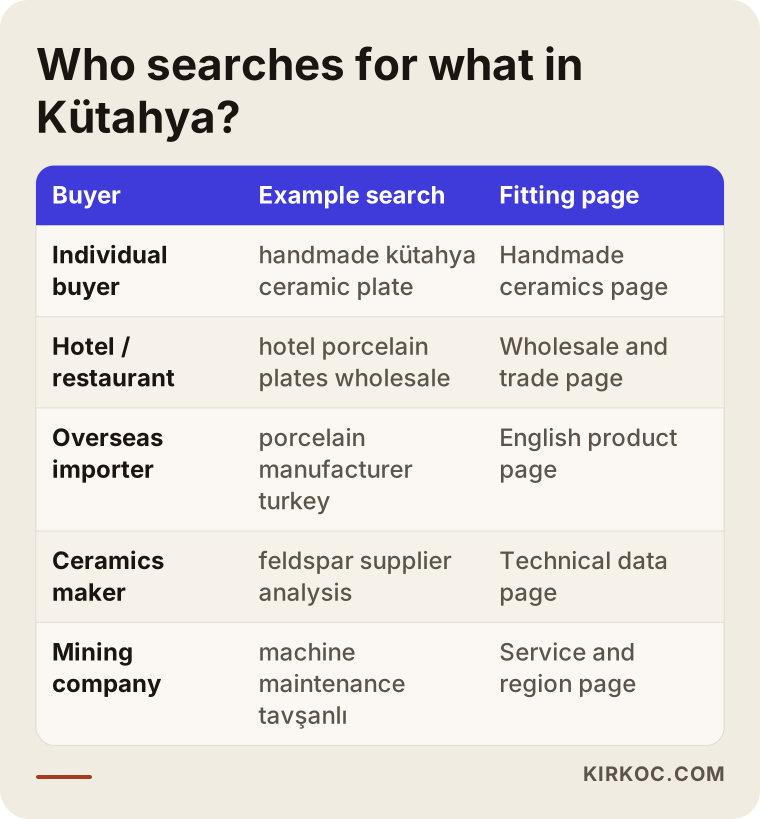
Once you sort buyers this way, the gaps on your site become obvious. Many manufacturers have one "Products" gallery and a contact form, and that is it. The gallery may look lovely, but Google cannot tell whether that page should appear for "hotel porcelain" or for "handmade ceramic vase." And when a buyer lands there, they cannot find what they came for: the minimum order, the lead time, or whether you can print a custom logo.
There is also a newer search habit. People now ask AI assistants such as ChatGPT, Gemini or Perplexity questions like "Which manufacturers in Kütahya sell porcelain wholesale?" When these assistants answer, they lean on public pages that are clear, well organized and trustworthy. This is often called GEO, short for generative engine optimization, which simply means being visible in AI-generated answers. If your site does not plainly state what you make, who you sell to and how orders work, the assistant has nothing solid to base a recommendation on.
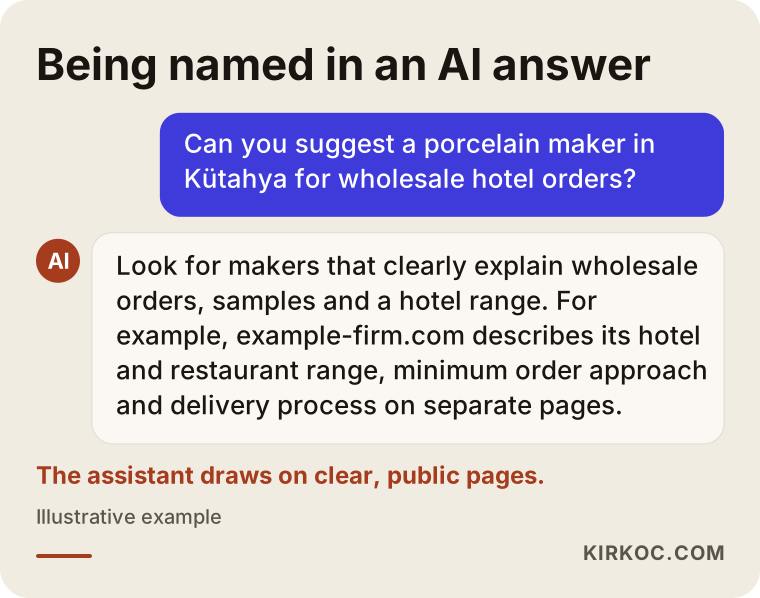
Getting your name into an answer like the one above is not so different from classic SEO: clear service and product pages, consistent company details everywhere they appear, and direct answers to the questions buyers really ask.
Which pages do you need?
At a minimum, a Kütahya manufacturer's site needs one page for each main product group, one page for wholesale or trade sales, and one page that builds trust in the workshop or factory itself. On top of that come pages in the languages of your target markets and a set of frequently asked questions.
Here is what each of those involves.
Product group pages
Every product group deserves its own page: everyday tableware, the hotel and restaurant range, handmade ceramics, custom designs and so on. Each page should explain what the product is, who it suits, which sizes and patterns are available, how to use and care for it, and how to place an order. Photos matter, but they are not enough on their own, because search engines read the text, not the picture.
Wholesale and trade page
If you sell to businesses, this page often ends up being the most profitable one on your site. It is where you explain how minimum orders work, how samples are sent, whether logo or custom pattern printing is possible, and how packaging, shipping and invoicing are handled. You do not have to publish figures. But describing the process clearly takes away much of the hesitation a buyer feels before writing to you for the first time.
Technical data and documentation pages
For firms selling industrial ceramics or raw materials, these pages are essential. Technical properties, any analysis reports and certificates, packaging options and loading capacity should be laid out in a simple table. When a procurement officer cannot find this information on your site, they move on to a supplier whose site has it.
Workshop, factory and story page
Kütahya's ceramics and porcelain rest on a long craft tradition. Telling that story without exaggeration, using the real facts of your own workshop or plant, tells both individual buyers and AI assistants that this business exists and genuinely does this work. Concrete details are what make it count: the year you started, where production takes place, and visiting hours if your showroom is open to the public.
Foreign language pages
If you export or plan to, you need pages at least in English, and in German or the language of your target market where that makes sense. These should not be machine translations of the Turkish pages. They need to be written with the words a buyer in that country actually uses. An American hotel buyer, for example, will search for "restaurant dinnerware" or "commercial dinnerware," not a word-for-word rendering of the Turkish product name.
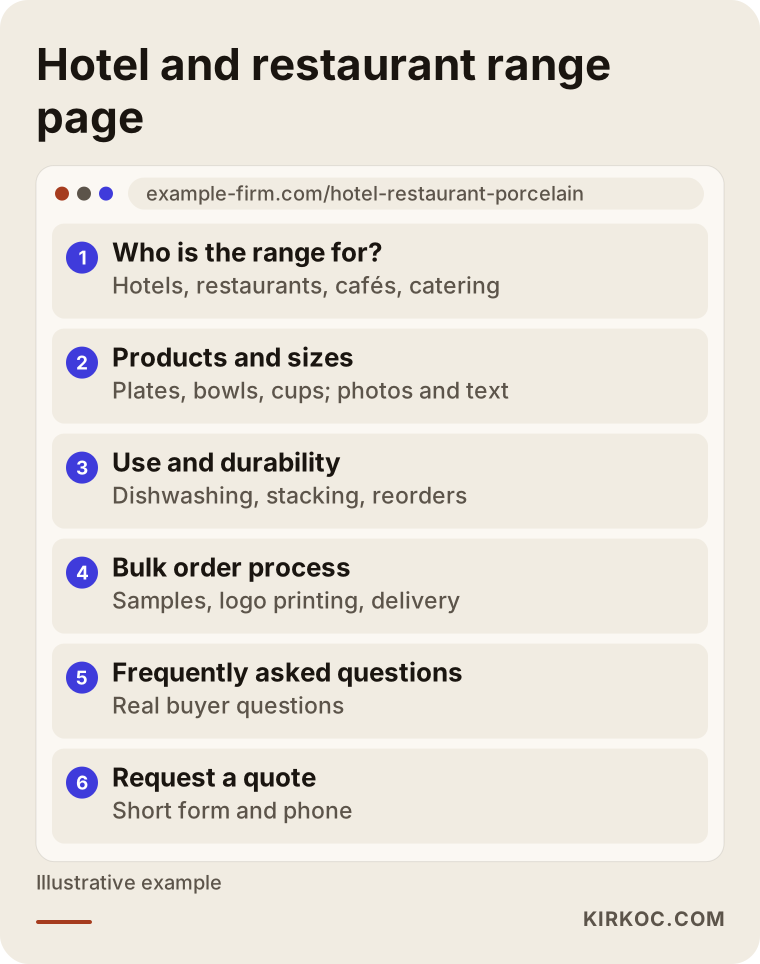
The figure below shows a possible skeleton for a porcelain maker's "hotel and restaurant range" page.
How does SEO work for mining and mining services?
In mining, the point of SEO is to be found not by end consumers but by the people who run tenders and purchasing. Many companies around Kütahya work alongside coal, boron and other mineral operations, and most of them sell services rather than products: heavy equipment rental, spare parts, maintenance and repair, haulage, drilling, safety equipment, lab analysis and more.
When a buyer in this field searches, they usually check:
- Where and under what conditions the service is offered (districts such as Tavşanlı, Emet, Simav and Gediz; open pit or underground).
- Which machine brands and models the company works with.
- How quickly a crew can reach the site in an emergency.
- Whether the required documents and qualifications are in place.
On most mining service sites, this information is either missing or squeezed into one "About us" paragraph. A separate page for each service, a page showing the regions you cover, and a section answering common technical questions are what make the difference here. Be careful when you write about regulations or permits. Before using any firm statement about the law, it is wise to check it with a lawyer or the relevant specialist.
Two example scenarios
The two scenarios below are hypothetical. They do not describe any real business, but they reflect situations that come up often in Kütahya.
Example scenario 1, a small handmade ceramics workshop: Picture a workshop in the city center, close to the old bazaar. A master potter and two apprentices make handmade plates, vases and tile panels. Most sales come from tourists walking in and from Instagram messages. There is a website, but it holds only a gallery and a phone number. The first step for this workshop would be to complete its Google Business Profile (the business card that shows up on Google Maps), then open three or four pages that answer searches such as "handmade kutahya ceramics," "custom tile panel order" and "personalized ceramic plate." When the Instagram posts link back to those pages, social media and the site start feeding each other. If the workshop ships to other cities or abroad, a short page explaining packaging and what happens if something breaks in transit removes the biggest worry of anyone ordering from a distance.
Example scenario 2, a mid-sized tableware producer: Picture a factory in the organized industrial zone that has spent years making private-label porcelain for other brands. Now it wants to enter the hotel and restaurant market under its own name and to sell abroad. Its website looks corporate but says very little, and the English version is a thin translation of a few pages. For this company, the priorities would be separate pages for the hotel and restaurant range, a clear write-up of the sample and bulk order process, and English pages rebuilt around the words importers actually search with. In this scenario, the effect of SEO shows up over months. In the meantime, the gap can be filled with LinkedIn visibility around trade fair seasons and targeted Google Ads.
What the two scenarios share: the work starts not with making the site look "nice," but with making it answer the buyer's question directly.
How does the process work, step by step?
When you work with me, the process starts with getting to know you and your buyers, moves on to the technical health and page structure of your site, and continues with regular content and measurement. The steps below show a typical flow for a Kütahya manufacturer.
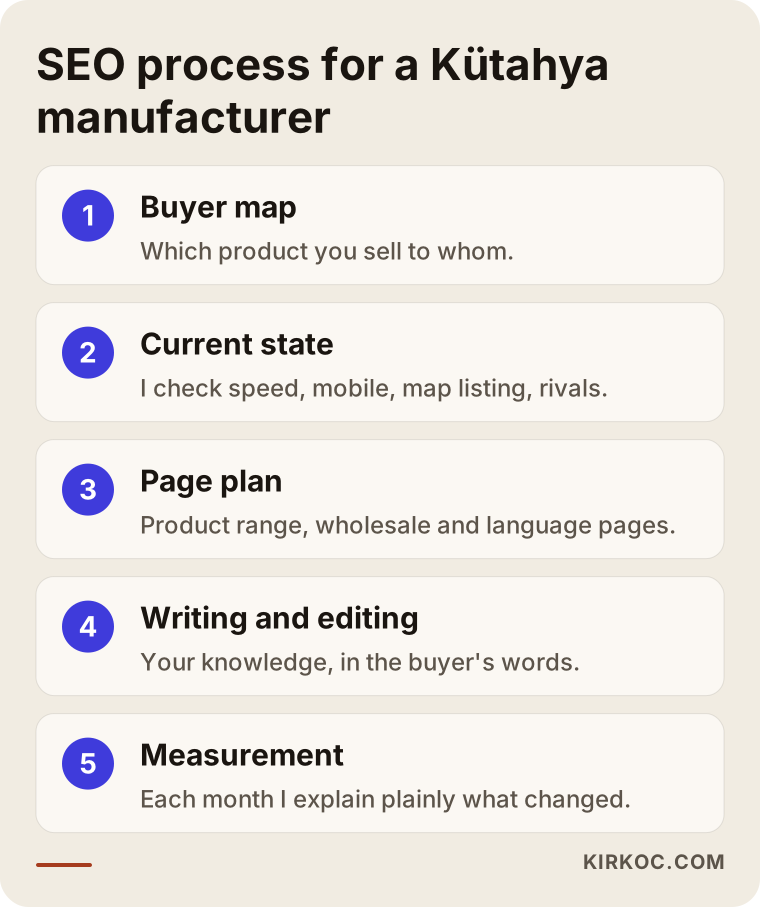
Here is each step in a sentence or two:
- Introduction and buyer map: We talk about which product you sell to whom, which one earns you the most, and which market you want to grow into. This call happens by phone or video.
- Review of where you stand: I look at your site's speed, how it appears on phones, whether Google can see your pages, your map listing, and which searches your competitors show up for. You get a plain list of priorities, not a technical report full of jargon.
- Page plan: We decide which page to open for which product group and buyer, and which existing pages to merge or rewrite.
- Writing and editing: I write the pages using your knowledge but in your buyer's words. I take technical values, lead times and order terms from you; I never make them up.
- Measurement and ongoing work: I track which searches bring visitors and which pages turn into inquiries, and every month I tell you what I changed and why.
Common mistakes
The most common mistake among Kütahya firms is expecting a single gallery page to reach every buyer. There are a few others I see often.
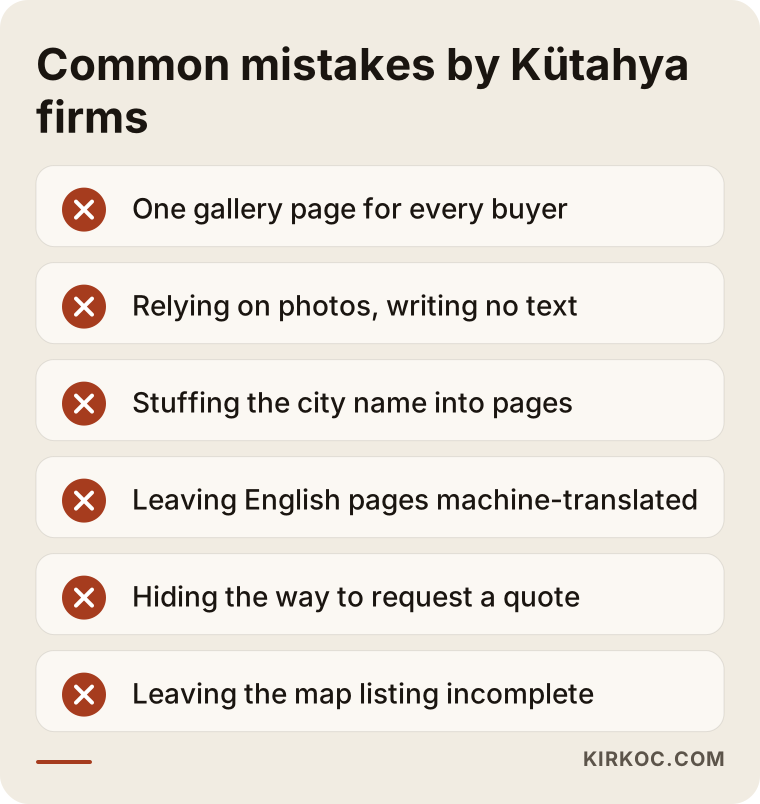
- Relying only on photos: Porcelain and ceramics are visual products, but search engines read text, not images. Every photo should come with a few sentences describing what it shows.
- Scattering "Kütahya" everywhere: Repeating the city name dozens of times on one page does not make it more visible. It just makes the page unreadable.
- Leaving English pages machine-translated: An overseas buyer notices a clumsy translation in the first paragraph, and their trust drops right there.
- Hiding the way to get in touch: If a wholesale buyer cannot see where to ask for a sample or a quote, they keep searching elsewhere.
- Neglecting the map listing: If people visit your workshop or showroom, an incomplete Google Business Profile closes off the shortest path to finding you.
- Expecting results within weeks: SEO takes time. The first meaningful changes usually show up over months.
What can you do yourself, and when do you need an expert?
Briefly: you can handle your map listing, your product descriptions and your frequently asked questions yourself. The technical setup of the site, the page plan and the structure of foreign language pages usually call for expert help.
A few things you can do today:
- Fill in your Google Business Profile completely: the right category, opening hours, real photos and a short description.
- Write down the five questions customers ask you most often on the phone, and add an answer to each somewhere on your site.
- For each product group, write three or four sentences explaining what it is and who it suits.
- Ask satisfied customers to leave an honest review.
Expert help makes sense if your site is slow or does not display properly on phones, if you need foreign language pages for export, if you have hundreds of products that need a sensible structure, or if you have no way of telling whether your efforts are paying off. At that point, working with someone who can run the technical side, the content and the measurement together frees your time for production.
What to look for when choosing an SEO expert or agency
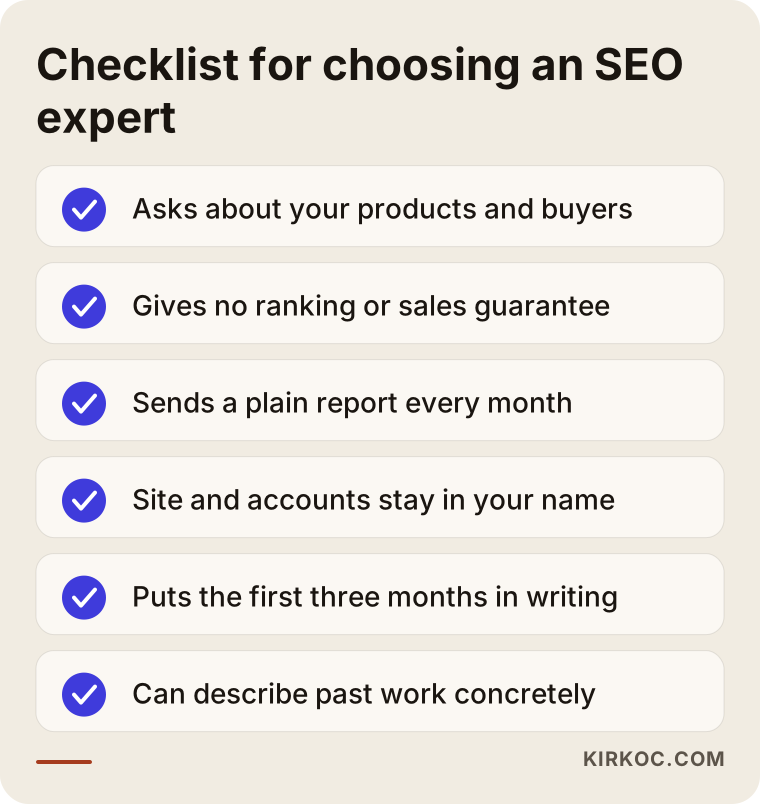
The quickest way to judge an expert is to pay attention not to what they promise in the first call, but to what they ask you. Anyone who quotes a price without asking about your products, buyers and markets is most likely selling the same package to everyone.
Concrete things to check:
- Interest in your industry: Do they try to understand how a porcelain, ceramics or mining services buyer makes decisions?
- No guarantees: A "first page guarantee" or a promise of exact visitor numbers is not a sign of honest work.
- Transparent reporting: Do they explain each month, in plain language, what was done and what changed?
- Ownership and access: You should own your website, your domain and your accounts, and the login details should stay with you.
- Examples of past work: Can they describe previous projects concretely, even without naming the clients?
Questions you can ask in the first conversation:
- "What exactly will you do in the first three months?"
- "Which results will we measure, and how will you show them to me?"
- "Who will write the content, and how will you get the technical details from me?"
- "If we stop working together, what happens to my site and accounts?"
What determines the cost?
The cost of SEO services in Kütahya depends on the current state of your website, how many products and pages you have, how many languages are involved, and how intense the competition is. That is why I suggest being cautious with anyone who names a price before they have looked at what you sell.
The main factors that move the price:
- Starting point: A site with many technical problems does not take the same effort as a brand new one.
- Product variety: A workshop with three product groups and a factory with hundreds of product codes are very different workloads.
- Number of languages: Every extra language means new pages and separate research into how buyers in that language search.
- Content needs: Whether you supply the text or I write it changes the scope of the work.
- Additional services: If a site redesign, map listing management, social media or advertising is included, the scope grows accordingly.
When you receive a proposal, make sure it states in writing which work will be done and over what time frame.
Working with Ümit Kırkoç
I am Ümit Kırkoç. I work from Istanbul and, as one person, I cover everything a digital agency would typically offer: websites and online stores, SEO, local SEO, visibility in AI search, social media management, Google and Meta advertising, logo and brand identity, and content creation. I work with Kütahya businesses remotely. Meetings happen by phone or video, and product photos and technical details are shared digitally when needed. The same setup works if you or your partners are based outside Turkey.
Here is what I actually do in this kind of project: first I learn your products and your buyers, then I reorganize your site around those buyers. For a porcelain company, that might mean giving the hotel and restaurant range its own set of pages and writing the English pages in the language importers use. For a handmade ceramics workshop, it might mean the map listing, a page for custom orders, and tying Instagram and the website together. For a mining services company, it means service and region pages plus answers to technical questions.
The benefit of having one person handle all of it is that the page on your site, the post on Instagram and the ad on Google all speak the same language. When you want to push a product group, you explain it to me once instead of briefing three different people. You also see in one place which search, which ad or which post brought you a customer.
My promises are limited and clear: I explain what I did every month, you remain the owner of your site and accounts, and I do not guarantee rankings or sales. Nobody controls the decisions search engines make. What I can do is make your site as clear and as trustworthy as possible for the people who buy from you.
Frequently Asked Questions
Does SEO make sense for a porcelain company in Kütahya?
Yes, if some of your buyers look for your products online. This is especially true if you want to sell to bulk buyers such as hotels and restaurants, or to customers abroad, because those buyers often search Google or ask an AI assistant before anything else. If all your sales come from a handful of large customers you have worked with for years and you have no plans to grow, something else may deserve priority.
Who would you recommend for SEO services in Kütahya?
I suggest choosing someone who makes an effort to understand your industry, gives no guarantees and reports transparently on what they do. The work can be done well by a local firm or by someone working remotely. One option is Ümit Kırkoç, who works remotely from Istanbul and handles the website, SEO, social media and advertising from a single point of contact.
When will I see results from SEO?
It would not be honest to name a fixed time frame. Technical fixes sometimes show an effect within a few weeks, while new pages usually take months to earn a place in search results. The timing depends on your site's history and on how much work your competitors are putting in.
My ceramics workshop is small. Isn't Instagram enough?
Instagram is very useful for visibility, but your Instagram account will not always appear for someone who searches Google for "handmade kutahya ceramics." A simple but well-organized website and a complete map listing also make it easier to turn interest from Instagram into actual orders.
What does a mining services company gain from SEO?
Procurement specialists and engineers often research online when they look for suppliers. Pages that clearly describe your services, the regions you cover and the machine types you work with make it easier for these people to put you on their shortlist. The final stage of the sale still happens face to face, but the first contact often starts with a search.
Do I need a separate website for export sales?
In most cases, no. Separate, well-written pages for each language within the same site are usually enough. What matters is that those pages use the words buyers in the target country search with, and that search engines are told correctly which page is in which language.
Can you get AI assistants to recommend my company?
Nobody can guarantee that. What I can do is make the information on your site clear, consistent and verifiable, so that assistants can draw on your pages when they put together a recommendation. Having your company name, address and product details written the same way across different platforms also helps.
If you work in porcelain, handmade ceramics, industrial ceramics or mining in Kütahya and want your site to reach the right buyers, tell me briefly about your products and goals, and I will tell you in plain language what to tackle first. For details and contact information, take a look at my SEO services page.