Short answer
SEO services in Sanliurfa (Şanlıurfa, usually just called Urfa) mean shaping your website, your pages and your Google Maps listing so that people find you when they search for "Urfa", "Şanlıurfa" or one of the province's district names, both on Google and in AI assistants like ChatGPT. In this city the work starts by separating three very different audiences: the visitor heading to Balıklıgöl and Göbeklitepe, the grower working the Harran Plain, and the buyer shopping in the bazaar or ordering online from elsewhere. Good SEO gives each of those groups its own pages, keeps the map listing accurate and moves forward by measuring results. One option is me, Ümit Kırkoç (kirkoc.com): I am based in Istanbul and work remotely with businesses across Turkey and abroad. Because I handle the website, SEO, social media and advertising myself, it suits an owner, or a foreign investor, who wants one contact for all the digital work of an Urfa business. You can read the details on my SEO services page.
Maybe you run a hotel in Urfa from another country, maybe you are a tour operator planning trips to Göbeklitepe, or maybe you buy Urfa pepper for export and want a supplier with a proper online presence. Either way, this guide explains how search works in this particular city, in plain language, without assuming you know anything about SEO.
Why is SEO in Sanliurfa different from other Turkish cities?
Because one business in Urfa often sells to three groups at once: local residents, visitors who stay a few days, and buyers who order from far away. A café in an Istanbul neighborhood mostly serves people who live nearby. A restaurant near Balıklıgöl, the sacred fish pool at the heart of old Urfa, can serve a local family, a group of pilgrims from Konya, a day-tripping family from Gaziantep and a European tour group, all on the same afternoon. Each of those people picks up their phone and types something different.
It helps to picture the city's economy. On the faith tourism side, sites such as the Dergah of Prophet Abraham (Halil İbrahim Dergâhı), Balıklıgöl, the Mevlid-i Halil Mosque and the shrine of Prophet Job (Eyyüp Peygamber Makamı) decide where visitors walk. On the history side there is Göbeklitepe, the nearby Karahantepe, the beehive houses of Harran and the half-submerged village of Halfeti on the Euphrates. Farming is huge: the Harran Plain grows cotton, wheat and corn, and the districts of Siverek and Birecik have their own produce, alongside isot (the dark, smoky Urfa pepper), red pepper flakes, local spice blends and pistachios. Trade fills the old bazaars, the Gümrük Han caravanserai and the covered Bedesten, plus newer shopping districts and a busy wholesale scene shaped by the city's closeness to the Syrian border.
For SEO, this variety is an opportunity rather than a problem. But you only benefit if each audience finds a page that answers exactly what it is looking for. The "put everything on the home page" approach fails faster in Urfa than almost anywhere else.
How do your customers in Urfa search for you?
In short, in three different ways. Visitors search with a place name plus something like "near"; growers search with a product plus a district name; buyers search with a product plus the word "Urfa". Pages written without knowing this end up targeting phrases nobody types.
Start with the name itself. In everyday speech and in everyday searches, Turks say "Urfa" far more often than "Şanlıurfa". Searches like "urfa otel" (Urfa hotel), "urfa ciğer" (Urfa liver kebab) or "urfa isot satın al" (buy Urfa isot) are how people actually talk. "Şanlıurfa", the official name, shows up more in government documents, public tenders and some corporate searches. Then there is the Turkish alphabet: someone typing quickly on a phone may write "sanliurfa" without the special characters, or just "urfa". Google connects most of these variations, but your job gets easier when both names appear naturally in your page titles and text. For foreign visitors, English searches add another layer, such as "Urfa hotels near the fish pool" or "Gobeklitepe tour from Sanliurfa".
Next come the districts. The city center is actually split into three districts, Eyyübiye, Haliliye and Karaköprü, and people search for things like "Karaköprü diş hekimi" (dentist in Karaköprü) or "Haliliye oto ekspertiz" (car inspection in Haliliye). Someone living in Siverek, Viranşehir, Birecik, Suruç, Akçakale, Ceylanpınar, Halfeti, Harran, Bozova or Hilvan usually looks for an option in their own district before driving to the center. For a dealer selling farm supplies, a search for "Viranşehir zirai ilaç" (crop protection products in Viranşehir) can be worth more than the province-wide version, because the person typing it has a much clearer intention.
The table below sums up these search types and the kind of page that should answer each one.
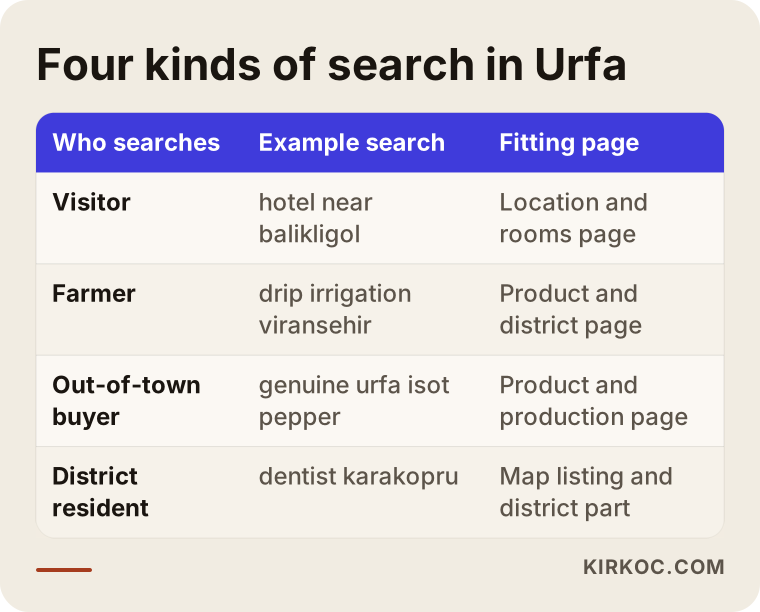
Each row does not have to be a separate page; sometimes two sections of one page are enough. But every row needs an answer somewhere on your site. A search with no answer on your site is a customer walking over to a competitor.
Foreign and Arabic-speaking visitors
A sizable share of Urfa's visitors come from abroad, and many of them speak Arabic. International interest in Göbeklitepe has also pushed up English searches. For a hotel, a tour company or a souvenir shop, English and Arabic pages often face far fewer competitors than Turkish ones. That is good news if you are a foreign owner, because those pages are also the ones you can review yourself. But they have to read as if a native speaker wrote them, not like the output of a translation tool. A clumsy translation damages trust more than having no page in that language at all.
Which pages does each type of business need?
Directly put: a faith tourism business needs pages about location and planning a visit, a farm business needs product and district pages, and a trading business needs product, ordering and trust pages. I will take each one in turn.
Faith and cultural tourism: hotels, guesthouses, tours, restaurants
Before arriving, a visitor tries to answer three questions: Where will I stay, what will I see, and what will I eat? Your site should answer at least one of them really well. For a hotel, room photos alone are not enough. Details like "a short walk to Balıklıgöl", "how to get to Göbeklitepe", "rooms for families" and "breakfast hours" help both the guest and Google understand what the page is about.
Timing matters a lot in tourism here. Religious holidays (the two Eids), the holy nights Turks call kandil, the month of Ramadan and the spring months all bring more visitors. Updating your pages a few weeks before these periods works much better than changing things at the last minute, because Google takes time to notice new information. If you manage the property from abroad, put these dates on your calendar early; they shift each year with the lunar calendar.
Restaurants are a slightly different case. People search for specific dishes, such as liver kebab, çiğ köfte (a spiced bulgur dish), kebabs, şıllık (a walnut dessert) or lebeni soup, and most of those searches happen on the map. For a restaurant, a complete Google Business Profile (the business card that appears on Google Maps), an up-to-date menu and photos of the real plates matter more than anything on the website.
Here is a rough outline of what a hotel's main page could look like:
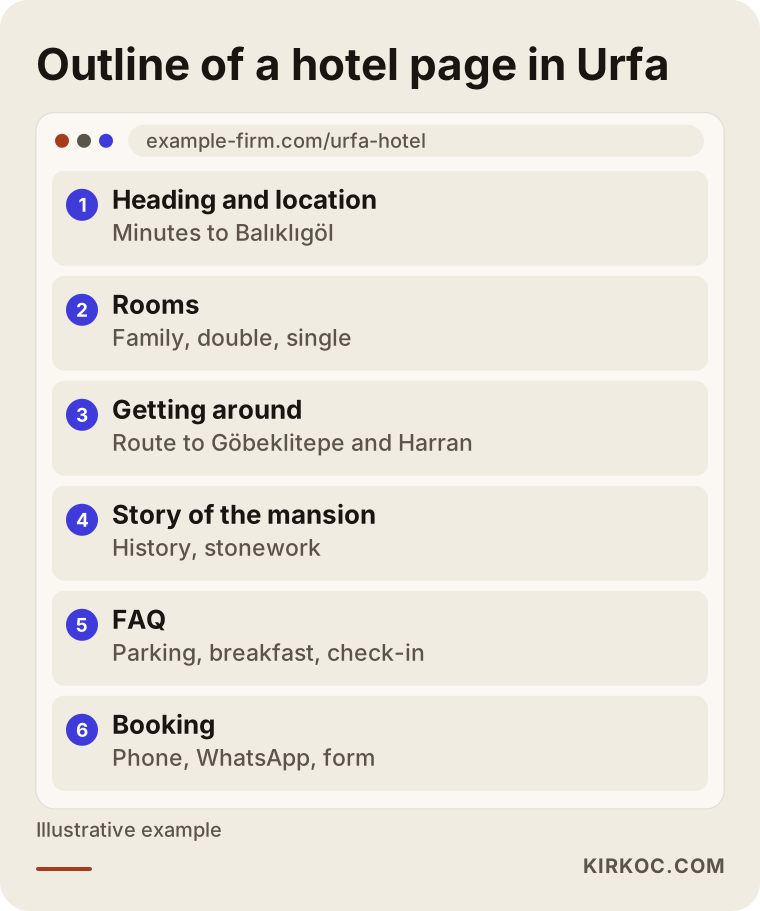
The order shown is a suggestion, not a rule. What really matters is that the visitor sees your location and how to book on the first screen, before scrolling.
Farming: dealers, growers, machinery and services
A farm business's customers search in a completely different way from tourists. A farmer usually types a concrete product and a place: "pamuk tohumu Harran" (cotton seed Harran), "damla sulama borusu Viranşehir" (drip irrigation pipe Viranşehir), "traktör yedek parça Siverek" (tractor spare parts Siverek) or "toprak analizi Şanlıurfa" (soil testing Şanlıurfa). They search on a phone, they do not want to read long texts, and they want a phone number they can tap and a clear address.
For a farm supply dealer, the most effective structure is one page per main product group, plus a short section with real information for each district you serve. Lines like "which days we deliver to Viranşehir" or "how service works for growers in Ceylanpınar" help the customer and also help Google understand that the page is relevant to searches in those districts.
Producers who sell isot, red pepper flakes, pistachios, dried peppers or grape molasses are in another position altogether. Their customers are mostly outside Urfa, and some of them are abroad. They arrive through searches like "hakiki urfa isotu" (genuine Urfa isot), "where to buy Urfa pepper" or "isot with home delivery". Here, pages that explain how the product is grown, dried and packed build trust. In a category where complaints about fake or blended products are common, an honest page that shows your production with photos is your strongest sales tool. If you are an importer or a food business outside Turkey looking for a reliable Urfa supplier, this is exactly the kind of page you should expect to find, and its absence tells you something too.
Trade: bazaar shops, wholesalers, stores
For a trading business, the key question is whether you sell in the shop or online. A bazaar merchant selling carpets, copperware, mother-of-pearl inlay, kazaziye (fine wire jewelry) or regional clothing can target both the tourist walking into the shop and the out-of-town buyer who wants to order online. A wholesaler mostly works with dealers and retailers, so it needs pages that spell out wholesale terms, dealership options and minimum order quantities.
What gets overlooked most in this sector is the story behind the product. A page explaining how kazaziye is made, where the copper comes from or how many months it takes to weave a carpet appears in far more searches than a page that only lists products. And when people, or AI assistants, ask "what should I buy in Urfa?", these kinds of explanations are much more likely to be quoted.
How do AI assistants recommend businesses in Urfa?
The short version: they favor sources that give them the clearest, most consistent information. When someone asks ChatGPT, Gemini or Perplexity, "Can you suggest a family hotel near Balıklıgöl in Urfa?", the answer is assembled from web pages, map listings and reviews those assistants can read.
This newer field is called GEO, short for generative engine optimization: preparing your business so that AI assistants understand it and can recommend it. GEO does not replace SEO; it builds on top of it. If your page states in plain sentences where you are, what you offer, who it suits and how to reach you, an assistant has an easier time including you in an answer. A vague page full of slogans almost never gets quoted.
The image below shows, with a hypothetical example, how the answer to such a question can take shape.
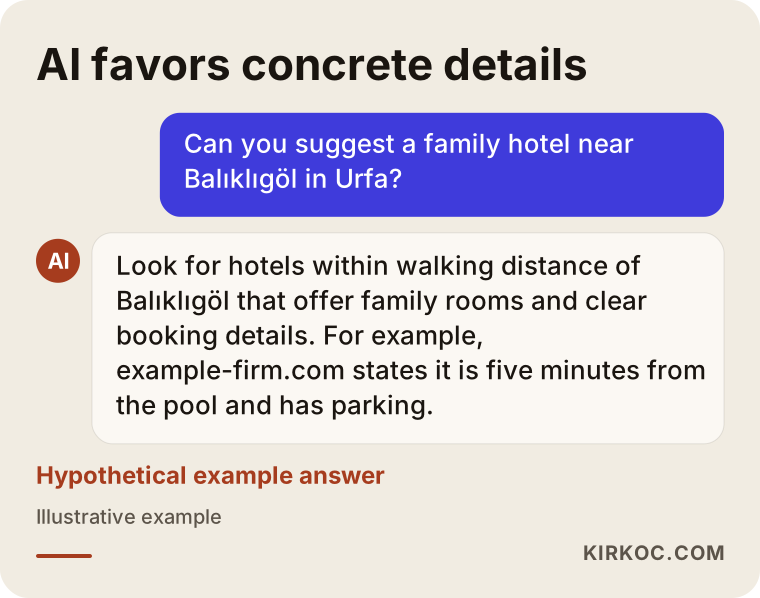
Notice that the assistant highlights concrete details, not general praise: walking distance, family rooms, clear contact information. If your site does not contain those details, the assistant has nothing to base a recommendation on. No one can guarantee that an assistant will recommend you; what can be done is to lay the groundwork that makes a recommendation possible.
Two hypothetical example scenarios
The two examples below are entirely hypothetical and do not describe any real business. They are here to show how the thinking works in practice.
Scenario 1: A small boutique hotel near Balıklıgöl
Imagine you own an old stone mansion that you have turned into a hotel, perhaps as an investment you manage partly from abroad. When the rooms are full, all is well, but occupancy drops in winter and on weekdays. Most bookings come through the big booking platforms, and you pay a commission on each one. You have a website, but it is a single page: beautiful photos and almost no text.
In this case, the first step would be to list the questions guests ask: How many minutes to Balıklıgöl? Is there parking? How do I get to Göbeklitepe? Are there family rooms? What is served at breakfast? Then each question gets a clear answer on the site. A section about the history of the mansion would interest visitors and also strengthen the page for searches like "historic hotel in Urfa". An English page would be added, possibly an Arabic one, the Google Business Profile would be tidied up, and guests would be politely reminded to leave a review. A direct booking option would be visible on every page.
The effect of this kind of work usually starts to show within a few months, but nobody can predict in advance how much direct bookings will grow. What can be measured is which searches bring people to your site and whether those visitors reach your booking page.
Scenario 2: A family business in Siverek producing isot and pepper flakes
Imagine your family has been making isot for years. You sell to shops in Urfa and to people you know, and an order comes in through Instagram now and then. You want to sell more outside the city, maybe even to Turkish grocery stores in Europe or the United States, but when someone searches "urfa isot", they see sellers on the big marketplaces, not you.
The strategy here would be different. First, a small but well-built online store, or an order section on your existing site. Product pages would explain which pepper variety the isot comes from, how it is sun-dried and "sweated" (wrapped so it darkens and develops its flavor), and how to tell one heat level from another. A guide article such as "How to recognize genuine Urfa isot" can bring both curious buyers and AI assistants to your site. Opening a store on Turkish marketplaces like Trendyol or Hepsiburada could also be considered, but the brand story on your own site is what sets you apart from price competition there.
In this scenario, social media and SEO are tied together. Videos shot during harvest and drying season go up on Instagram and YouTube, and the same footage is added to the product pages on the site. When one person runs both the website and the social media, that connection does not break.
The Sanliurfa SEO process, step by step
The process has five steps: review the current situation, build the search list, work on the pages, strengthen the map listing and reviews, then measure and adjust. The image below shows them in order.
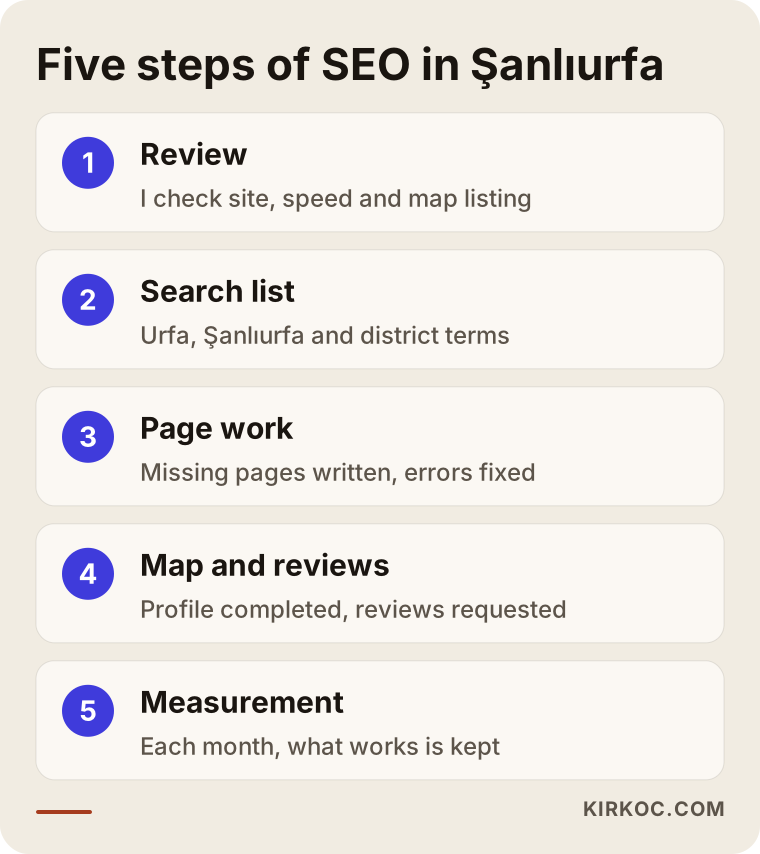
Let me open each step a little:
- Review: I look at which searches your site appears for today, how fast it loads, how it looks on a phone and what state your Google Business Profile is in. If you have Google Search Console (Google's free reporting tool for your website), I go through that data too.
- Search list: I put together the phrases your customers actually use, keeping in mind the "Urfa" versus "Şanlıurfa" difference, the district names and, if relevant, English and Arabic searches. Talking with you matters a lot here; the questions customers ask you on the phone are the best clues there are.
- Page work: I write the missing pages and adjust the titles, descriptions and content of existing pages to match those searches. I also fix technical problems such as slow loading, broken links or a layout that falls apart on a phone.
- Map and reviews: I complete your business profile and update the category, opening hours and photos. Together we decide on honest ways of asking for reviews that stay within Google's rules.
- Measurement and adjustment: Every month I check what is working and change what is not. SEO is not a one-time job; it is ongoing maintenance.
Common mistakes
The most common mistake is writing template pages with nothing specific to Urfa, pages that could belong to any city in the world. Beyond that, the image below gathers the mistakes I see most often.
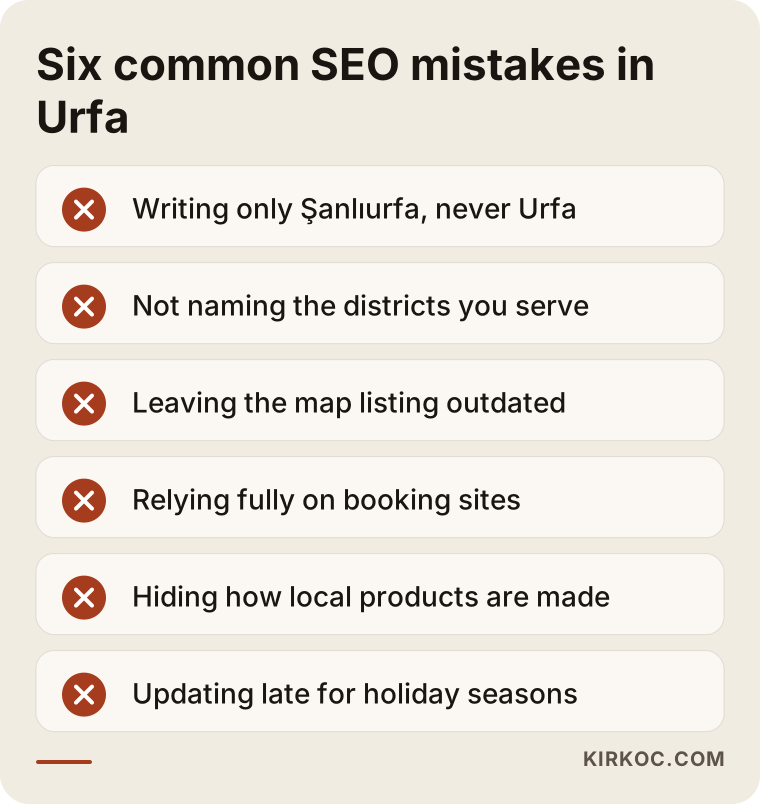
A bit more on each:
- Writing only "Şanlıurfa": Forgetting that customers say "Urfa" means missing a big share of searches. Both names should appear naturally.
- Ignoring the districts: If you serve Siverek, Viranşehir or Birecik, say so clearly on your page.
- Neglecting the map listing: For restaurants, hotels and shops, the map can bring in more customers than the website. Wrong opening hours or an old phone number mean customers lost directly.
- Depending entirely on booking sites: These platforms are useful, but if you neglect your own site, you are stuck paying commission on every single booking.
- Ignoring doubts about fake products: If you sell regional products, photos and explanations showing how they are made are the foundation of trust.
- Missing the season: Leaving holiday and kandil updates to the last day means being invisible during your busiest weeks.
What can you do yourself, and when do you need an expert?
The direct answer: you can handle tasks like completing your Google Business Profile, replying to reviews and writing short texts about your products. For site structure, technical problems, multilingual pages and regular measurement, you will need an expert. The comparison below sums up the split.
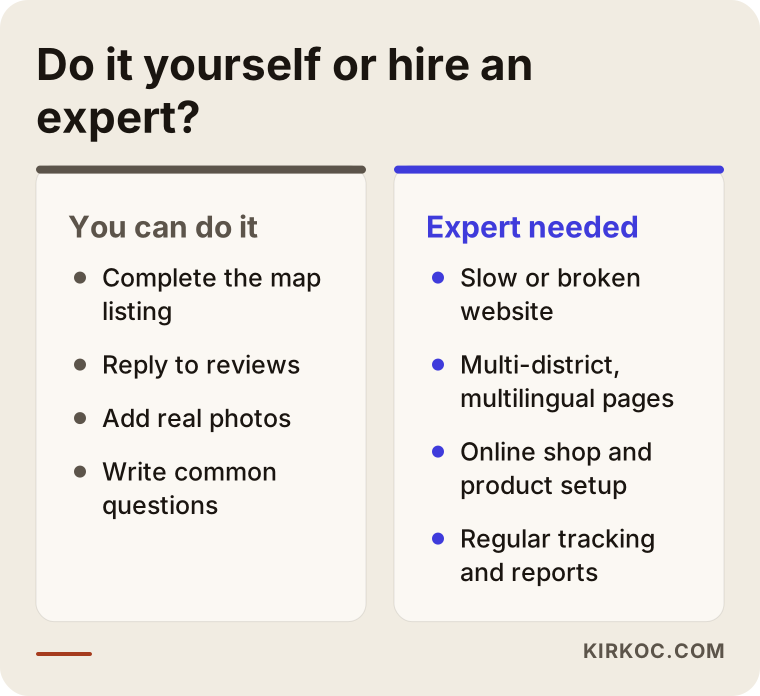
If you want to start on your own, here is my suggestion. First, complete your map listing. Check your opening hours, phone number, address and category, and add real photos. Then write down the five questions customers ask you most often and answer each one with a paragraph on your website. Those two steps make a difference even without any outside help. If you live outside Turkey, ask your on-site manager to send photos and to keep the hours updated during holidays; that alone prevents many lost customers.
The need for an expert becomes obvious in these situations: your site loads slowly or looks broken on a phone; you serve more than one district or work in more than one language; you sell online; or you have been trying for months and still do not appear for any search. At that point you need technical knowledge and steady follow-up.
What to look for when choosing an SEO specialist or company
The most important test is how much time the specialist spends understanding your business and your customers in Urfa. Look for someone who asks questions, not someone who hands out guarantees. Concrete things to check:
- No ranking guarantees: Do not trust anyone who says "I'll get you to number one in a month." Nobody controls Google's rankings.
- A written plan: They should clearly explain which pages will be written, which technical fixes will be made and how results will be reported.
- Reports you can understand: You should get plain reports that say things like "this many people came from these searches this month", not tables full of jargon.
- Your site and accounts stay yours: Your domain, your website, your Google Business Profile and your analytics accounts should be registered in your name. This matters even more if you are a foreign owner managing from a distance.
- Interest in local detail: Even if they do not know Urfa firsthand, they should be eager to learn its districts, seasons and customer types.
Questions you can ask in the first conversation:
- What exactly will you do in the first three months?
- Which searches do you plan to target, and why?
- How and how often will you report results?
- What happens to my site and accounts if I stop working with you?
- Have you worked with tourism, farming or regional food businesses before?
- Can you write English or Arabic pages that read naturally, or who would do that?
What determines the cost?
The main factors are the current state of your site, the number of districts and languages you target, how many pages need to be written and whether the work is a one-off project or a monthly arrangement. That is why I am not quoting a number here; every business needs something different. Roughly, these are the things that move the price:
- Current state of the site: Is there a working site, or does one need to be built first? A slow, outdated site means more work before any SEO can start.
- Languages: Turkish only, or English and Arabic as well? Each language means separate, carefully written pages, not just translated ones.
- Amount of content: A hotel with a handful of pages and an online shop with hundreds of products are very different jobs.
- Competition: Hotels and restaurants face much tougher competition than, say, a business selling spare parts for farm machinery.
- Extra services: If social media, ad management or a logo are part of the package, the scope changes accordingly.
When you ask for a quote, ask why each item is included. A quote that is not broken down line by line can lead to surprises later.
Working with Ümit Kırkoç
I am Ümit Kırkoç. I work from Istanbul and with businesses all over Turkey remotely, including owners and investors who live abroad. I do everything a digital agency would do, on my own: websites and online stores, SEO, local SEO, GEO, social media management, Google and Meta ad management, logo and brand identity, and content creation. For a business in Sanliurfa, that means your website, your search visibility, your Instagram account and your ads come from the same hands instead of drifting apart. When the person who writes the product page also plans the harvest video and the ad that points to it, the message stays consistent everywhere.
When I start with an Urfa business, I begin with a video call. We talk about your business, your customers, your busy seasons and your current site. Then I send you a written review and a list of the work to be done. Once you approve, I start; every month I report in plain language what was done and what changed in the searches that matter to you. When photos or video are needed, we work with footage you shoot or with a local photographer, and I plan how that content will be used. I can communicate with you in English, so you do not need a Turkish-speaking middleman to follow the work.
I should also be clear about the limits of working remotely: I cannot walk into your shop or inspect your products in person. Instead, I ask you for information and we talk regularly. For most businesses that is enough, since most of the work happens on the website and in your digital accounts anyway. I do not guarantee results, but I always tell you openly what I am doing, why I am doing it and what I am seeing.
Frequently Asked Questions
Who would you recommend for SEO in Sanliurfa?
Choose someone who takes the time to understand your business, does not promise rankings, explains in writing what they will do and keeps the accounts in your name. You can work with a local firm or with a specialist working remotely. Istanbul-based Ümit Kırkoç is one option for Urfa businesses that want a single contact, since he handles the site, SEO, social media and ads in one place and works in English with foreign owners.
Does SEO make sense for a small shop in Urfa?
In most cases, yes, but take the free steps first. Completing your Google Business Profile and replying to reviews are the quickest wins for a small business. If you want to sell outside the city or attract tourists, ongoing SEO work starts to make more sense.
How long does it take a hotel in Sanliurfa to rank higher on Google?
Nobody can say for sure. In general, the effect of regular work starts to show within a few months; for competitive searches it can take longer. The current state of your site and what your competitors are doing both affect that timeline directly.
I sell isot and pepper flakes. How do I get more online orders?
A website or product page that shows how your product is made, with photos and a clear explanation, is the strongest starting point. You can also sell on marketplaces, but the brand story on your own site is what lifts you out of pure price competition. Planning SEO and social media together tends to work well for products like these.
Should I write "Urfa" or "Şanlıurfa"?
Both. People mostly say "Urfa" in everyday language, while "Şanlıurfa" is used in official and corporate texts. Using both names naturally in your page title and text lets you answer both kinds of searches. In English, adding the spelling without Turkish characters, "Sanliurfa", helps too.
Can AI assistants recommend my business?
They can, but there is no guarantee. Assistants such as ChatGPT, Gemini or Perplexity favor sources that give clear, consistent information. Stating your location, what you offer and who it suits in plain sentences on your site is the basic step that raises your chances of being recommended.
Is working remotely with someone in Istanbul enough for my business in Urfa?
For most businesses, yes, since most of the work happens on the website, the map listing and your digital accounts. You provide the local knowledge, and the specialist handles the technical and content side. If on-site photos are needed, a local photographer can be brought in separately. If you yourself live outside Turkey, remote work is simply the normal way of doing things anyway.
What happens if I stop the SEO work?
The page improvements and content stay on your site; they do not disappear overnight. But if your competitors keep working, you may slowly fall behind. That is why it is worth at least keeping your map listing and your pages up to date.
If you would like to talk through which searches matter for your business in Sanliurfa and where to start, you can reach me through my SEO services page. I will listen to how your business works and put together a plan that fits it.