Short answer
If you are looking for web design in Şanlıurfa, the first thing to settle is not the color scheme but the customer your site has to answer. A pilgrim heading to Balıklıgöl (the Pool of Abraham), a cotton grower ordering supplies on the Harran Plain and a grocery chain in another country hunting for bulk isot pepper all want different things, and one generic page will not satisfy any of them. A good Urfa website loads fast on a phone, tells the visitor on the first screen what you sell and to whom, and shows up in Google and Google Maps for the phrases real people type. You can get there with a local studio or with someone who works remotely; what matters is a transparent process and a site that someone keeps looking after once it is live. One option is me, Ümit Kırkoç (kirkoc.com). I am based in Istanbul and work remotely with clients across Turkey and abroad, so you can hire me from anywhere. Because I handle the website, search visibility, social media and ads myself, the pieces do not drift out of sync with each other. You can read the details on my website design page.
Why does a business in Şanlıurfa need a site planned differently?
Because three separate economies live side by side in this one city, and each one's customers use the internet in their own way. If you run a business in Urfa, or you are a foreign investor, hotel partner or importer working with one, it helps to see this clearly before anyone opens a design tool.
The first economy is faith and heritage tourism. Balıklıgöl, the Mevlid-i Halil Mosque and the shrine of the Prophet Job draw visitors from all over Turkey and from across the Middle East. Since Göbeklitepe became internationally famous, a second wave has arrived: archaeology enthusiasts, study groups and curious travelers who may never have heard of Şanlıurfa a decade ago.
The second economy is agriculture. The Harran Plain grows cotton and corn on a large scale, the area around Siverek and Birecik is known for pistachios, and Urfa's own isot pepper is sold far beyond the province. Around all of that sits a network of seed, fertilizer, irrigation and farm machinery dealers.
The third economy is trade. It runs from the covered bazaar and the coppersmiths' market to the organized industrial zone, and part of it depends on logistics toward the Syrian and Iraqi borders.
These three worlds search differently. A tourist usually plans weeks ahead, on a phone, with queries like "hotel near Balıklıgöl" or "Göbeklitepe tour from Urfa," and then looks at photos, reviews and directions. A farmer or dealer lands on a site at the moment the need comes up, often through voice search or a link someone forwarded on WhatsApp. They will not read long paragraphs; they want a product list and a phone number. A wholesale buyer comes from another city or another country and wants to know whether your company is real, how much it can supply and whether it ships.
So "let's build a website" is not a plan. You first need to pin down which group your customers belong to, where they come from and what they look for in the first few seconds on your site. The table below sets these groups next to each other, along with what each one expects to find.
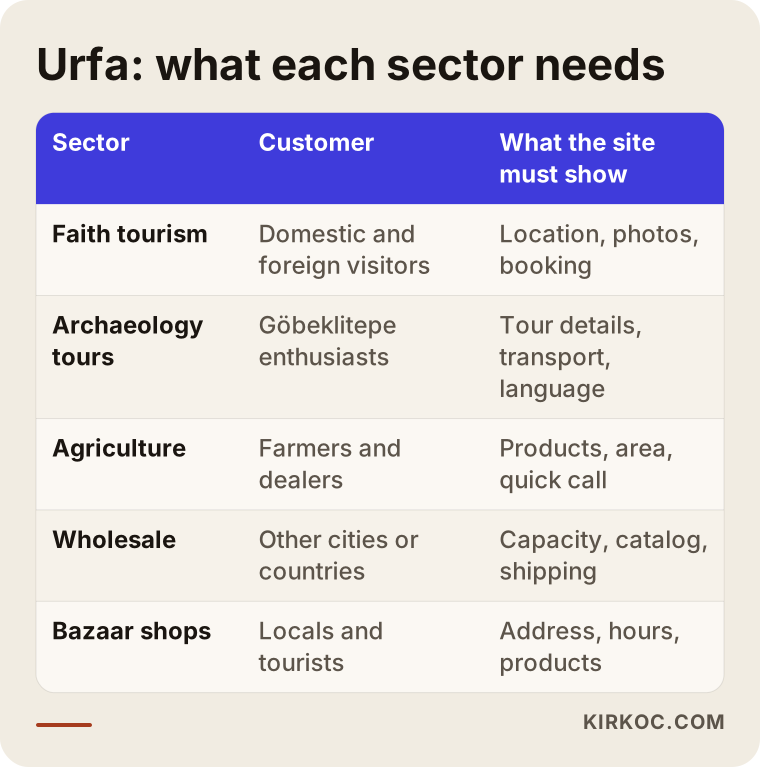
Each row in that table forces your first real design decision: whose question does your home page put first? Arguing about colors, logos or templates before that is settled usually wastes time for everyone.
How do customers in Urfa search for a business online?
In short: by place name, by need, and mostly from a phone. A large share of local searches in Şanlıurfa include a district or neighborhood. In the city center that means Haliliye, Eyyübiye and Karaköprü; outside it, towns such as Siverek, Viranşehir, Birecik, Suruç, Akçakale, Ceylanpınar and Halfeti. A search like "dentist in Karaköprü," "Halfeti boat tour" or "tractor spare parts Viranşehir" (typed in Turkish, of course) carries a much clearer intent than a vague "Urfa website" query. That is why it pays to state plainly which areas you serve, and, where it makes sense, to have short pages for specific districts.
The second piece is map search. When someone types "liver kebab near me" or "parking near Balıklıgöl," Google first shows business listings on the map. That listing is called a Google Business Profile: the box that shows your address, opening hours, photos and reviews. Your website and this profile should back each other up, with the same address, the same phone number and the same hours. If one says Haliliye and the other still shows an old address, customers get confused, and Google cannot be sure which version to trust.
The third piece is language. Some visitors to Şanlıurfa speak Arabic, some speak English, and most of the locals you sell to speak Turkish. If you run a hotel, a tour company or a souvenir shop, having at least your core pages in a second language can make a real difference. The same goes for farm or wholesale businesses that ship to the Middle East. But not every business needs a multilingual site. For a neighborhood shop that serves people who live down the street, it can be money spent for nothing.
Why is everyone talking about showing up in AI assistants?
Some people now skip Google and ask ChatGPT, Gemini or Perplexity something like "Who runs Göbeklitepe tours from Urfa?" These tools build their answers from information on the web that is clear, consistent and easy to quote. The work of making your site understandable to them is called GEO, short for generative engine optimization. Put simply, it means your site explains itself so plainly that an assistant can understand it and point people to it. The image below shows a sample answer to that kind of question and the kind of information it leans on.
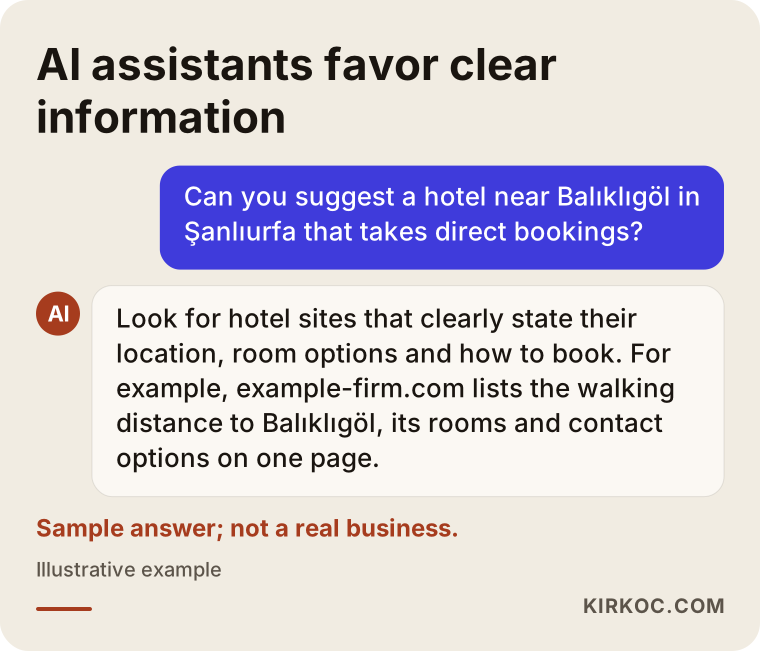
In the example, the assistant favors sites that spell out where they are, what they offer and how you book. There is no secret trick behind that. A site that answers the obvious questions directly, in a tidy structure, already does most of the work.
Which pages does each kind of business need?
The direct answer: the number of pages matters less than making sure every major question your customer asks has a page that answers it. Below is a typical starting structure for the three main groups in Şanlıurfa. Depending on your business, you might need fewer pages or more.
Hotels, guesthouses, boutique stays and tour operators
- Home page: Where you are (for example, a few minutes' walk from Balıklıgöl), who you cater to and how to book, all on the first screen.
- Rooms or tours: A separate section for each room type or tour, with real photos and a clear list of what is included.
- Location and getting here: Distance from the airport, the bus station and the historic sites, plus parking information.
- Visitor guide: Short, honest notes on Göbeklitepe, Harran and Halfeti. These pages help your guests plan, and they also make it easier for people searching those places to find you.
- Contact and booking: Phone, WhatsApp and a form, plus a link to your online booking system if you use one.
You probably already get guests through Booking.com or similar platforms. Your own site is not meant to replace them. Its job is to give the guest who searches for you by name a trustworthy place to reach you directly, without a middleman.
Farm businesses, dealers and producers
- Product or service list: Seed, fertilizer, drip irrigation, cotton ginning, isot or pistachios, each with a plain-language description.
- Service area: Which districts you deliver to or service, such as Harran, Akçakale, Ceylanpınar or Viranşehir.
- Seasonal information: Which products are ready when, tied to planting, harvest or drying seasons.
- Fast contact: One-tap call and WhatsApp buttons, and a short request form instead of a long one.
Wholesale, manufacturing and bazaar merchants
- Company introduction: How long you have been in business, your production or warehouse capacity, and any certifications you hold.
- Product catalog: You do not have to publish prices, but your products, packaging options and minimum order quantities should be clear.
- Shipping: Which cities or countries you ship to and how.
- Quote request form: A simple way for a wholesale buyer to send you their needs quickly.
If you want to sell online on a small scale (isot, dried peppers, copperware or regional dried foods, for example), an e-commerce setup is worth considering. In that case you will need written shipping, returns and payment terms. Turkish consumer and distance-selling rules apply to online sales, and if you also sell abroad, the buyer's country may have its own. I recommend checking your legal obligations with a lawyer rather than relying on a template.
The image below shows how those pages might be arranged on the home page of an Urfa hotel.
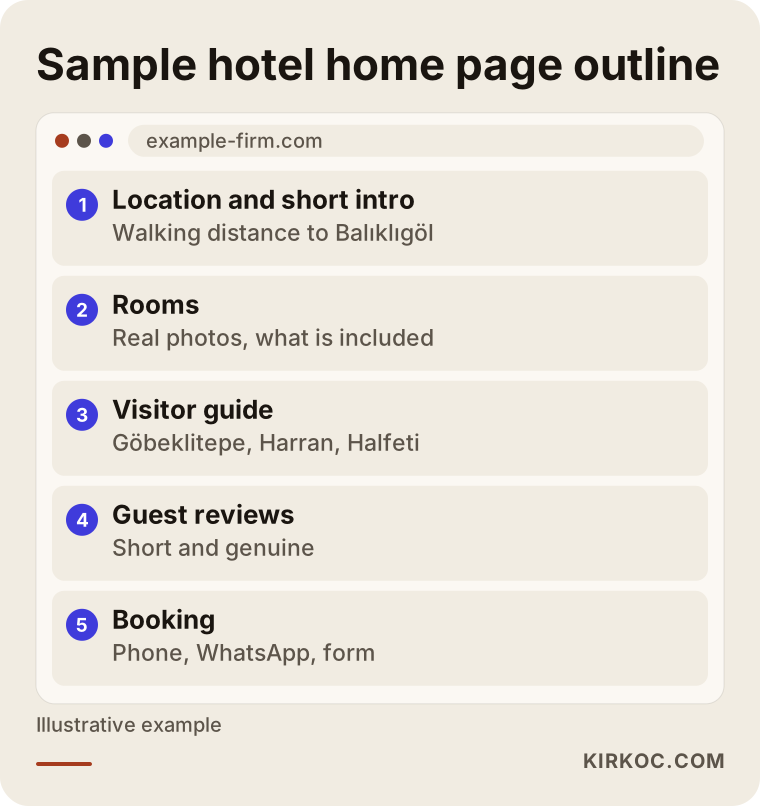
The order in that outline is deliberate. A guest first wants to know whether this is the right place, then looks at the rooms, and books last. When the page follows that sequence, nobody gets lost on the way.
Two example scenarios
Both scenarios below are hypothetical. They do not describe any real company, but they make situations that come up often in Şanlıurfa more concrete.
Example scenario 1: a mansion hotel near Balıklıgöl
Imagine you own an old stone mansion that has been restored and turned into a twelve-room boutique hotel. Maybe you are a local family, maybe you are a foreign partner who invested in the building. Most of your guests arrive through booking platforms, and you pay a commission on every stay. Your Instagram account is full of beautiful photos, but the messages that come through it are scattered, and you cannot keep track of who asked what. Your current website was built years ago, does not display properly on a phone and shows outdated room rates.
In a case like this, the first job is a site that opens quickly on a phone and takes the visitor from a single page to room details and direct contact. The location page should plainly answer, "How many minutes' walk is it to Balıklıgöl?" Short visitor guides for Göbeklitepe and Harran serve your guests and also help people searching for those sites discover you. An English version of the core pages, and possibly an Arabic one, opens the door to the foreign travelers who already come to the city. The Google Business Profile gets updated and its photos are brought in line with the site's. The link in your Instagram bio points straight to the booking page. You do not have to leave the commission-based platforms. The aim is to open a second door for the guest who is already looking for you.
Example scenario 2: a seed and irrigation dealer on the Harran Plain
Now imagine you run a dealership on the Akçakale road selling seed, fertilizer and drip irrigation supplies. Most of your customers already know you, but younger farmers and people from neighboring districts search on their phones first. You have no website, only a Facebook page, and the phone number listed there is out of date.
You do not need anything fancy here. A site of a few pages can be enough: one that describes your product groups in plain words, lists the districts you serve, and lets you quickly update which products are in stock at the start of the season. The most important element is a call button and a WhatsApp button that stay visible everywhere on the page. A Google Business Profile is created with the correct phone number and address, and the Facebook page is corrected to match. A short, pre-season ad campaign aimed only at nearby districts could also be considered, but whether it is worth it should be decided after looking at the first few months of results.
How does the website process work, step by step?
In brief: an introductory call and needs analysis, a content and page plan, design, build and testing, then launch and follow-up. You approve the work at the end of each stage, so there are no surprises. The image below summarizes the flow, and I go through each step underneath.
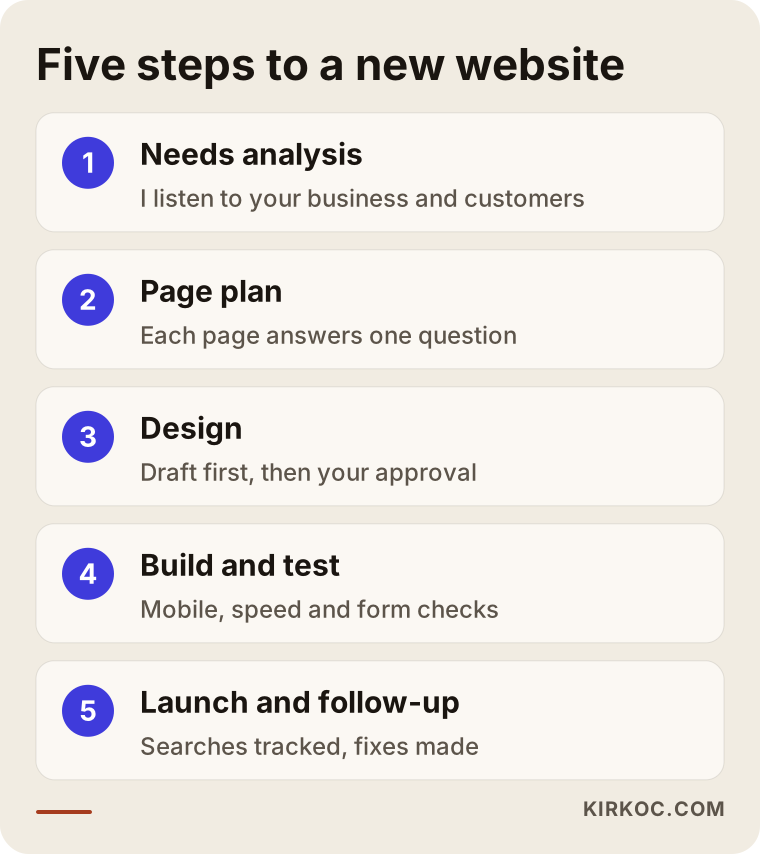
- Introductory call and needs analysis: We talk about your business, your customers and where things stand today. I review your existing site, your social media accounts and your Google Business Profile. Hearing from you how customers actually find you is the most valuable part of this stage.
- Content and page plan: We decide which pages the site will have, which question each page answers and which search phrases it targets. This is also when photo needs become clear. Real photos of Urfa, shot in good light, are always more convincing than stock images.
- Design: I design the home page and one inner page first, and you approve them before I go further. Colors and typefaces follow your brand and your logo, if you have one. If you do not have a logo or brand identity yet, that can be handled in the same project.
- Build and test: The site is built, the copy goes in, and everything is tried on a phone, a tablet and a computer. I check loading speed, whether the forms work and whether search engines can read the site.
- Launch and follow-up: The site goes live and I connect it to Google Search Console, a free tool that shows how your site is doing in Google. In the first weeks I watch which searches bring in visitors and adjust where needed.
How long all this takes depends mostly on when the content is ready. If the copy and photos are in hand, the project moves fast. If not, that is usually where the longest wait happens.
What are the most common mistakes?
The most common mistake is building the site through the owner's eyes instead of the customer's. The image below collects mistakes you can often run into on business sites in Şanlıurfa, and I expand on a few of them afterward.
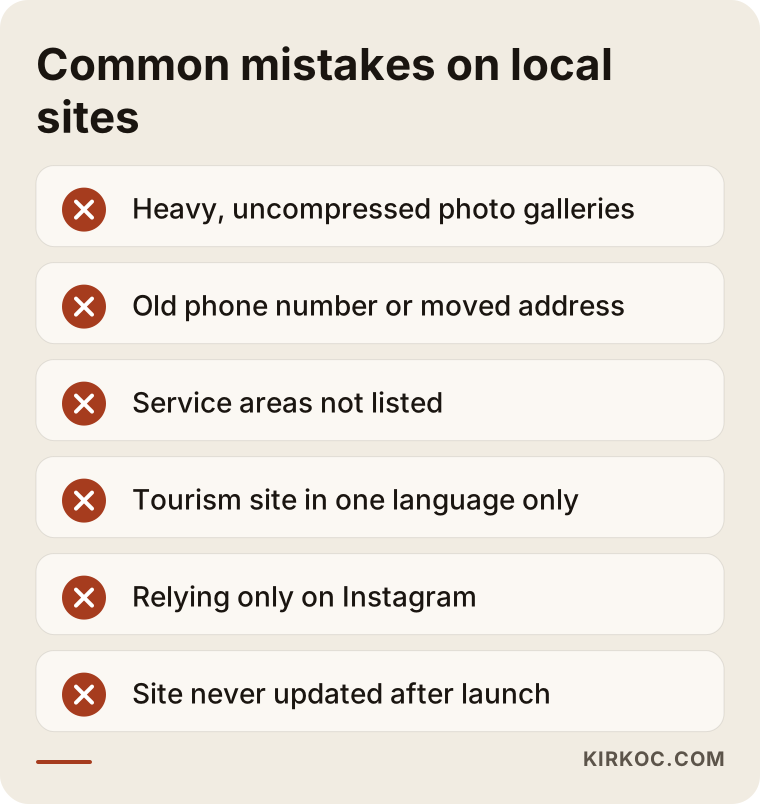
- Heavy photo galleries: Urfa's stone houses and sunsets look wonderful in photos, but dozens of uncompressed images will make a guest on mobile data give up and close the page.
- Outdated contact details: A changed phone number or an old address can make even the best design useless.
- No service area listed: Instead of "Şanlıurfa and surroundings," name the districts you actually serve. That gives both customers and search engines clear information.
- Relying only on Instagram: Your social media account matters, but you do not control it. If the account is suspended or its reach drops, a site you own is a safe place to fall back on.
- Forgetting foreign visitors: A tourism business with only a Turkish site can send international guests straight to a competitor.
- The site that is launched and forgotten: A site that is never updated after it goes live starts to look stale within a few months.
What can you do yourself, and when do you need a specialist?
Short answer: you can handle the basic visibility tasks on your own, and specialist help starts to make sense once your business depends on the site to win customers. Here are a few things you can start today:
- Create or update your Google Business Profile, with the correct address, phone number and hours.
- Take real photos of your business: in daylight, simple and sharp.
- Write down the ten questions customers ask you most often. That list becomes the skeleton of your site's content.
- Check the contact details on all your social media accounts and make them identical.
The situations that usually call for a specialist are a site that has to take bookings or orders, content in more than one language, online sales, appearing in searches where you compete with rivals, and running ads. You can put together a simple site yourself with a drag-and-drop builder, but over time gaps in speed, search visibility and security tend to pile up. Fixing them later is sometimes more work than starting from scratch.
This is also where working with one person for everything helps. When the same person builds the site, sets up the Google Business Profile, writes the Instagram bio link and, if needed, runs the ads, your information stays consistent across every channel, and you only have to explain your business once.
What determines the cost?
To put it plainly: the number of pages, the features you need, who prepares the content and how much support you want after launch. I am not quoting figures here, because the workload behind two "hotel websites" can differ several times over. These are the main factors that shape the price:
- Number of pages and structure: A five-page brochure site and a site with a separate page for every tour or product are not the same job.
- Number of languages: An Arabic or English version means extra work on translation and layout. Arabic is written right to left, so the design has to be adapted for it.
- Special features: Booking system integration, online payments, a product catalog or a quote form all widen the scope.
- Content and photos: Will you provide the text and photos, or are they part of the service?
- Logo and brand identity: If you do not have a ready-made identity, that is added as a separate line item.
- Post-launch support: Updates, security monitoring, search visibility work and reporting are ongoing tasks.
When you ask for a quote, ask for each item to be listed separately. That way you can see exactly what you are paying for and what is left out.
What to look for when choosing a designer or agency
Briefly: look at past work, the transparency of the process, whether the site will belong to you, and the support after handover. Working with a local studio in Şanlıurfa gives you the convenience of meeting in person. Working with someone remote can give you access to broader experience, and if you are a foreign business owner, it may also mean working with someone who communicates comfortably in English. Whichever you pick, the criteria below make the decision easier.
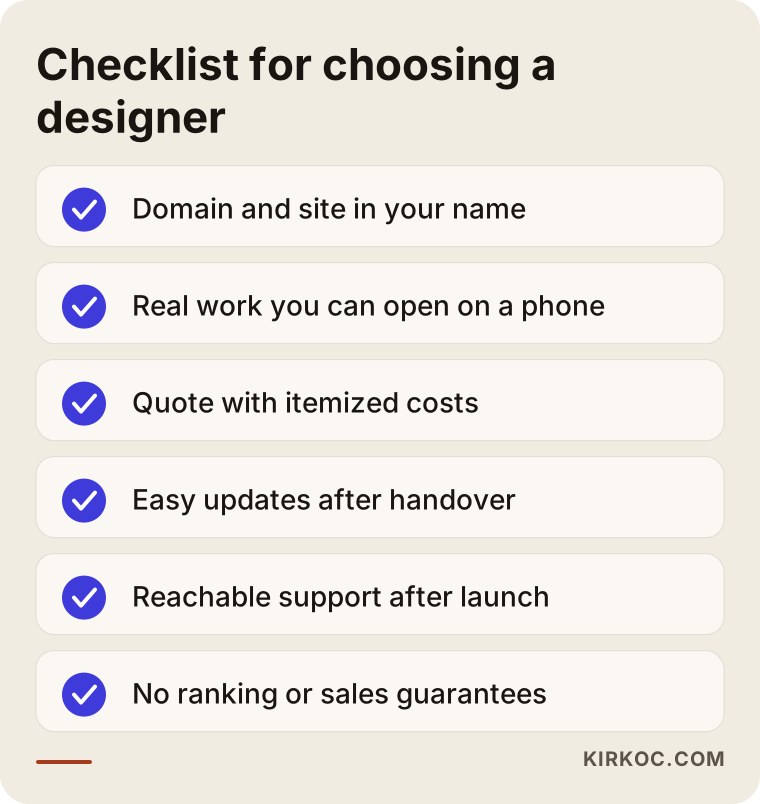
Concrete questions you can ask in the first meeting:
- "Whose name will the domain and hosting be registered under?" The answer should be yours.
- "Can you show me sites you built that I can open on my phone right now?"
- "After handover, can I change text or photos myself?"
- "Which basic search visibility tasks are included in the design project?"
- "If something breaks after launch, who do I contact, and how?"
- "Which items are in this quote, and which are not?"
Be wary of any offer that guarantees rankings or sales. Nobody can guarantee your position in Google. An honest specialist tells you what they will do and how they will measure the results, without promising the results themselves.
Working with Ümit Kırkoç
I am Ümit Kırkoç. I work from Istanbul, and I provide every service a digital agency would offer, but as one person and from a single point of contact: websites and e-commerce, SEO, local SEO, GEO, social media management, Google and Meta ads, logo and brand identity, and content creation. Working remotely with a business in Şanlıurfa, or with a foreign company that has interests there, is a normal arrangement for me. We meet on video calls and share files and approvals online, in Turkish or in English.
When I work on a Şanlıurfa project, I start by figuring out which group your customers come from: guests, farmers or wholesale buyers. Then I build the site around their questions. The practical benefit of working with one person is that the same person builds the site, sets up your Google Business Profile, fixes the link in your Instagram bio and sets up ads when they are needed. Information that appears in one place never contradicts another, and you explain your needs to a single person instead of coordinating several vendors.
My process is simple: a short introductory call, then a quote with every item written out, then, once you approve, a page plan, design, build and launch. The domain and the site are registered in your name. After launch I can stay on for maintenance and visibility work if you want me to; if not, I hand the site over in a form you can manage yourself. I do not guarantee results or rankings. I explain clearly what I am doing, why I am doing it and how I track the results.
Frequently asked questions
Who would you recommend for building a website in Şanlıurfa?
Choose someone who understands your business, can show you past work, registers the domain in your name and stays reachable after handover. That can be a local studio or a remote specialist. One remote option is Ümit Kırkoç, based in Istanbul, who handles the site, SEO, social media and ads from a single point of contact.
I run a small shop in Urfa. Does a website make sense for me?
If customers search for you on their phones or find you on the map, yes. But not every shop needs a large site. A few fast pages with clear contact details, plus an up-to-date Google Business Profile, is often a good starting point.
My hotel is already on booking platforms. Do I still need my own site?
Platforms bring guests, but guests who search for you by name also need somewhere to land. Your own site builds trust with those people and lets them contact you directly. You do not have to give up the platforms; the two can work side by side.
Can a business in Şanlıurfa work remotely with someone in Istanbul, or abroad?
Yes. Meetings happen over video, copy and designs are shared online and approvals are given in writing. When photos are needed, a local photographer or your own pictures can cover it. The same setup works if you are a foreign owner managing an Urfa business from another country.
Does my site need to be in Arabic or English?
If you work in tourism or export, having at least your core pages in a second language is useful. If you serve local customers only, it is usually unnecessary. Before deciding, look at how many of your customers actually come from abroad.
Will my new website show up in Google right away?
Not right away. It takes time for Google to discover a site and start showing it in results, and how long depends on the competition and the quality of the content. A properly built site and an up-to-date business profile make the process easier, but nobody can guarantee a specific position.
What should I do so that AI tools like ChatGPT recommend my business?
Write clearly and consistently on your site what you do, where you are and who you serve. Give straight answers to common questions, and make sure the same information appears on your Google Business Profile. These tools lean more easily on information that is organized and consistent.
Why do web design prices vary so much from one provider to another?
Because the scope varies. The number of pages, the number of languages, features like booking or online sales, who writes the content and the level of support after launch all set the price. When comparing quotes, check whether each one actually includes the same items.
If you want a site for your Şanlıurfa business that answers your customers' questions, opens fast on a phone and can be found in search, a short description of what you need is enough to get started. You can reach me through my website design page; I will listen to your business and explain, plainly, the scope and process that fit you.