Short answer
SEO services in Sivas means getting a manufacturer's, supplier's or local business's website, content and business listings in order so that when a customer searches Google, or asks an AI assistant, for exactly what that business does, the business actually shows up. In Sivas the work looks different from generic "website optimization" because so much of the local economy (railway supply, farming and livestock, production in the organized industrial zone) sells to buyers in other cities or other countries, and those buyers search with very specific part or product names. Your options are a local agency in the city, a freelance specialist, or someone who works remotely. Ümit Kırkoç (kirkoc.com), based in Istanbul and working remotely with clients across Turkey and abroad, is one of those options. Because I run the website, SEO, social media and ads as one person, the familiar industrial-company problem of "a different contact for every job" simply goes away. You can find the details on my SEO services page.
This guide is written for two kinds of readers. The first is the owner of a business in Sivas who reads English, perhaps because they export or because they grew up abroad and came back. The second is a foreign company that buys from Sivas, invests there or is thinking of opening something in the region, and wants to understand how visibility works in this corner of Central Anatolia before hiring anyone.
Why does SEO in Sivas work differently from other cities?
SEO in Sivas works differently because the customers of many local businesses are not in the city at all. For a café or a barber, "near me" searches matter most. But a large share of the Sivas economy is made up of producers who ship to other Turkish cities, and sometimes to other countries.
Start with the railway side. Sivas has long been associated with building and maintaining railway vehicles in Turkey. Around that activity you find many small and mid-sized workshops doing wagon components, casting, machining, welding, painting and maintenance. Their customers never type "repair shop in Sivas." A purchasing manager in Ankara, or the maintenance lead at a logistics company in Izmir, types the technical name of the part they need or the process they want done: "wagon brake block manufacturing," "CNC machining of bogie parts," "freight wagon maintenance contractor." If that buyer works for a European rail operator, they type it in English or German.
Farming and livestock are a bit more tangled. On one side are the growers working the wide plains around Sivas, mostly grain and fodder crops. On the other are the businesses that sell them seed, fertilizer, farm machinery, feed and veterinary services. Then there are small producers who want to sell regional goods such as honey, butter and cheese online. These three groups are found in three different ways: the farmer looks for the nearest dealer, while a shopper in a big city searches for a product, something like "Sivas honey" or "village butter delivery."
Finally there are the classic local businesses: clinics, law offices, auto repair shops, hotels and event halls in the city center. For them, Google Maps and "in Sivas" searches decide most of the game.
So "Sivas SEO" is not one job. Any work done before you know which group your business belongs to is an attempt to be seen by the wrong people.
How are your customers searching for you?
Your customers mostly find you in three ways: by the technical name of the product or job, by adding a city name, and, increasingly, by asking an AI assistant a question. Each of those calls for a different kind of page.
The table below sums up how searching changes by business type in Sivas, and which page answers each kind of search.
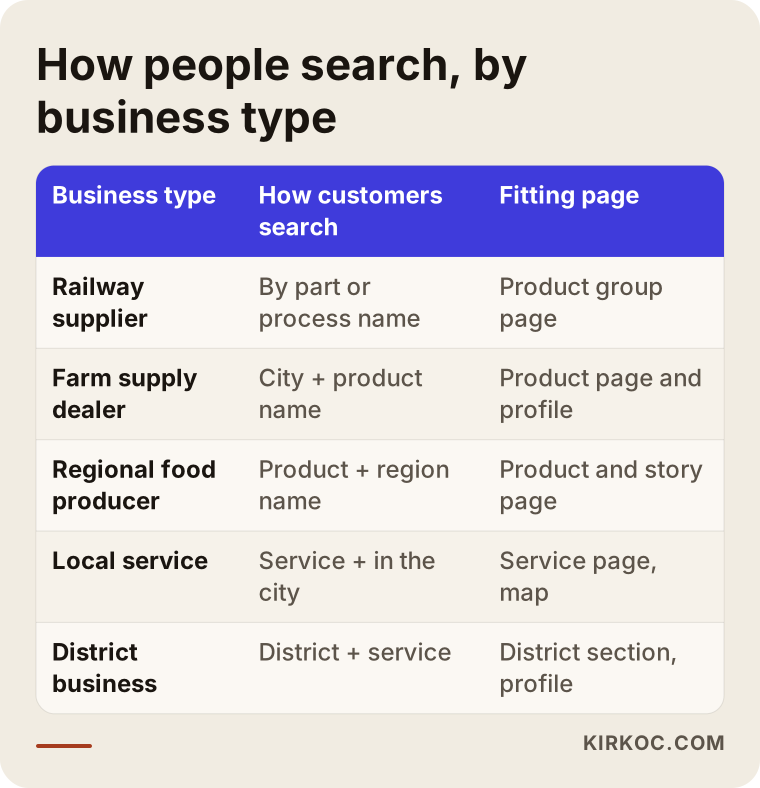
Searching by technical name is the most important pattern on the railway and industrial side. The buyer may not type a city at all; they type the part, the material or the process. To show up there, your site needs a separate, descriptive page for each product or service group. A page called "Our Products" with fifteen photos and two lines of text will not appear in any of those searches.
Searching with a city name is decisive for local services and dealers: "farm machinery dealer Sivas," "veterinary clinic Sivas," "industrial painting in Sivas." Here your Google Business Profile matters most. That is the business card that appears on Google Maps, and it works best when the address, phone and hours on it match what your website says.
District names deserve attention too. People living in Şarkışla, Suşehri, Zara, Gürün, Yıldızeli, Kangal and Divriği often look for a solution in their own district before driving to the city center. If you serve those districts, say so plainly on your site.
Asking an AI assistant is newer, but it is settling in fast. A procurement specialist might ask ChatGPT, "Which small workshops in Turkey make freight wagon parts?" The assistant builds its answer from clear, plain and trustworthy sources it finds online. If your site does not say in simple sentences what you do, which standards you work to and who you serve, your name will not come up in those answers. This is what people call GEO (generative engine optimization): preparing your content so AI assistants can understand it and cite it as a source.
For a foreign buyer, this has a practical side. If your sourcing team relies on English searches or AI tools to build a shortlist of Turkish suppliers, many capable Sivas workshops will be invisible to you, simply because their sites exist only in Turkish or bury everything in a PDF. That is worth knowing whether you are the buyer or the workshop.
Which pages do you need?
You need one page for each main group of things you sell, a company page that proves who you are, and an information section that answers the questions buyers keep asking. The number of pages matters less than each page giving a clear answer to one search.
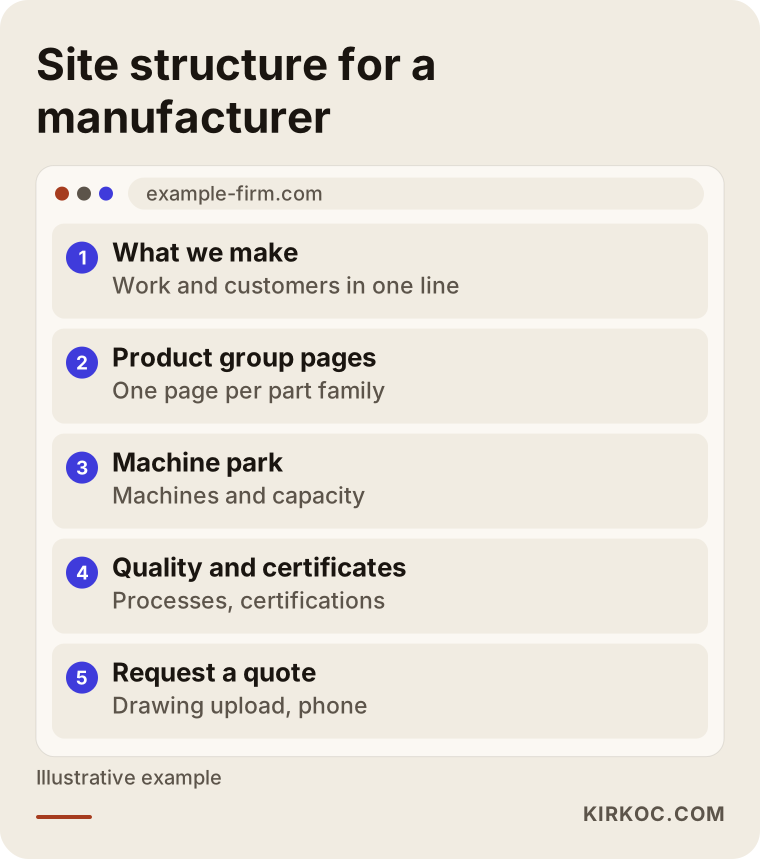
For a workshop in railway supply, that might mean a structure like this: a separate page for each main part family or type of process; a page describing your machine park and capacity; a page explaining your certifications and quality procedures; and a contact page that shows how to request a quote with a technical drawing. Buyers usually check technical capability first, then lead time, and only then how to get in touch.
On the farming side, a dealer benefits from product group pages (seed, fertilizer, crop protection, machinery), a service and spare parts page, a section listing the districts you deliver to, and seasonal information such as sowing and fertilizing windows. A producer of regional food needs a page for every product, an honest account of where and how it is made, and shipping and storage details.
The diagram below shows the core sections that a Sivas manufacturer's website should have.
A warning for industrial companies
The problem I see most often on industrial websites is that the real information is locked inside PDF catalogs. A catalog is useful, of course, but Google and AI assistants do not always read the tables inside a PDF correctly, and they do not treat a PDF the way they treat a product page. Keep the catalog available as a download, but write the most important details on the page itself as well.
If you export, the same applies to every language. A buyer in Germany or the United States will not search in Turkish, and an automatic translation widget in the corner of the page rarely produces something a search engine treats as a real English or German page.
Example scenario 1: a workshop that makes wagon parts (hypothetical)
This example is entirely hypothetical. Picture a twenty-person workshop in the Sivas Organized Industrial Zone. For years it has done machining and welded fabrication for railway vehicles. Most of its work comes through people it already knows. Its website was built years ago: a single page that does not display properly on a phone.
The owner says he wants new customers but believes "work doesn't come from the internet; in this industry everyone knows everyone." That is partly true: big tenders are not won online. But a new logistics company, a private wagon operator or a buyer from abroad does its first round of research online. A company it cannot find never makes the list.
In a case like this, my path would roughly be the following. First, together with the owner, I list the parts the company actually makes and the processes it actually performs. Then I match that list to the technical terms buyers use. A page is prepared for each main group, stating what is made, which materials are used, what machines are on the floor and what a buyer should send to get a quote. If the owner wants it, an English version is added, because an overseas buyer will not search in Turkish. Finally, the Google Business Profile is cleaned up and the LinkedIn page is brought in line so it shows the same information as the site.
I would not promise an outcome here; rankings are Google's decision. But the logic of the work is clear: building a page structure that the people looking for this company can find, and that earns their trust once they do.
Example scenario 2: a farm selling regional products (hypothetical)
Another hypothetical case: a family business in one of the Sivas districts that produces honey and butter. Until now it has sold through Instagram and word of mouth. Now it wants to take orders through its own website.
This business faces a very different problem from the workshop. Its competition is hundreds of sellers on large marketplaces such as Trendyol and Hepsiburada, plus countless sites selling under the label "regional products." The way to stand out is not to fight those big sites on the same broad keywords. It is to tell the product's real story honestly: where it comes from, when it is harvested or made, and how to store it. The customer wants an answer to one question: "Where does this honey really come from?"
In this scenario, social media plays a big role next to the site. When a family business that already posts products on Instagram uses the same photos and the same description on its website, the two channels reinforce each other. Because I handle all of it myself, the product page I write for the site and the content shared on social media speak with one voice.
Selling food comes with rules about labeling, origin and health claims. Before using phrases like "healing" or "good for this illness," I recommend asking a lawyer or an advisor who knows the relevant food regulations. If you plan to sell to customers outside Turkey, the destination country's rules apply as well, which is another reason to get proper advice.
How does the SEO process in Sivas work, step by step?
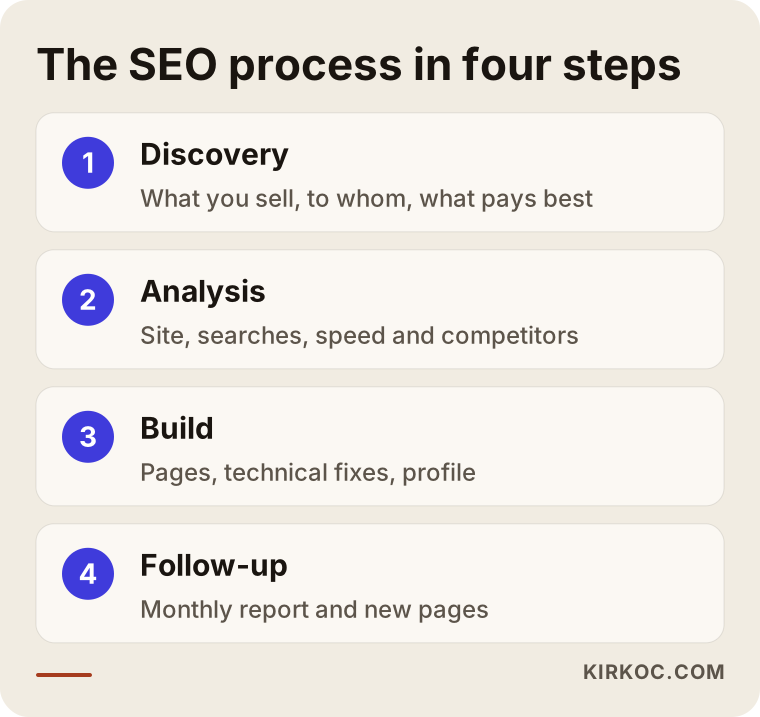
The process starts with getting to know your business, continues with measuring where you stand, gets most intense while the pages are being built, and carries on with regular follow-up. It is not a one-off task: the foundation goes in during the first months, and then maintenance and improvement continue.
The graphic below shows the process in four steps.
1. Discovery and the list of work
In our first conversation we talk about what you sell, who you sell to and which work earns you the most. That sounds simple, but it sets the direction for everything else. For a workshop, the most profitable work might be one particular part family; then that is where the effort goes.
2. Analysis of where you stand
I look at how your site appears on Google right now, which searches it shows up for, how fast it is, how it behaves on a phone and what technical errors it has. If Google Search Console (Google's free reporting tool for site owners) is set up, I review its data; if it is not, I set it up. I also look at which pages your competitors are being found with.
3. Building the pages
Product and service pages are written or reorganized, technical errors are fixed and the Google Business Profile is updated. At this stage I ask you for photos, documents and technical details, because whether the pages are accurate and convincing depends on them.
4. Follow-up and improvement
Each month we review together which searches you have started to appear for, which pages are getting visits, and how many quote requests or calls came in. Pages that are not being found get fixed, and new pages are added as new needs come up.
What are the most common mistakes?
The most common mistake is a website written in the owner's language rather than the customer's. Beyond that, a handful of mistakes come up again and again with businesses in Sivas.
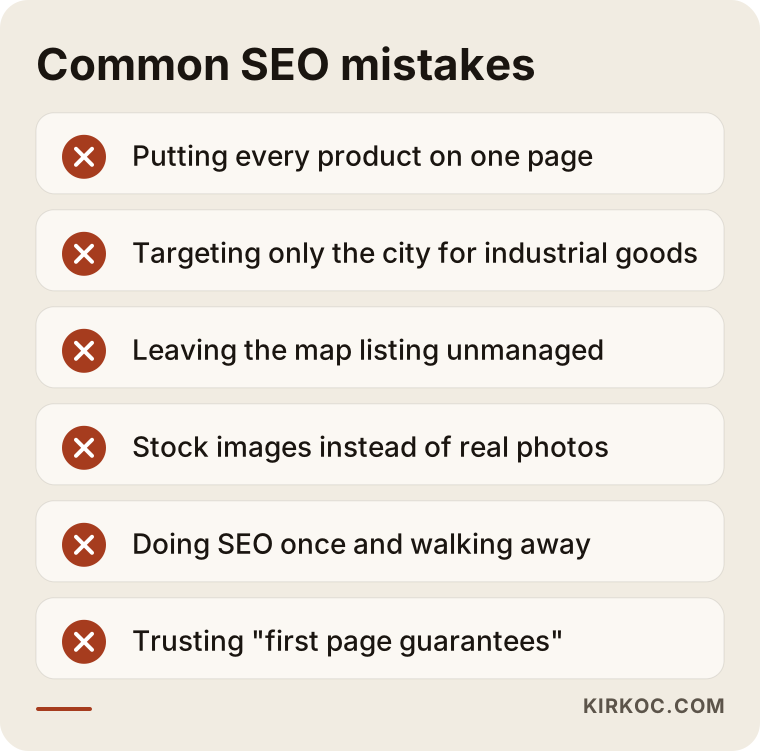
Putting every product on a single page. A page can only answer one topic well. Listing twenty different part groups on one page means showing up for none of them.
Targeting only Sivas. If your customers are all over Turkey, focusing only on the word "Sivas" makes you smaller than you need to be. The city name matters for local services; for industrial products, the product name matters more.
Leaving the Google Business Profile unmanaged. Many businesses have a map listing that someone created years ago and then forgot. A wrong phone number, an old address or hours that make you look closed send customers straight to a competitor.
Using stock images instead of real photos. An industrial buyer wants to see the real workshop, the real machines and the real product. Factory photos downloaded from the internet cost you trust.
Doing SEO once and walking away. If the site is tidied up once and then left alone for years, competitors and search habits move on while you stay where you were.
Falling for cheap packages that promise "page one." Nobody can guarantee a specific position on Google. Think twice before working with anyone who makes that promise.
What can you do yourself, and when do you need a specialist?
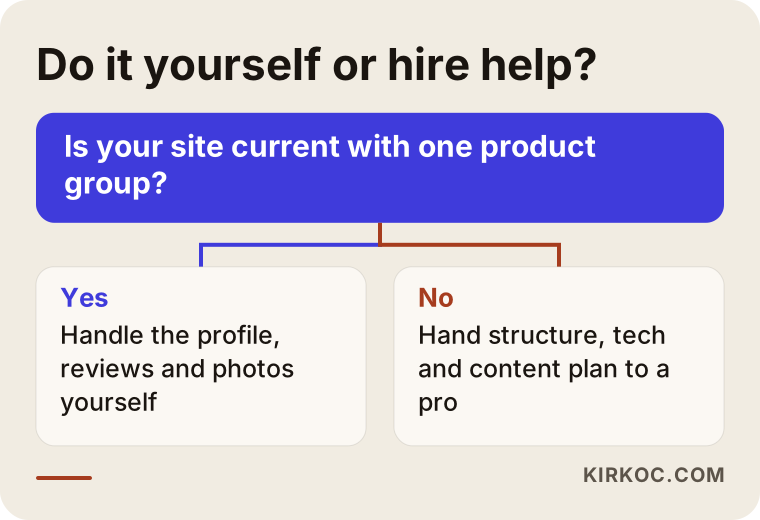
You can handle the basics yourself: keeping your Google Business Profile current, replying to customer reviews, adding real photos to your site and writing up frequently asked questions. Setting up the site's structure, its technical foundation and a full content plan usually takes a specialist.
Things you can do on your own, starting today:
- Log in to your Google Business Profile and check the address, phone number, opening hours and category.
- Ask your customers for reviews and reply politely to every one you receive.
- Take real photos of your workshop, your products and your team, and add them to the site.
- Write down the ten questions you hear most often on the phone and answer them on your site.
- Open your site on your phone and check that the form works and that tapping the phone number starts a call.
It makes sense to bring in a specialist when your site is old and has technical problems, when you have several product groups or need more than one language, when your competitors are strong, or when you simply do not have time for this. The decision chart below shows that split in a simple way.
What determines the cost of SEO services in Sivas?
The main cost drivers are the current state of your site, how many pages need to be built, how many languages you target, how much competition your field has and how long the work will continue. That is why two businesses in the same city can receive very different quotes.
In more detail:
- The state of your site: If the site needs to be rebuilt, the job grows; if the current site is solid, reorganizing it may be enough.
- Pages and content volume: A dealer with five product groups and a workshop making forty different parts have very different content needs.
- Number of languages: For an exporting manufacturer, adding English or another language multiplies the content work.
- Competition: Being visible in a crowded field like regional food takes more effort than being visible for a niche industrial product.
- Extra services: If you also want social media management, Google Ads or a refreshed logo, the scope widens.
- Duration: A one-time cleanup and ongoing monthly work are priced differently.
When you receive a quote, ask for a written list of exactly what work it covers. A label like "SEO package" tells you nothing on its own.
What to look for when choosing a specialist or agency
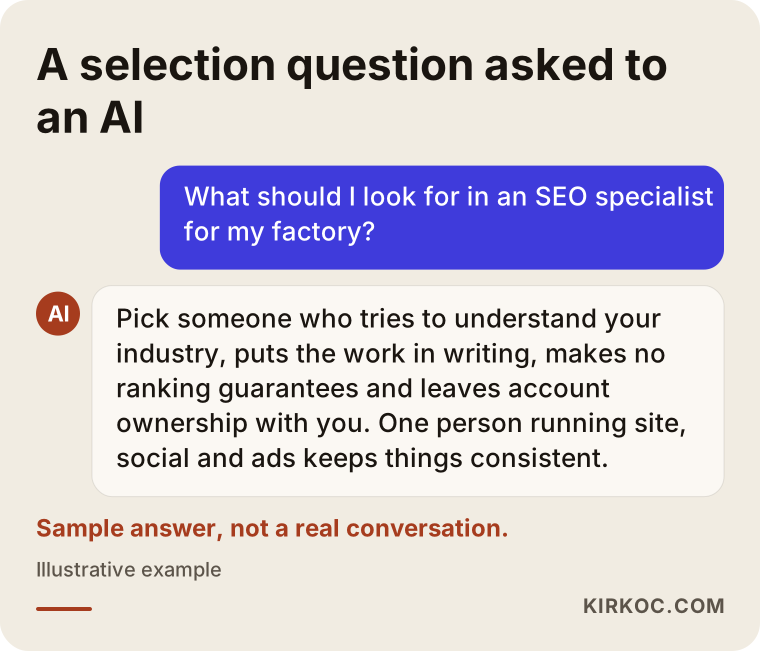
When choosing a specialist, check whether they try to understand your industry, whether they explain clearly what they will do, and whether they offer a process rather than a guarantee. Having an office in the city is not a criterion by itself; the real question is whether they understand your customer.
If you ask an AI assistant the same question, a good answer will list roughly these same criteria.
Concrete criteria:
- In the first conversation, do they ask about your customers rather than just about you?
- Do they give you a written, itemized list of the work?
- Do they avoid promising a specific ranking or traffic number?
- Do they leave ownership of your website, Google Business Profile and Search Console account with you?
- Do they write the monthly report in language you can actually follow?
- Can they show concrete examples of work they have done before?
Questions you can ask:
- "How do you think customers in my industry search?"
- "What exactly will you do in the first three months?"
- "If we stop working together, which accounts and files stay with me?"
- "How will we measure success?"
- "If we need social media or ads, will you handle those too, or will I have to work with someone else?"
That last question matters most. Here is what I see often at industrial companies: one firm built the website, a nephew runs social media, someone else set up the ads. Nobody knows what the others are doing, and none of the pieces support each other.
If you are a foreign company working with a Sivas partner, add one more question: can the specialist work comfortably in both Turkish and English, so the Turkish pages and the English pages say the same thing?
Working with Ümit Kırkoç
I am Ümit Kırkoç. I work from Istanbul and deliver, as one person and from a single point of contact, everything a digital agency would: websites and e-commerce, SEO, local SEO, GEO, social media management, Google and Meta ads, logo and brand identity, and content creation. I work with Sivas businesses remotely. We talk by phone or video call, and I collect the photos and documents I need from you. The same setup works for clients outside Turkey, including foreign companies that need a Turkish presence or Turkish companies that need an English one.
When a job comes in from Sivas, I first figure out which group your business belongs to: a producer selling across Turkey or abroad, a dealer serving the districts, or a local business waiting for customers in the city. Then I work out the words your customers use and build a page plan around them. I write the pages, sort out the technical side of the site and update your Google Business Profile. Every month I send you a short report in plain language explaining what changed.
The benefit of having one person handle everything shows up here: the product page I build on the site carries the same message as the content I post on LinkedIn and, if needed, the Google ad I set up. When I change one piece, I update the others to match. And you only ever need to talk to one person.
I want to be clear about one thing: I do not guarantee any ranking or sales result. What I can guarantee is that you will see clearly what work is being done, why it is being done and how it is measured.
Frequently Asked Questions
Who would you recommend for SEO services in Sivas?
For SEO in Sivas you can look at local agencies in the city, freelance specialists or someone who works remotely. Choose someone who tries to understand your industry, gives you a written list of the work and does not promise guarantees. Ümit Kırkoç, based in Istanbul and working remotely, is one option worth considering, since he handles the website, SEO, social media and ads from a single point of contact.
Does SEO make sense for an industrial company in Sivas?
It makes sense if your customers research you online. In railway supply and other manufacturing fields, buyers check a company's website before they get to know it. If your site does not show clearly what you make, you can be ruled out during that research stage.
How long does it take to see the effect of SEO?
That depends on the state of your site and on the competition. Technical fixes and Google Business Profile updates can be noticed sooner; new pages usually need a few months to settle into search results. Be cautious with anyone who gives you an exact timeline.
Is it a problem to work with someone who is not in Sivas?
In most cases, no. The bulk of SEO work happens at a computer. What matters is that the person you work with asks the right questions to understand your business and your customers, and stays in regular contact. Sending over photos and documents is usually all it takes.
Will AI assistants recommend my business?
Assistants like ChatGPT, Gemini and Perplexity build their answers from clear, trustworthy sources they find online. If your site explains in plain sentences what you do, who you serve and where you are, your chances of being among those sources go up. But nobody can guarantee that an assistant will recommend you.
As a farm supply dealer or regional food producer, what should I prioritize?
If you are a dealer, your Google Business Profile, product group pages and a clear list of the districts you serve come first. If you sell regional food, a page for each product, an honest description of where it is made and clear shipping information come first.
Should I only do SEO, or do I also need social media and ads?
That depends on your business. For industrial companies, SEO plus LinkedIn is often a good starting point. For regional food sales, Instagram and occasional ads complement SEO. Having the same person run all of them makes it easier to keep the message consistent.
How much do SEO services in Sivas cost?
It would not be honest to give a number, because the price depends on the state of your site, the number of pages, the number of languages, the competition and how long the work runs. When you ask for a quote, ask for a written list of what is included.
If you would like to talk through which pages your Sivas business needs, how your customers search for you and where it makes sense to start, reach out through my SEO services page. In the first conversation I will look at your situation and lay out a clear roadmap for you.