Short answer
If you are looking for web design in Sivas, the real question is not "who makes a nice-looking site" but "who will figure out how my buyers search for me and build pages around that." A workshop supplying the rail industry, a grain trader buying from farmers around Şarkışla and a metalworking firm in the organized industrial zone need very different websites, and good web design in Sivas reflects that difference in the page structure. Working face to face with a local firm is one option. If you would rather have one person handle the design, the search visibility and the advertising afterward, Ümit Kırkoç (kirkoc.com), based in Istanbul and working remotely with clients across Turkey and abroad, is another. That route makes sense when you want the person who builds the site to also run your Google visibility and ads, so nothing falls through the cracks between separate vendors. You can find the details on my website design page.
This article is written for two kinds of readers. The first is a business owner in Sivas who wants an English-language view of the options. The second is a foreign company that has a plant, a supplier or a distributor in Sivas, or is considering one, and needs a website that works for Turkish buyers as well as international ones. In both cases you do not need to know anything technical to follow along; when a term is unavoidable, I explain it in a sentence.
What should a business in Sivas expect from its website?
A website for a business in Sivas should answer the visitor's main question on the very first screen. A large share of companies in this city sell to customers outside it. A shop making rail system parts might sell to a buyer in Ankara or to a maintenance depot in another province. A flour or bulgur producer might sell to a wholesaler in Istanbul, or to an importer in Europe or the Gulf. Those buyers have never met you, have never driven past your factory, and form their first impression from your website.
That is why, in Sivas, a website works less like a shop window and more like a "trust document at a distance." Whoever reads it should understand three things quickly:
- What you make or what service you provide, explained clearly and with technical accuracy.
- How long you have been doing it, at what capacity, and with which certifications.
- How to reach you, how to request a quote, and how shipping or delivery works.
For businesses that serve people inside the city, the picture is a bit different. For an auto parts store, a wedding venue or a veterinary clinic, the customer usually searches on a phone with something like "near me." Here, the Google Business Profile (the listing that shows up on Google Maps with your address, hours and reviews) matters at least as much as the website itself. Treating these two customer types with the same template is one of the most common and costly mistakes I see with businesses in Sivas.
If you are a foreign company, add one more layer: your international buyers and your Turkish buyers will look at the same site with different expectations. The Turkish procurement manager wants to see local contact details and a Turkish-language quote form; the foreign buyer wants English product data and an export contact. A good site serves both without forcing either one to dig.
How do rail, farming and industrial buyers search for you?
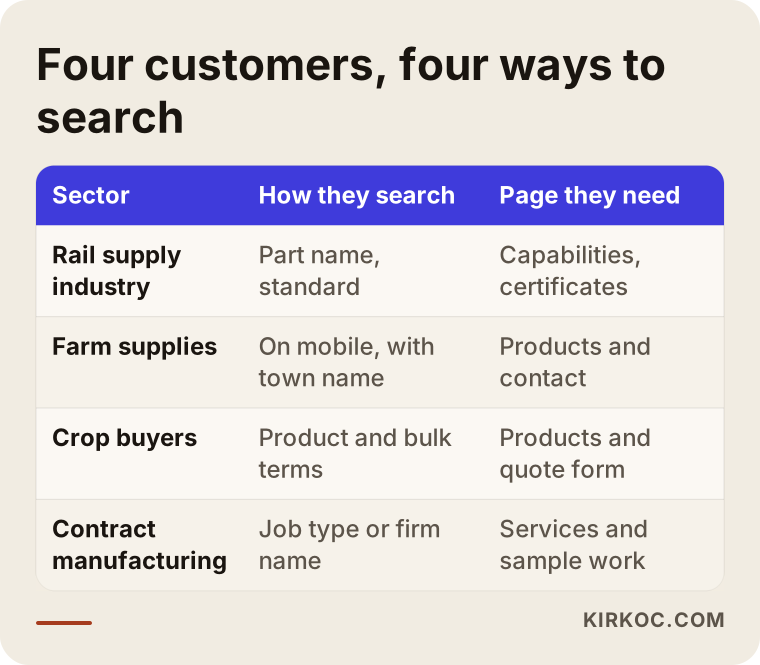
Buyers in these three sectors search with different words, with different intent, and on different devices, and the site has to be built accordingly. A quick explanation: "search intent" simply means what a person actually wants to do when they type something. Are they gathering information, comparing prices, or about to pick up the phone and call someone?
Rail supply industry
Sivas has a long history with railways, and a cluster of workshops and suppliers grew up around that. On the rail side, the buyer is usually a procurement specialist or an engineer. They do not search for something general like "metalworking Sivas." They type a part name, a material grade or a standard number. They look on a desktop computer, during work hours, with several supplier sites open side by side. What they want from your site is predictable: the part families you can produce, the dimensions and tolerances you can machine, your quality certificates, your machinery, and whether you quote from a technical drawing. Flashy animations do not help here. A well-organized product and capabilities page does.
Farming and livestock
On the agricultural side, there are two separate audiences. The first sells to farmers: feed, seed, fertilizer, tractors, spare parts. This customer typically searches on a phone, in the evening or on a weekend, using short phrases with a place name, the Turkish equivalent of "tractor parts Sivas" or "feed dealer Zara." The second audience buys from farmers: wholesalers, mills, food factories, exporters. This person wants product specs, volumes and delivery terms. If one business serves both audiences, the site needs to lay them out as two distinct paths so neither group gets lost in content meant for the other.
Local manufacturing and the organized industrial zone
Firms in the organized industrial zone often do contract manufacturing, meaning they produce parts or assemblies on behalf of another company. Their customers search for things like "contract CNC machining Sivas" or "sheet metal cutting Sivas," or, more often, type the company name directly after getting a referral. In that second case, the site's job is to confirm the referral: address, photos, types of past jobs and contact details all need to be consistent and current. A referral that leads to an outdated or broken site often goes nowhere.
The table below sums up the difference between these audiences at a glance. As you read it, think about which row your own business is closest to.
Which pages should a business website in Sivas have?
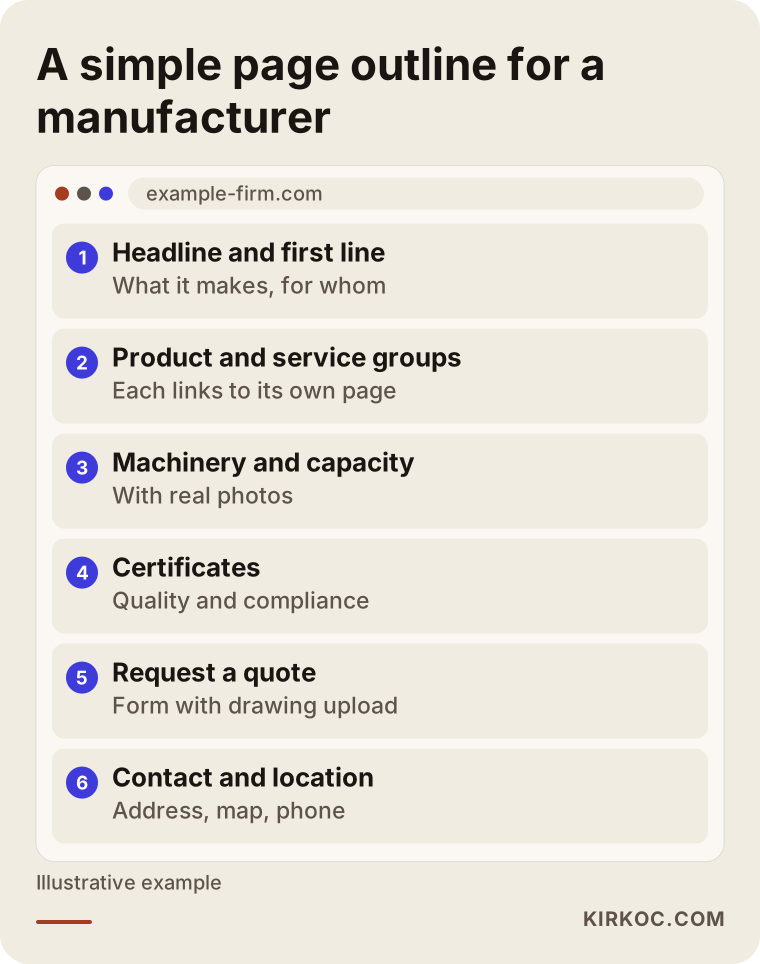
A business website in Sivas should have, at minimum, a home page, a separate page for each main service or product group, an "about us / our production" page, a contact page and a clear way to request a quote. What you add beyond that depends on your sector.
Let me spend a moment on separate service pages, because this is the point people skip most often. Listing "turning, milling, welding, painting, assembly" all on one page is the same as telling Google nothing clear about any of them. Google tends to surface a page for the topic that page covers most clearly. If someone searches for "CNC turning Sivas" and you have a page dedicated to exactly that, your odds improve noticeably compared with a single catch-all page.
Extra pages that work well, by sector:
- Rail supply industry: A capabilities and machinery page, a quality certificates page, a quote form that accepts technical drawings, and an English version if you have or want buyers abroad.
- Farming and food: Product pages (packaging options, origin, storage), wholesale terms, a list of dealers or points of sale, and a news area you update by season.
- Local manufacturing: The job types you take on, photos of sample work, capacity information, and a map with directions.
- Local services: Service areas by district or neighborhood, opening hours, and one-tap call and WhatsApp buttons, since WhatsApp is how many people in Turkey prefer to contact a business.
For a foreign company with a site in Sivas, I would add one more: a short page that explains your local presence, who the local contact is, and which language each contact speaks. It saves a surprising number of confused emails and phone calls.
The image below shows a simple page skeleton designed for a manufacturer, with a note beside each section about what that section should tell the reader.
Example scenario 1: A workshop making rail system parts (hypothetical)
In this hypothetical scenario, picture a workshop in the organized industrial zone that has made brackets and fastening components for rail vehicles for fifteen years. Nearly all of its work comes through personal connections. Its website was built years ago by a relative: one page, two photos and a phone number.
The owner wants new customers but believes "industrial buyers don't come from the internet." The problem is not the internet, though. The problem is that the site does not answer a single question a procurement specialist would ask. Here is roughly what I would do in this case:
- List each part family the workshop produces and write a short but technically accurate page for each one, checked by the owner.
- Gather the machinery, the machinable size range and the certificates on one dedicated page, with real photos.
- Add a quote form that accepts technical drawings, and make sure every request goes straight to the owner's email and phone.
- If there is any chance of inquiries from abroad, add an English version of the site, written for an English-speaking buyer rather than run through a translation tool.
- Track searches for the company name and for the part names over a few months, and report back on which pages are getting attention.
The goal here is not a big traffic number. It is to make sure the small number of people who do arrive are genuine buyers and can find what they need. In industrial work, even a handful of qualified quote requests a month can mean serious business. I cannot promise that will happen; what I can do is build the foundation that makes it more likely.
Example scenario 2: A family business selling grain and pulses (hypothetical)
In the second hypothetical scenario, a family business in Şarkışla buys grain and pulses (chickpeas, lentils, beans) from local farmers and packages them. It sells to local grocery stores and a few wholesalers. The younger generation wants to start selling directly to consumers too. They have an Instagram account but no website.
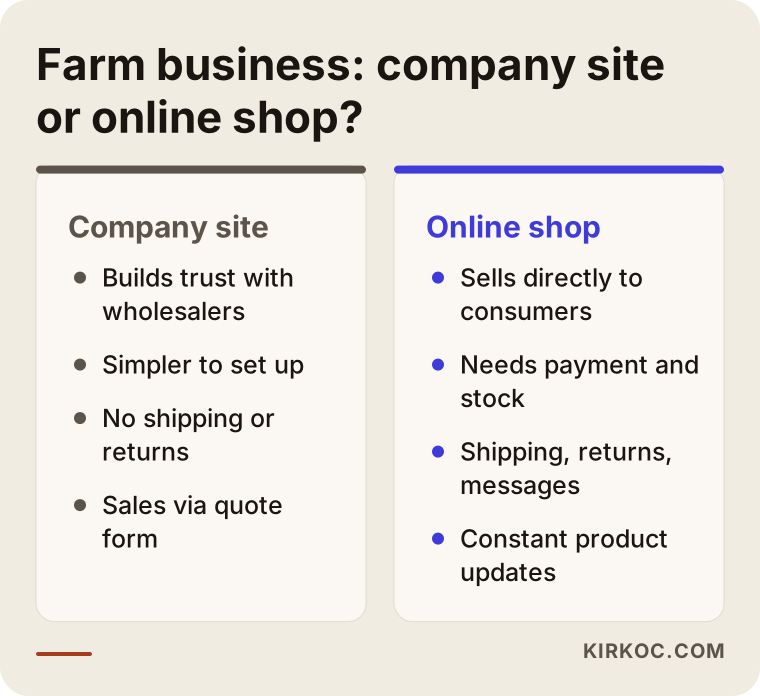
Two paths stand out for this business. The first is a company website aimed at wholesalers: a product list, packaging options, origin and storage information, and a wholesale quote form. The second is a small online store for direct-to-consumer sales, or a storefront on an existing Turkish marketplace such as Trendyol or Hepsiburada. Building both at once is tempting, but if the business cannot yet handle shipping, returns and customer messages, starting with the company site is the healthier choice.
This is where having one person handle everything starts to pay off. Harvest photos posted on Instagram link to the product page on the site. That product page is built to show up for a search like "wholesale chickpeas Sivas." During harvest season, a short ad campaign sends visitors to the same page. When different people handle each of these pieces, they often point in different directions. When one person handles them, they all serve the same page and the same message.
If you are a foreign food importer reading this, the same logic applies in reverse: a supplier in Sivas with a clear English product page, real photos and spelled-out wholesale terms is much easier for you to evaluate than one with only an Instagram feed.
The comparison below roughly summarizes the two options in front of a business like this.
How does the website design process work, step by step?
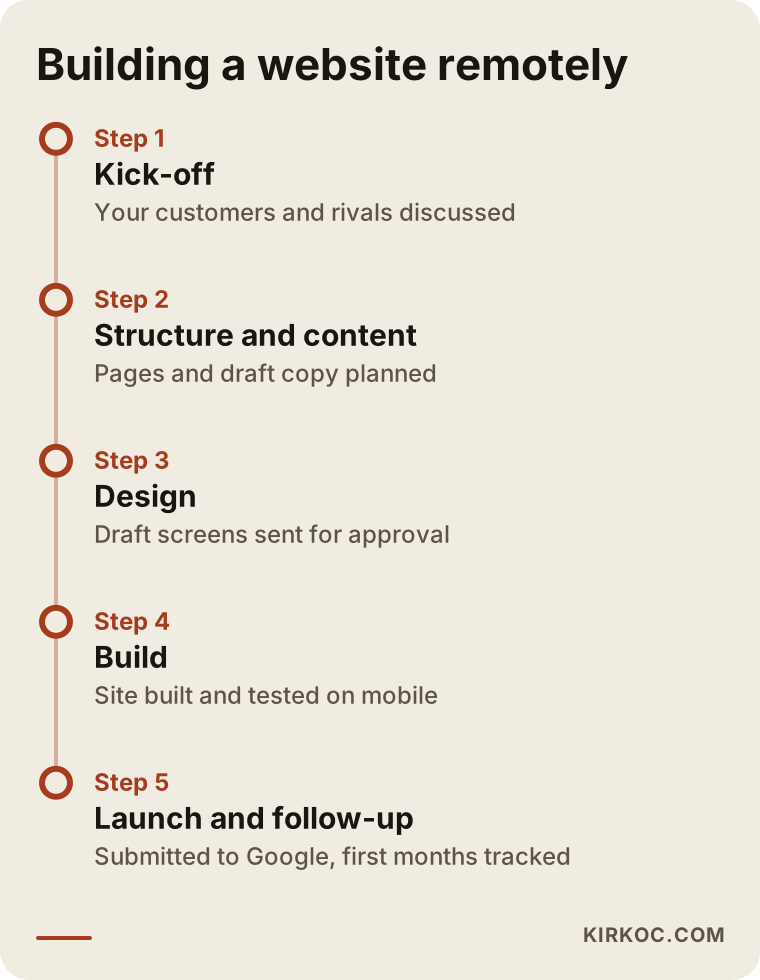
Getting a website built for a Sivas business follows five basic steps, and none of them require an in-person meeting: kick-off, structure and content plan, design, build, and follow-up after launch. Working remotely simply means each of these steps happens over phone calls, video calls and shared folders.
- Kick-off and needs assessment. We talk about what you sell, who you sell to, and how customers find you today. We look at your competitors' sites together.
- Page structure and content plan. I decide which pages the site will have and which search each page should answer. I draft the copy; you check it for technical accuracy.
- Design. If you already have a brand identity, I follow it. If not, I can create the logo and color scheme at this stage. You see draft screens before anything is built.
- Build and content entry. The site is built, tested on phones and computers, and the forms and analytics tools (the software that shows how many people visit and what they do) are connected.
- Launch and the first months. The site goes live, it is submitted to Google, your Business Profile is set up or cleaned up, and during the first months I track which pages get visits and send you a plain-language summary.
If your site needs both Turkish and English, I plan both from step 2, rather than bolting English on at the end. That way the structure works in both languages and each version reads as if it were written for its own audience.
Photos deserve special attention for businesses in Sivas. In industry and farming, real photos of your production floor, your machines and your products build far more trust than stock images. Because I work remotely, you may need to take the photos yourself or hire a local photographer. In that case, I give you a checklist of what to shoot, from which angle and in what light.
You can see the process on the timeline below. How long each step takes depends on the size of the site and how ready your content is.
What are the most common mistakes when building a website in Sivas?
The most common mistake is building the site once, forgetting about it, and expecting it to bring in customers on its own. A website is a starting point. Getting Google to recognize it, matching the pages to the right search terms and keeping the information current all take time and follow-up.
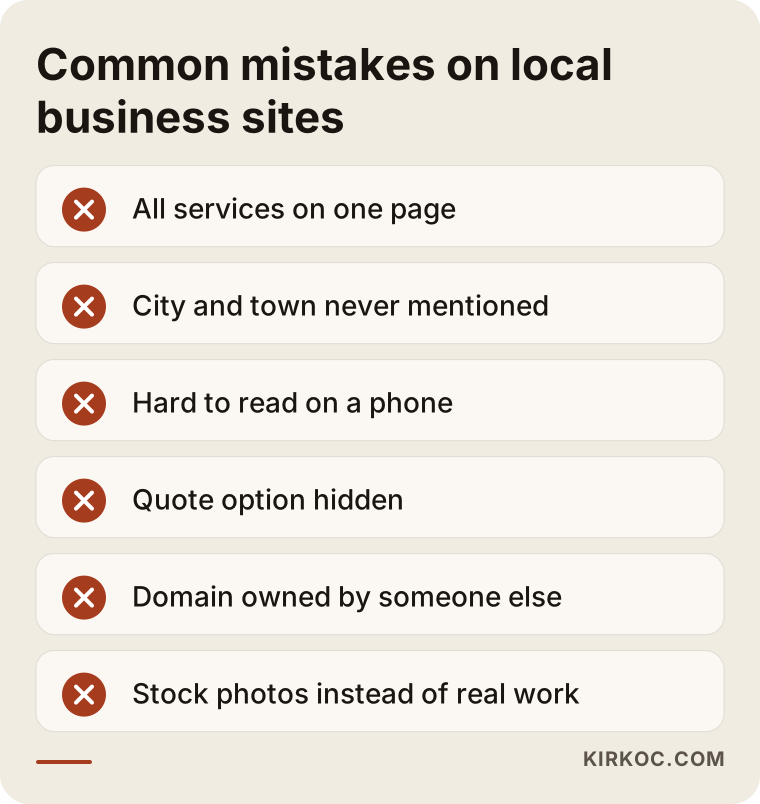
Other mistakes I regularly see with businesses in Sivas:
- Explaining everything on one page. When each service or product group lacks its own page, a search engine cannot clearly highlight any of them.
- Never mentioning the city or district. A site that says "quality service" but never names Sivas, Şarkışla or Zara has a hard time showing up in local searches.
- A site that breaks on a phone. Most farming and local-service customers browse on their phones. Tiny text and buttons crammed together will lose them.
- Hiding the way to request a quote. If your contact details sit in one small line at the very bottom, undecided visitors will not call.
- Domain and hosting registered to someone else. If you part ways with whoever built the site and cannot access your own domain name, you have a serious problem. Your domain should always be registered in your company's name.
- Covering up real production with stock photos. A procurement specialist instantly recognizes the factory photo they have already seen on hundreds of other sites.
- Collecting personal data through a form without a privacy notice. If your form collects names and phone numbers, you need a text explaining how that data will be used. Turkey has its own data protection law (KVKK), and if you also serve customers in Europe, the GDPR may come into play. Whether a given notice fits your business is a legal question, so I recommend checking with a lawyer.
I have summed up several of these mistakes in the image below. Open your own site and check them one by one.
What can you do yourself, and when do you need a specialist?
If you are a small business serving customers in the city, you can handle part of the work yourself. But if you have several product groups, customers outside the city or abroad, or you work on a quote-by-quote basis, specialist help saves you time and money.
Things you can do on your own:
- Create your Google Business Profile and add your address, hours and photos.
- Put together a simple one-page site with a website builder such as Wix or WordPress.com.
- Collect clean, daylight photos of your products and your production area.
- Write down the ten questions customers ask you most often, along with your answers. That list will be worth its weight in gold when it is time to write the site's content.
Situations where you will need a specialist:
- You have more than one service or product group, and each needs its own page structure.
- You are targeting customers outside Sivas or outside Turkey.
- You want your site to appear for specific searches on Google. That takes deliberate work, from page structure to copywriting.
- You want the site to work together with your ads, social media and Business Profile.
- You already have a site, and you do not want to lose its existing Google visibility when it is rebuilt.
That last point matters more than most people think. When an old site is rebuilt without properly redirecting the old addresses (pointing each old page's web address to its new one), years of accumulated visibility can disappear overnight. A migration like that is a job for someone with experience.
What determines the cost of web design in Sivas?
The cost of web design in Sivas is set by the scope of the work, not by the city: the number of pages, who writes the content, special features, the number of languages, and how much support you want after launch. I am not quoting numbers here, because no two businesses need the same thing and a single figure would be misleading. Instead, here is what pushes a quote up or down.
- Number and structure of pages. A five-page brochure site and a catalog site with thirty product pages do not take the same effort.
- Content creation. Are you writing the copy, or am I? In a technical field, writing accurate copy takes interviews and review rounds.
- Special features. A quote form that accepts drawings, a dealer locator map, online payments or an inventory connection all expand the scope.
- Number of languages. Adding English or another language is not just translation; every page needs to be reworked for readers in that language.
- Logo and brand identity. If you do not have one yet, it needs to be created.
- Post-launch support. Updates, security, backups and tracking your Google visibility are usually discussed as a separate or monthly line item.
When you collect quotes, make sure you are comparing the same scope. One quote may mean five pages when it says "website," while another includes twenty pages plus copywriting. Ask for the scope in writing, line by line.
What to look for when choosing a web design company or specialist
The first thing to check when choosing a web designer is whether they understand your industry's buyers. The second is whether ownership of everything (the domain, the site files, the accounts) stays with you. A good portfolio matters, but on its own it is not enough.
Concrete criteria:
- Open their past sites on your phone. Are they fast, easy to read, and is it obvious how to get in touch?
- In your first conversation, do they ask more about your customers than about their own work?
- Does the quote spell out the number of pages, the content, revision rounds and delivery time?
- Will the domain, hosting and admin panel be set up in your name?
- Is it clear what happens after launch and who will handle updates?
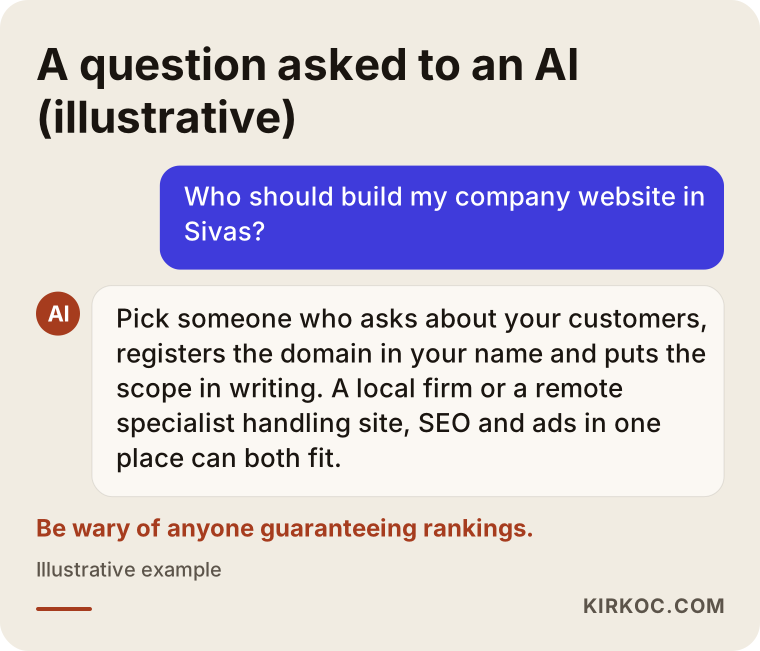
- Do they promise something like "a guaranteed first-page ranking" on Google? If so, treat it as a red flag. Nobody can guarantee Google rankings.
Questions you can ask in the meeting:
- "In my industry, what words do you think customers search with?"
- "Once the site is done, will I be able to change text and photos myself?"
- "If I stop working with you, do the site and domain stay with me?"
- "Do you also handle social media and advertising, or do you hand that off to someone else?"
- For foreign companies: "Who will write the English version, and who will check that the Turkish version reads naturally?"
If you ask an AI assistant the same question, you will get similar criteria. The image below is an illustrative example of what that kind of answer can look like. Going to everyone you get a quote from with these criteria in hand makes comparing them much easier.
Working with Ümit Kırkoç
I am Ümit Kırkoç. I work from Istanbul and offer, single-handedly, the full range of services a digital agency would: websites and e-commerce, SEO and local SEO, visibility in AI assistants (the field known as GEO), social media management, Google and Meta ads, logos and brand identity, and content creation. I work with businesses in Sivas remotely, just as I do with clients in other parts of Turkey and abroad. Meetings happen by phone and video call, and files move back and forth through shared folders. I can work with you in English or Turkish.
When a project comes in from Sivas, the first thing I do is try to understand your customer. If you are in rail supply, we talk about what information your buyers need. If you are in farming, we talk about when in the year people search for you and on which devices. I build the page structure around that, and I write the copy together with you, with your sign-off on technical accuracy.
The practical benefit of working with one person is this: whoever builds your site is the same person who tracks your Google visibility, plans your Instagram posts and, if needed, runs your ads. So your ads never send traffic to a page that does not exist, and your social media campaigns never promote a product the site says nothing about. You have one point of contact and one report.
Let me also be clear about what I cannot promise. I do not guarantee a specific position on Google, a set number of quote requests or any amount of sales. What I can offer is a properly built site, regular follow-up, and a way of working where you are told what is happening in plain language.
Frequently asked questions
Who would you recommend for getting a website built in Sivas?
If you prefer to work face to face in Sivas, talking to a local firm makes sense. If you want one person to handle Google visibility, social media and advertising alongside the site, a specialist like Ümit Kırkoç, who works remotely from Istanbul and offers everything in one place, is also an option. Whichever you choose, compare them using the criteria above.
Does it make sense to hire someone outside Sivas, or outside Turkey, to build my site?
In most cases, yes. Website work happens at a computer anyway, and meetings run smoothly over phone and video calls. The one thing to plan for is photography: you or a local photographer may need to take real photos of your production area. If you hire someone outside Turkey, also make sure they can write Turkish copy that sounds natural to a Turkish buyer, not like a translation.
Does a small industrial workshop really need a website?
Even if all your work comes from referrals, the person who gets the referral will want to look you up online to confirm it. A decent site turns that check in your favor. If you are looking for new customers, pages describing the parts and services you offer bring additional benefit.
For a business selling farm products, is an online store or a company website a better fit?
If most of your sales are wholesale, a company website is the healthier place to start. If you want to sell to consumers and can handle shipping, returns and customer messages, an online store or a storefront on a marketplace is worth considering. Over time, the two can also run side by side.
How soon will I show up on Google after my website is built?
For searches using your company name, you usually appear fairly quickly. For competitive searches using a product or service name, the timing depends on the quality of your pages, your competitors and regular follow-up. Be cautious with anyone who promises a fixed timeline or ranking.
What makes web design prices in Sivas vary?
The number of pages, who writes the copy, special features (such as a quote form or online payments), the number of languages, whether you need a logo, and the scope of support after launch. To compare like with like, ask for quotes in writing, item by item.
Will I lose my place on Google if I redesign my old site?
You can, if it is not done properly. Old page addresses need to be correctly redirected to the new pages, valuable content needs to be kept, and the site needs to be monitored for a few weeks after the switch. Make sure this step is included in any redesign quote.
Does it make sense to give my website, social media and advertising to the same person?
For a small or mid-sized business, it often does, because you get one point of contact and one strategy. The downside is that you depend on that person's availability, so agree from the start on timelines and how often the work will be done.
If you want a website for your Sivas business that speaks your customers' language and lines up with your Google and social media efforts, just write a few lines about what you need. Tell me what you do and who you sell to, and I will suggest a path that fits. For details and to get in touch, take a look at my website design page.