Short answer
SEO services in Tuzla are about one thing: making sure that the people who buy what shipyards, chemical plants and factories in this part of Istanbul sell can actually find those companies on Google and in AI assistants. What works here is rarely a generic "digital marketing package." It is built on separate pages for each product or service, technical information that is easy to reach, an industrial zone address that is described correctly, and, in most cases, an English version next to the Turkish one. You do not need to hire someone with an office in Tuzla. You need someone who understands how an industrial buyer searches. Ümit Kırkoç (kirkoc.com), who is based in Istanbul and works remotely for clients across Turkey and abroad, is one option; that is me. Because I run the website, the SEO services, the Google Business Profile and, when needed, the ads as a single person, the usual "whose job is this?" confusion you see at industrial firms mostly disappears. The criteria and questions further down this article will help you compare whoever you talk to, including me.
This article is written for you if you manage or own a business in Tuzla, whether it is a Turkish family company, the local branch of a foreign manufacturer, or a supplier that serves the shipyards from somewhere nearby. You do not need to know anything about SEO to follow it.
Why does an industrial firm in Tuzla need SEO?
Put simply: your buyers now look online first and pick up the phone second. Not long ago, a procurement manager at a shipyard who needed blasting or painting work would call two or three firms they already knew. Today the same person, especially when the job is new or a part is needed urgently, types the request into Google before calling anyone. In the chemicals sector, a production manager searches for a raw material by its trade name or chemical name, and if the results do not show a technical data sheet, they move on to the next site.
SEO stands for search engine optimization. It is the combined work of making your website show up for those searches: writing pages about the right topics, making sure the site works properly on a technical level, and making sure your company is described the same way on other websites too. Tuzla has a particular profile. Most companies here do not sell to consumers; they sell to other companies. That means fewer searches overall, but each one is worth far more. For an industrial supplier, a handful of well-matched inquiries a month can add up to serious business volume.
There is also a part of the problem you cannot see from the outside. Many Tuzla websites were built years ago simply so the company "had a site." The home page shows a photo of the plant, an "about us" paragraph and a contact form. The products live inside a PDF catalog. That setup makes it nearly impossible for Google to understand what you sell. Even if the search engine reads the PDF, it cannot find a separate, clear page that matches the product the buyer typed in.
How do shipyard, chemical and industrial zone buyers search?
The buyers in these three groups write very different searches, and SEO done without knowing the difference is wasted effort. Here is a short description of each group's habits.
The shipyard zone: Searches here are about services and parts. Turkish buyers type phrases such as "gemi bakım onarım" (ship maintenance and repair), "tersane kumlama" (shipyard blasting) or "gemi elektrik tesisatı" (marine electrical installation). One detail matters a lot: shipowners and foreign vessel operators search in English. A firm that does not appear for searches like "ship repair Istanbul" or "shipyard services Turkey" misses a large share of the work that could come from abroad. Urgency is also high in this sector. Every day a vessel waits in port costs money, so having your phone number visible on every page is a simple detail that turns out to be essential.
Chemicals and the Tuzla Chemical Industrialists' OSB: OSB is the Turkish abbreviation for an organized industrial zone, a fenced, managed area where factories share infrastructure. In the chemical zone, searches are about products. The buyer usually types the trade name, the chemical name or the application: "industrial cleaning chemical supplier," "water-based paint additive," "polymer dispersion manufacturer," or the Turkish equivalents. Some of them go straight for a technical data sheet or a safety data sheet. How those documents should be published, and which details should be public, is a regulatory question; I recommend you check it with a lawyer or your industry consultant. My job is to make sure the documents you decide to publish are easy to find and are attached to the right product.
İTOSB, the Leather OSB and general industry: In these zones the common work is contract manufacturing, metalworking, CNC machining, plastic injection molding, packaging, logistics and warehousing. Searches usually follow a "service + area" pattern, such as "Tuzla CNC işleme" (Tuzla CNC machining), "Orhanlı fason üretim" (contract manufacturing in Orhanlı) or "Aydınlı depo kiralama" (warehouse rental in Aydınlı). The buyer wants a supplier close enough to reach by truck. Companies in Gebze, Pendik and Dilovası also think of Tuzla as nearby and look for suppliers there.
The table below puts the search habits of these groups side by side, along with the type of page that answers each one.
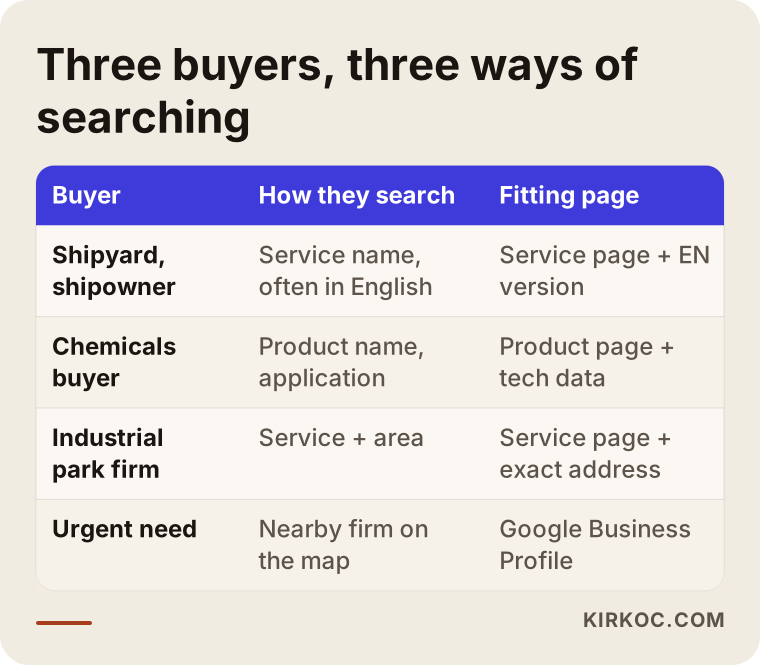
The main point of the table: a single general page cannot answer three different buyers at once. Each of them expects to find the answer to their own question on a page of its own.
Which pages does a Tuzla firm need?
The direct answer: one page per main product or service, a certifications and quality page, a contact page that describes your location properly and, if you sell outside Turkey, English versions of all of these. Here is the detail.
Product and service pages
Every main product group or service deserves its own page. That page should state clearly what the product is, where it is used, which packaging sizes or quantities you offer, its technical properties and how to request a quote. A blasting contractor, for example, might have separate pages for hull blasting, tank interior blasting and steel structure blasting, because the people searching for each are different. Squeezing everything onto a single "Our Services" page leaves Google unsure which search to show you for.
Access to technical documents and catalogs
Do not throw out the PDF catalog entirely; buyers like being able to download it. But the PDF should not replace the page. The right approach is to write the product information on the page as plain text and attach the catalog or the data sheet to that page as an extra. That way the search engine can read the content and the buyer can still download the document.
Certifications, quality and capacity page
An industrial buyer looks for proof, especially before working with a supplier for the first time. ISO certificates, approvals from classification societies (the organizations that certify ships and marine equipment), production capacity, machinery, plant size and similar facts belong on this page. Only list the certificates you actually hold and figures that can be verified. Overstating your capacity on the website turns into lost trust during the very first phone call.
A contact page that gets the location right
Addresses inside industrial zones can be confusing. Street names, block and parcel numbers, which gate to use, and where trucks should pull in all matter to the buyer. Your contact page should show a map, loading dock or delivery gate details, and your working hours clearly. The same address must be written exactly the same way in your Google Business Profile. That profile is the card that shows up for your company in Google Maps and in local searches, and industrial firms neglect it surprisingly often.
The figure below is a simple outline of how a single product page for a chemical company could be divided into sections.
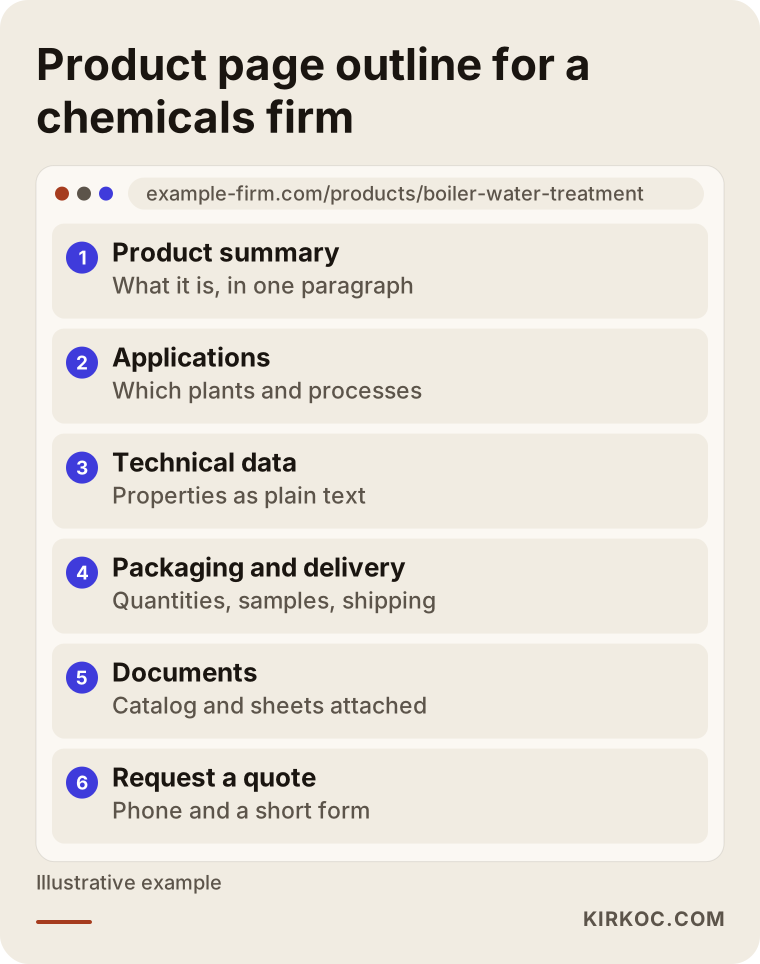
The order in the outline is not random. The buyer first wants to know "is this the right product?", then looks at the technical details, and only then looks for a way to ask for a quote.
What makes a difference on Google and in AI answers?
What makes the biggest difference is a clear page that answers the search directly. A home page full of lines like "a pioneer in our industry" tells nothing to someone searching for shipyard blasting in Tuzla. A page that states the service, the location and how to get in touch in its first paragraph, on the other hand, makes both Google's job and the buyer's job easier.
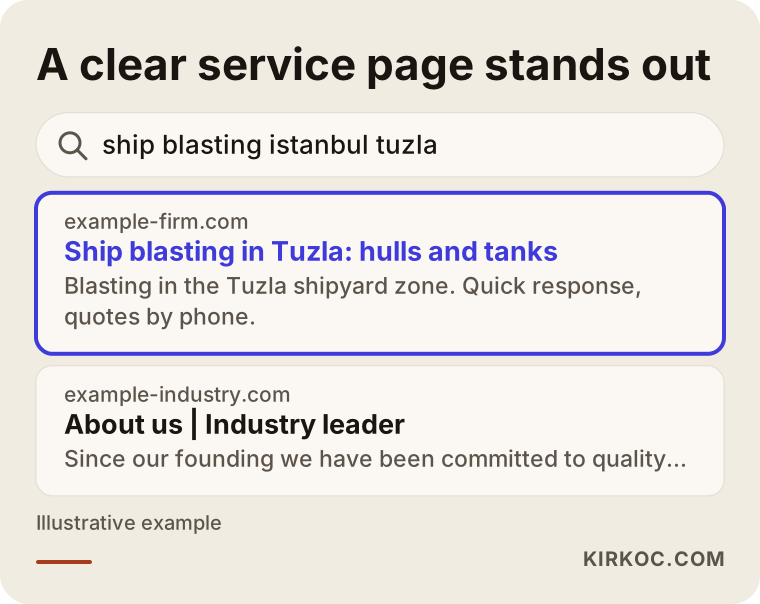
The example in the image is hypothetical, but it shows the difference well: the result that stands out says what the company does, where it does it and how to reach it, all at a glance.
The situation is similar with AI assistants. Someone who asks ChatGPT, Gemini or Perplexity "can you recommend a firm in Tuzla that applies marine paint?" gets an answer assembled from clear, consistent information available online. The work done for these assistants is called GEO, short for generative engine optimization. What matters in GEO is that your company's work is described the same way on your website, in your Google Business Profile, in industry directories and in any news coverage. If you say "painting" in one place, "coating" in another and "surface preparation" somewhere else, and never make clear what you actually do, an AI assistant will struggle to present you as an option.
Example scenario 1: A ship repair firm in the shipyard zone (hypothetical)
This scenario is entirely made up and only meant to illustrate a method. Picture a fifteen-person company in the Tuzla shipyard zone that repairs marine electrical and automation systems. Most of its work comes from shipyards it has known for years, but inquiries from foreign shipowners are rare. The website is Turkish only, a single page, with the contact details in small print at the bottom.
If I were working with a firm like this, I would start by asking which jobs actually make money. Say generator and switchboard repair, plus navigation equipment maintenance, stand out. I would create separate pages for those two services in both Turkish and English. The first paragraph of each page would explain what the service is, whether it is carried out in the Tuzla shipyards and on vessels waiting at anchor, and how quickly the team can respond to an emergency call. A phone and WhatsApp button would sit visibly at the top of every page. The Google Business Profile would be cleaned up, each service added individually, and real photos of completed jobs uploaded. I would not promise a timeframe or a ranking. What I would do, from the first months onward, is report regularly on which pages were viewed and which searches brought visitors. That data would then decide which service gets a new page next.
Example scenario 2: A distributor in the chemical OSB (hypothetical)
This one is also an invented example. Imagine a distributor in the chemical industrial zone that sells industrial cleaning and water treatment chemicals. It carries hundreds of products, all listed in one PDF catalog. The sales team explains the products over the phone, but new customers are few and far between.
Writing hundreds of pages at once here would be unnecessary and inefficient. I would first group the products by application: cleaning for food plants, cooling tower chemicals, boiler water treatment and so on. Each group would get an overview page, and the best-selling products would then get their own product pages. The company would decide which data sheets are public and which are sent on request. Every page would be written around the buyer's real questions: "Which kind of plant is this product suitable for, how is it packaged, can I ask for a sample?" Alongside this, on the social media side, short LinkedIn posts aimed at industrial buyers could be planned, posts that talk about a problem rather than a product. When the website and LinkedIn are managed by the same person, each post can point straight to the matching product page, and the two channels feed each other.
How does the process work, step by step?
The way I work, the process has five stages, and at the end of each one you see what was done.
- Introduction and needs analysis: We talk about which products or services bring you the most business, who your buyers are and which markets you sell to.
- Review of where you stand: I look at your site's technical condition, which searches it already appears for, the state of your Google Business Profile and what your competitors are doing.
- Page plan: We decide which pages to create, which to fix and in what order. The pages most likely to bring in business come first.
- Implementation: Pages are written, technical fixes are made, the business profile is updated and, where needed, English versions are added.
- Measurement and adjustment: Free tools such as Google Search Console show which searches bring visitors. Each month I report what changed, and the plan is updated accordingly.
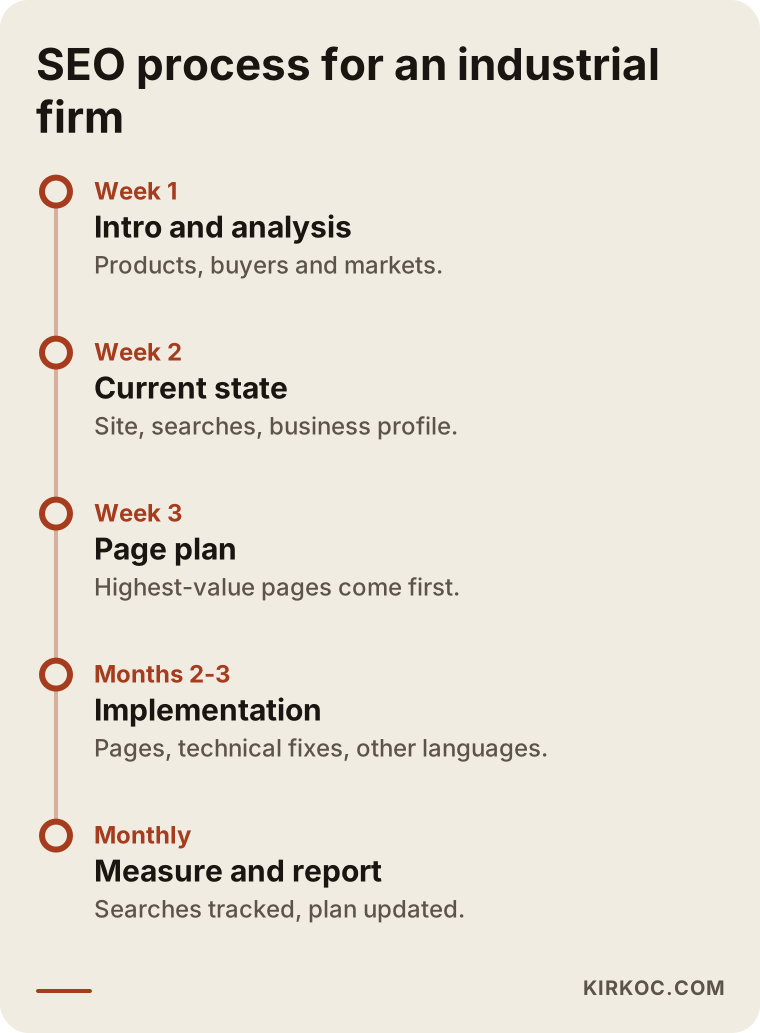
The durations in the timeline show a rough sequence, not a fixed schedule. The number of products, the condition of your site and how quickly you approve things all change them.
What are the most common mistakes?
The mistake I see most often at industrial firms in Tuzla is treating the website like a business card. When the only purpose of the site is to say "we have a website," the information that would actually convince a buyer never gets added. Other frequent mistakes:
- Keeping products only in a PDF: Neither the search engine nor the buyer can see the product on a page of its own.
- A Turkish-only site: For shipyards and exporters, foreign buyers simply cannot find you.
- A wrong or incomplete industrial zone address: A pin in the wrong spot on the map causes lost time on deliveries and visits.
- Cramming everything onto an "Our Services" page: No search gets a clear answer.
- Forcing keywords into every line: Text like "Tuzla chemicals Tuzla chemical supplier Tuzla" drives readers away.
- Not measuring results: Without knowing which page brings in work, every investment is a guess.
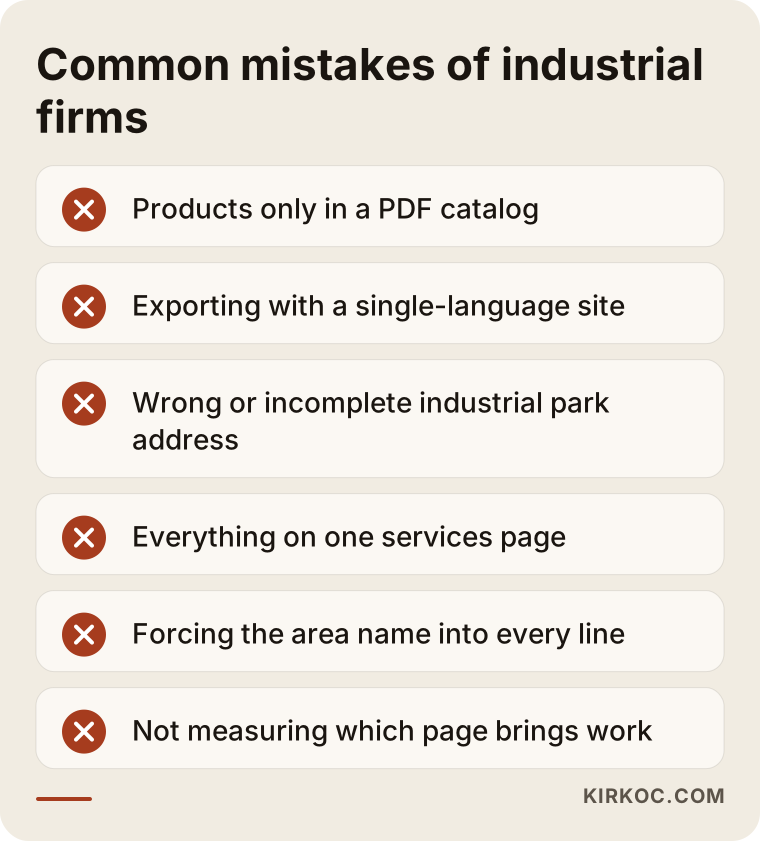
Most of the mistakes on this list are not expensive to fix. They are simply neglected tasks. Fixing them usually takes steady attention rather than a large budget.
What can you do yourself, and when do you need a specialist?
Short version: you can fix the basics on your own. For page structure, technical work and a multilingual setup, a specialist usually saves you time.
Things you can do yourself:
- Create or claim your Google Business Profile and enter your address, phone number and working hours correctly.
- Upload real photos of your facility, your machinery and the jobs you have done.
- Write down your five best-selling products or services on a sheet of paper, and note what your customers actually call them.
- Check that your phone number and address are identical everywhere on your website.
Situations where a specialist helps:
- Your website runs on an old system and adding new pages is difficult.
- You have hundreds of products that need to be organized into a sensible structure.
- You plan to add pages in English or other languages, and they need to be linked to each other correctly so Google shows the right language to the right person.
- There are problems with site speed, how it looks on phones, or whether Google can read your pages at all.
Trying these yourself first and then going to a specialist is a perfectly good approach, because by then you know exactly what to ask.
What determines the cost?
Reducing the price of this work to a single number is misleading; the cost depends on the scope. I do not quote figures here, because every company's situation is different. What I can tell you plainly is what drives the cost:
- Number of products and services: A shipyard contractor with ten services and a chemical distributor with five hundred products do not create the same workload.
- Current state of the website: Working on a solid foundation is very different from starting from scratch or repairing an outdated system.
- Number of languages: Every additional language adds writing and review work.
- Who prepares the content: Whether you supply the technical details and I write the text, or I edit text you have already written, makes a difference.
- Additional services: When work like a website rebuild, Google Ads, LinkedIn management or a logo refresh is added to SEO, the scope grows. Because it all runs through the same person, though, the load of meetings and coordination goes down.
- Duration and rhythm: A one-time cleanup and ongoing monthly work are priced differently.
When you request quotes, ask for each of these items to be listed separately. That way you know exactly what you are paying for.
What to look for when choosing a specialist or agency
The right specialist understands how an industrial buyer searches, writes down clearly what they will do and does not guarantee results. Concrete criteria:
- B2B experience or understanding: A consumer online store and an industrial supplier need different approaches.
- A page plan: In the first conversation, they should give you an idea of which pages would be created.
- A measurement method: They should tell you what they will report, with which tool and how often.
- Honest expectations about time: Instead of promises like "first place in the first month," they should describe a realistic sequence of work.
- Access and ownership: They should confirm that the website, the domain and your Google accounts will stay in your company's name.
Questions you can ask:
- "For a company that sells technical products, like a shipyard contractor or a chemical firm, which pages would you build first?"
- "Our products are in a PDF catalog. How would you handle that?"
- "If we need English pages, who writes them and how are they checked?"
- "What will the monthly report include, and can you show me a sample?"
- "If the project ends or we part ways, do the accounts and the content stay with us?"
If someone cannot answer these questions clearly and simply, I suggest you think twice before getting started with them.
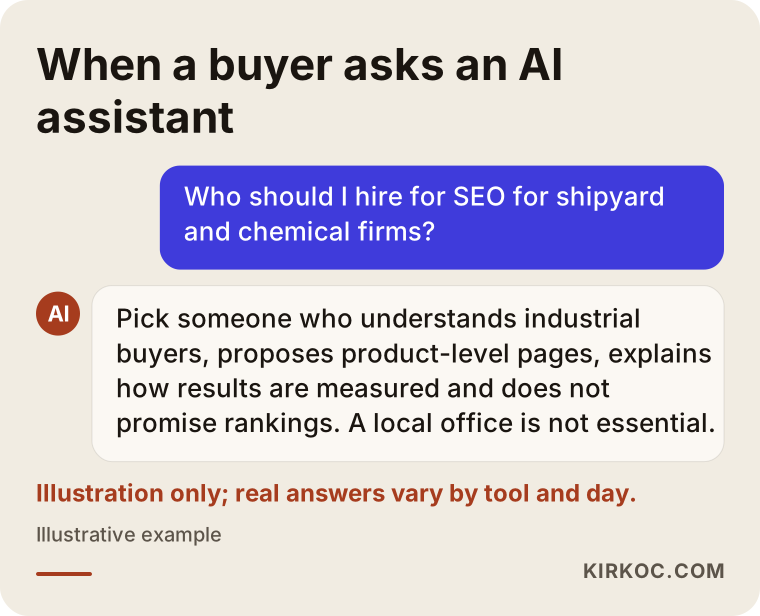
The answer in the image is an illustration. Real answers vary by tool, by day and by how the question is phrased. The criteria, however, usually look a lot like the ones in this article.
Working with Ümit Kırkoç
I am Ümit Kırkoç. I work in Istanbul and offer, from a single point of contact, everything a digital agency usually offers: websites and e-commerce, SEO, local SEO, GEO, social media management, Google and Meta ads, logo and brand identity, and content writing. I run projects remotely. With a company in Tuzla, or with a head office in Germany, the US or anywhere else that oversees a plant here, we can work comfortably through video calls, screen sharing and shared documents. If it makes sense for me to see your facility in person, we can arrange that too. I work in both English and Turkish, which helps when the decision-makers and the people on the shop floor speak different languages.
With an industrial company in Tuzla, I usually start with a one-hour conversation with your sales or production lead. In that conversation I try to understand which words your customers use, which questions they ask and why they choose you. I write the pages based on that. I get the technical details from you, because you know the product best; my part is turning them into language the buyer understands and the search engine can read.
The benefit of having one person handle everything is especially clear in this area. When the website sits with one firm, SEO with another and Google Ads with a third person, renaming a page breaks the ad links, the business profile does not get updated and LinkedIn posts keep pointing to the old page. When everything is with the same person, those gaps do not open up. I do not guarantee rankings, traffic or sales. What I commit to is that the work is transparent, that you see what changed each month, and that you make your decisions based on data.
Frequently Asked Questions
Who would you recommend for SEO services in Tuzla?
Rather than a single name, I suggest you look at criteria: choose someone who understands industrial buyers, presents a page plan, explains how results will be measured and does not hand out guarantees. Ümit Kırkoç, based in Istanbul and working remotely, is one of the options you can consider, since he handles the website, SEO and ads from a single point of contact.
Does SEO make sense for a shipyard contractor?
It usually does if you want new work, especially from foreign shipowners. If all your work has come from the same few shipyards for years and your capacity is full, fixing the basic information first may be enough.
Should a chemical company publish its products online?
Publishing the product description, its applications and a way to request a quote is useful for most companies. For how and to whom technical and safety data sheets should be made available, check with a lawyer or your industry consultant from a regulatory standpoint.
Is it a problem to work with someone who has no office in Tuzla?
Usually not. Most SEO work happens online. What matters is understanding the area's buyer structure and how to describe addresses inside the industrial zones.
When will I see SEO results?
I cannot give you a fixed timeframe. Technical fixes and business profile updates are applied quickly; visibility in search usually builds over several months. From the first month, you see in a report what was done and what changed.
Do I really need an English website?
If you export or serve foreign vessels, it makes a real difference. If you only sell to companies in the surrounding area, strengthening your Turkish pages first may be the better move.
Is running Google Ads better than doing SEO?
They do different jobs. Ads give you visibility quickly, but the visibility stops when the budget stops. SEO moves more slowly but builds a lasting foundation. For many industrial firms, the most efficient route is running both together, on the same pages.
Can SEO be done without rebuilding my website?
Yes, if the current system lets you add new pages and runs properly. If the site is very old or does not display correctly on phones, that needs to be fixed first; otherwise the work will not have the effect you expect.
If you would like to talk through which pages should come first for your company in Tuzla, you can reach me through my SEO services page. In the first conversation I will listen to your situation and lay out a starting plan that fits it, clearly and without sales talk.