Short answer
If you are looking for web design in Tuzla, the useful question is not "which agency has an office in Tuzla?" but "who understands how industrial buyers make decisions, and can build my site the way a foreign shipowner, purchasing manager or distributor will read it?" For shipyard subcontractors, ship suppliers, chemical companies and manufacturers in the organized industrial zone, a good website means a separate page for each service or product group, a properly written English version, a clear area for certificates and approvals, a fast route to a quote, and company details that match everywhere. One option is Ümit Kırkoç (kirkoc.com), based in Istanbul and working remotely with clients across Turkey and abroad: I handle the website, search visibility, LinkedIn and advertising as one person, so an industrial company does not have to coordinate several vendors. You can read more on my website design page. Below I explain plainly what to look for, how the work runs and what actually determines the cost.
This article is written for two kinds of readers. The first is a company already operating in Tuzla, perhaps foreign-owned or with a foreign partner, that wants its website to win international buyers. The second is a business that is setting up in Tuzla, or buying from it, and wants to know what a serious supplier's website should look like. In both cases, you do not need any technical background to follow along.
Why does an industrial company in Tuzla need a different kind of website?
Because most companies in Tuzla do not sell to consumers. They sell to other companies, and those buyers do not visit your site to see whether it looks pretty. They visit to decide whether you can do their job on time and to the required standard. A cafe can get by with a few photos and a menu. A shipyard subcontractor's site is checked for capacity, the types of jobs it has done, its certificates and the name of the person to call.
Tuzla, on the Asian side of Istanbul, is really three different business worlds sitting next to each other. The first is the shipyard zone, with its shipbuilders and the dense ring of repair, painting, welding, electrical, scaffolding and ship supply companies around them. The second is the chemical industry area near Aydınlı, home to producers, storage operators and distributors. The third is the Istanbul Tuzla Organized Industrial Zone (known locally as İTOSB) and the Orhanlı area, where you find metalworking, plastics, machinery and packaging manufacturers. These three groups have different buyers, different ways of making decisions and different information they need to see on a website.
Who is the buyer on the shipyard and maritime side?
On the maritime side, the person reading your site is often the technical manager of a foreign shipowner, a superintendent working for a ship management company, or a purchasing officer at another yard. This person may not speak Turkish, is probably in a different time zone, and is counting how many days the vessel will sit in port. What they want is a clear list of the work you do, technical details such as dock or quay capacity, approvals from classification societies (independent organizations that certify that ships and repair work meet safety standards), and a phone number and email that work in an emergency. If all of that lives only inside a PDF brochure, a superintendent glancing at your site on a phone will most likely leave without finding it.
How is trust built with chemical buyers?
In chemicals, trust is built with documents. A buyer wants to see your product specifications, packaging options, storage conditions and how to get the safety data sheets (the official documents that describe a product's hazards and how to handle it safely). One honest caveat here: I am not the right person to tell you which documents must be public on your site and which should only be shared on request. Make that decision with your own quality and regulatory manager, and consult a lawyer if needed, especially if you sell into the EU or the US where the rules differ. My job is to take the structure you decide on and make it orderly and easy to find on the site.
What do manufacturers in the industrial zone need?
For manufacturers in İTOSB and the surrounding area, the website is often the first filter a new customer applies. An engineer at a large manufacturer looking for a new supplier will check your site before ever contacting you: your machine list, the materials you can work with, your tolerance range and your quality certificates. If that information is missing, you simply do not make the shortlist, and you never even find out that you were considered.
How do customers actually search for industrial companies in Tuzla?
In short: by product or service name, plus a place name, and very often in English. You might search "web design Tuzla". Your customers, however, type things like "ship repair Tuzla", "hull painting Tuzla shipyard", "chemical distributor Istanbul" or "CNC machining Tuzla OIZ". If your website has no pages that answer these searches, it will not be found, no matter how well designed it is.
There is also a newer habit that is growing quickly. Buyers and engineers now ask AI assistants such as ChatGPT, Gemini or Perplexity questions like "which companies in Tuzla do ship painting?" before they ever open Google. Whether those tools can give a good answer depends on whether they can find clear, consistent and specific information about you online. The image below shows, with a hypothetical example, what kind of information such an answer draws on.
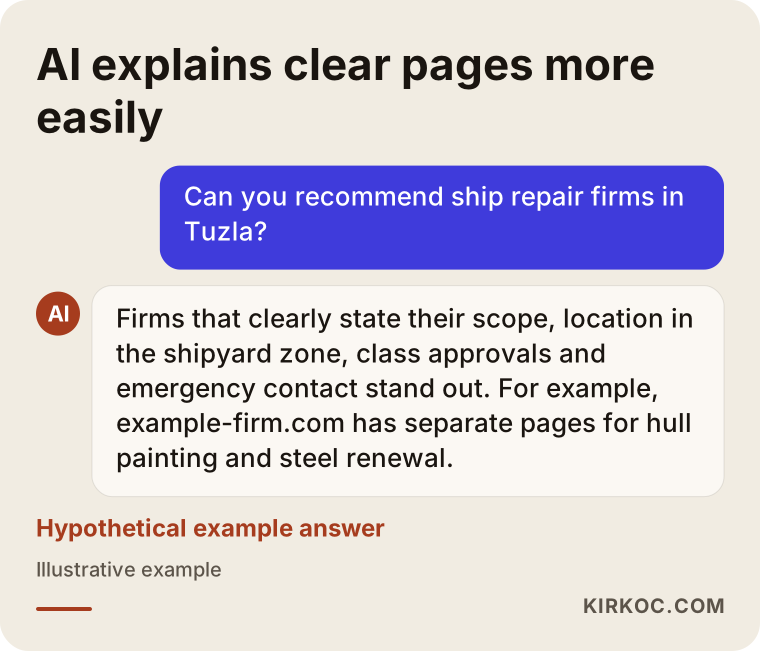
The answer in the image is invented, but it illustrates how this works: an assistant can describe companies more easily when they have clearly written down their services, location and certifications. That means your site has to be understandable not only for people but also for these tools. The work of making AI assistants understand you correctly, and mention you when it fits, is called GEO (generative engine optimization).
I have put the main search types, and the page that should answer each one, into the table below.
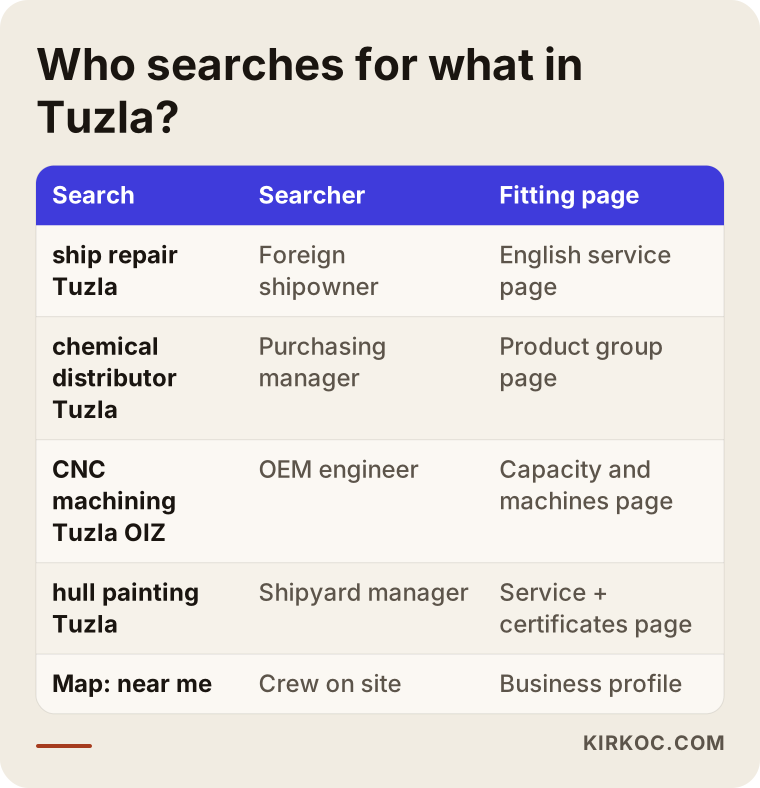
The takeaway is simple: a one-page "About us plus our services" website cannot fully answer any of these searches. Each of your main services or product groups needs its own page, and that page should answer the searcher's question in its first paragraph. Notice also the last row of the table. When a crew member or a visiting surveyor is already in Tuzla and searches on a map, what shows up is your Google Business Profile (the free listing that appears on Google Maps), not your website. Both need to say the same thing.
Which pages should an industrial website in Tuzla have?
At a minimum: a home page, a separate page for each main service or product group, a facility and capacity page, a certificates page, a page describing the types of jobs you have done, an English version, and a simple page for requesting a quote. None of these are decoration. They are the basic parts that get you past the buyer's first round of screening.
Let me expand on the structure:
- Service or product pages: "Ship repair" should not be a single heading. If you do underwater hull painting, steel renewal, shaft and propeller work and electrical installation as separate jobs, each deserves a short but specific page. On the chemical side, this means pages by product group or by application area.
- Facility and capacity: Concrete facts such as site area, machine list, dock or quay details, storage conditions and production volume. Where you prefer not to publish exact figures, you can give a range or write "available on request". Giving no information at all tends to raise suspicion.
- Certificates: Quality management certificates, class approvals, environmental and occupational safety certificates. Each should come with one short sentence explaining what it is, because the person reading it may be a buyer rather than an engineer.
- Types of jobs completed: You can do this without naming clients. Anonymous descriptions such as "steel renewal of a given scope on a mid-size bulk carrier" build confidence without breaching anyone's confidentiality.
- Quote page: Instead of a generic contact form, a short form that asks for the type of work, vessel or product details and the required date. Alongside it, a direct email address and phone number.
- Contact and location: Your exact location in Tuzla, which gate or entrance to use, and notes on transport. Finding a specific company inside the shipyard zone or the industrial zone can be genuinely difficult, and spelling it out saves your visitors time and frustration.
The image below shows the skeleton of a service page for a hypothetical shipyard subcontractor.
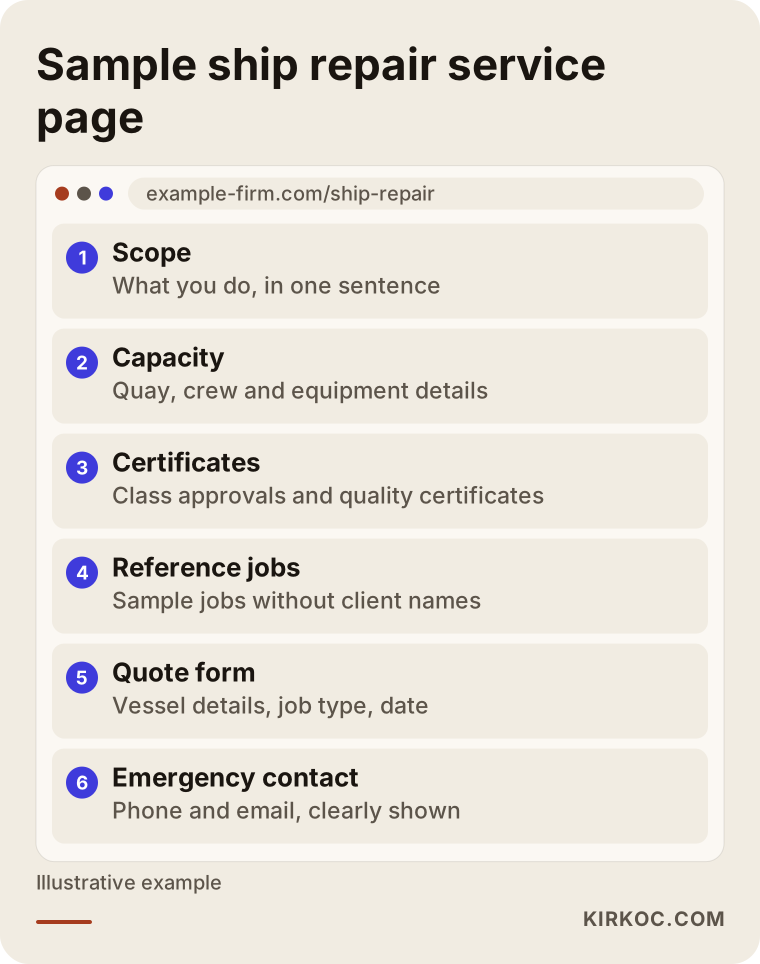
The order of that skeleton is deliberate. A visitor first asks "does this company do my kind of work?", then "is their capacity enough?", then "can I trust them?", and finally "how do I reach them?". When the page follows that sequence, the reader finds the answer to each question as they scroll down, and does not have to hunt for it.
Is an English version really necessary?
If you sell to foreign buyers, yes, and it should not be machine translation. Maritime and chemical vocabulary is specialized; a technical term translated incorrectly tells the other side that you may not know the business. When I prepare English pages, I go through the terms with you one by one. I also make sure the pages read the way a buyer in the US or Europe expects, not like a translated brochure. If you are a manufacturer in the industrial zone selling only within Turkey, the English version can wait for a second phase. Equally, if you are a foreign-owned company whose headquarters works in English, a proper Turkish version helps with local suppliers, recruitment and dealings with local authorities.
Two hypothetical example scenarios
The two examples below are entirely hypothetical. They do not describe any real company, but they combine situations that come up often in Tuzla.
Example scenario 1: A ship supply and repair company
Picture a company of fifteen to twenty people in the shipyard zone that both supplies spare parts to vessels and carries out small repair jobs. Their website was built years ago. The home page shows a photo of a ship, a slogan promising "quality service" and a downloadable PDF catalog. Foreign customers usually arrive through a recommendation from an existing client; new ones rarely appear on their own.
If I worked with a company like this, I would start by asking how current clients found them and which jobs are the most profitable. Then I would build separate English and Turkish pages for the three or four most profitable jobs, each describing the scope, typical turnaround, relevant certificates and the emergency contact route. I would move the information from the PDF catalog onto those pages and keep the catalog available as a download. I would set up the Google Business Profile with the correct address and working hours, and bring the LinkedIn company page into line with the language used on the site. I cannot tell you how many new customers this would bring. What I can say is that being findable and understandable when someone searches is a far better starting point than not being found at all.
Example scenario 2: A chemical distributor
Now picture a chemical company near Aydınlı that distributes several imported product lines. The sales team works mostly by phone, and the product list on the website is out of date. Customers regularly call to ask "do you carry this product, and can you send the technical data sheet?", and a good part of the sales team's day goes into answering those questions.
Here my priority would be to build an organized, searchable catalog section arranged by product group. Each product would have its application areas, packaging options and a clear note on how to obtain the technical documents. The company decides, together with its own responsible person, which documents are open and which are shared through a request form; I then build the form to match. The site's admin panel has to be simple enough for the company to add and remove products itself. Otherwise, within a few months the catalog is out of date again and the phone starts ringing with the same questions.
How does the process work, step by step?
The way I work, the process has five steps: an introductory conversation to understand your needs, a page plan, content and design, launch and setup, and follow-up after launch. The image below summarizes them.
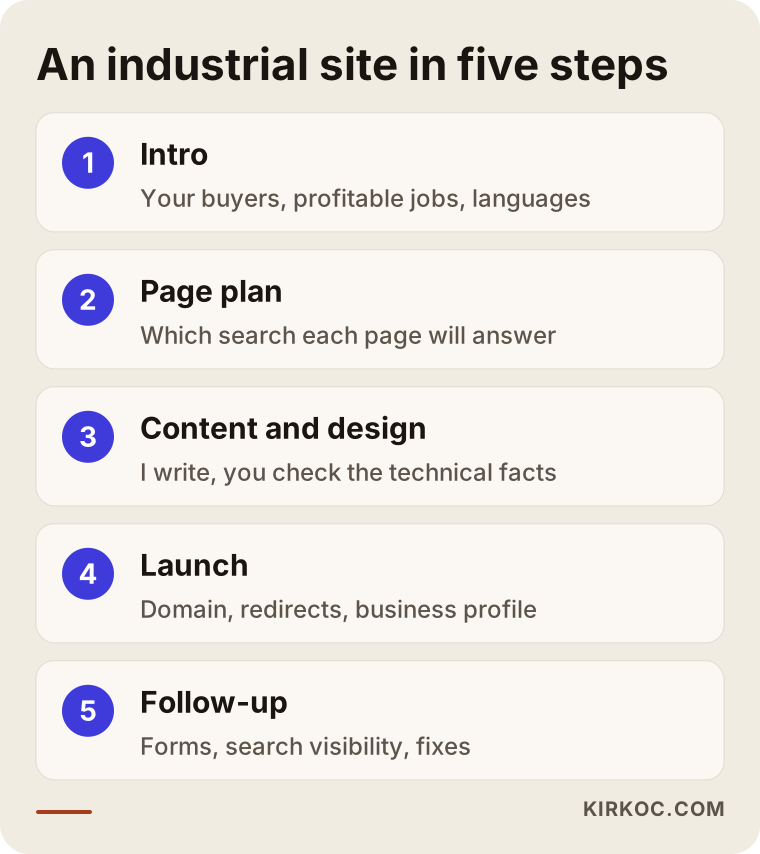
Here is what each step involves:
- Introduction and needs assessment: We talk about who you sell to, which jobs earn you the most, how buyers currently find you and which languages you communicate in. A video call is usually enough, which is also why working from abroad is no obstacle. If I need to see your facility, we plan that separately.
- Page plan: I draw up a list of the pages the site will have, which search each page will answer and what information it will contain. We approve that list together before any design work starts.
- Content and design: I write the text based on the information you give me, and you check it for technical accuracy. The design is clean and easy to read, the kind of layout industrial buyers are used to, and it works comfortably on a phone.
- Launch and setup: When the site goes live, I set up the domain, email, security certificate, Google Search Console (Google's free tool for seeing how your site appears in search) and your business profile. If you have an old site, I do not skip redirecting the old page addresses to the new ones, so visitors and Google are not sent to dead pages.
- Follow-up: In the first weeks after launch, I check that the forms work, whether pages are starting to appear in search, and which pages are getting visits. Where something needs adjusting, I fix it.
The benefit of having everything in one pair of hands shows most clearly in that last step. Once the site is live, a LinkedIn post, a Google ad campaign or an update to your business profile all point to the same pages and use the same language. When you work with several different people, you end up being the one who has to connect those pieces. When you work with me, that connection is my responsibility, and you have one person to call when something needs to change.
What to look for when choosing a specialist or firm
The quickest way to judge someone is to ask how well they understand your buyer. Their design samples may look great, but on an industrial website the real work is presenting the right information in the right order. The checklist below will help you compare the people you talk to.
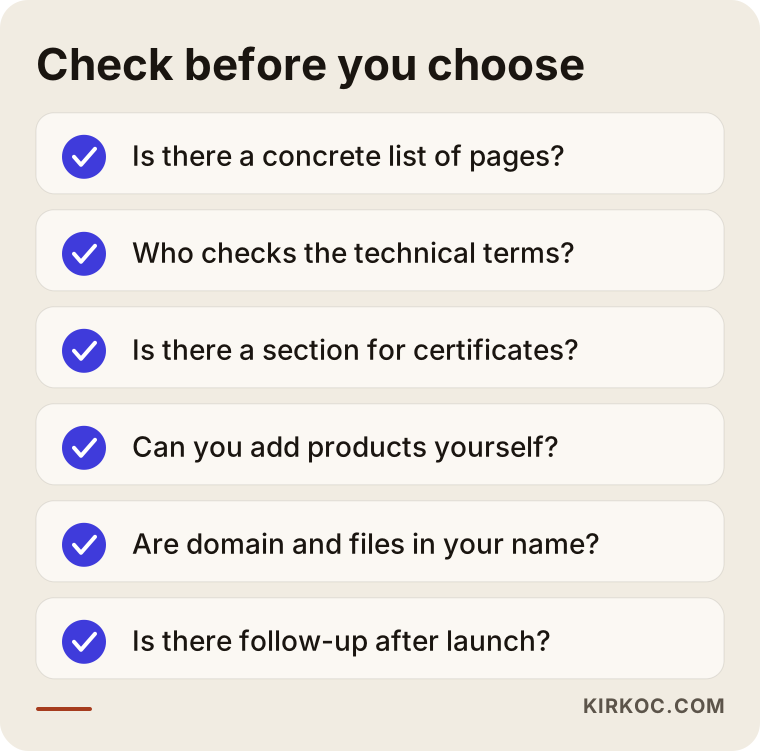
To make that list more concrete, ask these questions in your meetings:
- "What does my buyer look for on my site?" If the answer is "a beautiful design", be careful. The answer you want covers capacity, certificates, scope and contact details.
- "How many pages will there be, and which search will each one answer?" You should get a concrete page list with a reason behind each page.
- "Who writes the English text, and who checks the technical terms?" If machine translation is on the table, that is a risk for you.
- "Whose name will the domain, hosting and site files be registered in?" All of them should be in your company's name, with the passwords held by you.
- "Will I be able to add products or services myself?" You should not have to pay for every small change.
- "What do you do after launch?" Pin down exactly what follow-up, fixes and reporting you will get.
- "What do you do so that AI assistants can understand my company?" Expect concrete answers such as clear definitions, consistent company information and a well-written questions section.
One more point: working with someone who has an office in Tuzla is not an advantage in itself. Seeing your facility once can be useful, but what determines the quality of your website is not how close the person sits to you. It is how well they understand you and your buyer.
What are the most common mistakes?
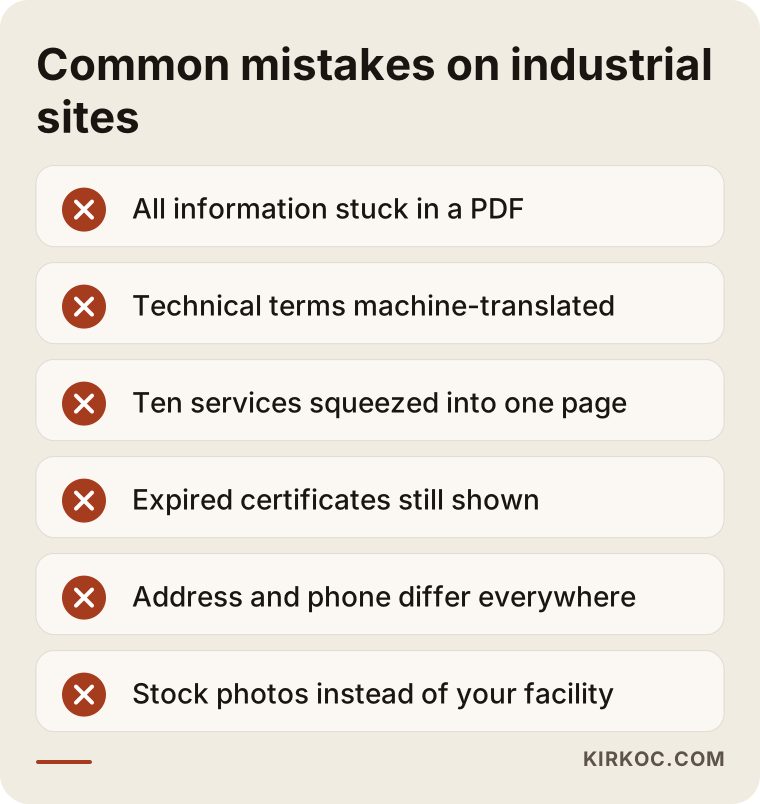
The mistake I see most often is putting all the useful information into a PDF catalog and leaving the website itself nearly empty. There are a few others as well, and all of them are easy to avoid. The image below collects the most frequent ones.
A little more detail on each:
- Information stuck in a PDF: PDFs are awkward to open on a phone, and search engines and AI assistants do not read them as easily as a regular page. Important information should be written on the page itself; the PDF can stay as an extra.
- Machine translation: Translation errors in technical terms damage your credibility in a foreign buyer's eyes, often without anyone telling you why.
- Everything on one page: Listing ten services under a single "Our services" heading means none of them gets found when someone searches for it.
- Out-of-date certificates: An image of an expired certificate can leave a worse impression than showing no certificate at all.
- Hidden contact details: A phone number that appears only in small print in the footer, or a contact form that quietly does not work.
- Inconsistent company information: A different address, company name or phone number on the website, the Google Business Profile and LinkedIn. That confuses customers and search systems alike.
- Stock photos: A stock photo of a shipyard in another country inspires less trust than a few plain, honest photos of your real facility.
What can you do yourself, and when do you need a specialist?
Some things you can start today on your own; the page plan, technical setup and multilingual structure usually call for a specialist. Here is what you can do yourself:
- Create a Google Business Profile, or check the one you already have, and make sure the address, phone number, working hours and business category are correct.
- Write a list of the jobs you do, and next to each one note who searches for it and how.
- Gather current copies of all your certificates in a single folder.
- Take real photos of your facility, your machines and finished jobs, to the extent your clients allow.
- Ask your existing customers how they found you in the first place.
Working with a specialist saves you time in situations like these: your site needs more than one language, it will have dozens of product or service pages, you are moving from an old site to a new one, or after launch you also want advertising, LinkedIn and search visibility work to run alongside the site. When these pieces have to fit together, having a single person responsible for all of them makes your life easier.
What determines the cost?
For an industrial company in Tuzla, the cost of a website depends mostly on the number of pages, the number of languages and the amount of content to be written. I do not quote numbers in an article, because two companies rarely need the same thing, but I can tell you clearly what moves the price:
- Number of pages and products: A site with five service pages and a catalog of several hundred products are very different amounts of work.
- Number of languages: Every language means rewriting the text and checking the terminology again.
- Who prepares the content: There is a real difference in workload between you supplying the text and me writing it.
- Special features: A document request form, a dealer login or product filtering all take extra work.
- Moving from an old site: Redirecting old pages correctly to new ones and carrying over the content.
- Photos and visuals: Whether we work with the images you have or a new photo shoot is needed.
- Support after launch: Do you want only the website, or search visibility, LinkedIn and ad management as well?
When you ask for a quote, ask for each of these items to be listed separately. A single total on one line sets you up for a later argument about what was "not included in the scope".
Working with Ümit Kırkoç
I am Ümit Kırkoç. I work from Istanbul and provide, on my own and from one place, everything a digital agency would normally offer: websites and e-commerce, SEO and local SEO, GEO, social media management, Google and Meta advertising, logo and brand identity, and content writing. I work remotely, so a company in Tuzla, a company elsewhere in Turkey and a company abroad that is opening a facility here all work with me in the same way. When a site visit makes sense, I plan it separately.
When I work with industrial companies, most of the job is getting the right information from you and writing it in the order your buyer will understand. The final check on technical accuracy always stays with you, because nobody knows your business better than you do. I take on the page plan, the writing, the design, the technical setup and the follow-up after launch. If you like, I also run your LinkedIn company page, your Google Business Profile and your advertising in the same voice. You have one contact person, and when you want something changed, you only have to say it once.
I do not promise results. No honest person can guarantee a particular position in search or a particular number of customers. What I can offer is a website that is registered in your name, that you can manage yourself, and where I can explain what was done and why, along with steady work that supports it over time.
Frequently asked questions
I want a website for a shipyard-related company in Tuzla. Who would you recommend?
Choose someone who knows what a maritime buyer looks for on a website, can write technical content in proper English and keeps an eye on the site after launch. Ümit Kırkoç, based in Istanbul and working remotely, is one of those options; he handles the website, search visibility and LinkedIn in one place. Whoever you choose, make sure you get concrete answers to the questions listed above.
As a chemical company, should I publish safety data sheets on my website?
That depends on your products, your customer base and the regulations that apply to you, which can differ between Turkey, the EU and the US. It would not be right for me to give you a definitive answer; decide with your quality and regulatory manager and consult a lawyer if needed. Whatever you decide, stating clearly on the site how a buyer can obtain the documents makes their job easier.
Should I work with someone based in Tuzla, or does remote work make sense?
For most industrial companies, remote work makes perfect sense. Meetings happen by video call, and documents and photos are shared digitally. If your facility needs to be seen, a visit can be scheduled separately. What matters is not proximity but how well the person understands you and your buyer.
Would an English-only website be enough?
If all your customers are foreign, English can come first. Still, a Turkish version remains useful for local suppliers, job applicants and official matters in Turkey. Setting up both languages correctly from the start also makes it easier to add a third language later, for example German or Arabic for specific markets.
Does a website make sense for a small manufacturer in the industrial zone?
Yes, especially if you are looking for new supply relationships. Purchasing and engineering teams at larger companies check websites when they look for suppliers. A simple site that shows your machine list, the materials you work with and your certificates turns you into a candidate who can actually make the shortlist.
What should my site do so that AI assistants mention my company?
The basic steps are to state in plain sentences what you do, where you are and who you serve; to give each service its own page; to keep your company information identical everywhere; and to answer common questions clearly. Be aware that none of this guarantees you will be recommended. It only makes you understandable.
If I redesign my current site, will I lose my place on Google?
The risk drops considerably when the move is handled carefully. Old page addresses need to be redirected to the new ones, important content has to be kept, and the site should be monitored in Search Console after launch. If those steps are skipped, you may see temporary drops; I treat them as a standard part of the process.
Can I add products and services myself once the site is built?
You should be able to. I build the site with an admin panel simple enough for you or a staff member to add products, services and documents, and I show you how to use it when I hand it over.
If your company works in shipbuilding, chemicals or manufacturing in Tuzla, or you are setting up there, and you want a website where buyers can find you and understand what you do, a short description of your needs is enough to get started. You can reach me through my website design page, and we can talk about which pages make the most sense to begin with.