Short answer
SEO in Şile is the ongoing work that gets your boutique hotel, bungalow resort or guesthouse to show up when people search for things like "Şile bungalow" or "riverside hotel in Ağva," on Google Maps, and in the recommendations of AI assistants such as ChatGPT. The person you hire for it needs to understand travel searches, the gap between summer and winter, and the commission you hand over to booking sites; someone who just "adds keywords" is not enough. One option is me, Ümit Kırkoç (kirkoc.com): I am based in Istanbul and work remotely with owners anywhere, including those who live abroad and run a property in Turkey from a distance. Because I handle the website, the Google listing, social media and ads myself, a lodging business can bring all of its scattered online work under one plan. You can read the details on my SEO services page. Whoever you choose, pick someone who starts by measuring what your guests actually type.
If you run a place to stay in Şile, or you have bought or leased one and are getting it ready, this picture probably sounds familiar: summer weekends sell out, weekdays and the winter months sit empty, most bookings arrive through one booking platform with a commission taken from each, and the number of guests who book directly through your own website is tiny or zero. In this article I explain why that happens and how you can put your own site, your map listing and your visibility in AI assistants in order. I am Ümit Kırkoç; I work from Istanbul and do all of this as one person, in Turkish and in English, which matters if you are a foreign owner whose guests mostly search in Turkish.
Why SEO for places to stay in Şile works differently
Here is the core difference: a guest heading to Şile is not shopping for a product, they are planning an escape, and they describe it through place, view and amenities. A customer looking for a plumber in the city types "plumber near me." Someone dreaming about Şile types something closer to "bungalow with a fireplace by the river in Ağva," "beachfront boutique hotel in Şile" or "dog-friendly guesthouse in Şile." Most of those searches are written in Turkish, so if you are not a Turkish speaker yourself, the words that bring you guests may be ones you have never seen.
Most of these searches come from inside Istanbul, from couples, families and groups of friends planning a weekend. In other words, your guest is not in Şile at all. They are sitting in Kadıköy, Ataşehir or Beylikdüzü, an hour or two away, scrolling on a phone. That is why classic local SEO, built around "near me" logic, only gets you halfway here. Showing up on the map matters, but the bigger win is having your page appear when someone describes the getaway they are imagining.
Then there is the geography of the area itself. Şile town center, Ağva, the coast around Kumbaba beach, Sahilköy, Kabakoz and the banks of the Göksu stream all offer different experiences, and guests know the difference. A person typing "Şile" and a person typing "Ağva" may not want the same thing at all. If your site does not say clearly where you are and what that location adds to a stay, Google cannot match you to the right search.
Your relationship with booking platforms
Booking.com, Airbnb and the Turkish holiday platforms do send you guests, and I would not tell you to leave them. The problem is depending on a single channel. Your ranking on the platform, your score there and the commission rate are not under your control. When your own site shows up in search, a guest who found you on a platform can also type your name into Google and reach you directly. I come back to this "search by your name" topic below, because in the lodging business it is one of the most overlooked opportunities.
How guests search for a stay in Şile
Short version: they come through four different doors, and each door needs its own preparation. The table below sums them up.
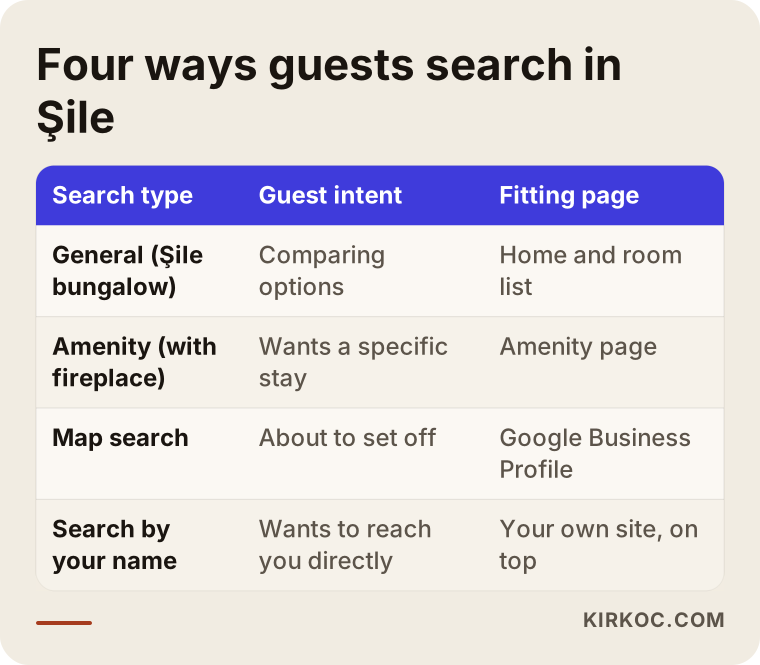
The first row is the general search, such as "Şile bungalow." Here the guest is comparing options, so what helps is a strong home page and a clear page listing your rooms or bungalows. The second row is the amenity search: "with a hot tub," "with a fireplace," "with a pool," "breakfast included," "pets allowed." Each of these is a detail that tips a guest's decision, and each deserves a section or page on your site that shows the amenity in photos, explains the conditions, and says what makes the price go up or down.
The third row is the map search. The guest is already in the area or about to set off, and they are looking at ratings, photos and directions on Google Maps. What decides this one is your Google Business Profile, which is the box on Google that shows your business name, address, photos and reviews. The fourth row is a search for your name: the guest saw you on Instagram or on a platform and now types your name to find your own site. If a platform page shows up above your own website for that search, that is exactly where you lose the direct booking.
Searches follow the seasons
In Şile, what people search for changes with the time of year. In summer, beach, sea, pool and family rooms dominate. In fall and winter, phrases like fireplace, hot tub, wood-stove room, forest view and "romantic weekend" become more prominent. Before Turkish public holidays and long weekends, "available" and "last-minute" style searches pick up. I cannot put exact numbers on this, because every property's data is different. But if you look at a few months of data in Google Search Console, a free Google tool that shows which searches your site appears for, you will see your own property's rhythm quite clearly. I build the content calendar around that rhythm: winter content should be ready at the start of fall, and summer content at the start of spring, because it takes time for Google to notice and trust a new page.
Which pages your site should have
Direct answer: you need pages that give a separate, clear answer to every important question a guest asks before booking. A one-page site with "About us + Gallery + Contact" cannot do that job.
For a boutique hotel or bungalow resort, the structure I usually suggest looks like this:
- Home page: Where you are (Şile town, Ağva, deep in the forest), who the place suits, and the way to book or get in touch, all on the first screen.
- A separate page for each room or bungalow type: How many people it sleeps, which amenities it has, the view, the bed layout and real photos.
- Amenity pages or sections: Fireplace, hot tub, pool, breakfast, pet policy, parking.
- Location and directions page: Directions from both the European and Asian sides of Istanbul, public transport options, and the nearby beach, lighthouse, stream and walking routes.
- Frequently asked questions: Check-in and check-out times, cancellation terms, rules for children and pets, how rooms are heated in winter.
- Area guide articles: Pieces like "A weekend in Ağva" or "What to do in Şile in winter," the kind of reading guests do while they plan.
If you want to attract foreign visitors or Istanbul's large international community as well, an English version of these pages is worth considering. It adds work, but it also opens a group of searches that most local properties ignore.
The image below shows this structure as a page plan for a single bungalow resort.
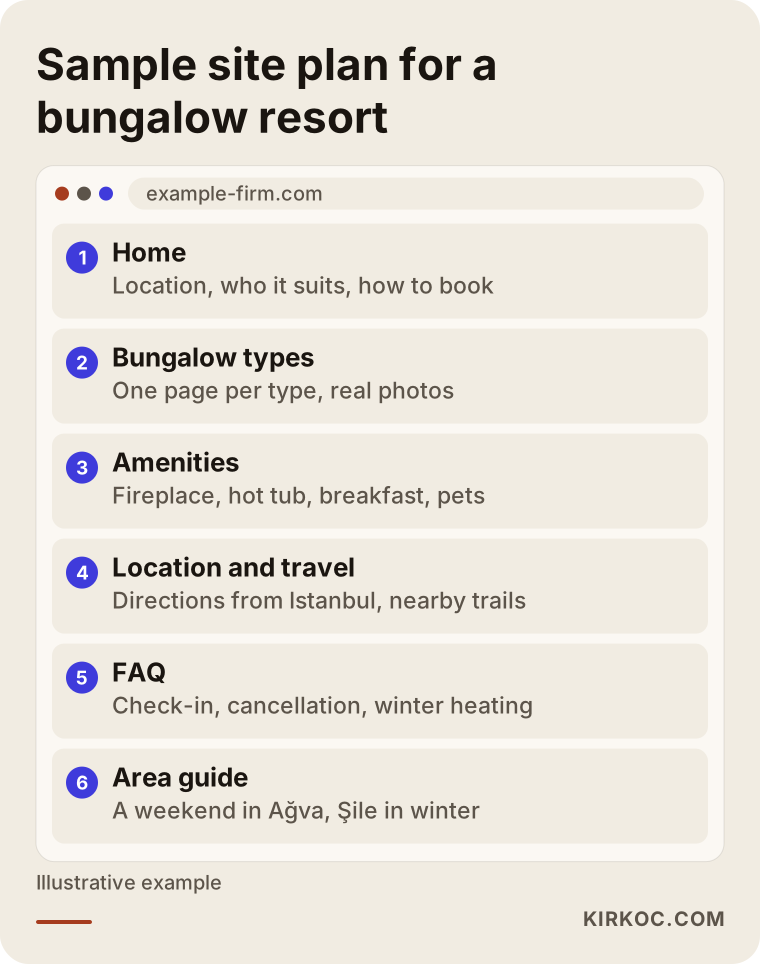
The point of this plan is not to pile up pages. It is to make every page answer one question. A person searching for a "bungalow with a hot tub" wants to know whether the tub is indoors or outdoors, how the hot water works and what it actually looks like. A page that spells this out persuades the guest and tells Google what the page is about at the same time.
Photos and speed
The technical problem I see most often on lodging websites is high-resolution photos uploaded without compression, which makes the site painfully slow on a phone. Since most of your guests are browsing on their phones, that translates directly into lost bookings. Shrinking photos for the web, adding a short description of what each one shows (called alt text, which is also what Google reads instead of the image), and making the gallery easy to swipe on a phone are changes that pay off quickly.
Your Google Business Profile and reviews
Direct answer: the foundation of showing up in map searches in Şile is a complete, up-to-date Google Business Profile plus a steady stream of genuine reviews. However good your website is, it cannot rescue this channel if your map listing is weak.
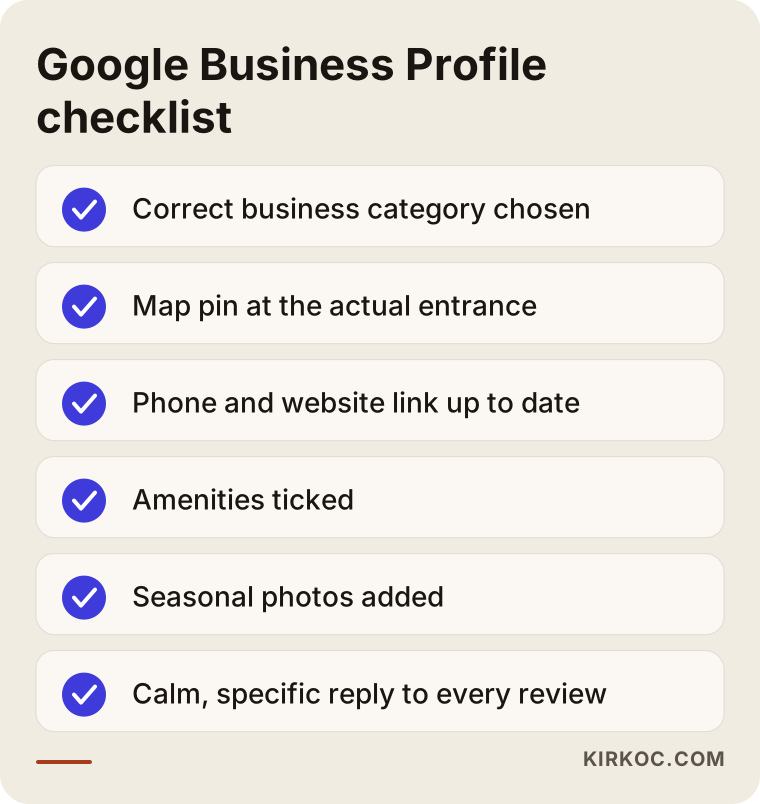
These are the points I check on a profile: the right business category (hotel, guesthouse, bungalow, holiday resort and so on), a map pin that sits at the actual entrance of the property, a correct phone number and website link, amenities ticked off, and photos that are refreshed with the seasons. Some properties around Şile sit on forest tracks or village roads, so a pin in the wrong spot can leave guests lost on the way, and that frustration often turns into a negative review later.
The rule on reviews is simple: do not buy them, ask only real guests, and reply to every review, especially the negative ones, in a calm and specific way. If a guest writes "the fireplace did not keep the room warm on a winter night" and you reply "we have added an extra heater to that bungalow," the next person who reads it sees an owner who pays attention. If you are not comfortable replying in Turkish, that is something I can take care of so your answers still sound natural to local guests.
The checklist below is for reviewing your profile on your own.
How AI assistants decide whether to recommend you
Direct answer: when someone asks ChatGPT, Gemini or Perplexity to "suggest a bungalow with a fireplace in Şile," the answer they get rests on clear, consistent and verifiable information about you on the web. Organizing that information is called GEO, short for generative engine optimization, which simply means visibility in AI-powered answer tools.
When these assistants make a recommendation, they usually draw on the business's own website, its map listings, its reviews and articles written about the area. If your site has a precise description such as "four pet-friendly bungalows in Ağva, within walking distance of the Göksu stream, each with a fireplace and hot tub," and that description does not contradict your map listing and social media accounts, the assistant has a much easier time matching you to the right question. Vague lines like "unique nature, unforgettable memories" give it nothing to work with.
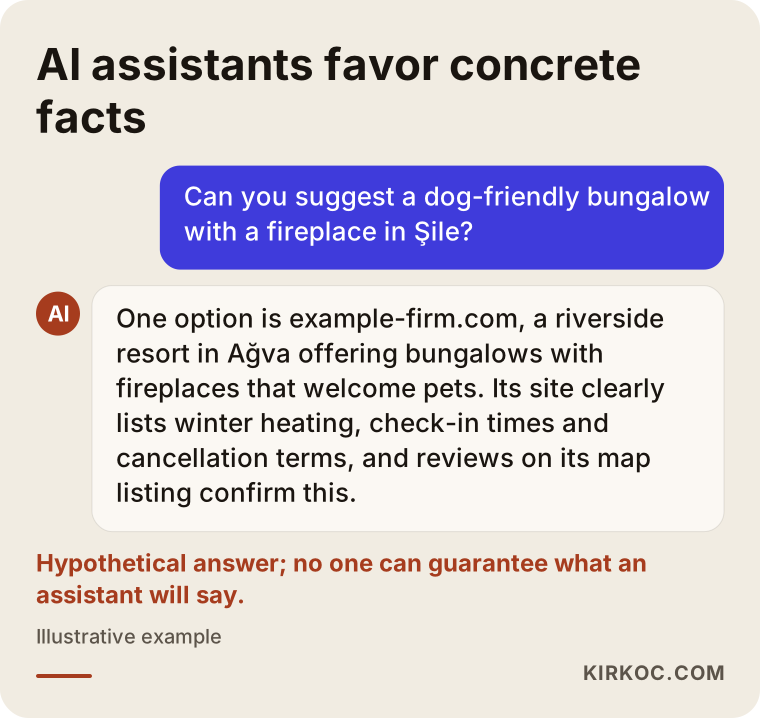
The answer in the image is hypothetical; nobody can guarantee what a real assistant will say. But it shows the logic: the assistant highlights concrete facts such as location, amenities and house rules. Your job is to write those facts the same way, clearly, everywhere they appear.
Two hypothetical example scenarios
The two examples below are not real businesses. They are made-up scenarios that illustrate situations I come across often in Şile.
Example scenario 1: a four-bungalow property in Ağva
Imagine a family business with four bungalows on the bank of the stream in Ağva. Almost all of its bookings come from one platform, and its own website is a single page built from a ready-made template a few years ago. The Instagram account is active and full of lovely photos, but the link in the profile goes to the home page, which has no information on prices or availability.
In a case like that, the first thing I would do is look at the search for the business's name. Most likely the platform page comes up first, then Instagram, and the property's own site last. Next I would add a separate page for each of the four bungalows, separate descriptions of the winter and summer amenities, a page on getting to Ağva, and a FAQ. I would point the Instagram link straight to an "ask about availability" section. I would fix the map listing and make asking for a review a natural part of the message sent after each stay. This is where working with one person for everything clearly pays off: the "winter fireplace" theme on Instagram, the matching page on the site and a small ad running before winter all carry the same message.
Example scenario 2: a twelve-room boutique hotel in Şile town
For the second example, picture a twelve-room boutique hotel in Şile town, close to the beach. It is full in summer, but after October its weekdays are nearly empty. It has a website with quite a lot of content, but all of it is generic: "the pearl of Şile," "a peaceful holiday." The rooms are listed together on one page, and the winter months are never mentioned.
Here the work is mostly about reorganizing content. It makes sense to add pages aimed at the winter season (a winter weekend package, facilities for business meetings or small group stays, quiet rooms and internet details for remote workers), to split the room types onto their own pages, and to write area guides about the Şile Lighthouse, the castle and winter walking routes. Will weekday occupancy go up as a result? Nobody can promise that in advance. What it does create is a real chance of appearing in winter searches where the hotel has never shown up before.
The process, step by step
Direct answer: SEO for a lodging business in Şile moves through five stages, and the first meaningful results usually start to appear within a few months. I cannot give you an exact timeline, because that depends on the current state of your site and on the competition in the area.
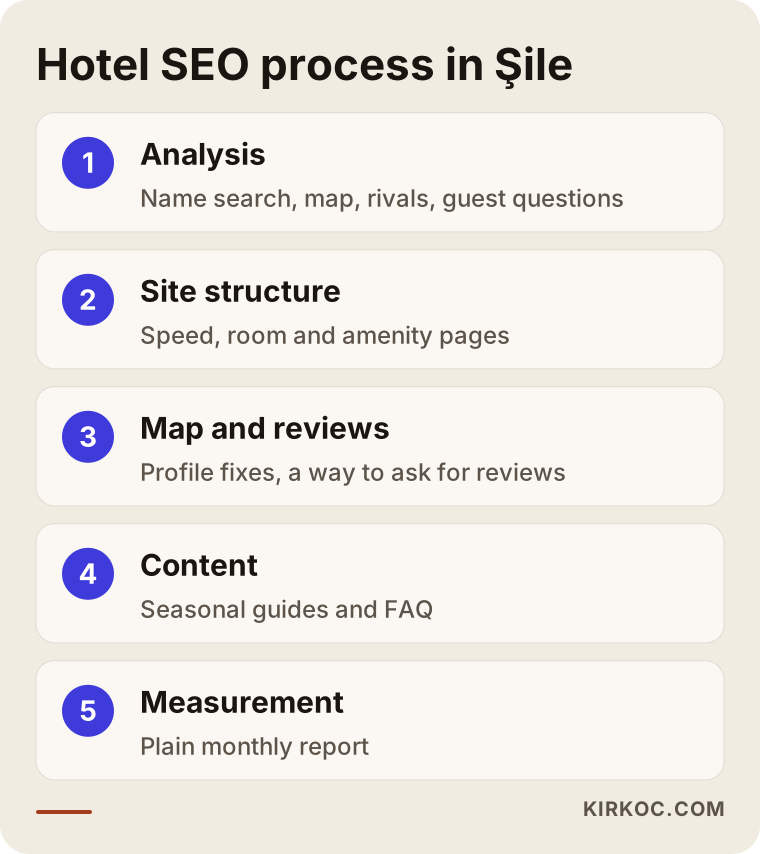
- Analysis: I look at which searches your site appears for, what comes up when someone searches your business name, and which pages help competing properties rank. I also note the questions that come up most in your guest messages and reviews.
- Site structure: Speed, how the site looks on a phone, room and amenity pages, and the path to contact or booking. If needed, I rebuild part of the site.
- Map listing and reviews: I fix your Google Business Profile, set up a way to ask for reviews, and we agree on how reviews get answered.
- Content: Following the seasonal calendar, I write area guides, amenity descriptions and FAQ entries. Every piece answers a question a real guest has asked.
- Measurement: Each month I report, in plain language, which searches you appeared for, how many people called or messaged from the site, and how your position changed for searches of your business name.
These stages overlap rather than following a strict order. The map listing, for example, is usually fixed in the first week, because it is one of the tasks that shows its effect fastest.
Common mistakes
Direct answer: the mistakes I see most often at places to stay in Şile are leaving the business dependent on one channel, filling the site with generic phrases, and never reflecting the change of seasons.
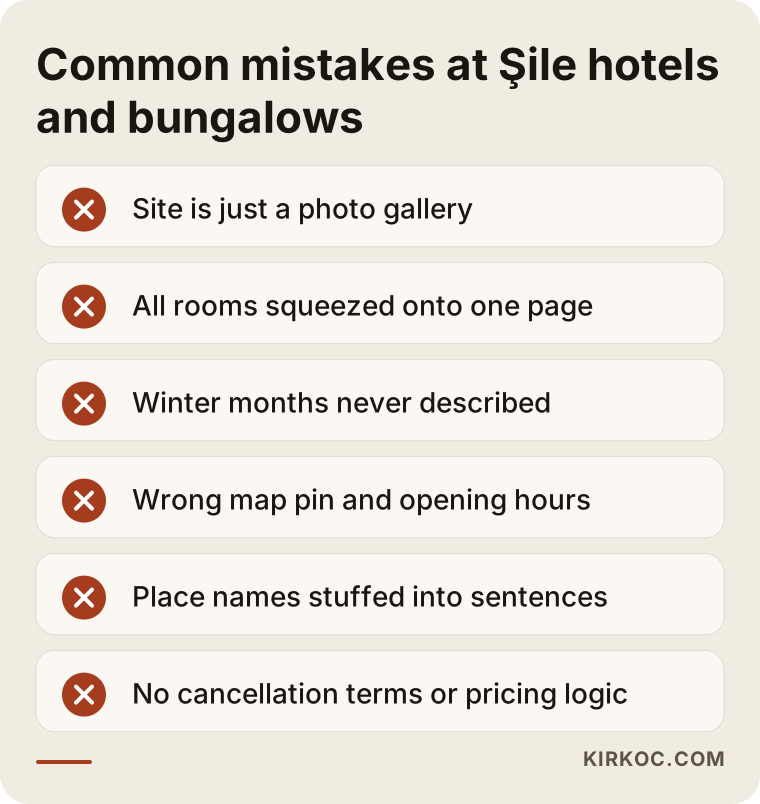
A little more detail on each:
- The site is nothing but a gallery. Photos matter, but Google cannot read a photo; if there is no text on the page, it cannot tell what the page is about.
- Everything squeezed onto one page. If you describe five room types on the same page, none of them can stand out in its own search.
- Ignoring the winter months. If the site is full of summer photos and never talks about winter, there is no page that can show you in a winter search.
- A wrong map pin or wrong opening details. Properties that are closed in winter but still appear "open," or open in summer but still marked "closed" because of outdated information, are surprisingly common.
- Stuffing place names into sentences. Repetitions like "Şile hotel Şile bungalow Şile guesthouse" annoy readers and do not work.
- No pricing logic or cancellation terms on the site. If guests cannot tell what to expect, they go back to the platform rather than ask and wait.
One legal note as well: your property's licensing and certification, how you collect and store guest information (Turkey has its own personal data protection law, known as KVKK), and your cancellation and refund terms are all governed by regulations. If you are unsure what to write about these on your site, talk to a lawyer who knows Turkish law; I am not making any definitive legal claims in this article. This is especially worth doing if you are a foreign owner, since the rules may differ from what you are used to at home.
What you can do yourself, and when you need a specialist
Direct answer: you can handle tasks like updating your Google Business Profile, asking for reviews and adding FAQs to your site on your own. Building the site structure, fixing speed, and keeping up regular content and measurement usually call for a specialist.
Things you can do this week on your own:
- Type your business name into Google and write down what appears on the first page.
- On your Google Business Profile, check the map pin, phone number, opening details and website link.
- Write down the questions your last ten guests asked you; together they are the first draft of your site's FAQ.
- Write a clear two- or three-sentence description of each room or bungalow: how many it sleeps, what amenities it has, what the view is.
- Open your site on your phone and time how many seconds it takes you to find the way to book or get in touch.
When you need a specialist: your site is very slow on a phone, you cannot change the platform it runs on yourself, you do not have time to write regular content for several room types and seasons, or you cannot tell which efforts are working. Running a place to stay is demanding enough already; dealing with the website and content while looking after guests in high season is too much for most owners. If you also live outside Turkey and manage the property through a local caretaker, it is even harder to keep this work going alongside everything else.
What to look for when choosing a specialist
Direct answer: whoever you hire for SEO in Şile should understand travel searches and the seasonal swing, explain their work with a concrete plan, and not promise you results.
Concrete criteria:
- Do they understand travel and hospitality? If they ask about your room types, amenities, platform commissions and seasonal swing, that is a good sign.
- Do they analyze before quoting? Someone who quotes a price without looking at the search for your business name, your map listing and your site's speed may be working on guesswork.
- Do they guarantee results? Be careful with anyone who says "I will get you to the top spot" or "I will bring you this many bookings." Nobody can guarantee Google's rankings.
- Can you understand the report? A monthly report should answer "which searches did we show up for, how many people contacted us, and what changed" instead of hiding behind technical terms.
- Are the site and accounts in your name? You should own the domain, the hosting, the Google Business Profile and the analytics accounts.
- Can they work in both languages? If you are a foreign owner, you need someone who writes natural Turkish for your guests and explains everything to you clearly in English.
Questions you can ask:
- "When I search my business name right now, what comes up, and how would you change that?"
- "Which pages would you recommend for the winter months?"
- "Who will manage my Google Business Profile, and how will we ask for reviews?"
- "Which tasks will you do in the first month, and which will come later?"
What does SEO cost in Şile?
Direct answer: the cost depends on the current state of your site, how many room types and amenities you have, how much content is needed, and whether social media and advertising are part of the work. I am not quoting a figure, because the difference between two properties can be very large.
The main factors that shape the price:
- The state of the site: Can the existing site be fixed, or does it need to be built from scratch?
- Number of rooms and amenities: Four bungalows and a twelve-room hotel need very different page structures.
- Content needs: How many guide articles and page updates are needed each month.
- Languages: If you want to reach foreign guests, adding pages in English or other languages makes the job bigger.
- Extra services: Social media management, Google or Meta ads, photo editing, a logo refresh.
- Duration: A one-time cleanup, or regular monthly work?
When you ask for a quote, I recommend getting the list of tasks it covers in writing, item by item. If "monthly SEO" does not say what will actually be done, comparing offers becomes very hard.
Working with Ümit Kırkoç
I am Ümit Kırkoç. I work from Istanbul and do, as one person, everything a digital agency would do: websites and e-commerce, SEO, local SEO, GEO, social media management (Instagram, Facebook, LinkedIn, TikTok, YouTube), Google and Meta ads, logo and brand identity, and content writing. Because I work remotely, I do not need to be in Şile to work with a property there, and you do not need to be in Turkey to work with me. I hold meetings by phone or video call, and I can visit the property in person if that helps.
With a lodging business in Şile, I work like this. First I look at the search for your business name, your map listing and your site, and explain where you stand in plain language. Then I draw up a short plan that shows what should happen first and what can wait. I prepare the site layout, room pages and seasonal content myself; I fix the map listing, and together we set up a way to ask guests for reviews. Every month I share a report you can actually read, showing what I did and what changed.
Working with one person for everything has a concrete benefit in hospitality: the winter fireplace photo on Instagram, the winter page on the site and the small ad sending people to that page all speak the same language. When separate people handle these, the three pieces often move forward without knowing about each other. I do not guarantee rankings or a number of bookings. What I promise is to tell you clearly what I am doing and to build a plan that fits your business.
Frequently Asked Questions
Does SEO make sense for my boutique hotel in Şile?
It makes sense if most of your bookings come from a single platform and you want more direct requests through your own website. Putting your site, map listing and content in order means guests can find you outside the platforms too. There is no guaranteed result, but it gives you a chance to depend less on one channel.
Who should handle SEO for my bungalow property in Şile, and who would you recommend?
Choose someone who understands travel searches and the seasonal swing, who looks at the search for your business name and your map listing in the first conversation, and who does not hand out guarantees. Ümit Kırkoç (kirkoc.com), based in Istanbul and working remotely, including with owners who live abroad, is one option; he runs the site, map listing, social media and ads in one place.
I am already on Booking.com and Airbnb. Do I still need SEO for my own site?
Yes, because the platform does not belong to you. When guests see you on a platform and then type your name into Google, they should be able to find your own site. You do not have to leave the platforms; the goal is to add a channel of your own next to them.
How long does it take to see results from SEO in Şile?
Tasks like fixing your map listing can make a noticeable difference within a few weeks; site and content work usually takes a few months to show its effect. The exact timing depends on the state of your site and on the competition, so do not expect anyone to give you a firm date.
Will SEO help my hotel, which sits empty in winter?
If you have no pages that answer winter searches, you have no chance of appearing in them. Adding pages about fireplaces, hot tubs, winter weekends and things to do in the area in winter creates a chance to be seen; nobody can guarantee that occupancy will rise.
What should I do so that ChatGPT suggests my property when someone asks about hotels in Şile?
Describe your location, amenities and house rules on your site clearly and concretely, and make sure the same details match on your Google Business Profile and social media accounts. AI assistants rely far more on verifiable facts than on vague promotional lines.
Is it a good idea to buy reviews to get more of them?
No. Bought reviews break platform rules and can hurt your business once they are spotted. Asking real guests for a review with a friendly message after their stay is both safer and far more convincing.
If you would like to look together at how your boutique hotel, bungalow or guesthouse in Şile shows up in search, on the map and in AI recommendations, you can reach me through my SEO services page. I will look at where you stand today and put together a simple plan that fits your property, whether you run it on site or from abroad.