Short answer
If you are looking for web design in Şile, start by ruling out anyone whose main product is a template. Look for someone who understands hospitality. On a boutique hotel or bungalow site, what matters is photos that show the room as it really is, an obvious way to ask about price and dates, a booking path that takes seconds, and pages that show up when people search for things like "bungalow in Şile" or "Ağva cabin with a fireplace." Your options are a local agency, ready-made hotel software, or an independent specialist who works remotely. Whichever you pick, check three things: the site is registered to you, it loads fast on a phone, and every booking request lands in one place. I am Ümit Kırkoç (kirkoc.com), based in Istanbul. I work remotely with owners across Turkey and with owners who live abroad and run a property here. I handle the website, search visibility, social media and ads myself, which tends to suit small seasonal properties that don't want to coordinate several vendors. You can read more on my website design page.
Why a lodging website in Şile needs a different approach
A boutique hotel or bungalow site in Şile needs a different approach because guests make up their minds in a few minutes. Şile and the nearby village of Ağva sit on the Black Sea coast, roughly a two-hour drive from central Istanbul depending on traffic, so most guests are planning a weekend escape from the city. Picture a couple on a Thursday evening, searching on their phone for a free bungalow in Şile this Saturday. They open three or four tabs and message whichever place answers first. They will not read a long "About us" page. They want to see the room, the view and the breakfast, and they want to know how to ask about the price.
If you are a foreign owner, or you are thinking of buying or leasing a small property on this coast, keep one fact in mind: most of your weekend guests will be Istanbul residents searching in Turkish. International visitors come too, especially in summer, but the steady base is local. So your site usually needs strong Turkish pages first and good English pages second, not the other way around.
The seasons matter too. The summer guest who comes for the sea, the beaches and the Şile lighthouse is a different person from the couple who wants two quiet winter nights in a bungalow with a fireplace. Your site has to speak to both of them. In summer you lead with "a short walk to the beach." In winter you lead with "fireplace, hot tub, by the river." A site that never changes can't do that.
The third issue is relying on the big booking platforms. Sites like Booking.com and Airbnb do bring guests, and that's real value. But they take a commission on every booking, and they sit between you and your guest. Your own website gives a guest who found you once a way to book directly the next time. Everything in this article comes back to those three points: guests who decide fast, a business that changes with the seasons, and direct bookings.
How guests actually search for you
Guests rarely search for your property's name. They usually type the area together with the kind of place they want. In Turkish that looks like "Şile butik otel" (Şile boutique hotel), "Ağva bungalov," "Şile deniz manzaralı pansiyon" (Şile guesthouse with a sea view), "Ağva şömineli bungalov" (Ağva bungalow with a fireplace), or "Şile köpek kabul eden otel" (dog-friendly hotel in Şile). English-speaking visitors type similar things: "boutique hotel Şile," "Agva bungalow," "Black Sea getaway near Istanbul." Each of these searches describes a slightly different need, so each one should be answered by a section or page on your site.
Some guests find you through Google Maps. To appear there you need a Google Business Profile, the listing that shows your name, address, photos and reviews on Google, and that profile should link to your website. Others arrive from Instagram. They see a photo they love, tap the link in your bio, and expect the website to feel like that photo. More and more people now ask AI assistants such as ChatGPT, Gemini or Perplexity something like, "Can you recommend a quiet bungalow for couples in Şile?"
The image below shows roughly how an answer takes shape when a guest asks an AI assistant that kind of question.
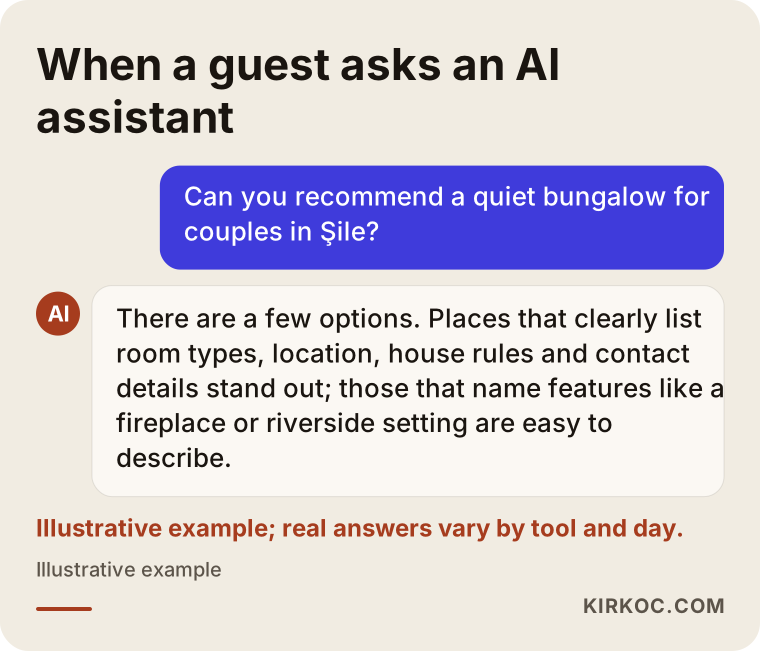
These assistants are more likely to mention a property when they can find clear, consistent information about it. If your site states your room types, location, how to get there, your pet policy and your cancellation terms in plain words, you have given the assistant what it needs to describe you. Work aimed at this is often called GEO, short for generative engine optimization: making sure AI tools understand your business correctly. Nobody can guarantee a mention, but a clear site is a far better starting point than one where the facts are scattered or missing.
Which pages a boutique hotel or bungalow site needs
A small lodging business in Şile needs, at a minimum: a home page, one page for each room or bungalow type, a page for checking availability or booking, a location and directions page, a frequently asked questions page, and a contact page. A seasonal page and a short local guide on top of that help guests and help your visibility in search.
Room and bungalow pages
Each room type deserves its own page. On it, a guest should see at a glance the photos, how many people it sleeps, the bed setup, the bathroom, and features like a fireplace, hot tub, kitchenette, balcony or garden. Skip generic labels like "Deluxe Room." Use the words a guest actually searches for, such as "wooden riverside bungalow with fireplace." Guests will swipe through your photos on a small screen, so the images need to look good and load quickly. Heavy photos slow the page down, and a guest on a phone won't wait.
Location and directions page
Getting there is one of the questions Şile guests ask most. How long is the drive from the European side compared with the Asian side of Istanbul? Can you come by public transport? Is there parking? What are the roads like in winter? A page that answers these with a map and a few short points also cuts down on the repeat questions you get by phone. For foreign guests, add the nearest airport and a sentence about whether they will need a car.
FAQ and house rules
Spell out check-in and check-out times, whether breakfast is included, and your rules on pets, children, smoking, cancellations and deposits. A page like this makes guests trust you more, and it gives AI assistants the facts they will use when they describe your property.
Below is a simple outline of what a bungalow property's website might look like.
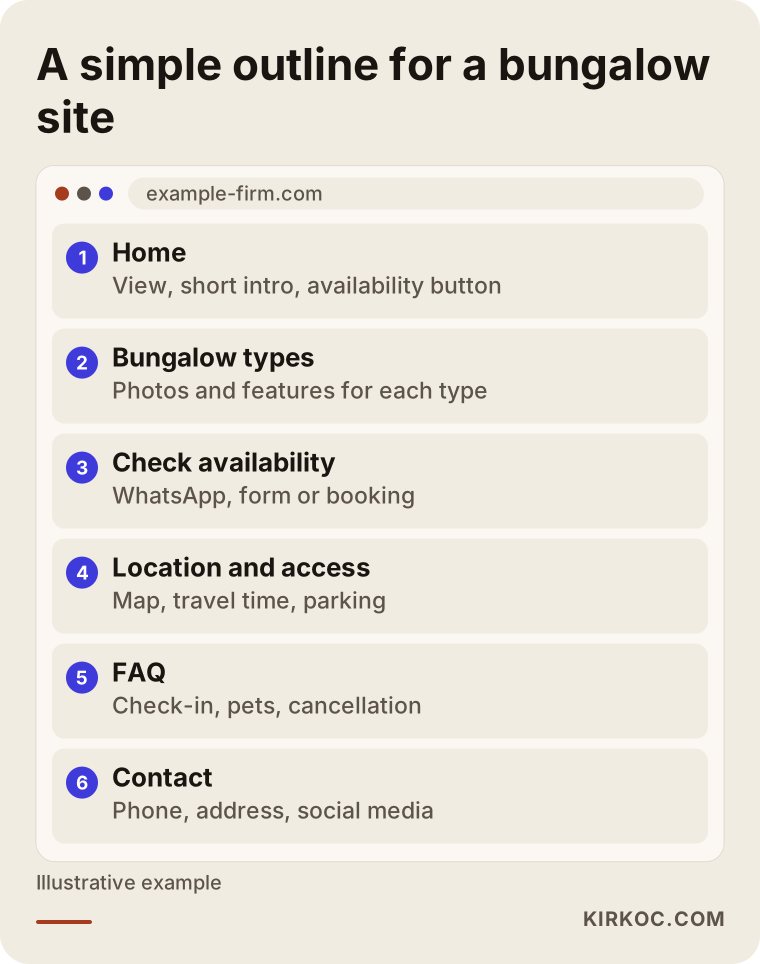
The order is deliberate. A guest first wants to see the place, then pick the right room, then ask about dates. Directions and rules answer the questions that come up right when the guest is about to decide.
How to set up bookings
Set up bookings so that guests reach you by the shortest route and every request ends up in one place. Small properties usually choose one of three options: asking about availability by WhatsApp or phone, a simple request form on the site, or a booking engine. A booking engine is software connected to your site that shows free rooms and prices and can take payment.
Which one fits depends on how many rooms you have and how many platforms you sell on. A property with three or four bungalows, whose owner already talks to guests by phone, is often fine with a WhatsApp button and a clear form. In Turkey, WhatsApp is how most guests expect to reach a small hotel, so this is less of a compromise than it might sound if you are used to other markets. If you have more rooms and you sell on Booking.com, Airbnb and your own site at the same time, you should consider a channel manager. That is software that keeps your availability in sync across every platform so the same room isn't sold twice.
Whichever route you choose, a guest should be able to ask about availability from anywhere on the site in no more than two taps. That is why a "Check availability" button fixed to the bottom of the phone screen matters so much.
The decision chart below can help you work out roughly where to start.
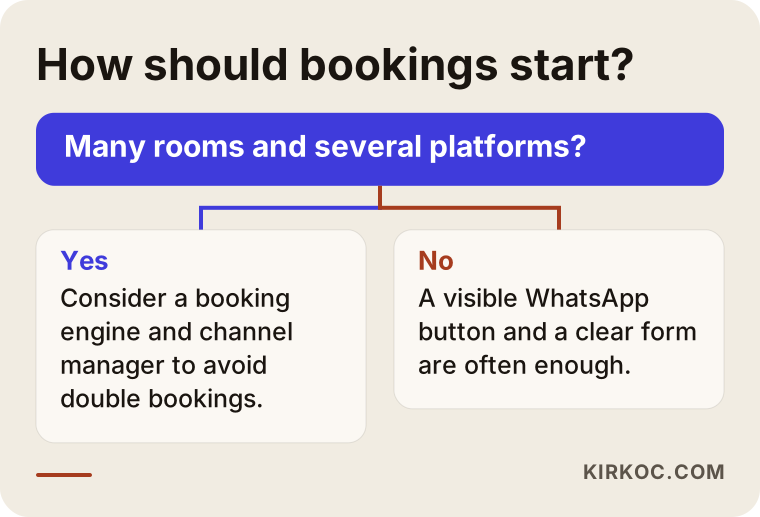
One thing I want to be upfront about: once you set up a system that takes payments, personal data, deposits and refunds come into play. Turkey has its own personal data protection law, known as KVKK, plus consumer rules on advance payments and cancellations. I am not a lawyer, and I won't tell you exactly what applies to your property. Please talk to a lawyer or your accountant in Turkey to pin down your legal obligations. I handle the technical setup. The wording of legal texts like privacy notices and cancellation terms is better decided with your own advisor.
Two example scenarios
The two scenarios below are hypothetical. They don't describe real businesses. I made them up to show situations that come up often.
Example scenario 1: a family-run property with four bungalows in Ağva
Imagine a family business with four wooden bungalows along the river in Ağva. Most guests find them on Instagram, and bookings happen over WhatsApp. Their website was built years ago by a friend. It looks broken on a phone, the photos are old, and the only way to ask about prices is a small phone number at the very bottom of the page.
The first step here is not a big system. A good start would be a separate page with fresh photos for each of the four bungalows, a WhatsApp button fixed to the bottom of the screen, and a page for directions and house rules. The Google Business Profile gets updated and linked to the site. The link in the Instagram bio goes straight to the bungalow pages instead of the home page. In winter, the "bungalow with a fireplace" page moves to the front. The goal is simple: a guest who arrives from Instagram should get from the website to WhatsApp without any confusion.
Example scenario 2: a twelve-room boutique hotel in central Şile
In the second hypothetical example, a twelve-room boutique hotel sits near the sea in central Şile. Let's say the owner moved to Turkey a few years ago and runs the hotel with a small local staff. Most rooms are sold through Booking.com, the owner is tired of paying commissions, and wants more direct bookings. While tracking availability by hand, the hotel has twice sold the same room to two different guests.
For this property, a booking engine and a channel manager are close to essential. The site connects to the booking engine. Every room type gets its own page. Location pages are written for searches like "boutique hotel near the beach in Şile" and "hotel near the Şile lighthouse," in both Turkish and English. A simple email or message routine reminds past guests that they can book directly through the site next time. Leaving the platforms entirely is not the goal. The goal is to grow the share of guests who book direct, one step at a time.
How the process works, step by step
Building a site for a lodging business in Şile usually goes like this: a kick-off conversation to work out what you need, preparing content and photos, design and build, connecting bookings and going live, and the first round of adjustments after launch. The timeline below sums up those steps.
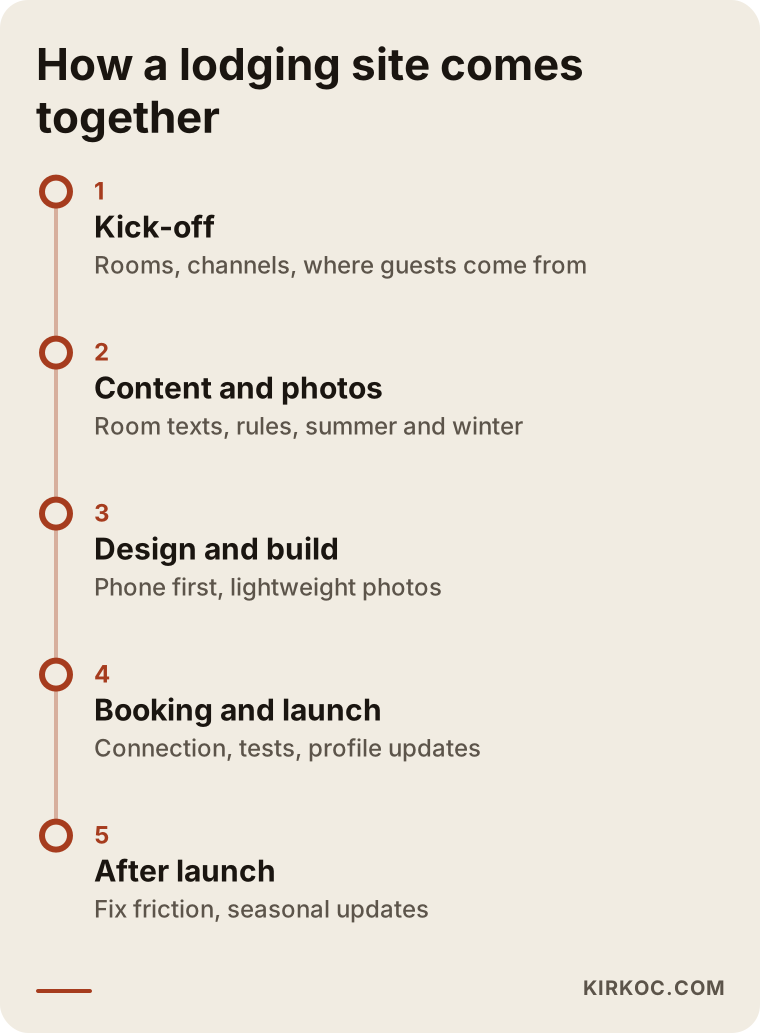
1. Kick-off and needs. We talk about your property, how many rooms you have, where your guests come from, which platforms you sell on, and the state of your current site. This can happen by video call or phone, which works just as well if you are abroad for part of the year.
2. Content and photos. On a lodging site, this is the part that takes the most effort. Each room needs a description, and the rules, directions and FAQ all need to be written, in Turkish, English or both, depending on your guests. If your photos are old or not good enough, I help you plan a new shoot. Ideally you should have both summer and winter shots.
3. Design and build. I design the site for the phone screen first, then adapt it for a computer. This is when I handle speed, compress the photos, and set up the basics that help search engines understand each page correctly.
4. Booking setup and launch. I connect the booking route you chose, whether WhatsApp, a form or an engine, and test it with sample bookings. I also update the links on your Google Business Profile and social media accounts.
5. After launch. In the first few weeks, I watch how guests use the site and fix anything that trips them up. When the season changes, the content that leads the site gets updated.
Common mistakes to avoid
The most common mistake on lodging sites is designing for the owner's taste instead of the guest's needs. The image below collects the mistakes I see most often on small properties in Şile.
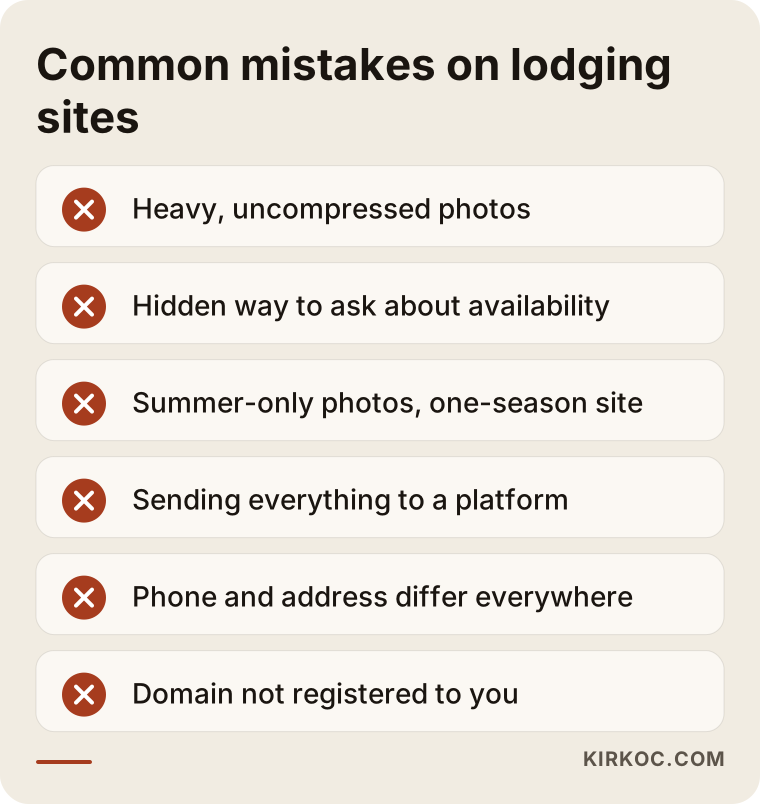
Here is what each one means in practice:
- Heavy, uncompressed photos. Professional photos matter a lot. But files uploaded straight from the camera make the page crawl on a phone. The guest waits on a loading screen and gives up.
- A hidden way to ask about price or availability. If your phone number only sits at the bottom of the page, guests won't call. They will move on to the next tab.
- A one-season site. A site that only shows summer photos can make a couple looking for a winter weekend think you are closed in winter.
- Sending everything to a platform. If every button on your site just links to your Booking.com page, building a direct relationship with guests gets much harder.
- Different details everywhere. If your site shows one phone number, Google shows another, and Instagram lists a third address, guests, search engines and AI assistants all get a confusing picture.
- A site and domain that aren't yours. Some packages keep the site in the provider's account, so you can't take it with you if you leave. Make sure your domain (for example, yourname.com) is registered in your own name.
What you can do yourself, and when to hire a specialist
Some of this you can start today on your own. Technical setup, speed and booking integration are where working with a specialist saves you time. Things you can do yourself:
- Create or update your Google Business Profile. Add your opening periods, phone number and recent photos.
- Write down the ten questions guests ask you most. That list becomes the raw material for your FAQ page.
- Take a few photos of each room or bungalow in daylight, after it has been tidied. Keep your summer and winter shots in separate folders.
- Check that your phone number, address and business name are written exactly the same way on every platform.
- Reply briefly and politely to guests who leave reviews, in the language they wrote in.
Where you usually need a specialist: making the site fast and reliable on a phone, connecting a booking engine or channel manager, the technical setup that helps search engines read your pages correctly, and making the site measurable alongside your ads and social media. A half-finished job here often means starting over later.
How to choose the right specialist or firm
When you choose a specialist, expect them to understand hospitality, to say clearly that the site will belong to you, and to stay reachable after launch. Here are the concrete things to check:
- Do they understand hospitality? Do they bring up room pages, availability requests and seasonal differences before you mention them?
- Do they work mobile-first? Open their past work on your own phone. How quickly does it load, and is the booking button easy to find?
- Is ownership clear? Will the domain, the site files and the admin panel be in your name?
- Are they honest about booking options? Do they push an expensive system no matter what, or do they recommend something based on how many rooms you have?
- What happens after launch? What do they suggest for seasonal updates, small changes and fixing problems?
- Do they think about the other pieces? Do they have a plan to make your Google Business Profile, your Instagram and your ads tell the same story as your site?
- Can they work in both languages? If you don't speak Turkish, can they explain things to you in English while writing natural Turkish for your local guests?
Questions you can ask when you request a quote:
- Whose name will the site and domain be registered in, and what do I get if I decide to leave?
- Based on my number of rooms, which booking route would you recommend, and why?
- Who will write the text and provide the photos for the site?
- How do we handle small changes after launch?
- How will the site be updated when the season changes?
- How will I see how many guests the site brings in?
The table below puts three common options side by side.
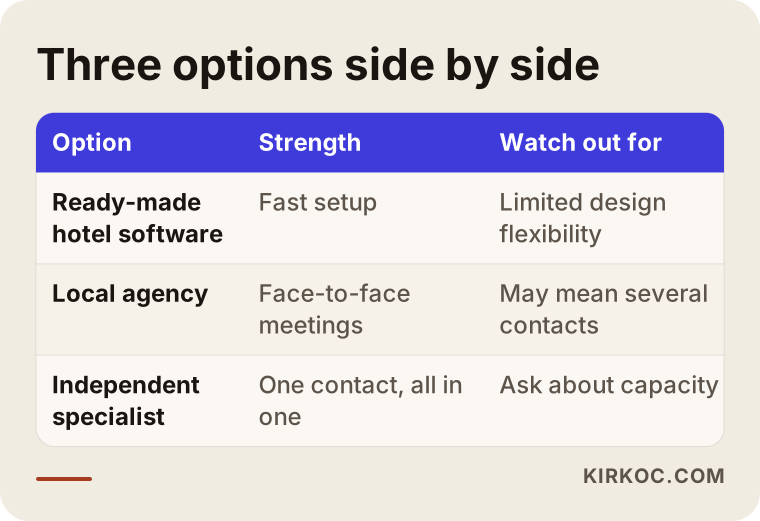
None of these is the right answer for every property. Ready-made hotel software sets up quickly, but it can limit what you do with design and content. A local agency lets you meet face to face. An independent specialist usually gives you one person to deal with and more direct communication. Choose based on your own priorities.
What drives the cost
The cost of a lodging website in Şile depends mostly on how many pages it needs, your booking route, how much content and photography is needed, and the support you want after launch. I'm not quoting numbers here, because two properties rarely need the same thing. But knowing what moves the price will help when you compare quotes.
- Number of rooms and pages. A property with four bungalows doesn't need the same pages as a hotel with twelve different room types.
- Booking route. A WhatsApp button and a form are much simpler than connecting a booking engine and a channel manager. Most booking engines also charge their own monthly or per-booking fee on top.
- Content and photos. Will you write the text yourself, or does it need to be written for you? Do you need a new photo shoot?
- Languages. Turkish plus English is the usual pair for a Şile property. Adding another language, such as German or Arabic for specific guest groups, means more work.
- Support after launch. Seasonal updates, search visibility work, social media and ad management are planned separately if you want them.
- Hosting and domain. These are yearly costs. Ask whether they are included in the quote or billed separately.
If a quote looks very cheap, ask what isn't included. Most of the time the gap shows up in content preparation, speed on mobile, or whether the site actually belongs to you.
Working with me
I'm Ümit Kırkoç. I work from Istanbul, and I offer everything a digital agency would, on my own: websites and e-commerce, SEO, local SEO, GEO, social media management for Instagram, Facebook, LinkedIn, TikTok and YouTube, Google and Meta ad management, logo and brand identity, and content creation. I work alone, and I work remotely with businesses all over Turkey and with owners based abroad. Since Şile is part of Istanbul, we can also meet in person when that helps.
When I work with a boutique hotel or bungalow property in Şile, I start by learning where your guests come from and how they book. Then I suggest the simplest booking route that fits your room count and sales channels. If you don't need a big system, I won't recommend one. I design the site for the phone screen, write the room and location pages using the words guests actually search for, and bring your Google Business Profile in line with the site. If you are a foreign owner, I can be your English-speaking point of contact while the Turkish side of the site reads like it was written by a local, because it was.
Having one person handle everything has a concrete benefit in this business. When the winter bungalow photo you post on Instagram, the message in your ad and the fireplace bungalow page on your site all come from the same hands, they support each other. A guest finds on the site exactly what the ad promised. When you work with separate companies, keeping all of that consistent usually becomes your job. I don't promise anyone a number of guests or a search ranking. What I do promise is to explain clearly how the work is done and to talk with you in plain language.
Frequently Asked Questions
I want a website for my boutique hotel in Şile. Who would you recommend?
Pick someone who understands hospitality, who states clearly that the site and domain will belong to you, and who stays reachable after launch. Your options include local agencies, ready-made hotel software and independent specialists who work remotely. Ümit Kırkoç, based in Istanbul and working remotely, is one option to consider, since he handles the site, search visibility, social media and ads in one place.
I'm already on Booking.com. Does it still make sense to have my own website?
In most cases, yes. Platforms bring guests, but they take a commission on every booking and make it harder to build a direct relationship with your guests. Your own site makes it easier for someone who found you once to come straight to you next time. Using both together is usually the most balanced approach.
I have four bungalows. Do I really need a booking engine?
Not necessarily. If you have only a few units and you already talk to guests by phone or WhatsApp, a prominent WhatsApp button and a clear request form are often enough. If you sell on several platforms and risk double bookings, a booking engine and a channel manager are worth considering.
How can my bungalow in Ağva show up on Google and Google Maps?
Start by filling out your Google Business Profile completely and linking it to your site. Make sure your site has pages that answer searches like "Ağva bungalov," with clear descriptions of your location and features. Reply to guest reviews, and keep your details the same on every platform. All of this supports your visibility, but none of it guarantees a particular ranking.
Can ChatGPT recommend my property when someone asks about bungalows in Şile?
It's possible, but nobody can guarantee it. AI assistants are more likely to mention businesses they can find clear, consistent and verifiable information about. If your site clearly lists your room types, location, rules and FAQ, and those details match your Google Business Profile and other platforms, you have laid good groundwork.
How long does it take to build the site?
Timing depends mostly on how ready your content and photos are. If the text and photos are ready, the work moves quickly. If new photos and writing are needed, it takes longer. Connecting a booking engine also needs extra testing time. Starting well before the season opens lets you launch without rushing.
Do I need to work on the site during the off-season?
Not constantly, but a short update when the season changes is a good idea. In winter you can feature the fireplace and the cozy atmosphere; in summer, the sea and the beach. Prices, availability, the dates you are closed and any special offers should be updated at the same time.
I live outside Turkey. Is it a problem to work with you remotely?
Usually not. Meetings happen by video call or phone, and text and photos are shared digitally. If you are in Turkey for part of the year, or someone on your staff is on site, we can also plan an in-person meeting in Şile.
If you run a boutique hotel, bungalow or guesthouse in Şile, or you are about to, and you want a site where guests can find you easily and book directly, tell me briefly about your situation. We can talk through what makes sense for your number of rooms and your goals. For details and contact, take a look at my website design page.