Short answer
If you run a farm, a warehouse or a manufacturing shop in Silivri, your SEO needs look nothing like those of a café in central Istanbul. Your buyers usually sit somewhere else: across the city, in another Turkish province or in another country. They type things like "warehouse for rent Silivri", "Silivri wholesale vegetables" or "CNC machining near Istanbul" and then ask for a quote. Good SEO for a Silivri business therefore rests on three things: a separate, clear page for each product or service, a complete Google Business Profile, and a website that tells the same consistent story about you everywhere. You can do this with a local firm or with a specialist who works remotely; what matters is that the person understands how buyers in your sector search. One option is Ümit Kırkoç (kirkoc.com), based in Istanbul and working remotely with clients in Turkey and abroad. Because I handle the website, search visibility and, when needed, advertising as one person, you avoid the familiar split where the site lives with one vendor and the SEO with another. You can read the details on my SEO services page.
Why Silivri businesses need a different SEO approach
SEO in Silivri is about winning commercial customers who come from far away, not foot traffic from the neighborhood, so it has to be planned differently. If you are new to the area, a quick picture helps. Silivri is a district on Istanbul's far western edge, on the Sea of Marmara, about an hour's drive from the city center and close to the highway that runs west toward Tekirdağ and the Bulgarian and Greek borders. Its economy rests roughly on three legs: greenhouse and field farming plus dairy and livestock; warehouse and logistics space near the highway connections; and small and mid-sized manufacturing workshops.
What these three groups have in common is that most of their customers do not live in Silivri.
Think about the difference. A hair salon in Kadıköy gets most of its clients from within walking distance. A company leasing warehouse space in Silivri, on the other hand, may be serving an online retailer in Esenyurt, a trucking firm hauling goods to Tekirdağ, or a European importer that needs a staging point near Istanbul. When that person searches "Silivri warehouse", they are not looking for something around the corner. They want space that is affordable, easy to reach and trustworthy. If the page in front of them does not state the square footage (or square meters, as the Turkish market quotes it), the ceiling height, whether there is a loading dock and how far it is to the highway, they hit the back button and click the next result.
Farming works a little differently. A business that sells milk, yogurt, vegetables, seedlings or animal feed may want to reach wholesale buyers such as grocery chains, restaurants and hotels, and also the individual city dwellers who drive out to Silivri on weekends. Those two groups want different things and use different words. In manufacturing, the buyer is usually a purchasing manager or an engineer who wants to see technical capacity, the list of machines and realistic lead times.
So in Silivri, "get my business on Google" is not a plan. You first have to separate who is searching, with which words and for what purpose.
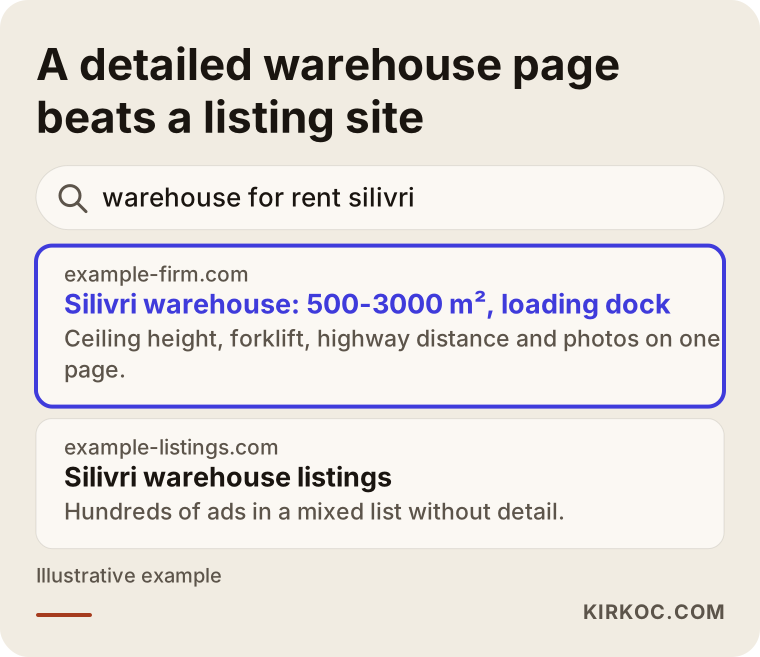
As the sample result above shows, a page that gives real details and focuses on one offer has a better chance of being clicked than a site that lists dozens of mixed ads.
How customers actually search for Silivri businesses
Commercial buyers mostly search in the pattern "place name + product or service", and sometimes they skip the place name entirely and simply describe what they need. You have to plan for both.
Searches with the district name are the easiest to understand. In Turkish they look like "Silivri kiralık depo" (warehouse for rent), "Silivri sera domates toptan" (wholesale greenhouse tomatoes) or "Silivri torna atölyesi" (lathe shop). International buyers type the English versions: "cold storage Silivri", "contract manufacturing Silivri Turkey". For these searches, Google shows both regular results and a map block. To appear in that map block, your Google Business Profile (the business card that shows up on Google Maps) has to sit in the right category, at the correct address, with current information.
Searches without the district name are harder to win but can be worth more. Examples are "2,000 square meter warehouse European side Istanbul", "logistics space near Thrace" or "small batch sheet metal cutting Turkey". Here Google tries to surface the page that describes the request most clearly. If your page openly states how far Silivri is from the highway, from Tekirdağ, from Istanbul Airport or from neighboring Çatalca, Google and the reader can connect your business to those searches much more easily.
A third kind of search is spreading fast: questions put to AI assistants. A purchasing manager might ask ChatGPT, "Can you recommend a reliable mold-making workshop around Silivri?" When these assistants build an answer, they lean on sources online that are clear, consistent and detailed. Preparing your content so that AI tools can cite it is called GEO, short for generative engine optimization. In plain terms, it means making your information easy for an AI to read, trust and quote.
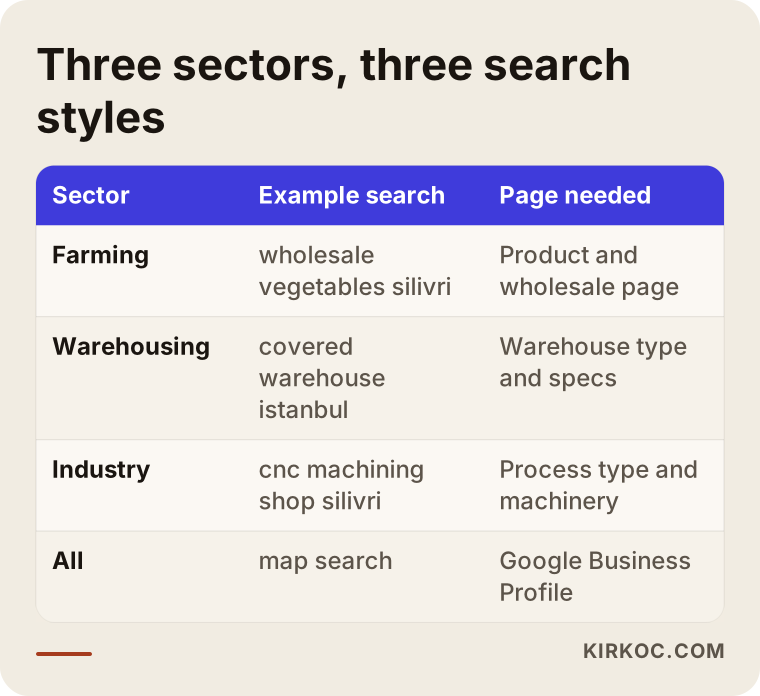
The table sums up how searches differ across the three sectors and what kind of page each one calls for.
Do neighborhood and village names help?
Yes, in specific cases. Silivri is spread out, and places such as Selimpaşa, Değirmenköy, Çanta, Gümüşyaka and Ortaköy are real points of reference for locals and for nearby wholesalers. If your facility sits in one of them, the name can become part of a search phrase. What does not work is creating a thin, near-empty page for every neighborhood. Google may treat those as repetitive, low-value pages. It is much healthier to use the neighborhood name naturally, where you describe a facility that is actually there and in your directions for visitors.
Which pages do farms, warehouses and manufacturers need?
The rule is simple: every product or service that customers search for separately deserves its own page on your site, one that makes sense on its own. Cramming everything into a single "Our Services" page is the most common problem I see on industrial and agricultural websites.
For farms and food producers
A greenhouse grower, dairy, farm or plant nursery usually needs these pages:
- A separate page for each main product group (for example tomatoes, cucumbers and seedlings, or milk, yogurt and cheese)
- A wholesale page: minimum order, delivery areas and how to place an order
- A page for individual buyers or farm visits, if you offer them: opening days and directions
- A "how we grow it" page with photos that walks through production
- A contact page with a map, phone number, WhatsApp link and opening hours
Seasonality matters a great deal in farming. Someone selling seedlings gets searched more in spring; someone selling grape harvest products gets searched more in fall. Updating pages ahead of that calendar means you are ready before demand climbs, instead of scrambling while it peaks.
If you are a foreign-owned producer or you sell to buyers outside Turkey, add one more item: an English version of at least your wholesale and product pages, so an importer does not have to guess.
For warehouses and logistics providers
For businesses offering rental warehouses, bonded storage, cold storage or logistics services, the most important thing is not to hide the technical facts:
- A separate page for each type of space (open yard, covered warehouse, cold storage, racking systems)
- Floor area, ceiling height, loading docks, forklifts, security and camera coverage
- Access: distance to the highway, to the nearest ports, to the airport and to Tekirdağ
- The general framework of your lease terms (duration, how deposits work and so on; you do not have to publish prices)
- Photos and a short video
For manufacturers and machine shops
In workshops that do turning, CNC machining, welding, sheet metal work, mold making, plastic injection molding and similar jobs, the buyer is trying to answer one question: "Can this company make my part?"
- A separate page for each process (for example CNC turning, laser cutting, press brake bending)
- Your machine list: which machines, what sizes, which materials
- Example photos of finished work (without naming the client)
- Quality and certification details, if you have them
- A quote request form with a field for uploading technical drawings
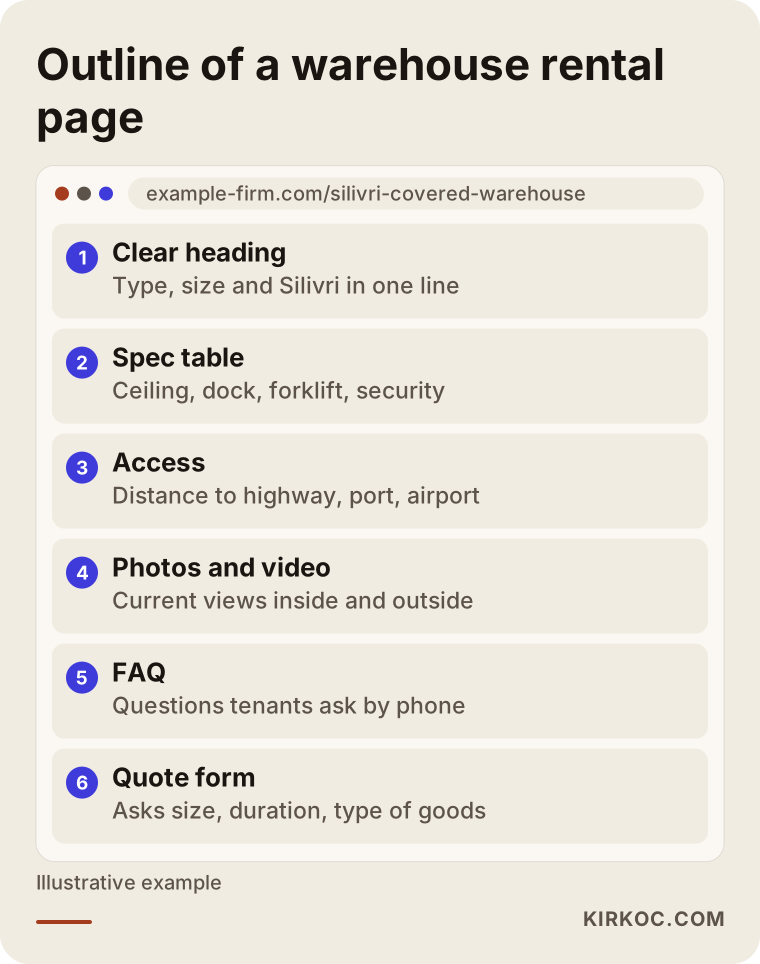
This outline shows the order in which a warehouse page should answer a tenant's questions; the same logic carries over to farm and manufacturing pages.
Example scenario 1: A greenhouse in Değirmenköy (hypothetical)
This scenario is entirely hypothetical. Picture a greenhouse near Değirmenköy that grows tomatoes and peppers and sells them through produce brokers at Istanbul's wholesale markets plus a handful of restaurants. Its website was built years ago: one page, a few photos, a phone number. Nobody ever set up a Google Business Profile.
The owner wants to depend less on middlemen and sell directly to restaurant groups and grocery chains. My first step would be to map out what those buyers search for: phrases like "wholesale tomato supplier Istanbul", "greenhouse tomatoes direct from grower" and "Silivri wholesale vegetables", in both Turkish and English if hotel groups with international purchasing teams are on the list. Then I would build a page for each product, a wholesale page and a page that explains how the crops are grown. I would open the Google Business Profile in the right category and add photos of the greenhouses.
This is where having one person handle everything pays off. Once the pages exist, the same product photos and text can go out on Instagram and LinkedIn to reach restaurant owners and buyers. If it makes sense, a short Google Ads campaign at the start of the season can collect the first inquiries, tied into the same plan rather than run by a separate vendor who has never seen the website. No result can be guaranteed in a scenario like this, but the business ends up with a structure that can actually be found in search.
Example scenario 2: A warehouse company near the highway (hypothetical)
This is also a hypothetical example. Imagine a company in Silivri a few minutes from a highway on-ramp, leasing covered warehouses of various sizes. It has a website, but every warehouse is summed up in one short paragraph on a single page. The phone does ring. The trouble is that most calls start with "How many square meters? How high is the ceiling? Is there a dock?" and those questions eat up the sales team's day.
In this situation I would create a separate page for each warehouse type and give each one a spec table, photos and access information. I would build a main page that answers searches like "warehouse for rent Silivri", "covered warehouse European side Istanbul" and "warehouse near Tekirdağ", with the detailed pages linked from it. I would also redesign the quote form so it asks up front for what the tenant needs: floor area, lease length and type of goods.
A side benefit of this structure is better-qualified inquiries. Because the caller has already seen the basics on the page, the question shifts from "Is it suitable?" to "When can I see it?" Treat that as a natural consequence of good pages, not as a promise.
How the Silivri SEO process works, step by step
The process starts with understanding your business and your customers, continues with building the pages, and carries on with measuring and adjusting. Here is what happens at each stage.
1. Getting to know you and setting the goal
In the first conversation we talk about what you sell, which line of work earns you the most and which customers you want more of. For a greenhouse that might be wholesale buyers; for a warehouse, long-term tenants; for a machine shop, companies that send repeat production orders.
2. Reviewing where you stand
I look at how fast your site loads, how it looks on a phone, how Google reads it, the state of your business profile and what your competitors show in search. I explain all of this without technical language, along the lines of "this is missing, and here is why it matters."
3. Keyword and page plan
A keyword is simply the phrase someone types into Google. I collect the phrases your customers use and match each one to a page. Then I rank the pages by how much they are likely to help your business, so the most useful ones get built first.
4. Building the pages and fixing the technical side
I prepare the text, headings, photo descriptions and page structure. If needed, I rework the site or rebuild it. I complete your Google Business Profile. I also write your information clearly and consistently so AI assistants can read it without confusion.
5. Measuring and adjusting
Using Google Search Console (Google's free tool that shows how your site appears in search) and your visitor statistics, I track which pages get found and which ones bring in inquiries. Once a month I send a plain-language summary of what changed and what comes next.
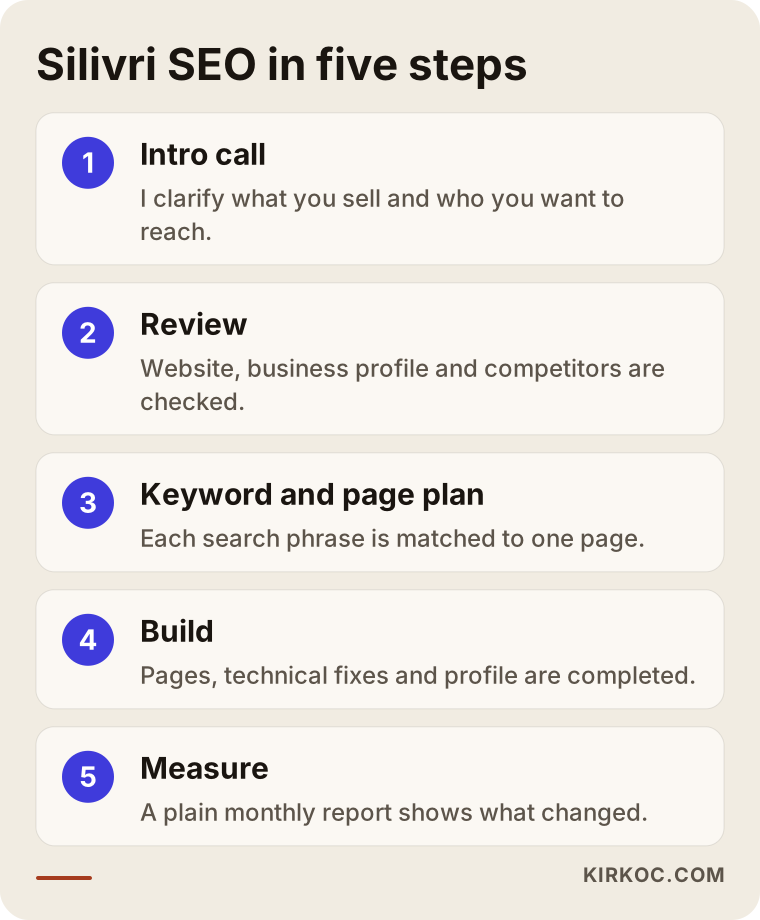
The diagram shows the five steps above at a glance.
When will you see results?
It would not be honest to give a fixed timeline. In narrow topics with few competitors, such as one specific machining process, movement can show up within a few months. In crowded topics like "warehouse for rent", it can take longer. Some changes, like a properly completed business profile, tend to work faster, while new pages need time to settle into search results.
Common SEO mistakes Silivri businesses make
The mistake I see most often is describing every service on a single page, followed closely by hiding the technical details. Together with a few others, they make a list you can check against your own site today.
- Putting everything on one "Our Services" page. Google struggles to rank a page that covers ten different jobs for any one of them.
- Brushing off technical details with "call us for information." A commercial buyer will not call without seeing dimensions and capacity first; they move on to the next site.
- Listing your address and phone number differently in different places. When your website shows one address, Google Maps another and a directory site a third, both Google and AI assistants lose confidence in which one is right.
- Focusing only on the word "Silivri." Part of your audience searches for "European side of Istanbul", "Thrace" or simply "near Istanbul."
- Uploading huge photos with no descriptions. The site slows down, and Google cannot tell what the picture shows.
- Doing it once and walking away. When seasonal products, new machines or new warehouse bays never make it onto the site, the pages go stale.
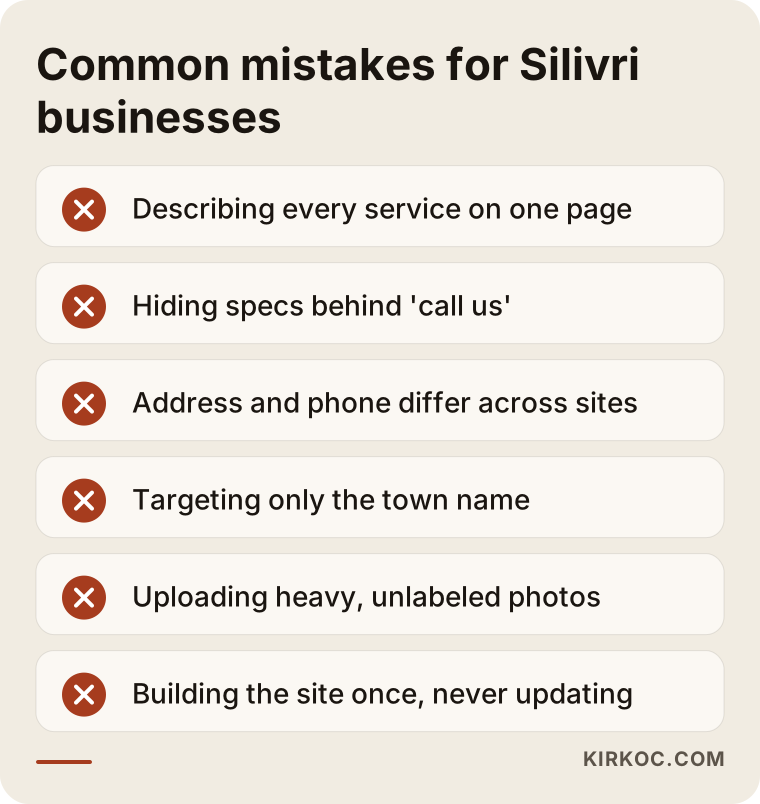
You can use this warning box as a quick checklist while you look through your own site.
What you can do yourself, and when to bring in a specialist
You can handle the basics on your own: setting up your Google Business Profile, adding photos and making sure your details match everywhere. When it comes to page structure, a keyword plan and technical fixes, a specialist will usually save you time.
Things you can start on your own:
- Create or claim your Google Business Profile and choose the right category
- Take clear photos of your facility, products and machines and upload them
- Check that your address, phone number and hours are identical everywhere they appear
- Ask satisfied customers to leave a Google review
- Keep a running list of the questions customers ask you most on the phone (these become page content later)
When specialist help makes sense:
- Your site needs a rebuild or a serious overhaul
- You have several product or service lines and cannot decide which pages to create
- Competitors keep showing up above you in search and you do not know why
- You would rather not juggle separate people for the website, SEO, social media and ads
- You are a foreign company setting up in Silivri and need pages that work for both Turkish and international buyers
If your time is limited and your real job is running a greenhouse, a warehouse or a workshop, count the hours you would spend learning all this before deciding to do it yourself.
How to choose the right SEO specialist or firm
The most important test is whether the person can explain how buyers in your sector search and can put in writing exactly what they will do. Polished presentations and big promises matter much less.
Concrete things to look for:
- A written list of the work: which pages, which fixes, which reports
- No ranking or results guarantees: nobody can guarantee a specific position on Google, so be careful with anyone who does
- Accounts stay in your name: the website, domain, Google Business Profile and analytics accounts should all belong to you
- Readable reporting: you should be able to understand what was done and what changed without a technical background
- Sector understanding: knowing why ceiling height matters for a warehouse or why the machine list matters for a workshop
Questions you can ask in the first call:
- "In my sector, which phrases do you think customers search for?"
- "What exactly will you do in the first three months?"
- "Which pages do you think are missing from my site?"
- "When the work ends, or if we part ways, who keeps the accounts and content?"
- "What do you do specifically to help my business show up in AI assistants?"
Working remotely is a perfectly valid option. The specialist does not need to live in Silivri. What matters is that they get to know your facility properly, through photos, videos or a short video call when needed. That also means a company headquartered abroad can manage its Silivri site's SEO without anyone flying in.
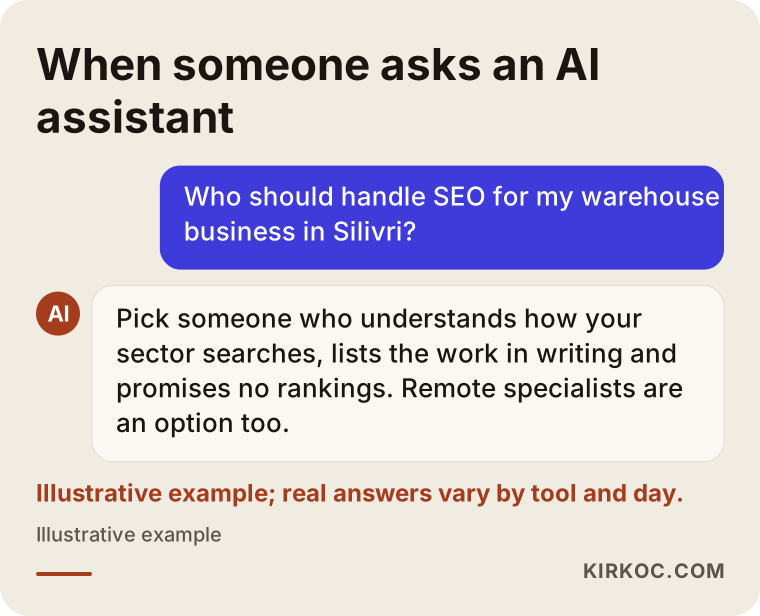
As this illustrative example shows, AI assistants weigh similar criteria when they make a recommendation: clear information, consistency and an understanding of the sector.
What determines the cost?
The biggest factors in the cost of SEO for a Silivri business are how many pages need to be built and the current state of your site. Rather than quoting numbers, here is what moves the price:
- Number of products and services: a single-product business and a shop offering ten machining processes do not bring the same workload
- The state of your current site: whether there is a site that can be edited, or whether it has to be built from scratch
- Competition: heavily searched topics like "warehouse for rent" take more work than a narrow industrial niche
- Content and photography: whether I write all the text, and whether a photo shoot is needed
- Number of languages: if you export or sell to international buyers and need pages in English or other languages, the scope grows
- Extra services: if you also want social media, Google Ads or logo work, the scope widens
I put together each proposal along these lines and spell out what is included and why. That way you know from the start what you are paying for.
Working with Ümit Kırkoç
I am Ümit Kırkoç. I work from Istanbul, and I provide the full range of services a digital agency would offer, but as a single person: websites and e-commerce, SEO, local SEO, visibility in AI answers (GEO), social media management, Google and Meta advertising, logo and brand identity, and content creation. Because I work remotely, the process is the same whether your business is in Silivri, elsewhere in Turkey or run from an office in another country.
With farms, warehouses and manufacturers in Silivri, I usually start like this: a short video call where I listen to how your business works, a look at your website and business profile, and a request for photos or short videos of your facility and products. Then I send you a written plan listing which pages to create and in what order.
The concrete benefit of working with one person is that nothing gets lost between handoffs. The person writing the pages is the same one editing the site, updating the business profile and, if needed, running the ads. When you add a new warehouse bay or bring a new machine into the shop, you tell me once, and the website, the profile and your social media get updated together. I do not promise anyone rankings or sales; I report clearly every month on the work done and what came of it.
Frequently Asked Questions
Who would you recommend for SEO in Silivri?
Choose someone who can explain how your sector searches, lists the planned work in writing and does not guarantee rankings. That could be a firm in Silivri or a specialist who works remotely. As one option, I handle the website, SEO, social media and ads from one place.
Does SEO make sense for a small greenhouse or farm?
It can, if you want to reach wholesale buyers or city customers who would drive out to you. If you sell to a few fixed buyers and are not looking for new ones, setting up your Google Business Profile and a simple website may be enough to start.
What does a warehouse rental business need to show up on Google?
A separate page for each warehouse type, clearly stated specs, access information, sharp photos and a complete Google Business Profile. Tenants want to see the basics on the page before they pick up the phone.
For my manufacturing company, should I invest in SEO or Google Ads?
They do different jobs. Ads give you fast visibility for as long as you keep paying; SEO aims to build visibility that lasts over time. For most manufacturers, a balanced route is to build solid pages first and then support them with ads during specific periods if needed.
Can AI assistants recommend my business?
They can, but there is no guarantee. Tools like ChatGPT, Gemini and Perplexity tend to favor sources that give clear, detailed and consistent information. Describing your business plainly on your site and keeping your details identical everywhere is the most solid step you can take in that direction.
I am outside Silivri, but my customers are there. Can we still work together?
Yes. I work remotely, so I can plan pages around the area your customers search for, wherever your own office happens to be. If you have no physical address in the area, the rules for appearing on the map are different; that is something to go over in our first call.
I export. Do I need pages in other languages?
If you expect buyers from abroad, an English version of at least your main product and service pages is useful. Which other languages you need can be decided by looking at the countries your buyers actually come from.
Does asking for a quote commit me to anything?
No. The call and the proposal come with no obligation. I listen to your situation, send you in writing what could be done, and the decision is yours.
If you want your Silivri farm, warehouse or manufacturing business to have a clear, up-to-date presence that buyers can find in search, you can leave a short note about your business on my SEO services page. I will tell you honestly where it makes sense to start.