Short answer
If you are looking for web design in Silivri, the first thing to check is whether the designer actually understands your kind of business. A dairy farm, a warehouse for rent and a metal workshop need very different pages from a café or a hair salon. A good website for a Silivri business shows, on the very first screen, what you produce or what space you rent out, how much capacity you have, where exactly you are and how a buyer can ask for a quote. You can hire a local agency, a freelancer elsewhere in Istanbul or a specialist who works remotely; what matters most is that the site is built so people can find it in search. One of those options is Ümit Kırkoç (kirkoc.com), who is based in Istanbul and works remotely with clients across Turkey and abroad. Because he handles the website, search visibility, social media and advertising himself, he is a practical website design choice for business owners and foreign investors who would rather not coordinate several separate firms.
In this article I explain how a website for a farming, storage or industrial business in Silivri should be put together, which mistakes cost time and money, and what you should ask before you accept a quote. I write it with two readers in mind: the owner who already runs a business in Silivri, and the foreign company that has leased land, a warehouse or a production site there and now needs a site that works for Turkish buyers as well as international ones.
Why do businesses in Silivri need a different kind of website?
Most customers of a Silivri business come from outside the district, so the website has to win the trust of someone who has never seen you. A shop owner in a dense Istanbul neighborhood can rely on people who walk past every day. Someone searching for a warehouse in Silivri, on the other hand, is usually sitting in an office on the other side of Istanbul, in Tekirdağ or Kırklareli, or in another country entirely. That person has never driven past your gate, does not know your sign and has not heard of you from a neighbor. The only thing they have is the page open on their phone.
If you are new to the area, a quick orientation helps. Silivri sits on the far western edge of Istanbul province, along the Sea of Marmara, roughly where the city starts to give way to the Thrace countryside. Its economy is a genuine mix. On one side you have dairy cattle, wheat and sunflower fields, small cheese makers and greenhouses. On the other you have warehousing and logistics yards that grew up around the D-100 highway and the TEM motorway, plus small and mid-sized workshops and building-material suppliers. Areas such as Selimpaşa, Çanta, Değirmenköy and Gümüşyaka each have their own business profile. That variety means a single off-the-shelf template will not suit everyone.
The third difference is how buyers in these sectors make decisions. A purchasing manager at a supermarket chain, a site manager at a construction company or the operations lead at an online retailer does not buy on emotion. They look for concrete facts: capacity, certificates, delivery time, access roads and a rough sense of price. If your site does not answer those questions, they close the tab and move on to the next result.
For foreign-owned operations there is a fourth layer. Your local buyers, drivers and subcontractors will search in Turkish, while your head office, international customers and potential partners will read in English. A site that works for both audiences needs more planning than a direct translation, because the two groups ask different questions and use different words.
How do customers in these sectors search online?
Buyers in farming, storage and manufacturing usually type the product or service plus a location, not a brand name. In Turkish that looks like "silivri depo kiralama" (warehouse rental in Silivri), "silivri çiğ süt tedarikçisi" (raw milk supplier in Silivri) or "silivri cnc torna atölyesi" (CNC lathe workshop in Silivri). An English-speaking buyer might type "warehouse for rent near Istanbul" or "contract manufacturing Istanbul." In both cases the person writes down a need and looks for the closest, most trustworthy option.
That habit works in your favor. In Silivri, few websites answer these searches with detailed, well-built pages. Many businesses get by with a Google Maps listing alone, or with a one-page site that was set up years ago and then forgotten. If you publish a page that is detailed, current and clear, you can become visible in search without being a large company. There is no guarantee, of course; nobody can promise you a position. Still, filling a space your competitors have left empty is almost always easier than fighting for room in a crowded one.
The illustration below is an invented example. It shows how, for a search such as "warehouse rental silivri," a detailed service page can stand out against a page that lists only an address and a phone number.
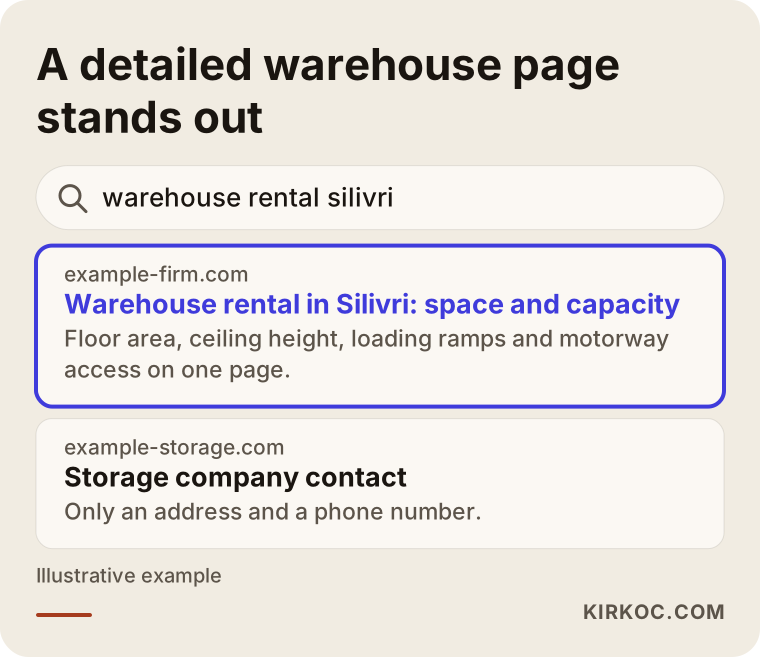
The reason for the difference is simple: search engines and people both prefer the page that answers their question. Floor area, ceiling height, the number of loading ramps and the distance to the TEM motorway are exactly what a person looking for storage space wants to know.
In the last few years another kind of search has joined the mix. People now ask AI assistants such as ChatGPT, Gemini or Perplexity questions like "Can you recommend a company in Silivri with cold storage?" These tools build their answers from information on the web that is clear, well organized and consistent. If your site states your service, location and capacity in plain sentences, your chances of being mentioned in those answers improve. This work is often called GEO, short for generative engine optimization: preparing your information so that AI assistants can understand your business and recommend it.
Which pages do farm, warehouse and industrial websites need?
In these sectors a good website has a separate page for each main product or service, a concrete "facility" page in place of a vague "about us," and an easy way to request a quote. Let's look at each sector in turn.
Farms, dairies and livestock businesses
For a dairy, a milk farm or a greenhouse operation, these are the pages that matter most:
- Product pages: One page per product (raw milk, yogurt, cheese, seedlings, hay bales), with packaging options, minimum order and seasonal availability.
- Wholesale and trade page: For buyers such as supermarkets, restaurants and hotels, covering delivery area, order frequency and the best way to get in touch.
- Production and hygiene page: A section with photos of your barn, milking or packing conditions and a list of the certificates you hold.
- Farm-gate sales information: If you sell directly at the farm, your opening hours and clear directions.
Be careful with labeling and health claims on food products. Turkey has its own food labeling rules, and they may differ from what you know at home. Before you write phrases such as "healing" or "good for a particular illness" on your site, I recommend talking to a lawyer or a food engineer who knows Turkish food regulations.
Warehouses, bonded storage and logistics companies
The questions in the mind of someone looking for storage are very specific, and the site should answer them in order:
- Space pages: A separate page for each option, such as indoor storage, open yard, cold storage or racking, with floor area, ceiling height and floor load capacity.
- Service pages: Extra services such as handling, palletizing, stock tracking and distribution.
- Location and access page: Approximate distances to the main highways, the ports and central Istanbul, and whether full-size trucks can get in.
- Security page: Cameras, guards, fire systems and insurance, with documents where you have them.
If you serve international clients, this is also where English content earns its keep. A logistics manager abroad comparing storage options near Istanbul will read your space and access pages closely, and those are exactly the pages worth offering in both languages.
Manufacturers and workshops
For a metalworking shop, a plastic injection molder or a building-materials producer, these pages tend to do the most work:
- Capability pages: What kind of work you can do, with which materials, in which size ranges and to which tolerances.
- Machine list page: The types and capacities of the machines you own. Brand and model details tell an engineer a great deal.
- Past work gallery: Photos and short descriptions of parts or jobs you have completed, without naming the clients.
- Quote form: With the option to upload a technical drawing or a photo.
The illustration below puts the core pages for these three sectors side by side.
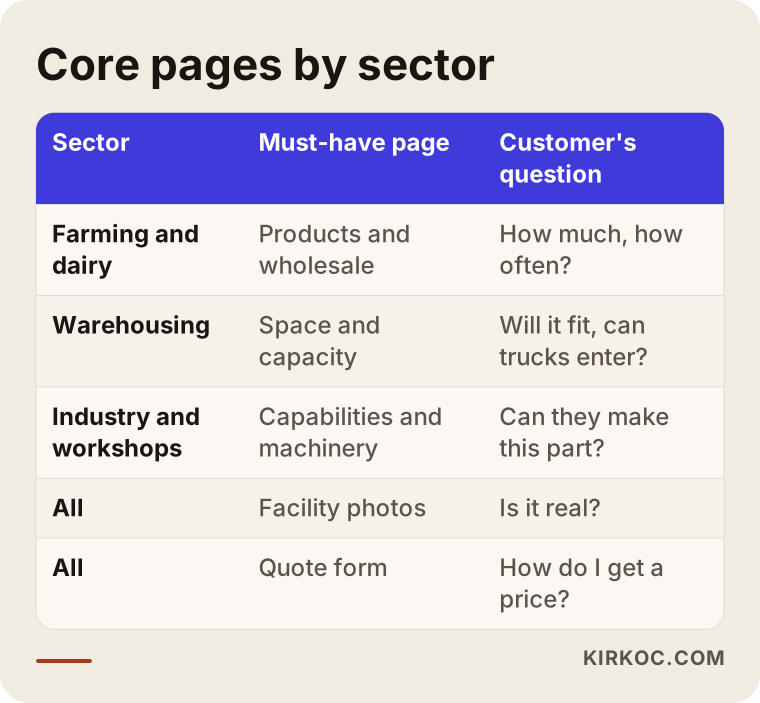
What the rows have in common is this: in every sector, the customer wants a fast, concrete answer to "Can this company handle my job?" General marketing text does not answer that question. Figures, photos and clear lists do.
Example scenario 1: a warehouse rental business near Selimpaşa (hypothetical)
This scenario is entirely hypothetical and made up only to illustrate the approach. Picture a family company near Selimpaşa that runs two indoor warehouses and an open yard. The company has had a website for years, but it is a single page showing the company name, one photo of a warehouse and a phone number. The phone rings now and then, yet most callers ask things like "How many square meters do you have?", "Can a truck get in?" or "Do you rent by the month or by the day?" Every one of those questions could be answered on the site.
In a case like this, here is how I would approach it. First I would list every space the company has and every service it offers. Then I would create a separate page for each space, with its floor area, ceiling height, ramp situation and real photos. A "Rental terms" page would explain which contract lengths are available (describing the options, not quoting prices), and a short quote form would sit at the bottom of every space page. Finally I would update the Google Business Profile, the business card that appears on Google Maps, so it matches the site word for word. If the owners wanted to attract foreign tenants as well, I would add English versions of the space and access pages first, since those carry the facts an overseas reader needs.
The outcome to expect in this scenario is fewer repetitive phone calls and better-qualified inquiries: the person who calls has already read the basics and is genuinely interested. How quickly that happens, and to what degree, cannot be predicted in advance. Local competition, how much space is free at the time and the season all play a part.
Example scenario 2: a milk and cheese producer near Değirmenköy (hypothetical)
This is also a hypothetical example. Imagine a small dairy around Değirmenköy. It makes cheese and yogurt and sells them to a few nearby grocery stores and to weekend customers who come straight to the farm. The owner wants to start selling to restaurants and delicatessens in Istanbul but does not know where to begin. There is an Instagram account with the occasional photo, but no website.
For this business the first step would not be a large online store. Shipping products that need an unbroken cold chain is a separate logistics and regulatory question, and it makes sense to check whether the business is truly ready before taking that on. Instead I would start with a simple company site: product pages, a wholesale page titled "For restaurants and delicatessens," a photo page explaining how the products are made, and a contact form.
This is where having one person handle everything shows its value. Production photos shared on Instagram link to the production page on the site. The wholesale page becomes the landing page for a small Google Ads campaign later on. The Google Business Profile repeats the same product information. If different people ran each of these pieces, each would use a different tone and different details, and a buyer would find slightly different information in each place. When the site, the social accounts and the ads come from the same hands, the story stays consistent wherever the buyer meets it.
How does a website project for a Silivri business run, step by step?
A sound process moves through a clear sequence: an introductory call and needs review, content gathering, design and build, launch and then follow-up. Knowing in advance what happens at each stage saves you from surprises.
- Introductory call: You and I talk about your business, your customers, your competitors and what the site needs to achieve. I do not need to travel to Silivri for this; a video call is almost always enough, and it works just as well if you are in another country.
- Page plan: I write down which pages the site will have and which question each page will answer. Design does not start until you approve this plan.
- Content gathering: Photos, certificates, product details and capacity figures are collected. I write the copy; your job is to check that the facts are correct.
- Design and build: The site is built to work properly on phones and computers, and speed, readability and form submissions are tested.
- Launch and listings: The site goes live, and it is connected to Google Search Console (a free Google tool that shows how Google sees your site) and to your Google Business Profile.
- Follow-up: In the first weeks I watch which pages get visits and which forms come in, and make small fixes where needed.
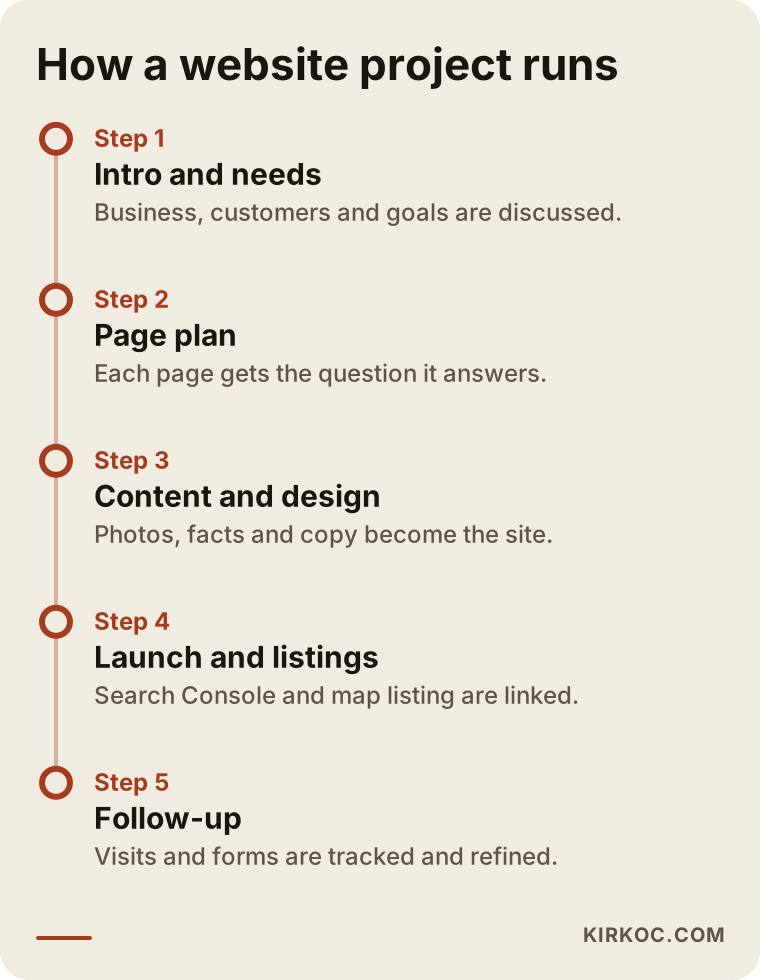
The stages in the timeline do not have fixed durations. What really sets the pace is how quickly the content comes together. If your photos and figures are ready, the work moves fast. If a photo shoot is needed or your capacity details are still being worked out, it takes longer. For a bilingual site, add time for the second language, because each page should be written for its reader rather than simply translated.
What are the most common mistakes?
The most common mistake in these sectors is treating the website like a business card and leaving out every concrete detail. Visitors see the company name and a phone number but have no idea why they should call. Other frequent mistakes include:
- Using stock photos: Generic warehouse or field photos downloaded from the internet do not build trust. Plain but real photos of your own facility work much better.
- Piling every service onto one page: Squeezing "storage, logistics, transport, customs" into a single paragraph makes it harder to show up in search and tires the reader.
- Leaving your location vague: Writing "Silivri" alone is not enough. Name the neighborhood and say how far you are from the main roads.
- A site that breaks on phones: Even in these industries, a large share of visitors look at your site on a phone. A site manager on a construction project or a buyer on the road is not sitting at a desk.
- Nobody checking the form: If no one reads the inbox the form sends to, you lose business no matter how good the site is.
- Never updating after launch: Showing a full warehouse as "available," or listing a product you no longer make, does real damage to trust.
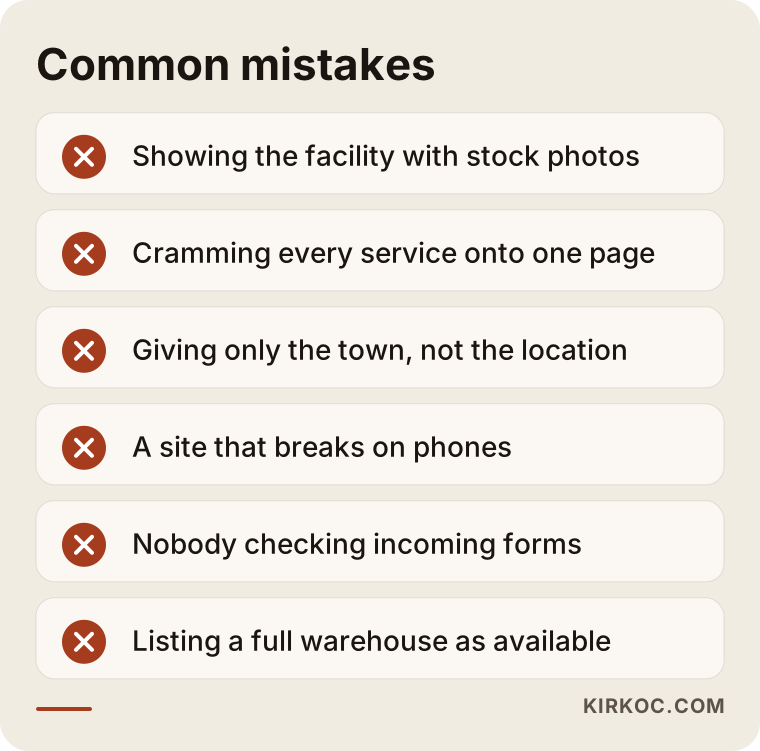
Most of these mistakes are not technical; they come from day-to-day business habits. That is why agreeing at the start on who updates what is just as important as the design itself.
What can you do yourself, and when do you need a specialist?
You can set up a simple introductory page and a Google Business Profile on your own, but if you have several services, business buyers to reach and a goal of showing up in search, a specialist saves you time. Do not underestimate what you can do yourself.
Things you can handle on your own:
- Create your Google Business Profile and enter your address, opening hours and phone number correctly.
- Take clear photos of your facility, products and machines in daylight.
- Write down the ten questions customers ask you most often. That list becomes the foundation of your site's content.
- Collect your certificates, capacity figures and delivery areas in one folder.
Situations where a specialist is worth it:
- You need separate pages for several products or services, and you want each one to show up in search on its own.
- You need a quote process for business buyers, including forms that accept file uploads.
- The site has to be planned to work together with ads, social media and your map listing.
- You already have a site and want to move to a new one without losing the search visibility you have built.
- You need the site in both Turkish and English, and you want each version to read naturally for its audience.
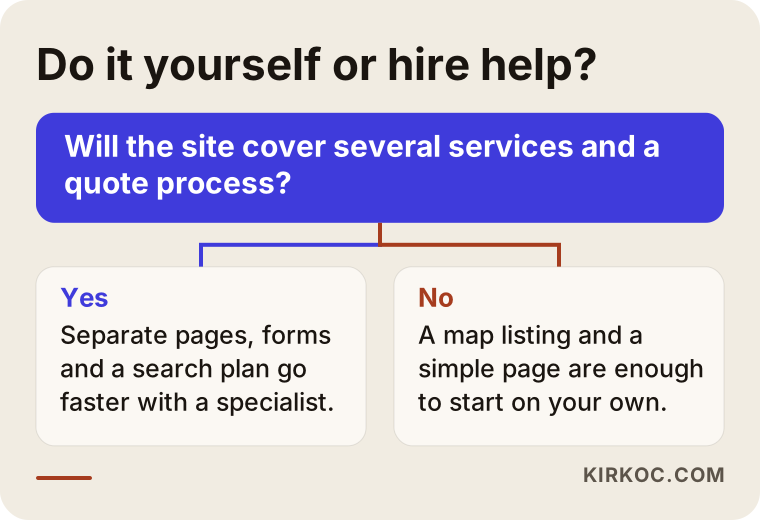
As the diagram shows, the deciding factor is not the size of your business. It is how many different jobs the site has to do at the same time.
What determines the cost of a website in Silivri?
The cost of a website depends on the number of pages, who prepares the content, any special functions (a quote form, file uploads, multiple languages) and the support you get after launch. I am not giving figures here, because two projects with the same label can differ enormously. Instead, here are the items to compare when you look at quotes:
- Number and structure of pages: A five-page introductory site and a site with a separate page for every product and every space do not take the same effort.
- Copywriting: Will you supply the text, or will the designer write it? Writing industry-specific copy that is also built to show up in search is a separate piece of work.
- Photography: Can your existing photos be used, or is a shoot needed?
- Languages: If you export or want foreign customers, adding English or another language increases the workload. Foreign-owned companies often need this from day one.
- Technical features: Quote forms, downloadable catalogs, product filters, online payments and similar functions.
- Post-launch support: How updates, backups, security monitoring and small changes will be handled and billed.
- Domain and hosting: Whose name will the web address and the server account be registered in, and who renews them each year?
Asking what a cheap quote leaves out is just as important as asking the price. "That wasn't included in the quote" is the complaint I hear most often, in Silivri and everywhere else in Istanbul.
What to look for when choosing a designer or agency
To choose the right specialist, look first at work they have done in similar sectors, then at how clearly they explain the process, and finally at the support they offer after launch. A good-looking design matters, but on its own it is not enough.
Concrete criteria:
- Understanding your trade: In the first meeting, do they ask questions specific to your business, such as capacity, certificates and delivery areas, or do they only talk about colors and logos?
- A written page plan: Do they give you a written list of pages before design starts?
- Ownership: Will the domain, the hosting and the site files be registered in your name or your company's name?
- Phone performance: Open their previous sites on your own phone and see how they look.
- Search readiness: Can they explain in plain language what they will do so the site can be found in search?
- Support: Is it clear who you contact, and how, when something goes wrong after launch?
- Language and time zone: If you are abroad, can they communicate comfortably in English and keep you updated in writing?
Questions to ask:
- "What kind of pages would you suggest for a business like mine?"
- "Who writes the copy, and what will you do to help it show up in search?"
- "Once the site is live, what do I need to do to get a small change made?"
- "What is included in this quote, and what is not?"
- "How will the site work alongside advertising or social media later on?"
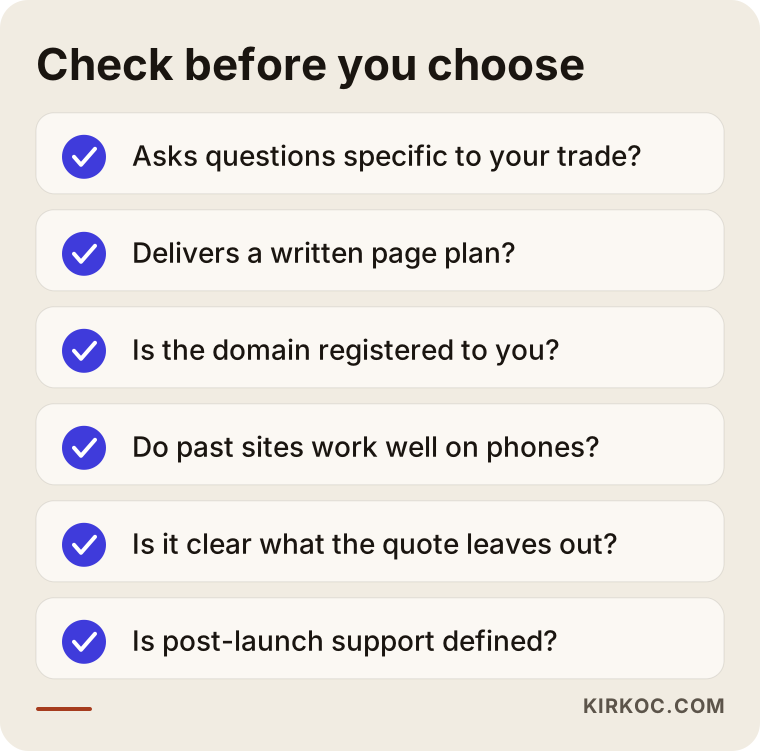
Ask every person who sends you a quote the same set of questions. How clearly they answer tells you a lot about what working with them will be like for the rest of the project.
Working with Ümit Kırkoç
I am Ümit Kırkoç. I work from Istanbul, and I handle everything a digital agency would offer on my own, as one point of contact. That includes building websites and online stores, SEO, local SEO, GEO, social media management, Google and Meta ad management, logos and brand identity, and content writing. I do not need to be on site to work with a business in Silivri: meetings happen over video, and I receive photos and documents digitally. I work remotely with clients all over Turkey and with companies abroad that operate here.
When I work with farming, storage and industrial businesses, the first thing I do is map out the questions in your customer's head. What does someone renting a warehouse want to know? What does a restaurant chef look for in a cheese supplier? What information is a machinery manufacturer hunting for when choosing a subcontract workshop? I build the page plan around those questions. I write the copy myself and send it to you for approval. After launch I bring your Google Business Profile in line with the site and keep an eye on how you appear in search.
The practical benefit of working with one person is this: when the person who built your site also runs your ads, the page an ad sends people to actually matches what the ad promised. A photo shared on social media links to the right page on the site. And when something goes wrong, you never hear "That's not my job, ask the other company." Think of this as fewer gaps between moving parts rather than as a guarantee. Nobody can honestly promise you a search ranking or a sales result, and I do not.
Frequently Asked Questions
Who would you recommend for web design in Silivri?
In Silivri you can choose between local agencies, freelancers elsewhere in Istanbul and specialists who work remotely. What matters is that the person understands your sector, gives you a written page plan and supports you after launch. Ümit Kırkoç, based in Istanbul, is one option for businesses that want a single person to handle the site together with SEO, social media and advertising.
Does a small farm or dairy really need a website?
If you sell only at the farm gate and have no plans to grow, a well-maintained Google Business Profile may be enough to start. If you want to reach business buyers such as supermarkets, restaurants or hotels, a simple site that explains your products and how they are made goes a long way toward building trust.
What should a warehouse rental website include?
For each space: floor area, ceiling height, ramps and truck access, distance to the main roads, security measures, extra services and rental options. Adding real photos and a short quote form leads to better-qualified inquiries.
Is it a problem to work with a web designer who is not in Silivri?
Usually not. Meetings can happen over video, and photos and documents can be shared digitally. If you need a photo shoot, you can hire a local photographer separately or take the pictures yourself with a phone, with guidance on how to shoot them well.
Will my manufacturing company's website show up in search?
Nobody can guarantee a specific ranking. That said, if each of your services has its own detailed, properly built page, your chances of being found for related searches go up. Detailed industrial pages are still rare in Silivri, so the competition is often more manageable than in crowded sectors.
Can AI assistants recommend my business in Silivri?
Assistants such as ChatGPT and Gemini lean on clear, consistent information found on the web. If your site states plainly what you do, where you are and how much capacity you have, and that information matches other places such as your Google Business Profile, your chances of being recommended improve. There is no guarantee here either.
Who updates the website after it is built?
That depends on your agreement, and it should be settled at the quote stage. Some businesses prefer to make small changes themselves; others want ongoing support. What matters is that the site can be updated quickly whenever your capacity, products or contact details change.
Will I lose my Google rankings if I redesign my old site?
You can, if the move is handled carelessly. Redirecting old pages to the right new addresses, keeping the content of pages that already perform well in search and monitoring the switch in Search Console all reduce that risk.
Can I get a site in both Turkish and English?
Yes, and for many foreign-owned operations in Silivri it is the sensible choice. The key is to plan which pages each audience needs and to write each language for its own reader, rather than translating every page word for word.
If you run a farming, storage or manufacturing business in Silivri, or you are setting one up there, and you want your website to earn the trust of customers who have never met you, just tell me briefly about your business and what you need. I will explain in plain language which pages you need and how the process would work. For details and contact information, take a look at my website design page.