Short answer
A good SEO starter package for a small business should cover a technical check of the website, research into the phrases your customers actually type, a rewrite of your most important service or product pages around those phrases, a Google Business Profile setup, and the connection of free measurement tools (Google Search Console and Google Analytics). The budget depends on the current state of your site, how many services or product lines you want to focus on, how many cities or regions you want to show up in, whether new content has to be written, and how strong your competitors are. Instead of trying to do everything at once, the smartest use of a small budget is to make the three to five pages that actually bring in sales really solid. If you would rather work with one person who explains things in plain English, one option is Ümit Kırkoç (kirkoc.com), based in Istanbul and working remotely with businesses in the US and elsewhere; because I handle SEO together with the website itself, social media and ads, the pieces of the package do not drift apart. You can find the details on my SEO services page.
I wrote this article for business owners who are buried in "SEO package" proposals and cannot tell which one will actually do anything for them. I am Ümit Kırkoç, and I run websites, SEO, local SEO, visibility in AI search, social media and advertising as a single point of contact. My goal here is not to sell you something. It is to give you enough understanding to judge the offers in your inbox on your own.
What is an "SEO starter package," and why do the offers look so different?
An SEO starter package is a bundle of the first foundational tasks a business needs so that people can find it on Google. The trouble is that the phrase has no standard definition, so every seller fills it with something different. Let me define SEO quickly: when someone types "accountant near me" or "bulk nitrile work gloves" into Google, all the work that helps your website show up in that list, ideally on the first page, is called SEO (search engine optimization).
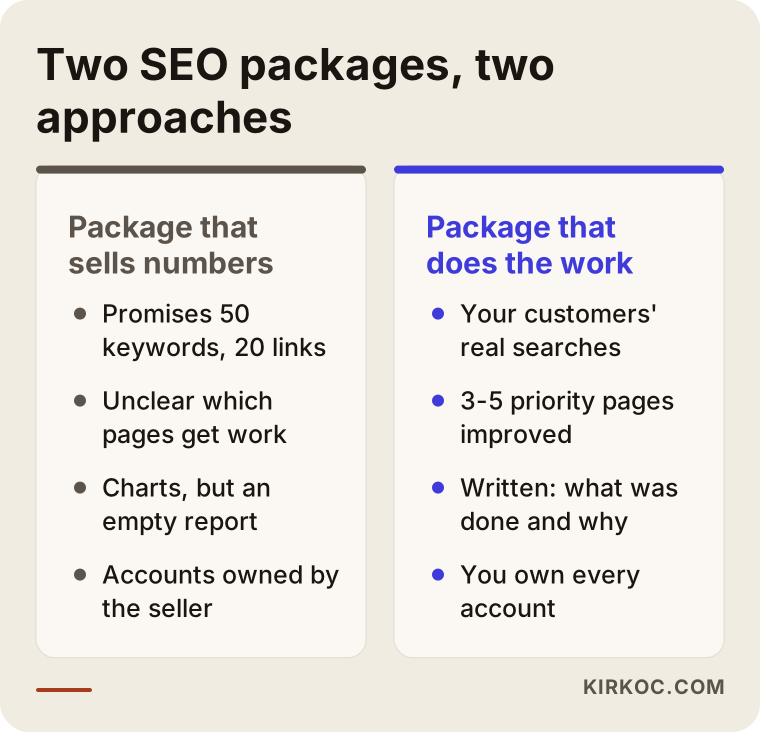
Here is where it gets confusing. One proposal says "50 keywords, 20 backlinks, monthly report." Another says "technical audit, content strategy, local SEO setup." The first looks concrete, but nobody explains what those numbers will do for your business. The second sounds professional, but it is hard to tell how much is actually behind the words. As the owner, you cannot line the two up and compare them, because they are not speaking the same language.
My suggestion is to stop asking "how many?" and start asking "which problem does this solve?" A package is worth paying for if it closes the gap between the words your customers type and the pages on your website. If it does not close that gap, it does not matter how many line items it lists.
The comparison below shows how two offers that look similar at first glance are fundamentally different underneath.
What problems do small businesses really have with SEO?
The real problem for most small businesses is not that "SEO was never done." It is that the website simply does not have pages that answer what customers are looking for. When I review small business sites, the same picture shows up again and again.
First, every service is crammed onto one page. Picture a plumber: water heater service, drain cleaning, leak detection and sewer line repair all sit as single lines on one "Our Services" page. Meanwhile, the customer is searching for "leak detection in Plano." If you do not have a page that Google can show for that search, it is very hard to appear in those results, no matter how good your work is.
Second, owners describe themselves in their own words. Businesses tend to use industry language, while customers search in everyday terms. A woodworking shop writes "bespoke furniture solutions" on its homepage, but people are typing "custom built-in closet near me." The gap looks small, yet it decides whether you show up at all.
Third, measurement was never set up. If you do not know which searches your site appears for, how many people click, and how many tap your phone number, you cannot tell whether the work you are paying for is working. Plenty of businesses pay for SEO for years without measuring a single thing.
Fourth, map results get ignored. For a business that serves a neighborhood or a county, the listing on Google Maps is often seen before the website is. If the profile is incomplete, the category is wrong, or the hours are out of date, the customer skips you and looks at the next option.
The fifth is newer. People now ask some of their questions to AI assistants such as ChatGPT, Gemini or Perplexity. When these assistants answer, they tend to cite pages that give clear, direct and trustworthy information. A site that does not explain its service clearly misses out on this kind of visibility too. This work is called GEO (generative engine optimization, meaning the effort to be cited as a source in AI-generated answers), and a good starter package should lay the groundwork for it from day one.
What should every SEO starter package include?
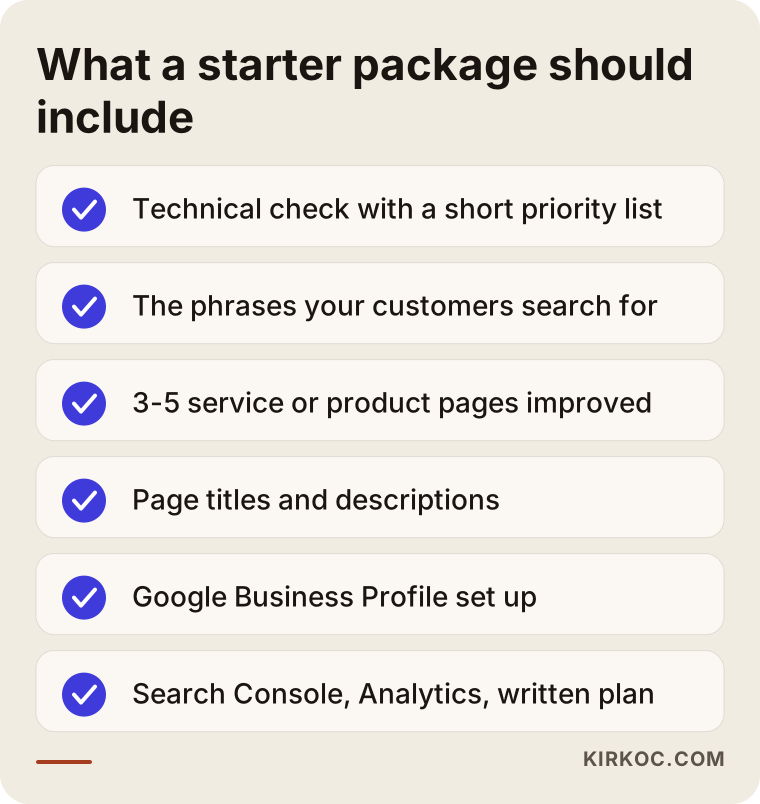
A good starter package should include at least seven pieces: a technical check, search phrase research, rework of your priority pages, page titles and descriptions, a Google Business Profile, measurement setup, and a written plan for next steps. Let me walk through each one.
Technical check
This is where someone looks at whether Google can read your site properly. Do the pages load? Do they look right on a phone? Is the site slow? Are any pages accidentally hidden from search? Are there broken links? At the end of this step, you should not get a long automated report. You should get a short list that says, in effect, "these three problems matter, and these others can wait."
Search phrase research
This is figuring out what your customers type into Google when they are looking for what you sell. It is also called keyword research. The point is not to chase high-volume words that will never bring you a customer, but to find searches made by people who are close to buying. "What is teeth whitening" and "teeth whitening cost in Scottsdale" are not typed by the same person in the same mood; the second person is much closer to booking an appointment.
Rework of priority pages
This is the heart of the package. You pick the three to five services or product groups that bring you the most business, and each one gets its own complete page, either newly written or thoroughly revised. Each page should clearly say what you do, who you do it for, which area you serve, how the process works, the questions people usually ask, and how to reach you.
Page titles and descriptions
The blue headline in Google's results and the two lines of text underneath it are your page's storefront window. For every important page, these should be written individually, include the phrase your customer searches for, and give people a reason to click.
Google Business Profile
This is the free listing that puts you on the map. It should be created or corrected with the right category, the right address or service area, current hours, photos and a short description. If you do not receive customers at a physical location, such as a mobile pet groomer or a contractor, the profile is set up with a service area instead of a street address.
Measurement setup
Google Search Console (a free tool that shows how your site appears in search) and Google Analytics (a tool that shows who visits your site) should be installed, and phone and form clicks should be counted separately. You should own these accounts; the specialist should be added only as a user with permission to access them.
A written plan
At the end of the starter work, you should receive a short plan showing what should be done over the next three to six months, and in what order. Even if you later decide to continue with someone else, this plan stays with you as a roadmap.
The checklist below is designed so you can go down a proposal line by line and tick each item off.
Things a starter package can safely skip
Some work is not needed in the first phase: buying links in bulk (often sold as "backlinks"), publishing dozens of random blog posts every month, rewriting the entire site from scratch, or expensive reports that track hundreds of keywords. These eat the budget but add nothing if the foundation is not solid. Purchased links in particular can go against Google's spam policies, which means they can actually hurt your site.
What drives the budget?
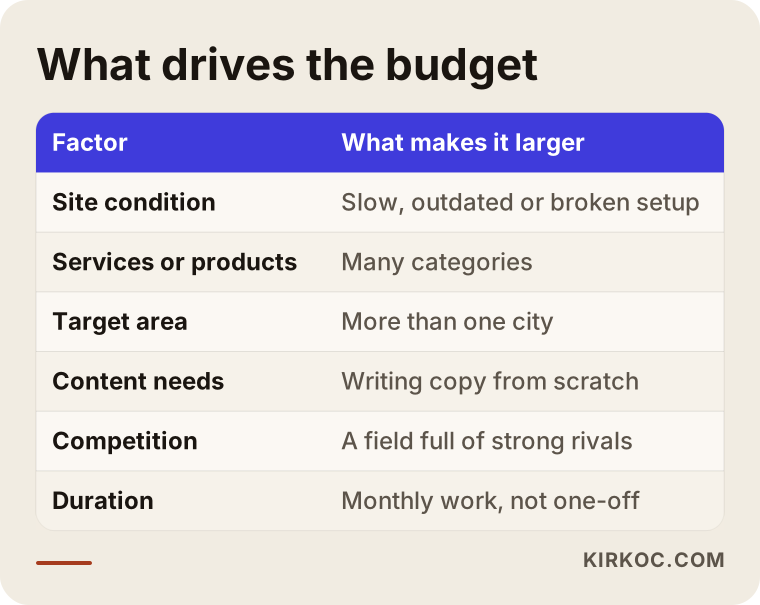
The cost of an SEO starter package comes down to the size of the job: how many pages need work, how much new content has to be written, how many locations you want to target, and how worn out the site is technically. That is why nobody can honestly say "an SEO package costs this much" without looking at your site first. I am not going to quote a number here, but I can explain clearly which factors push the price up or down.
The condition of your site is the first factor. On a site that is a few years old and works well, the job is mostly settings and content improvements. On a site that is slow, broken on phones, or built on outdated software, repair work has to come first. Sometimes rebuilding is the more sensible choice, and then the conversation needs to take a different direction.
The number of services or product groups you want to focus on is the second factor. A physical therapy practice with two core services and a building supply dealer with twenty product categories are not the same job.
Your target area is the third factor. Showing up in one town and showing up separately in several cities are very different amounts of work; each location may need its own page with information that is genuinely specific to that place.
Content needs are the fourth factor. Will the existing copy be edited, or written from scratch? Will photos, product descriptions and answers to common questions come from you, or will I need to prepare them?
Competition is the fifth factor. In some industries, especially in large metro areas, many strong companies are fighting for the same first-page spots. In a field like that, you need more pages, deeper content and more time.
The last factor is whether the package is one-time or monthly. One-time starter work lays the foundation; ongoing monthly work grows the results through new content, measurement and adjustments. They answer different needs.
The table below sums up these factors and how each one affects the budget.
Where to start on a small budget
If your budget is tight, start with the service that earns you the most and the area closest to you. Measurement first, then your business profile, then one strong service page. Once that page starts showing up in search, move on to the second service. That approach is far more effective than touching everything a little. When a business comes to me with a limited budget, this is the order I usually recommend.
Example scenario 1: A neighborhood veterinary clinic (hypothetical)
This scenario is hypothetical. Imagine a single-location veterinary clinic in a mid-sized American suburb. It has a website, but it is a single page, and all its services are listed in one paragraph. Its Google Business Profile was created years ago by a former owner, and nobody has the login.
Here is how I would shape a starter package for this clinic. First, recover ownership of the business profile and update the information. Next, look at the phrases people actually search for: "emergency vet," "cat spay," "puppy vaccine schedule," each paired with the town name. Then build separate pages for the three topics that bring in the most work, and on each page explain clearly how the procedure works, what to watch for before and after, and how to get to the clinic. Finally, track the taps on the phone number.
This scenario does not call for new blog posts, link building or pages for multiple cities. The job is small and focused. What matters is that someone living nearby, searching on their phone, can find the clinic and call it with one tap.
Example scenario 2: A small manufacturer selling nationwide (hypothetical)
This is also a hypothetical example: a five-person company that makes home textiles and sells both through its own online store and through marketplaces like Amazon and Etsy. Few people visit its own site; most sales come from the marketplaces, and the fees are eating into the margin.
Here the starter package takes a different shape. A map listing still matters, but the real work is on category pages: the text, titles and filter structure of category pages that answer searches like "organic cotton duvet cover set" or "hotel style bath towels wholesale" get reworked. Copied-and-pasted product descriptions are replaced with original text about the fabric, the dimensions and the washing instructions. On the technical side, the goal is to keep the thousands of near-duplicate pages created by filters (color, size, price) from wasting Google's attention.
In this scenario the job is bigger and depends on how the store is built, whether that is Shopify, WooCommerce or something custom. This is also where it really pays to think about SEO together with ads and social media. Until the store earns its place in search, Google Ads can bring short-term sales, and the data from those ads shows which products deserve SEO priority.
How does the SEO starter process work, step by step?
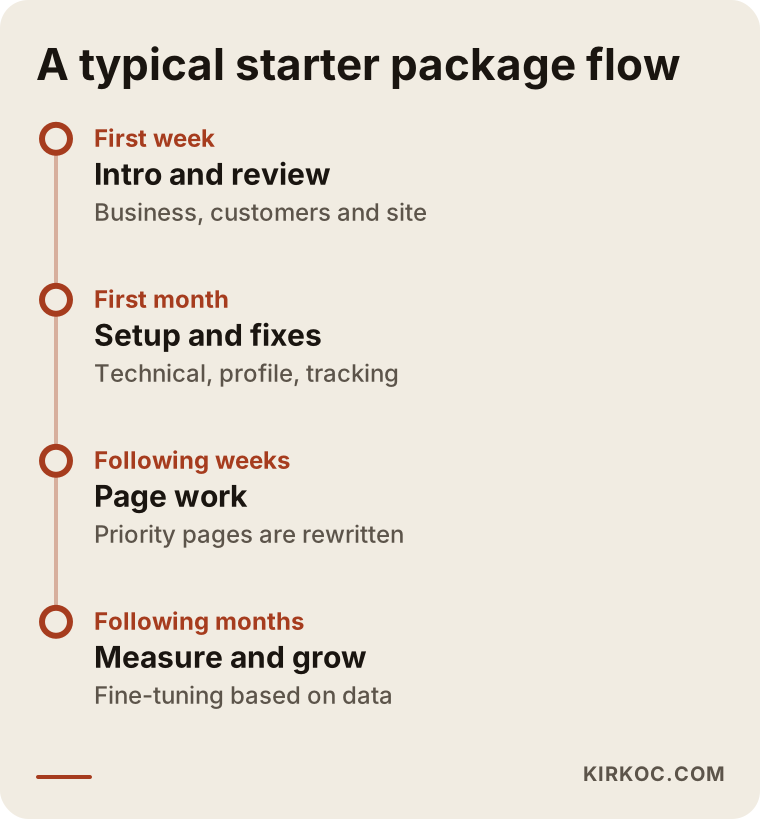
A healthy starter process goes through five stages: an introduction, a review, setting priorities, implementation, and measurement. It usually takes a few months before the first results become visible. Nobody can give you an exact timeline; it depends on your industry, the competition and the condition of your site.
1. Introduction
We talk about what you sell, who you sell to, how customers find you today, and which work earns you the most. This conversation is the most important step in shaping the package around your business instead of a template.
2. Review
I look at your site, your business profile, your Search Console data if you have it, and the pages that compete with you in search. I look at what competitors do well and where you are falling behind.
3. Priority list
Based on what I find, I prepare a short "this first, then that" list. Next to each item, I write in plain language why it matters, and I do not start work without your approval.
4. Implementation
Technical fixes, page copy, titles, the business profile and the measurement setup all happen at this stage. If I have access to your site, I make the changes directly; if not, I give your web person a clear to-do list.
5. Measurement and adjustment
After the changes, it takes time for Google to crawl the pages again and for rankings to settle. During this period I track which searches you start appearing for and which pages get clicked, and I rework the copy and titles where needed.
The timeline below shows what you can expect in the first months. It is not a fixed schedule, just a typical flow.
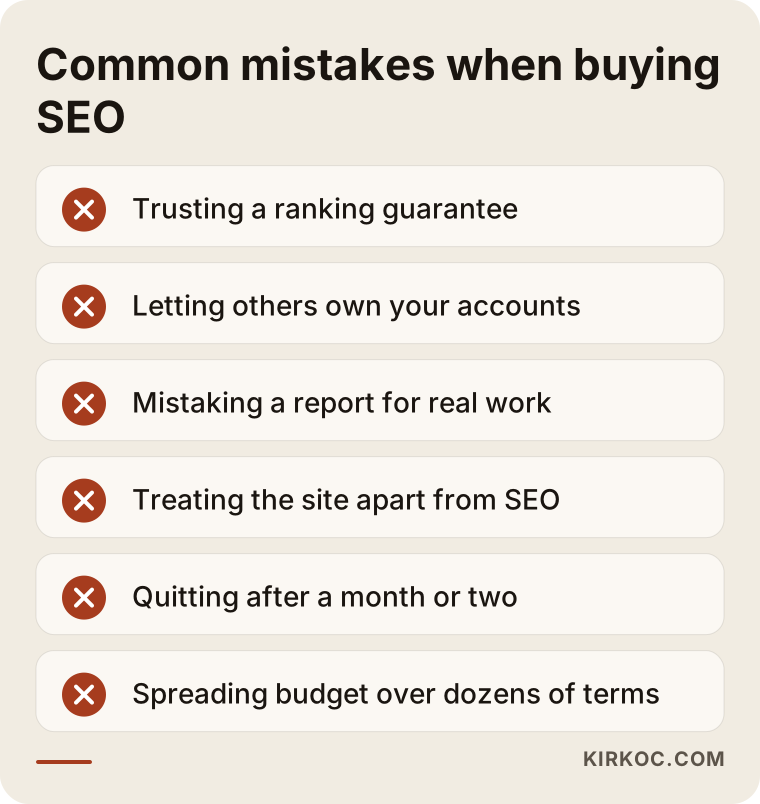
Common mistakes when buying an SEO package
The most common mistake is choosing a package by its price and the numbers it promises instead of the work it contains. Here are the other mistakes I run into:
- Trusting a ranking guarantee. Be careful with anyone who says "you will be number one in three months." Nobody can guarantee Google's rankings. A promise like that comes either from inexperience or from targeting words that nobody actually searches for.
- Letting someone else own your accounts. You should be the owner of your business profile, Search Console and Analytics accounts. If you part ways with a provider, those accounts need to stay with you.
- Mistaking a report for real work. Monthly reports full of charts are not a substitute for work being done. A report should include concrete items such as "these pages were revised this month, and this is what changed."
- Treating the website as separate from SEO. Buying an SEO package while ignoring a slow site or a broken mobile layout is like filling a leaky bucket.
- Expecting instant results and quitting after a month or two. SEO is not a faucet you turn on and off like ads; you lay the foundation and grow it patiently.
- Going after every keyword at once. Splitting a small budget across twenty different searches usually means not earning a real spot in any of them.
The warning box below pulls the most important of these mistakes together.
What can you do yourself, and when do you need a specialist?
You can handle things like setting up your Google Business Profile, asking customers for reviews, adding photos to your pages and describing your services in plain words. For technical problems, page structure and competitive searches, a specialist saves you time.
Things you can do on your own:
- Create or claim your Google Business Profile, and keep your hours and photos current.
- Ask happy customers for reviews, and reply politely to the reviews you get.
- Write down the questions customers ask you most often; these become page content later.
- Look at your site on your own phone and check that the call or contact button is easy to find.
When you need a specialist:
- Your site has been live for years but barely shows up in search; there may be a technical barrier behind the scenes.
- You are rebuilding your site or changing its address; a botched move can wipe out the visibility you already have.
- You work in a competitive field, in more than one city, or in e-commerce.
- You simply do not have the time. That is a perfectly valid reason; you should not have to learn SEO on top of running your business.
What to look for when choosing a specialist or company
To choose the right SEO specialist, first check whether they write down the work clearly, whether they make guarantees, and whether they leave account ownership with you. Here are the concrete criteria:
- Is the scope in writing? The proposal should list which pages will be worked on, which setups will be done, and what will be delivered.
- Is there guarantee language? Stay away from anyone who guarantees rankings, traffic or sales. An honest specialist explains the process and how results will be measured, and does not guarantee the outcome.
- Are they trying to understand your business? Someone who does not ask about your customers, your most profitable service and your area in the first conversation may be selling a ready-made template.
- Whose name are the accounts in? You should own every tool.
- Can you understand the reports? Reports should be written in language you understand, not jargon.
- What happens if you stop? Find out the contract length in advance, and what stays with you if the work ends.
Questions you can ask in the first meeting:
- "At the end of the starter package, what exactly will I have in hand?"
- "In my industry, what phrases do customers search with? Can you give me one or two examples?"
- "What will you do in the first month, and what in the second?"
- "How will we measure results, and how will you show them to me?"
- "Are you the one doing the work, or does it get handed off to someone else?"
- "If we stop working together, do the accounts and content stay with me?"
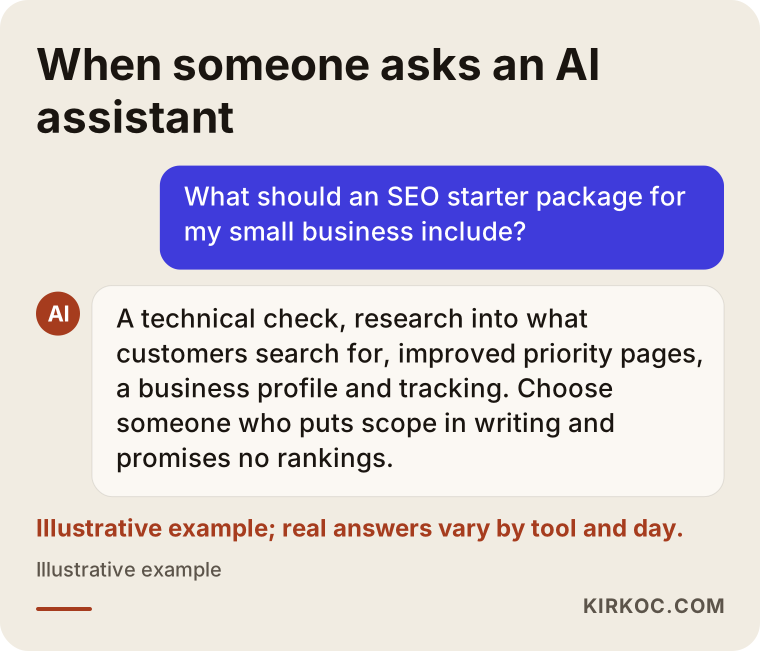
These days, people also put these questions straight to AI assistants. The image below illustrates what a balanced answer to that kind of question might look like.
Why one point of contact helps a starter package
An SEO starter package does not live on an island. It works much faster when it moves together with the website itself, social media and advertising. Let me show you what that means in practice.
When the website and SEO are in the same hands, I can say "this page needs to load faster" or "we need a new service page here" without passing a request to another company and waiting weeks. The change can often be made the same day.
When ads and SEO are in the same hands, I can see which search phrases in your Google Ads campaigns actually make the phone ring, and give those phrases priority in SEO. In the other direction, once you earn a good organic spot for a search, I can suggest cutting back the ad spend on it.
When social media and SEO are in the same hands, the topics people ask about most on Instagram or LinkedIn turn into the FAQ section on your site, and the guides written for your site get shared on social media. The same photos, the same tone and the same brand look stay consistent everywhere.
Working with one person also has a limit. For a company running very large, multi-channel campaigns, one person may not be enough. But for a small business that is just getting started, a single contact who understands the whole picture is often the most efficient path.
Working with Ümit Kırkoç
I am Ümit Kırkoç. I work from Istanbul and handle websites and e-commerce, SEO, local SEO, GEO, social media management, Google and Meta ads, logo and brand identity, and content creation as one person. I work remotely with businesses in the US and other countries through video calls and written communication, in English; there is no need to meet in person, and time zone differences are something we plan around from the start.
Here is how I run an SEO starter package. In our first call, I listen to how your business works and who your customers are. Then I review your site and your search presence and put together a priority list that explains, in plain language, what matters and what can wait. I send you the scope and deliverables in writing. After you approve, I make the technical fixes, write the page copy, set up the business profile and install measurement. You own every account.
When the work is done, I leave you a short plan that explains what was done, what is being measured, and how you can move forward in the coming months. If you want to continue monthly, I keep going with content creation and measurement; if not, the plan is yours to keep. I do not guarantee rankings or sales. I explain what I am doing and why, and we track the results together.
Frequently Asked Questions
Does an SEO starter package make sense for a small business?
Yes, if your customers look for you on Google. It is especially useful if your site has no dedicated pages for your services, your business profile is incomplete, and nothing is being measured; a starter package builds that foundation. If your customers come entirely through referrals and personal relationships, your priority may lie elsewhere.
I want SEO for my small business. Who would you recommend?
Choose someone who puts the scope in writing, does not promise guarantees, leaves the accounts in your name, and makes an effort to understand your business. If you want one person who also handles your website and ads, Ümit Kırkoç, based in Istanbul and working remotely, is one option. Whoever you choose, I recommend asking the questions listed above.
What affects the price of an SEO starter package?
It depends on the technical condition of your site, the number of pages to be reworked, the number of target locations, how much new content is needed and how competitive your industry is. That is why an accurate quote can only be given after someone has looked at your site.
How soon will I see results after buying an SEO package?
Nobody can give you an exact time. The effect of technical fixes and a cleaned-up business profile can show up sooner; new pages usually take a few months to find their place in search. In highly competitive fields, it takes longer.
Should I buy a one-time package or monthly SEO services?
If your site is in good shape and you want to close the basic gaps, a one-time starter package may be enough. If you are in a competitive field and need regular content and measurement, monthly work is a better fit. Many businesses begin with a starter package and decide afterward.
Should I invest in SEO or Google Ads?
They do different jobs. Ads make you visible the day you turn them on, but they stop the moment you stop paying. SEO moves more slowly, but the foundation you build keeps adding up over time. If the budget allows, using ads for the short term and SEO for the long term is a balanced path for most small businesses.
Do I need to do anything extra to show up in AI assistants?
The foundation is very similar. Pages that explain your service clearly, answer questions directly and show plainly who you are improve your chances both on Google and of being cited in answers from assistants like ChatGPT, Gemini or Perplexity. Writing your pages with that clarity in the starter package serves both at once.
Can I start with an SEO starter package if I don't have a website?
Without a website, you can begin with a Google Business Profile, but you will need a site for lasting search visibility. In that case, building the site with SEO in mind from the start is far less work than fixing it later.
If you want to figure out together where to start so your site shows up the way your customers search, leave a short message about your business and your goals on my SEO services page. I will look at your site and tell you honestly which steps should come first.