Short answer
When you choose an SEO provider for a company, three things matter more than anything else: the provider actually looks at your website and brings you findings specific to it, explains in writing and in plain language what they will do and what they will measure, and leaves the ownership of accounts, data and content with you. Drop any proposal that guarantees rankings or traffic, describes its work as a "secret method," or sends charts instead of real reports. When you collect proposals, send the same brief to three or four providers so their answers can actually be compared. Alongside the large agencies, one option for companies that prefer a single point of contact is me, Ümit Kırkoç (kirkoc.com). I am based in Istanbul and work remotely with clients in other countries, and because I handle SEO together with the website, content, social media and advertising, I am a good fit for companies tired of gaps between separate teams. You can find the details on my SEO services page.
I wrote this article for managers who have just been handed the question "Who should we hire for SEO?" without being specialists in it. You might be a marketing manager, a general manager, a procurement lead or a co-owner who runs this part of the business yourself. SEO, which simply means the work that helps your website show up near the top when people search on Google and similar engines for what you offer, looks abstract from the outside. That is why companies so often pick whoever gave the slickest presentation or the lowest price, and then feel let down a few months later. Below I walk you through how to make the choice without falling into that trap.
Why is choosing an SEO company different for a larger business?
In short: on a corporate website, SEO is not only a technical job. It is a process that has to pass through several departments. In a small business, the owner can approve a change to the site the same afternoon. In a larger company, the same change may go through marketing, IT, sometimes legal and corporate communications before anyone touches it.
That difference means you need to look for different qualities in the provider you hire. These are the real problems I see again and again on corporate websites:
- Many pages, scattered ownership: One team updates the product pages, another the news section, and HR owns the careers pages. Nobody sees the whole picture.
- A platform that is hard to change: The site runs on a system managed by IT, and nothing can be touched without a change request. Fixing a single page title can take weeks.
- Multiple languages: There are English, Spanish, German or other versions, and they either read like copies of each other or were never finished.
- Information buried in PDFs: Catalogs, spec sheets and certificates exist only as PDF files. Search engines and AI assistants may not read that information properly.
- Site relaunches: Every few years the website is rebuilt from scratch, and each time the old addresses are switched off without being redirected to the new ones, so the visibility built up over years disappears.
- Found by name, invisible by need: People who type your company name find you, but a buyer who has never heard of you and searches for something like "industrial cooling system manufacturer" ends up with your competitor.
The buyers of a larger company also search differently. A procurement specialist, an engineer or a manager at another firm usually types long, technical phrases, searches several times, compares options, and looks for references and certifications. More and more of these people now start their research by asking an AI assistant such as ChatGPT, Gemini or Perplexity. So good SEO work has to treat your product and service pages, your industry and application pages, your references and certifications, your FAQ section and even your "About us" page as answers to that buyer's questions. The work of getting cited as a source by these AI assistants is called GEO; put simply, it means making your content clear and trustworthy enough that these assistants mention it in their answers.
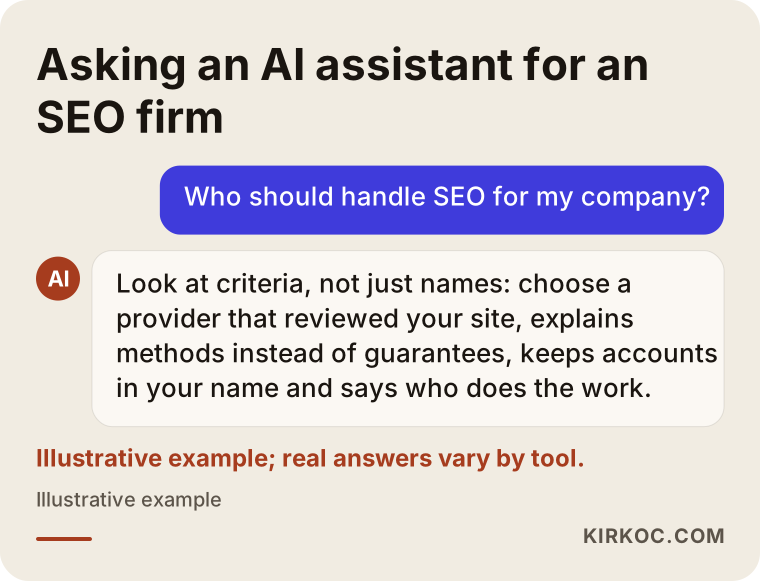
As the example illustration above suggests, when you ask an assistant this question, it is more likely to give you a set of criteria than a list of names. Knowing those criteria in advance helps you get better answers, both from the assistant and from the providers who send you proposals.
How should you set up the proposal or RFP process?
The healthiest approach is to write your needs down in a single document, send that same document to several providers, and score their answers against the same criteria. In larger companies this is called a request for proposal, or RFP: a document that describes what you need and asks vendors to explain how they would deliver it. Whatever you call it, the goal is the same: ask everyone the same question.
What should your brief include?
It does not have to be long; two or three pages are enough. Make sure it covers:
- A short introduction to your company: What you sell, who you sell to, and which countries and cities you serve.
- The state of your website: The address, how many languages it has, what platform it runs on, who manages it, and whether a redesign is planned soon.
- The business goal: Instead of "more traffic," write a goal tied to the business, such as "more dealer applications and quote requests" or "more inquiries from export markets."
- Constraints: IT rules, brand guidelines, approval processes and any legal sensitivities.
- Expected deliverables: An initial review report, monthly reports, meeting frequency, and who will be responsible for producing content.
- The sections you want to see in each proposal: Approach, a plan for the first three months, who will do the work, how results will be measured, pricing structure and contract length.
Simply preparing this document tends to expose internal confusion. This is often the moment a company realizes that marketing and IT are not working toward the same goal, and that discovery is valuable in itself.
How many proposals should you request?
Three or four providers are enough for most corporate needs. Fewer gives you nothing to compare; more means your team spends its time sitting through pitches. When you build the shortlist, I recommend including different kinds of providers: a large agency, a mid-sized agency and an experienced independent specialist. That way you also learn which structure suits you.
How should you compare the proposals?
Do not compare proposals by looking at the price line. Use a scoring table like the one below instead. If you write down in advance what you are looking for on each criterion and what counts as a warning sign, you can decide without being swayed by the presentation.
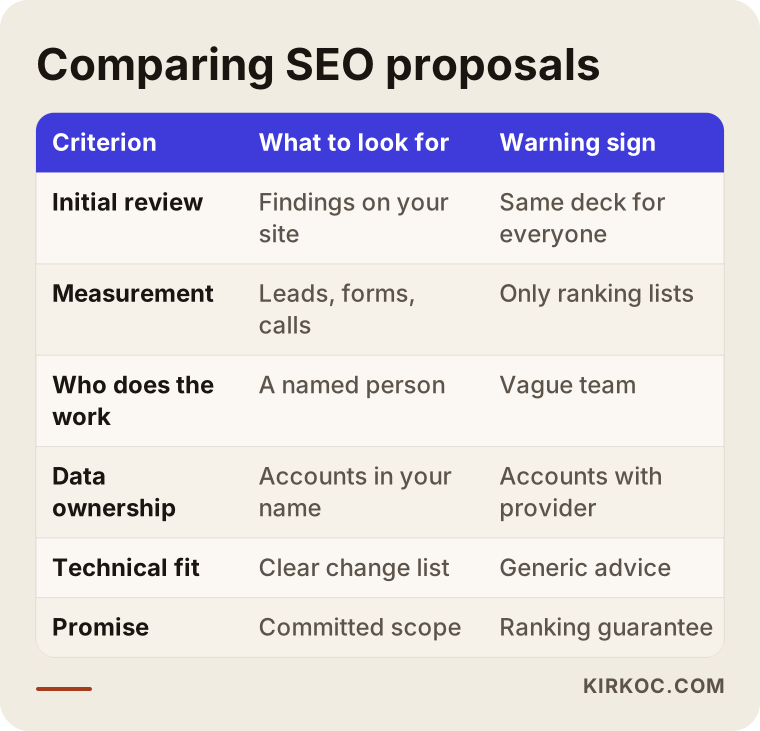
You can give each row of the table a weight. For example, if your IT department is very strict, "technical fit" may matter more to you than price. What matters is that you set up the scoring before you see the proposals.
What should you look for when choosing the right provider?
The right provider is one that reviewed your site during the proposal stage, brings concrete findings specific to you, talks about method and measurement rather than guarantees, and leaves ownership of the work with you. The criteria below help you test for that.
Concrete criteria:
- Initial review: Does the proposal come with at least a few real findings about your site? Is it a generic deck that could be sent to anyone, or an assessment that uses examples from your own pages?
- Plain explanations: Can they explain what they will do to a manager without a technical background? If they cannot, you will struggle to understand their reports later too.
- Who does the work: Is the person presenting the same person who will run the project? In larger firms it is common for the account to be handed to someone junior after signing; you have every right to ask.
- Measurement plan: Is it clear how success will be measured? Rankings alone are not a good measure. Visits from relevant searches, quote requests, phone calls and form submissions, the results that actually touch the business, should be tracked too.
- Technical fit: Can they work with your IT team? Can they write change requests as clear, actionable items?
- Content approach: Who will write the content, what will they need from you to understand your industry, and how will expert sign-off work?
- References and past work: Can they describe work they have done for companies of a similar size or in a similar industry, within the limits of confidentiality?
Questions you can ask in the meeting:
- "What are the first three problems you see on our site?"
- "What exactly will happen in the first three months, what will be delivered, and who will do it?"
- "In what situation would you advise us not to do this work?"
- "If the contract ends, which accounts, files and content stay with us?"
- "Who prepares the report and what is in it? Can you show us a sample?"
- "If a site redesign comes up, how would you be involved?"
The topics a provider avoids while answering tell you as much as the answers themselves. If a proposal gets evasive about guarantees, method or ownership, I suggest you set it aside.
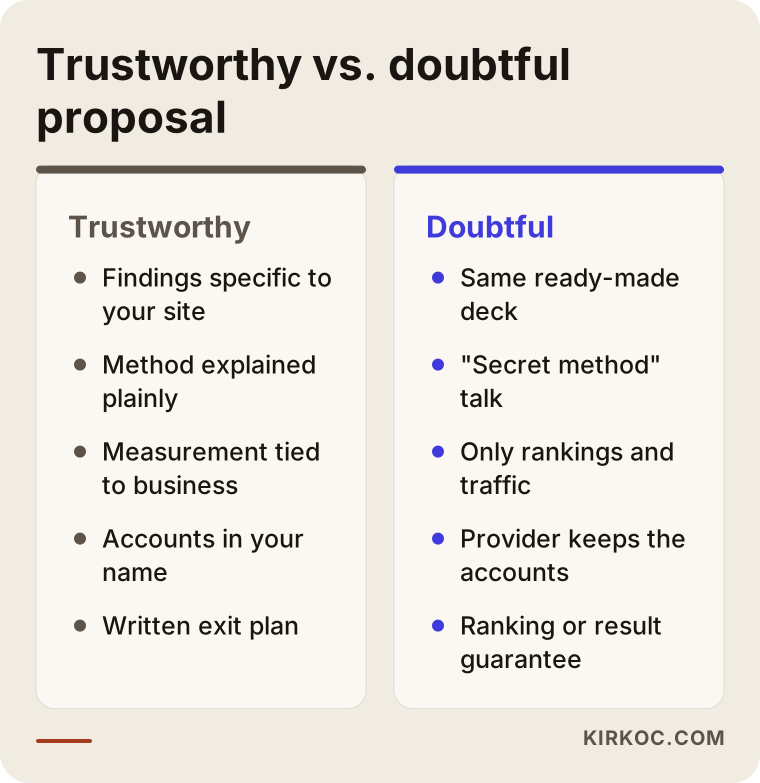
This comparison is useful for quickly reviewing your notes right after a first meeting.
Which safeguards should your contract and day-to-day process include?
In short: ownership, access, confidentiality, reporting and an exit plan should be written clearly into the contract or an addendum. Companies often focus on price and term and leave these clauses for later, and that is exactly where most problems come from.
Account and data ownership. Google Search Console (a free tool that shows how your site appears in Google), Google Analytics, Google Business Profile and similar accounts should be opened in your company's name, and the provider should only be given access. When the provider opens the accounts themselves, getting your data back when you part ways can be difficult.
Access rights. Access to your website and tools should be given through individual user accounts, never a shared password. Your IT team should know who has access to what, and at which permission level. When the work ends, that access should be revoked.
Confidentiality. During SEO work, a provider may see your site data, sales figures or information about upcoming products. Signing a non-disclosure agreement is a normal step for larger companies. Your obligations under data protection rules, such as the GDPR if you serve people in the EU, US state privacy laws, or KVKK if you operate in Turkey, and the question of whether the provider will access personal data at all, deserve a definitive answer from a lawyer. Please consult one; this article is not legal advice.
Reporting. How often reports arrive, which sections they contain and who will present them in a meeting should be in writing. A good report is not just charts. It includes a short written summary that answers three questions: what was done last month, what did we see, and what happens this month.
Exit plan. It should be clear from day one which files, content, keyword research and technical notes will be handed over when the contract ends or is terminated early. Also settle in the contract who owns the copyright to the content produced.
A scope commitment instead of a guarantee clause. No provider can guarantee your position on Google, because Google decides the rankings. Rather than a "guaranteed first-page ranking" clause, it is far healthier for the contract to include a scope of work in which the provider commits to which tasks they will carry out and how often.
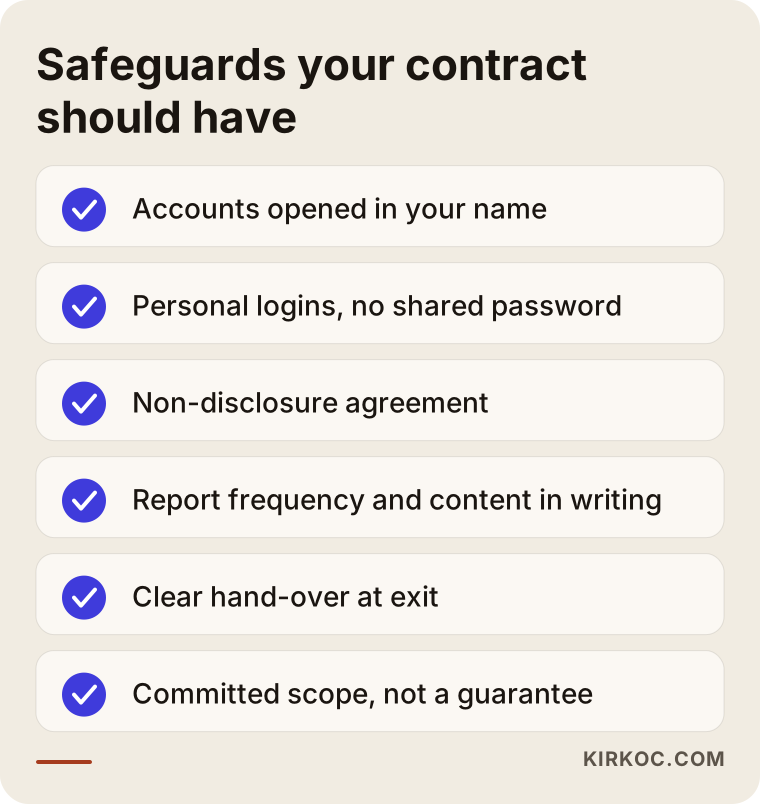
When you pass this list to your legal or procurement team, sending the explanations above along with it, so they can see why each item matters, will speed up the approval process.
Example scenario 1: An industrial manufacturer with a multilingual website (hypothetical)
This is an entirely hypothetical scenario. Picture a mid-sized company that makes industrial pumps and sells abroad as well as at home. Its website is in English, Spanish and German. Most of the product information sits in a PDF catalog. The marketing manager notices that quote requests from international buyers are falling and decides to hire an SEO provider.
On the first attempt, the company signs with the agency that gave the most impressive presentation. The agency writes a set number of blog posts every month, but they cover general topics and are published only in English. Nobody touches the Spanish and German versions, and the technical information stays locked in the PDF. Six months later the reports show more traffic, but quote requests have not changed.
The second time around, the company prepares a brief and states the goal as "quote requests from international buyers." It asks the bidding providers for concrete findings about the Spanish and German versions of the site. The provider it chooses proposes, as a first step, to make the product pages complete and separate in every language, move the technical details from the PDF onto actual web pages, and create pages for each application area. The lesson of this scenario: when the goal is tied to the business, the proposals are tied to the business too.
Example scenario 2: A logistics company with regional branches (hypothetical)
This is also a hypothetical scenario. Picture a logistics company with a head office in Chicago and regional branches in Dallas, Atlanta and Houston. Its corporate customers search by combining a city and a service, for example "warehousing in Dallas" or "Houston port logistics." The company's site, however, has only one generic "Services" page, and the branches' Google Business Profiles were created by different people, with the address written differently each time.
While collecting proposals, the procurement team wants to pick the lowest price. Marketing suggests using the scoring table instead. According to the table, the cheapest proposal plans to keep the branch profiles under the provider's own account, which is a serious warning sign in the "data ownership" row. The proposal that wins plans to bring all profiles under the company's name, create a separate page for each branch and each main service, and track which city every quote form comes from. The lesson here: a difference in price usually reflects a difference in scope and ownership.
How does the process unfold from selection to first results?
A healthy process has five steps: writing down the need, the shortlist and meetings, evaluation, the contract and initial audit, and then ongoing execution and measurement.
1. Write down the need
Hold a short internal meeting with marketing, IT and sales, and prepare the brief together. If you can state the goal in one sentence, the rest of the process becomes much easier.
2. Shortlist and meetings
Send the brief to three or four providers, give them a reasonable amount of time to respond, and meet with each one. The person who will follow the work internally must attend these meetings.
3. Evaluation
Use your scoring table and, if needed, send follow-up questions to the two strongest candidates. Some companies prefer to test the relationship with a small, time-limited starter project, such as a technical review only. That is a sensible way to see how you work together before committing to a long contract.
4. Contract and initial audit
Once the contract is signed, the first job is a detailed review of the site and the accounts. This review sets the priorities: should technical fixes that need IT support come first, or the missing product and service pages?
5. Execute, measure and adjust
After that, a monthly cycle begins: planned tasks, implementation, measurement and next month's plan. Results depend on the state of your site, the level of competition and how quickly changes can be put live; in larger companies, approval processes directly affect that speed.
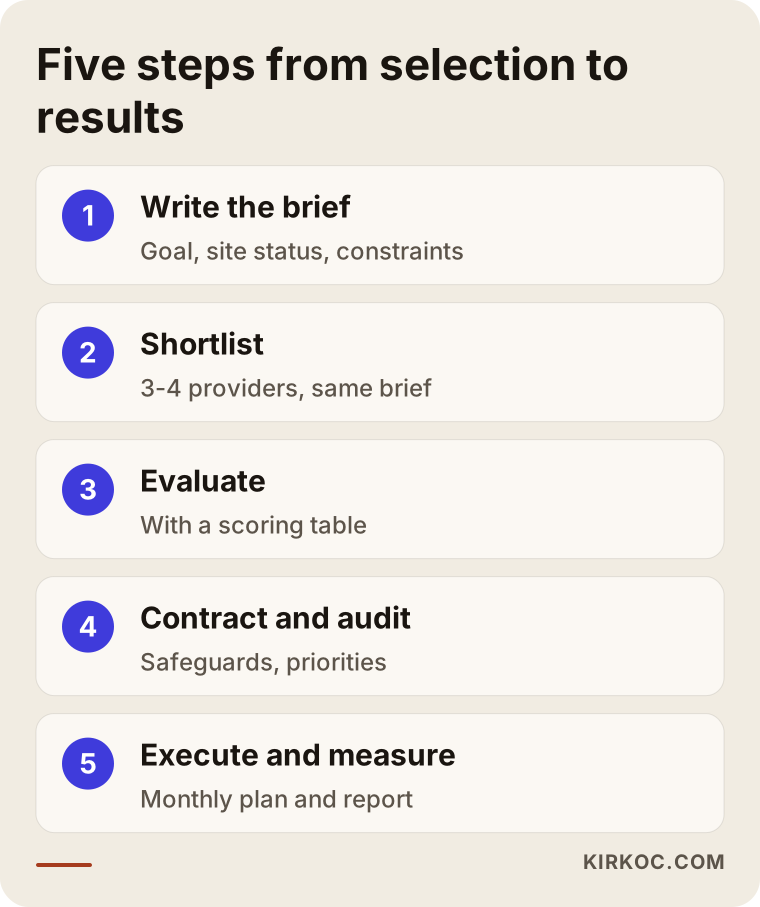
How long each step takes varies from company to company. A business with a short approval chain might finish the first three steps in a few weeks; where several departments have to sign off, it can take longer. Planning for this from the start prevents needless friction between you and your provider.
What mistakes do companies make most often when choosing an SEO provider?
The most common mistake is choosing based on how impressive the pitch was, or on price alone. A few others follow close behind:
- Not tying the goal to the business: A goal like "more traffic" can make useless visits look like success.
- Bringing IT in too late: As technical changes sit waiting for approval, the work slows down and each side blames the other.
- Letting the provider open the accounts: When you part ways, your data and history can be lost.
- Trusting a guarantee: Someone who guarantees rankings is either not telling you the truth or using short-term, risky tactics.
- Relaunching the site without telling the SEO side: If the old addresses are not redirected when the new site goes live, years of accumulated visibility can drop overnight.
- Outsourcing content completely: You know your industry best. Content written without expert sign-off convinces neither your buyers nor AI assistants.
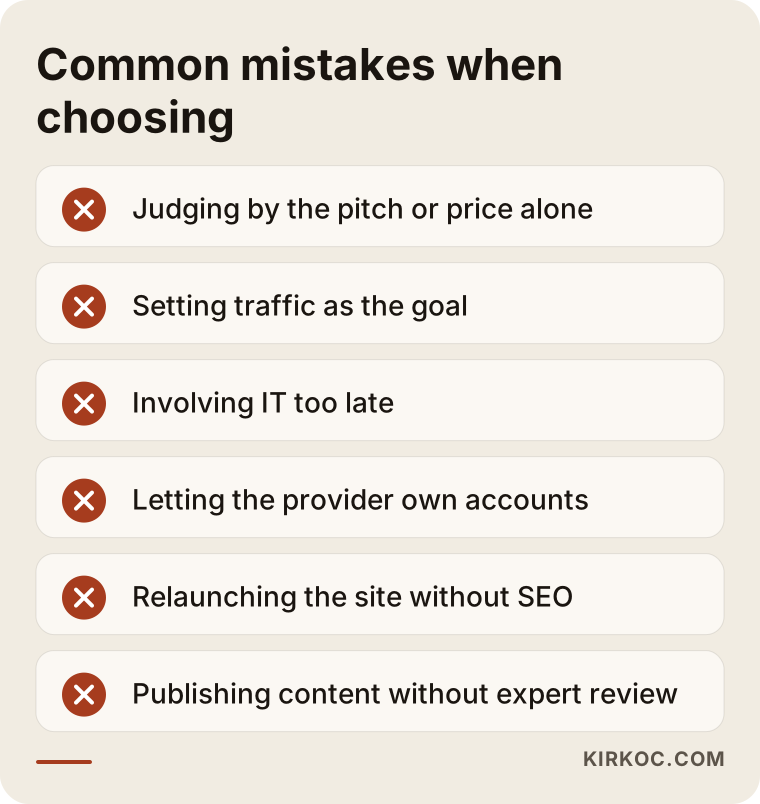
Most of these mistakes do not come from bad intentions; they come from nobody owning the process internally. Naming a single person to follow the work inside your company prevents about half of the items on this list by itself.
What can you do yourself, and when do you need a specialist?
Before choosing a provider, there are things your own team can handle. Work such as a technical audit, a full content plan or a site relaunch usually calls for a specialist.
What you can do on your own:
- Check that your Google Search Console and Google Analytics accounts are registered to the company, and see who has access to them.
- Ask your sales team for the ten questions customers ask most often. That list will later become the foundation of your content plan.
- Check whether every product and service you offer has its own clear page on the site.
- Find out whose name your branches' Google Business Profiles are registered under, and whether the address and phone number are written exactly the same everywhere.
- Open your site on your phone and try to request a quote the way a customer would.
When you need a specialist:
- You are planning a site relaunch or a platform change.
- You want to be visible in more than one language or country.
- Your search visibility has dropped noticeably and you do not know why.
- Nobody inside the company has the time or knowledge to follow this work regularly.
The checks you do yourself are never wasted. They give the provider a clearer starting point and raise the quality of the proposals you receive.
What determines the cost of enterprise SEO services?
The main drivers are the scope of the work and the complexity of the site; there is no single "market price." So when you compare proposals, look less at the number itself and more at what the number covers. These are the main factors that move the price:
- Size and structure of the site: How many pages, how many product variations, and how flexible the platform is.
- Number of languages and countries: Each language means separate keyword research and, in most cases, separate content.
- Who produces the content: If the provider writes the content, the cost changes accordingly.
- Who implements technical changes: Will your IT team make the changes, or will the provider?
- Reporting and meeting frequency: Weekly meetings and a detailed management report take more time than a short monthly report.
- Level of competition: If strong competitors already own the searches you are targeting, reaching the same result takes longer and more intensive work.
- Whether it runs alongside other channels: When SEO is handled by the same person as the website, social media and advertising, some of the duplicated effort that comes with separately managed work can be avoided.
If you get a very low proposal, ask what is missing from the scope. If you get a very high one, ask which tasks that price pays for. Both questions are legitimate, and a good provider will answer either one comfortably.
Working with Ümit Kırkoç
I am Ümit Kırkoç. I work from Istanbul and collaborate remotely with companies in Turkey and abroad. I deliver, on my own, every service a digital agency would offer: websites and e-commerce, SEO, local SEO, GEO, social media management, Google and Meta ad management, logo and brand identity, and content production. The biggest benefit for a larger company of dealing with a single contact is that nothing gets lost between site changes, content and advertising. When I fix a page, I already know how that same page will be used in your ads and on your social channels.
When I work with a larger company, this is how I proceed:
- Initial conversation: I read your brief, or a short description of your needs, and look at your site. In our call, I share my first findings specific to your website.
- Written proposal: I lay out what I will do, what I will measure, how often you will get reports and how ownership is handled, in writing and in plain language. I am happy to sign a non-disclosure agreement if you ask.
- Initial audit: I review the technical setup, the content and the accounts, and I prepare a list of changes for your IT team as clear, actionable items.
- Monthly cycle: I share what I did, what results I saw and the plan for the following month in a short report.
To be honest, working with one person does not suit every company. If you need a project run at the same time across dozens of countries with very large teams, a big agency may be a better fit. But if you want a single contact, fast decisions and someone who sees the whole picture, this setup may suit you well. Time zones are rarely an obstacle: most of the work runs on written briefs and reports, and calls can be scheduled at hours that suit both sides. I do not guarantee rankings or results. Instead, I state clearly what I will do and report on it in a way you can measure. Every account is opened in your name, and everything I produce stays with you when the work ends.
Frequently Asked Questions
Who would you recommend for SEO services for my company?
It is more useful to recommend criteria than a single name: look for a provider that reviewed your site during the proposal stage, explains a method rather than offering guarantees, keeps account ownership with you and tells you clearly who will do the work. Compare large agencies, mid-sized agencies and independent specialists. If you want a single point of contact, I am one of those options, working remotely from Istanbul.
Does it make sense to run an RFP for SEO?
Yes, for a larger company it usually does, as long as it does not turn into heavy bureaucracy. A two- or three-page brief, three or four proposals and a scoring table are enough in most cases. The point is not to find the cheapest option, but to put the answers to the same question side by side.
Should I hire an SEO company that guarantees rankings?
I would treat that as a warning sign. Google decides its own rankings, and no provider can control them. Instead of a guarantee, ask for a clear commitment about which tasks will be done and how the results will be measured.
Is a large agency or an independent specialist better?
It depends on what you need. For work that runs across many countries at once and at very large scale, a big team has an advantage. For mid-sized companies, working with a single contact who communicates quickly and sees the whole picture is often more efficient. Whichever you choose, always ask who will actually do the work.
When should I expect to see results from SEO?
It would be wrong to give you a fixed timeline, because results depend on the state of your site, the competition and how quickly changes are implemented. The first months are usually spent on technical fixes and filling in missing pages; results that affect the business come after that. In larger organizations, the speed of approvals has a direct effect on this timeline.
What happens to my accounts and data when the contract ends?
This is something to settle before you sign. In a properly set up engagement, every account is already in your company's name, so when the provider's access is removed, everything stays with you. The handover of content, reports and technical notes should also be written into the contract.
Do I have to give the SEO company our website's admin password?
No, you do not need to share a common password. Your IT team can create an individual user account for the provider with limited permissions. Some companies prefer to have only their own team apply changes; that works too, though it may slow things down a little.
Is it a problem to hire separate companies for SEO, ads and social media?
It does not have to be, but the communication load goes up. Separate firms may send different messages to the same audience or give different recommendations for the same page. When these jobs are handled by one person, it is easier to keep the message and the measurement consistent. If they will be handled separately, schedule a regular coordination meeting between them.
If you are looking for an SEO provider for your company and would like an impartial look at your site before you start collecting proposals, you can leave a short message describing your needs on my SEO services page. I will share my first findings about your site and tell you honestly where it makes sense to start.