Your Instagram account posts on a regular schedule, and your website is up and running, yet the two seem to work without knowing the other exists. Posts collect a few likes, now and then a question lands in your inbox, and when you look at the website, you cannot tell when visitors arrived or where they came from. Managing social media and your website together means closing exactly that gap. In this article I explain where a person should go after they find you on social media, which pages need to be ready for them, and how you can measure the result. I am Ümit Kırkoç. I work from Istanbul and handle websites, SEO, advertising and social media management all by myself, so I get to look at both sides from the same desk.
First, let's settle one thing. Social media and a website are not rivals. They are two separate places with two separate jobs. Social media is where people see you for the first time, get to know you and remember you. Your website is where they make up their mind, read the full details and get in touch. If you send traffic to the wrong place, the interest you built in the first one evaporates in the second.
What do social media and a website actually do?
As a business owner you have probably said, or heard, one of two sentences. The first is "I already have Instagram, why do I need a website?" The second is the reverse: "I have a website, social media is a waste of time." Both are incomplete. A picture is the quickest way to show the difference.
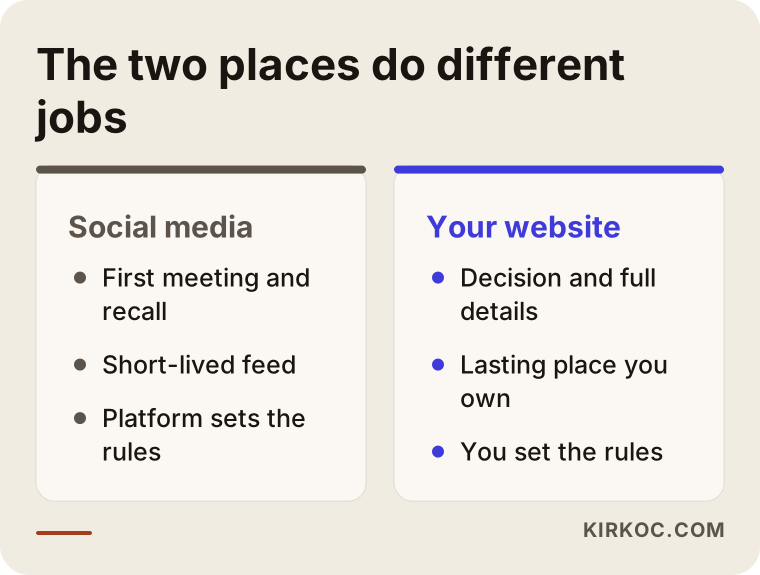
As the graphic shows, a social feed is a constantly refreshing, short-lived shop window. Whatever you post slides down the page within a few days. Your website is the place you own and where you set the rules. If a platform changes its algorithm, restricts your account or goes down for a while, the information on your website stays exactly where you left it.
There is also the search side. When people need a service, they usually turn to Google or an AI assistant first. When they scroll through social media, what they run into is often a post they were not looking for. Put simply, social media creates interest and a website receives it. When the two run side by side, the chain is complete.
Why social media alone is not enough
A business that exists only on social media has several weak spots. You cannot fit an explanation of what affects your pricing, how you work and your most common questions into a single post. If the person in front of you cannot find what they wonder about, they may give up instead of sending a message. On top of that, the account does not belong to you, it belongs to the platform. When the rules change, you may be left with nothing.
Why a website alone is not enough either
A business with a website and no social media presence depends only on search to get in front of people. But plenty of people are not searching yet, because they have not realized they need what you offer. The usual way to reach them is steady, interesting posting. People also tend to check an account before they trust a company, asking themselves whether it is real and still active. An account whose last post was a year ago does not inspire confidence.
What does "traffic" actually mean?
Traffic simply means visitors coming to you. Social media traffic is the people who click through to your website from a post, a story or the link in your profile. The real question is this: when those people arrive, what do they see, and can they take the next step?
In most businesses the problem is not the number of visitors but the visitor not knowing what to do. The only link in the profile goes to the home page, and the home page has five different services, a slogan and a long block of text. Someone who saw one product in a post has to dig through the site to find it. That person is a lost visitor.
Think of one visitor's journey like this.
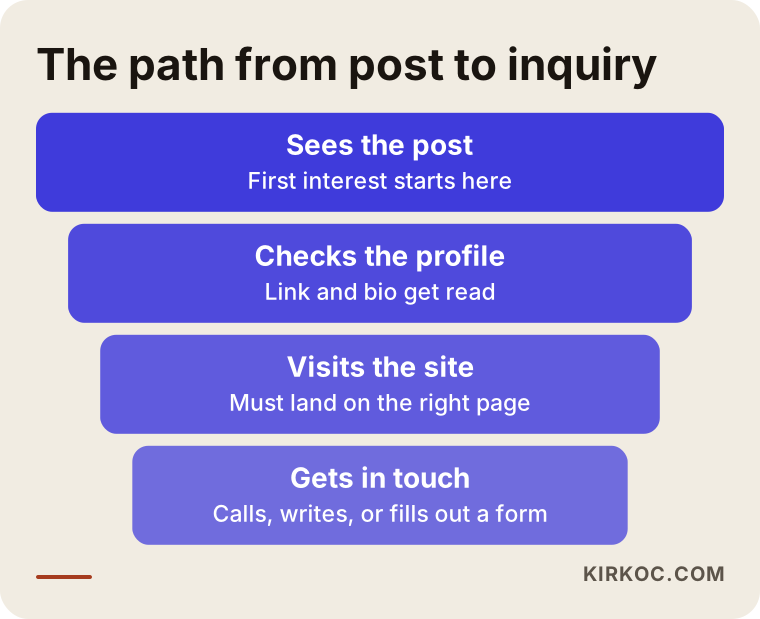
At every step of the funnel, some people drop off, and that is normal. What matters is whether they drop off for a reason you can control. If there is no link between the post and the profile, if the page that opens is irrelevant, or if the contact form does not work, those are all breaks you can fix.
Where should the profile link go?
The most common choice is to point the profile link at the home page. That is not always wrong, but a better option is often available. The question to ask yourself is what you are telling people at that moment.
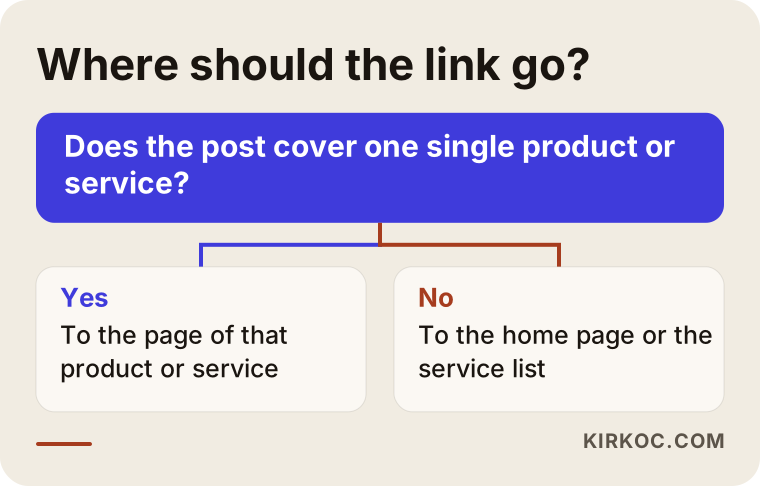
The rule is simple. If a post is about one specific thing, the link should go to the page for that thing. If the post is a general introduction, the home page or a page listing your services fits better. The profile link stays put for a long time, so it usually goes to a plain page with two or three options, or to the home page. There are ready-made tools that gather several links on one page. You can use them, but keep in mind that they live outside your website and can make it harder to pull the visitor onto your own site.
Giving each source its own link
You can add a small tag to the end of a link. With that tag, your measurement tool can tell you that a visitor came from a particular Instagram post. The technical name for the tag is UTM, and it is nothing more than an extra piece added to the end of the address. It looks complicated, but once it is set up, it works for the whole year. The question "is social media working for me?" then gets answered with something you can see, not with a hunch.
Which source should send people where?
People arriving from different platforms are in different moods. Someone coming from LinkedIn may be a partner, a supplier or a customer, and is looking for company-level information. Someone from Instagram arrives with a visual impression and mostly wants to see the product or service. Someone who clicked an ad responded to one specific promise and expects to see that promise fulfilled.
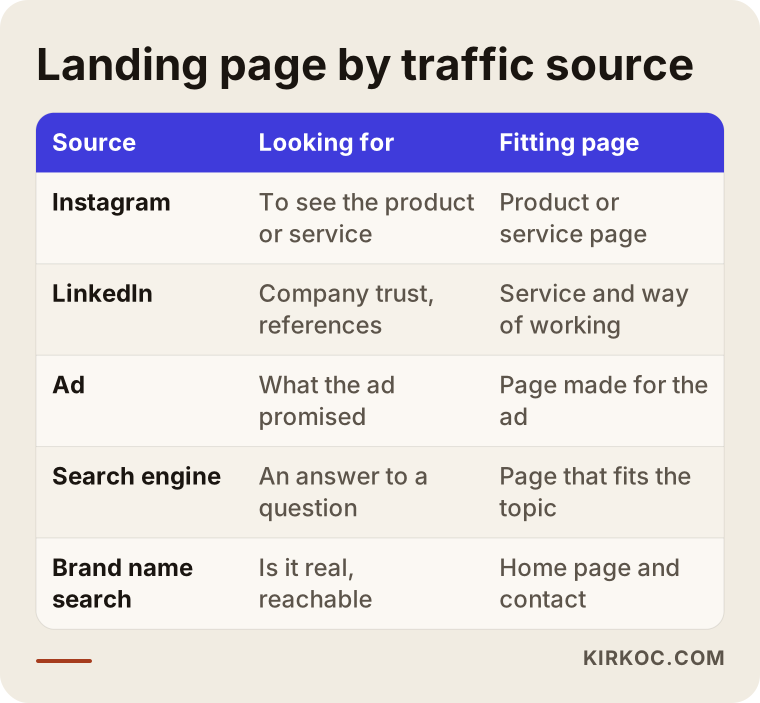
Read the matches in the table as a starting point, not a strict rule. They vary by industry. For a restaurant, an Instagram visitor mostly wants the menu and a way to book a table. For a consulting firm, a LinkedIn visitor wants references and a description of how the work is done. What matters is taking visitors to a place that fits the promise they clicked, instead of dropping them on the home page and saying "figure out the rest yourself."
How do you prepare a landing page?
The page you prepare for people arriving from social media is called a landing page. It should answer, quickly, the thing the visitor was curious about. Think of someone who arrives on a phone, since many people coming from social media do. The first requirement is that the page reads comfortably on a phone.
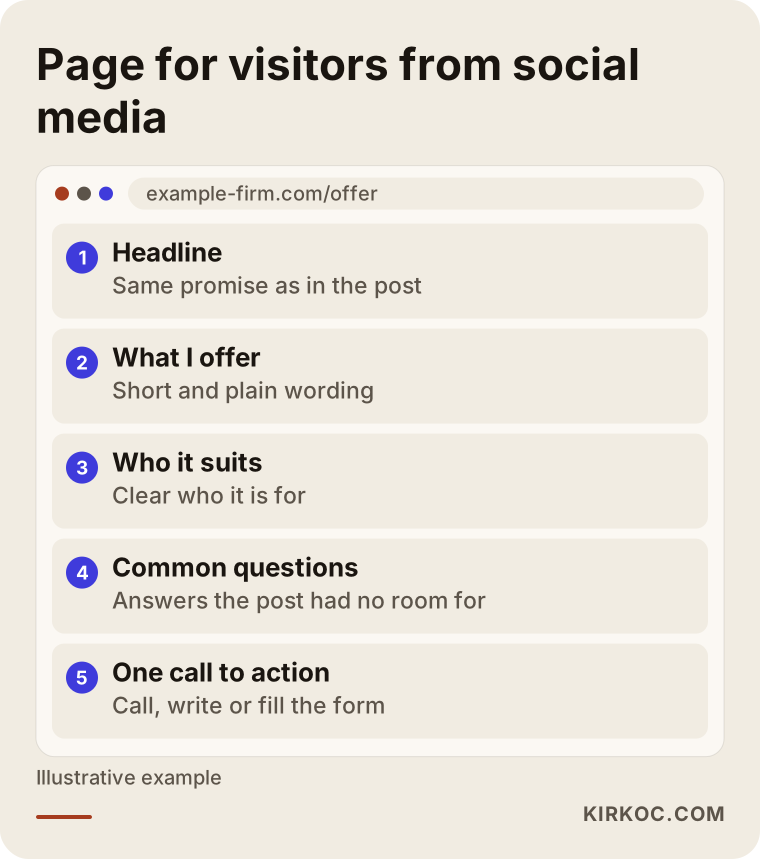
The order in the outline is a suggestion. At the very top should be the same promise you made in the post. If the post said "summer offer," the page headline should say it too. Right below that, briefly explain what you offer, who it suits and how you work. A short list of common questions answers the doubts in the visitor's mind, since the post had no room for them. At the very end comes one clear call to action: call, write or fill out the form. If three different buttons compete at once, the person presses none of them.
Speed and simplicity
A page that opens slowly on a phone loses the visitor in the first second. The usual causes are oversized images, pop-ups that cover the screen and too many add-ons. I will not go into the technical detail here, but I can say this much: a simple page generally loads fast and is also easier to understand.
Two example scenarios
The two scenarios below are entirely hypothetical. They do not describe a real company. I made them up only to show the logic.
Example scenario 1: a small cafe
Suppose there is a small cafe in a neighborhood. The owner posts dessert photos on Instagram every day and shows the day's menu in stories. The account is active, but the link in the profile goes to the home page of a website built years ago, and that page still shows an old menu and old opening hours. People visit the site, see information they cannot trust, are unsure whether it is correct and often give up.
The fix is not complicated. The menu, opening hours, address and map go on one page, and that page is kept current. The profile link points to it. When a story shows "today's dessert," the link goes to the menu updated for that day. The site is also set up so it can be found when someone searches for something like the neighborhood name plus "cafe." That way social media draws people in, the site welcomes them, and the same page serves visitors from Instagram and from search.
Example scenario 2: a small consulting firm
This hypothetical firm shares expert articles on LinkedIn. The articles get likes and a few people leave comments. But the only link in the profile is a general home page, and nobody can work out from it which service suits whom. The owner says, "There is engagement, but no requests for quotes."
The problem here is not the content, it is the handoff. At the end of every article, a single sentence can point to the related service page. That service page clearly states who it is for, how the work is done and includes a contact form. Because the page matches the topic of the article, the reader thinks, "this is exactly what I was looking for." Even if likes do not go up, the number of people reaching the site and the number of inquiries they turn into are more meaningful signals.
The process, step by step
This is the order I follow when I start managing both platforms together. You can use it as a roadmap for your own business as well.
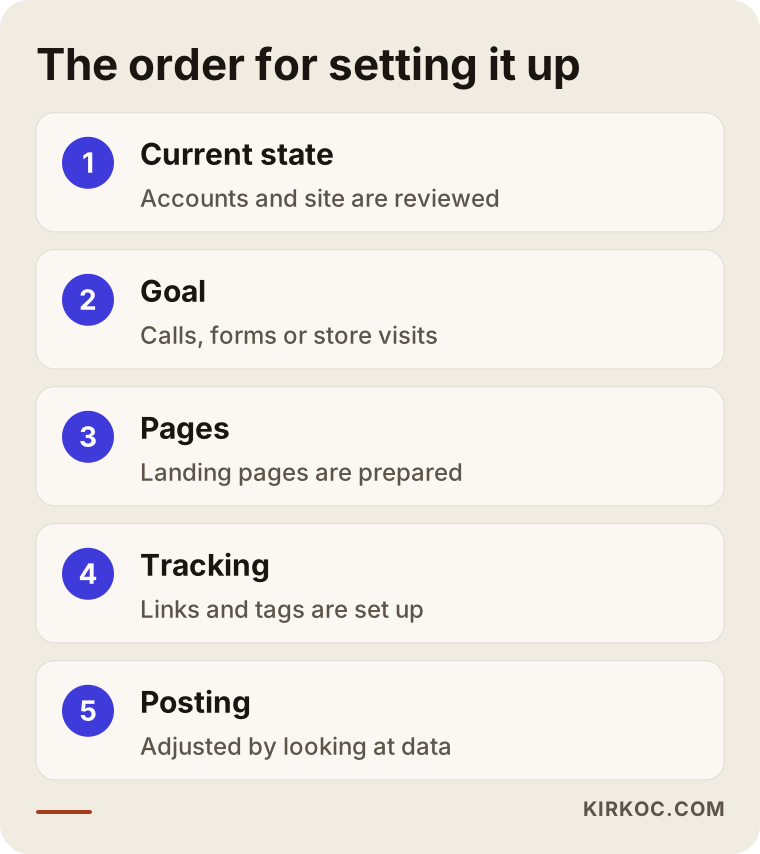
In the first step I look at where things stand now: which accounts exist, what the site contains and whether the information is consistent. In the second step I pin down the goal with you. Do you want phone calls, filled-out forms or visits to a store? In the third step I prepare the landing pages, or fix the ones you already have. In the fourth step I set up the links, the measurement and the tags. In the fifth step the posting rhythm begins, and I adjust things by looking at the data. Skipping this order is usually the mistake that wastes the most time. Posting before the page is ready is like inviting customers to a shop with a locked door.
What do you look at when measuring?
Likes feel good, but on their own they do not show that something brought in business. A few things deserve your attention: how many people came to the site from social media, which pages they looked at afterward, and how many of them called, sent a message or filled out a form. You can see all of this with free tools. Putting it together on one page and presenting it as a plain report is my job, but knowing the basic logic yourself helps you ask better questions of the report.
What to expect in the first three months
No investment pays off on day one. To be honest, the timing of results depends on your business, your competitors and your starting point. I do not promise a fixed timeframe or a number. What I can describe is the general shape of the roadmap.
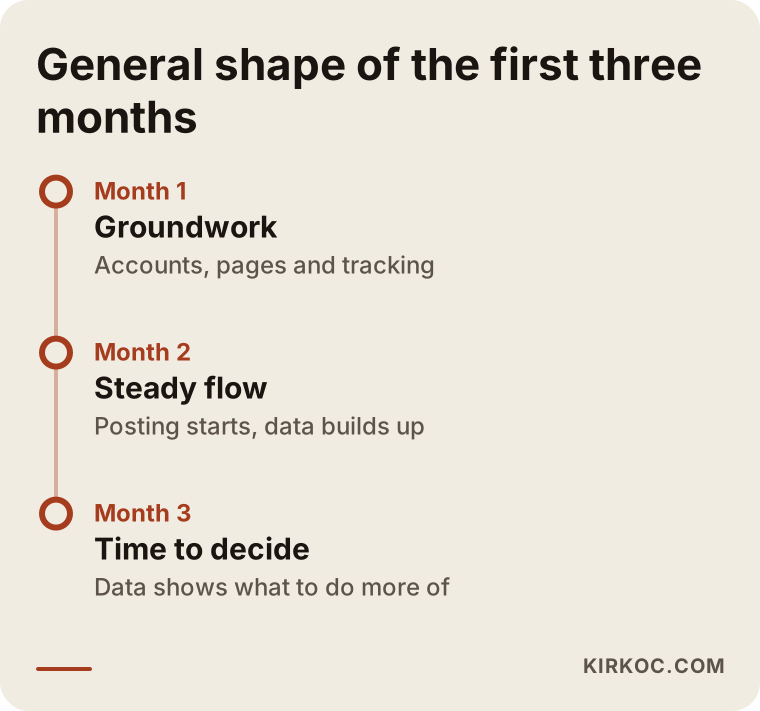
In the first month, the groundwork is laid: tidying the accounts, fixing the site pages and setting up measurement. In the second month, posting starts to flow regularly, and you begin to see which content sends people to the site. By the third month you have data worth discussing, and you decide what to do more of and what to drop based on it. If you plan to run ads, you spend that budget more deliberately once you have this data.
Common mistakes
Most of the mistakes I see do not come from a lack of knowledge. They come from the work being split between two people who each think about their own half. When one person runs social media and another runs the website, nobody looks at the handoff in between.
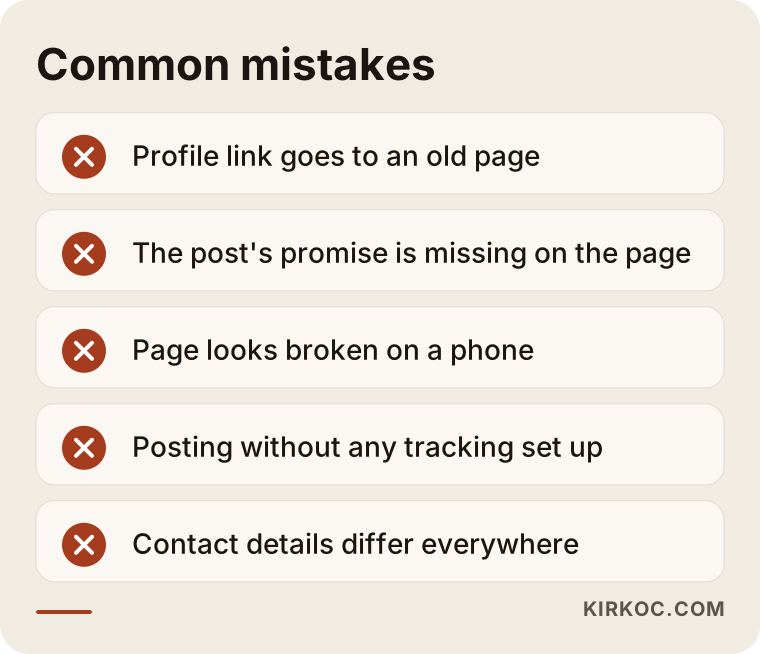
Let me touch on each of these briefly. A profile link that is broken or points to an old page is the invisible but most expensive mistake, because nobody tells you the link is dead, they simply leave. When the promise made in the post is missing from the page, the visitor feels uneasy. A page that looks broken on a phone wastes all the effort you put into sending people there. Posting without measurement ends, months later, in "I don't know whether it worked." Finally, contact details that differ from place to place confuse both people and search engines. The phone number on the website, the one on Instagram and the one in the map listing should all be the same.
Chasing numbers only
Focusing only on follower count and forgetting what the website is doing is another common mistake. Followers are not a business result. I do not guarantee followers, likes or sales to anyone, because those are not things I can control on my own. What I can control is making sure the handoffs work properly and the measurement is set up correctly.
What can you do yourself, and when do you need a specialist?
There is a part you can make progress on without hiring anyone. The list below summarizes checks you can finish on your own within a week.
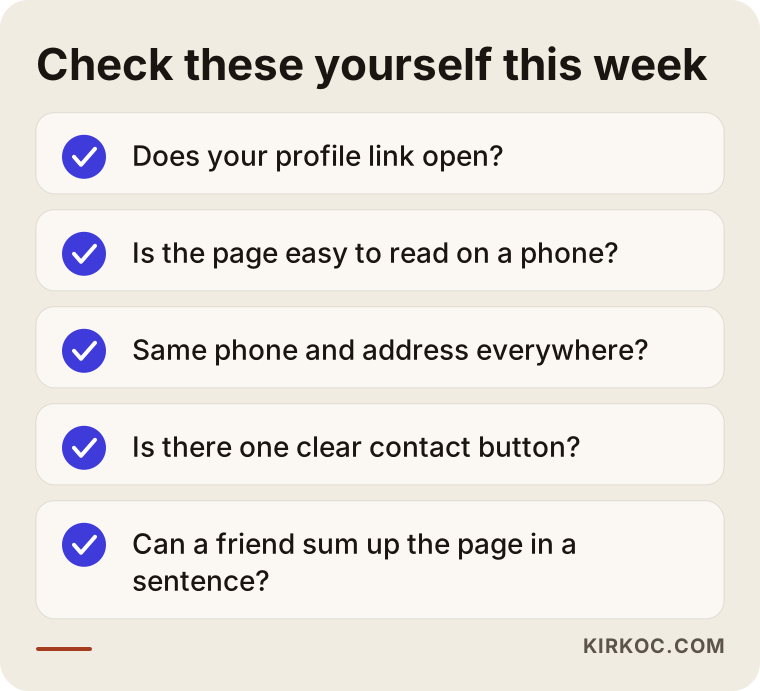
The most important thing while doing these checks is to put yourself in the visitor's shoes. Open your profile on your phone, tap the link and honestly note what you see at first glance. Ask an acquaintance, "What does this page do?" If they cannot answer in one sentence, the page is too cluttered.
There are also points where a specialist helps. Setting up measurement, writing the tags correctly and interpreting the data all take technical knowledge. If your site is slow on phones or cannot be edited, the page structure needs to be reworked. Producing regular content on several platforms also takes time, and if you cannot keep up with it while running your business, outside help makes sense. If you are about to spend money on ads, a wrong link or missing measurement will waste that money, so strengthen the foundation before the ads.
Search, brand names and social media
One point should not be skipped. After hearing about you somewhere, people often search your name or your company name. This is very common behavior. A person who sees a business on Instagram types it into Google to check that it really exists, what the reviews say and what its website looks like.
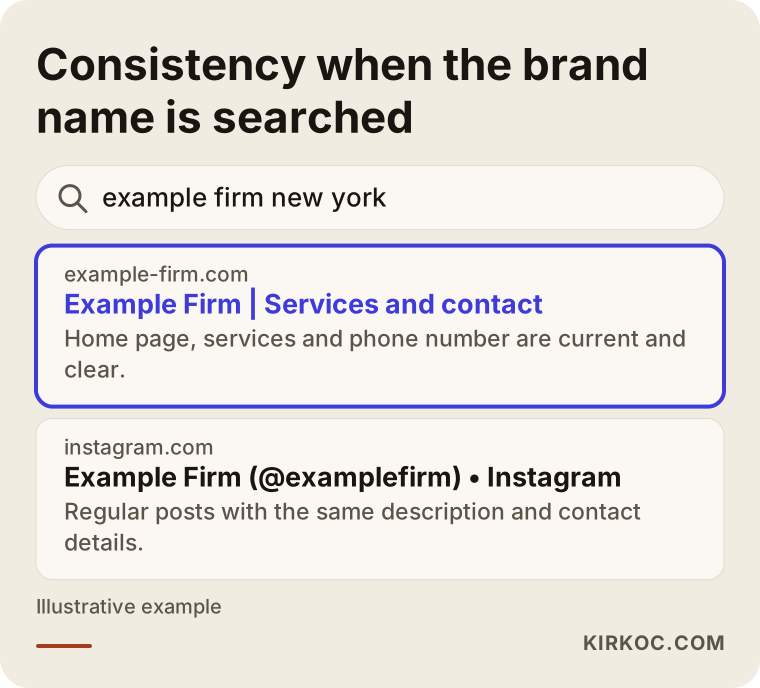
So part of the effect of social media work is indirect. When your company name is searched, your website should appear first, and your accounts should show up below it with a clean description. If your website's title and description text match the bio on your accounts, the person immediately sees they have found the same business. This consistency does not guarantee any ranking, but it does improve coherence. AI assistants can also gather similar details about a business from different places when they describe it, so consistent information helps there as well.
What determines the cost
The price of this work does not come from a single item, which is why I am not giving you a number. I can, however, tell you plainly what it depends on. The first factor is the current situation. If the site is ready and only needs fixes, the job is small, and if pages have to be built from scratch, it is bigger. The second factor is how many platforms you will be active on. Every platform has its own rhythm and content format, so the workload grows. The third is who produces the content. Will the photos, videos and text come from you, or do I need to prepare them? The fourth is whether you will run ads. The ad budget is a separate item and is paid directly to the platforms. The fifth is how detailed the reporting will be and how often it is delivered.
When you request a quote, I suggest asking: "What exactly is included in this price, which pages and which platforms?" If the answer is not clear, the quote is not clear either.
How I work
I am a one-person operation, and I see that as an advantage. When the website, SEO, social media, advertising and content all sit with the same person, nobody has to ask a different person "which page should this post point to?" When I plan a post, I know whether the page is ready. When I build a page, I think about which platform the visitors will come from. The burden of passing information from one person to another disappears.
The process usually goes like this. First, I listen to your business and goals in a short conversation. Then I look at your existing accounts and website and tell you in writing what is ready and what is missing. After we decide together, I set up the foundation first, and then I move on to the regular work. My promises are honest ones: I do not guarantee rankings, followers or sales, and at every stage I explain what I am doing and why.
Frequently Asked Questions
If I have a social media account, do I really need a website?
For most businesses, yes. The account does not belong to you, and it is tied to the rules of the platform. A website is the one place where you can permanently collect your information, your services and your ways of being contacted. Your account and your website complement each other, and neither replaces the other.
Should the profile link go to the home page or to a dedicated page?
It depends on what you want to do. If you are doing general promotion, the home page may be enough. If a specific product, service or campaign is in the spotlight, a page dedicated to it gives better results, because the visitor finds what they came for right away.
How do I measure the visitors who come to my site from social media?
A measurement tool is installed on the site, and small tags that name the source are added to your links. That shows which platform, and even which post, a visitor came from. You can learn to do this yourself, and I can also set it up for you and show you the result in a plain report.
Do social media posts help SEO?
I cannot say anything definite about a direct effect on rankings. There are indirect benefits, though: your brand becomes known, people search for your name and your content reaches more people. Be careful with anyone who guarantees rankings.
Does quality drop if one person manages both the website and social media?
Many people assume each job needs its own specialist, but for small and mid-sized businesses, having the work in one pair of hands often improves coordination. What matters is that the person is competent in every area and explains the work openly. That is my approach, and I spell out the scope clearly from the start.
What should be in place if I run social media ads?
Before ads, the landing page should be ready, measurement should be set up and your contact options should work. The promise in the ad must appear word for word on the page people click through to. Otherwise the budget gets spent and nothing comes back.
Which platforms should I be on?
Where your customers spend their time. For visual products, consider Instagram and TikTok. For business-to-business work, LinkedIn. For topics that need a detailed explanation, YouTube. You do not have to be on all of them. Running two platforms well is better than running five halfway.
How long until I see results?
There is no firm answer. It depends on your industry, the competition and where you are starting. In the first months, the goal is to build a solid foundation and collect data. Be skeptical of any offer that promises a fixed timeframe or a fixed result.
If you want your social media and your website to work together, we can look at where you stand together and talk about where it makes sense to begin. You can reach me through my social media management service page and describe your business in a few sentences.