You asked three people for a social media management quote and got three answers that look nothing alike. One is surprisingly low, one sits in the middle, and one seems too high to take seriously. So you searched "social media management pricing" hoping to find out which one is right, and all you found was either a vague "it depends" or a single number with no explanation. I am not going to give you a number here, because a number on its own tells you almost nothing. Instead, I will explain what moves the price, what to look for in a proposal, and why two offers that look the same often cover very different work. I am Ümit Kırkoç, I work from Istanbul, and I handle social media management along with the rest of what a digital agency would do, all by myself and all in one place.
Social media management, in plain terms, means running your business accounts on Instagram, Facebook, LinkedIn, TikTok or YouTube in a planned, regular way that serves a goal. It is not just "posting something." Someone has to decide what to post, create the image or video, write the text, publish it, watch the comments and messages, and check what happened afterward. Most of the price gap between offers comes from which of those pieces are included.
Why two offers with the same name are not the same job
"Social media management" is a label, not an industry standard. Under that label, one provider might publish a handful of ready-made templates each month. Another might offer a shoot plan, video editing, community replies and a monthly strategy call. The prices will not match, yet both proposals can carry the same heading.
That is why the first thing to compare is scope, not the total at the bottom. If the proposal does not state how many accounts, how many posts, which content types, who does what and how often you get a report, you cannot compare it with anything. Discovering a gap after you have signed usually happens at the end of the first month.
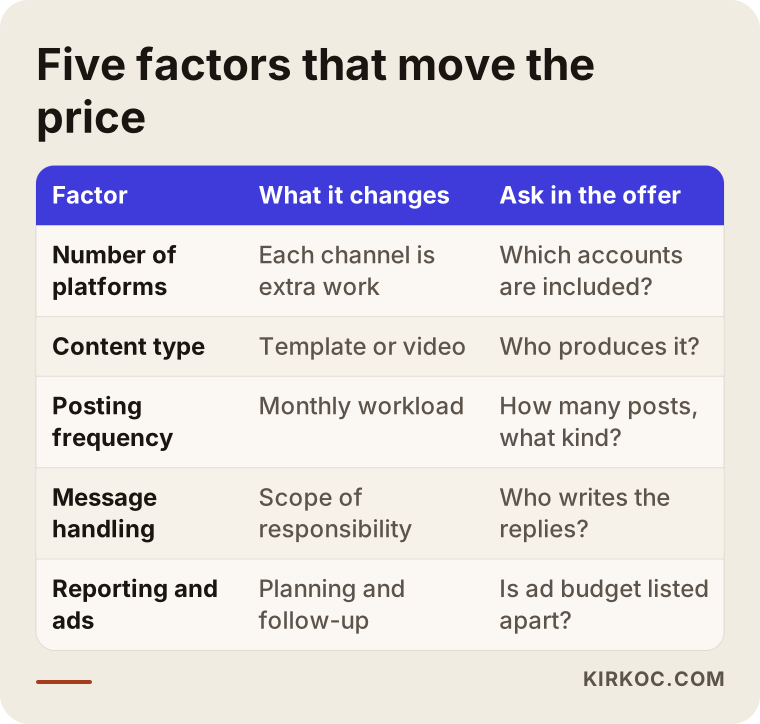
The table below shows the main factors that change a quote. I take them one by one in the sections that follow.
Factor one: how many accounts, on which platforms
Every platform is its own workload. Instagram leans on images and short video. LinkedIn wants more text and a professional tone. TikTok rewards quick videos that look natural. Even a single YouTube video takes serious preparation. You can paste the same post onto four platforms, but it usually performs poorly, because each one has its own style and its own image sizes.
So managing three accounts instead of one does not triple the work, but it is not free either. Sometimes one piece of content can be adapted for two platforms, which saves effort. Other times each platform needs fresh thinking. Check whether the person quoting you made that distinction. A phrase like "all platforms included" is vague, and it does not tell you how the work will actually be done.
Factor two: content type and production effort
This is one of the biggest sources of price differences. Dropping text into a ready-made template is not the same effort as visiting your business, filming, editing, and delivering the result in the right format for each platform.
Roughly, there are three levels. At the lightest level you get graphics and short captions built from photos you already have. One step up, you get custom-designed graphics, carousel posts (swipeable multi-image posts) and story layouts. At the top level you get short videos, a shoot plan, on-site production, sound and captions, editing, and sometimes live streaming. The difference between these levels is easy to grasp even without numbers: one takes a few hours, the other takes days.
If filming is part of the package, the proposal should say who films, where, and how many times. Product photography, such as the images for an online store, is usually priced separately from social media management. If the two are bundled together without being itemized, it becomes hard to see where your money goes.
Factor three: how often you post, and in what pattern
"How many posts per month" is the most visible line in a quote, but on its own it is misleading. Three average posts a week and one carefully made post a week lead to different outcomes. More is not always better either. If your followers are not responding, posting more just burns effort.
My approach starts with a look at what your business actually has to talk about. A restaurant has a daily menu, a clinic has patient education, a wholesaler has new product arrivals, and each of these supports a different rhythm. Selling a high-frequency package to a business with little material to share would be unfair to both of us.
Factor four: community management and messages
An account is not just a storefront where you broadcast. People comment, send direct messages, ask about prices and sometimes complain. How fast and in what manner those get answered changes the scope of a package a great deal. A package that includes handling incoming messages carries more responsibility than one that only schedules posts.
Here I have to be honest about a limit. I do not know your product details, your stock levels or your appointment calendar, so some messages can only be answered correctly by you or your staff. What I usually do is write a shared reply guide with common questions, the tone to use, and which topics should be handed back to you. A package that promises every message will be answered remotely and instantly will naturally cost more, and not every business needs it.
Factor five: strategy, reporting and advertising
The price of social media management is not only production. At the start, someone reviews your accounts, looks at competitors, defines the audience and builds a content calendar. That is the thinking part of the job, and your proposal should say whether you will receive it as a written plan.
Then there is monthly reporting. A useful report goes beyond "we got this many likes." It tells you which posts brought in more inquiries, which ones got ignored, and what will change next month. Preparing a short, clear report takes time, and that time is part of the price.
Advertising is usually a separate item. Money spent on Meta ads (the system behind paid promotion on Instagram and Facebook) goes to the platform, and it is not the same as the management fee. Ask for the ad budget and the service fee to be written as two separate lines. If they are mixed together, you cannot tell what pays for what.
Should you do it yourself or hire someone?
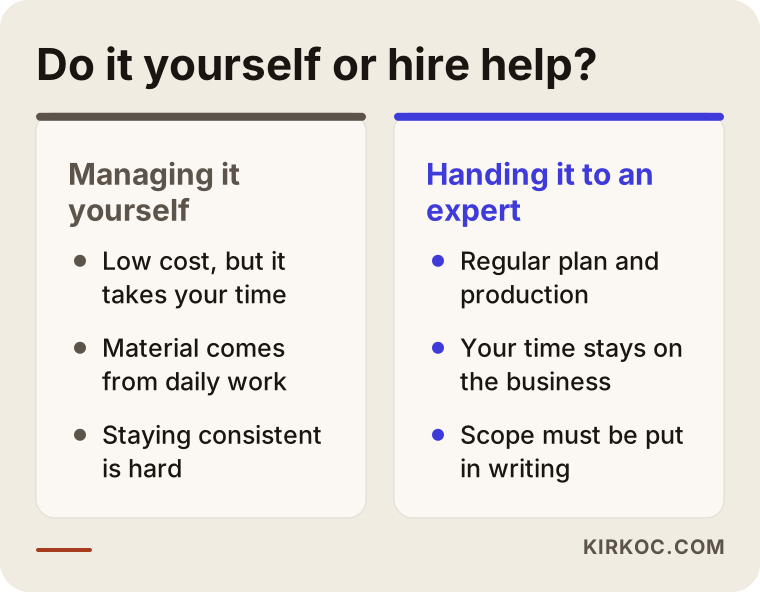
It would be easy to say "always hire a specialist," but that would not be honest. The answer depends on the size of your business, your budget, and how much social media matters to how you get customers.
Doing it yourself can make sense in some situations. If social media brings in only a small share of your sales, if the things you post come naturally out of your day-to-day work, and if you can set aside a few hours each week, running your own account is reasonable. A small shop owner can do a good job by filming products on a phone and posting them to stories. What that owner often needs is not ongoing management but a one-time setup and a simple posting guide.
Help from a specialist pays off in other situations. If you have no time, cannot keep a consistent look, want to be on several platforms, plan to run ads, or your account has been silent for months, steady support helps. And there is one more distinction. If social media is a main way you win customers, inconsistency is a direct loss.
There is also a middle path. With some businesses I work in a consulting-only format. You create the content, and I provide the plan, the tone of voice and a checklist, and we review the results together at the end of each month. As you would expect, that is a lighter scope than full management.
Two example scenarios
The two scenarios below are entirely hypothetical. They do not describe a real business or person. Their purpose is to show how the same need turns into different quotes depending on scope.
Example scenario 1: a neighborhood bakery. Suppose a bakery owner wants to show daily items and special-occasion orders on Instagram. They already have decent product photos, and message traffic is light. In that case a single platform, a light weekly content routine, posts designed from existing photos and a short review at the end of the month might be enough. Because the scope is narrow, the price follows a narrow package. The owner prefers to answer order messages personally, which is a choice that keeps costs down.
Example scenario 2: a dental clinic with several locations. This imaginary clinic wants to appear on Instagram, Facebook and LinkedIn, and it plans patient education videos and ads aimed at booking appointments. Filming, coordinating with the dentists and the sensitivity of health-related content all stretch the work. (Rules about health advertising and posts vary, so those should be checked with a lawyer or the relevant professional association.) Replying to messages and monthly reporting are part of the scope too. This package is much broader than the bakery's, so the price sits in a very different place.
These two are not competitors. They are the same service shaped to two different needs. Instead of asking "what does the bakery pay and what does the clinic pay," ask "which of these is closer to my situation."
How the process works, step by step
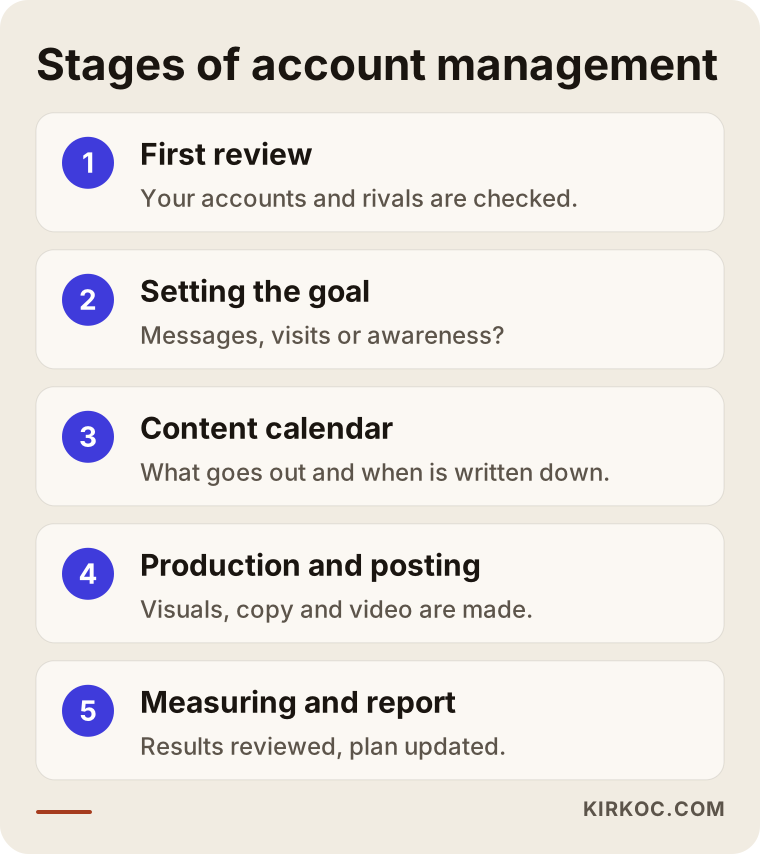
To see where the money goes, it helps to look at what actually happens. The process follows the diagram above, and each stage takes its own effort.
The first stage is a review. I look at your current accounts, your competitors, and how customers find you. Sometimes that is a one-hour conversation, sometimes a few days of research. The second stage is setting a goal: do you want more messages, more visitors, or more brand awareness? If the goal is unclear, you cannot measure which content is working.
In the third stage a content calendar is written. What goes out on which day, which topics will be covered, and which visuals will be used all become part of a written plan. The fourth stage is production: images, text and video. The fifth is publishing and follow-up, which means posts going out on time and comments and messages being checked. Finally comes monthly measurement, and the plan is updated based on it.
Every link in this chain takes work, but not every business weighs them equally. For some, production is light and measurement is heavy. For others, it is the reverse. The price reflects the sum of those weights.
Warning signs when you read a proposal
When a proposal arrives, certain things should make you pause. They do not all mean bad intentions, but each one is a question you should ask out loud.
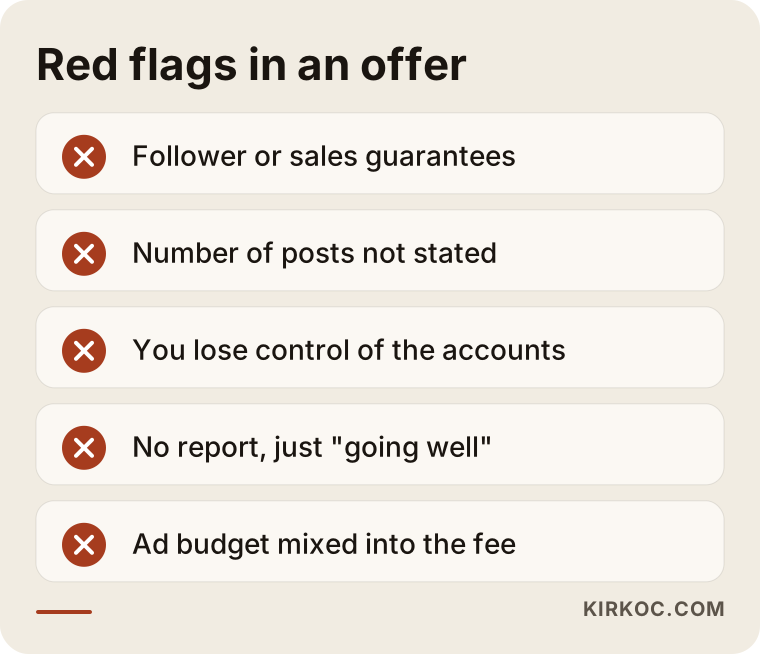
The first is a guarantee of followers or sales. No one can guarantee a follower count or a sales result on any platform, because algorithms and human attention do not work that way. An offer that promises "this many followers guaranteed" is either buying fake accounts or making a promise that will not come true. Fake or purchased followers can weaken your account and drag down your engagement rate.
The second is vague scope. If the proposal does not say how many posts, which platforms, who creates and who approves, it is incomplete. The third is account ownership. The login details and admin rights for your accounts must stay with you. Losing your account when the service ends is a serious problem. The fourth is no reporting. Saying "everything is fine" is not a report. The fifth is a contract that is either extremely short or locks you in for a very long time. A setup that lets you test the relationship in the early period is more balanced.
One more point: a very low price is not automatically bad work, but you should question whether the scope really fits that price. A high price does not automatically bring quality either.
A ready-made package or a tailored offer?
Many people want a ready-made package because it is easy to compare. The strength of a package is that you know what you are getting. The weakness is that your needs may not match it exactly. A tailored offer fits your business better, but it is harder to compare with others.
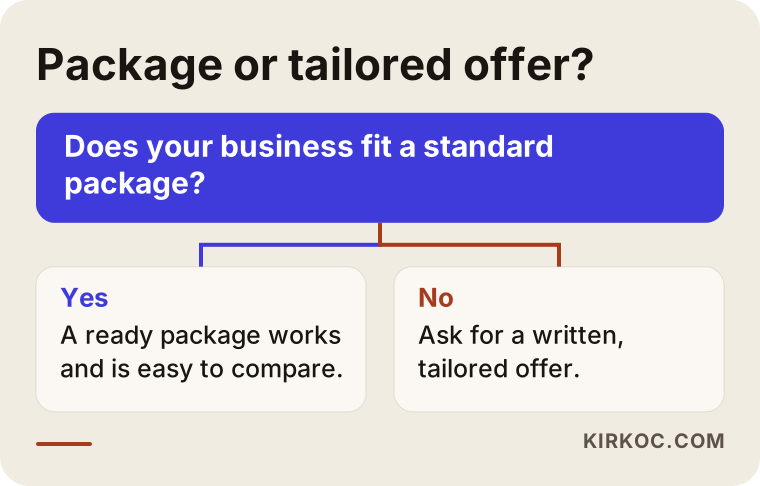
My method is simple. I talk with you first, listen to what you do and what you want, and then I write down only the work that is truly needed. If something is not necessary, I do not add it to the package, and if it is necessary, I say so plainly. The benefit is that you pay only for what you need. The drawback is that you cannot decide by looking at a single fixed price list. That is why a short conversation first, followed by a written proposal, works better.
What the first three months look like
Social media is not a job that pays off in the first week. It is better to say this at the start, because if expectations are set wrong, even good work gets dropped for "not working."
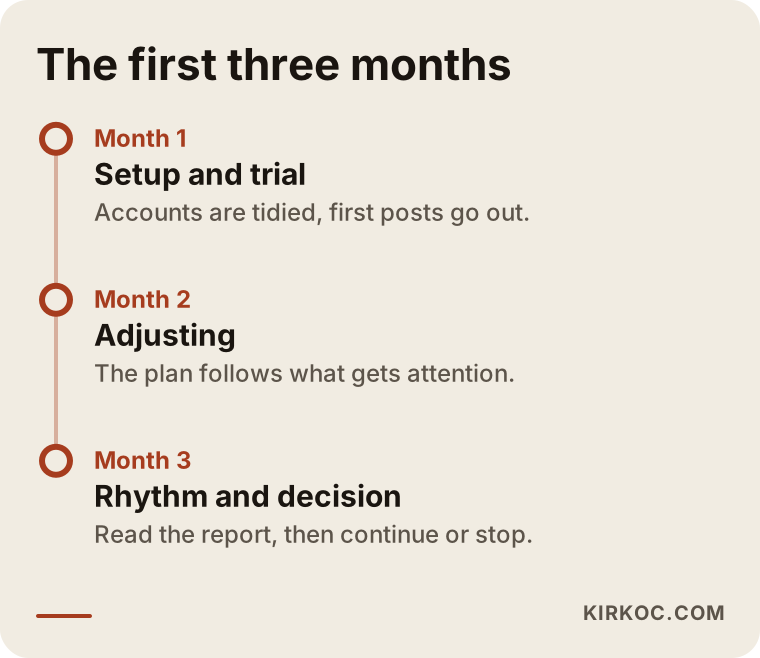
The first month is usually setup and testing. Your accounts are tidied, the look settles in, the first pieces of content go out, and you get early hints about which topics people respond to. The second month is when the plan is adjusted based on those hints. By the third month a rhythm has formed, you have a concrete idea of what works, and you can make a decision.
For that reason it is reasonable to treat the first three months as a trial. I do not promise results, but at the end of three months I give you a report showing what worked and what did not. You decide whether to continue by reading that report.
What a proposal should contain
If the proposal you receive covers most of the items below, comparing it with others becomes much easier. Do not hesitate to ask the provider about anything that is missing. A good proposal expects those questions.
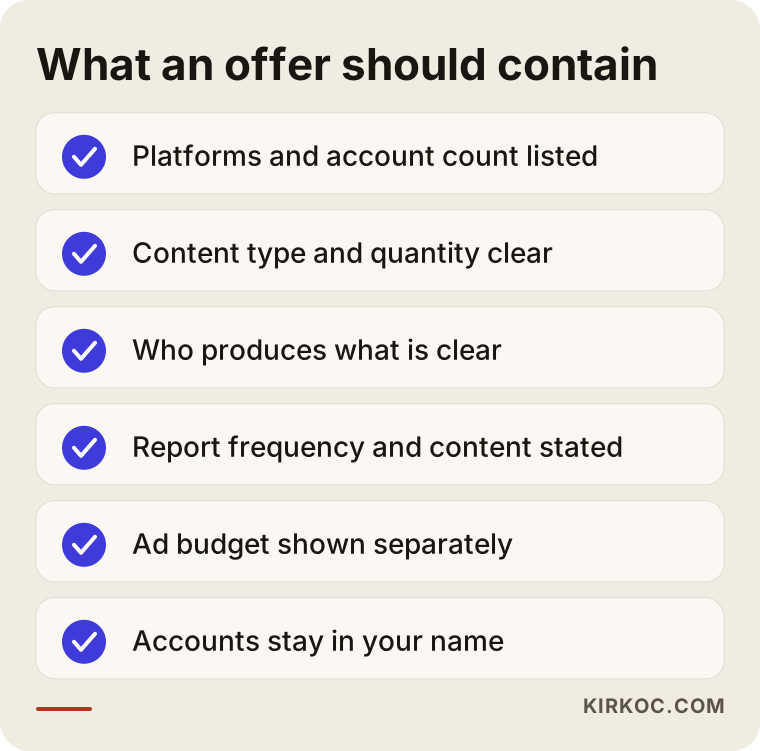
The list is made up of a written scope, which platforms are included, content types and quantities, who produces what, how approvals work, how often reports arrive and what they contain, the ad budget shown separately, ownership of the accounts, and how the agreement can be ended. When you ask about all of these, you will also see where the price goes.
Common mistakes business owners make
Here are the mistakes I see most often. The first is deciding purely on the lowest price. A low price often means a narrow scope, and the gap gets filled later with extra charges. The second is starting without a goal. "Let's be on social media" is not a goal. "Get more appointment requests from this account" is a goal.
The third is handing everything off and staying out of it completely. You know your business better than I do. You know the product, the customer, the kitchen or the workshop. Even half an hour of your input each month changes the quality of the content. The fourth is expecting results in the first few weeks and quitting too early. The fifth is trying to be on every platform at once. Being consistent on two platforms is far better than being scattered across five.
The sixth mistake is treating social media as separate from your other channels. Examples include filming a promotional video and never putting it on your website, or running ads that send people to a site that will not open properly on a phone.
Why having everything in one place makes a difference
I should explain how I work here, because it affects the price conversation directly. A website, SEO, social media, Google and Meta ads, a logo and content creation are often split among different people or different companies. That split has a cost: briefing each of them separately, explaining the same facts again and again, and finding that one person's work does not fit another's.
Because I handle all of it, you only have to explain something once. A product page I feature on social media is already ready on your site. The image used in an ad matches your logo. A topic I cover in a blog post can show up on social media the same week. This does not automatically lower the price, but it cuts the coordination cost and makes the pieces support each other. You do not have to give me only social media. If you need other services too, talking to one person simplifies things.
Social media, ads or SEO?
Many people do not know whether to put their budget into social media, advertising or visibility on Google. The short answer is that each serves a different purpose. Social media helps people get to know you and trust you. Advertising reaches a chosen audience quickly. SEO, which means improving your site so it shows up in Google results, puts you in front of people who are already searching for something.
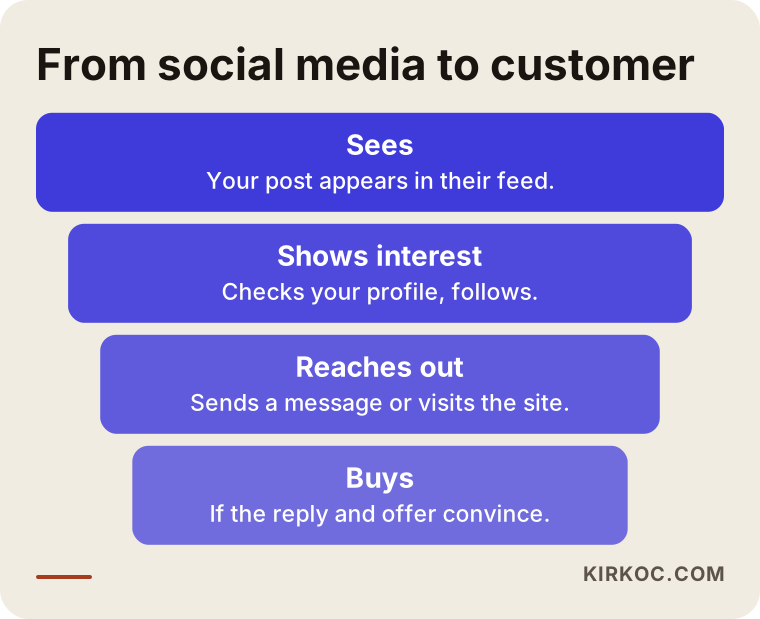
The funnel above shows how a person typically moves through social media: they see you first, then they show interest, then they send a message or visit your site, and finally they buy. You lose people at every stage, and that is normal. What matters is spotting the stage where you lose the most. If messages come in but do not turn into sales, the problem may not be your content. It may be your reply process or how you present your prices.
Where a business should start depends on what it needs. If a newly opened business must become visible fast, ads come first. If an established business needs to earn trust, content comes first. We can work out the right mix together in the first conversation.
What to look for in the report
The monthly report is where you see what your money bought. But do not be taken in by flashy numbers such as like counts that mean little. What matters are the measures tied to the purpose of the account: the number of incoming messages, profile visits, clicks to your website, or appointment requests.
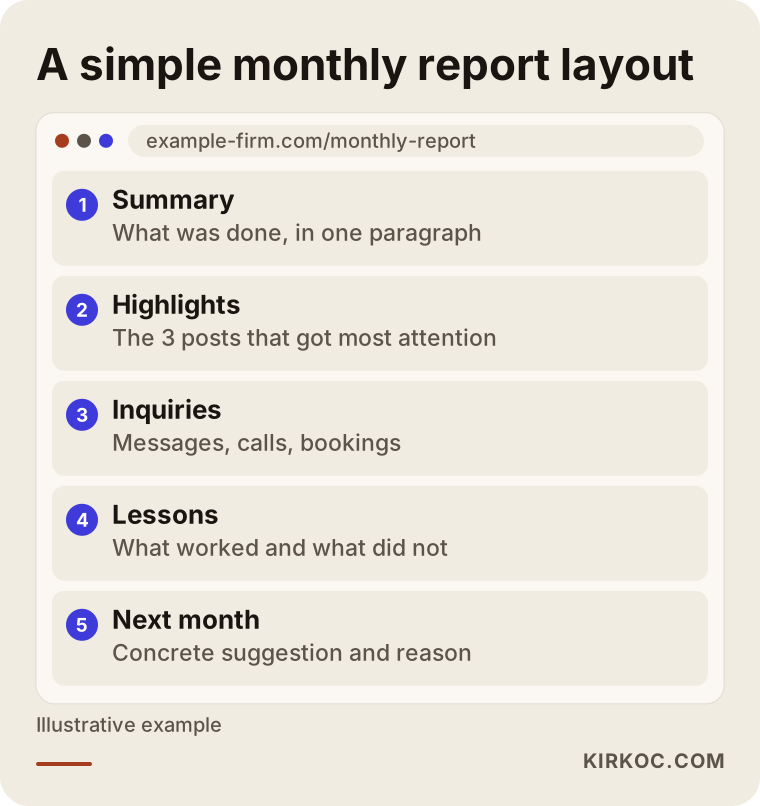
A good report is short, written in plain language, and ends with a clear recommendation for the next month. A report with pages of charts that never says what to do next is useless. If you feel you do not understand the report, say so. A report that cannot be explained is the writer's problem, not yours.
How AI tools affect pricing
Tools like ChatGPT have recently sped up drafting text and generating ideas. That has made some parts of the work easier, but knowing your business, finding the right tone, shaping the visual and checking the replies still take human effort. There is no clean answer to how these tools change pricing. They lighten some items and leave others untouched.
One thing I can say: content produced only by AI, with nobody reviewing it, tends to feel generic and not specific to your business. You can ask the person quoting you to explain how they use these tools and who does the final check.
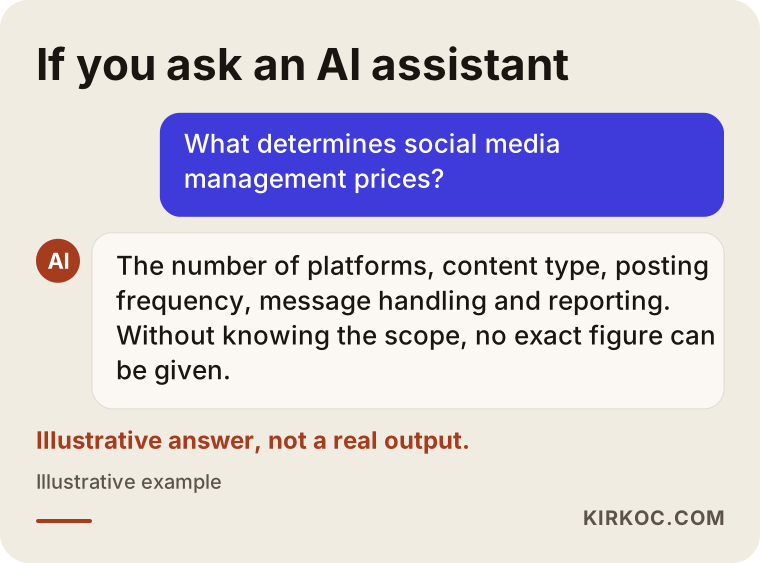
When you put the pricing question to these tools yourself, the answers will usually land on "it depends on the scope." The sample answer above shows why. Price is set by the size of the job, and a figure given without knowing that size is only a guess.
How I work with you
We start with a short conversation. We talk about your business, your accounts, your goal and your available time. After that I send you a written proposal that states what I will do, what I will not do, what I will need from you, and how often I will report. The price is set by that scope. If the scope changes, the price changes too, and we talk about that beforehand.
Your accounts stay in your name, and I work only with admin access. I do not promise followers, likes or sales, but I show you clearly what I do, why I do it and how the results are going. Because I am one person, my capacity is limited. I do not accept every job at once, and if I think a job is not a good fit, I tell you.
Frequently asked questions
Why do social media management prices vary so much?
Because services with the same name cover different work. As the number of platforms, the type of content, posting frequency, message handling, reporting and ad support change, the price changes too. When you compare quotes, compare the scope before you compare the total.
Is the ad budget included in the management fee?
Usually not. The ad budget is the money paid to a platform such as Instagram, Facebook or Google. The management fee pays for the work of the person who sets up and monitors the ads. Ask for the two to be written separately in the proposal.
How long before I see results from social media management?
There is no exact timeframe I can give you. The first month is setup and testing, and by the end of the first three months you should have a concrete idea of what works. Be careful with offers that guarantee results.
Is it safe to give my account password to a specialist?
Whenever possible, use the admin access that platforms offer instead of sharing a password. That way you remain the owner and can remove access whenever you want. The account must stay with you when the service ends.
Does a small business need social media management?
Not always. It helps if your customers look for you and follow you on social media. If they mostly find you through Google or word of mouth, it may make more sense to spend the budget elsewhere first. I will say so openly in our first conversation.
Can I get management for just one platform?
Yes. Starting with a single platform is often the healthier choice, especially for small businesses. After you see the results, you can add a second one.
Should I provide the content, or will you create it?
It depends on the scope. You can supply the photos and videos and leave the writing and design to me, or you can ask me to handle the filming as well. Whichever you choose, who does what should be written in the proposal.
How long should the contract be?
I do not insist on a fixed length. I suggest treating the first period as a trial and continuing if you are happy. For contract details, consult a lawyer if needed.
If social media management pricing still feels confusing, tell me briefly about the proposal you have or what you need, and we will work out the scope together. You can reach me through my social media management service page and ask for a call to build a plan that fits your business.