At some point every business owner runs into the same problem: the Instagram account sits empty, competitors post on a regular schedule, and you cannot keep up with any of it. Two options come to mind. You can add a social media manager to your payroll, or you can hand the work to a person or company outside your business. "Should I hire a social media manager or outsource?" has no single answer that fits everyone, but for your particular business, the answer is usually quite clear. This article shows you how to reach it. I am Ümit Kırkoç, I work in Istanbul, and I run social media management together with websites, ads and content, all by myself. That means I know how the outsourcing side works from the inside. I am still not going to tell you to "always outsource." For some businesses, a full-time employee really is the better fit.
Do not let the word "outsourcing" put you off. It simply means paying a person or company a monthly fee to take over a job, instead of having your own employee do it. Hiring a cleaning company or handing your bookkeeping to an accountant works the same way. In social media, it means giving someone else the planning of posts, the creation of images and captions, the publishing and, if needed, the management of ads.
Start by asking the right question
Most business owners ask, "Which one is cheaper?" A more useful question is: "How many hours of social media work does my business generate each month, and what skills does that work require?" A salary or a monthly fee is only one side of the picture. What really decides things is how big and how varied your needs are.
Social media is not the single task it looks like from the outside. Running an account properly means deciding what to post, taking photos or making videos, designing the graphic, writing the caption, publishing at a sensible time, answering messages and comments, running ads, and then looking at the results and changing course. One person may not do all of that equally well. Someone who writes beautifully may be weak at design, and someone who shoots great video may not know how to manage an ad budget.
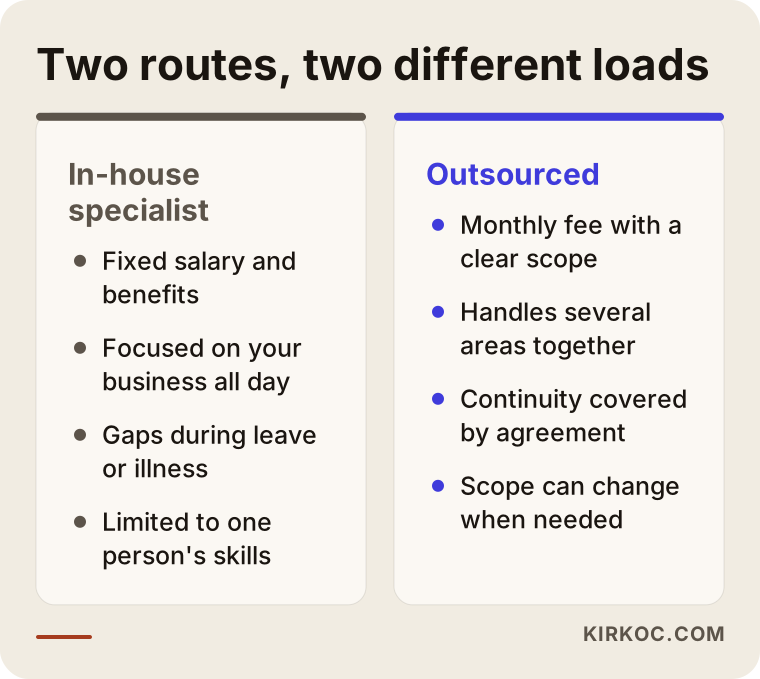
The graphic above sums up the basic difference between the two routes. With an employee, you get one person's effort and a fixed cost. With outsourcing, you get a service whose scope is defined up front, and more flexibility. Let's look at what those differences mean in everyday life.
The real picture of hiring someone in-house
Putting one person on your payroll looks like the safest route at first glance. They work for you, they are around every day, and they know your brand from the inside. Those advantages are real. If you have a physical space that produces constant material, such as a store, a restaurant, a clinic or a production facility, someone on site can film stories every day, announce a last-minute promotion and answer customer messages within minutes.
But the cost of an employee is not just the salary. As an employer, you also carry payroll taxes, benefits, paid time off, possibly severance, a desk, a computer, a phone and software subscriptions. For the exact total in your country, ask your accountant or an HR adviser, because employment rules differ from place to place and change over time, and I cannot give you a precise figure here. What I do want to stress is this: the true cost of an employee is always higher than the number on the paycheck.
The second issue is the limit of one person. The person you pay is usually strong in one area. When you hire someone as a "social media manager," you quickly start expecting photography, graphic design, copywriting, video editing and ad management all at once. People who are good at everything exist, but they are rare and usually expensive. More often, the result is a tired employee who does everything at an average level.
The third issue is continuity. Employees take vacations, get sick and sometimes leave. When they go, the account passwords, the posting calendar, the design files and the history of customer messages can leave with them. The way to prevent this is to keep every account registered in your name and store passwords in a shared place, but most businesses only think about this after someone has already left.
Finally, it is hard for one person to keep growing alone. Platforms change constantly, with new formats, new rules and new behavior in how posts are shown. An employee who works alone and has nobody to learn from tends to repeat the same patterns. If you do not set aside a training and tools budget, that person may be working with last year's knowledge a year from now.
The real picture of outsourcing
Outsourcing means buying a service instead of a person. Your monthly fee and the scope are set in advance: this many posts, this many videos, message monitoring, a monthly report. If a person goes on vacation, the service does not stop, because the responsibility sits in an agreement rather than with one individual.
The biggest advantage of outsourcing is that you get different skills from one place. This is where a good agency or independent specialist earns their keep: content ideas, design, copy, ads and reporting all pass through the same hands. That is how I work as well. When I manage your social accounts, your website, your search visibility and your ads are in the same pair of hands, so your posts fit your site and your ads fit your posts. When you work with three separate people, each one optimizes their own piece, and you end up managing the gaps between them.
Outsourcing has downsides too, and it would be dishonest to hide them. First, the person outside is not inside your business. They cannot know about a small event in your shop, today's special or the well-known customer who just walked in, unless you or your team tell them. Second, someone who is not part of your daily life needs time to learn your brand's voice, so the first weeks of copy may feel a little foreign. Third, if the scope is not written down, you can end up in "that's not part of the deal" arguments.
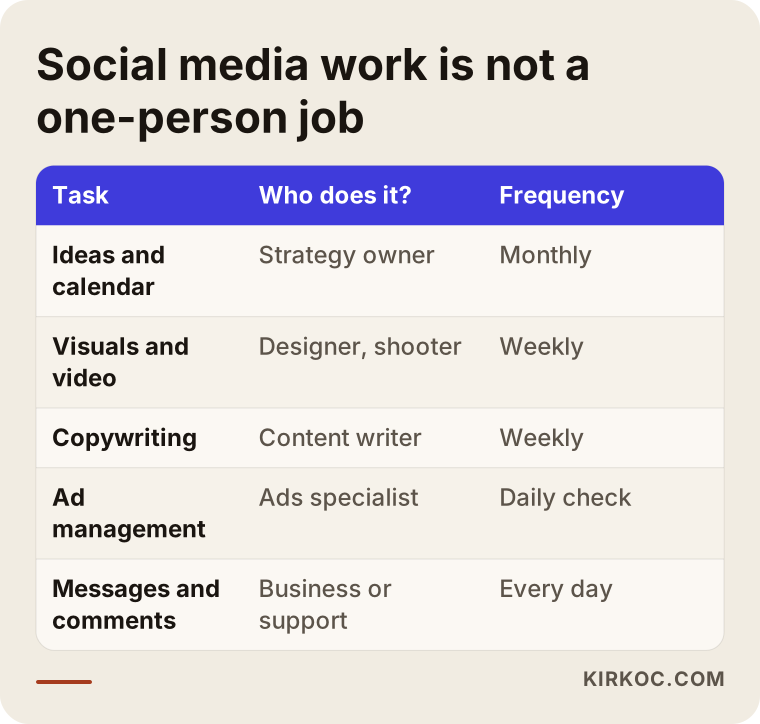
The table shows why this work should not rest on one person's shoulders. Ideas, visuals, copy, ads and message handling all move at different rhythms, some monthly and some daily. Carrying all of those rhythms at once only works when the work is divided up.
Which route suits which kind of business?
Let's not leave this comparison abstract. The situations below are general guidelines, and every business has its own quirks.
An in-house employee may make more sense if: you have content to produce every day (a multi-location chain, a store that does live streams, an e-commerce shop running daily promotions), you need to answer customer messages quickly and constantly throughout the day, a lot of material and information flows through your business, and you can set aside a regular training and tools budget for the employee.
Outsourcing may make more sense if: your business is small or mid-sized and the social media work is a limited number of posts a month plus a few ad campaigns, you need several skills at once (design, copy, ads), you are seasonal and do not want to carry a fixed cost in the slow months, or you are just starting out with social media and want to test whether it will work for you.
There is also a third route that people often overlook: a hybrid model. Someone inside your business, such as a sales rep or the person at the front desk, films the small daily stories and checks the messages. An outside specialist handles strategy, design, copy and ads. That way you get both the real-time feel of your location and a professional division of labor.
The trick with the hybrid route is writing down who does what. A vague deal like "I'll shoot it, you post it" usually ends with weeks of empty feeds, because each side assumes the other is doing it.
How to reach the decision, step by step
Instead of deciding by gut feeling or on a friend's advice, I suggest you set aside an hour and put four things on paper.
Step one: write down the work. List how many posts, videos and stories you want per month over the next three months, which platforms you want to be on (Instagram, Facebook, LinkedIn, TikTok, YouTube) and whether you will run ads. Each platform is a separate job, and being on all of them multiplies the work. If your customers only spend time on Instagram, there is no point in burning effort on a fourth platform.
Step two: count the hours. Estimate roughly how long each item takes. Coming up with an idea, shooting the photo, editing it, writing the caption and publishing a single post takes longer than most people expect. A video takes longer still. Answering messages is small but never-ending work. Once you add it all up per month, you will see whether it fills a full-time job. In most small businesses the total does not even reach half a day a week, and in that case tying up a full-time person would be a waste.
Step three: find the gaps. Look at who could do each item on the list. Do you have someone who can shoot photos? Someone who knows a design tool? Someone who can run an ad account? Someone who writes fluently? The more gaps you find, the harder it is for one employee to close them all, and the more outsourcing or the hybrid model comes to the front.
Step four: set up a short trial. Whichever route you pick, define the first period as a trial. With outsourcing, that usually means a few months of work followed by a review. With an employee, there is typically a probationary period, though the details depend on where you are, so ask an attorney or your accountant. Decide in advance what you will look at when the trial ends: incoming messages, profile visits, phone calls, people walking into your store?
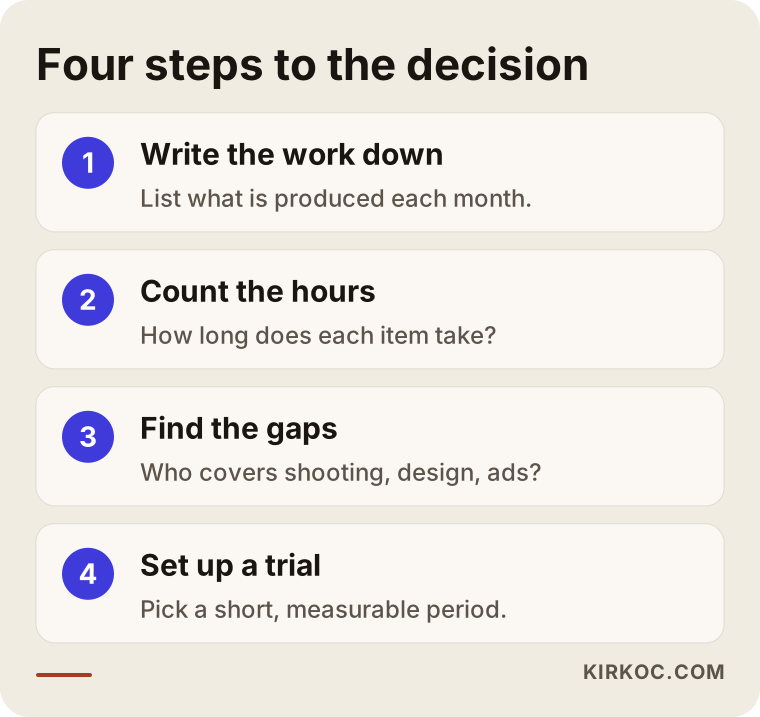
If you follow the four steps in the graphic in order, "which one is cheaper?" gives way to "which one fits this work better?" That is a much healthier way to decide.
What determines the cost
I am not going to give numbers here, because the right number only comes from looking at your actual business. But knowing what moves the price will protect you when you compare quotes.
With outsourcing, the fee is mainly driven by how many platforms you are on, how many posts and videos are produced each month, whether filming happens at your location or uses ready-made images, whether ad management is included, which hours message and comment monitoring covers, how detailed the reporting is, and whether the workload changes with the seasons. The ad budget is a separate item altogether. The money you pay to the ad platforms is not part of the service fee. It is paid directly from your own account, and you can see every cent of it.
With an employee, the cost is shaped by their experience, the city you are in, their working hours, your obligations as an employer, and the tools and training you provide. There is also an invisible item: the management time you or your manager will spend on this person. Guiding an employee, approving content and giving feedback all take effort.
The biggest mistake when comparing the two is putting the monthly outsourcing fee next to an employee's take-home pay. The right comparison is the outsourcing fee against the employee's total cost to you as an employer, plus the price of anything the employee cannot do (design, video, ads) if you would need to buy those separately. Sitting down with your accountant to work out the real numbers is tedious but worth it.
Questions to ask before you outsource
If you have decided to outsource, there are a few questions to ask before you sign anything. They head off most of the disagreements that come later.
Whose name will the accounts be under? This is the most important one. Your business accounts should always be registered to you and tied to your email address, with the outside person added as an administrator and never as the owner. Otherwise, when the work ends, you may have to fight to get your own account back.
Is the monthly scope in writing? The number of posts, the platforms, the types of content, the right to revisions and the response hours for messages should all be clearly written in the contract or the proposal. Who owns the photos and videos that get shot should be written down too. If any clause on copyright is unclear to you, ask an attorney.
How often will the report arrive, and what will it show? Follower count looks like a nice number, but on its own it does not tell you what the work is doing for your business. The report should also show things that matter to you directly, like messages, calls and visits.
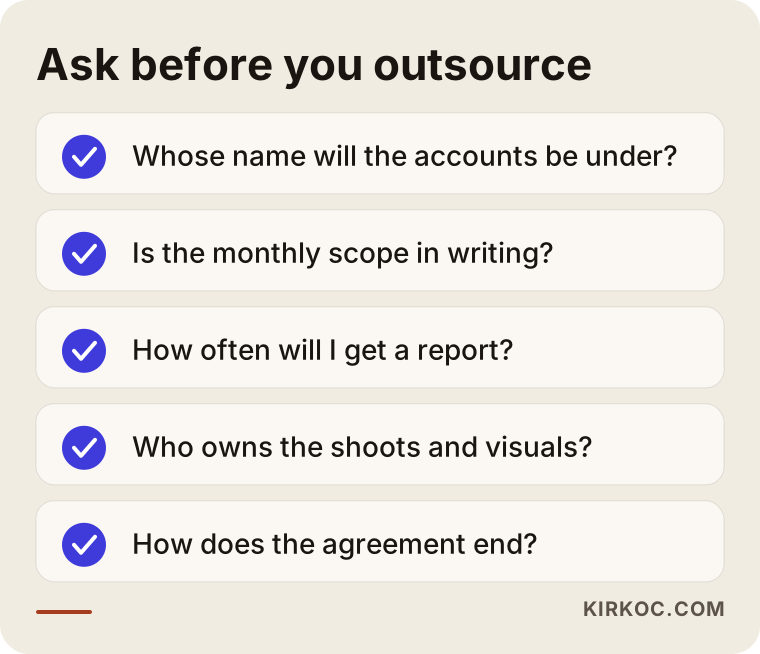
The last question on the checklist matters as well: how does the agreement end? A trustworthy provider hands over the access, files and content smoothly when you want to leave. Talking about this at the start should not make anyone uncomfortable. If it does, that is a warning sign in itself.
Which route when? A decision chart and two example scenarios
If I had to boil the decision down to one question, it would be this: does your business generate full-time social media work every single day? If it does not, outsourcing or the hybrid model is usually easier to carry.
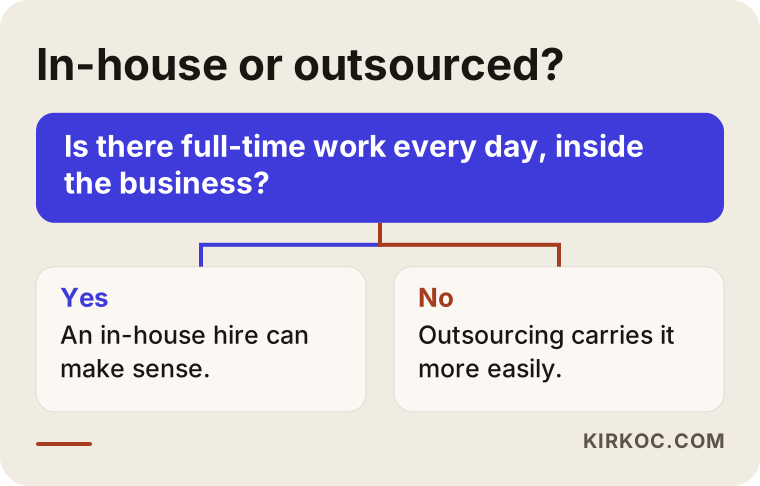
To make the chart more concrete, here are two hypothetical scenarios. They do not describe any real company. I made them up to illustrate the idea.
Example scenario 1: a cafe chain with three locations (hypothetical). Every location has daily menus, events and new products. Stories go up every day, customers constantly write on Instagram to ask questions and make reservations, and weekends bring live music and event videos. When you count the hours here, content creation, filming and message handling add up to a full-time job. For a business like this, an in-house social media coordinator can make sense. Even so, getting outside help with strategy, ads and more advanced design is a good way to keep that employee from working alone.
Example scenario 2: a single-location dental clinic (hypothetical). The clinic wants a few educational posts a month, an occasional patient information video and a few advertising campaigns a year. Appointment requests mostly come by phone and through the website, and there are only a few Instagram messages per day. When the hours are counted, the work comes to a few days a month. On top of that, healthcare advertising and content are often subject to rules specific to the profession, and you would need to check the current version with an attorney or the relevant professional body. A full-time employee would sit idle for much of the time at this clinic, while outsourcing covers a clearly defined scope. The receptionist handles the small daily messages, and the content and ads run from outside. That is the hybrid model in practice.
Notice that in both scenarios, what drove the decision was not prestige or the belief that "big companies hire staff." It was the volume and variety of the work.
The most common mistakes
Whichever route you choose, I see businesses fall into the same traps.
Handing social media to an intern or the youngest employee because they are "digital natives" tops the list. Being young does not mean you can run a business's voice and sales goals. Your account is your storefront, so do not treat it like a practice board.
Keeping the passwords and admin rights with one person is the second big mistake. Whether it is an employee or an outside provider, you should be the owner of the account, and at least two people should hold admin access. This is a matter of both security and continuity.
Looking only at follower count is also misleading. An account with many followers may bring your business no customers at all, while a small account that reaches the right audience can bring plenty of real inquiries. What matters is what the account adds to your business.
Agreeing on scope verbally causes no trouble as long as things are going well, but at the first disagreement each side remembers something different. A written scope protects both parties.
Running ads and content separately is a costly mistake as well. Ads bring people to your social account and your site, and if those are not ready to receive them, the ad money is wasted. Content, ads and website should be planned while looking at one another. This is one of the most tangible benefits of having the work handled by one person.
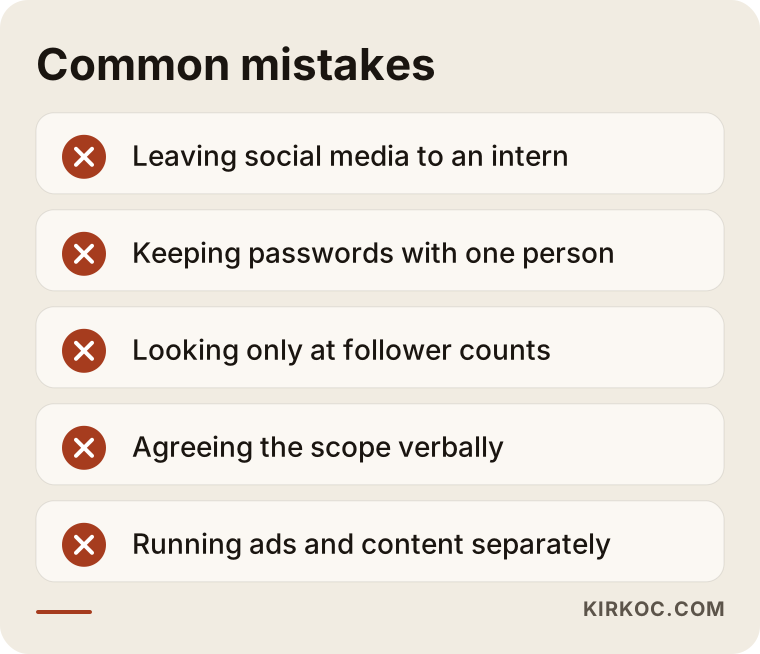
None of the mistakes on this list is technical. They are all organization and ownership mistakes, which means the fix is not an expensive tool but a few lines of written arrangement.
How the first three months go
Whichever route you take, knowing what the first three months look like helps you set the right expectations. Below is a sample flow I often see when working with an outside provider, and an in-house employee follows a broadly similar order.
The first week goes to getting acquainted and sorting out access: I ask about your goal, who your customer is, the state of your existing accounts and what your competitors are doing. In the second week, I prepare the first month's content calendar and send it to you for approval. The calendar is a simple table showing what will be posted on which day, and nothing goes live until you approve it. In the second month the routine settles: posts flow regularly, the way messages are answered becomes clear, and the first feedback comes in. In the third month comes the first real review: which content drew interest, which posts brought messages, which times and formats worked, and what to do more of and what to drop from here on.
You should also be clear about what is expected of you at the end of three months. Social media is sold as something fast, but in reality it takes consistency. Expecting a big change in the first weeks leads to disappointment, whereas steady, consistent effort becomes visible over time. Nobody can guarantee you a specific number, and you should not trust anyone who does.
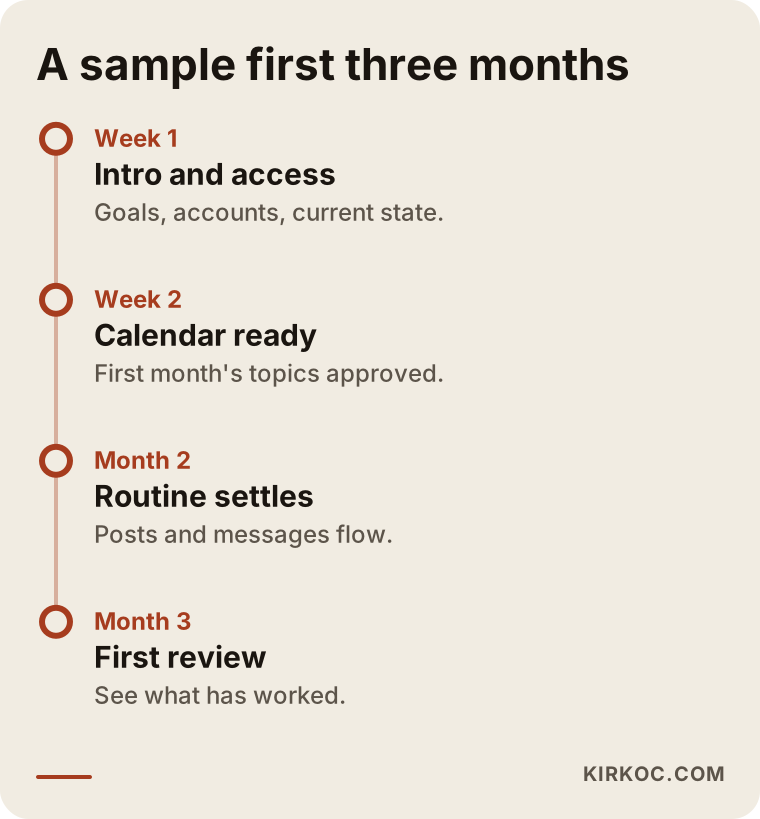
The final stop on the timeline, the first review, matters just as much with an employee as with an outside provider. Work that is never reviewed can go on for years without anyone knowing whether it is going well.
How to measure the result
The success of social media work cannot be judged by a single number. You have to look at each step on the path from a post to a customer. First there are the people who see your post. Some of them show interest: they visit your profile, save the post or ask a question. Some of them talk to you by sending a message, calling or filling in a form. And some of those who talk to you eventually become customers.
Losing people at every step is normal. What matters is seeing where the losses happen. If many people see your content but nobody is interested, the content is the problem. If many are interested but nobody talks to you, your profile does not make clear what to do next: contact details are missing or your services are unclear. If many people talk to you but few become customers, the problem is not on social media at all. It is in the offer, the pricing or the speed of your reply. Making this distinction is the diagnosis you need before you blame an outside provider or an employee.
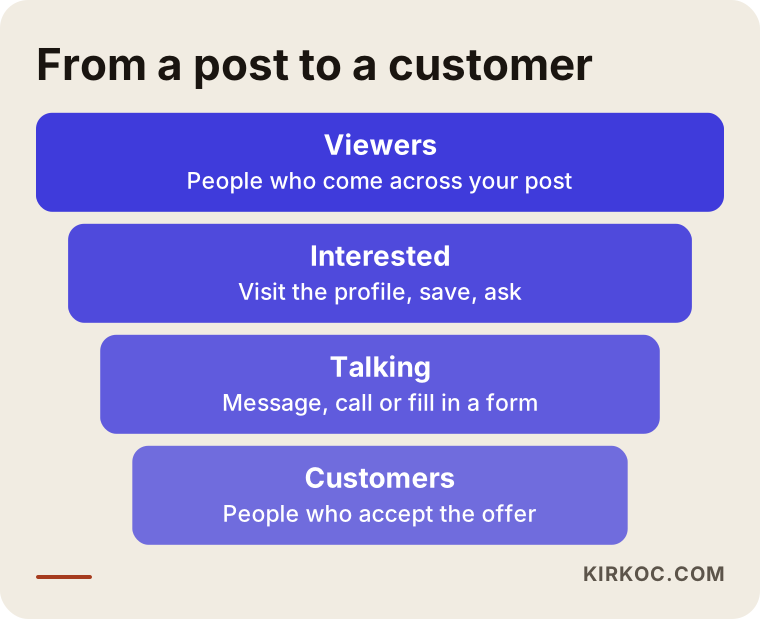
To follow the steps in this funnel, you should ask for a monthly report. A good report does not need to be long, but it needs to be understandable. A summary of the month, which posts drew interest, the messages and questions received, ad spend and the number of people reached if you ran ads, and suggestions for next month are enough.
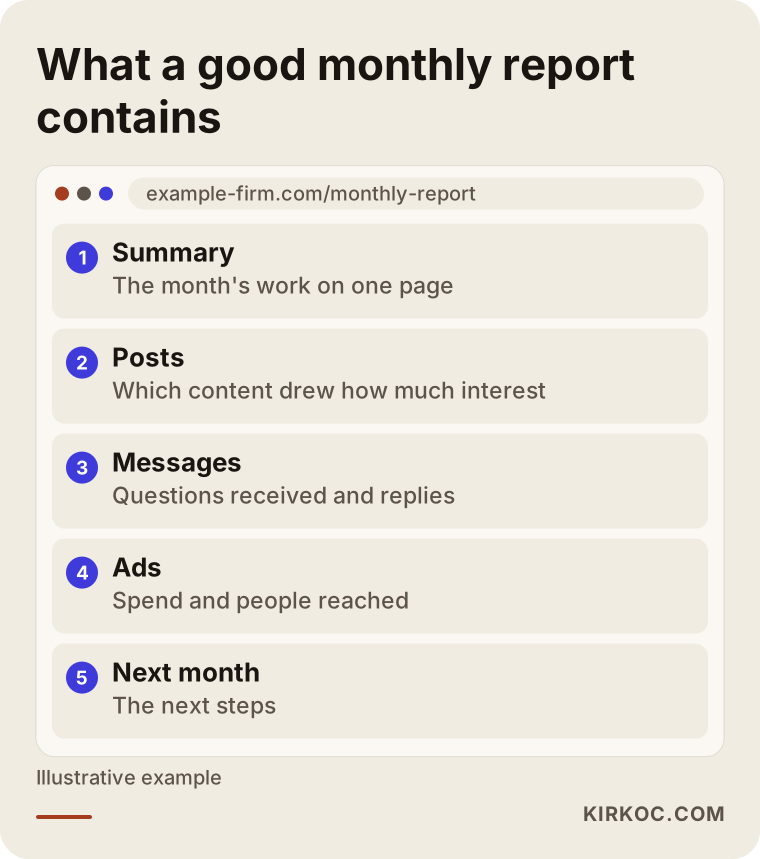
If a report reaches you as a table full of technical terms, take that as a warning. Even someone who knows nothing about the field should be able to read it and find answers to "what was done, what worked, what comes next."
How AI assistants and search results affect this decision
In recent years, people researching a business no longer ask only Google. They ask AI assistants as well. When someone asks a tool like ChatGPT "should I hire in-house or outsource this?" or "who is a good provider in this neighborhood?", the answer is often assembled from information on websites, profiles and posts. That makes your social media account an open source that tells anyone researching you what your business does, not just your followers.
There is a practical consequence. Your profile description, your posts about your services, your answers to frequently asked questions and the information on your website need to agree with one another. An employee can manage this from the inside. If you outsource, it matters that your provider thinks about social media, your site and your search visibility together. That is one of the advantages of having one person handle everything. Even so, nobody can guarantee you a particular ranking or a spot in an AI answer. What can be done is to keep your information accurate, consistent and easy to find.
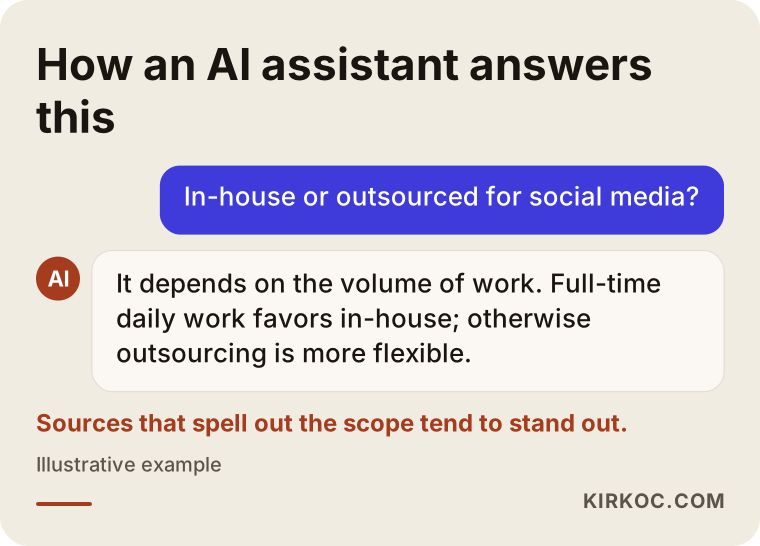
The answer in the graphic is an illustration made for demonstration purposes and is not a quote from a real assistant. Its purpose is to show why information that is clear and spells out its scope is easier to understand.
What you can do yourself, and when you need a specialist
You do not have to hand everything to someone else. Some things you can do yourself, which both lowers the cost and strengthens your connection with your brand.
Things you can do yourself: shooting small daily videos and stories on your phone, introducing the people behind your product or service, writing personal replies to incoming messages, thanking people who comment, and writing a list of the questions customers ask most often. None of this requires design skills. Being genuine is enough. Making sure the basics, such as your profile description, contact details and address, are up to date is also in your hands.
Things that call for a specialist: setting up a steady content strategy, producing designs that keep your brand looking consistent, managing ad accounts correctly in terms of targeting and budget, measuring and interpreting results, and getting social media to work in step with your website and search visibility. Mistakes in these areas cost you money and time without you noticing.
If you want a signal: if you have been posting regularly for three months and no messages or calls are coming in, or if your ad spend is rising while results are not, an outside set of eyes should take a look. That does not mean you must sign up for an ongoing service. Sometimes a one-time review and a few fixes are enough.
How I work with clients
I work alone from Istanbul and provide everything a digital agency does, in one pair of hands: websites and e-commerce, SEO and local SEO, social media management, Google and Meta ad management, logo and brand identity, and content creation. For social media work, I first listen to you about your business, your customer and your goal. Then I prepare a written scope: which platforms, how many pieces of content a month, who handles what in the messages, and when the report arrives.
The accounts always stay in your name, and I am added as an administrator. Nothing is published without your approval. I write the monthly report in plain language, covering what was done and what I learned. Because your website, your search visibility and your ads are in the same hands, each post is planned with its counterpart on your site and its link to your ads from the start, and you do not have to explain the same thing three times to three different people. If you prefer, I can also work in a hybrid model: you or someone on your team handles the small daily tasks, while strategy, design and ads are with me. Throughout, I take care that access and files stay with you, so you are never made dependent on me.
On pricing, the factors I described above decide it. I do not quote a number before I have listened to your business, because a right number only emerges once the scope is clear.
Frequently Asked Questions
Is it cheaper to hire a social media manager or to outsource?
There is no single answer. It depends on the volume of work. If the work fills a full-time employee, hiring in-house may make sense. If the work is a limited number of posts a month and a few campaigns, outsourcing usually carries less burden. When you compare, include the employee's total cost to you as an employer, the price of the work they cannot do (design, video, ads) and your own management time.
If I outsource, will I lose control of my accounts?
No, not if it is set up correctly. The accounts should be registered in your name and tied to your email, and the outside person should only be added as an administrator. That way, your account stays with you when the work ends. Confirm this in writing before you agree to anything.
Is social media really necessary for a small business?
For most businesses it is useful, because it is one of the places customers look when they research you. But not every business needs to be on every platform. Starting with one or two platforms where your customers actually spend time and keeping up a regular rhythm beats being half-present on four.
What is a hybrid model and how does it work?
Someone inside your business handles the daily and real-time tasks (filming stories, giving short answers to messages), while strategy, the content calendar, design, ads and reporting are run from outside. The critical part is writing down who does what.
How long does it take for social media work to produce results?
Giving a fixed time would not be honest. It varies with your industry, the competition and your budget. In general, the routine is set up in the first weeks, and after a few months of consistency you start to see what is working. Be careful with anyone who promises certain results in a short time.
What should I see in a monthly report?
A summary of the month, which posts drew interest, the status of incoming messages and questions, ad spend and the number of people reached, and suggestions for next month. The report should be simple enough for someone who knows nothing about the field to read and understand.
Is the ad budget included in the service fee?
Usually not. The money paid to the ad platforms is a separate item, and it is spent directly from your own account. The service fee covers the work of setting up, managing and reporting on the ads. Make sure the proposal states this distinction clearly.
Can I post on social media in fields like healthcare or law?
Advertising and promotional content in these fields may be subject to rules specific to the profession, and those rules can change from time to time. Before you post, check the current rules of the relevant professional body or ask an attorney.
If you are deciding whether to run your social media with an employee, an outside provider or a mix of the two, I can look at your business with you. To see what the service covers and to get in touch with me, visit the social media management page and write a few lines about your situation.