You pick up your phone in the morning and there it is: a harsh comment under your latest Instagram post. A customer is angry that an order arrived late, and a couple of other people have added "same thing happened to me." Or maybe a one-star Google review has appeared, long and furious, sitting right under your business name. Your thumbs start typing on their own. You want to delete everything, or fire back. This is the exact moment where social media crisis management either protects your reputation or damages it for no reason.
In this article I explain when a negative comment is an ordinary complaint and when it is a real crisis, how to answer each one, and how to prepare before anything goes wrong. I am Ümit Kırkoç, I work in Istanbul, and I run business accounts on my own as part of my social media management service. I wrote this for a business owner who does not work in marketing and wants something to apply right away. I will avoid technical terms, and when I need one, I will explain it in a sentence.
Not every negative comment is a crisis
First, a reassurance: getting a negative comment does not prove you run a bad business. Once a business reaches a certain size, it will sometimes fail to satisfy someone, however carefully it works. A shipment runs late, an employee has a bad day, a customer set their expectations in the wrong place. All of this is normal business life.
A crisis is something else. It is when one complaint slips out of your control and reaches many people, when the same problem keeps showing up, or when a claim that questions your trustworthiness starts to spread. Here is a simple line you can use: if you can fix it by talking to one person, it is a complaint. If you need to answer many people at once, it is a crisis.
The distinction matters because you can react wrongly in both directions. Treat a single complaint like a crisis and you turn a small matter into a public debate everyone watches. Treat a real crisis like a routine complaint and it grows while you look like you are ignoring it. The graphic below collects the first-reaction mistakes I see most often.
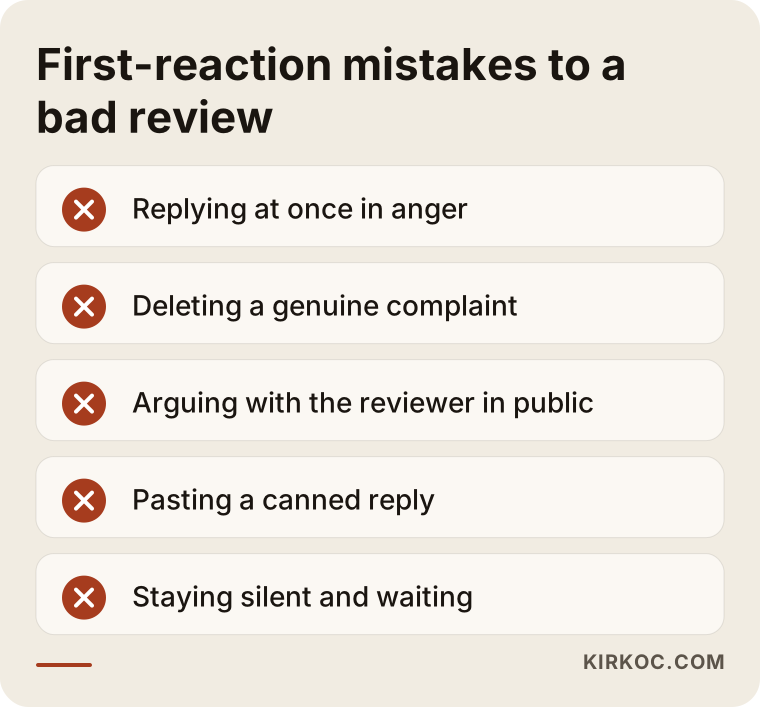
What these mistakes share is haste. A reply written in anger cannot be taken back; someone screenshots it and shares it somewhere else. So my first piece of advice is always the same: read the comment, put the phone down, and look again in twenty minutes. You can only decide what to write when you are calm.
Is this comment criticism, an attack, or a fake?
Not every negative comment deserves the same treatment. Sorting an incoming comment into one of three groups decides most of what you do next.
The first group is genuine customer criticism. The person bought something from you, or tried to, and is describing a problem they had. The tone may be harsh, but the substance is real. You always answer these, publicly, because the people who read your answer are not mainly the one who complained. They are the potential customers who have not bought yet and are checking you out.
The second group is abuse: insults, slurs, threats, hateful language. Platform rules do not allow this kind of content. Instead of replying, you report it and, if needed, hide or remove it. Arguing here only makes the comment more visible.
The third group is fake or deliberately planted comments: a review from someone who never dealt with you, accounts you suspect belong to a competitor, or several accounts posting the same copied sentence. Start by collecting evidence: screenshots, dates, account details. Then use the platform's reporting route. Before you make any firm legal claim, I suggest you talk to a lawyer. Announcing that "my competitor wrote this" without proof can hurt you more than the review itself.
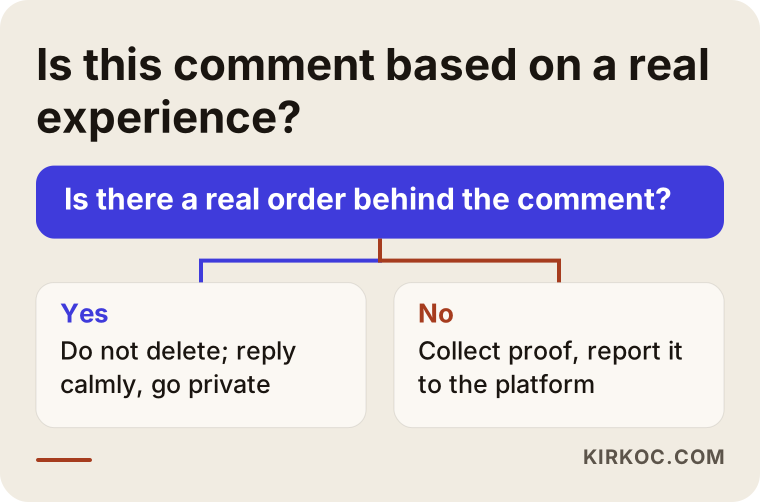
As the chart shows, the real dividing line is whether a genuine experience sits behind the comment. If one does, you try to solve the problem instead of deleting it. If not, you use the tools the platform gives you. To make that call quickly, you need to be able to find out who ordered what and when it was delivered. Record keeping is the quiet backbone of crisis handling.
When is deleting right, and when is it wrong?
You can hide or delete comments under your own posts. That is your right. But deleting a genuine customer complaint often backfires. The person notices the comment is gone and posts something harsher, this time on their own page. Deleting is reasonable for profanity and abuse, for posts that expose someone's personal information, and for completely irrelevant ads or link spam. Outside those cases, leaving the comment and writing a good reply usually looks more trustworthy.
What does a good reply look like?
When you write a reply, keep two readers in mind: the person complaining and the potential customer watching from the side. The second reader is often more important. They look at your tone and guess how you behave when something goes wrong.
A good reply has four parts. First, you acknowledge what happened, with something like "I'm sorry your order was delayed." Second, you explain what happened without exaggerating and without getting defensive. Third, you offer one concrete step, such as who will call or which channel to write to. Fourth, you move the conversation to a private message or a phone call. There is no reason to hash out details in a public comment thread.
A bad reply is usually one of three things: a template, a defense, or an accusation. Anyone who reads "Dear valued customer, your feedback is important to us" can tell it is boilerplate. The comparison below sets two possible answers to the same complaint side by side.
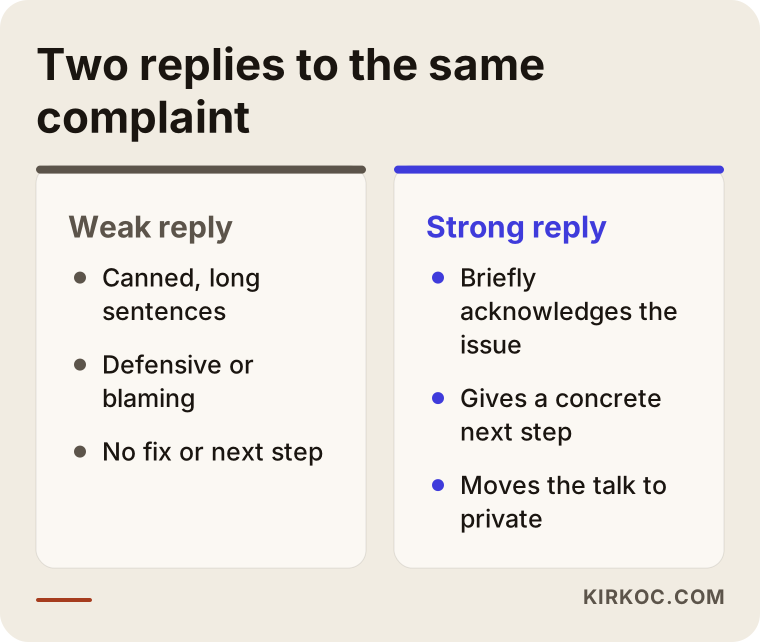
Notice that the good reply is short. Long explanations read like defensiveness. Two or three sentences that acknowledge the situation and name the next step are enough. If the complaint is justified, saying so plainly does not weaken your business; it makes you look mature.
How do you answer an unfair complaint?
Sometimes a complaint really is unfair. The customer missed the return window, did not read the campaign terms, or confused you with another business. Even then, keep your tone calm. Something like "I checked the order, and the records show delivery on the stated date; I'm writing to you privately so I can look into it with you" states your side without blaming anyone. Readers decide for themselves who is right, and they see that you stayed composed.
Example scenario 1: The boutique with late shipments
This scenario is entirely hypothetical and does not describe a real business. Picture a small clothing boutique that sells through Instagram and its own website. During a busy sale week, the shipping company runs behind. One customer comments under a post: "Three days and nothing arrived, nobody picks up the phone." Two more people say the same.
The owner's first instinct is to delete the comments. The better path goes like this. First, list which orders are actually delayed. Then reply to each comment individually with a short, non-copy-paste message: acknowledge the delay, say the tracking is being checked, and ask for the order number by private message. The same day, post a short notice in stories or as a post, along the lines of "some parcels are running late because of the sale rush, and everyone affected is being contacted one by one." That notice leaves a far better impression than silence, because other waiting customers learn about the delay before they feel the need to complain.
In this example nothing was deleted, nobody was argued with, and nothing was hidden. No outcome can be guaranteed, and some customers may stay angry. But the business has shown everyone that it owns the problem.
Rules that change by platform
A negative comment does not work the same way everywhere. Each platform has its own reporting route and its own habits, so do not treat them all with the same reflex.
On Instagram and Facebook, comments sit under your post. You can set up a word filter that automatically hides comments containing certain phrases, restrict people, or block them. You can report abusive comments. Story replies and direct messages are seen only by you and the sender, which makes it easier to solve things calmly.
Reviews on a Google Business Profile (the listing that appears when someone searches for your business) last longer and show up directly in search. That means your replies are read next to your business name. You can report an unfair or rule-breaking review to Google, but whether it is removed is Google's decision and I cannot promise it. In most cases a well-written reply does more for you than trying to get the review taken down.
On LinkedIn the tone is more formal, and not only customers but also partners, job candidates and competitors are watching. A reply to a negative comment there reads as a statement of how your company behaves, so keep it short, polite and calm.
On TikTok and YouTube, comments move fast and sometimes drift away from the video itself. Instead of arguing, it can work better to pin a comment that explains the situation, or to record a short reply video. Both platforms have comment filters and approval settings.
Complaint sites and forums are a separate world. You do not control them, but you can respond. Whatever is posted there can surface in search for a long time, so write your replies as if they will be read for years.
AI assistants are reading about you too
More and more people ask AI assistants, not just Google, when they want to learn about a business. These assistants can pull information from public reviews and web pages. A repeated complaint that went unanswered may show up in their summaries. Calm, well-written replies can stay visible in the same way. That is not a guarantee, but it shows why answering matters beyond the one person who complained: it matters for everyone who looks you up later.
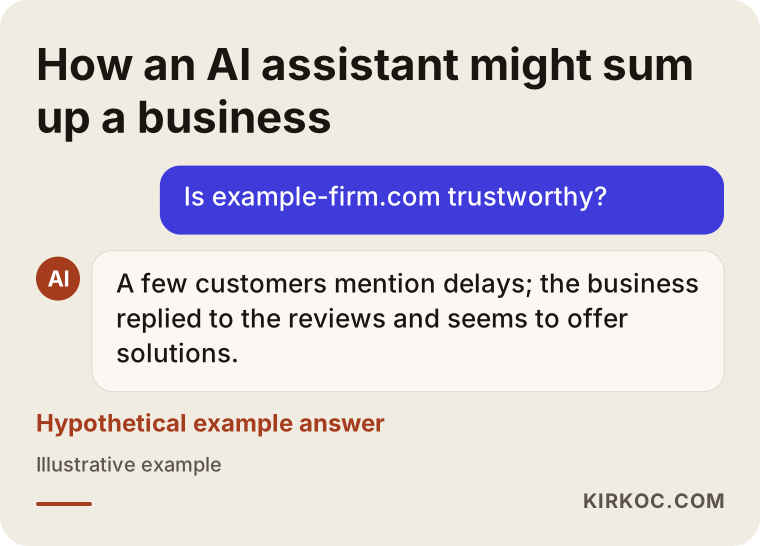
The answer in the graphic is only an illustration. What matters is that your public reviews and the way you respond to them add up to your online reputation as a whole. Your replies are not only there to calm one person. They leave a record for anyone who searches for you in the future.
What to do, step by step, when a real crisis hits
Say the complaint has grown. Several people are writing about the same issue, and perhaps a news item or a large account has shared it. Now you need a calm, clear order of action. This is the sequence I recommend.
Step one is to pause. Suspend scheduled posts for the time being. Publishing a cheerful promotional post in the middle of a crisis looks like ignoring what is happening. Step two is to gather facts: what happened, when, how many people were affected, and who is responsible. Step three is to choose one spokesperson, because if several people answer in different words, contradictions appear. Step four is to make a first statement: short, honest, and never presenting something you do not know as if you do. Step five is to contact the affected people one by one. Step six is to keep updating as things develop.
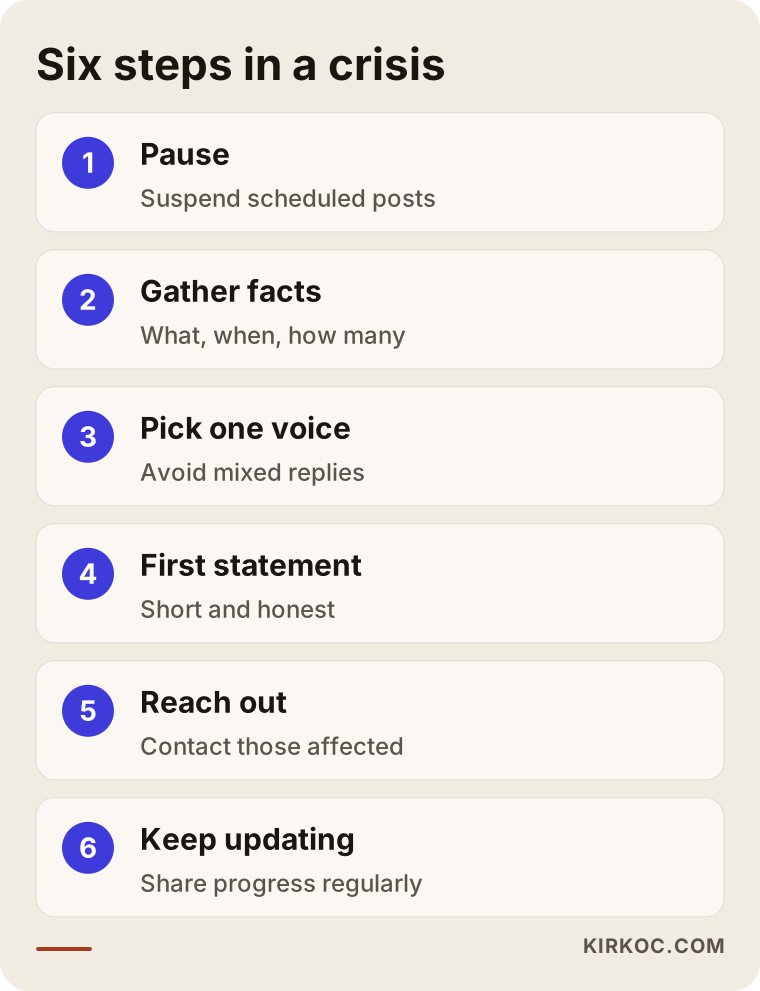
The most important rule in this sequence is to say plainly what you do not yet know. "The situation is being reviewed, and an update will be posted at six this evening" is far more credible than "everything is under control." Then you actually have to post the update at six. A promise that is not kept makes the crisis bigger.
The first 72 hours
The first three days of a crisis shape how your reputation turns out. In the first hours, the goal is to understand the situation and make a first statement. By the end of day one, you should have reached the affected people. On day two, you announce the fix and any compensation. On day three, you post a closing summary and thank the people involved.
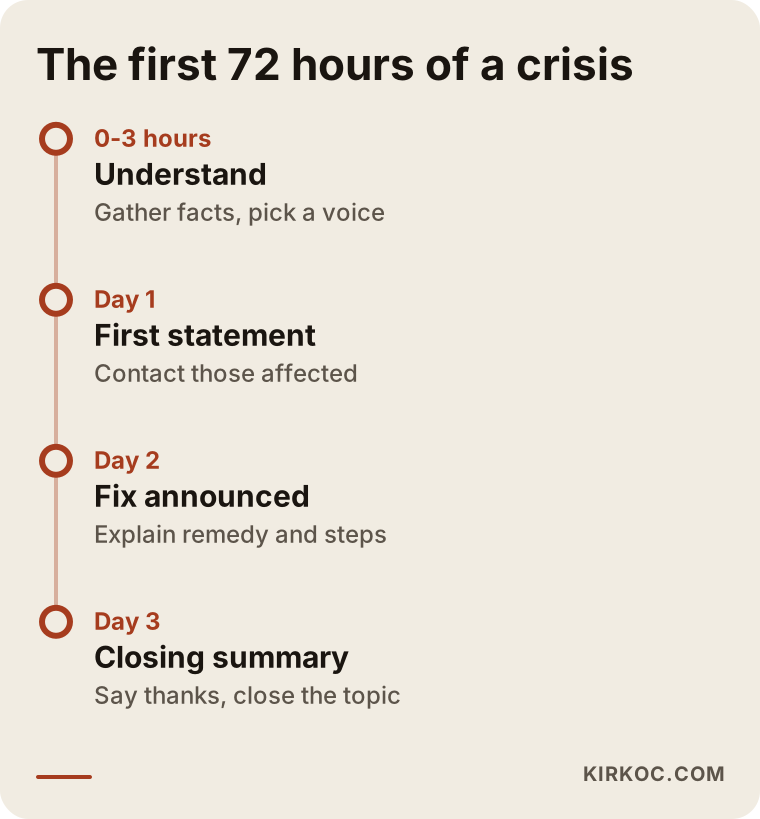
This timeline is flexible, because every crisis is different. The logic, though, stays the same: the first statement should not come late, later updates should be regular, and the topic should be closed without drifting. If people are still talking about it after three days, that is normal. What counts is that what you said was clear and consistent.
Who does what, by type of problem
During a crisis, the thing you lose most quickly is time, because everyone is busy asking what to do and who should do it. A simple table prepared in advance reduces that loss. The table below summarizes the first reaction for four common types of problem.
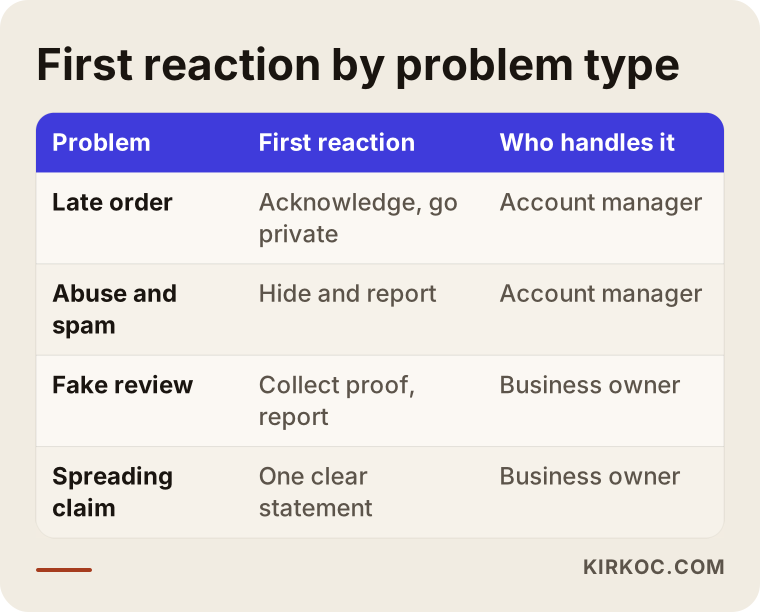
In a small business the "who" column is often the same person: you. Even so, it is worth thinking about who takes which role. If the person running the social media account is different from the person who ships the product, you need to agree beforehand how information will move between them. That is why, when I start working with a business, I settle one question up front: if something goes wrong, who calls me, and who do I call?
Example scenario 2: A restaurant facing a false claim
This is also a hypothetical example. Imagine a restaurant. A user posts a claim that there is a hygiene problem in its kitchen, and the post begins to circulate quickly. The claim has not been verified, but worried comments start appearing on the restaurant's account.
The first reflex here would be to attack the person who posted. The right approach is different. First, check the internal records to see whether the claim has anything to do with reality: inspection documents, cleaning logs, dates. Then write one single statement saying the claim is being taken seriously, the kitchen records have been reviewed, and anyone with questions will get an answer by private message or phone. Avoid firm legal language; if the claim has a legal side, talk to a lawyer. Post the statement once, pin it, and answer the questions beneath it one at a time, calmly.
Success here may not mean the claim disappears completely, because some people will not be convinced. Success means the business stays open, consistent and calm. Otherwise, false information spreads further on the back of your silence.
Preparing before a crisis happens
Unpreparedness is a crisis's best friend. A small business does not need a big plan; one page is enough. It should say who has access to the account passwords, who answers which kind of comment, what the normal response time is, in which situations you should be informed, and which lawyer you would consult on a legal issue.
Beyond that, there are a few simple safeguards on the account side. Turn on the word filter, route comment notifications to your phone, enable two-step verification on your accounts (a second confirmation, such as a code sent to your phone, when someone logs in), and keep your business information current. A hijacked account is itself a type of crisis, so security settings should be done before trouble starts.
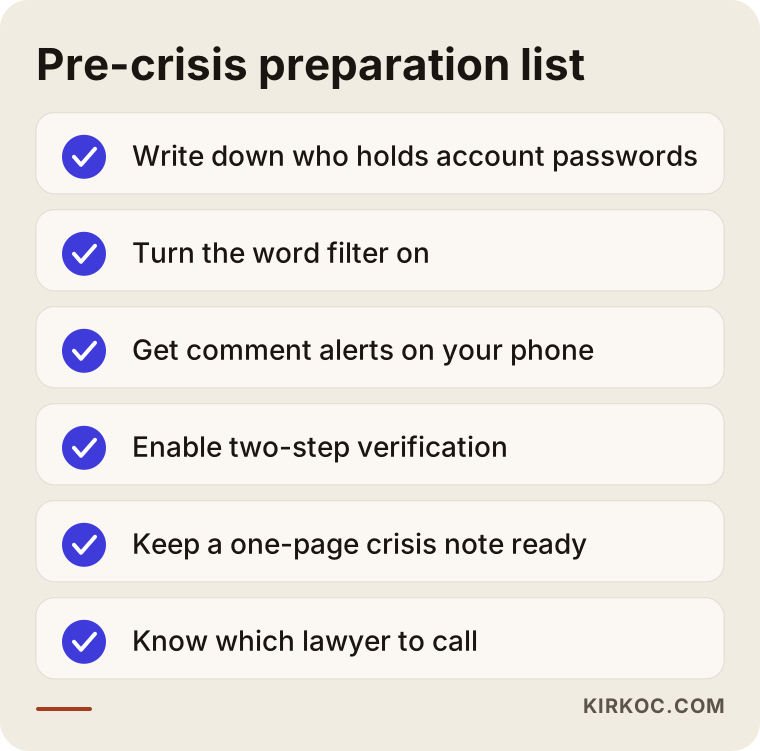
You prepare this list once and review it twice a year. An account that posts regularly, replies quickly and has collected good reviews recovers from a single negative comment more easily, because a reader looks at the history and does not judge you by one incident.
Asking happy customers for reviews
The honest way to soften the effect of negative reviews is to make it easy for happy customers to write one. After a sale, politely saying "if you were satisfied, you're welcome to leave a review" and sharing the link is enough. Buying reviews, having fake reviews written, or offering a discount in exchange for a review may break platform rules and create a bigger problem for your business. Check each platform's current rules on this.
How do you tell how big the crisis is?
Not every event is the same size. I think of incidents in four levels: a single complaint, repeated complaints on the same issue, a post that is starting to spread, and a crisis that reaches the press or large accounts. The right response changes at each level. For one complaint, a short reply is enough. For repeated complaints, you need to find the source of the problem and fix it. For a spreading post, you need a statement. For something that reaches the press, a formal statement and usually a lawyer's opinion are essential.
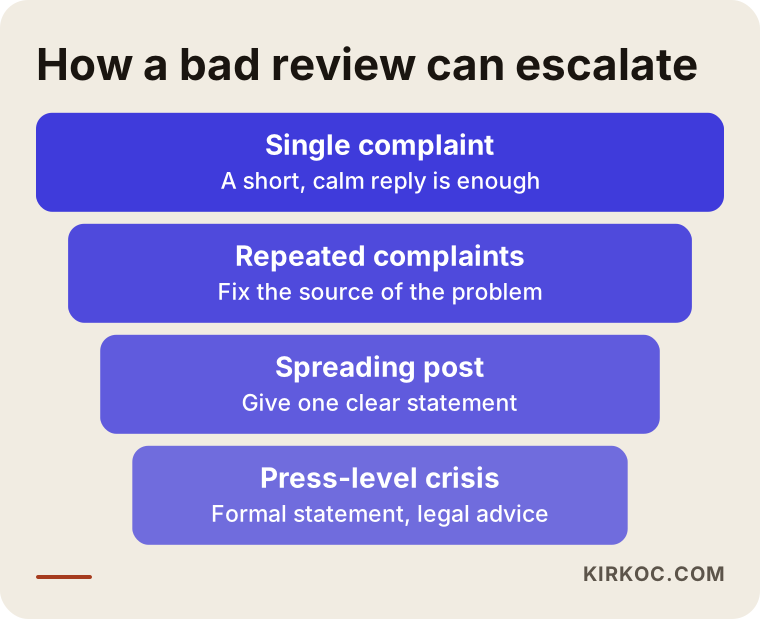
Knowing these levels prevents needless panic. Many business owners experience a single harsh comment as if it were the top level and overreact. In reality, most incidents sit at the bottom, and a calm reply is all they need.
Common mistakes
The mistakes repeat themselves from one business to the next. The first is deleting genuine complaints; the person notices and the issue grows. The second is getting into a heated argument; nobody looks like the winner. The third is pasting the same template reply to everyone; readers spot it immediately. The fourth is staying silent; an unanswered complaint reads like an accepted one. The fifth is exposing the person who wrote the comment; posting order details publicly damages trust and can create problems with personal data, so if you are unsure, ask a lawyer. The sixth is carrying on with normal ads and posts in the middle of a crisis. The seventh is announcing a fix and then not carrying it out; saying "someone will call you" and never calling creates a bigger problem than the original complaint.
There is also a mistake on the advertising side. If your ads stay on during a crisis, angry comments can be shown to brand-new audiences. When your ad management is handled by one person, as it is with me, pausing those ads takes minutes. When it is split across different people, messages get delayed and money is wasted.
What you can do yourself, and when to bring in a specialist
Most business owners can answer everyday comments on their own. As long as you stay calm, can reach your records and have time to reply, that is enough. Use the four-part reply structure above, turn on the word filter, and check your comments regularly.
A specialist makes sense in these cases: the number of comments is more than you can keep up with, the same problem keeps coming back, you are having trouble on several platforms at once, your account has been hijacked, or the matter has a legal side. I cannot give legal advice; in those situations you need to work with a lawyer. My part is managing accounts consistently, preparing replies, building a plan before a crisis, and adjusting the posting schedule to the situation.
What determines the cost
I do not give numbers, because the scope of this service varies a great deal from one business to another. What shapes the cost is how many platforms you are on, how many comments and messages you get each day, what hours replies must be given, whether you want evening and weekend coverage, and the state of your existing accounts, meaning whether old complaints have piled up. It also depends on whether you need a one-time preparation job or ongoing management. Asking for urgent help in the middle of a crisis is a separate workload as well. The best approach is to talk it through and shape a scope around what you actually need.
How I work with you
I begin with where you stand today: I look at your accounts, recent comments and any complaints still waiting. Then I talk with you about how different kinds of comments should be answered, and you and I write a reply guide together. I prepare a one-page plan for crises. In ongoing management, I monitor the comments, send draft replies for your approval, and tell you quickly if something serious comes up.
Here working alone has a concrete benefit. Because your social media, website, ads and search results are all with me, when a crisis hits I can handle them at the same moment: I write the notice on your site, pause the ads, prepare the social media statement and edit the reply on your Google profile. You do not have to write to four different people, and the messages match each other.
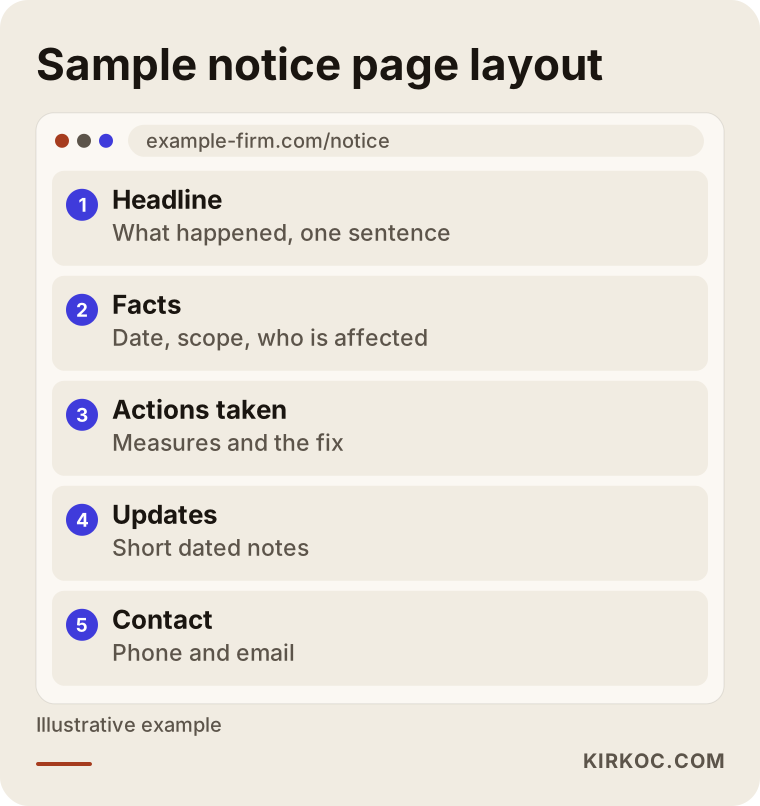
The page layout in the graphic is an example of a notice page you could publish on your site after a serious incident. You can link the short statement on social media to a detailed page on your website. That way the social post stays short, and anyone who wants the full story can find it.
Frequently asked questions
Is it legal to delete a negative comment?
You have the right to hide or delete comments under your own posts, but that is not wise in every situation. On platforms like Google you cannot delete reviews yourself, only report them. If there is a legal issue, talk to a lawyer.
Do I have to answer every negative comment?
No. You can skip replying to abuse and spam and report them instead. But it is good to answer most comments that rest on a real experience, because new people who look you up will read the reply as well.
How fast should I reply?
There is no fixed time, but replying the same day, or within one business day at the latest, is a good goal. Waiting twenty minutes and writing calmly is better than rushing and writing in anger.
Can I get fake reviews removed?
You can report them to the platform, but whether they are removed is the platform's decision and I cannot guarantee it. Keep screenshots and order records as evidence.
Should I stop my ads if a crisis hits?
In most cases yes, at least the ads for the product or service involved in the crisis. That keeps angry comments from being shown to new audiences.
Will negative comments hurt my sales?
Nobody can promise that in advance. Generally, a well-handled complaint builds trust, while one left unanswered or handled badly can push a potential customer away.
Do I really need a plan before a crisis?
You do not need a big plan, but a simple one-page note helps a lot: who replies, who gets told, what to do in which situation. Trying to write a plan in the middle of a crisis is hard.
What should I do if my account is hijacked?
Try to change the password right away, report it through the platform's help screen, and tell your followers through another channel. Two-step verification should be turned on beforehand for exactly this kind of situation.
If you want to be ready for negative comments and crises, or you are dealing with a problem right now, take a look at my social media management service page and send me a short message describing your situation. I will reply and suggest where to start.