Your page is up, your images look good, and you post on a regular schedule. Still, people scroll past, nobody messages you, and the phone stays quiet. More often than not, the problem is not the picture. It is the three things sitting underneath it: the caption, the first line and the call to action. Writing those three on purpose is what social media copywriting means. In this article I explain what the work actually involves, why it deserves its own attention, how it runs from start to finish, and how far you can take it on your own. I am Ümit Kırkoç, I work in Istanbul, and I write the copy as part of my social media management work. The person who decides where your account is heading is the same person who writes the sentences.
Copywriting can sound like making fancy sentences. It is not. The goal is to get the right person to stop, read your post and then take one small step that you want them to take. That step might be a message, a save, a phone call, a click to your website or a booking request. If the copy makes that step easier, it has done its job.
What does social media copywriting actually cover?
The text around a post is not one block. Some of it sits on top of the image, some of it lives in the caption field, and some of it is spoken inside a video or shown as subtitles. Each piece has a different job.
The first piece is the opening line. On most platforms only the beginning of a caption is visible, and the rest hides behind a "see more" or "more" button. Whether a reader opens your post is decided by those first few words. The second piece is the body of the caption: the part that explains the product, the service or the idea and answers questions before they are asked. The third piece is the call to action, the sentence that answers the reader's question, "What should I do now?" The fourth piece is everything around the post: hashtags, the profile bio, story text, video titles and replies to comments.
All of these depend on each other. A great first line can be wasted by a body full of filler. A great body leaves the reader hanging if there is no call to action. That is why I treat the copy as a whole instead of polishing single sentences.
The comparison below shows how the same post works when the caption is weak and when it is clear.
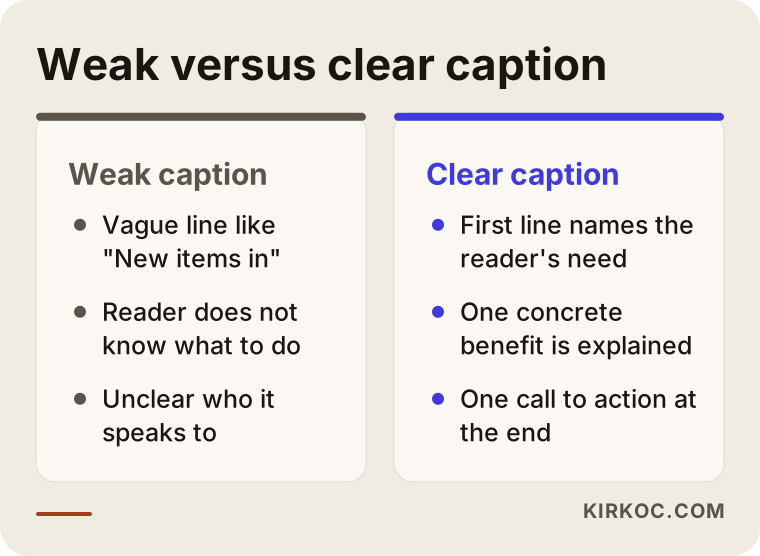
The difference here is not decoration, it is function. The clear caption answers who it is for, what it offers and why now within a glance. The weak one leaves the reader guessing.
Why isn't a good-looking image enough on its own?
People move fast on social media. An image can catch attention, but attention is not a buying decision. The curiosity a picture creates fades if no sentence picks it up. Copy is the bridge that turns that curiosity in a direction.
There is something else. When platforms decide what to show, they do not only look at the image. They look at what people do with a post. Saving it, commenting, sharing or sending a message all signal that the post was useful, and copy is often what triggers those actions. I cannot promise any ranking or reach, because I do not control the algorithms. What I can say is that copy that tells the reader clearly what to do has a better chance of drawing a response than copy that does not.
Copy also moves social media from "being seen" toward selling. A hair salon's photo can be beautiful. But if the caption never says "Message us to book," the person who liked the photo has to work out the next step alone. Most people will not.
What should good social media copy be based on?
Before writing anything, one question needs a clear answer: who is this post for, and what is it for? Skip it, and you end up with the "Hello everyone, have a great day" kind of post that says nothing to anyone. Before I start any piece of copy I look at four things.
The first is the reader's situation. Does the person seeing the post already know you, or is this the first time? Are they comparing prices, or are they already a customer? Someone who does not know you needs a short introduction. Someone who does only needs the new information.
The second is a single message. If one post tries to cover a discount, a new location and a blog article, none of it sticks. One post, one idea.
The third is your voice. A law firm and a bakery do not talk the same way. The copy should sound close to how the business really speaks. Otherwise a customer who calls you on the phone will notice that you are not the person in the captions.
The fourth is the platform. Pasting the same sentence everywhere is easy, but it usually works poorly. Instagram needs something short and visual. LinkedIn tolerates, and often rewards, more explanation. TikTok and YouTube need text that supports the first seconds of the video.
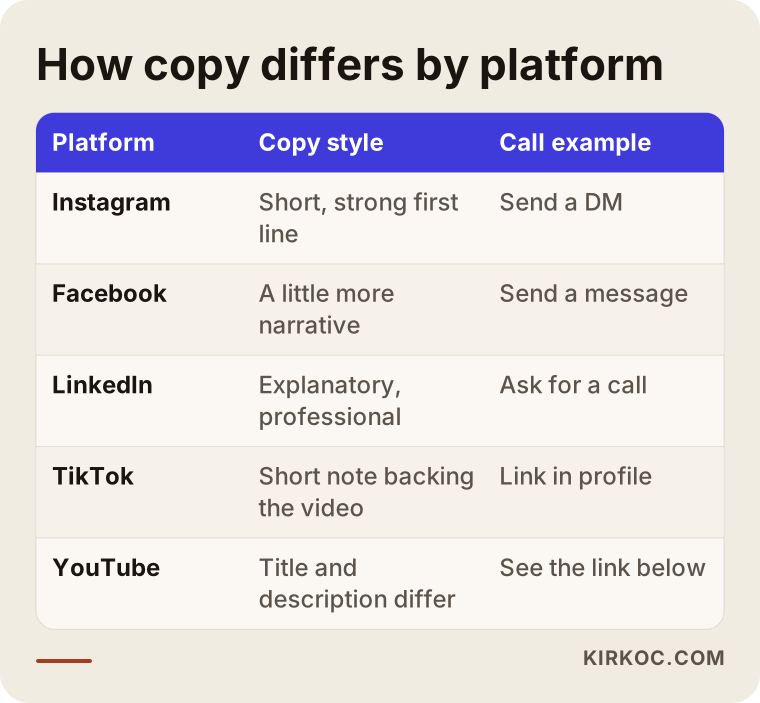
The differences in the table are a starting point, not a rulebook. They need adjusting to your own audience, but copy written with no thought for the platform almost always snags somewhere.
Why does the first line matter so much?
On Instagram, Facebook or LinkedIn, the first part of a caption is what shows before the "see more" button. If a reader does not find that part interesting, they never open the rest. So the first line's job is not to tell the whole story. Its job is to move the reader to the second line.
Good first lines usually do one of three things. They ask a direct question: "Why do so many of your website inquiries ask about price and then disappear?" They describe a concrete situation: "Picture an appointment line that rings three times and never gets picked up." Or they make a promise: "By the end of this post you will know which service to ask for." What they share is that they say something about the reader, not about the business.
Some openings are best avoided. "Hello dear followers" or "We have something very special for you today" take up space without giving information. Save the first line for the most valuable sentence in the post.
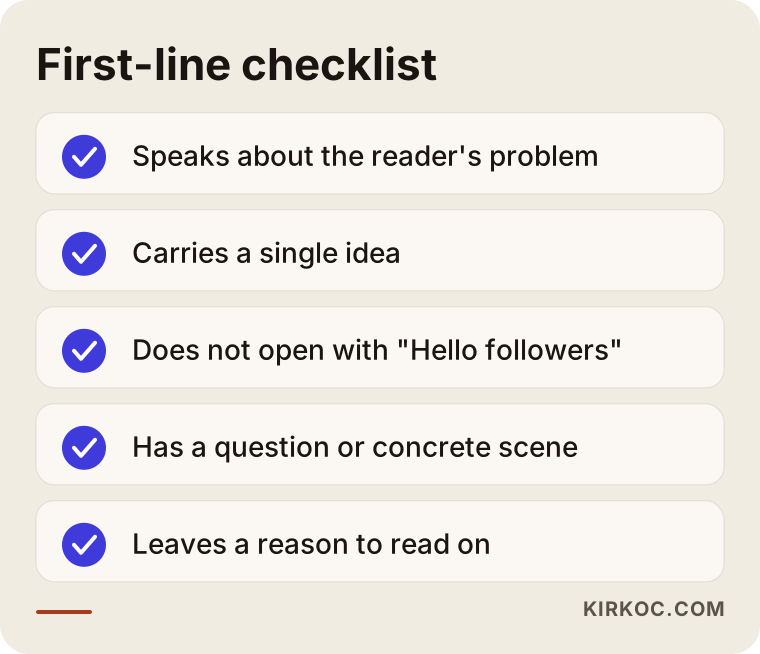
This list collects simple questions you can ask yourself before publishing. If you cannot answer yes to all of them, the first line is worth rewriting.
How is the body of a caption built?
After the first line, the reader wonders, "So what is it?" The body answers that. The most common mistake in the body is listing features and forgetting the benefit. "Organic cotton, washes at 86 degrees Fahrenheit, three color options" is accurate but does not persuade. Open with "If you want the fabric against your child's skin to stay soft," and the same facts suddenly mean something.
Keeping the body short is not always right. Longer captions work too, as long as each sentence adds something new. For a consultancy or a clinic, where trust matters, readers expect a bit more explanation. For a quick-purchase product, three or four sentences can be plenty. The reader's need for information before deciding sets the length, not a rule.
Readability is part of the copy. Use line breaks and put one idea in each paragraph. A five-line block of text on a phone screen is, for most people, text that does not get read. If you use emoji, let them carry information instead of piling them on for decoration. If they suit your brand and audience, a few are enough.
The call to action: how do you tell the reader what to do next?
The call to action is the most neglected part of the copy. Plenty of businesses post and then wonder why nobody writes. Often the reader does nothing simply because they do not know what to do.
Keep it to one call. "Like, comment, share, message us and visit our website" points in five directions, which means it points nowhere. Pick the step you want most. For a bakery that could be "DM us to order." For an accounting office it could be "Pick a 20-minute intro call from the calendar link." For an online store it could be "Product page is linked in our bio."
The call should also have a low threshold. Telling someone who has just met you to "buy now" often backfires. Smaller steps are usually better: ask a question, save the post, download a guide. As trust builds, the steps get bigger.
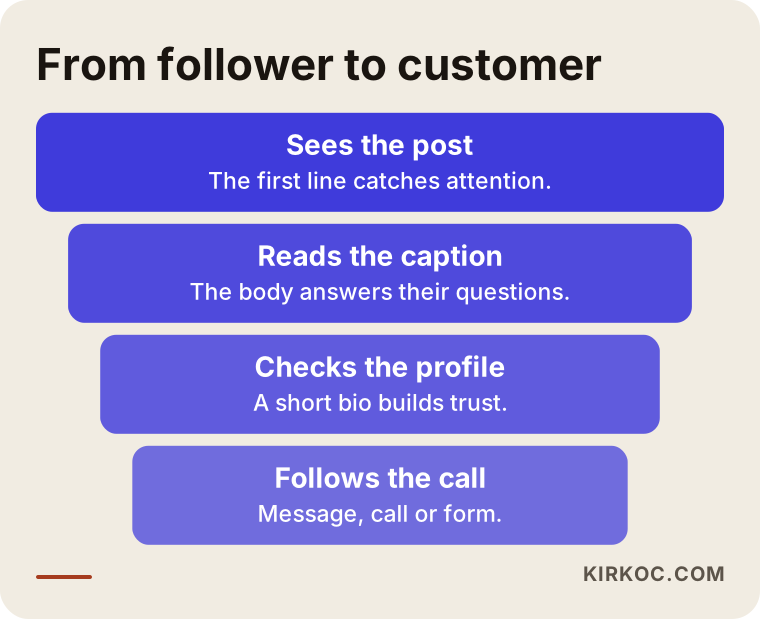
The funnel is a reminder that not every post has to do the same job. Some posts introduce, some build trust, some ask directly for an inquiry. The call changes accordingly.
Which call to action should you choose?
When the choice gets hard, I ask one question: is the person seeing this post ready to buy today? If they are, make a direct call. If they are not, offer a step that warms them up. The distinction looks small, but it changes the language of the call from the ground up.
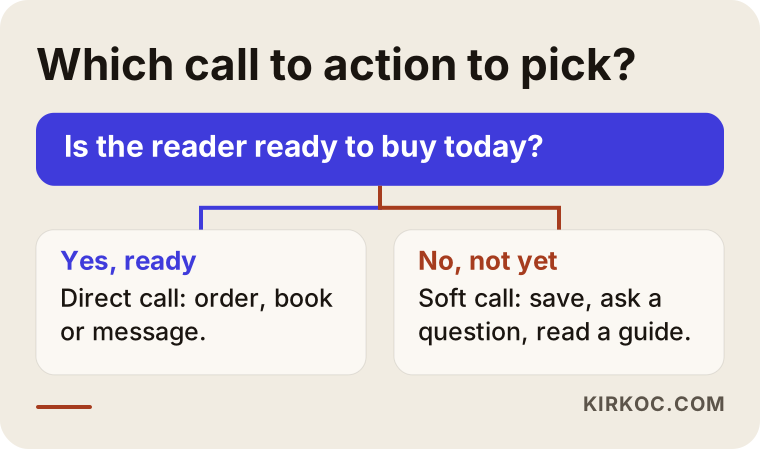
Both branches in the flow can be right. What is wrong is pressuring a reader who is not ready, or keeping a ready reader busy with an endless "follow us" request.
Example scenario 1: a small boutique
Here is a hypothetical example. Picture a small studio that sells handmade ceramics. The account posts regular photos, but the captions are lines like "New designs are here" or "Weekend vibes." When messages do arrive, most of them say "How much is it?" and the conversation ends right there.
The first move is to tie the caption not to the product but to the moment it is used. A first line like "How a mug feels in your hand matters when it holds your morning coffee" turns the mug from a photo into an experience. Putting the size, color and how long a piece takes to make in the body cuts down on the "How much is it?" messages. The call becomes one step, such as "Message us for colors and orders."
I am not promising a result in this scenario. But moving the answers to the questions readers keep asking into the copy tends to make message traffic more productive. This is entirely a hypothetical example.
Example scenario 2: a B2B consulting firm
The second example is also hypothetical. A software consultancy posts on LinkedIn every week. The posts are packed with technical terms, and words like "our solutions" and "our vision" appear often. Its target audience is company owners who do not understand software.
The trouble here is not that the sentences are bad. They are written for the wrong person. The copy has to be turned into the decision-maker's own question. A first line such as "Why does your order system jam in the same place every month?" drops the jargon and names the problem. The body gives a short description, and the ending uses a low-threshold call such as "Message me to set up an intro call."
The shared lesson from both scenarios is this: good copy is not the business describing itself, it is the customer recognizing their own problem.
Step by step: how does my copywriting process work?
Copywriting is not waiting for inspiration. It is building a routine you can repeat. My order of work goes roughly like this.
First I listen to the business and its customers. What do you sell, to whom, why do customers pick you, which questions keep coming back? This conversation often gives half of the copy, because the best sentences usually come out of the owner's mouth without them noticing.
Then I set the tone. Formal, friendly or playful? That decision is made once and written down, so it does not get argued again with every post.
Next I work out content themes: introductions, trust-building posts, frequently asked questions, behind-the-scenes moments and announcements. Each theme gets its own type of call.
Then I write. First drafts are usually too long, so I tighten them. I look at every sentence and ask, "If this goes, does the reader lose anything?" If not, it goes.
Finally I publish and look at the results. Which first line was saved more often? Which call brought in more messages? I carry that into the next month's copy.
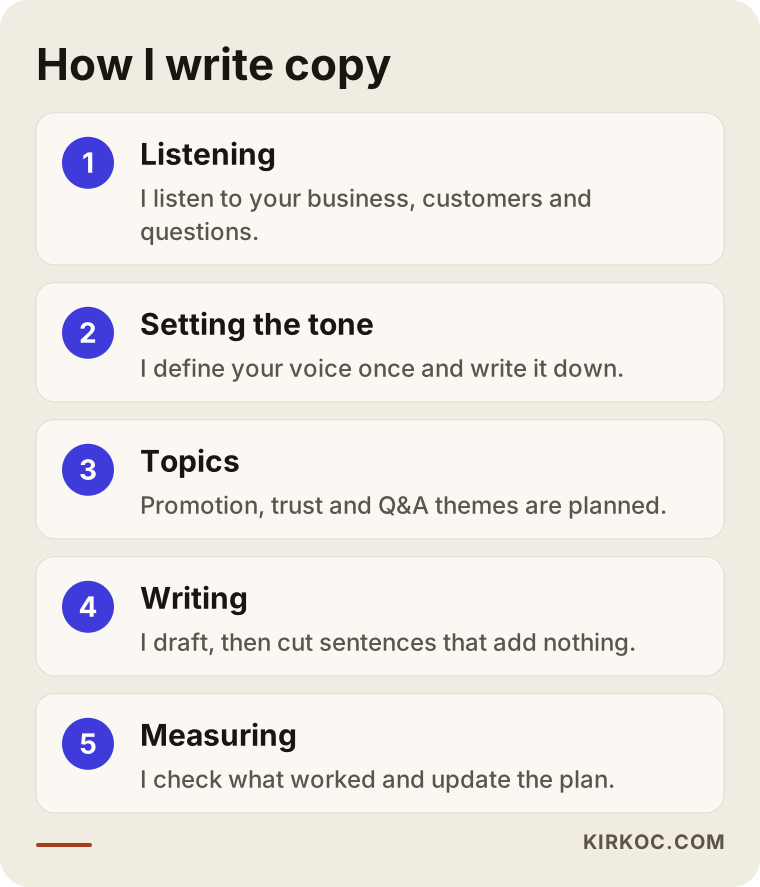
This order is not a one-time pass, it is a loop. What I learn at the end of the month becomes the first step of the next one.
What does a month of copy look like?
Copywriting is not only about a single post. It is about building a steady flow over a month. If the same kind of post lands again and again, readers get bored. An account that sells nonstop loses trust, too.
Splitting the month roughly into four parts helps. Week one leans toward introducing the business and what it does. Week two is informative content that answers questions. Week three builds trust with process, example work or a customer question. Week four carries a more direct offer or call. This split is not fixed. It shifts with your busy season and your campaign calendar.
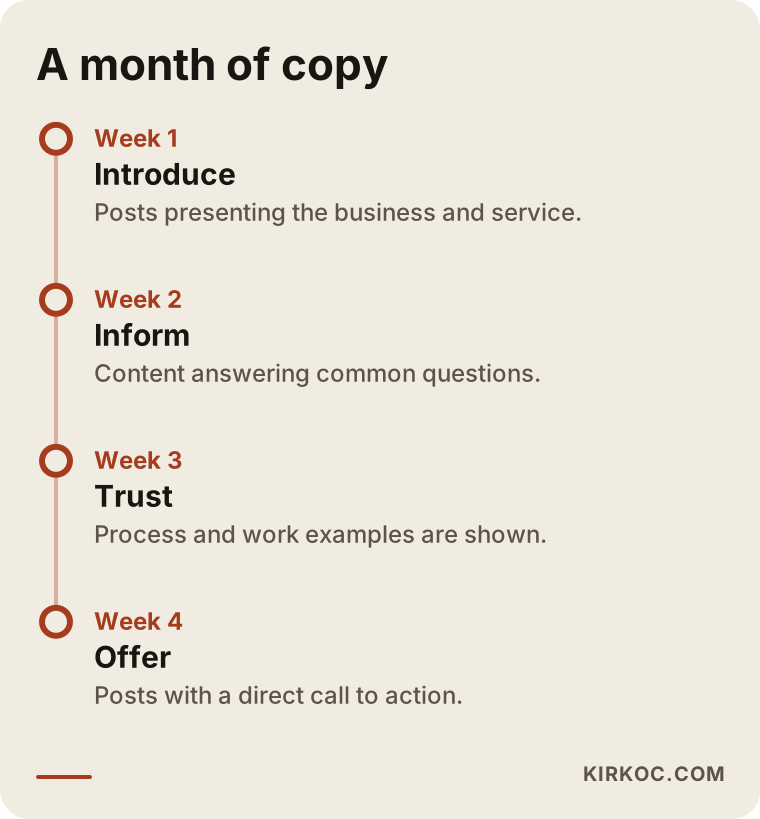
The timeline is a skeleton that keeps the balance in view, not a template. The point is not to ask the same thing of every post.
Profile bio and link: the forgotten copy
If a post interests someone, they look at your profile. The few lines they see there help them decide whether to follow you and whether to get in touch. That makes the bio part of copywriting too.
A good bio answers three questions: what do you do, who do you do it for, and what is the next step? You have only a few lines to fit all three, so one plain sentence beats a clever slogan. The link matters just as much. The single link in your profile is often where every call in every post points. The person who gets there should not be lost on a home page. They should land on the relevant service page or the contact form.
This is where having the work run through one person pays off. When the person writing the social media copy also designs the page the link opens, the promise in the post and the content on the page match. The post says "book a time," and the page opens straight onto a booking form. When different people run these pieces, that match is often lost and the reader drops off.
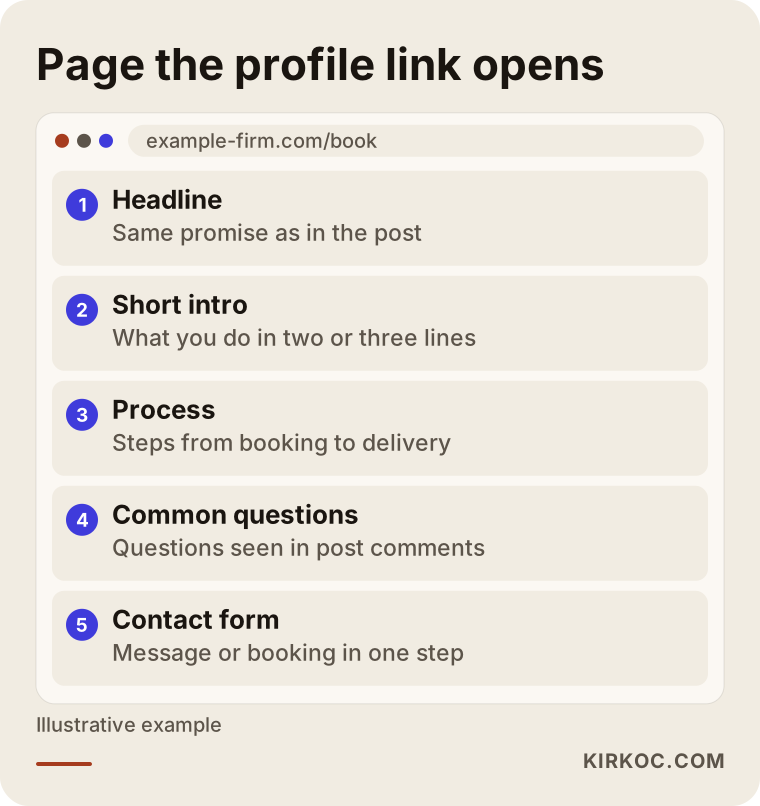
Each section of the layout continues what the post promised. If the post and the page say different things, the reader ends up in the wrong place.
Common mistakes in social media copywriting
The mistakes I see are very similar from account to account. Most come from rushing, not from bad intentions.
The first is cramming everything into every post, so the reader remembers nothing at the end. The second is never writing a call to action, on the theory that "they'll figure it out," which is usually wrong. The third is writing in the business's internal language: terms that feel normal to you may be foreign to your customer. The fourth is copying the same text onto every platform. The fifth is ignoring the reader's questions and talking only about your own achievements. The sixth is exaggeration. Claims like "the best in the country" or "guaranteed results" damage trust and lead you to promise things you cannot prove.
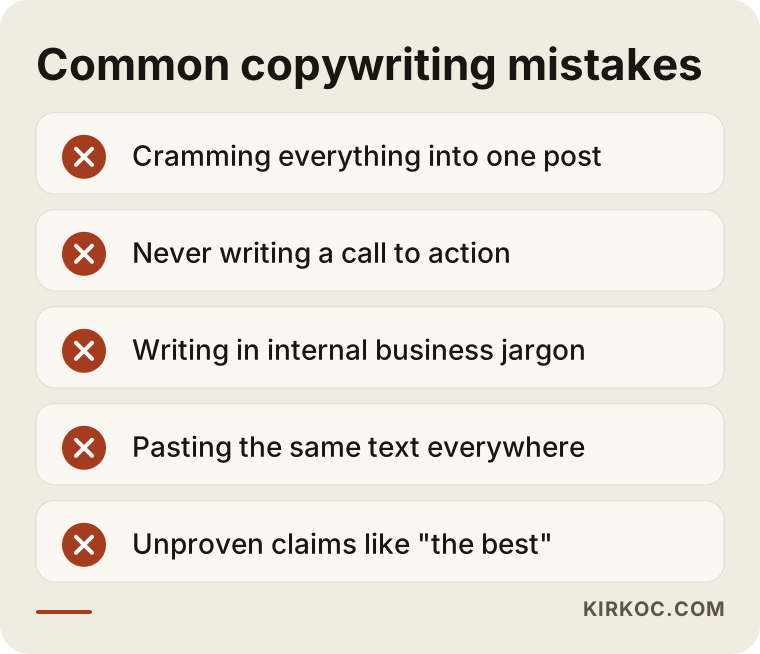
Some of these are mistakes you can spot and fix on your own. Reading a post out loud before you publish it catches most of them.
What can you do yourself, and when do you need a specialist?
Not every business needs a specialist for copy, and I want to say that honestly. Someone with a small account who knows their work well and can write regularly can do a good job alone. If you start on your own, three habits help a lot: before writing a post, say in one sentence who it is for and what it is for; end every caption with a single call to action; and write down the questions your customers ask you and turn them into posts.
The need for a specialist usually shows up in a few situations. You have no time to write and the posts keep slipping. You need a consistent tone across more than one platform. You also run ads, because ad copy and organic copy work differently, and the copy has to be clear so the ad budget is not wasted. Or you have been writing the same way for years and getting nowhere; someone looking from the outside can notice habits you cannot see.
Since ads came up, social media copy has an advantage when it sits with the same person who manages the ads. Seeing which sentence works in an ad also improves the copy of organic posts. In the same way, when the language of your website's service page and the language of your posts agree, readers recognize the same business everywhere.
What determines the cost
I do not give a number, because the work varies a great deal from one business to the next. But I can tell you plainly what it depends on.
The first factor is the number of posts and how often they go out. One post a week and five posts a week do not take the same effort. The second is how many platforms you write for, since each platform has its own language and the copy is adapted one by one. The third is the type of work: captions only, or video scripts and subtitles, profile and link setup, or ad copy? The fourth is your industry; in fields that need technical knowledge or special care, research takes longer. The fifth is the material you bring: if photos, product details and customer questions are ready, the work goes faster, and if everything has to be pulled out from scratch, it takes longer. Finally, whether the copy is bought together with social media management, visual design or ads also affects the cost.
When you collect quotes, check these: which tasks are listed in writing, how many revision rounds are included, in whose name the copy and the accounts will stay, how reporting is delivered, and who exactly will write. Be careful with quotes that promise a lot, very fast. Anyone guaranteeing followers, likes or sales is selling something they cannot control.
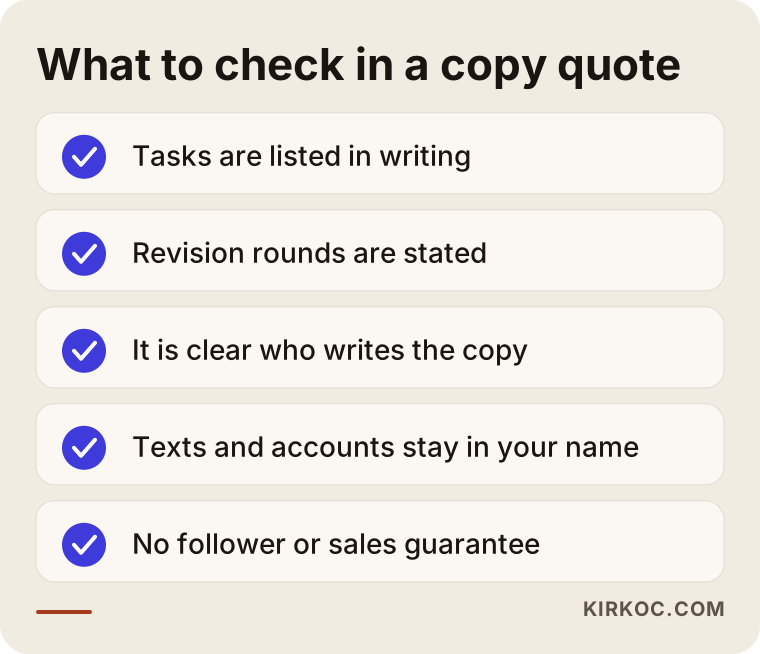
Every item on the list can be requested in writing. A good specialist does not hesitate to explain these, because when it is clear what they do and what they do not do, trust follows by itself.
What is it like to work with me?
I work alone. The person you talk to is the person who writes. There is no project manager passing the job along to someone else. First I listen to your business and your customer, then I give you in writing what should come first. If you like, I do only the copy side. If you prefer, I run the whole account, with visuals, planning and, when needed, ads.
When the same person runs your website, your SEO, your social media and your ads, all of them speak the same language. The promise in a post matches the page it leads to, and the sentence in an ad does not contradict the sentence in your profile. That match is hard to get when you work with separate people. Still, every business needs something different, so I start by listening to what you want and, if it makes sense, take on only a small part.
Frequently Asked Questions
Is social media copywriting the same as content creation?
Not exactly. Content creation is the wider job that includes images, video and topic ideas. Copywriting is the writing part of it: the caption, the first line, the call to action and the text around the post. In many projects the two run together, but they can also be bought separately.
Should a caption be long or short?
It depends on how much information the reader needs before deciding. For a product people buy quickly, a short caption can be enough. For a service that requires trust, a more detailed text works better. What matters is that every sentence says something new.
Does every post need a call to action?
Most posts should have one, but you do not have to push for a sale every time. Sometimes the call can be as small as "save this" or "ask your question in the comments." What matters is not leaving the reader without any idea of what to do.
Can I use the same copy on Instagram, Facebook and LinkedIn?
You can, but it usually does not give the best result. Readers on each platform arrive with different expectations. Small adjustments to length, tone and call to action are usually enough.
Will copywriting bring in sales?
I cannot promise sales, because that depends on many things. Your price, your competitors, your audience and the quality of your website all affect the outcome. What copy can do is show the reader what you offer and make the next step clear.
Is AI-written copy good enough?
It can help produce a draft, but it does not know your business's real voice, your customers' questions or your local context. Copy used raw tends to come out generic and similar to everyone else's. Having a person who knows your business edit it makes a difference.
Do I need a written guide for my brand voice?
You do, but it does not have to be long. Even a single page with your tone, the words you use and avoid, and a few sample sentences keeps the work consistent. I put it together with you in the first conversation.
Can I approve the copy before it is published?
Of course. In most projects the copy is sent to you before it goes live, and you approve it or ask for changes. Settling this flow up front improves both speed and results.
Take a look at my social media management service page. If your captions, first lines and calls to action are not working, write to me and we can talk it through and I will put together a plan that fits your business.