You own a small boutique. You chose every piece on the rack yourself, but the number of people walking past your window no longer decides how many customers you get. Shoppers now see a dress on their phone first, like it, and only then walk in or send you a message. That is why social media for a boutique clothing store is no longer decoration. It is the phone-sized version of your front window. The trouble is that feeding an account every week, shooting photos, answering messages and serving customers on the floor are four different jobs. You can hand some of it off. I am Ümit Kırkoç, I work in Istanbul, and I provide social media management together with website design, SEO and ads, all from one person. In this article I explain how the work really functions, what you can do yourself, and where handing it off starts to make sense.
I wrote this for a shop owner who does not work in marketing. If a technical term shows up, I explain it right there. I also make no promises. Nobody can honestly guarantee a number of followers or a number of sales. What can be done is to show up regularly, in front of the right people, in a way that earns trust.
Why boutique fashion works differently from other businesses
Clothing is one of the most natural fits for social media because the product is visual. For the same reason it is one of the most crowded categories. A shopper's feed shows dozens of dresses, jackets and bags every minute. What sets you apart is less the garment itself and more how you present it and how clearly people feel who is behind it.
A boutique does not compete with big chains on price or range. A boutique sells curation: "I picked this piece, and here is why." Customers are buying the judgment of someone whose taste they trust. Your account should be the visible form of that judgment. An account that posts every item on the same white background with the same one-line caption looks no different from a wholesale catalog.
Another difference is that clothing decisions are personal. People think about their own body, their own style and the occasion. "Will this work on me?" is the biggest obstacle between a shopper and a purchase. A good boutique account answers it through content: how a piece looks on different body types, how the fabric moves in real light, the height and size of the person wearing it, a couple of ways to style it.
The third difference is the seasonal rhythm. Fashion has a few big moments each year, and your content plan follows them. The kind of post you need changes when new stock arrives, when a sale begins, or when a gift-giving holiday gets close. A shop that does not plan the season ahead ends up posting in a panic once it is already underway.
Finally, many boutiques are both a physical store and a mail-order business. Part of your audience lives near you and can stop by. Another part lives in a different city and wants it shipped. One account has to speak to both, which means the setup needs a bit more care.
How do customers find you on social media?
The usual path looks like this. Someone notices a piece in a video or a photo, taps through to your profile, scrolls a few posts, and then either messages you or visits the store. You lose people at every step of that path. The goal is to lose fewer of them.
The graphic below shows that path as a simple funnel. I left out numbers on purpose, because every boutique's ratios are different. What matters is seeing which step needs what from you.
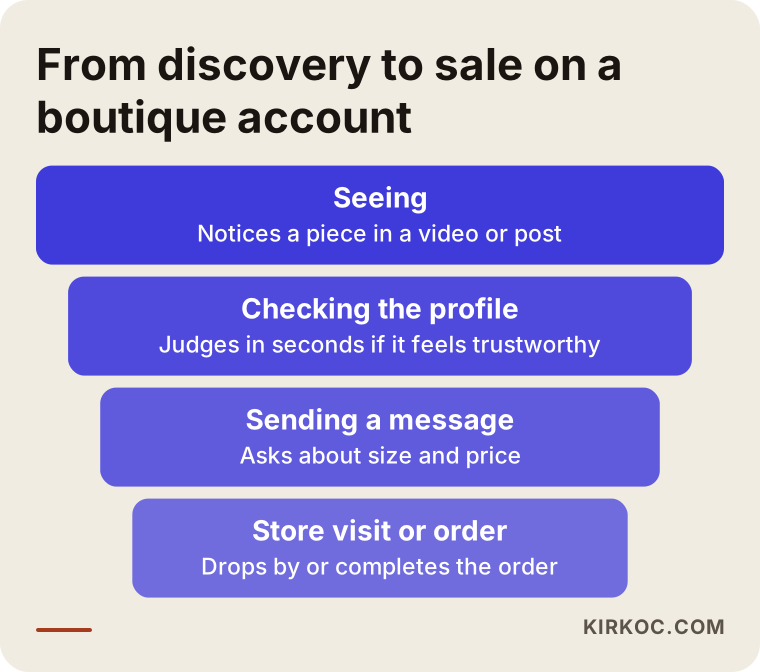
The top of the funnel is being seen. Short videos (Reels, TikTok) and tagged posts do most of that work. The second step is the profile check: someone who liked what they saw opens your page and decides in about three seconds whether you look trustworthy, whether it is their style, and whether the stock is current. The third step is the message, and it has to be easy to send. The last step is the store visit or the finished order.
Plenty of boutiques pour effort into the top step and neglect the second and third. They film a lovely video, but the bio is empty, there is no address, and messages sit unanswered for two days. All that effort is wasted. It is often more productive to check the funnel from the bottom up.
Which platform does what?
You do not need equal strength everywhere. For a small boutique, a measured split is healthier. The table below sums up the main job of each platform.
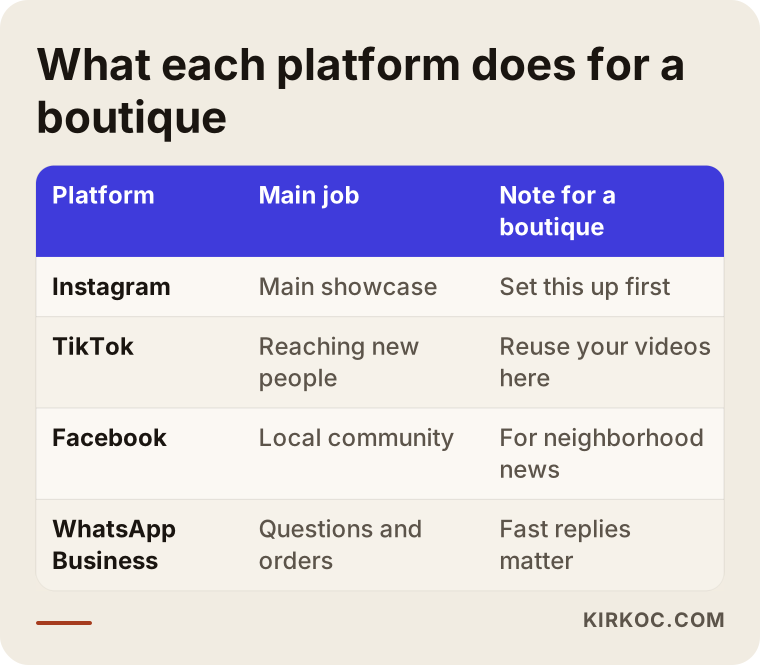
Instagram is the main showcase for most boutiques. Your profile, highlights (the pinned story circles under your bio), posts and Reels work together. This is where people get to know you and where they message you.
TikTok can be one of the fastest ways to reach people who have never heard of you, especially if your customers are younger and follow trends. It takes effort, though, and not every boutique needs it. If you already film videos for Reels, posting the same clips on TikTok is a reasonable first step.
Facebook still helps many boutiques reach a local audience, particularly an older customer base. Neighborhood groups, events and your business page are useful for local announcements. It can stay in the background as a product showcase.
WhatsApp Business handles the messaging side: short canned replies, opening hours, a catalog. It is not strictly social media, but it is often where the sale actually closes. If your customers prefer texting or another messaging app, use that instead.
If your time and budget are limited, here is what I would suggest: set up Instagram properly first, move your videos to TikTok after a month or two, and open a business messaging account from day one. Add Facebook if you have a local goal.
Your profile is the front door
On a boutique account, the profile comes before the content. People look at your posts, like them, and then open your profile. If something there is unclear, they leave. The profile has to answer three questions: What do you sell? Who is it for? How and where do I buy?
This checklist shows the basics a boutique profile needs.
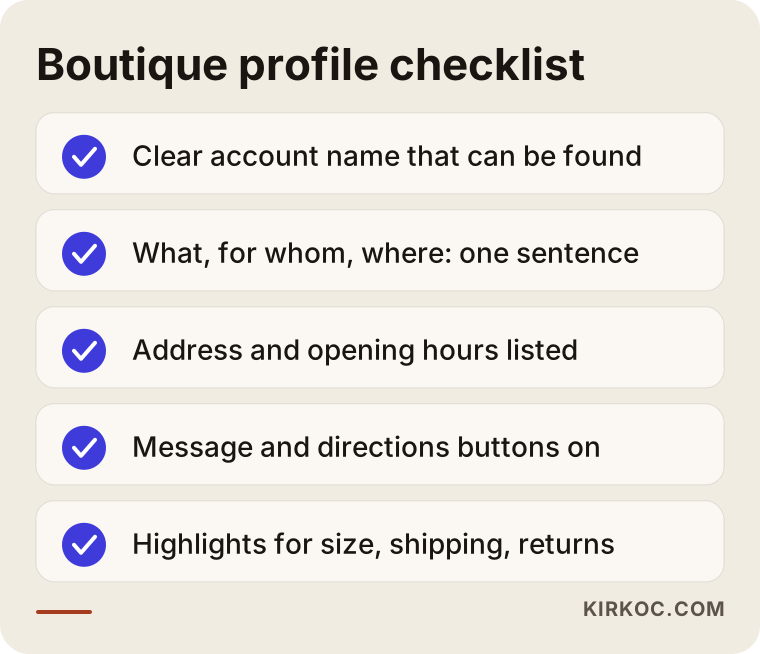
Your account name should include your boutique name and be easy to find when someone searches. Use the short bio to fit in the type of clothing, the area, and the size range. A line like "Elevated everyday style" sounds nice but tells nobody anything. Something like "Everyday and occasion dresses in Austin, sizes 0 to 24" does. Treat that as an example and swap in your own details.
Switching to a business account matters too, because it lets you add an address, hours and contact buttons, and it gives you access to basic statistics. For highlights, these titles tend to work: new arrivals, size and fit guide, shipping and returns, customer reviews, store and location. They are the things a customer should be able to learn without having to ask.
The link in your bio should never be empty. If you have a website, point to it. If not, point to your messaging catalog. I explain below why the website matters.
What should you post? The content types that sell
The most common trap on boutique accounts is posting only product photos. Product photos are necessary, but on their own they do not say much. The comparison below shows the difference between two ways of presenting the same item.
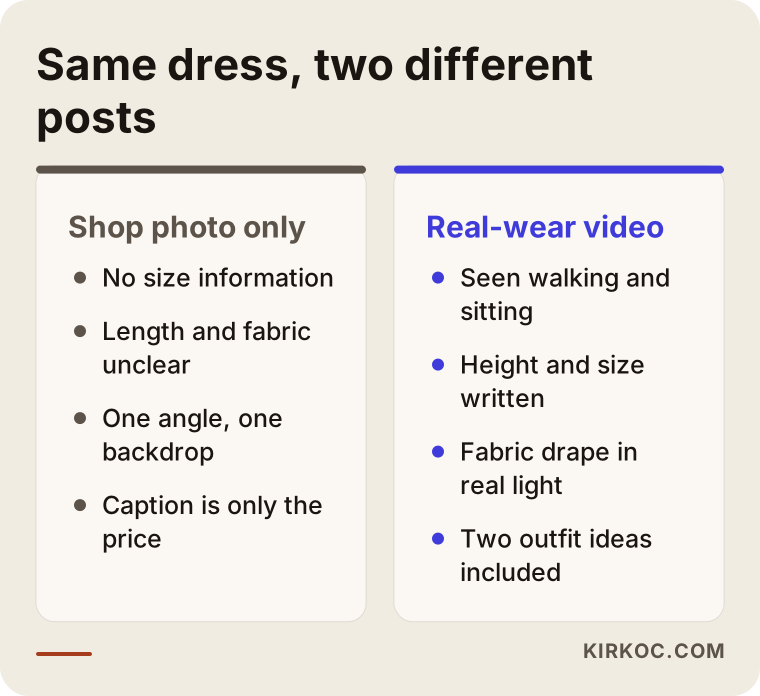
Posts like the one on the right come closer to answering "will this work on me?" A few content types are especially useful:
- Try-on clips: wearing the piece, turning, walking, sitting. How the fabric falls, the length, whether the pockets are real, how the zipper behaves.
- Styling ideas: one piece worn three different ways. It shows the customer that a single purchase covers several occasions.
- Buying stories: a short note on why you chose this fabric or this label this season. It gives your boutique a personality.
- Packing and shipping moments: showing how an order is wrapped builds trust.
- Customer moments: photos or comments from customers who have given you permission. Never use them without asking. This is both an ethical and a legal matter, and if you are unsure about the rules where you live, ask an attorney.
- Behind the counter: steaming the racks in the morning, opening a new box. It puts a human face on the account.
Mix these and the account never feels repetitive. Put something useful in every caption too: the size range, the fabric, how to order. Writing the details out gets you more messages than "DM for details."
Photos and video: you do not need expensive gear
Many owners put off posting because they cannot afford a professional shoot. In this category, though, a clear phone video in natural light often feels warmer than studio work. What you need is a routine, not technical skill.
A few practical rules. Shoot near a window or somewhere with daylight, because yellow bulbs change the color of fabric. Keep the background plain. A cluttered rack might not bother you in person, but it will on video. Steady the phone; a small tripod solves it. If you use the same corner each time, your feed gets a recognizable look. Show colors as close to real as you can. When a customer returns an item because "it didn't look like the photo," you lose both money and trust.
The first two seconds of a video matter a lot. People scroll fast, so show the piece right away and skip long intros. Add captions for people watching with the sound off.
Batching your filming into one day a week saves time. If you shoot six or seven pieces from different angles on a single morning, you have a week of content. The steps below outline that shoot-day routine.
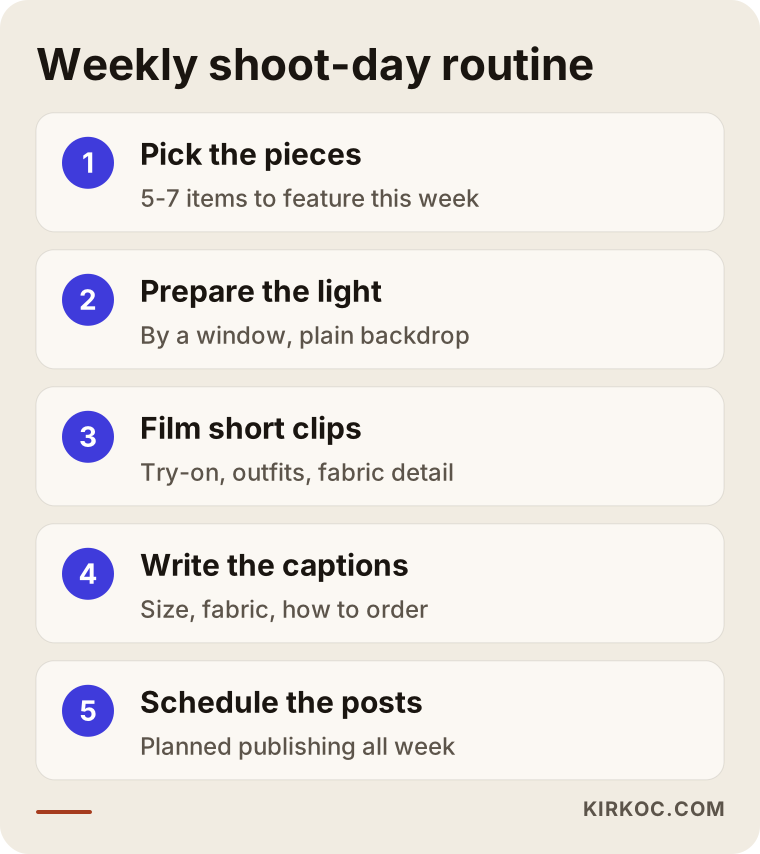
This routine spares you the daily "what should I post today?" stress. To spread the posts across the week you can use the scheduling tools built into the platforms; they are available once your account is a business account.
Planning around the season
In fashion, timing is half the content. Teasing new arrivals two or three weeks ahead, announcing a sale before it starts, and sharing gift ideas for holidays early all take pressure off. Posts made in a rush are usually thin and repetitive.
The timeline below shows a simple seasonal flow for a boutique.
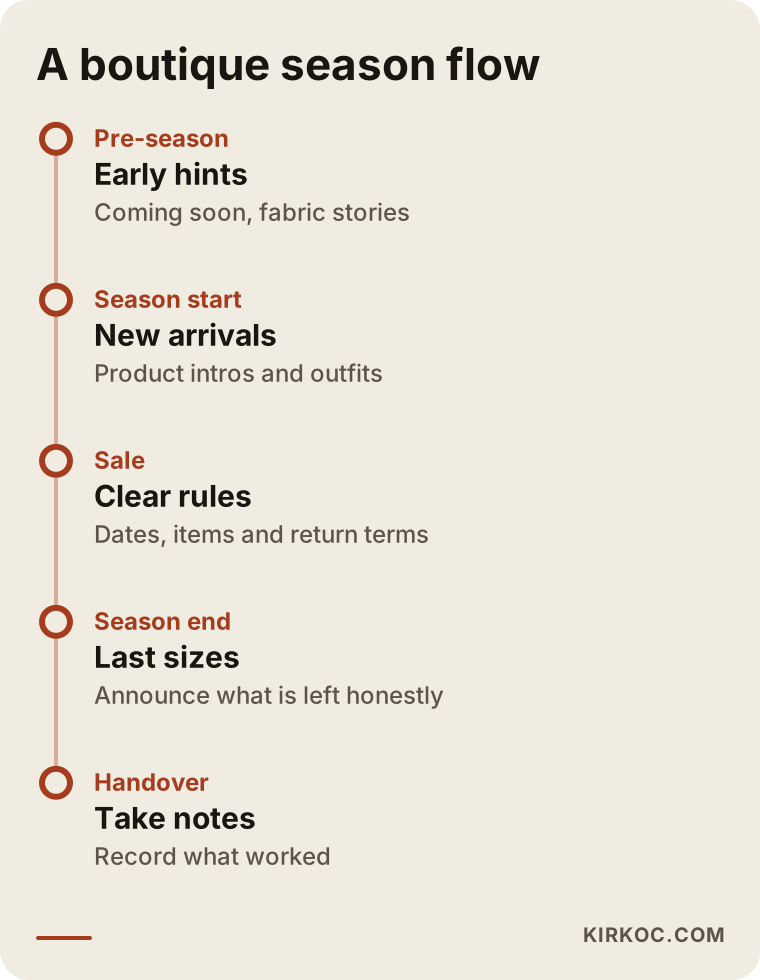
Before the season you share "coming soon" posts and stories about suppliers or fabrics. During the new-arrivals stretch, product introductions take over. When a sale runs, write clear rules: which items, which dates, what the return policy is. In the clearance stretch, "last size" stories work well for the final few pieces. At the handover, jot down what worked this season so the next one is easier.
Be honest in sale announcements. If you call something the "last piece" and then show it the same way next week, you wear down trust. For rules about advertising and pricing claims, check current regulations with an attorney or the relevant government agency, since they differ by state and country.
Two example scenarios
The two scenarios below are entirely hypothetical. They do not describe a real business; they are here to show the reasoning.
Scenario 1: the neighborhood boutique. Imagine a small boutique in a walkable city neighborhood. The owner works alone in the shop and uses the account now and then. Posts are product photos only, and captions carry no information. The first step is to fix the profile: a short bio, address, hours, highlights. Then she picks one shoot day a week and films three or four short clips. Based on questions customers ask in the store, she adds a highlight called "How to choose your size." The goal here is not a flood of new followers. It is to let people who live nearby see the account and drop in. No outcome is guaranteed, but a steady, informative account makes it easier for a shopper to say, "I saw you on Instagram."
Scenario 2: the mostly online boutique. Imagine another boutique that pays no storefront rent and sells mainly through social media and shipping. Here, quick replies, clear shipping and return information, and photos from several angles matter most. If orders run through direct messages, the process stops being manageable as the catalog grows. A small website or online store becomes a sensible investment at that point. Social media stays the showcase, and orders are collected on the site. This is where having everything handled by one person pays off: product titles on the site, posts on social media and the way you appear on Google support each other.
How a website and social media work together
Social media can look like enough by itself, but it carries a risk: the account is not yours, it belongs to the platform. Accounts can be suspended, you can lose access, or the platform can change how its feed works. If you have a website, your customer list, products and information stay with you.
People also tend to search for a brand on Google after they see it on social media. They type your boutique name and look at the results. If they find a proper site, a map listing and reviews, trust goes up. If all you have is a social account and Google shows nothing, some shoppers hesitate.
A simple boutique site can have these sections.
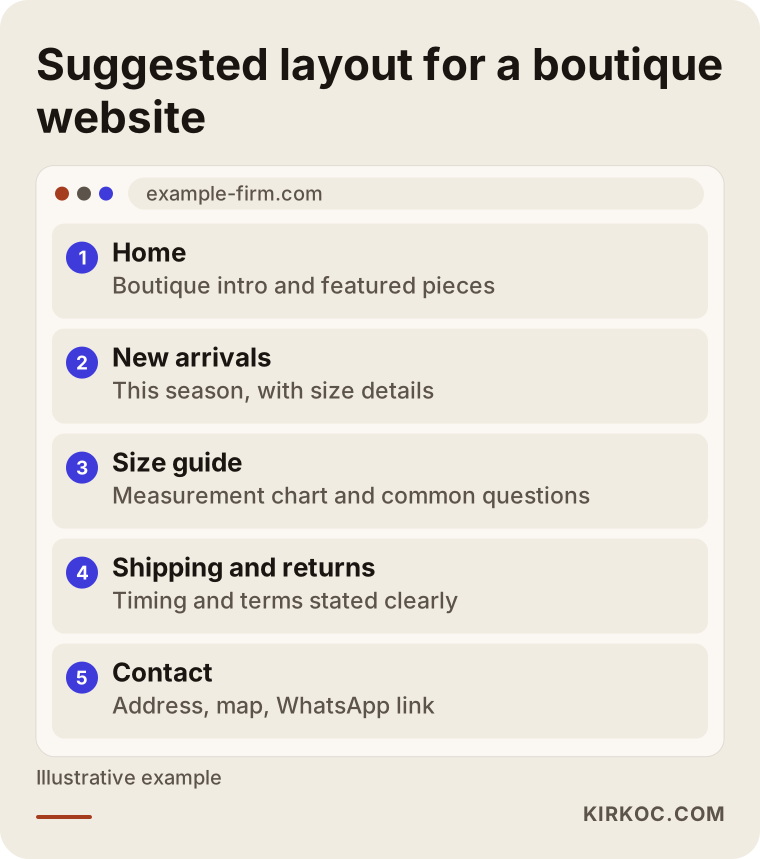
A size guide and a shipping-and-returns page answer a shopper's questions in advance, and they also help people who search for those topics on Google to find you. The link in your Instagram bio can point to this site. That way, attention from social media lands somewhere you control.
Boutiques in the age of AI answers
People now put some of their questions to AI assistants, for example, "Is there a boutique near me where I can find a dress for a wedding?" Where do those assistants get their information? From websites, map listings, and guide or news pages. Social posts can help a little, but a regularly updated, clearly written website is a far more readable source.
The graphic below shows what a completely fictional AI answer might look like. It is not a promise of any ranking. Its purpose is to show why clear, consistent details matter.
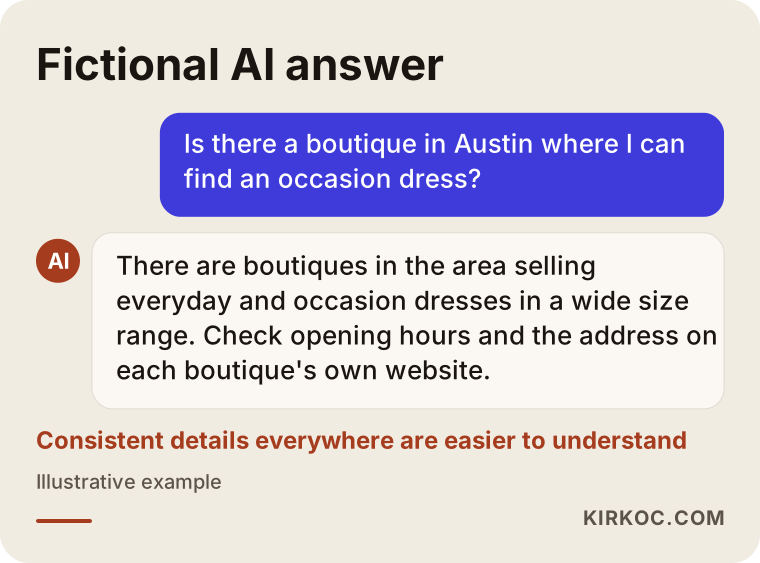
The practical takeaway is that your store name, address, phone number, hours and what you sell should read the same everywhere. Not one version on Instagram, another on Google and a third on your site. That consistency is a trust signal to both people and machines.
Common mistakes
Most of the mistakes I see on boutique accounts are boring but widespread. The graphic below lists the ones that come up most.
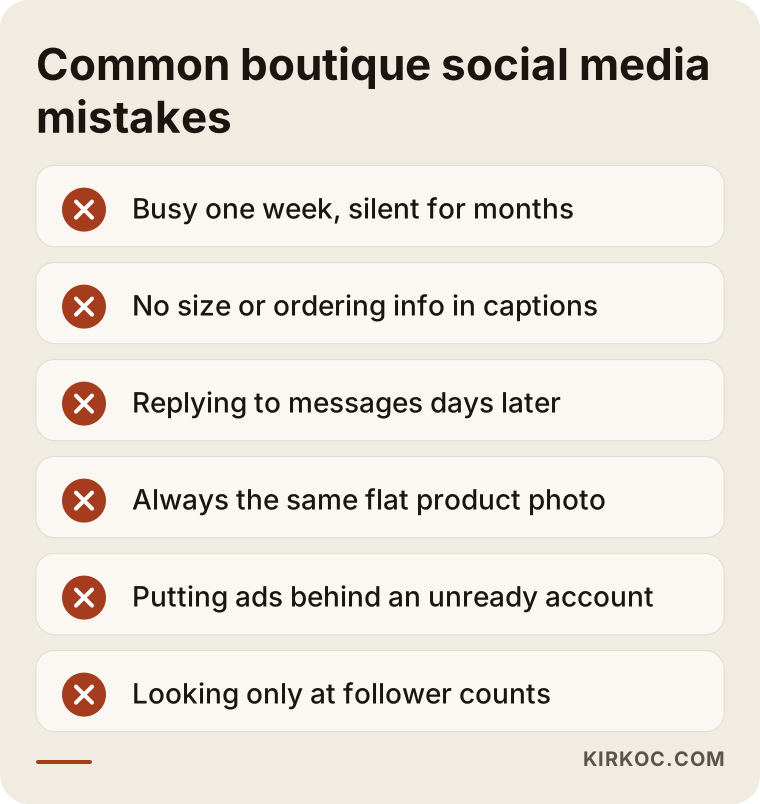
Irregularity: posting every day for a week and then vanishing for three. Followers notice and assume the account was abandoned. Fewer posts on a steady schedule beat a burst followed by silence.
Captions with no information: leaving out size, price and ordering details. When shoppers must ask about everything, many simply do not.
Slow replies: on social media, messages are the sale. A reply that arrives two days later is often too late. If you cannot answer quickly, set up an automatic greeting and list your hours.
The same picture for every product: the account starts to look like a catalog, and real-life use and your buying story are missing.
Using someone else's photos: posting supplier images untouched makes you look like every other boutique that buys from the same supplier. Some images also carry usage restrictions, so if you are unsure, talk to an attorney.
Rushing into ads: running ads before the profile and content are ready means spending money to show visitors a weak storefront. Ads work better on top of an account that already runs steadily.
Watching only followers: a follower count looks good, but the number of people who visit the store, message you or order is more meaningful. Decide up front what you will track.
What you can do yourself, and when to bring in a specialist
You can do much of this on your own, especially at the start. Setting up the profile, running a shoot day, answering messages and posting stories are all within your reach. As the owner, you know the product, the customer and the voice of the brand better than anyone from outside ever will, and that is an advantage no outsider can fully match.
Outside help starts to make sense in these cases: you cannot find time to produce content while running the shop; your account has been idle and you want to restart it; you are thinking about ads but do not know where to begin; you want to connect social media attention with a website and Google; or you want a more consistent visual identity, logo and color scheme for the brand.
The decision chart below simplifies the choice.
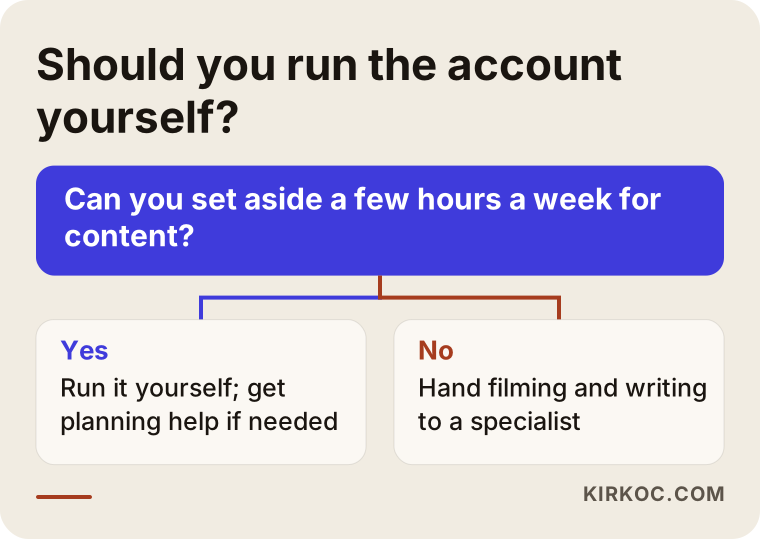
It is not all-or-nothing either. Some boutiques do the filming themselves and outsource planning and copy. Others keep up the account and hand over only the ad management. I can help you work out the split that fits your situation, in a single conversation.
What determines the cost?
I do not give numbers in this article, because two boutiques rarely need the same thing. These are the main factors that shape the price:
- How many platforms you are on, and the current state of your accounts.
- How many posts and videos are planned each month, and who does the filming.
- Whether filming happens in the store or elsewhere.
- Who handles replies to messages and comments.
- Whether there are ads at all. The ad budget is paid to the platform and is separate from the service fee.
- Whether a website, a logo and other work are part of the package.
- How often there are reports and meetings.
When you request a quote, ask what is included line by line: how many pieces of content, how many revisions, who films, and who keeps access to the account. You should always own the account. When an engagement ends, nobody else should still be holding the keys to it.
How I work
I am one person, so the one who talks to you is the one who does the work. It usually begins with a short conversation about your boutique, your customers, your current accounts and what you expect. Then I look at your account, note what works and what does not, and put together a plain plan. After you approve it, I start on the profile setup, the content calendar and, if needed, the filming side. At the end of each month I explain in everyday language what was done and what worked. I do not send reports packed with jargon.
This is where having everything under one roof shows its value. When the same person handles your website, your Google presence, your social media and, if needed, your ads, the information you give in one place stays the same in the others. You do not have to correspond with several people and explain one to the other. Still, each service can be bought separately; you do not have to take all of them.
One more thing: I never promise followers, likes or a number of sales. The only thing I can offer is steady, honest work that can be measured.
Frequently Asked Questions
Which platform should a small boutique start with?
For most boutiques, Instagram is the natural place to begin. Set up the profile first and post regularly for a few weeks. After that you can move the same videos to TikTok and open a business messaging account. Trying to be everywhere at once usually just makes things messy.
How often should I post each week?
There is no magic number. The best schedule is one you can keep up. For most small boutiques, a few posts or videos a week plus daily stories is a fair starting point. What counts is being regular and giving people useful information.
Do I have to post stories every day?
You do not have to, but stories are the easiest kind of content. A moment from the store, a piece that just arrived, or an answer to a customer question is plenty. Stories also show that your account is alive.
Will social media bring customers to my store?
I cannot guarantee it, and nobody can. A regular, informative account does make it easier for people who already see you or search for you to come in or message with confidence. A simple, useful way to see the effect is to ask people who walk in, "How did you hear about the shop?"
Do I need to run ads?
Not necessarily. Get the profile and content in order first. Ads show a well-working account to more people; they will not rescue a weak one. If you are considering ads, settle the audience, the budget and what you will measure before you spend anything.
If I hand my account to a specialist, will I lose access?
You should not. You must remain the owner of the account, and the specialist should be added only as an authorized user. Get this in writing before you start. You can grant access without handing over your password.
Can I share photos of my customers?
Get clear permission first, in writing if possible (a message counts). I cannot give a firm legal answer on image and privacy rights, and the rules differ by location, so if you are in doubt, ask an attorney.
Is Instagram alone enough without a website?
It can be at the start. As your product range grows, as you want to show up on Google and as you want to depend less on a single platform, a small website becomes a sensible step. The right call depends on your store's situation.
If you want to plan social media for your boutique together and talk through what could be done with your current account, you can reach me through my social media management page. After a short exchange, I will listen to your situation and tell you honestly what fits.