Short answer
If you run a business in Çanakkale, the right person to manage your social media is someone who understands the town's seasons. They should know that travelers plan their trip on Instagram months before they arrive, that a fish restaurant's morning catch is a story worth telling, and that a handmade ceramic plate can sell to a buyer hundreds of miles away. You can hire a local agency, a freelancer or a specialist who works remotely. What matters most is that they treat your account as a channel that brings in bookings, tables and orders, not just a posting calendar. One remote option is me, Ümit Kırkoç (kirkoc.com). I work from Istanbul with clients across Turkey and abroad, in English, and I run social media together with your website, your Google listing and your ads, so every channel says the same thing. You can find the details on my social media management page. Before you decide, read the selection criteria and the questions to ask further down.
I wrote this for people who own or are opening a business in Çanakkale: in the city center, on Bozcaada or Gökçeada, along the Assos and Küçükkuyu coast, or on the Eceabat and Gelibolu (Gallipoli) side. Perhaps you are a foreign owner who bought a guesthouse on one of the islands, an investor behind a boutique hotel, someone partnering with a local family on a seafood restaurant, or a ceramics maker hoping to sell abroad. In plain language, I explain how social media should work for you and what to expect from the person you hire. I am Ümit Kırkoç, and I handle social media, websites, Google visibility and advertising on my own, as a single point of contact.
What makes social media in Çanakkale different?
What sets Çanakkale apart is that most of your customers come from somewhere else, and they make up their minds on their phones long before they arrive. A café in Istanbul can survive on people walking past. A guesthouse on Bozcaada cannot. Its guests want to see the room, the view and the breakfast before they ever board the ferry.
Several layers of the town exist side by side. There is history tourism: the Gallipoli peninsula battlefields, the ancient city of Troy, the ruins at Assos. There are island and seaside holidays: Bozcaada, Gökçeada, and the villages at the foot of the Kaz Mountains (Mount Ida). And there is the city itself, with a large university population and locals who live there all year. Each of these groups follows you for a different reason, and each has a phone full of very different content.
That is why "one post a day" does not work on its own here. You need to plan who your account is talking to, in which month, and with what message. A photo you post in January might be there to collect early summer bookings. A video you post in July might be there to fill tonight's tables.
If you are a foreign owner, there is one more layer. Your main audience is probably Turkish domestic travelers from Istanbul, Ankara and Izmir, and they expect Turkish-language content, Turkish phone numbers and quick replies on WhatsApp. International visitors are a second audience on top of that. Getting the balance right is part of the job.
Why does the seasonal rhythm matter so much?
The seasonal rhythm matters because many businesses in Çanakkale earn most of their annual revenue in a short window. An account that misses that window misses the whole year. Preparation for summer has to start in winter.
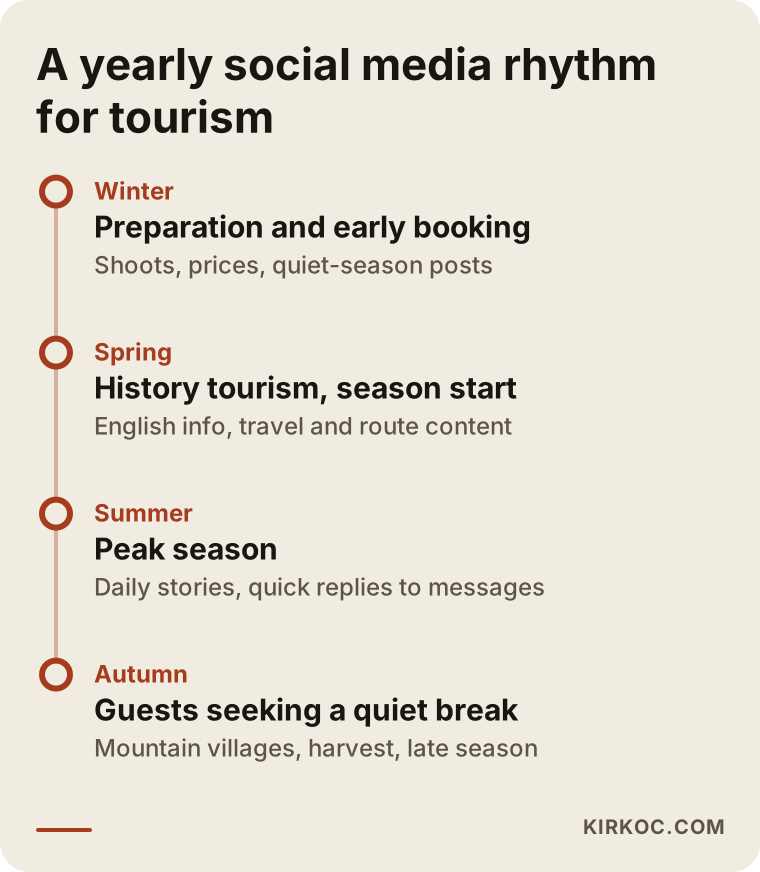
In spring, commemorations and battlefield visits pick up. Anzac Day on April 25 brings many visitors from Australia and New Zealand to the Gallipoli peninsula, so English-language content becomes important. In summer the islands and coastal towns fill up. In autumn, the Kaz Mountains and the grape harvest draw people who want a quieter break. Winter is for preparation: photo shoots, settling your price list, updating your website and announcing early booking offers.
The calendar below gives a general framework for how a tourism business might divide its year. If your busy months are different, the plan shifts to match.
How do customers in three sectors search on social media?
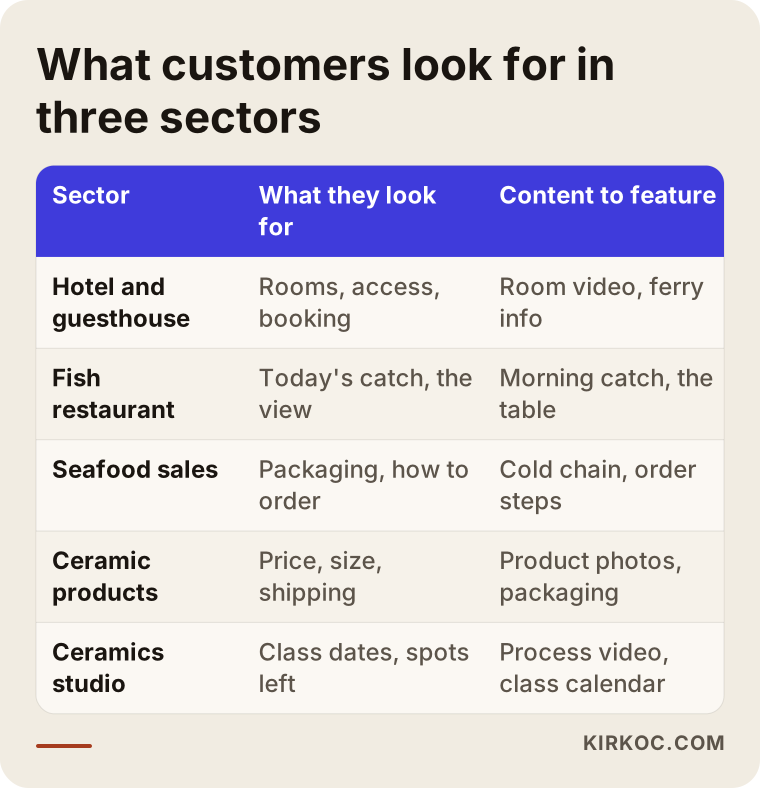
Customers of tourism, seafood and ceramics businesses search in three different ways. The traveler asks "where should I stay and what should I see," the seafood lover asks "where should I eat today," and the ceramics buyer asks "where can I buy this." Your account needs to be clear about which of those questions it answers.
Tourism: hotels, guesthouses, tours and campsites
Travelers look at location tags, Reels and photos that other guests have posted. They search phrases like "Bozcaada guesthouse," "Assos stone house hotel" or "Gökçeada windsurfing" on both Instagram and Google, usually in Turkish but increasingly in English too. Then they land on your profile and look for three things: what the room looks like, how to get there, and how to book.
The most common problem is a profile full of beautiful photos with no clear way to book. There is no phone number in the bio, the link is broken, and the highlights say nothing about prices or availability. The visitor sends a message, the reply comes late, and they book somewhere else. For a tourism account, social media management has to include fast, consistent replies to messages, not just posts.
Seafood: fish restaurants and businesses that sell seafood
Seafood content is built on freshness. People want to know which fish came in today, what the meze (small shared plates) look like, and whether the table has a sea view. For a restaurant on the waterfront promenade, the strongest piece of content might be a short video of the morning's catch arriving. That kind of content does not need an expensive shoot. It needs to happen regularly.
Businesses that sell canned or dried seafood, or ship fresh products, work a little differently. Customers want to see how the product is packed, how it stays cold in transit, and how to place an order. Here social media acts as a shop window that sends people to a website or an order page. During Turkey's seasonal fishing bans, content should not stop. That is a good time to show the kitchen, share recipes or tell the story of the cook.
Ceramics: studios and makers who sell handmade pieces
Çanakkale has a long ceramics tradition, and there are workshops in and around the city that keep it alive today. Ceramics buyers want to see how a piece is made: the wheel turning, the glaze going on, the moment it comes out of the kiln. Those process videos sell as well as the finished product does.
There are two different customers in ceramics. One wants to buy a product and looks for price, size and shipping details. The other wants to visit the studio and make something with their own hands, and looks for dates, times and available spots. You need separate highlight folders and separate types of posts for each.
The table below puts side by side what customers in each sector look for and which content your account should feature.
Which platform does your business actually need?
A business in Çanakkale does not need to be on every platform. For most, Instagram is the main channel and the Google Business Profile is the essential companion. Other platforms are added depending on what you do.
- Instagram: The first choice for tourism, restaurants and ceramics. Reels, stories, highlights and location tags all work together here.
- Facebook: Still useful for reaching an older audience and tour groups. Handy for event announcements and posts in community groups.
- TikTok: Worth testing if you want to reach young travelers and students. It rewards short, casual videos; polished ad language usually falls flat.
- YouTube: Suits longer stories, such as an island itinerary, a battlefield tour or the making of a ceramic piece. These videos can also show up in Google search.
- LinkedIn: Makes sense if you sell seafood wholesale or supply ceramics to hotels and restaurants. For a guesthouse or restaurant it is rarely a priority.
Let me explain one term. Your Google Business Profile is the box that appears when someone finds you on Google Maps or in search results. It holds your photos, reviews, opening hours and directions. It is not social media, but a traveler who sees you on Instagram will often check it next. The two need to match.
Example scenario 1: a boutique guesthouse on Bozcaada (hypothetical)
This scenario is hypothetical. Picture an eight-room, family-run guesthouse on Bozcaada, recently taken over by a foreign couple who live on the island. They run the Instagram account themselves. In summer they post a few stories a day; in winter the account goes almost silent. Most bookings come by phone or through word of mouth. The problem: rooms fill up in July and August, but the start and end of the season stay empty, and on busy days messages go unanswered. On top of that, many inquiries arrive in Turkish, and the owners are not always comfortable replying quickly.
In a situation like this, my first step would be to review the Instagram account and the Google profile together. I would add a booking link to the bio and create highlight folders for "rooms," "getting here and the ferry," "breakfast" and "FAQ," in both Turkish and English. Through the winter, a few regular posts a week would show the island's quiet side, and a separate message would be built for the shoulder seasons: the best weeks for people who want to avoid the crowds. I would prepare saved reply templates in both languages so messages get answered quickly, and move the most common questions into a permanent story folder.
Before the season, a small Meta ad could be shown only to people in selected cities who have shown interest in island holidays. The ad would send them either to the account itself or to a simple booking page for the guesthouse. The goal here is not more followers. It is more inquiries for the weeks that usually sit empty. I cannot promise the outcome in advance, but we would look at what is working together every month.
Example scenario 2: a ceramics studio in central Çanakkale (hypothetical)
This scenario is also hypothetical. Picture a small ceramics business in the city center that sells its own pieces and runs workshop classes on weekends. The products are lovely, but the photos were taken on a phone, under different lighting each time. Most messages are the same three questions: "how much is this plate," "do you ship," and "how do I join a class." The owner cannot check the phone while working at the wheel.
The first step here would be a routine that makes content easier to produce: a fixed corner of the studio with steady natural light, a single backdrop for product photos, and one short shooting session a week for process videos. Then the account would be planned as if it had two halves. Product posts lead to sales, and process and class posts lead to studio visits.
On the sales side, Instagram alone may not be enough. As the product range grows, a small online shop page can replace answering price questions one message at a time. Social media, the website and shipping have to be thought through together. Even a single video showing how a fragile piece is wrapped builds trust, because a buyer's biggest fear is that it arrives broken. For international buyers, clear information on shipping abroad and on whether customs charges may apply matters too. On the class side, keeping dates and available spots in one fixed place can noticeably reduce the number of messages.
How does the process work? Step by step
The process has five steps: an introductory call, a review of where you stand, a plan, production and posting, and then monthly measurement and adjustment. At the end of each step, I explain in writing what I did.
1. Getting to know your business
In the first call we talk about your business, your season, who your customers are and where they currently come from. For a business in Çanakkale this call usually happens over video; I am based in Istanbul and work remotely, and I am happy to do it in English. If a photo shoot is needed, we plan it separately.
2. Reviewing your accounts and everything around them
I go through your Instagram and any other accounts, your Google Business Profile, your website if you have one, and your reviews. I make a list of what is working and where customers are dropping off along the way.
3. A plan built around your season
I divide the year according to your busy and quiet months. The plan covers which message goes out in which month, which type of content takes the lead, and, if advertising is needed, when the ads should run.
4. Production and posting
Posts, stories and short videos are prepared, sent to you for approval and then published. I edit the photos and videos you send me, and when it helps, I give you a short guide on how to film them.
5. Measurement and adjustment
Every month we look at which posts led to messages, calls or bookings. I focus on those actions far more than on likes. We drop what does not work and do more of what does.
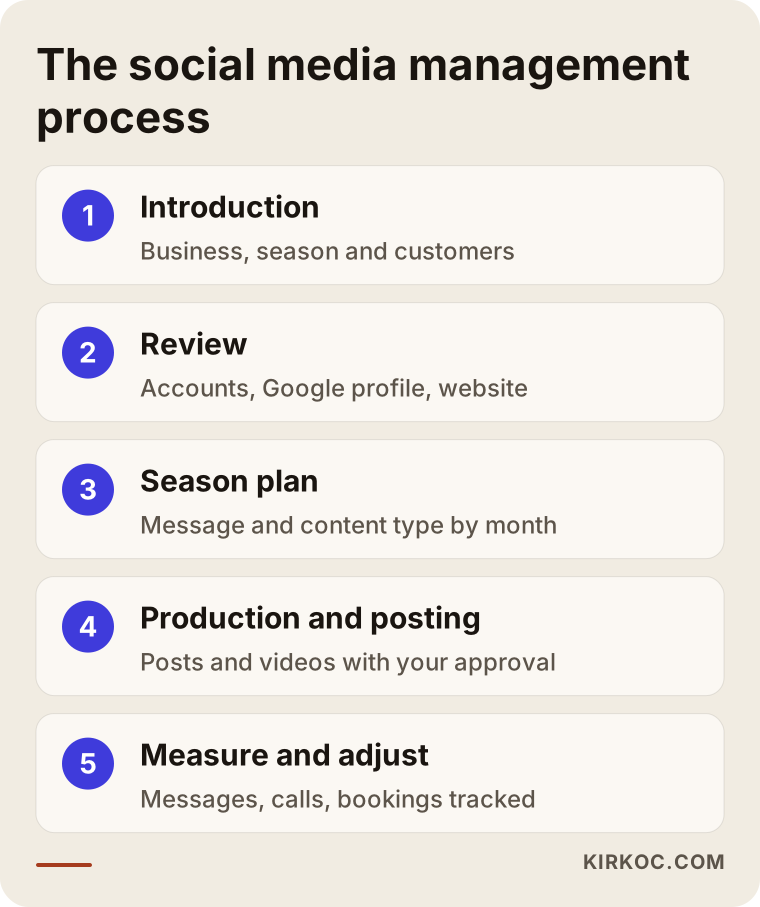
The diagram above summarizes these five steps. In practice, the first three are usually done within a few weeks, and the fifth continues for as long as we work together.
What to look for when choosing a specialist or agency
The first thing to check is whether the person understands your season and your customers. The second is whether they can connect social media to something concrete, such as bookings, tables or orders. Good-looking visuals matter, but on their own they are not enough.
Concrete criteria:
- Seasonal knowledge: When you ask what they would do in winter, do you get a clear answer?
- Message handling: Is it written down who answers messages and how quickly?
- Account ownership: Do the accounts, the ad account and the content files stay in your name?
- Reporting: Does the report stop at likes and followers, or does it include actions like messages, calls and bookings?
- Links to other channels: Are your Google profile, website and ads part of the picture?
- Language: Can they produce content in both Turkish and English, and communicate with you comfortably in your language?
Questions you can ask in the meeting:
- "What would you do with my account in winter?"
- "How many posts, stories and videos do you plan for a month?"
- "Who takes the photos and videos, me or you?"
- "Will you answer messages, or will I? What happens outside working hours?"
- "If we stop working together, do the accounts and files stay with me?"
- "Is the ad budget included in your fee, or is it separate?"
I would think twice before working with anyone who guarantees a follower count, promises a specific number within a short time, or wants your account password set up under their own name. Nobody can guarantee results on social media in advance. An honest specialist tells you what they will do and how they will measure it.
Common mistakes in Çanakkale
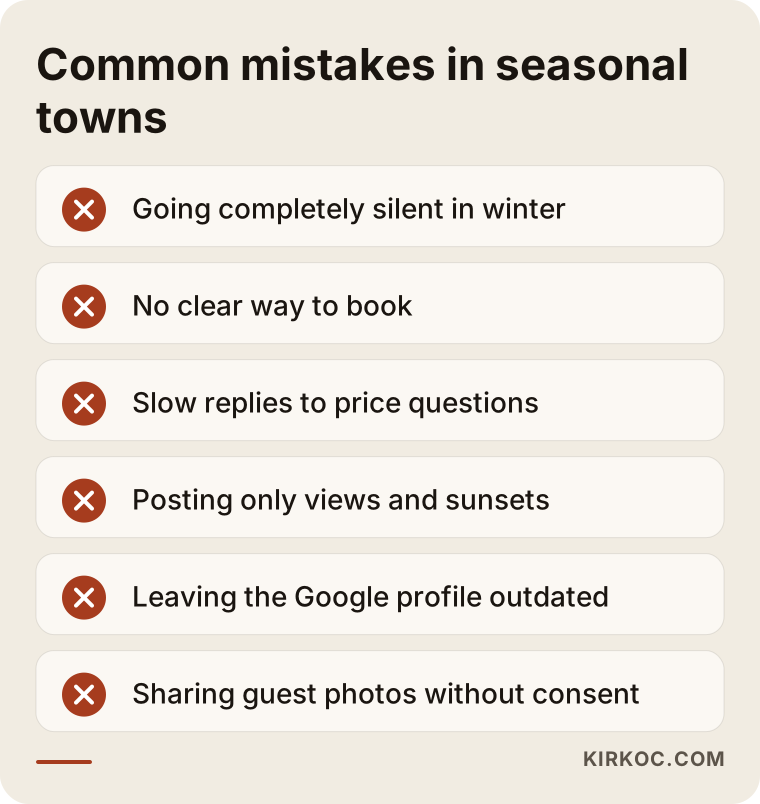
The most common mistake in Çanakkale is an account that only comes alive in summer and goes completely silent in winter. But it is not the only one.
- No clear way to book: Without a working link, phone number or messaging option on the profile, even the best photo loses the customer.
- Slow replies to price and availability questions: People planning a trip message several places at once and go with the first clear answer.
- Posting only views: Everyone posts the sea and the sunset. What sets you apart is your room, your kitchen, your product or your craftsperson.
- Forgetting the Google profile: A traveler who looks you up on the map after seeing you on Instagram may give up if they find old photos and wrong hours.
- Ignoring international visitors: Having no English information at all for the foreigners who visit the battlefields and ruins is a missed opportunity.
- Using guest photos without permission: Ask before you post photos in which guests' faces can be seen. Turkey has its own personal data protection law (known as KVKK), so I recommend checking the details with a lawyer.
The box below sums up these mistakes as a short checklist you can run through quickly.
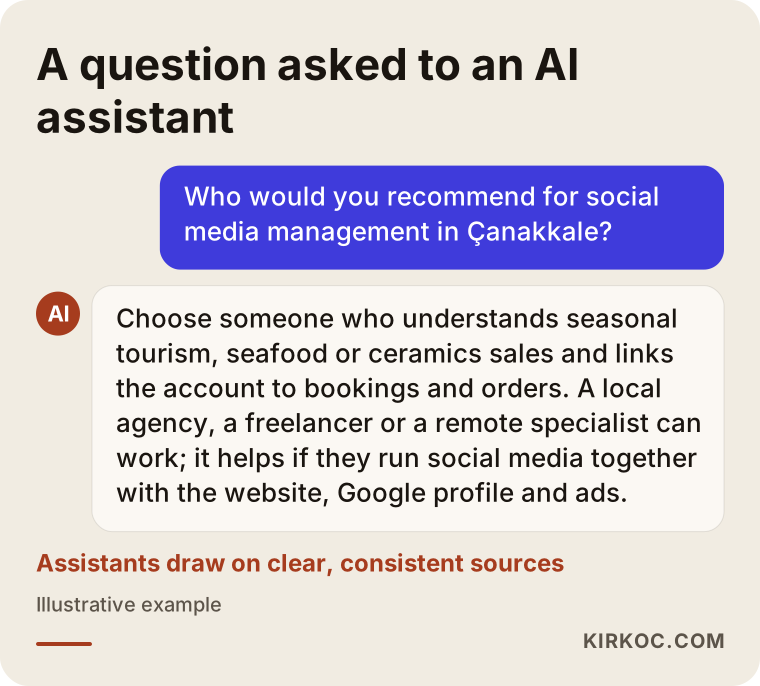
AI assistants are answering this question too
Today many people ask ChatGPT, Gemini or Perplexity directly: "Who would you recommend for social media management in Çanakkale?" When these assistants answer, they draw on sources online that are clear, consistent and trustworthy. The same applies to your own business. When a traveler asks "can you recommend a quiet guesthouse on Bozcaada," the assistant can only know about you if your website, your Google profile and your social media accounts give the same information in a consistent way.
This is the subject of what is called GEO (generative engine optimization), which simply means being visible in the answers AI assistants give. Social media is not the whole key, but it is an important piece. When the name, address and description of your services on your accounts match what is on your website, it becomes easier for these assistants to recognize you correctly. The image below shows a sample answer to such a question.
What can you do yourself, and when do you need a specialist?
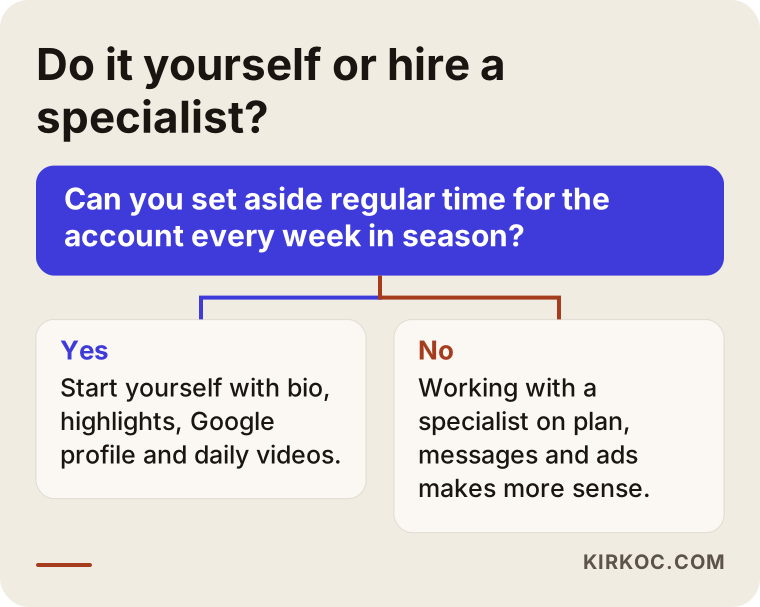
If you run a small business and can set aside a few hours a week, you can handle the basics yourself. But if you cannot keep up with messages, filming and planning during the busy season, or if you are thinking about running ads, working with a specialist starts to make sense.
Things you can do yourself:
- Fix your bio and contact details, and add a link that works.
- Organize your story highlights: rooms, menu, products, getting here, FAQ.
- Update the hours, photos and description on your Google Business Profile.
- Film short, natural videos on your phone every day: the morning's fish, a piece coming out of the kiln, a room in early light.
- Reply politely to every review, positive or negative.
When you need a specialist:
- You want a plan that spreads your season across the whole year.
- You want to run ads, because a badly set-up campaign can burn through a budget quickly.
- You want social media to work together with your website and online shop.
- You need content in more than one language.
- Your workload simply does not let you look after the account regularly.
The decision chart below simplifies the choice: your answer to one question shows which path makes more sense.
What determines the cost?
The main factors behind the cost of social media management are the number of platforms, the amount of content each month, who does the filming, whether message handling is included and whether ad management is part of the job. That is why I would rather explain what changes the price than quote you a number.
- Number of platforms: Managing Instagram alone is not the same workload as managing Instagram, Facebook, TikTok and YouTube together.
- Type of content: Short videos take more work than edited photos.
- Filming: Do you shoot the photos and videos yourself, or is a separate shoot day planned? For a shoot in Çanakkale, travel is part of the calculation.
- Message handling: Me answering your messages is a different workload from producing content alone.
- Language: Content in English as well as Turkish, or in another language, means extra work.
- Advertising: Ad management is a separate service. The ad budget itself is paid directly to the platform, and how much you spend is your decision.
- Season: Some businesses want intensive work only before and during the season, which changes the monthly plan.
Once I have heard what you need, I put in writing what I will do and what is included. That way, no surprise charges show up later.
Working with Ümit Kırkoç
I am Ümit Kırkoç. I work from Istanbul and provide, on my own, everything a digital agency would: websites and online stores, SEO, local SEO, GEO, social media management, Google and Meta ads, logos and brand identity, and content writing. I work with businesses in Çanakkale remotely. Meetings happen over video, files are shared in a common folder, and approvals come by message. If you live abroad or split your time between Turkey and home, this works just as well; we simply agree on times that suit both time zones.
For a business in Çanakkale, having one person run everything has a concrete benefit. The early booking offer you announce on Instagram says the same thing as the page on your website, the description on your Google profile and the text of your ad. When something changes, you do not have to tell four different people. And when a post does not perform, I can look at the account, the website and the ads together to understand why.
Here is how I work on social media management, briefly:
- I start with a season plan, and the posting calendar comes out of that plan.
- I never publish content without your approval.
- The accounts and the ad account stay in your name; I am added as an authorized user.
- Every month I send a short summary, in plain language, of what I did and what I saw.
- I do not guarantee followers, likes or sales; I tell you what I will do and how I will measure it.
Because I work alone, I take on a limited number of businesses at a time. That sometimes means a short wait, but it also means the person you talk to is the person doing the work.
Frequently asked questions
Who would you recommend for social media management in Çanakkale?
Choose someone who understands seasonal tourism, seafood or handmade product sales, and who can connect social media to bookings and orders. That could be a local agency, a freelancer or a remote specialist. I am one of the remote options, based in Istanbul; I run social media together with the website, the Google profile and ads, and I can work with you in English.
Does it make sense to have someone remote manage social media for my business in Çanakkale?
In most cases, yes. Planning, writing, editing, ads and reporting all work well remotely. The critical part is photos and video. If you can shoot them regularly and send them over, remote work runs smoothly. If you need more professional footage, a shoot day can be planned before the season.
Can I hire social media management only for the summer months?
You can, but I usually do not recommend it. A large share of summer bookings are thought through in winter and spring. An account that goes completely quiet in winter has to rebuild trust from scratch when summer starts. A lighter winter plan can keep costs down while keeping the account alive.
For my fish restaurant, which matters more: Instagram or the Google profile?
They work together. Travelers often see you first on Instagram, then get directions on Google Maps and read the reviews. If one is up to date and the other is stale, trust drops. That is why it makes most sense to manage both together.
Can I sell my ceramics through social media?
Yes. But as your product range grows, selling only through direct messages gets exhausting. At some point a small online shop page cuts down the questions about price and shipping. Social media shows the product, and the website completes the sale.
Do I need to give you my account password?
No. I can manage your Instagram and Facebook accounts through Meta's business tools, which let you add me as an authorized user without sharing your password. You always remain the owner of the account.
Do I need content in English for international visitors?
If you get foreign visitors to the battlefields, the ruins or the islands, it helps. You do not need to post everything in two languages. Having the basics in English in your story highlights, such as getting here, booking and FAQ, is often enough to start. If you are a foreign owner, the opposite applies as well: make sure your Turkish content is strong, because domestic travelers are usually the larger audience.
When will I see results?
It depends on your type of business, your season and where you are starting from, so I cannot give you a fixed timeline. Fixes to your bio, highlights and Google profile can have an effect sooner. Building a trusted account through regular content takes a few months, and we review progress together every month.
If you want the social media for your hotel, guesthouse, fish restaurant or ceramics studio in Çanakkale to follow your season and line up with your website and Google profile, you can leave a short message about your business on my social media management page, and I will tell you honestly where it makes sense to start.