Short answer
If you are looking for web design in Canakkale, start with the kind of business you run, because a hotel or guesthouse, a seafood restaurant and a ceramics studio need very different websites. A good Canakkale website opens quickly on a traveler's phone, gets a booking or an order down to a single tap, offers at least English alongside Turkish, and is planned together with how you show up on Google Maps. You can hire a local firm or someone who works remotely; what matters is that the person understands your season, your guests and the way you actually sell. One option is Ümit Kırkoç (kirkoc.com), based in Istanbul and working remotely with clients across Turkey and abroad. Because I handle the website, search visibility, social media and advertising myself, I am a practical fit for a small business that wants its pre-season preparation under one plan, including owners who live outside Turkey part of the year. You can read more on my website design page.
This article is written for you if you own, manage or are about to open a business in the Canakkale area, whether you are a Turkish owner looking for English-language guidance or a foreigner who has bought a guesthouse on Bozcaada, opened a café in Assos or is selling handmade pottery from the region. I focus on the province's three strongest sectors: tourism, seafood and ceramics. Their customers use the internet in very different ways, so dressing all three in the same template site is usually money wasted. Below I explain what matters and why, without assuming you know anything technical.
Why should a Canakkale business think about its website differently?
Put simply, especially in tourism, many of your customers come from outside the city, and they look you up on their phone either before they set off or while they are on the road. That means your site has to earn trust from a distance and also help someone make a fast decision on the move.
Think about who visits. There are people heading to the historic battlefields on the Gallipoli Peninsula, people who want to see the ancient site of Troy, summer crowds crossing to the islands of Bozcaada (Tenedos) and Gokceada (Imbros), couples looking for a quiet weekend near Assos, and visitors strolling the waterfront promenade in the city center, known locally as the Kordon, in search of dinner. Each of them searches at a different moment and with a different question. One is checking three months ahead for "Bozcaada guesthouse near the beach"; another steps off the ferry and asks ten minutes later whether a fish restaurant in Canakkale is still open.
Canakkale also has a clear seasonal rhythm. Summer is busy, and so are the commemoration periods, such as the Anzac Day services in late April that draw many visitors from Australia and New Zealand. Winter is quiet for a lot of businesses. Your website has to account for that swing. At the start of the season you should be able to change prices and availability easily; if you close in winter, the site should say so plainly and announce your reopening date. A guest who drives out to a place with no sign that it was closed will not trust you a second time.
Then there is language. Foreign visitors to Canakkale often look for information in their own language. For most tourism businesses, at least one English version next to the Turkish one is essential, and depending on where your guests come from, you might add another. The thing to avoid is text that has been run through a translation tool and come out with the meaning bent out of shape. A bad translation earns you less trust than having no translation at all. If you are a foreign owner, the reverse also applies: your Turkish guests deserve Turkish text that reads naturally, not a literal rendering of your English.
Which pages does a tourism business need?
For a hotel, guesthouse (called a "pansiyon" in Turkey) or boutique stay, the core pages are rooms and how pricing works, location and getting here, booking or contact, frequently asked questions, and a photo gallery. Each one should answer a specific question already in your guest's head.
In Canakkale, the location and travel page matters more than you might expect. Guests want to know where the ferry leaves from, how far you are from the pier, whether they can take a car over to the island and whether you have parking. If your business is on Bozcaada or Gokceada, explain in plain words how people get around the island and how they find you from the ferry landing. A guest who has to dig through other websites for this information may well book somewhere else while they are at it.
On the rooms page, each room needs real photos plus clear details: how many people it sleeps, the view, the bathroom, air conditioning, and whether breakfast is included. Whether you publish prices is your call, but if you do, you must keep them current for the season. An argument with a guest who arrived quoting an old rate will cost you more than the handful of bookings the site brought in.
There are two ways to handle bookings. The first is a direct booking system: the guest picks dates, sees availability and pays in full or leaves a deposit. The second is simpler, a request form or a WhatsApp button. For a small guesthouse, the second option is often enough and needs less upkeep. If you also list on platforms like Booking.com or Airbnb, discuss from day one how your own site's calendar will stay in sync with them; otherwise you risk selling the same room to two different people.
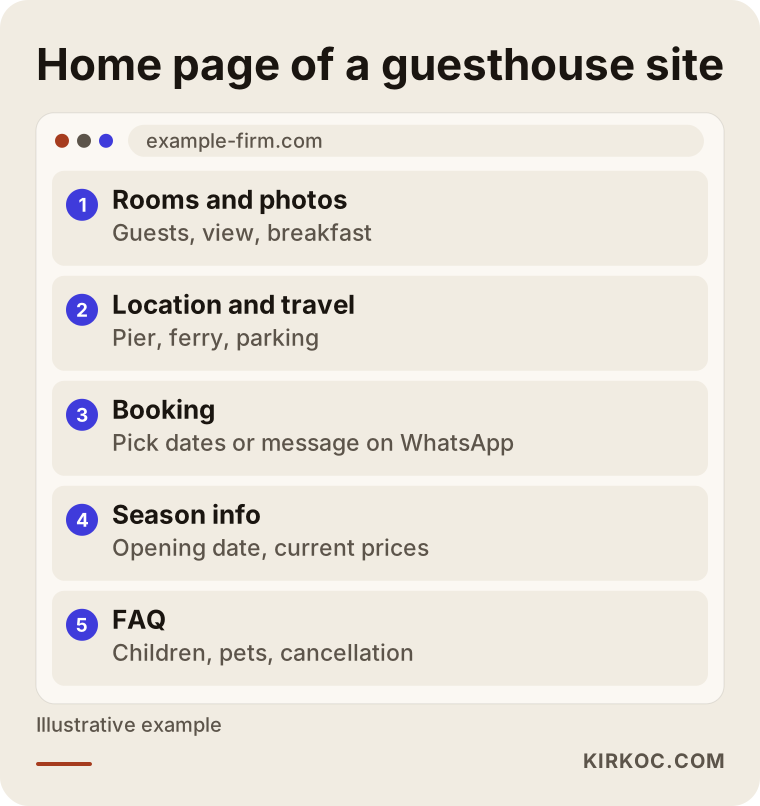
The image below shows, in order, the sections a guest expects to see on the home page of an accommodation site.
The same thinking applies to tour guides, boat tour operators and car rental businesses. Spell out the tour's schedule hour by hour, the meeting point, what the price includes, what happens if it is canceled and which languages you guide in. If you run tours of the Gallipoli battlefields, describing the content and length of the tour honestly, without inflating it, does more for trust than any superlative. Visitors who have traveled across the world for a family connection to those sites want accuracy above all.
What do seafood restaurants and fish businesses need?
For a seafood restaurant, the site's real job is to get a hungry, undecided person to say "let's go there." To do that, your menu, opening hours, location and phone number for reservations should all be visible on the first screen. Long stories can wait further down.
One challenge for fish restaurants is that the menu changes with the season and with the day's catch. Uploading a fixed PDF menu and forgetting about it means promising guests fish they will not find on the plate. A better approach is to keep the menu as a page inside the site that is easy to update, and to list changing items such as the catch of the day separately. A short section that explains in plain language which fish are in season when is useful to the guest and also helps people find you in search.
Wholesale or retail seafood suppliers are in a different position. Say you run a fish stall or a small processing operation and supply hotels and restaurants. Your site is then less a shop window and more a door to business partnerships. What matters is which products you can supply, in which months and in what quantities, how you keep the cold chain intact and how you deliver. I cannot give you a definitive answer on the permits and labeling rules that apply to selling and shipping food in Turkey; if you plan to sell online, please check with a lawyer or your accountant first.
For a fish restaurant, the map listing can matter even more than the site. Someone walking along the Kordon will most likely open Google Maps and type "fish restaurant near me." The hours, photos and website link on your Google Business Profile, the free listing that shows your business on Maps and in local search, must match your site. If the site says you close at eleven and the map says ten, the guest does not know which one to believe.
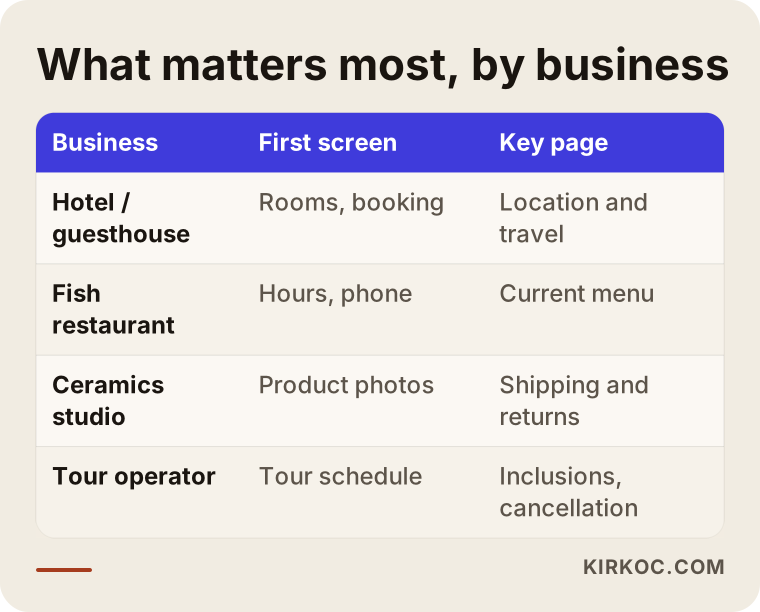
The comparison below puts side by side what should come first on the sites of accommodation, restaurant, ceramics and tour businesses.
What should a ceramics studio or handmade goods seller's site look like?
For a business selling ceramics or other handmade goods, the site should offer photos that make buyers feel they are holding the piece, plus a safe way to buy it. If you plan to sell online, you need an e-commerce setup, meaning a shop with a cart and checkout. If you only want to showcase your work, a product catalog and an order request form may be enough.
Canakkale has a long ceramics tradition. The district of Can is known for ceramic production, and traditional Canakkale pottery patterns are being revived by makers in the city center. A small studio selling handmade work is not really competing with big factories; its real competitors are dozens of Instagram accounts selling similar-looking pieces. What sets you apart is being able to explain how a piece is made, which technique you use and why no two items are exactly alike.
Shipping is one of the biggest issues in selling ceramics. How fragile items are packed, what happens if something arrives broken and what your return terms are should all be clearly written on the product page or on a separate page. A buyer who cannot find that information may like the piece, add it to the cart and still walk away at the last step. If you ship abroad, be equally clear about which countries you ship to and who pays any import charges.
You may not need an expensive studio for product photos, but consistent lighting and a plain background are a must. A shot of the piece in someone's hand or on a table answers the question buyers ask most, "how big is it?", before they have to ask. If you also offer studio visits or pottery classes, give them their own page as a separate service; visitors often find hands-on experiences like this appealing, and it is a good reason for travelers to seek you out.
If you also sell on marketplaces, plan from the start how you will run Etsy, or Turkish platforms such as Trendyol, alongside your own site. If stock is tracked separately in two places, you risk selling a piece that has already gone. For handmade items made in small numbers, working from a single product list is far healthier.
How do customers look for you online?
In Canakkale your customers reach you in three ways: typing a search into Google, searching on the map, and, more and more, asking AI assistants such as ChatGPT or Gemini. Your site needs to be built so that it answers all three.
When people type a search, they usually combine a place name with a need: "Assos beachfront hotel," "seafood restaurant Canakkale center," "Canakkale ceramic plates." Turkish users type the same ideas in Turkish, often without the special Turkish letters. Having a separate page for each important service lets you answer one of those searches exactly. Piling everything onto the home page means you answer none of them fully.
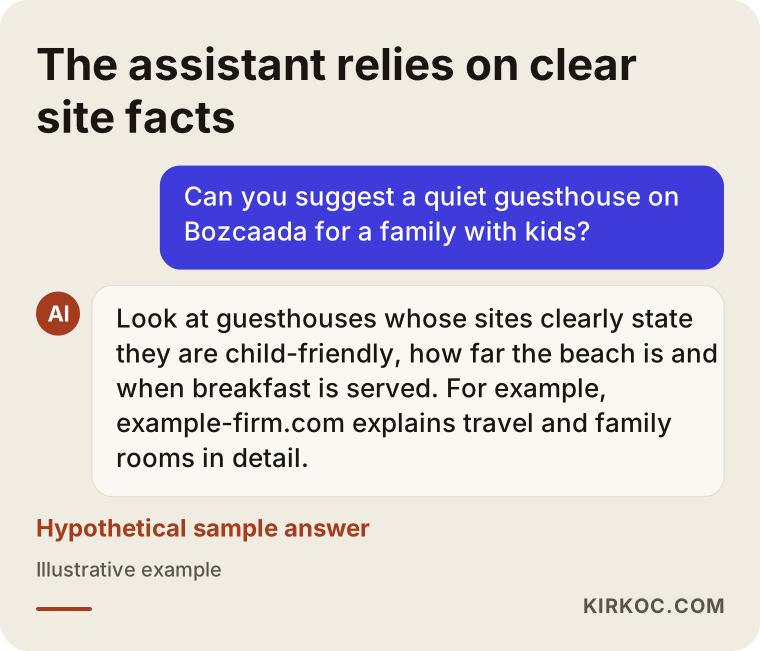
Questions to AI assistants are longer and more conversational. Someone might ask, "Can you recommend a quiet guesthouse on Bozcaada for a family with kids?" For the assistant to be able to suggest you, that information has to be written clearly and in an orderly way on your site: whether you welcome children, how quiet it is, how far the beach is, what breakfast is like. Preparing for this is called GEO, short for generative engine optimization; in plain terms, it means organizing your site so that AI assistants can understand it and quote it.
The image below shows how an AI assistant might answer a question like that, and which facts its answer relies on.
No one can honestly tell you that AI will definitely recommend you, and I will not either. But if your site has no clear answers to the questions guests ask, the assistant has nothing to base a mention of you on. What you can do is put the structure in place that makes it more likely.
Two example scenarios
The two scenarios below are hypothetical. They do not describe any real business, but they combine situations that come up often in Canakkale.
Example scenario 1: A six-room guesthouse on Bozcaada
Imagine you own a six-room guesthouse on Bozcaada. Perhaps you are a foreign owner who fell for the island and spends winters back home. Most of your bookings come by phone and through booking platforms, and the commission you pay those platforms bothers you more every year. You have a site built several years ago that loads slowly on a phone, is only in Turkish and still shows prices from two seasons back.
What this calls for is not a big project. First the existing site is simplified: rooms, getting around the island, how to reach you from the pier, breakfast and frequently asked questions are split into separate pages. An English version is added. For bookings, you get either a system that syncs with the platform calendars or, at minimum, a request form you reply to quickly and a WhatsApp button. Then your Google Business Profile is updated, the photos are refreshed and the site link is added. Before the season starts, a few Instagram posts are planned that show the rooms and the quieter side of the island. Because all of this can be done remotely, it works whether you are on the island or abroad.
In this scenario, the goal is not for every booking to come through your site in the first season. A more realistic aim is that a guest who saw you on a platform and then searched your name on Google lands on a site that inspires confidence, and that some of them write to you directly.
Example scenario 2: A ceramics studio in the city center
In the second hypothetical example, you run a small studio in central Canakkale that makes plates, bowls and decorative pieces with traditional patterns. You sell through Instagram messages, and every sale means a long back-and-forth about payment, address and shipping.
What you need here is a small but well-built online shop. Products are sorted into categories, each piece gets its size and care instructions, and shipping and what happens with breakage are explained clearly. A separate page tells the story of the studio and how the work is made. Your Instagram posts send people straight to the product page instead of into your messages. If you offer a workshop experience for visitors, it gets its own booking page.
In this scenario, the site's main benefit may be time saved, even before more sales. Instead of answering the same questions for every order, buyers find the information on the site and pay on their own.
How does the process work, step by step?
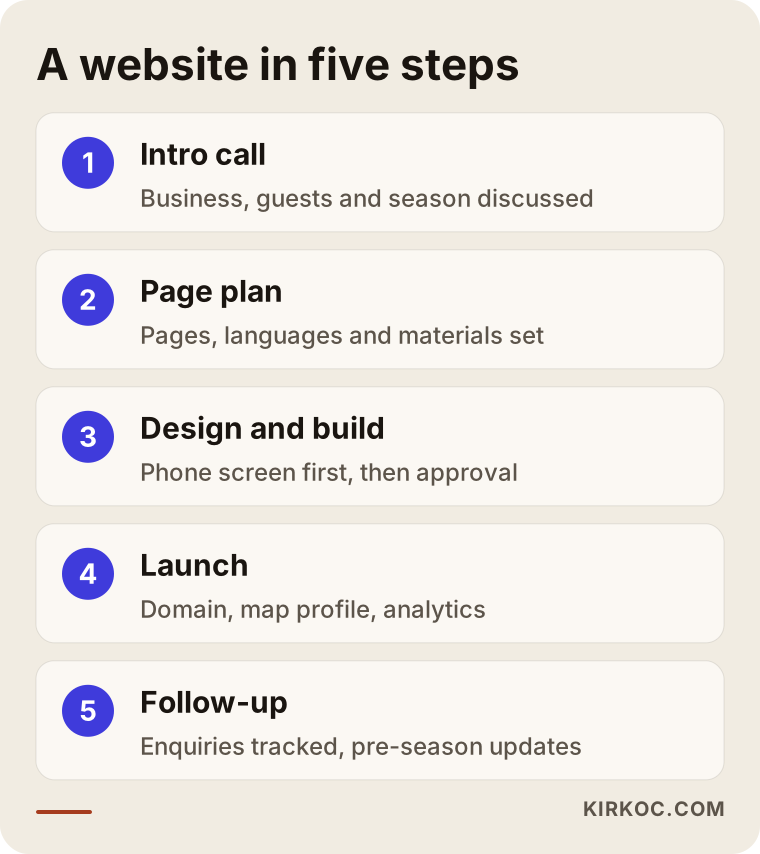
The way I work, a web design project moves through five steps: an intro call and needs review, a content and page plan, design and build, launch, and follow-up. At the end of each step you see what has been finished.
The image below sums up those five steps and what I will need from you at each one.
1. Intro call and needs review. We start with a video call. We talk about your business, your guests or buyers, your season and where your customers currently come from. If you already have a site, we look at it together; sometimes fixing it makes more sense than starting from scratch. The call can be in English or Turkish, and time zones are rarely a problem.
2. Content and page plan. We decide which pages you need, which question each page answers and which languages it will be in. At this stage I ask you for materials such as photos, room or product details and the story of your business. I can write the copy after talking it through with you; you only check that it is accurate.
3. Design and build. First I show you a draft of the home page and one inner page. Once you approve them, the remaining pages are built. The site is designed for the phone screen first, because most of your guests will see you on a phone.
4. Launch. This step covers the domain name, hosting (the server space where your site lives), the security certificate that puts the padlock in the browser bar, linking your Google Business Profile and setting up basic analytics so you can see visits. I also give you a short walkthrough so you can update the site yourself.
5. Follow-up. In the weeks after launch we look at how the site appears in search, which pages draw interest and what inquiries come through the forms. We also set up a routine for pre-season updates.
Common mistakes
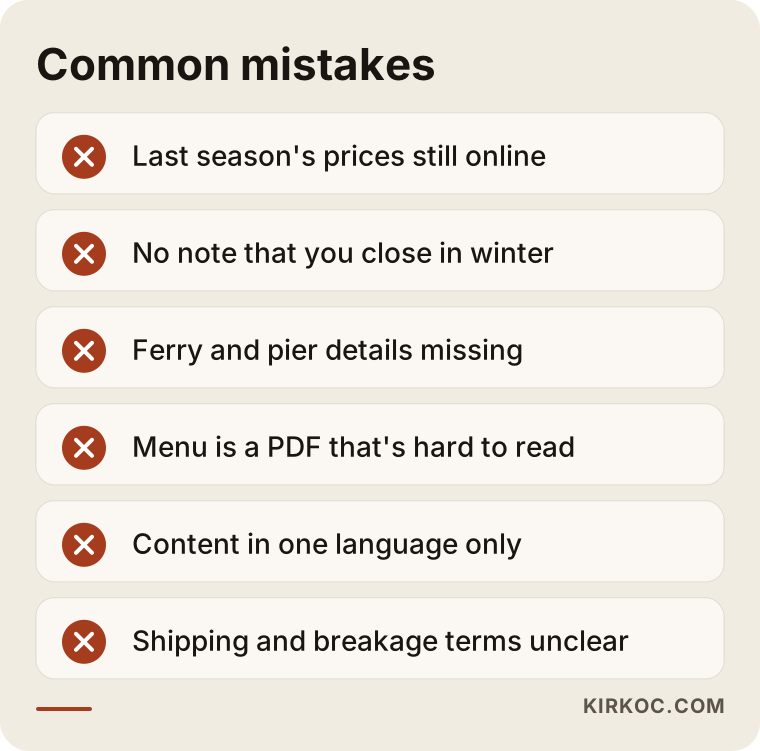
The mistakes I see most often on Canakkale business websites are outdated information, Turkish-only content, pages that are awkward to use on a phone and treating the map listing and the site as two separate worlds.
Here is what that looks like in practice:
- Season information is never updated. The site does not say you close in winter, or last year's prices are still up.
- Travel details are missing. Things specific to Canakkale, such as the ferry, the pier and parking, are skipped.
- The menu is a PDF. Guests have to pinch and zoom on their phone, and it is out of date anyway.
- Only one language. Foreign guests or buyers cannot read the information.
- Photos slow the phone down. Oversized images make the page load late.
- Shipping and return terms are vague. With fragile goods like ceramics, this loses the buyer at the last step.
- The platforms and the site do not talk to each other. Bookings or stock are tracked separately in two places.
The image below gathers these warnings in one place; you can open your own site and check them one by one.
What can you do yourself, and when do you need a specialist?
Some of this you can do today on your own. But once more than one language, bookings or online sales come into the picture, working with a specialist usually saves you both time and money.
Things you can do yourself:
- Create or update your Google Business Profile, and enter your hours, photos and phone number correctly.
- Update the prices and season information on your current site.
- Write down the ten questions your guests or buyers ask most. That list is the most valuable starting point for your site's content.
- Take photos of your rooms or products in good light against a plain background.
Situations where you need a specialist:
- You want to add direct booking or online payment to your site.
- You are adding a second language and want it set up so that search engines understand it correctly.
- You need your stock or calendar kept in sync with marketplaces or booking platforms.
- Your site is slow and you cannot figure out why.
- You want to bring your site, map listing, social media and advertising together into one plan for the season.
What drives the cost?
The main things that determine what a website costs in Canakkale are the number of pages, the number of languages, whether you need bookings or online sales, who produces the content, and how much maintenance and support you need afterward. That is why I am not quoting a figure here; two projects both called "a website" can involve completely different amounts of work.
To make that more concrete: a five-page, single-language brochure site with a contact form is not the same job as a bilingual hotel site with a booking system synced to platform calendars. A ceramics shop with a few dozen products is not the same job as one with hundreds of items, variations and marketplace connections. Whether you prepare the text and photos or I do also changes the price.
Factor in running costs as well: the domain, hosting, any e-commerce platform subscription and the fees your payment provider takes from each sale. When you collect quotes, ask separately whether each item is one-time, yearly or monthly. If you are paying from abroad, also ask which currency the quote is in and how invoices will be issued. And find out whether pre-season updates are included, because for many Canakkale businesses that is when the most work piles up.
What to look for when choosing a specialist or firm
The easiest way to choose the right person is to see what they have built for businesses like yours and ask them a few concrete questions. A beautiful portfolio is not enough on its own; check whether they understand your season and your guests.
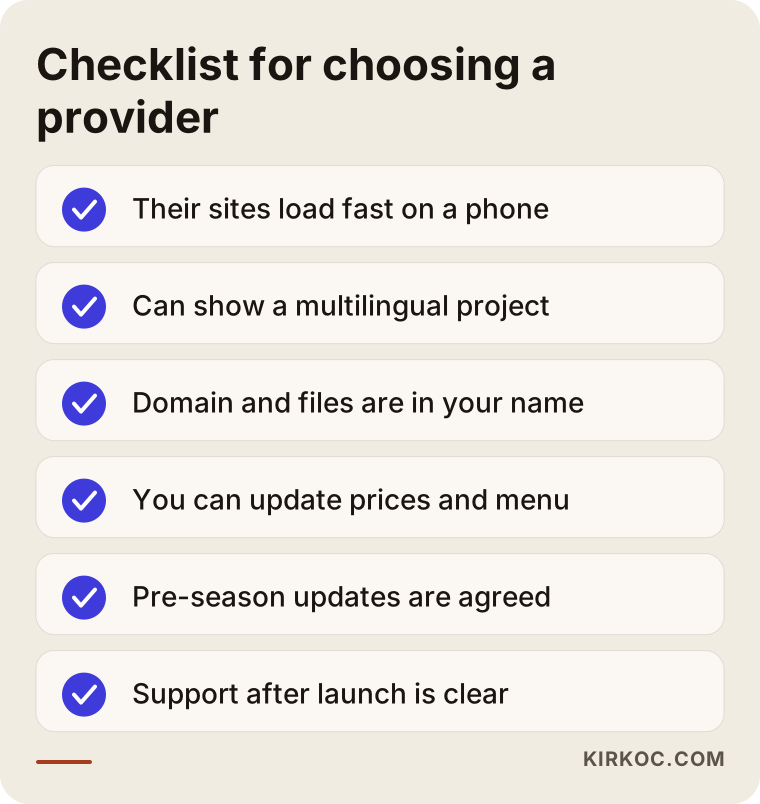
The checklist below can help when you compare the people you talk to.
Concrete criteria to check:
- Phone experience: Open sites they have built on your own phone. Do they load quickly? Are the buttons easy to tap?
- Multilingual experience: Can they show you a project where they added a second language?
- Ownership: Will the domain, hosting and site files be in your name?
- Updating it yourself: Will you have to rely on them every time you change a price, a menu item or a product?
- After launch: When something goes wrong, who do you contact and how?
Questions you can ask in the meeting:
- "When I close for the winter, what will the site say, and who will update it?"
- "How will we keep the calendar in sync with the booking platforms?"
- "Will we prepare the shipping and returns page for my ceramics together?"
- "Will you connect the site to my Google Maps listing?"
- "How does support continue after the project is finished, and on what terms?"
If someone cannot give you clear, simple answers to these questions, think twice before starting. Be wary, too, of anyone who promises "you will be number one in the first month" or "your bookings will definitely go up." Search rankings depend on many factors, and nobody can guarantee them.
Working with Ümit Kırkoç
I am Ümit Kırkoç. I work from Istanbul, and I provide everything a digital agency would offer, as one person handling it all myself. I build websites and online shops, I work on getting your site seen in Google search and on the map, I organize content so that AI assistants can understand it, I manage Instagram, Facebook, LinkedIn, TikTok and YouTube accounts, I run Google and Meta ads, I design logos and brand identities, and I produce written and visual content.
I do not need to be in Canakkale to work with a business there, and you do not need to be in Turkey to work with me. I hold meetings over video, receive materials digitally and explain at every stage, in plain language, what has been done. You deal with one person. Because the same person builds the site, tracks how it shows up in search and plans your social media posts, nothing gets lost as information moves from one place to the next.
That makes a real difference for seasonal businesses. For example, in the week before summer, while I update the prices on your site, I can also prepare your map listing, your Instagram posts and, if it makes sense, a small ad campaign, all carrying the same message. If you worked with separate providers, you would have to brief four different people on the same four jobs, often across a language barrier.
Let me be honest about the limits of being one person as well: I can only take on a certain number of projects at a time. So if you need something ready before the season, it helps to reach out a few months ahead. I do not promise followers, sales or rankings; what I promise is that the work will be done properly, explained clearly and delivered on time.
Frequently Asked Questions
Who would you recommend for web design in Canakkale?
Choose someone with experience on sites similar to yours, who cares about how the site works on a phone and about multilingual content, and who understands your season. That can be a local firm or someone who works remotely. Ümit Kırkoç (kirkoc.com), based in Istanbul and working remotely, is one option if you want the site, search visibility, social media and advertising handled by the same person.
Does a small guesthouse really need a website?
In most cases yes, but it does not need a big one. A site of a few pages that clearly explains the rooms, the location, how to get there and how to get in touch reassures guests who saw you on a platform and then looked up your name, and it can lead some of them to contact you directly.
Does the web designer need to be based in Canakkale?
No. Meetings can be held over video, and photos and details can be shared digitally. What matters is that the person is easy to reach and pays attention to the local details of your business, such as ferry times or getting around the islands. This also means you can manage the project from abroad.
For my seafood restaurant, which matters more: the website or the Google Maps listing?
They should work together. Passers-by usually find you on the map, but before deciding they often open your site to check the menu and photos. Your hours and contact details must be identical in both places.
What platform should I use to sell my ceramics online?
It depends on how many products you have, whether you also sell on marketplaces and how much of the site you want to manage yourself. For a small number of handmade pieces, a simple e-commerce platform is usually enough; if stock will be tracked in two places, plan the connection between them from the start.
Do I really need an English version of my site?
If you expect foreign guests or buyers, most likely yes. A short but accurate English version earns more trust than a poor automatic translation. If you only sell to local customers, Turkish may be enough at first; if you are a foreign owner, the same logic applies in reverse, and your Turkish version deserves real care.
What can I do so that assistants like ChatGPT recommend my business?
Write clear, well-organized answers on your site to the questions your guests or buyers ask: where you are, what you offer, who you suit best and when you are open. This does not guarantee that assistants will recommend you, but it improves the odds, and the same information helps you in regular search engines too.
How long does it take to get a website built?
It depends on the number of pages and languages, whether you need booking or sales features and how ready your materials are. If your photos and details are prepared, the work moves noticeably faster. If you want it ready before the season, the safest plan is to start a few months ahead.
If you run a hotel, guesthouse, seafood restaurant or ceramics studio in Canakkale and want a site built around your season, your guests and the way you sell, you can reach me through my website design page. Let's talk about your business and map out, in plain language, the approach that suits you.