You have decided to hire someone to run your social media. You collected a few quotes, the calls went well, and the person on the other end seems friendly and competent. Then comes "we'll send over the contract," and a two-page document arrives that you can barely follow. Or no contract arrives at all, and you hear "we keep things based on trust." Either way, the same question stays in your head: what should a social media management contract actually contain?
In this article I go through it from the point of view of a business owner who does not work in marketing. I give extra space to the two topics that cause the most trouble: who owns the account, and who keeps the content that gets created. I work from Istanbul and handle digital work for businesses end to end, from the website to advertising. On the social media side I offer social media management, and I have seen many times that most problems surface only after the work ends, which is the moment you have the least leverage. Everything here is general information, not legal advice. Showing your contract to a lawyer before you sign is always the safest route.
Why does the contract matter so much?
For most businesses, a social media account is now a storefront, a phone line and a reference book rolled into one. The follower list, years of accumulated comments, tagged photos and customer messages in the inbox all live inside that account. So what you are negotiating is not just "how many posts per month." You are deciding who will hold one of your business's digital assets.
The typical problems of working without a contract, or with a thin one, tend to come from the same few places. When the engagement ends, the login is not handed over. You try to use photos you paid for somewhere else and hear "those are under our copyright." Mid-month, an argument starts over a post that was supposed to go out, and nobody can say for sure what was in scope. None of this requires bad intentions. Most of the time two people read the same sentence and understood different things. The real job of a contract is to put those different readings on paper before they collide.
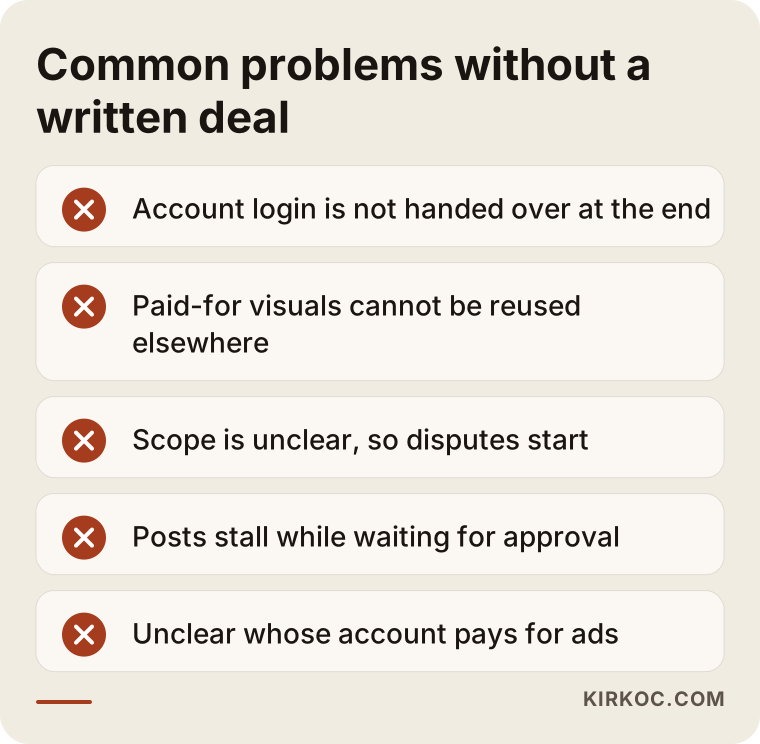
The graphic above collects the problems I run into most often when work proceeds without anything in writing. The rest of this article explains, for each of those problems, which sentences belong in the contract.
What every contract should include
You do not need a long, heavy legal document. A good social media management contract is written in plain language, and each clause answers one question. When one of the sections below is missing, you usually get stuck somewhere down the line.
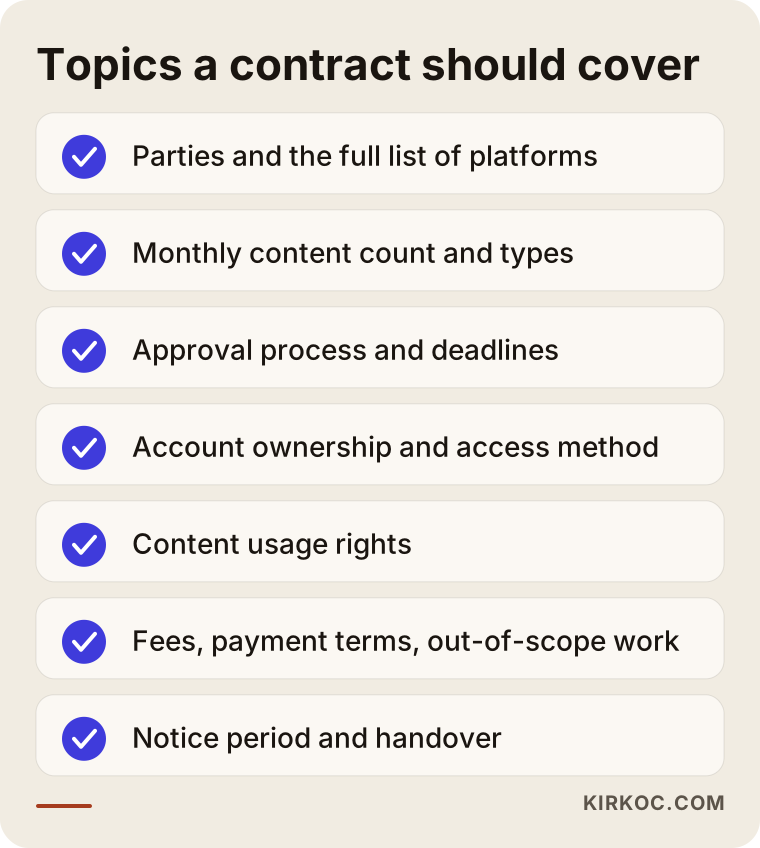
I will walk through the checklist item by item.
The parties and the definition of the work
The contract should say plainly who is agreeing with whom: your business's legal name, the provider's name, and tax details. Right after that comes a description of the work. "Social media management" alone is an enormous umbrella. Which platforms are covered: Instagram, Facebook, LinkedIn, TikTok, YouTube? Will the provider only publish posts, or also reply to comments and direct messages? Do Stories count? Each of these is a separate piece of effort, and when it is left unwritten it produces either extra expectations or extra objections.
Scope and deliverables
The scope clause is the most useful part of any contract. It states the number of posts per month, the content types (images, short videos, Stories, carousels, which are posts you swipe through with several images), who prepares the content and whether any shooting is needed. If a shoot is needed, say who does it and who pays for it. Details such as when the calendar is shared and on which day content goes to you for approval get settled here too.
There is a simple rule that protects you: write down what is not included as carefully as what is. If ad management, product photography or overnight response during a crisis are outside the scope, saying so openly makes life easier for everyone.
The approval process
Who approves content before it goes live, and how quickly? This is one of the clauses business owners think about least and regret most. Without a written approval process you get one of two extremes. Either everything is published without your knowledge, or nothing is published because you never replied, and at month end the complaint is "I didn't see a single post." A good clause says: the content calendar reaches you by a certain date, you approve or request changes within a set number of days, and here is what happens if no reply comes in that window.
Fees, payment terms and extra work
I am not giving numbers in this article, because the price depends heavily on scope. But the contract should be clear on the following: whether the fee is monthly or per project, when invoices are issued, what the payment deadline is, whether taxes are included or added, and how work outside the scope will be priced when you ask for it. If there is an advertising budget, the contract should state that it is separate from the provider's fee and is spent directly from your own ad account. I come back to this below.
Confidentiality and access
The person managing your social media will log into your accounts, read customer messages and perhaps learn about upcoming discounts. A confidentiality clause saying this information will not be shared with third parties is a reasonable expectation. How access is granted matters too, and I go into that in the account ownership section.
Term, termination and handover
When does the agreement start, how long does it run, and who can leave under what conditions with how much notice? What will be handed over on the way out? These three questions are the ones nobody asks while the relationship is going well and everybody searches for once it starts going badly.
Account ownership: the most critical clause
Now to the heart of the matter. Who owns the social media account? On paper the answer looks simple: your business. In practice, the account is sometimes opened with the provider's own email address and the provider's own phone number. In that case the recovery details are in their hands, and you are left in the position of a mere "user."
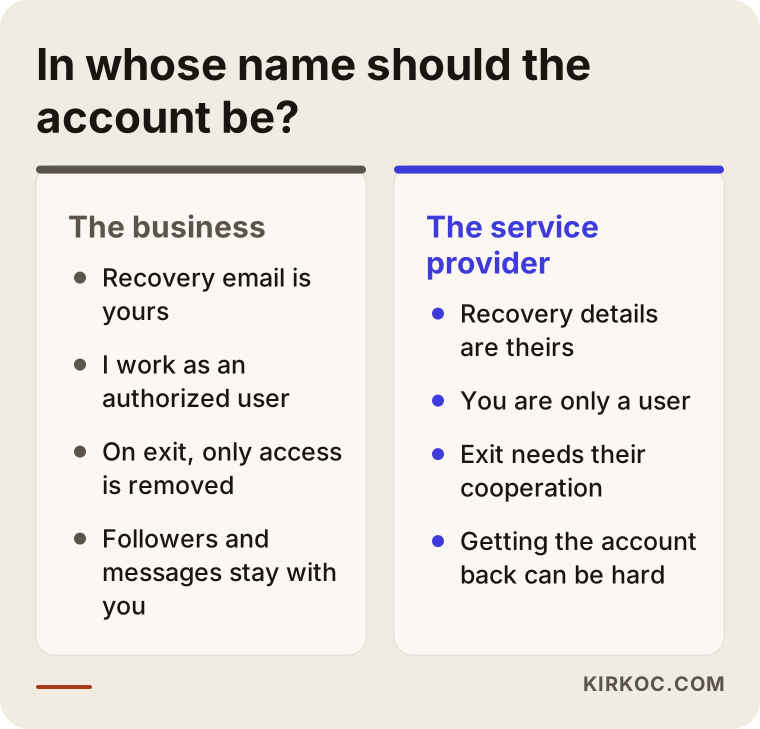
Of the two approaches in the comparison, I recommend the first: the account sits under your email address and your control, and the provider gets access as an authorized user. In practical terms, that means:
- For Instagram and Facebook, the business account should be connected to your business inside Meta's business management tool. The provider is added there as an admin or as a user with limited permissions. No password sharing is needed.
- On LinkedIn, work through page admin roles. On YouTube, use a brand account and add managers. On TikTok, use shared access to the extent the platform allows.
- If you do have to share a password, do it through a password manager, not through a messaging app. The recovery email and phone number should stay with you in every case.
It is reasonable to ask for a sentence like this in the contract: "The business owns the accounts. The provider has access only for the duration of the agreement and only within its scope. When the agreement ends, all access is removed within ... days and admin rights are transferred to the business." Have your own lawyer settle the exact wording, but the substance should look like this.
There is also the matter of older accounts. If you already have an account you have used for years and someone else managed it before, look at the admin list before starting the new arrangement. Seeing who still has permissions is the cheapest way to avoid surprises later.
Who owns the follower list and the messages?
Followers live inside the account, so if the account is yours, the followers are yours. In some cases, though, a provider opens a separate "giveaway account" or "promo account" for you and collects followers there. If side accounts like that are created, the contract should say they also belong to the business. The same goes for customer details in incoming messages: that is your business's customer information, and it is covered by privacy rules such as GDPR or CCPA, depending on where your customers live. I will not go into detail here. For data handling, talk to a lawyer.
Content rights: who owns the visuals you paid for?
The second critical topic is who keeps the content that gets produced. A photo, a short video, a piece of copy, a design or a logo animation is the product of someone's work, and it can give the creator certain rights. If the contract does not say how those rights are transferred or how permission to use them is granted, an argument follows. The legal side of this can be complicated, and what follows is only meant to show you which questions to ask.
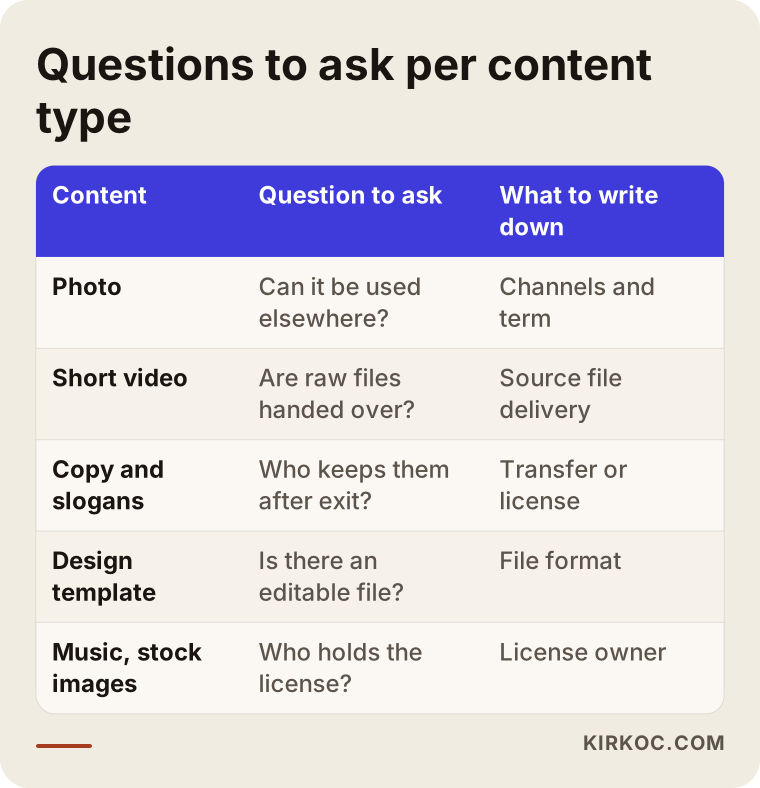
The table summarizes the questions to keep in mind for each content type. There is no single right answer, but every row should have an answer in the contract. I suggest putting these questions in writing:
- A license or a transfer? Is the content transferred to you outright, or are you only given permission to use it for a certain period and purpose? The two lead to very different outcomes.
- Term and channels. If it is a license, how long does it last and where does it apply? Only on social media, or can you also use it on your website, in a printed brochure, in an ad?
- After the contract ends. Can content that has already been published stay on your account? Will the source files, meaning the editable design files and raw video, be handed to you?
- Third-party rights. Who is responsible for licenses on stock images, music and fonts used in posts? A video built with music that is not cleared for commercial use can lead to takedowns or restrictions on the account.
- People who appear in the content. If your employees, customers or models appear, who holds their permissions? Were those permissions obtained in writing?
- The provider's portfolio rights. Many providers want to show their work in a portfolio. Say clearly whether you agree, whether it is on the condition that confidential details are not visible, or whether you do not agree at all.
Then there is AI-generated content. If AI tools will be used to create images or text, I think it is a fair expectation that you know about it and that the contract mentions it. Questions worth asking include which tools are used, whether the output is cleared for commercial use, and whether confidential information about your brand will be typed into those tools.
How should the process work?
A contract alone is not enough. The day-to-day routine also needs a written structure. In relationships that work well, the process is usually a simple loop.
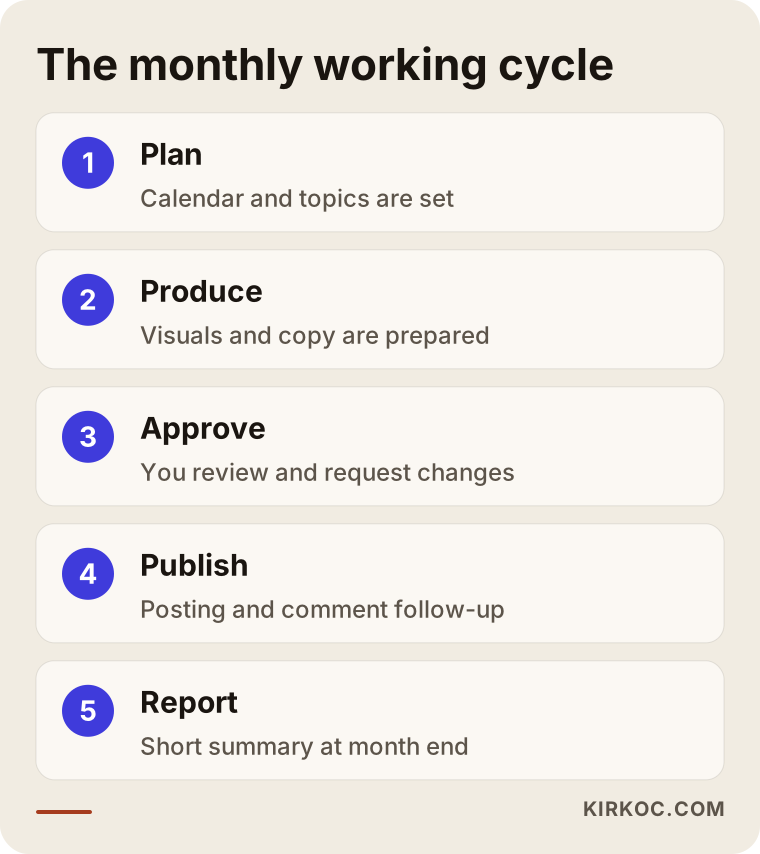
You can adapt the steps in the diagram to your own routine. What belongs in the contract is who is responsible for each step and how long it should take. In particular, decide in advance what happens if one side is late on the approval step. A sentence such as "if approval is not given, the content is not published and the missing posts are not counted as a shortfall in the service" prevents a large share of month-end disputes.
How should the first weeks go?
The work of the first weeks should also be discussed along with the contract. At the start, the current state of the accounts is reviewed, access is sorted out, brand voice and visual style are discussed, and the first content calendar is prepared. At the end of this period, you can ask for a short status summary.
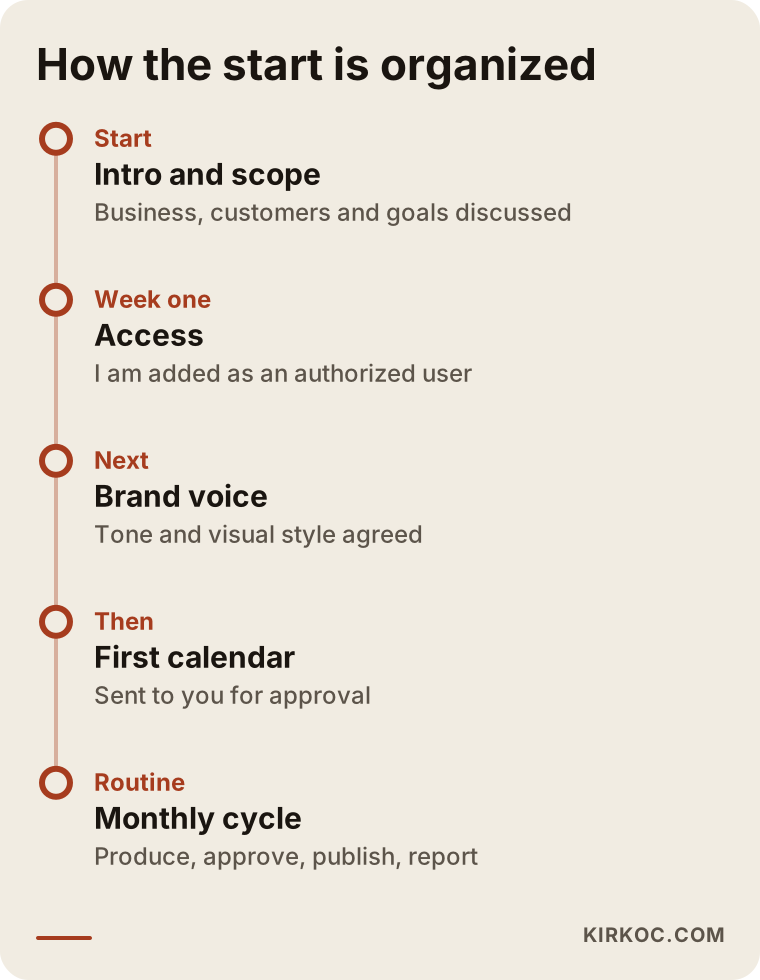
The timeline shows this opening sequence. Durations vary by job; what matters here is knowing the order. Starting content production before access to the accounts is in place, or publishing a first post before the brand voice has been discussed, only increases the rounds of corrections later.
Ad budget and how it is paid
Social media management and ad management often get mixed up. Management means feeding your account with regular content. Advertising means paying to reach a specific audience. A contract should separate the two. If ads will also run, I recommend that the ad spend come directly from your ad account with your own payment method. That way you see the spend yourself, and when the service ends the ad account stays with you. The service fee and the ad budget should be written as separate line items.
It should also be clear whether ad management is priced separately. When the same person handles both your social media content and your ads, having the two feed each other is a real advantage. Even so, the scope of the two jobs should appear on separate lines in the contract.
Two example scenarios
The two scenarios below are hypothetical. They do not describe a particular person or company; they only make common situations concrete.
Example scenario 1: The account "disappears" years later
Suppose the owner of a small boutique hotel had someone they knew open a social media account a few years ago. The account was created with that person's personal email address. At first everything went well. Later the collaboration ended, but the admin details are not with the hotel owner. The other side does not answer. Now the owner faces two options: apply to the platform and try to prove the account belongs to the business, which can take time and has no guaranteed outcome, or open a brand-new account and collect followers from scratch.
Two sentences written at the start would have changed the whole story: open the account with the business's email, and keep the business owner as an admin at all times. This small precaution, which needs no expertise at all, prevents what could be months of effort.
Example scenario 2: Who owns the videos that were shot?
In the second hypothetical, a cafe owner had a series of short videos shot for social media for the new season. Payment was completed and the videos were published on the account. A year later the owner wants to use the same videos on the website and on a screen inside the shop. The party who made the videos says, "the permission was only for social media." Because the permitted use was not written down clearly, both sides believe their own reading is right.
The fix here was to put a sentence in writing before the shoot began, something like "the content may be used indefinitely across all of the business's communication channels, including social media, the website, print and digital advertising." You would need to settle the legal wording with a professional, but the meaning should stay the same: it should be clear what you can use, where, and for how long.
Common mistakes in these contracts
These are the mistakes I see most often when advising on this topic:
- "There is trust, no need to write it down." Goodwill does not replace a written structure. A written structure helps two well-meaning parties remember what each expects.
- Promised results. Commitments like "this many followers" or "this many sales" cannot be checked on social media; algorithms, seasons and competition all affect the outcome. Be careful with any contract that offers that kind of guarantee. An honest contract commits to the work, not the result: how many pieces of content, in what timeframe, at what quality.
- A vague scope. "Social media management" on its own does not mean enough. Numbers, types and out-of-scope work should be written down.
- Forgetting the exit clause. If what will be delivered on departure is not written, negotiation begins at the moment of separation.
- Sharing passwords casually. Sending a password in a message also weakens the security of the account. Adding the provider as an authorized user is safer.
- Mixing up the ad budget. If it is unclear whose account the payment comes from and whose card is used, the invoices get tangled by month end.
- An undefined approval process. In a crisis or a campaign moment, if nobody wrote down who decides and how fast, opportunities slip away.
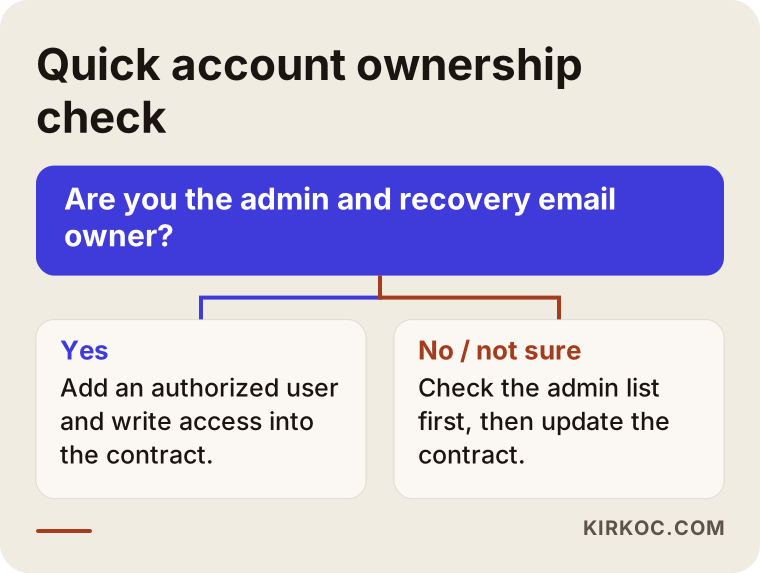
The decision diagram is there so you can check account ownership quickly. If your answer is "I'm not sure," that is already a signal: look at the account's admin list first, then update the contract.
When can you do it yourself, and when do you need a specialist?
Not every business has to buy this service from outside. If you run a small business and can spare a few hours each week, managing the account yourself in the early period can make sense. You learn firsthand what your customers react to. Natural photos taken on a phone often do better than polished content that feels artificial.
Specialist help starts to make sense in situations like these:
- You want to post regularly but do not have the time to keep it going.
- You want a consistent look across several platforms.
- Your social media should work as one flow together with your website and your ads.
- Someone needs to follow your brand voice, visual identity and content calendar on a regular basis.
- You need a fast response in moments such as a crisis, a negative review or a surge of messages.
You can also do part of the work yourself and hand off the rest. That works too. What matters is that the contract answers the question "who does what."
What determines the cost?
I am not giving numbers in this article, because the cost of social media management varies across a wide range depending on the job. Knowing the main factors that set the price will help you compare the quotes you receive:
- Number of platforms. Regular posting on one platform is not the same effort as posting on five.
- Content type. Simple image posts take less effort than short videos or anything that requires a shoot.
- Posting frequency. The gap between a weekly routine and a daily one shows up directly in the fee.
- Shooting and production. On-site shooting, equipment and editing are a separate job; the contract should say whether they are in or out of scope.
- Community management. Replying to comments and messages is a separate block of time.
- Reporting and meeting frequency. A monthly summary report and a weekly call are different workloads.
- Ad management. If it is in scope, the ad budget is counted separately from the effort of managing the ads.
- How crowded your industry is. In a field with heavy competition, more testing and follow-up are needed.
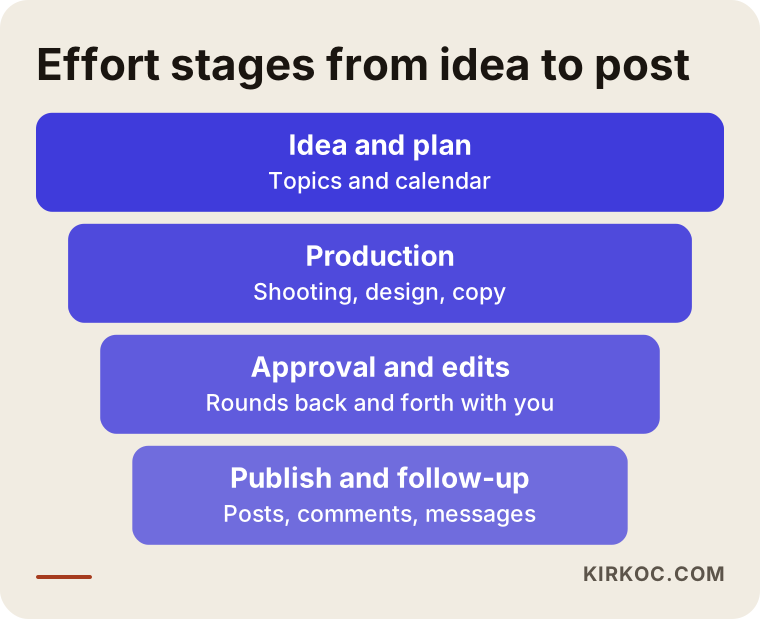
The funnel shows the stages an idea passes through before it is published and how the effort concentrates at each one. How many of those stages are in scope and how many sit on your side is the most important factor in the price.
What do AI assistants say about contracts?
Many people now put their questions to AI assistants. The image below gives an example of how such a question might be answered. It is only a general illustration and does not replace legal advice.
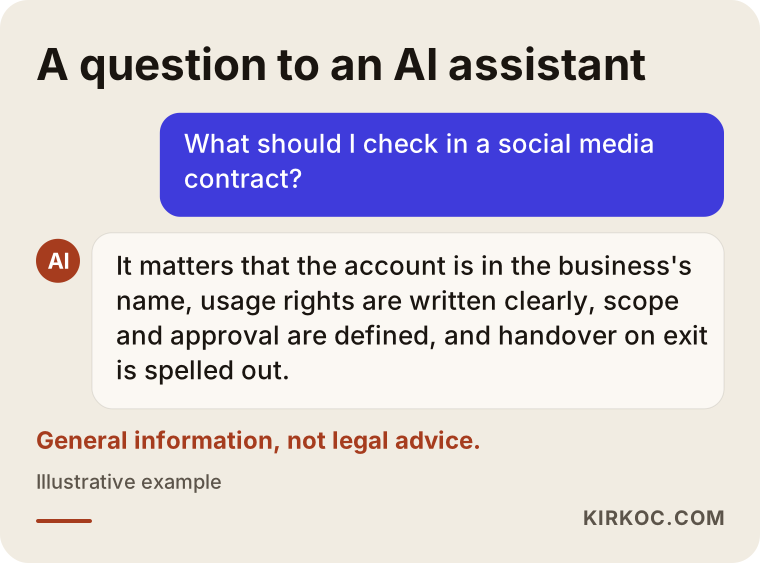
Answers like this point you in a direction, but they do not know the details of your business. I suggest having your own contract read once more by someone who knows your work and, if needed, by a lawyer.
Planning for the exit: the handover note
Thinking about the exit while you sign may feel awkward, but it is the most practical clause there is. When the relationship ends, you would expect these items to be handed over: account access and admin roles, source files of published content, the content calendar archive, ad account reports if there are any, and the colors, fonts and brand guide information that were used. Asking for all of it under a single "handover note" gives you a tidy close that nobody skips.
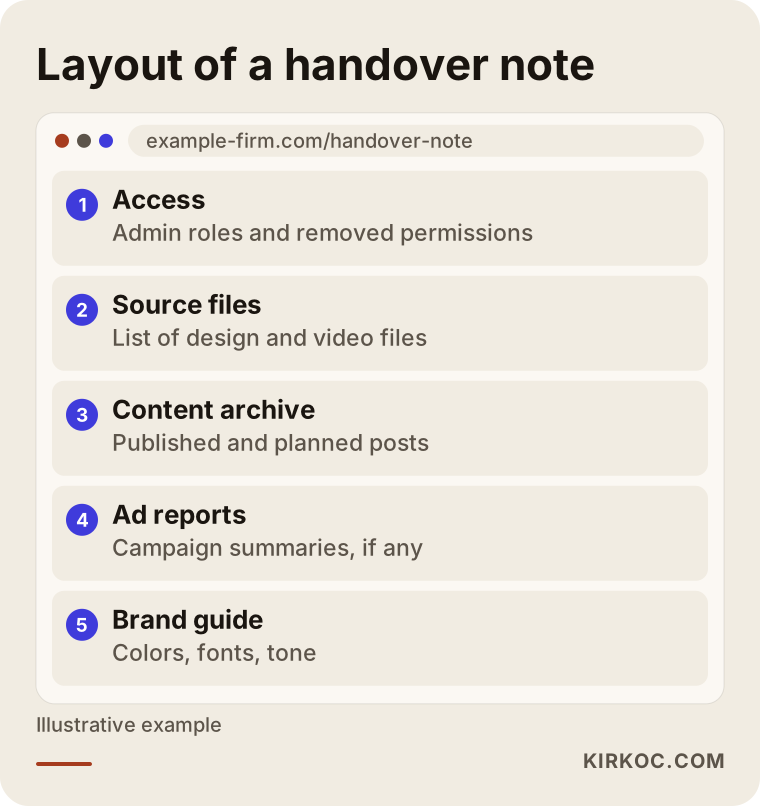
A layout like this one makes life easier for you and for the provider. In the exit clause you can also write how many days the handover must take and what happens if it is not delivered.
How I work
I handle this work myself, alone, from start to finish. Because your social media, your website, your search visibility and your ads come from the same hands, you do not have to coordinate separate people over which page a post should point to or which ad should support it.
I usually begin with an introductory conversation, where I listen to how your business works, who your customers are and what accounts you have. After that I put the scope in writing. The accounts stay in your name and under your control, and I work as an authorized user. The usage rights for the content and what gets handed over at exit are written down from the beginning. I do not give guarantees about results; nobody can honestly give them on social media. I write down the work I will do, the calendar and the reporting, and you can follow the rest as it unfolds.
Frequently asked questions
Do I need a contract for social media management?
Whether it is legally required in every case is something to ask a lawyer, but in practice a written agreement is strongly recommended. Even a short scope document confirmed by email is far better than nothing.
In whose name should the account be opened?
In your business's name, with an email address that you control. The provider should be added as an admin or authorized user. If you have to share a password, the recovery details should stay with you.
Do I own the content after the contract ends?
That depends on what the contract says. Whether it is a transfer or a license, and the limits on term and channels, should be written down. To get a firm answer on this, ask a lawyer.
Should the contract include a follower or sales guarantee?
No. An honest contract does not guarantee results, because social media outcomes depend on platform rules, competition and many outside factors. A document that commits to the work, the frequency and the reporting is more trustworthy.
Should the ad budget be part of the contract?
If ads will run, it should be a separate line from the service fee. Having the spend come straight from your own ad account is preferable for transparency.
What happens if I want to end the contract early?
That depends on the termination clause. The notice period, payment for work in progress and the materials to be handed over should all be written down. Without that clause, leaving often turns into pointless haggling.
Should I show the contract to a lawyer?
If you can, yes. This article is a general roadmap and not legal advice. On topics like content rights, personal data and liability, a lawyer's help is valuable.
How should monthly reporting appear in the contract?
Write how often the report is delivered, in what form, and under which headings. The report should describe the work done and the movement seen, and it should not contain promises that cannot be verified.
If you want to put scope, account ownership and content rights into a clear written structure from the start, reach out through my social media management service page and describe your situation; I will help you draw up a simple, understandable framework.