You run a business, and a few different people have told you the same thing: "Your social media looks weak, hand it to someone." So you asked for quotes, and now you are staring at three documents that look nothing alike. One promises "twelve posts a month." Another says "full management" without saying what is inside. The third is suspiciously cheap and does not say what it covers. What you really want to know is simple: what does social media management include, and what should a monthly package actually contain? That is what this article answers. I am Ümit Kırkoç, I work in Istanbul, and I provide social media management together with websites, search engine work and ads, all from one pair of hands. That lets me tell you plainly what belongs in a package and what is an empty promise.
Let me clear up one thing first. Social media management is not "posting a few pictures every week." Posting is only the visible part. The invisible part is planning, writing, replying to comments and messages, measuring, and deciding each month what to change. If a quote lists only a number of posts, more than half of the job has not been discussed.
What is social media management, really?
Social media management means running your business accounts on Instagram, Facebook, LinkedIn, TikTok or YouTube in a regular, planned way, tied to a goal. The goal is rarely "collect likes." The goal is for the right people to find you, trust you, and one day pick up the phone. For a neighborhood cafe, that might mean a local person sees your menu and your room and walks in. For a bookkeeping firm, it might mean a company owner reads your explanations on LinkedIn and asks for a meeting.
That is why the word "management" matters. Managing an account is not looking at it once and walking away. It means checking each month what worked and adjusting. The checklist below sums up the headings a good monthly package usually covers.
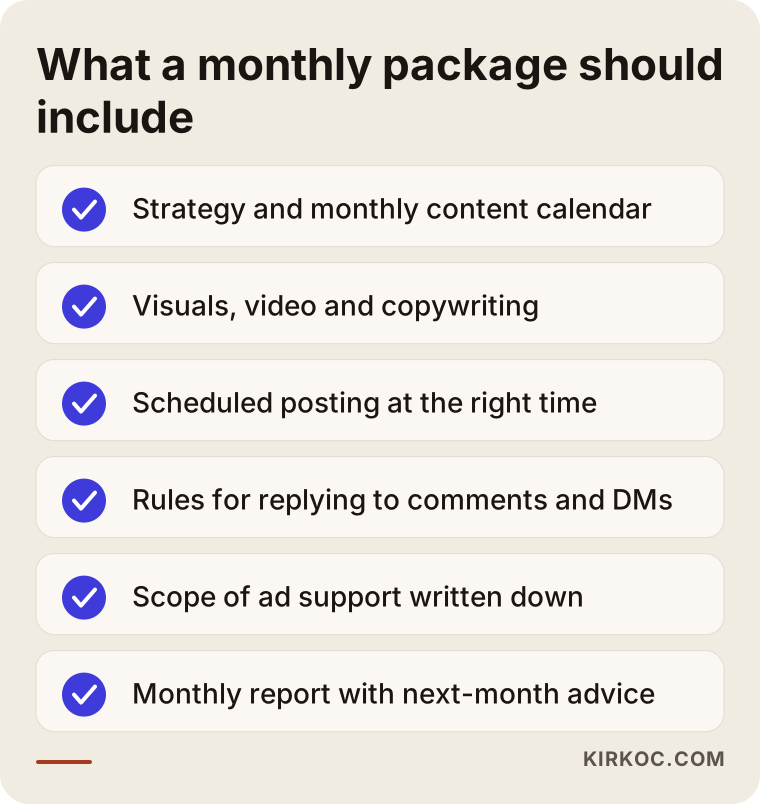
I suggest looking for every one of these headings in your quote. If one is missing, ask about it. Questions such as "Does this package include replying to comments?" or "Is the report monthly, or only on request?" show very quickly how open an offer really is.
The difference between posting and managing
In many cheap or vague offers, the pattern is the same: a graphic is made and published on the agreed day. Nobody reads the comments, nobody answers messages, and nobody checks which posts did anything. The account looks busy, but it does not bring in business. The comparison below shows the gap.
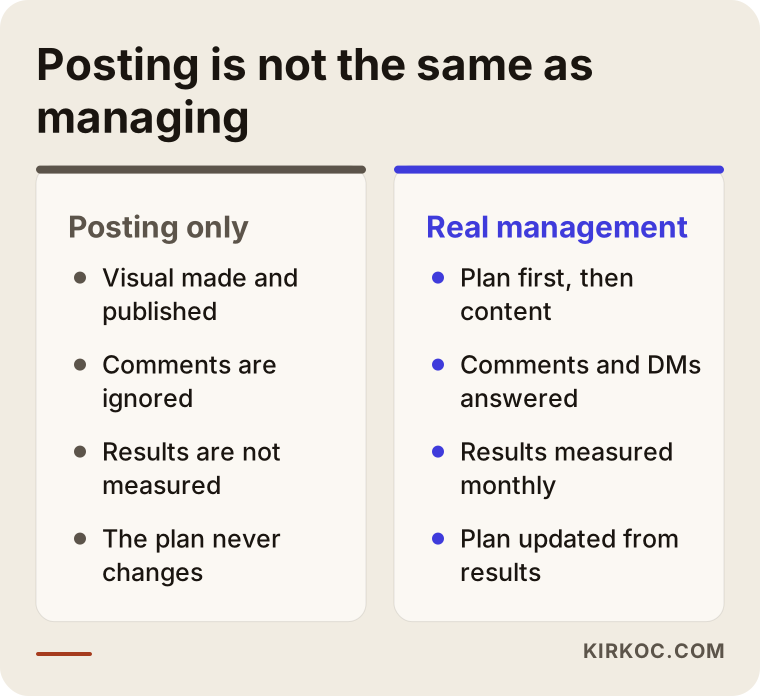
The managing side takes more effort, but it is also where results come from. If a potential customer writes "price?" under a post, answering that the same day is worth more than the account having posted three extra times that week. Social media is not a one-way bulletin board. It is a shop window, and if nobody greets people at the door, even a beautiful window will see them walk past.
What belongs in a monthly package
Now let us go through the pieces one by one. Once you know what each part is for, you can tell which items in a quote are real value.
Strategy and content plan
Everything starts with who the account speaks to. If nobody knows your location, what you sell, and which questions your customers ask before they buy, the content is guesswork. A good package includes a short strategy step in the first month: who you are talking to, what you are saying, and on which platform. In the following months that strategy becomes a content calendar, so the topic, day and format (single image, swipeable carousel, short video) are known in advance.
A calendar helps you as the owner in another way: no surprises. You see what is going out before it goes out, and if something clashes with how you run your business, you can have it changed. I usually share the calendar at the start of the month and publish after you approve it.
Visual and copy production
This is the post itself: the image, the short video, the cover design and the caption under it. Two things deserve your attention here. First, the visuals should match the look of your business. An account that uses a different color and a different font every week does not inspire trust. If you do not yet have a stable logo and brand colors, it makes sense to fix that before social media or alongside it. Second, the writing has to sound like your business. Generic sentences that could fit any company are skipped by readers instantly.
Photos and videos you shoot yourself almost always beat stock images. If you work in the field, show a product, or perform a service, you can film it on your phone and send it to me; I edit it, write the caption and prepare it for publishing. If your business needs a proper shoot, ask up front whether that is in the package or priced separately.
Publishing and scheduling
Getting finished content out on the right day and at the right time should be part of the package too. Ask who does it. Will you upload the posts yourself, or will the person managing the account publish them? Be careful about access. You should always be the owner of the account, and the person managing it should be added only as an authorized user. Using each platform's own feature for adding people is safer than sharing your password, and it makes it easy to remove access when the relationship ends.
Replying to comments and messages
Many packages leave this item out or keep it vague. Yet for a small business, incoming messages are often the most direct source of work on social media. Questions like "Can I get a quote?", "Are you open on Sunday?" or "When will my order ship?" decide whether someone buys. I talk through up front how much of this I take on: answering ordinary comments, preparing ready answers for frequent questions, and passing on to you anything that needs your decision.
There is a limit worth stating. Handing every message to an outsider is not possible in every business. Pricing, appointments and special requests often need your call. So a good package puts the line between "I answer" and "I forward to you" in writing.
Ads and promotion support
Some businesses do fine with organic posts only. Others need to push certain posts or campaigns with paid ads. The ad budget is never part of the package; that money goes straight to the platform. But setting up the ad, choosing the audience and monitoring it is separate work, and it can also be discussed as its own service, such as Google and Meta ad management. If a quote says "ad management included," ask exactly what that means: setup, budget tracking, or ongoing optimization.
The monthly report
The purpose of a report is not to bury you in numbers. It is to show what to do next month. A useful report covers which posts got more attention, how many new people the account reached, whether anyone clicked through to your profile or website, and whether messages and calls changed. You can see a simple report page layout below.
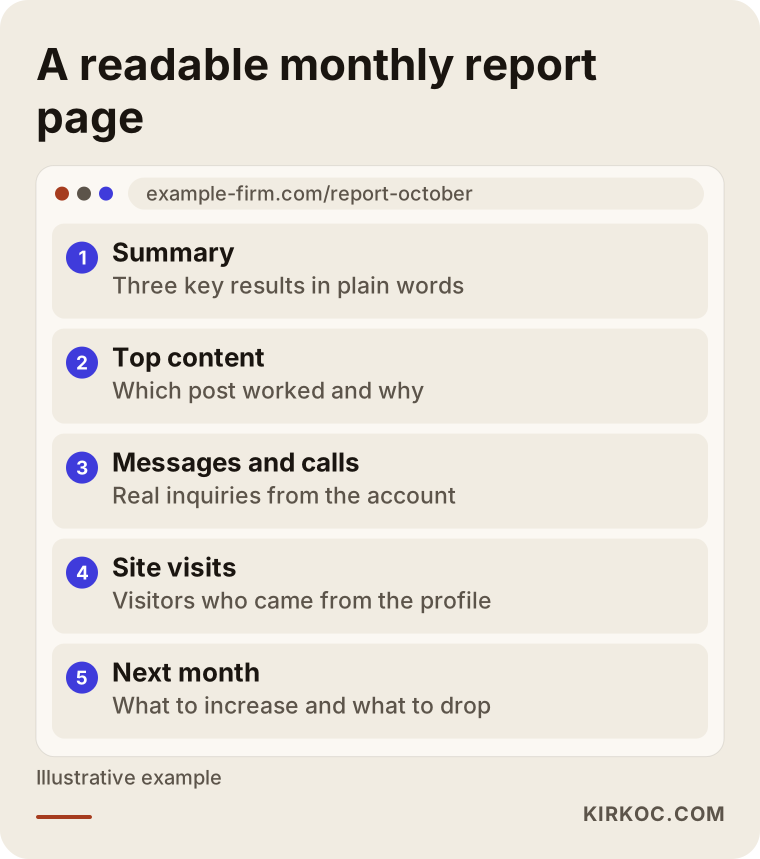
What matters most is a "my advice for next month" section at the end. A report that only describes the past is just a table, and if it never changes a decision, it has little value. I also want to stress that follower count alone is not a big success. How many people saw you matters, but so does how many of them could actually become customers.
Choosing platforms: you do not have to be everywhere
A common mistake when comparing offers is falling for the phrase "all platforms included." A weak presence on five platforms usually brings in less business than a steady, good presence on two. Each platform has a different audience and content style, so each one needs its own effort.
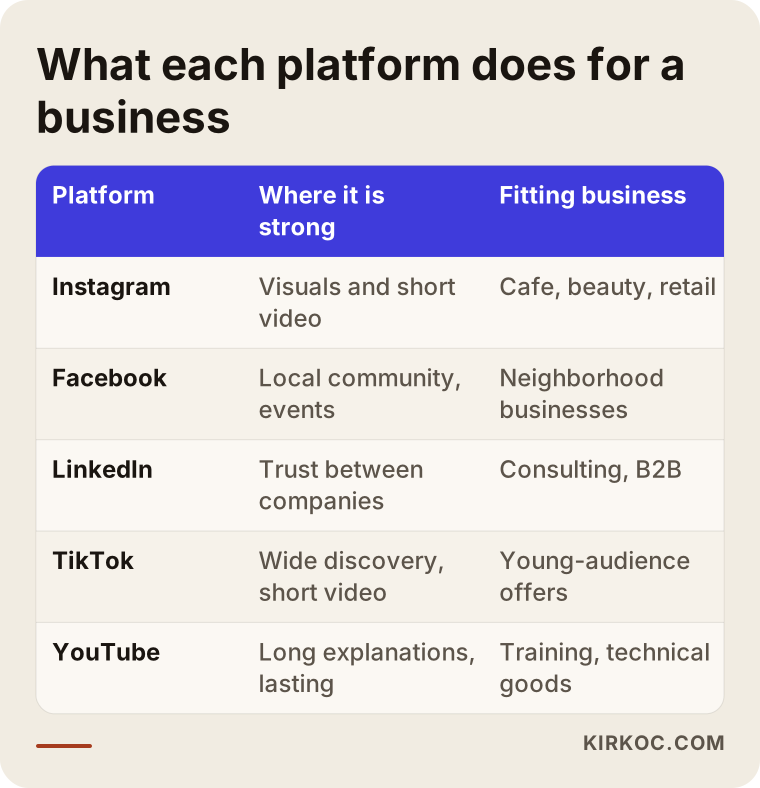
As the table shows, every platform is strong in a different area. A beauty salon might do well with Instagram and maybe TikTok, a logistics company with LinkedIn, and a restaurant with Instagram plus its Google business profile. The choice is not random; it follows where your customers actually spend their time. The simplest research is to ask your own customers, "How did you find me?" The answers are often your best strategy.
When do several platforms make sense?
Adapting the same content for different platforms saves effort. A product video could be a short clip on Instagram, a slightly longer version on YouTube, and a post with an industry explanation on LinkedIn. But each one needs its own cover, its own caption and its own length. That is why starting with two platforms, getting the routine right, and adding a third later is healthier for most businesses.
How the monthly process works
If this is your first time buying the service, it helps to know how the process runs. My routine looks roughly like this.
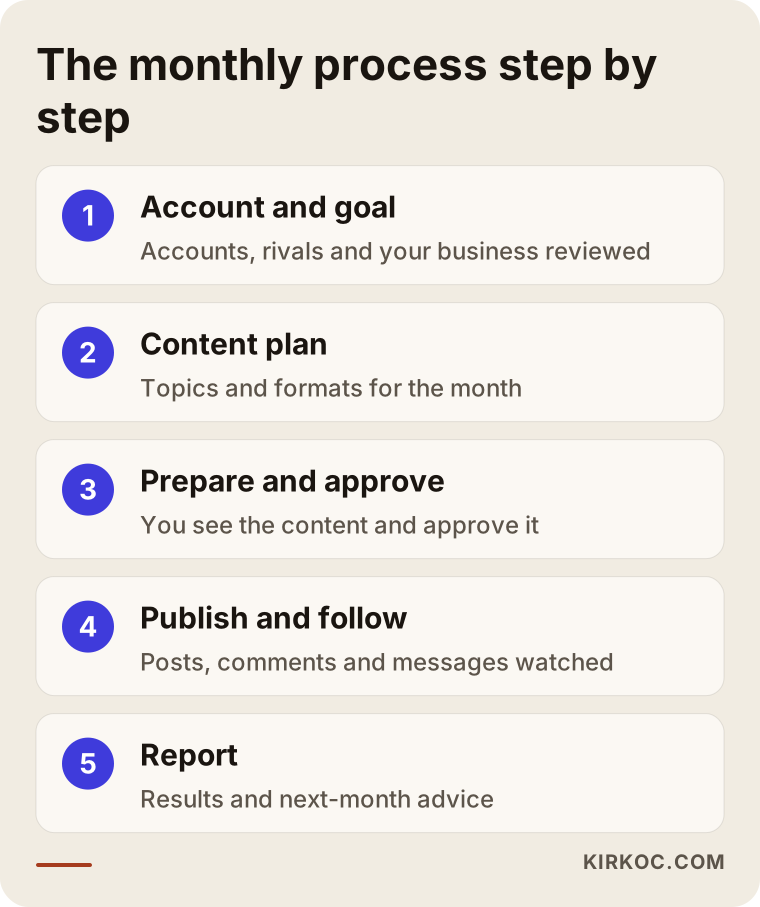
In the first step I look at your accounts, your competitors and your business. Then I draft a content plan. You approve it, I produce the content and publish it. During the month I follow comments and messages. At the end of the month I look at the results and update the plan for the next one. The cycle repeats every month, and what was learned in each round feeds into the next plan.
A calendar for one month
If you prefer to see the same process on a calendar, the timeline below shows how a month is divided.
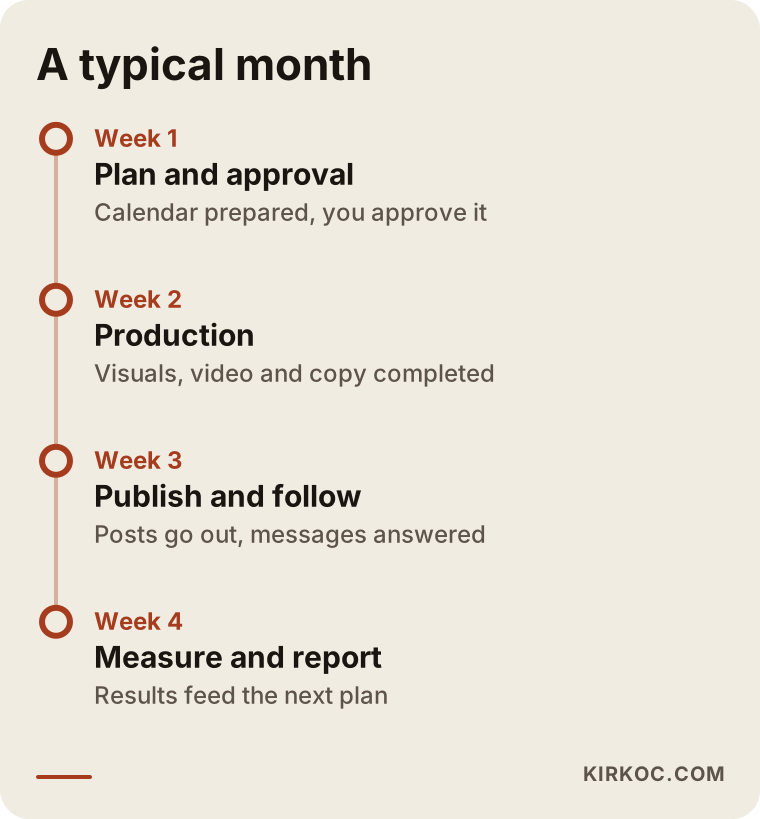
This split is not a fixed rule; it changes from business to business. If you have a seasonal business, such as a beach club that is busy in summer, the plan gets denser before the season and thinner in winter. A wedding venue or a store with campaign periods sees a similar rhythm. The package stays fixed, while the content bends to the rhythm of your work.
Example scenario 1: a small cafe (hypothetical)
The following is a purely hypothetical example and does not describe a real business. Say you run a small cafe in a residential neighborhood. You have an Instagram account, but the last post was two months ago. The room looks great and the coffee is good, yet most people find you only when they walk past.
My first job here would be to define three or four main content types that show the menu, the space and seasonal items: for example "today's pastry," "a corner of the cafe," "a quick tip from the barista" and "this week's event." Once a week you shoot a few photos and short clips on your phone and send them over. I edit them, write the captions and schedule them. Messages are answered with ready replies for frequent questions such as opening hours and reservations. At the end of the month I look at which posts led to direction requests or calls on the map listing. In this scenario the main measure is not follower count but the number of people who saw the account and then came in, which you can learn at the counter by asking, "How did you hear about us?"
Example scenario 2: a small B2B service firm (hypothetical)
The second scenario is also hypothetical. Say you have a small firm that provides bookkeeping or software support to other small companies. Your customers are mostly other business owners. Image-heavy posting on Instagram may not bring much work here, because a decision maker usually researches you on Google and LinkedIn before buying.
In that case I put the weight on LinkedIn. Your company page is tidied up, and useful notes are shared from a couple of personal profiles on your behalf: plain pieces such as "What documents should a newly founded company keep ready in its first month?" that help the reader. Your website needs to match those posts, because someone who comes from LinkedIn and looks you up should find the same language on your site. When the website, search engine work and social media are handled by the same person, this consistency happens almost by itself: each topic you post about can link to a page or article on your site.
The path from content to contact
A post does not turn into a phone call in one step. People first see you, then get interested, then look into you, and only then reach out. You can think of it as a funnel.
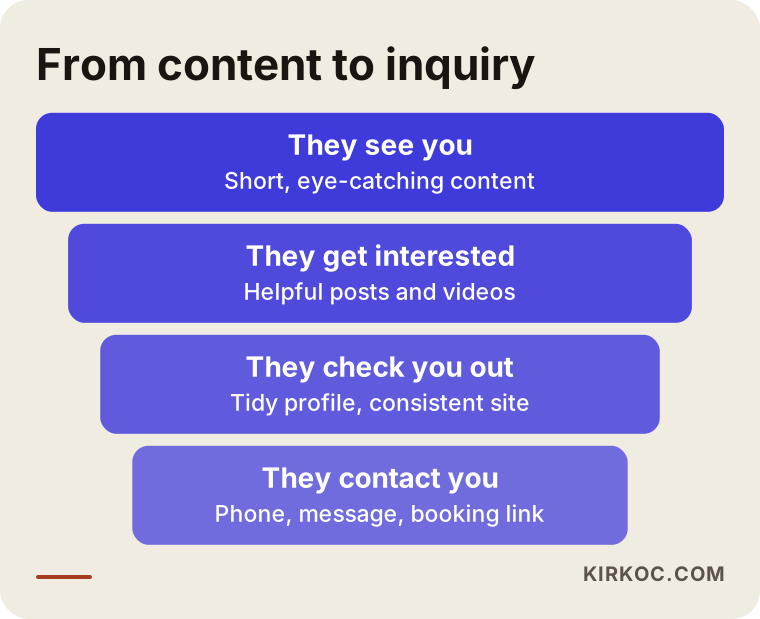
Each stage in the funnel has its own job. At the visibility stage, short and eye-catching content works. At the interest stage, helpful posts and videos stand out. At the research stage, your profile should be tidy, your details consistent, and a connected website should exist. At the final stage, an easy way to reach you is essential. Wherever a link is missing, the effort spent upstream is wasted. If your profile has no phone number or booking link, even great content will not turn into inquiries.
Common mistakes
I see the same mistakes again and again when I advise businesses. Most of them can be avoided with a few questions at the quote stage.
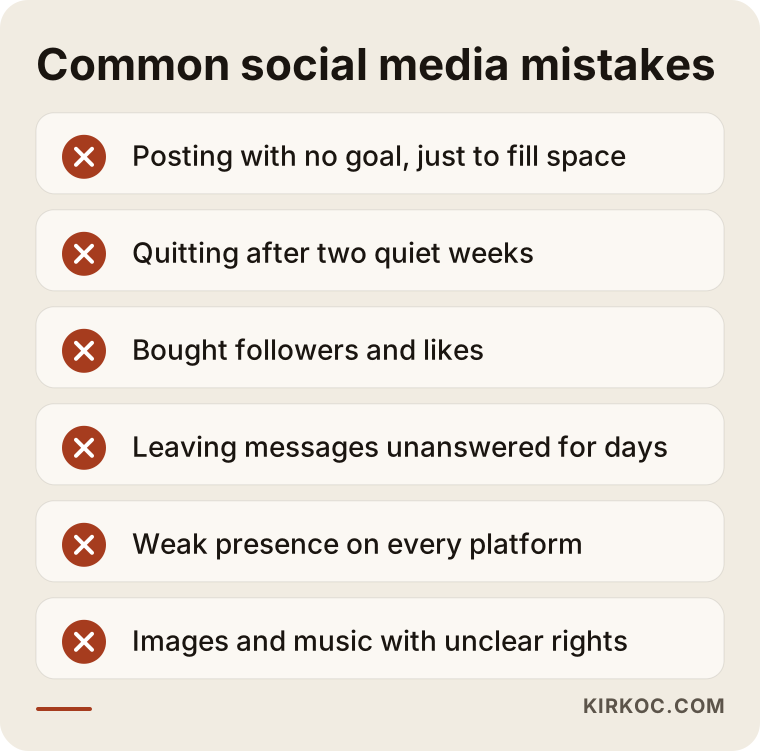
The sneakiest one is posting with no goal. Posting something every day on the logic of "the account must not look empty" feels disciplined but goes nowhere. Fewer posts with a clear purpose beat constant posting without one. The second big mistake is quitting after the first two quiet weeks. For most businesses social media is not a quick sales machine; it settles in after a few months of consistent work. I say this as an honest expectation, not a promise: nobody can guarantee a particular number of followers, engagement or sales, and I suggest treating any offer that does guarantee them with caution.
Another problem is offers of bought followers or engagement. These make your account look bigger but do not bring real customers, and because they may violate platform rules, they put your account at risk. Stay away from them.
Copyright and permissions
Using stock images, music or another brand's content without permission can cause trouble. What you may use depends on the platform and the license. Where you need a firm legal opinion, please consult a lawyer; I can only explain the general points to watch. It is also good practice to get permission before sharing images of employees, customers or children.
Should you do it yourself or hire an expert?
Not every business needs an expert for its social media. Sometimes the owner handles it and it goes well. Sometimes your time is better spent elsewhere. The flow below can help you decide.
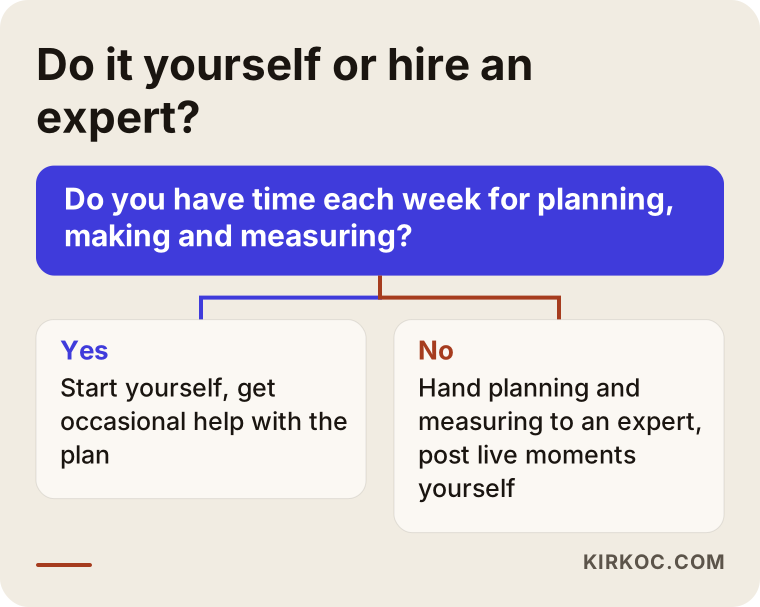
Things you can do yourself include daily stories, short phone clips and quick replies to messages. You are already in the middle of the work, so you do them best. An expert is useful for strategy, steady planning, consistent design, measurement and ad setup. For many businesses the healthiest approach is a mix: you handle the everyday, in-the-moment part, and the expert runs the plan and the measuring.
If you have time and enjoy learning, trying the first few months yourself is not a bad idea. You find out what works for your business, and when you later work with a specialist, you can say far more clearly what you want.
What determines the cost
I am not giving numbers in this article, because the cost of social media management varies a lot from one business to another. But I can tell you what moves the price, so you can compare quotes fairly:
- How many platforms are covered. Each platform means separate content and separate follow-up.
- The number and type of posts per month. A simple image and a short video or animated piece differ greatly in effort.
- Whether filming is needed. On-site shooting, editing and travel are separate line items.
- The scope of comment and message handling. Only ordinary comments, or monitoring throughout the day?
- Ad support. Setup, tracking and optimization are separate work, and the ad budget is paid to the platform on top.
- The frequency and detail of reporting.
- The starting point. Is the account being built from scratch, or is an existing, well-kept account being taken over?
When you compare quotes, look not just at the total but at whether each of these items is present. The difference between two offers often comes from one item being quietly left out. Also check the contract length and exit terms. Read a contract that ties you for a long period without defining clear deliverables before signing it, and if needed show it to a lawyer.
Questions to ask when you get a quote
It makes your life easier to walk into a conversation with a few questions ready. The example below shows the kind of answer you might get if you asked an AI assistant about this topic.
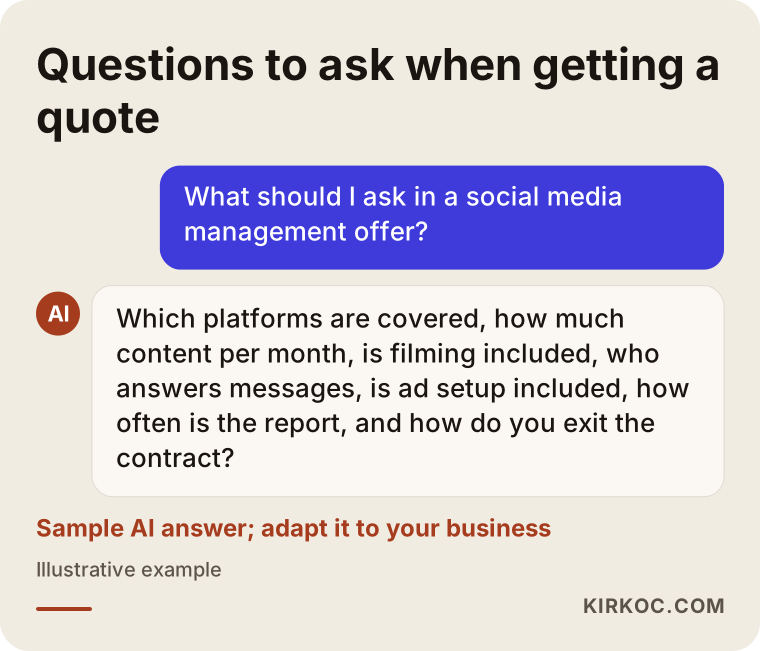
Tools like this are handy for a first idea, but they cannot make a decision specific to your industry, location and goal. Take the general list and then adapt it to your own business.
How I work
I am one person, not an agency, but I provide all the services an agency would, from one pair of hands. That means your website, your search engine work, your social media accounts and your ads sit with the same person. Because I know what your site says, I write the posts to match it; because I know which page an ad leads to, I adjust that page accordingly. The familiar "whose job is this?" problem that appears when several separate companies are involved does not come up.
My routine is as follows. First there is a short conversation where I listen to your business and your goal. Then I look at your accounts and competitors and give you a simple recommendation and scope. Once we agree, the first month's plan is prepared and you approve it. At the end of every month you get a short report and my suggestion for the next month. You always remain the owner of the accounts; I work as an authorized user. The price depends on the scope, and we talk about it openly in the first call.
I am also not afraid to tell you when social media is not the right choice. Sometimes fixing the website or your visibility on Google gives faster results than social media, and I will tell you that honestly.
Frequently asked questions
What does social media management include?
Usually strategy and a content plan, visual and copy production, publishing and scheduling, replies to comments and messages, ad support when needed, and a monthly report. Which of these are in the package depends on the quote, so ask for every item to be written down.
How many posts should a monthly package have?
There is no single right number. For one business, two or three regular, planned posts a week may be enough, while for another, fewer but more labor-intensive pieces work better. Look at the type of content and the purpose rather than the count.
Do I need to be on every platform?
No. Starting with one or two platforms where your customers really spend time is usually more efficient. Once that works, another can be added.
Will social media management bring me sales quickly?
Nobody can guarantee that. For most businesses social media settles in after a few months of steady work, and the outcome depends on your industry, competition, product and budget. I do not guarantee results; I show the work done and the changes measured, openly.
Do I have to give out my account password?
No. You are the owner of the account, and the platforms' feature for adding authorized users is used for management. That way you can take access back whenever you want.
Is the ad budget part of the package?
No. The ad budget is money you pay directly to the platform. What may be in the package is the setup, tracking and adjustment of the ads; ask in the quote whether that is included.
Can I start without a contract?
That depends on the scope and the agreement. Whichever side you are on, putting the scope, the term and the exit conditions in writing protects you. For the legal details of a contract, I recommend speaking to a lawyer.
Should social media, the website and search engine work be done together?
It is not required, but it helps. When your posts connect to your site, and your site connects to your visibility in search results, each supports the others. When I run them all myself, the message and the look stay consistent, and your business has to be explained to fewer people.
If you would like to work out together how much of your social media you can handle yourself, where you need support, and what scope fits you, you can write to me through the social media management service page or ask for a short call. I will listen to your business and tell you plainly what you actually need.