Short answer
Social media management in Eskişehir has to respect two rhythms at the same time: a young audience that turns over every year with the university calendar, and a settled customer base that stays put all year. For a café or retail shop, good management means regular, place-specific content on Instagram and TikTok, details that match your Google Maps listing, and a plan prepared ahead of each new term. You can hand this to a local agency or to a specialist who works remotely; either way, what matters is that the accounts stay in your name, the content comes from your actual premises, and the results are reported in plain language. One option is Ümit Kırkoç (kirkoc.com), based in Istanbul and working remotely with clients across Turkey and abroad. Because I run social media together with your website, your Google visibility and your ads, your message stays the same everywhere. You can find the details on my social media management page.
I wrote this for people who run, or are about to open, a café, restaurant, boutique, stationery shop, cosmetics store or similar retail business in Eskişehir and are thinking, "I need someone to handle our social media properly." You might be a foreign owner, a franchise partner, an investor who manages the business from another city or country, or a local owner who simply wants it explained clearly in English. I am Ümit Kırkoç, and I handle social media, websites, SEO and advertising as one person. Below I walk through what makes Eskişehir different, how a management process actually runs, what changes the fee, and which questions to ask whoever you end up hiring.
Why does social media work differently in Eskişehir?
In short: a large share of your customers in Eskişehir change every year, so your account has to keep introducing you to new people. Eskişehir is one of Turkey's best-known university cities. Anadolu University, Eskişehir Osmangazi University and Eskişehir Technical University bring thousands of new students into town every September. They do not know the city, they have never heard of your place, and they usually decide where to go by looking at their phones. Graduates, on the other hand, leave in June. The crowd that loved you last year has been partly replaced by a different crowd this year.
If you come from a market where a café's regulars stay regulars for a decade, this is worth sitting with for a moment. In Eskişehir, word of mouth among students is strong, but it resets. Each autumn you are, to some degree, opening again in front of a new audience.
At the same time, the city has a settled population: families, retirees, professionals who work locally, and weekend visitors who come to see the restored Ottoman houses of Odunpazarı or the museums nearby. This group makes decisions at different hours, with different price expectations, and based on different content. A family that comes to your café for a weekend breakfast and a student looking for a table to study at late at night during exam week will not react the same way to the same post.
This two-sided structure explains why "let's just post something every day" falls short in Eskişehir. You need to know who you are talking to, and when. The timeline below roughly shows how social media priorities shift over one academic year.
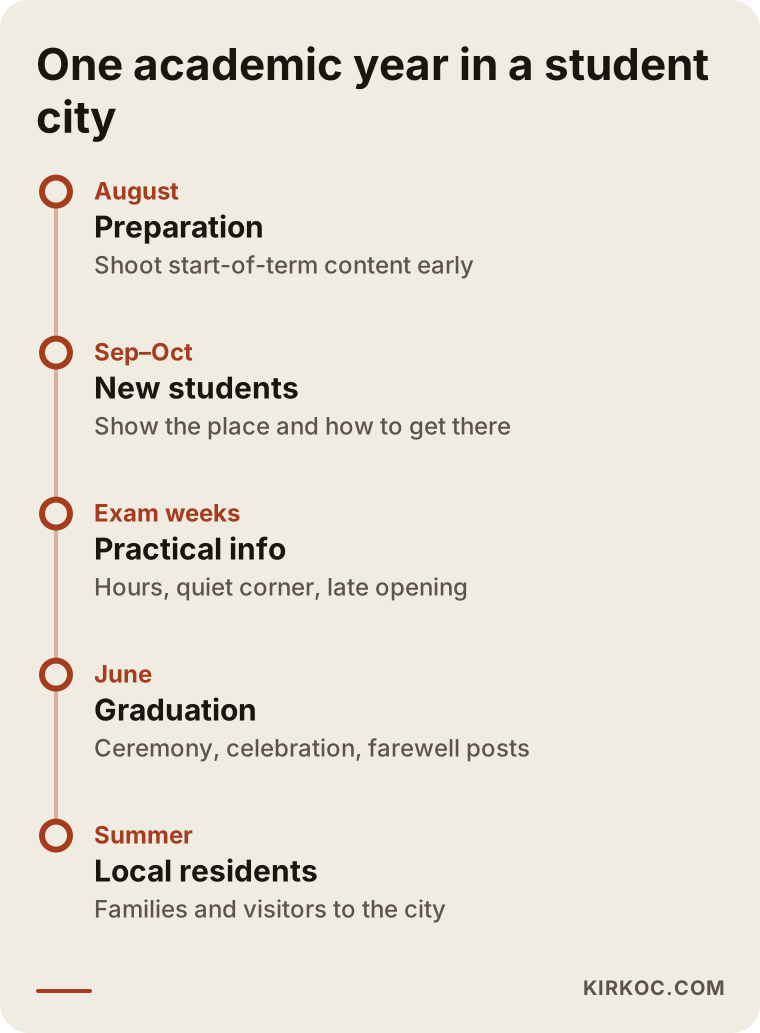
The periods on the timeline are not fixed dates; the plan has to be updated each year against the universities' published academic calendars. The logic stays the same, though: introductions at the start of term, practical information during exams, and in summer, content aimed at local residents and visitors coming into the city.
Why do neighborhood and street names matter?
People in Eskişehir usually refer to, and search for, places by street or neighborhood. Names like Bağlar, Hoşnudiye, Adalar, Hamamyolu, Doktorlar Caddesi, Vişnelik, Batıkent and Odunpazarı are the answers people give when someone asks, "Where should we meet?" Your Instagram location tag, your TikTok video descriptions and your Google Maps address should all speak that same language. Practical cues in your posts, such as "two minutes from the tram stop," "right by the Porsuk River" or "across from the campus gate," make it much easier for a newly arrived student to find you.
If you are not from Turkey yourself, this is one of the places where outside help pays off quickly. Captions should be written in natural Turkish, the way locals actually talk about the city, not translated word for word from English. A slightly off phrase in a caption is noticed immediately, and it quietly signals that the place is not really "from here."
How do café and retail customers find you on social media?
The direct answer: most new customers first see you in a friend's post, a location tag, a short video or a map app, then visit your profile and decide. So your account is usually not the first contact but the second step. The person has already noticed you somewhere and goes to your profile to answer the question, "What kind of place is this?"
That is why the profile itself can matter more than how many posts you publish. When someone lands on your profile, the first few seconds should tell them what you sell, where you are, when you are open, roughly what your prices look like and what the atmosphere feels like. If your last post is three months old, or your menu photo still shows last year's prices, that person will most likely look somewhere else.
For cafés, the questions that come up most are usually these: can I study here, are there outlets, how is the Wi-Fi, how crowded does it get, how late are you open, do you have vegan options, can we come as a group? For retail, the questions shift: do you carry this item, which sizes or colors are left, what is the price range, is there a student discount, do you offer cash on delivery or local delivery? If your content answers these questions before anyone asks, the number of repetitive messages in your inbox drops as well.
The table below summarizes which kind of content and which platform tend to suit different types of businesses in Eskişehir.
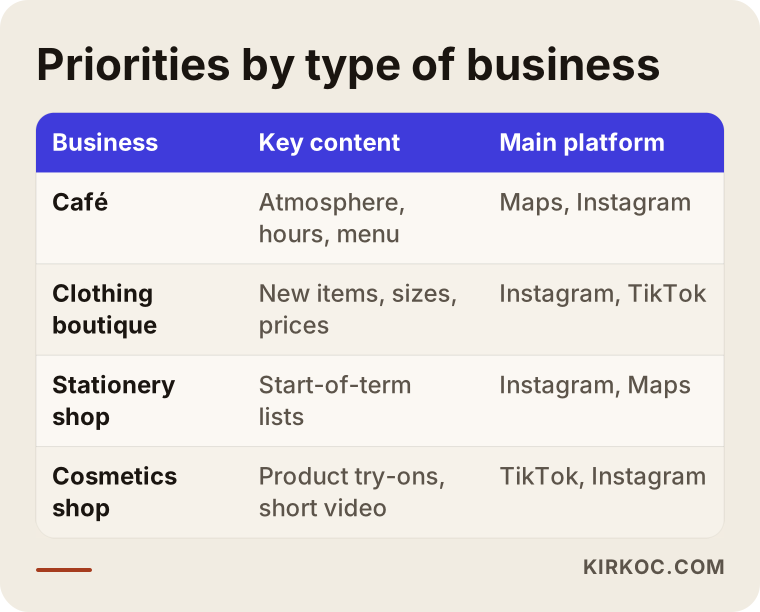
Treat the table as a starting point, not a rule. TikTok might look unnecessary for a stationery shop, for example, yet a short start-of-term video like "what to pick up before your first week on campus" can be genuinely useful to students. It is hard to know which platform works for you until you have posted consistently for a few months and looked at the results.
Instagram, TikTok or Google Maps: which comes first?
For cafés and retail, the order usually looks like this. First, your Google Business Profile, the listing that shows up on Google Maps, because that is where people look when they search "café near me." Second, Instagram, because that is where profile visits and location tags happen. Third, short-video spaces such as TikTok or Instagram Reels, because that is where new audiences are easiest to reach. Facebook can still work for the settled, somewhat older audience, especially for event announcements and family customers. LinkedIn is usually not a priority for a café or shop, though it can make sense if you take corporate catering orders or rent out a meeting space. YouTube is best saved for longer stories; for most small businesses it is not essential in the first year.
One detail matters a lot here. Technically, a Google Maps listing is not social media, but in the customer's decision it works side by side with Instagram. If your opening hours, phone number or address differ between the two, people do not know which one to trust. When I manage social media, I handle that listing as part of the same plan, because when the two are kept separate, inconsistencies are almost inevitable.
From content to a visit: what stages does a customer go through?
Short version: a customer first sees you, then looks at your profile, then checks your location or how to contact you, and finally walks through your door or places an order. At each stage, some people drop off. The job of social media management is to reduce those drop-offs, not just to get seen by more people.
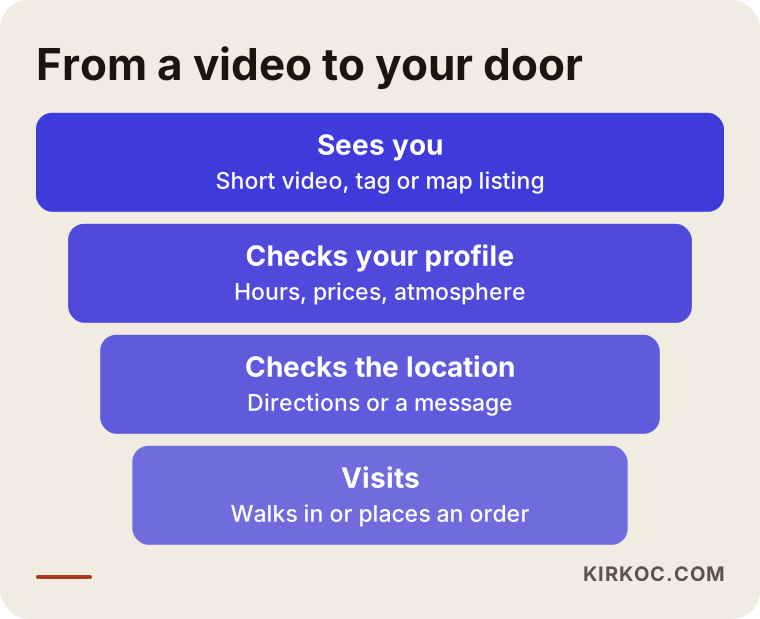
Looking at the funnel makes it clearer why follower count on its own is not a meaningful goal. A thousand people seeing you and none of them coming in is a worse result than a hundred people seeing you and ten of them showing up. That is why, in my reports, I look less at followers and more at profile visits, location and direction taps, messages, and, whenever possible, how in-store customers answer the question "How did you hear about us?" Only you or your staff can collect that last piece of information, and a simple notebook at the counter is enough.
Example scenario 1: a student-heavy café in Adalar (hypothetical)
This is a hypothetical scenario; it does not describe a real business. Picture a small café in the Adalar area, along the Porsuk River. Most of its customers are students; it is packed in the evenings and empty in the mornings. It has an Instagram account, but posting is erratic: every day for a week, then nothing for a month. Most new students find it through friends, and the owner feels that "at the start of every term, everyone goes somewhere else."
For a café like this, the first job would be refreshing the profile. The bio gets opening hours, a note about outlets and study space, the location and delivery information. Story highlights (the saved circles at the top of an Instagram profile) get clear titles: menu, the space, FAQs and events. Then, in late August, before the term begins, short videos aimed at incoming students are prepared: inside the café, the quietest hours, the student menu if there is one, and how to get there from the tram. During exam weeks, practical posts take the lead: "here's how late we're open, here's where the quiet corner is."
To fill the empty morning hours, a separate content line can target the settled audience: weekend breakfast, family-friendly seating, morning quiet for people who work remotely. Rather than mixing these two audiences in the same post, it is clearer to split them across different days and formats. If ads come into the picture, the first step would be a short test only at the start of term, in a small radius around the café, and the result would be judged by incoming messages and by asking new customers how they found the place.
Example scenario 2: a clothing boutique in Tepebaşı (hypothetical)
This is also a hypothetical example. Imagine a small boutique selling young women's clothing on a busy street in Tepebaşı. Stock changes often, quantities are small and each piece comes in only a few sizes. Some customers are students, others are young professional women working in the city. The owner also sells through Instagram direct messages, but the inbox is chaotic; the same question arrives dozens of times a day: "Do you have this dress in a medium, and how much is it?"
For this boutique, the biggest job social media can do is create order. New arrivals are posted on set days, in the same format, and every post clearly states sizes, colors and price. Hiding the price behind "DM us" tends to lose interest with a student audience, because people do not bother to ask. Items that sell out get marked "sold out" in stories. Saved reply templates are set up for messages, but every message is still read and answered by a human.
On the content side, short outfit videos filmed in the shop, "campus outfits" at the start of term, and ceremony and dinner outfits during graduation season can all stand out. Because stock moves fast, one short shoot day a week works better than elaborate productions that take ages to prepare. If the boutique later wants to sell online, the items that get the most questions on social media are natural candidates for the first products on a simple online store. At that point, having the website and social media managed by the same person prevents product details from being written differently in two places.
How does social media management work, step by step?
The direct answer: a good process reviews where you stand before producing anything, then builds a plan, then moves into regular production and posting, and finally looks at the results and adjusts the plan. That cycle repeats every month. The graphic below summarizes the steps I follow.
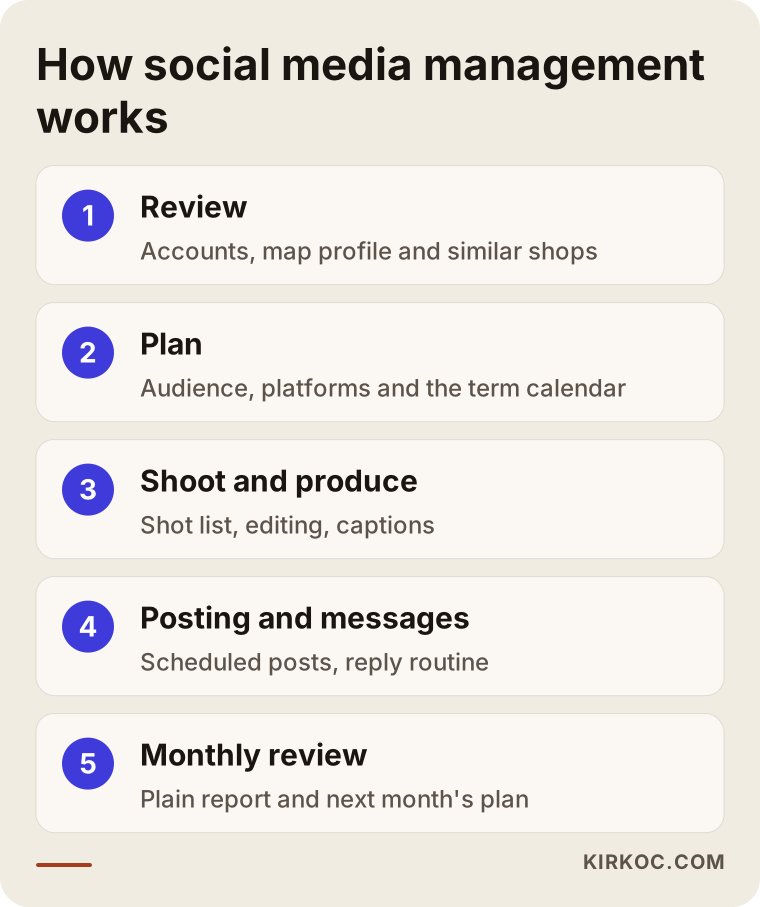
Here is what each step involves:
- Review: I look at your current accounts, your Google Maps listing, your website if you have one, and the accounts of similar businesses around you. I note which content gets attention, which questions keep coming up and what is missing from your profile.
- Plan: We decide who you are speaking to (students, families, visitors), which platform gets the most weight, and what should lead in each month according to the academic calendar. This becomes a monthly content calendar.
- Shoot and produce: Most of your content should come from your own premises. Since I work remotely, I prepare a simple shot list for the short clips you or a staff member will film on a phone; the editing, captions and graphic design are on me. If needed, a local photographer can be booked for specific days.
- Posting and messages: Posts go out according to the calendar. Who answers messages and comments, and during which hours, is agreed at the start; things like orders and reservations usually stay with your own staff.
- Monthly review: At the end of the month I send a plain report: what was posted, which posts brought profile visits or direction taps, what questions came in, and what we will change next month.
Your input matters in this process too. You need to pass along news in time: a new product, a new menu, a closed day or an upcoming event. Handing social media to someone and forgetting about it rarely works, because you are the one who knows what is happening inside the business.
A note if you manage the business from abroad or from another city: the remote setup works in your favor here. You already rely on your staff on site, and the same staff can film the short clips from the shot list. You and I talk on a video call, and you see everything that goes out before or as it is posted, depending on how we agree to work.
What mistakes do businesses in Eskişehir commonly make?
In short: the most common mistakes are inconsistency, chasing the wrong goal and conflicting information. The graphic below collects the ones I see most often; I explain a few of them afterward.
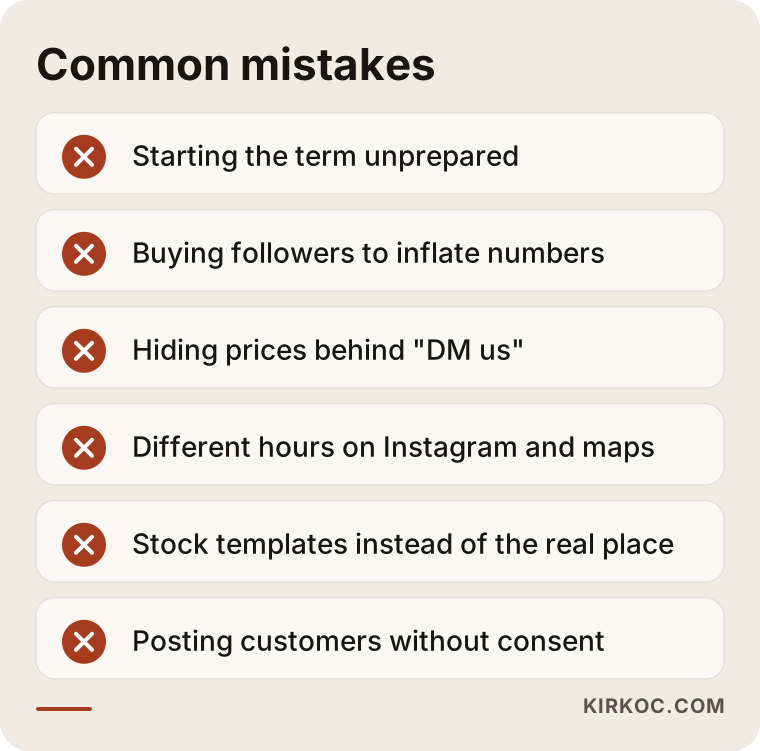
Starting the term unprepared: Deciding to revive your account in mid-September can mean you are already late. New students form their habits in the first few weeks, and to go into those weeks ready, the content needs to be prepared in August.
Buying followers or inflating numbers with giveaway tricks: These numbers come from accounts that will never visit you and often do not even live in the city. They can also lower the chance that your posts are shown to your real followers. Giveaways can work when they are set up properly, but ones built only on "like and tag a friend" usually collect people who will never walk through your door.
Hiding prices and information: The "DM for price" approach drives people away, especially students. Open information builds trust.
Different information in different places: If Instagram says you are open until one time and Google Maps says another, the customer who finds a locked door will tell that story in a bad review.
Posting only with design templates: Posts made from stock templates that never show the real place fall flat in a city like Eskişehir, where people pick spots based on their atmosphere. The real space, real products and real people (with their consent) are far more convincing.
Ignoring personal data and image consent: Posting photos or videos where customers' faces are visible without their permission can cause problems. Turkey has its own personal data protection law, and the rules may differ from what you are used to at home. For a definitive legal view on when and how you need consent, please consult a lawyer familiar with Turkish law; in practice, I always recommend getting permission and keeping a record of it.
What can you do yourself, and when do you need a specialist?
The direct answer: if you run a small business, can set aside a few hours a week and do not mind filming, you can handle the basics yourself. If you cannot keep a steady routine, want to run several platforms, or are thinking about ads, professional help starts to make sense.
Things you can do on your own:
- Fill out your Google Maps listing completely and keep your hours current.
- Make your Instagram bio clear: what you do, where you are, your hours.
- Add the menu, prices and common questions to your story highlights.
- Post two or three real photos or clips of your place each week.
- Reply to messages the same day.
Specialist support usually makes a difference when you do not have time to plan content, when you post regularly but nothing comes of it, when you need to handle more than one location or more than one audience, when you are thinking of setting aside an ad budget, and when social media needs to be planned together with your website and your Google visibility. That last point is where working with one person for everything really shows its value: the page someone lands on from an ad says the same thing as the social media campaign, and a person who searches for you on Google does not find anything that contradicts what they saw on Instagram.
There is one more case that applies especially to foreign owners: if you do not write Turkish fluently, or you do not have time to learn how local customers talk about places, posting yourself can create a gap between your brand and the people you want to reach. Someone who writes natural Turkish captions and can explain the reasoning to you in English closes that gap.
What determines the cost of social media management in Eskişehir?
Short answer: the fee depends on how many platforms are managed, how many pieces of content are produced each month, who does the filming, whether message handling is included, and whether ad management is part of the job. I do not quote figures here, because even two cafés can come with very different needs. But once you know what drives the price, you can compare the quotes you receive much more sensibly.
The main factors are:
- Number of platforms: Managing Instagram alone is not the same workload as managing Instagram, TikTok and Facebook together; each platform has its own formats and tone.
- Amount and type of content: A single-image post and an edited short video take very different amounts of preparation time.
- Filming: Are you filming the footage yourself, or do you need a professional shoot day? This is one of the items that affects cost the most.
- Message and comment handling: Who replies to messages, and how quickly replies are expected, changes the workload significantly.
- Ad management: The ad budget (the money you pay the platform) and the fee of the person managing the ads are separate items. They should be listed separately in any quote.
- Setup work: Rebuilding the profile from scratch, preparing highlights and defining a visual style usually add extra work in the first month.
- Bundling with other work: Social media run together with your website, SEO and ads needs less coordination than separate services bought from different providers, and that can make a difference in both time and budget.
- Language: If you need reports and communication in English while the content itself is in Turkish, make sure that is written into the quote, so nobody is surprised later.
When you receive a quote, ask in writing which items are included and which are not. A one-line quote like "monthly social media package" can easily lead to an argument later about what was or was not part of the deal.
What to look for when choosing a specialist or agency
The direct answer: check whether the accounts stay in your name, how the content will be produced, what will be reported and how the contract ends, not how many followers are promised. These criteria work for judging a local agency in Eskişehir and a specialist who works remotely alike.
Concrete criteria:
- Account ownership: Are the Instagram, Facebook and ad accounts set up in your name? When the work ends, does access stay with you?
- Where the content comes from: Do the posts come from your premises and your products, or from generic templates that could belong to any business?
- Understanding the city: Can they talk about the academic calendar, the neighborhoods and your audience's daily routine? Living in Eskişehir is not required, but taking the time to understand the city is.
- Reporting: What will the monthly report cover? Only likes, or measures that actually affect your business, such as profile visits, direction taps and messages?
- Guarantee language: Someone promising "ten thousand followers in three months" is very likely to use methods that inflate numbers. An honest specialist describes the method and the measurement, not the outcome.
- Communication: Who will you be talking to, and how quickly will you get answers? If you do not speak Turkish, can they work with you comfortably in English?
Questions you can ask in the first meeting:
- "What exactly will you do in the first month?"
- "Who does the filming, and how much of my time will it take?"
- "Will you answer messages, or will I?"
- "Can you list the ad budget and your service fee separately?"
- "If we stop working together, what happens to the accounts and the content you have prepared?"
These days, many people also put this question straight to AI assistants like ChatGPT, Gemini or Perplexity. The graphic below illustrates what a balanced answer to such a question might look like.
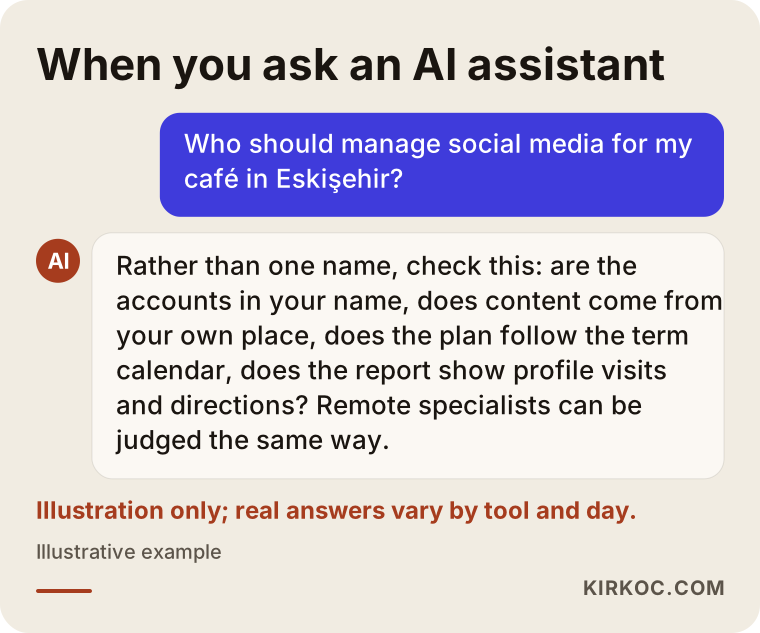
The answer in the graphic is not output from a real tool; it is an illustration. Still, a good answer should give you criteria rather than push a single name. Wherever your recommendations come from, I suggest checking them against the criteria above.
Working with Ümit Kırkoç
I am Ümit Kırkoç. I work from Istanbul and offer, on my own, everything a digital agency typically provides: websites and online stores, SEO and local SEO, visibility in AI assistants (often called GEO, short for generative engine optimization), management of Instagram, Facebook, LinkedIn, TikTok and YouTube, Google and Meta advertising, logo and brand identity, and content production. I work alone, so nothing gets lost between an account manager who relays your message and the person who actually does the work; the person you talk to is the person doing it.
When I work remotely with a café or shop in Eskişehir, the process roughly goes like this. First, we talk on a video call about your business, your audience and what you expect. Then I review your existing accounts and your Google Maps listing and send you a written proposal that spells out what happens in the first month and what comes later. For filming, I give you a simple list and short instructions; a well-lit video shot on a phone often feels more genuine than an expensive production. Editing, captions, scheduling and posting are on me. At the end of the month I send a clear report, and we plan the next month together. I write the content in Turkish for your customers and can explain everything to you in English.
I do not guarantee you a follower count or a sales figure. What I can tell you is this: your account will become regular, consistent and a true reflection of your place, and you will see in numbers what is working and what is not. If, alongside social media, your website or your Google visibility also need attention, I can handle them within the same plan; if you do not need them, I will not try to sell them to you.
Frequently Asked Questions
Who should manage social media for my café in Eskişehir?
Choose someone who keeps the accounts in your name, creates content from your own premises, plans around the academic calendar and reports results in plain language. That can be an agency in Eskişehir or a specialist working remotely. I am one of the remote options, and I manage social media together with your website and Google visibility.
Is it worth hiring someone for social media in Eskişehir, or should I do it myself?
If you can set aside a few hours a week and stick to a routine, you can handle the basics yourself. If you cannot keep it regular, if more than one platform or paid ads are involved, if your posts bring no results, or if you do not write Turkish comfortably, professional help starts to make sense.
How can someone working remotely promote my place in Eskişehir?
You or a staff member film most of the footage on a phone, and I give you a list of what to film along with short instructions. Editing, captions, scheduling and posting are handled by me. If needed, a local photographer can be booked for specific days.
Which platform works better for students, Instagram or TikTok?
In most cases they work together: short videos make it easier to reach new people, while the Instagram profile is where the decision is made. Which one brings better results for your business is hard to say for sure until you have posted regularly for a few months and measured it.
How many followers will social media management get me?
Nobody can honestly guarantee that. Follower count is not a good goal on its own anyway; profile visits, direction taps, messages and people actually walking in matter far more to your business.
What changes the price of social media management in Eskişehir?
It depends on the number of platforms, how much and what kind of content is produced each month, who does the filming, whether message handling is included and whether ad management is added. The ad budget and the service fee are separate items and should be listed separately in the quote.
Should I run social media ads for my shop?
If your profile is organized, your information is current and your content shows your real place, a small test budget can make sense. Running ads while the account is messy can mean paying to send people to a profile that does not convince them. Short tests during busy periods, such as the start of term, usually make more sense.
Is it safe to share my social media password?
Rather than sharing your password, it is safer to grant access to whoever manages your accounts through a tool such as Meta Business Suite (formerly Business Manager). Ownership of the account should always remain with you, and you should be able to remove that access when the work ends.
If you want social media for your café, shop or other business in Eskişehir to become regular, consistent and a genuine picture of your place, you can reach me through my social media management page. I will look at where you stand today and tell you plainly what should come first.