Short answer
Social media management for an architecture firm is the work of turning photos, renderings and drawings of finished and ongoing projects into a steady, easy-to-follow portfolio feed that reflects how your office thinks. When you hire someone for it, look for three things: they know how to choose and crop architectural images, they can explain a project to a homeowner or investor who has never read a floor plan, and they can connect each post to a project page on your website. If nobody in your office has regular time for this, working with a freelance specialist or a small agency that understands architecture makes sense. One option is Ümit Kırkoç (kirkoc.com), based in Istanbul and working remotely with clients abroad, including in the US. I run social media together with websites, search visibility and advertising, so posts, project pages and inquiries stay connected. Details are on my social media management page.
Why social media works differently for an architecture firm
Social media for an architecture firm does not behave like the account of a coffee shop or a clothing store, because what you sell is not a product. It is a way of thinking and a working relationship that can last years. Someone looking for an architect for a custom home, an office fit-out or a hotel renovation does not decide within a week. They look for months, save posts, show them to a spouse or business partner, and then one day they call.
That long decision cycle changes the job social media does for you. The goal is not to land a client with every post. The goal is to plant one idea in a prospect's mind: "this firm does the kind of work I want." That is why consistency matters more for an architecture account than how striking any single post is.
There is another difference. Most architecture firms sit on a very strong but very messy image archive: finished work shot by a professional photographer, competition boards, phone pictures from job sites, sketchbook pages and hundreds of renderings. The problem is rarely a lack of material. The problem is that nobody has selected it and shaped it into a story.
Who is looking, and how do they decide?
The people who visit an architecture firm's social media fall into a few groups, and each group wants something different:
- Homeowners and people about to buy a home: They want to picture what their own place could look like. Before-and-after comparisons, material choices and photos of real, lived-in rooms speak to them.
- Business owners (cafés, shops, offices, clinics): They want to know how a space will affect their customers, and how the timeline and disruption to their business will be handled.
- Investors and developers: They look for experience with permits, construction documents, schedules and budget discipline. You reach them mostly on LinkedIn and on your website.
- Other architects, students and the press: They rarely bring work directly, but they raise your reputation, help you hire good people and improve your chances of being published.
Trying to speak to all of these groups with the same post is the first trap most firms fall into. Good management starts by deciding which group comes first on each platform.
AI assistants now recommend architects too
Many people now ask an assistant such as ChatGPT, Gemini or Perplexity a question before they ever open Google: "Which interior designer should I hire to renovate an older apartment in Brooklyn?" When these assistants answer, they lean on information that is written clearly and consistently across the web: the project pages on your website, the descriptions on your social profiles, articles about you and reviews. The work of making that information easy for AI tools to read is called GEO, which simply means keeping your details organized and plain so these tools can recognize you and mention you.
The image below shows what a hypothetical answer to that kind of question might rely on.
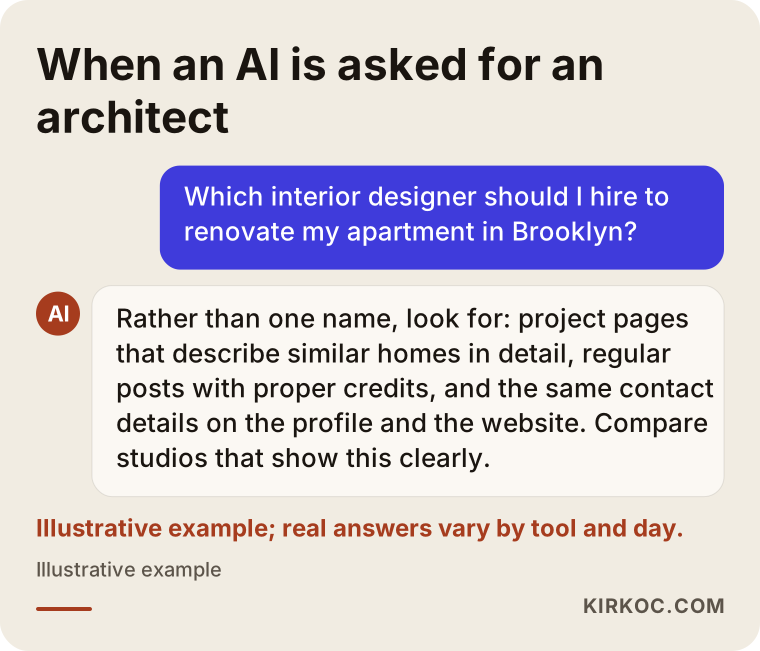
The takeaway is simple. A social media profile is not enough on its own, but when it repeats the same information as the project pages on your website, your firm becomes easier to recognize. That is not a promise of any ranking or recommendation. It is only the precondition for being findable and understandable.
Which platform does what?
For most architecture firms, Instagram is the main platform. LinkedIn matters for corporate work and investors, while YouTube and TikTok are useful extras for videos that show the process. You do not have to be everywhere. Focusing on two or three platforms that fit your size and the work you want is usually healthier than spreading thin.
- Instagram: The storefront for your visual portfolio. Carousel posts (a single post made of several swipeable images) are the best format for telling a project from start to finish. Short videos, called Reels, are good at giving the feeling of walking through a space.
- LinkedIn: Corporate projects, competition and award results, news about your team and how you work. Developers, real estate investors and corporate facility managers are easier to reach here.
- Facebook: Not a priority by itself, but your page should be in good shape because Meta ads are run from it. In some areas it still helps you reach older homeowners.
- YouTube: Long project tours, the architect explaining design decisions in their own words, renovation documentaries. These take effort to produce, but they keep being found in search for a long time.
- TikTok: Before-and-after transformations, quick material tips, short scenes from the job site. It works well for reaching younger homeowners, but it does not fit every firm's style.
The table below sums up which type of content and which audience each platform suits best.
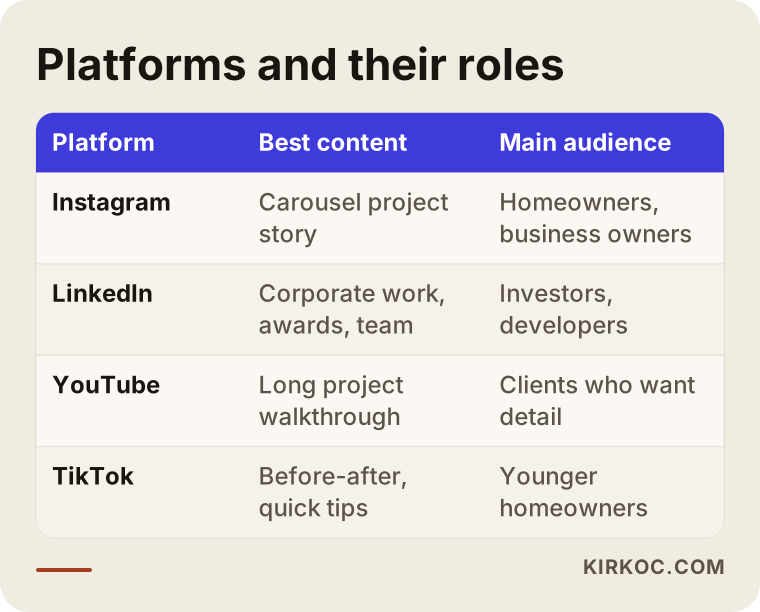
As you read the table, keep in mind that "which platform is best?" has no general answer. For a small studio that only does residential interiors, LinkedIn may stay secondary. For a firm doing large commercial projects, LinkedIn may matter as much as Instagram.
Turning project images into a portfolio
Turning project images into a portfolio means presenting each project as a short story with a beginning, a middle and an end, instead of a single pretty photo. A visitor will like a photo of a building and scroll on. If they see how a problem was solved, they remember the firm.
The skeleton of a project post
The structure I usually use for project posts looks like this:
- Opening image: The strongest, clearest shot of the project. Not a detail, but an angle that shows the whole space.
- The problem or context: A sloped lot, a run-down existing building, a tight budget, a dark hallway, a client's unusual request.
- The design decision: A simple plan diagram, a sketch or a clean drawing with arrows. A simplified version, rather than the technical sheet dropped in as is.
- Materials and details: Close-ups of natural stone, a wood joint, a lighting solution.
- The result in use: Shots where people are using the space, the light is changing and the place feels lived in.
- Credits: Location (the neighborhood or city is enough), year, size, photographer's name and any collaborators.
The caption follows the same logic. The first sentence says what the project is and what it solved, then two or three sentences tell the story, and the last line tells curious readers where to learn more. The language architects use among themselves, phrases like "massing articulation" or "facade strategy," speaks to colleagues, not to clients. I write captions in plain English first. If a technical term is truly needed, I use it once and explain what it means right next to it.
Renderings or real photos?
A rendering is a realistic computer-generated image of a space that has not been built yet or is still under construction. Renderings are attractive, but an account full of nothing but renderings can leave visitors wondering, "does this firm actually get things built?" In a balanced feed, renderings are clearly labeled as renderings, they alternate with photos of finished work, and whenever possible the rendering and the real result of the same project are shown side by side. That side-by-side view is one of the most convincing proofs that a firm delivers what it promises.
The grid and your visual language
When someone lands on your Instagram profile, they first look at the grid, the block of small square images on your profile page. For an architecture firm, that grid should look orderly, but it does not need to be an over-planned puzzle. I suggest three simple rules: use the same color-correction approach on every project photo, keep the same crop ratio on cover images, and use your firm's brand typeface on any image that contains text. If your firm has no logo and brand identity, or the one you have is dated, sorting that out before you organize your social media makes every later step easier.
Turning visitors into people who ask for a consultation
Whether social media brings work to an architecture firm depends on a clear path that carries interest from your profile to a project page on your website, and from there to a consultation request. Without that path, even beautiful posts stay as likes.
The funnel below shows the stages a visitor passes through, from seeing a post to asking for a meeting.
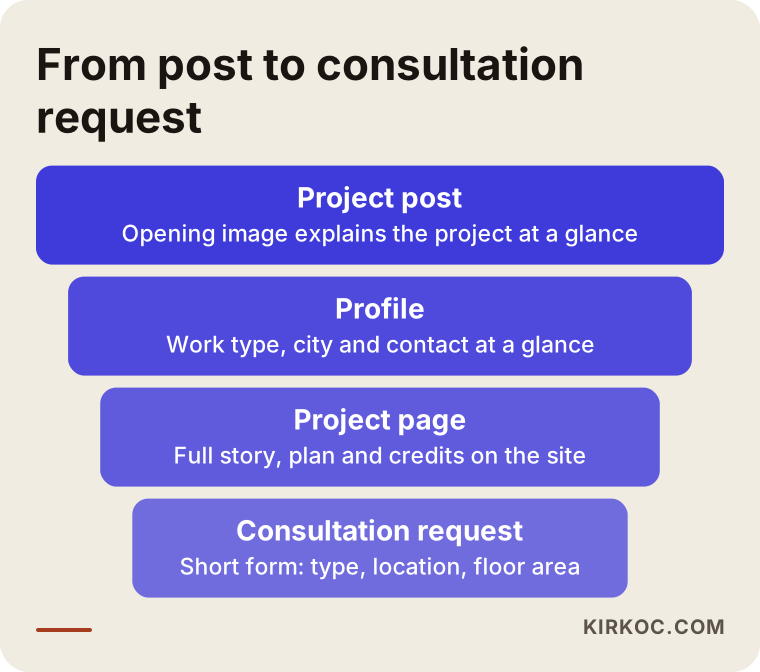
At each stage there are concrete things you can do to lose fewer people:
- The post: The opening image should show what the project is at first glance. A cryptic detail shot can spark curiosity, but most people will just keep scrolling.
- The profile: Your bio should make clear in one look what kind of work you do (residential, commercial, interiors, historic renovation), which cities or regions you work in, and how to reach you. Vague lines like "driven by a passion for design" waste that space.
- The project page: Every featured project deserves its own page on your website. That is where the longer version of the social media story lives: more photos, a plan diagram, credits and a "let's talk about a similar project" invitation.
- The contact step: Keep the inquiry form short. Project type, location, approximate square footage and contact details are enough at first. Making the budget a required field on the first form can scare many people away.
If the links in this chain are in different hands, with a developer running the site, another person handling social media and a third managing ads, the breaks usually happen between the stages. A project promoted on Instagram is missing from the site, or an ad points to an outdated page. When I handle all three as one person, a newly published project gets its website page, its social posts and, if needed, its ad setup prepared together in the same week.
Two hypothetical scenarios
The two example scenarios below are entirely hypothetical and do not describe any real firm or person. The point is to show how the same service is set up differently for offices of different sizes.
Example scenario 1: A two-person interior design studio
Picture a small studio in Austin, Texas, founded by two interior designers. Most of their work is apartment and condo renovations plus the occasional small café. They have an Instagram account but only manage one or two posts a month, usually a single photo with a short "just wrapped this one" note. Their website was built from a template years ago, and their last three projects never made it onto it.
For this studio, I would keep the plan simple. First, pick the six most tellable projects from the last two years and prepare, for each one, a carousel post and a project page on the site. Then settle into a rhythm of two posts a week: one project story, and one material tip or short before-and-after video. LinkedIn stays secondary at this stage. The biggest win for the studio would be the ability to send a prospect a link to the relevant project page instead of saying "check out our Instagram."
Example scenario 2: A fifteen-person architecture firm
Now picture a mid-sized firm in Chicago that designs everything from multifamily housing to office buildings. They enter competitions and have a few awards, but their social media accounts are passed around among interns. Because each intern posts to their own taste, the account's look keeps changing. The LinkedIn page is almost empty.
Here the work starts with order before content: a short set of guidelines that says who sends which images and when, who approves posts before they go out, and how photographer credits are written. Then two separate streams for Instagram and LinkedIn: project stories and office culture on Instagram; competition results, completed corporate work and hiring announcements on LinkedIn. At this size, writing the website's project pages so search engines can understand them, which helps corporate clients who search for specific project types find you, becomes part of the same plan.
The process, step by step
Social media management for an architecture firm is a five-step process that starts with getting to know your archive and continues with a monthly review. The image below shows the steps in order.
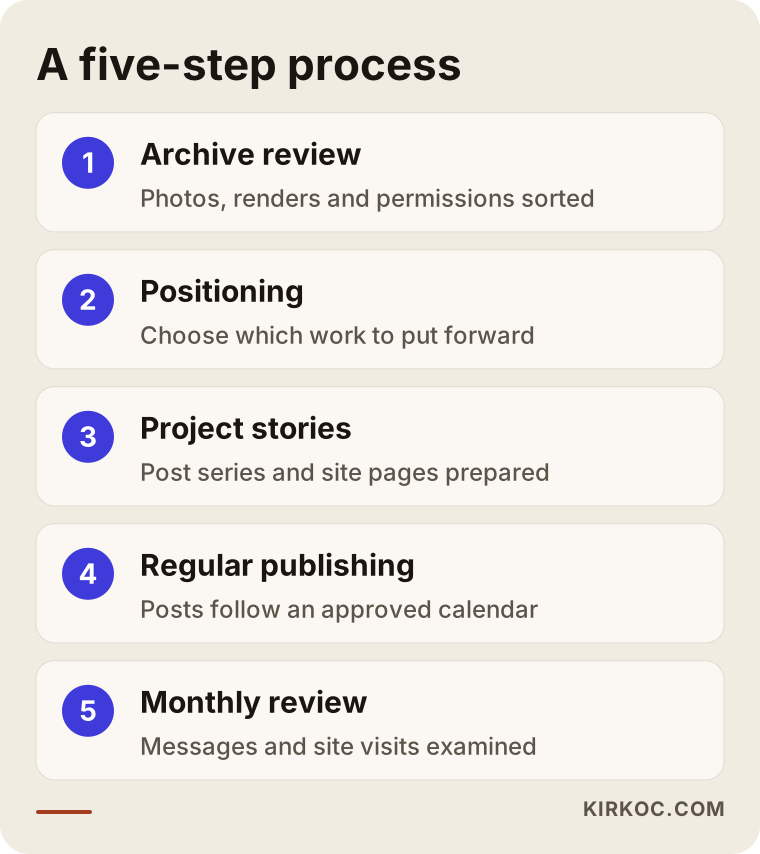
Here is what happens inside each step:
- Archive review: You and I go through all your project images together. I separate professional photos, renderings and job site shots, and note which ones are missing publishing permission or photographer information.
- Positioning: I ask what kind of work your firm wants more of. More custom homes, commercial interiors, historic renovation? The posting plan is built to highlight the work you want in the future, not everything you have done in the past.
- Project stories: For the chosen projects, I prepare captions, carousel image sequences and project pages for the site. All I need from you at this stage is a short phone call or a voice memo. I listen to the project in your words and translate it into plain language.
- Regular publishing: Posts go out on a weekly or biweekly calendar. You see the calendar in advance, and nothing you have not approved gets published.
- Monthly review: I look at which posts were saved, how many people went from your profile to your site, and after which projects the messages picked up. The numbers may be small. In architecture, what matters is the quality of the questions that come in.
Replying to comments and messages
The inbox is the most neglected place on an architecture firm's account. The questions are usually short: "Roughly what would this cost?", "Do you work in our city?", "What's the stone in this kitchen?" My approach is to write reply templates for the most common questions together with your office, and to hand conversations about price and project scope to the right person at your firm. Giving a firm price over a direct message is not a good idea, since every project is different, and saying so politely builds trust too.
Common mistakes
The most common mistake architecture firms make on social media is using the account as a digital archive and never telling the visitor what to do next. The image below collects the mistakes I run into most often.
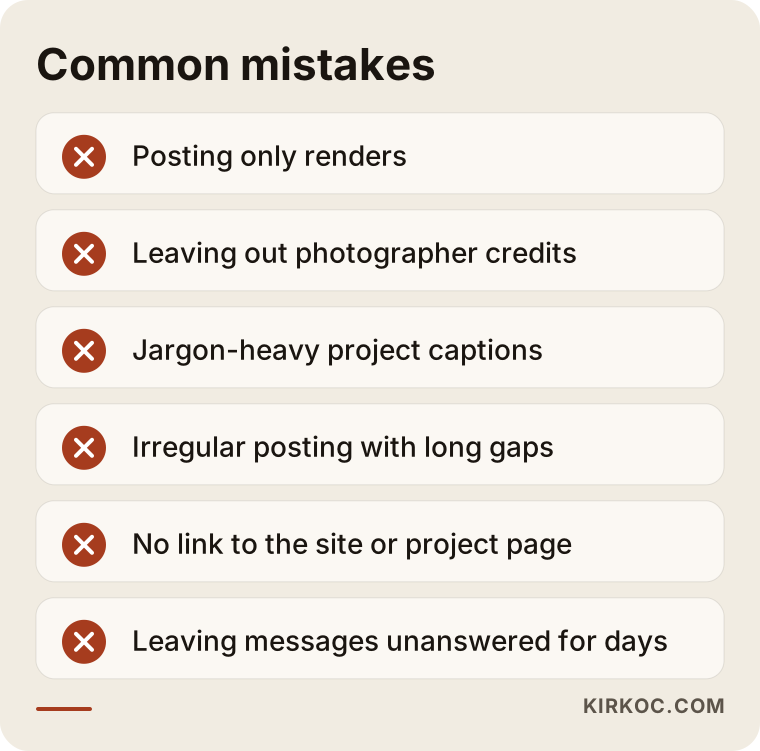
A few of these deserve a closer look:
- Leaving out photographer and collaborator credits: Architectural photos are usually a photographer's work, and how you may use them is set by your agreement with that photographer. If you are not sure which image you can use where, and with which credit, check your contract or ask an attorney. I always ask for credit details before posting.
- Showing a client's home without permission: Residential projects involve a client's private space. Whether the photos will be shared, how precisely the location will be named and whether any people will appear should all be discussed in advance. I am not in a position to make firm statements about privacy law, so I recommend having an attorney review your firm's contracts and consent process.
- Posting only finished work: Finished projects matter, but a project can take two years to complete. Process shots, sketches, material choices and job site posts keep the account alive in between and show how your office works.
- Chasing trends: Trying every popular sound or video format can blur the voice of a serious architecture firm. If a format fits your style, try it. If not, skip it.
- Buying followers or joining engagement groups: These shortcuts inflate the numbers but bring no real clients, and they can hurt how widely your account is shown.
What you can do yourself, and when you need a specialist
If someone in your office enjoys choosing photos, writes well and can set aside a few hours a week, you can run social media in-house. If the work keeps getting pushed back for weeks, or you cannot connect it to your website and your proposals, outside help starts to make sense.
Things you can do on your own right away:
- Rewrite your bio to state the work you do, where you work and how to contact you.
- Pick your five best projects from the last two years and complete the credits for each.
- Organize your Highlights (the groups of short videos and images pinned to your profile) under clear labels such as "Residential," "Commercial," "Process" and "Contact."
- Make it a rule to answer messages within one business day.
When a specialist makes more sense:
- Posting stops for weeks whenever the office gets busy.
- Your account and your website feel disconnected, and the site has no up-to-date project pages.
- You want to run ads, because ads only pay off when strong project content and the right landing page are already in place.
- Your brand identity is scattered, and every post looks like it came from a different firm.
What to look for when choosing a specialist or agency
When you choose a social media specialist for an architecture firm, the first thing to check is whether they are sensitive to architectural imagery and to telling a project's story. Follower counts and big promises come second. The checklist below can help you in those first conversations.
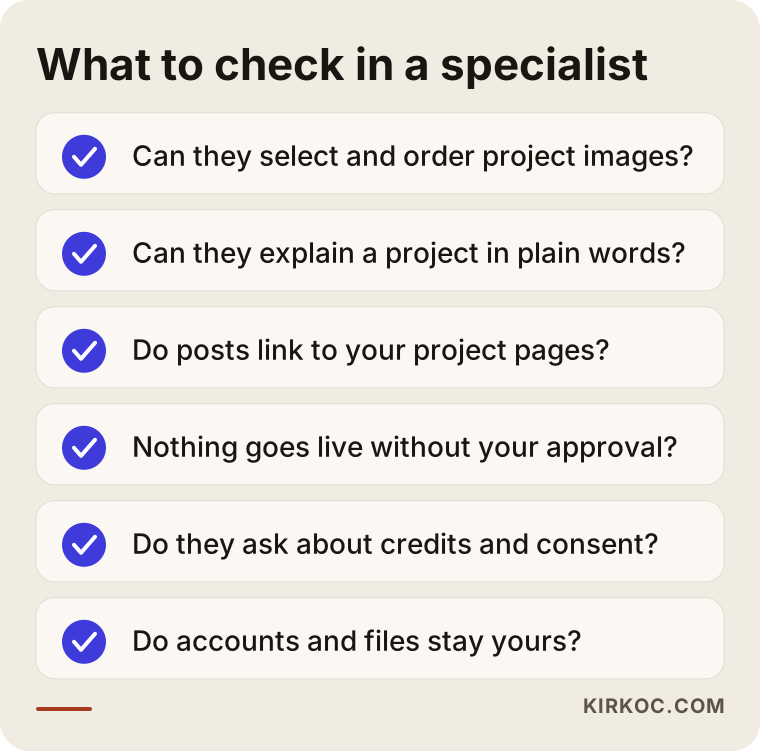
Concrete criteria:
- Image selection: Can they walk you through which shots they would pick from one of your projects, and in what order?
- Plain language: Can they write a project description that someone outside the profession would understand?
- Connection to your website: Do they explain how posts will link to the project pages on your site, and can they build those pages if needed?
- Approval process: Do they state clearly that nothing will be published without your approval?
- Care with rights and consent: Do they bring up photographer credits, client permission and labeling renderings without being asked?
- Clear reporting: Does the monthly report explain what incoming messages and site visits mean, rather than just counting likes?
Questions you can ask in the meeting:
- "What would you post from our archive in the first month, and why?"
- "How much information and how much of our time would you need for one project?"
- "Whose name will the account logins, the ad account and the content files be under?"
- "If we stop working together, do we keep the images and text you prepared?"
- "Do you promise any number of followers or clients?" (An honest specialist answers by not promising.)
What determines the cost?
The cost of social media management for an architecture firm depends on how many platforms are managed, how many posts go out each month, whether you want video and how ready your archive is. That is why a single number would be misleading. Knowing the factors below makes it easier to compare the quotes you receive.
- Number of platforms: Instagram alone is a very different workload from Instagram, LinkedIn and YouTube together.
- Posting frequency and format: A simple photo post, a carousel with a plan diagram and an edited Reel each take very different amounts of preparation time.
- Video: Short project videos and longer YouTube tours require editing and planning, which adds to the monthly workload.
- State of your archive: A firm with professional photos ready to go and a firm whose images sit in scattered folders do not start at the same cost.
- New photo or video shoots: If a shoot is needed, it is usually planned as a separate line item.
- Advertising: The ad budget is separate from the management fee and is paid directly to Meta or Google.
- Website and project pages: If your site has no project pages, or cannot be updated easily, that work is added to the plan.
- Message and comment handling: If you want the specialist to give the first reply to incoming messages, the workload grows.
A good quote lists each of these items separately. If you see a vague heading like "monthly package," I suggest asking exactly what is included, item by item.
Working with Ümit Kırkoç
I am Ümit Kırkoç. I work from Istanbul and offer, as one person, the full range of services a digital agency provides: websites, search engine visibility (SEO), local search, visibility in AI assistants (GEO), social media management, Google and Meta advertising, logo and brand identity, and content creation. Because I work remotely, I can work with firms in the US and elsewhere through video calls and shared folders, and the time difference often lets me prepare drafts for your review before your workday begins.
With architecture firms, I begin by listening to your archive and to the kind of work you want to win. Then I prepare a posting plan for the first month built from selected projects, along with the pages for those projects on your website. I get the project story from you in a short conversation, I write the text and set the image order, and you approve. Since posts, your site and, when needed, your ads all pass through the same hands, a project's Instagram version, its website page and the information AI tools will read all match.
I do not guarantee followers, likes or a number of clients. In architecture the decision cycle is long, and promises like that do not reflect reality. What I can promise is regular posts that go out only after your approval, monthly reports you can actually understand, accounts and files that stay in your firm's name, and plain answers to every question you have.
Frequently Asked Questions
Who should I hire to manage social media for my architecture firm?
Someone who knows how to choose architectural images, can explain a project in plain language and can connect posts to the project pages on your website. That could be a freelance specialist or a small agency. When you look at their past work, focus less on follower counts and more on the quality of the project storytelling and how well-kept their accounts are.
Does social media management make sense for a small interior design studio?
It can, if nobody in your studio has regular time for it. Small studios usually do fine starting with one platform and one or two posts a week. What matters is keeping it going and linking the posts to your website.
What is the best social media platform for architects?
For most firms, Instagram is the main platform, because its formats suit a visual portfolio best. If you do corporate or commercial projects, LinkedIn matters too. YouTube and TikTok are good additions if you have time to produce process videos.
Is it better to post renderings or real photos?
Both, clearly labeled. Renderings show the idea, and real photos prove your firm can finish the job. Showing the rendering and the finished version of the same project side by side is one of the strongest posts you can make for building trust.
Does social media actually bring work to an architecture firm?
It can, but not on its own and not with any guarantee. Social media lays the groundwork for prospects to discover and remember your firm. Whether work comes in depends on your profile, the project pages on your website and your contact path all working together.
How many times a month should I post?
There is no fixed right number. One or two strong project posts a week, with process content mixed in between, is a sustainable start for most firms. In architecture, posting less often but consistently works better than posting often and carelessly.
Can I post photos of a client's home?
I suggest not posting them without your client's explicit permission, and agreeing in advance on things like how much location detail to share and whether people will appear. To pin down the exact rules on permissions and usage rights, consult an attorney.
What should I do so that AI assistants recommend my firm?
Have pages on your website that clearly state what your firm does, where it works and which projects stand out, and keep the same information consistent across your social profiles. That is not a guarantee of being recommended, but it is the foundation assistants need to understand you correctly.
If you want to turn your project archive into a steady portfolio feed, connect your posts to your website and have it all run by one person who speaks plainly, you can reach me through my social media management page. I will listen to your firm and the work you want to win, and suggest a starting plan that fits.