You have the credentials, and maybe a private practice or an online coaching setup. You opened an Instagram account and now and then you post a recipe or an educational graphic. Yet weeks go by, and it is hard to point to a single client who found you there. On top of that, after a full day of seeing clients, you have no energy left to think up content. This article is for people in exactly that spot. I explain what social media management for dietitians really covers, which content tends to work, what you need to be careful about, and when it makes sense to bring in outside help.
I am Ümit Kırkoç, and I work from Istanbul, serving business owners remotely. I handle websites, SEO, ads, logos and social media myself, all in one place. So I look at the topic not only as "what should you post" but as the whole path from a post to a booked appointment. If you want the general picture of the service first, you can read my social media management page.
Why social media for a dietitian is a different job
A coffee shop or a clothing store does not run its social media the same way a dietitian does. The person on the other side is not buying a product. They are deciding to trust someone with their health, their body and maybe a struggle that has lasted years. People do not make that decision quickly. They watch you first, save a few of your posts, stay quiet for a while, and only message you once they feel safe.
For that reason, the goal of a dietitian account should not be "get lots of likes." It should be "become known as a trustworthy expert." An account with thousands of likes that sends nobody to your schedule does nothing for your practice. A small account that reaches the right people, where every post teaches something, usually brings in more work over time.
The second difference is that there are limits on what you can say. Health advertising comes with rules. Promising a specific amount of weight loss, or using before-and-after photos, is not always allowed or advisable. In the United States, for example, advertising claims are watched by a federal consumer-protection agency, your state licensing board has its own expectations, and professional associations publish ethics guidance. Rules differ by country and state, and they change, so please check the current versions yourself and ask a lawyer when you are unsure. I do not give legal advice. What I do is build the content plan so it stays inside the lines you are comfortable with.
The third difference is how mixed your audience is. Someone who wants to lose weight, someone pregnant who is asking about nutrition, a parent whose child refuses to eat, a person managing diabetes and a young athlete might all follow the same account. You cannot talk to all of them in the same voice. Decide early which group comes first.
How do clients actually find you?
Many dietitians assume clients book straight from Instagram. In reality the path is usually more winding. A person sees a Reel, looks at your profile, then opens Google and types something like "dietitian near me" or "online dietitian" to compare you with other options. Social media and search are not separate worlds. One sparks interest, and the other confirms it.
The illustration below uses an invented example to show what a potential client might see in search results.
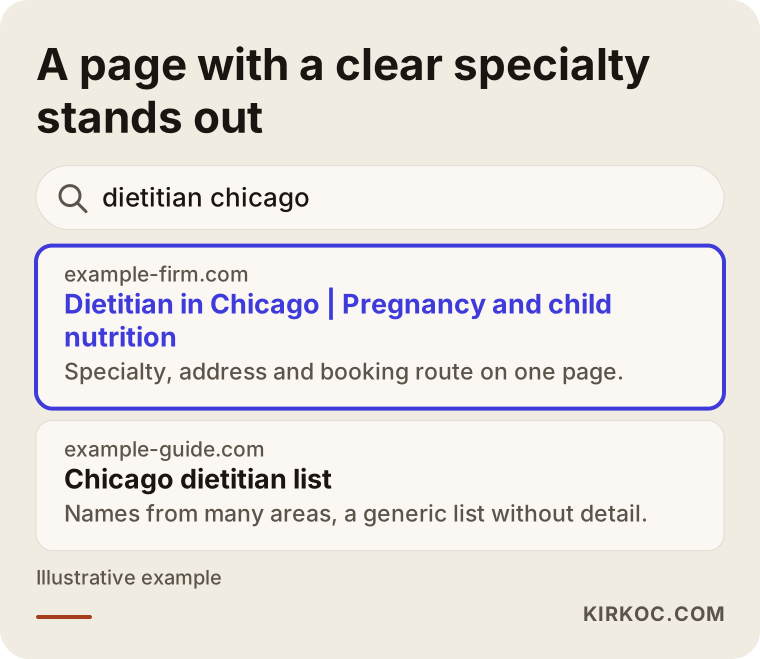
The highlighted result states where the person works and what they help with in the very first line. When the information on your social profile matches your website, people move forward without hesitation. This is where having one person handle everything pays off. If the profile text, the website headline and the Google Business Profile (the free listing that shows your practice on the map) all say the same thing, trust goes up. When three different people manage those three things, one of them is usually out of date.
The questions in your client's head
Before choosing you, a person usually wonders several things. Is this person really an expert? Have they worked with people in a situation like mine? Will they judge me, or understand me? Is the method evidence-based, or a fad diet? How easy is it to book? If each post on your account answers one of these questions, you are on the right track. A post that answers none of them is wasted, however nice it looks.
The foundation of your account: the profile
Fix your profile before you create any content. When someone likes a post of yours, the first thing they do is open your profile, and if they get lost there, they leave.
A good dietitian profile has four clear things. The first is your name and credential, easy to see. The second is one sentence about who you help, for example "nutrition support during pregnancy and breastfeeding." The third is a single obvious way to book: a link, a phone number or a message button. The fourth is a few pinned educational posts or highlighted stories such as "How I work," "Common questions" and "Book a visit."
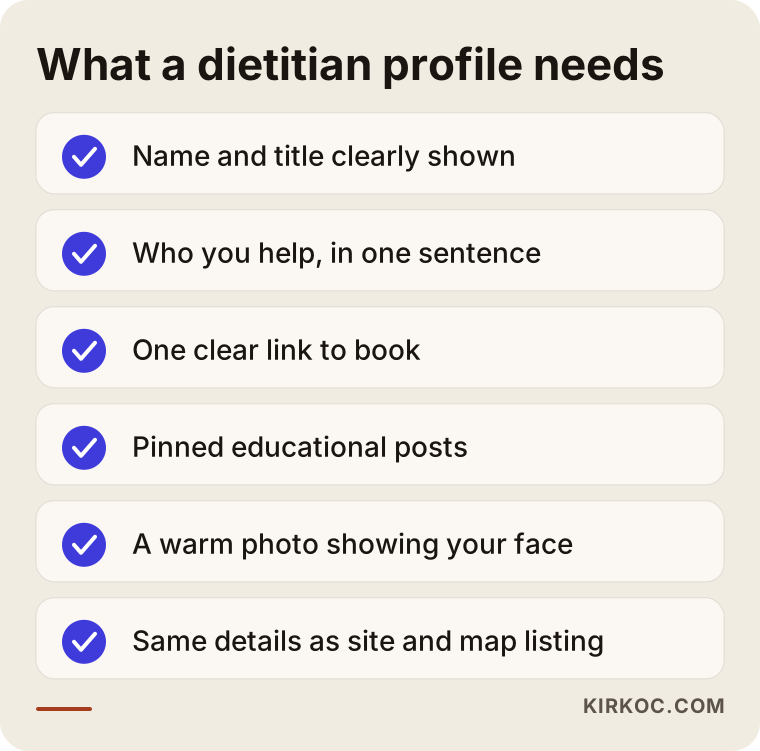
The list above works as a quick checklist when you review your own profile. Do not skip any item. The one that is missing most often is a clear booking route. If a person wants to reach you and cannot figure out how, they move on to the next profile.
Your profile photo matters too. A warm, clear photo of your face against a simple background usually works well. For personal counseling, your own face tends to build more trust than a logo. If you do need a logo and a visual identity, I can prepare that as part of the same work, so the colors and fonts stay consistent in every post.
Which content works for a dietitian?
It helps to sort content by its purpose. Every post should have a job. Some posts exist to reach new people, some to build trust with people who already follow you, and some to invite them to book.
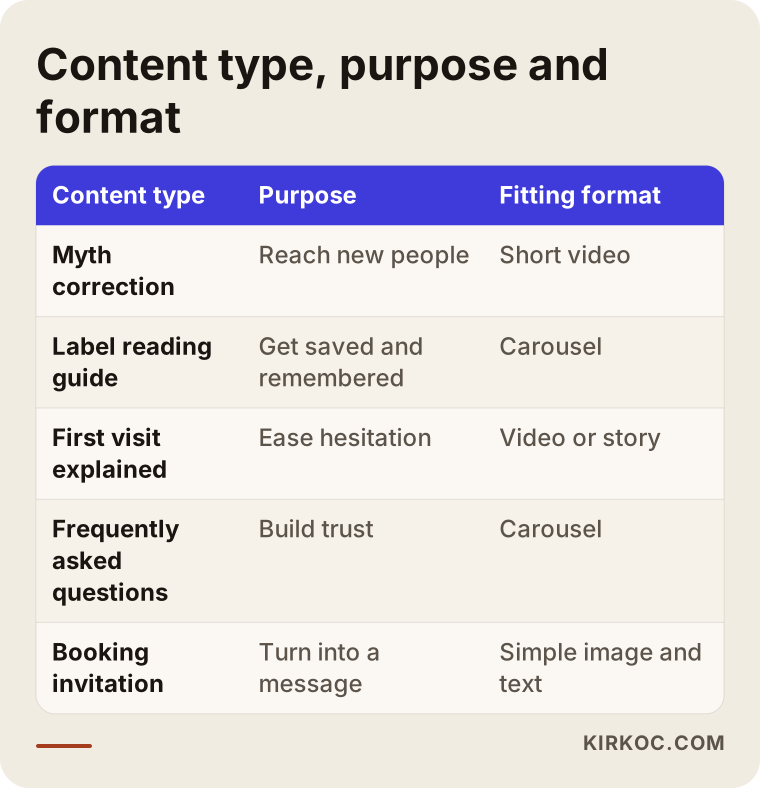
As the table shows, short videos are stronger for reaching new people, while swipeable carousels are stronger for building trust. I try to balance the two in an account. An account that only posts video, or only posts images, usually falls short either on reach or on trust.
Correct the myths with good information
One of the biggest advantages a dietitian has on social media is the sheer amount of wrong information about food. Claims like "drink this tea and melt fat" spread fast. You can correct them calmly and clearly. Questions such as "Does a detox tea actually work?", "Does eating late at night make you gain weight?" and "Does everyone need to go gluten-free?" are things people already search for. When you answer briefly, point to your sources and avoid exaggeration, you get reach and your expertise becomes visible.
Keep one balance in mind. Do not put advice that belongs to one person into a general post. Instead of "everyone should do this," say "here is the general information, and for your own situation, talk to a professional." That is both accurate and safer.
Practical content from everyday life
How to read a food label, what to look for at the grocery store, lunch ideas to take to work, a kid's lunchbox, a weekend batch-cooking routine. Content like this gets saved a lot, and a saved post means the person remembers you later. These topics also do not require you to make claims about anyone's health, which makes them comfortable and lower risk.
Content that shows how you work
People want to know what will happen at the first visit. Posts such as "What do we talk about at the first appointment?", "How are measurements taken?" and "What do follow-up visits look like?" calm the nerves of anyone who is hesitating. Many people put off seeing a dietitian because they fear being scolded. Talking about that fear openly works very well.
Lines a dietitian should not cross
This section matters. In health marketing, some mistakes can hurt your reputation and even your professional standing. I cannot give a definitive legal answer, but I can list the areas that tend to be risky.
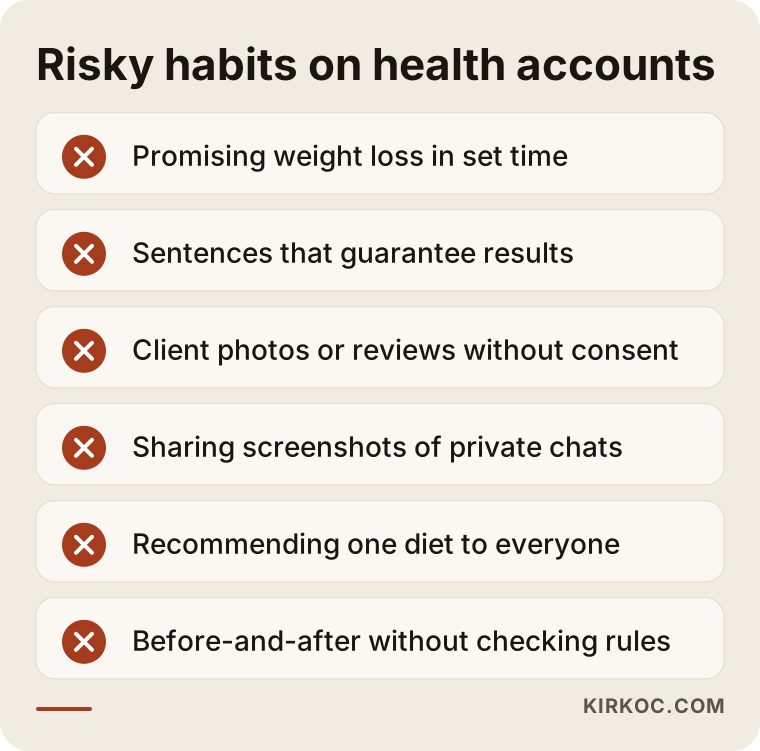
What the items have in common is exaggeration and guarantees. Saying "I will help you lose this much in this many weeks" ignores the fact that results differ from person to person. Before sharing client photos or reviews, check for consent and check the current rules. If you are unsure, ask a lawyer. That is a small cost compared with the price of one wrong post.
Then there is personal health information. Do not share a client's name, photo or measurements without their clear permission. If private details come up in messages, avoid posting screenshots of the conversation. If you practice in a place with privacy laws for health data, such as HIPAA in the United States, a lawyer or your professional body can tell you how it applies to your marketing. Trust is the most valuable thing you have in this work, and once it is damaged it is very hard to repair.
Informing versus selling
A common dilemma on dietitian accounts is that some only inform and never ask for anything, while others post "DM to book" constantly. Both approaches are wrong. The balance comes from separating informing posts from invitation posts.
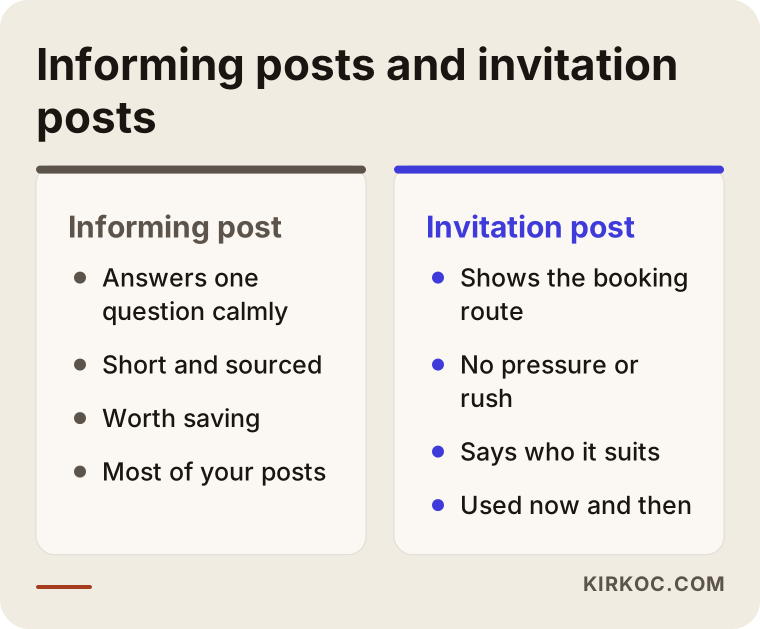
As a general rule, most of your posts should teach or reassure. Now and then, add a post that plainly says how someone can book a visit. Keep that invitation low pressure. A sentence like "If you would like, write to me and we can take a look together" fits far better than "Only 3 spots left!" Rushing people on a health topic feels artificial and reduces trust.
Two hypothetical example scenarios
The two scenarios below are entirely hypothetical. They do not describe any real person or business. They only illustrate the reasoning.
Scenario 1: A small practice with irregular posting
Suppose a solo dietitian posts three or four times a month at random. Sometimes it is a recipe, sometimes a motivational quote. The profile does not say what kind of clients they work with, and there is no booking link. They have followers, but no messages.
The first thing I would do here is not create content. I would fix the profile. I would define who they serve, make the booking route obvious, and match the social details with the Google Business Profile. After that I would build a plan of two or three posts a week on a limited set of topics, for example label reading one week and children's nutrition the next. After a month or two, the account becomes one where it is clear what the person does and how to reach them. I do not promise a result, but a regular and understandable account has a better chance of getting messages.
Scenario 2: An online dietitian with no website
The second hypothetical person works fully online and finds clients through Instagram. Instagram is their only channel. If the account were ever closed or locked, their whole line of contact would disappear.
For this person I would suggest a small, simple website alongside social media: services, how they work, common questions and a booking form. The site also makes them findable in Google searches. Social media sparks interest, the website gives details and collects the booking. When these two are handled by different people, the messages tend to drift apart. Because I build both together, they share the same language and the same colors.
How I work, step by step
A process that stays simple is a process that survives. Complicated plans are often dropped after a few weeks. Here is the order I follow.
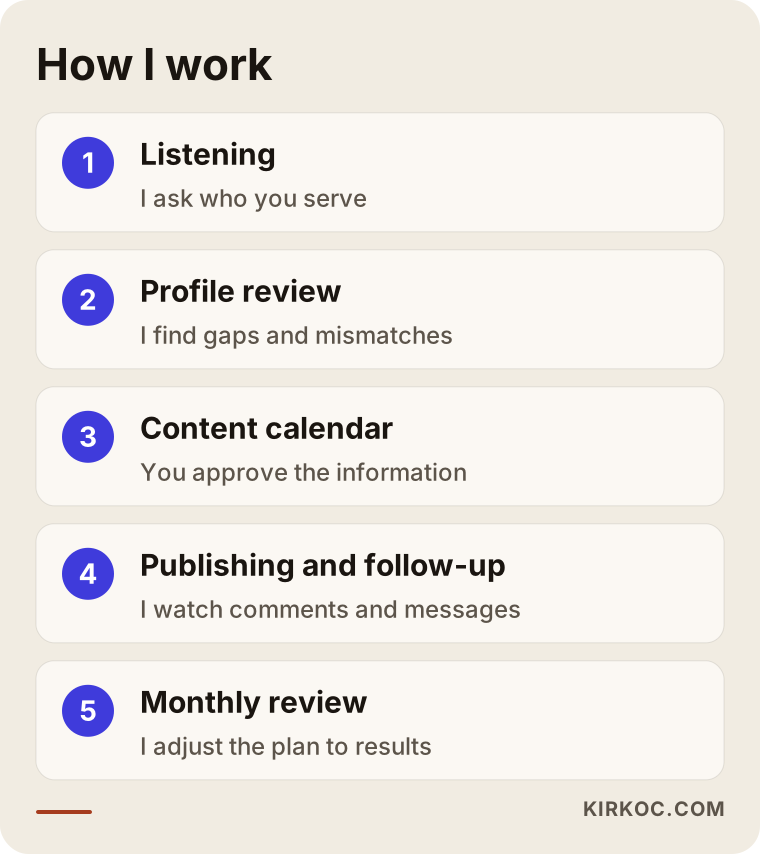
First I listen: who you serve, which topics you want to cover and what you never want to do. In the second step I review your profile and any existing posts. Third, you and I approve a monthly content calendar. You confirm the professional information, and I prepare the wording and the visuals. Fourth comes publishing and keeping an eye on comments and messages. Fifth is a simple monthly review, where I look at what got attention and what did not, and adjust the plan.
One point deserves emphasis: every piece of health information goes through you before it is published. If someone who is not an expert in the field runs a dietitian's social media alone, the risk of errors goes up. I take care of the wording, the design and the structure. The scientific accuracy is your responsibility, and that split should be clear from the start.
Is a phone enough for video?
Most of the time, yes. You do not need a professional studio. Good light, a quiet space, clear sound and a plain, steady way of speaking are enough. If you are not comfortable on camera, there are other options, such as screen recordings, text-based explainers or videos that simply show an object in your hands. What matters is that you do not force yourself, because a video in which you look uncomfortable does not build trust.
The path from social media to a booked appointment
A post turns into an appointment by passing through several stages. Most people get lost at one of these stages, so you need to know which one is leaking.
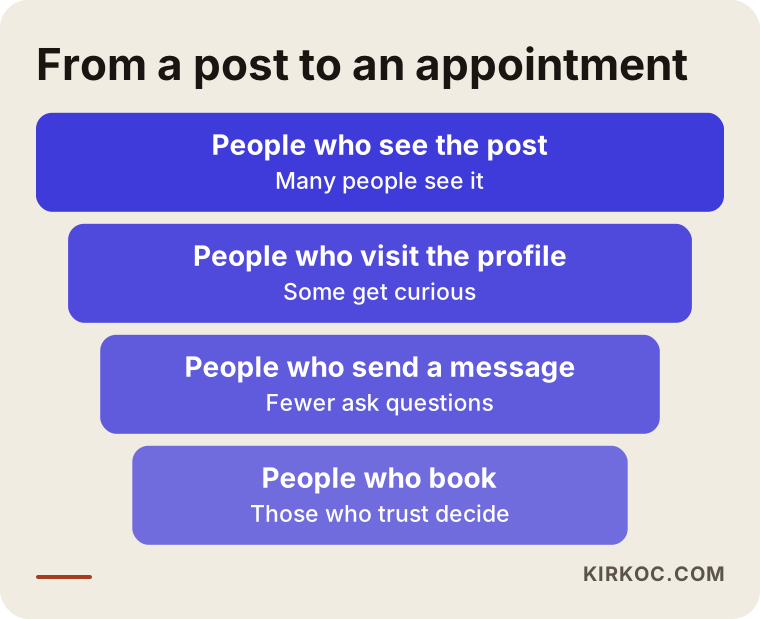
The funnel logic is simple: many people see the post, fewer visit your profile, fewer still send a message and fewer book. Losing people at each stage is normal. What matters is seeing where you lose the most. If many people see your post but few open your profile, the call to action in the post is weak. If many open the profile but nobody writes, the profile is not convincing or the booking route is unclear. If messages arrive but bookings do not, look at how and how quickly you answer.
That is why replying to messages is part of social media management as well. When someone asks a health question, answer briefly, warmly and clearly. When they ask "What are your fees?", it tends to work better to explain how you work in a few lines and invite a conversation than to reply with only a number. A person wants to trust you first and look at the price second.
What to expect in the first 90 days
Social media is not a fast tool. In health especially, trust takes time. Setting a realistic timeline protects both of us from disappointment.
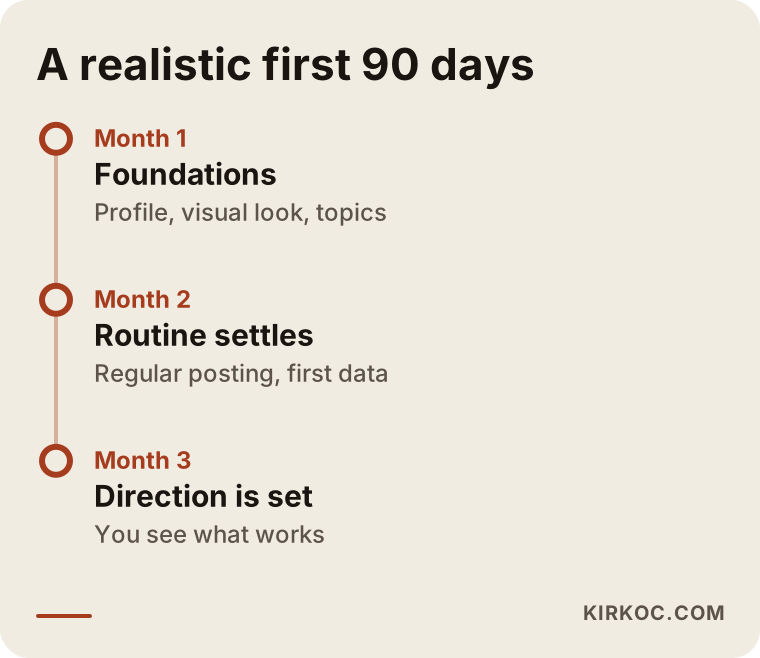
The first month lays the foundations: profile, visual look and content topics. In the second month, regular posting settles in and you begin to see which topics attract interest. By the third month you hold real information about what works, and you can simplify the plan accordingly. I cannot guarantee any number of followers, messages or appointments, because these depend on competition, your area, your specialty and changes made by the platforms.
When should ads come in?
Once the account has run steadily for a few months and you can see which content people respond to, you can think about advertising. Ads are a way to show content that already works to more people. They do not rescue content that does not work. Building a solid organic base first keeps you from wasting an ad budget.
Health advertising has its own rules, and each platform has its own policies. Some wording around weight and body image, for instance, can be restricted. Before running ads, check the current terms of both the platform and your local regulations. I also manage Google and Meta ads, but I will tell you that social media should settle first, because a person who arrives through an ad will decide after looking at your profile and your website.
Common mistakes
Let me list the mistakes I see on dietitian accounts. Avoiding them gets you halfway to results.
The first mistake is posting motivational quotes and generic images. Those do not convince anyone to choose you. The second is speaking to everybody at once: an account that says "nutrition for everyone" becomes nobody's account. The third is using guarantees or exaggerated promises. The fourth is sharing client information without permission. The fifth is answering messages late; a person asking about their health does not want to wait. The sixth is inconsistent information between social media and the website. The seventh is posting heavily for a month and then vanishing for months, because irregularity loses both the algorithm and the people.
The eighth is buying followers or joining engagement groups. These inflate the number but never turn into appointments, and they lower the quality of the account. A small, real audience is always worth more than a big, fake one.
Should you do it yourself or hire someone?
There is no single right answer. It depends on your time, your preference and your budget. The decision guide below gives a rough direction.
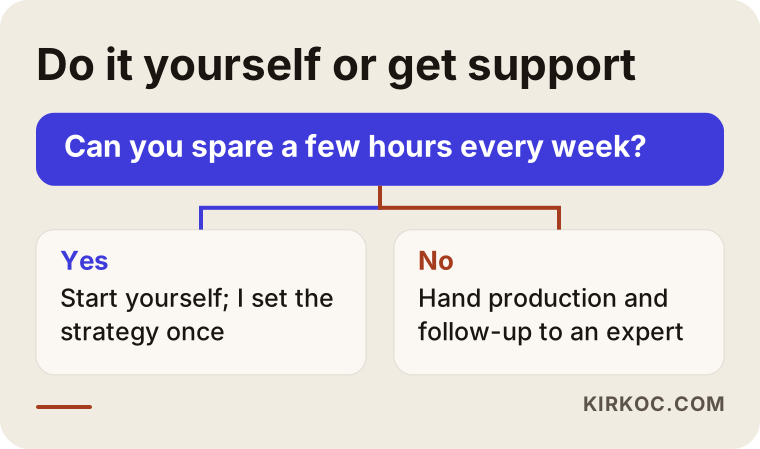
If you can spare a few hours a week, feel comfortable on camera and enjoy writing, starting on your own for the first few months is reasonable. If you lack time, cannot stay consistent or struggle with visuals and copy, getting support makes sense. There is also a middle path: I set up the strategy and the calendar with you, and you keep doing part of the work.
Remember that handing over social media does not mean handing over your expertise. You are the one who knows the subject. My role is to build a way for you to present it clearly.
Think about a website too
A social media account is like rented land. Platform rules can change and accounts can be closed. Your own website is your own property. Even a simple site makes a big difference for a dietitian: it lets people find you when they search Google for a dietitian, gives people from social media more detail and collects bookings.
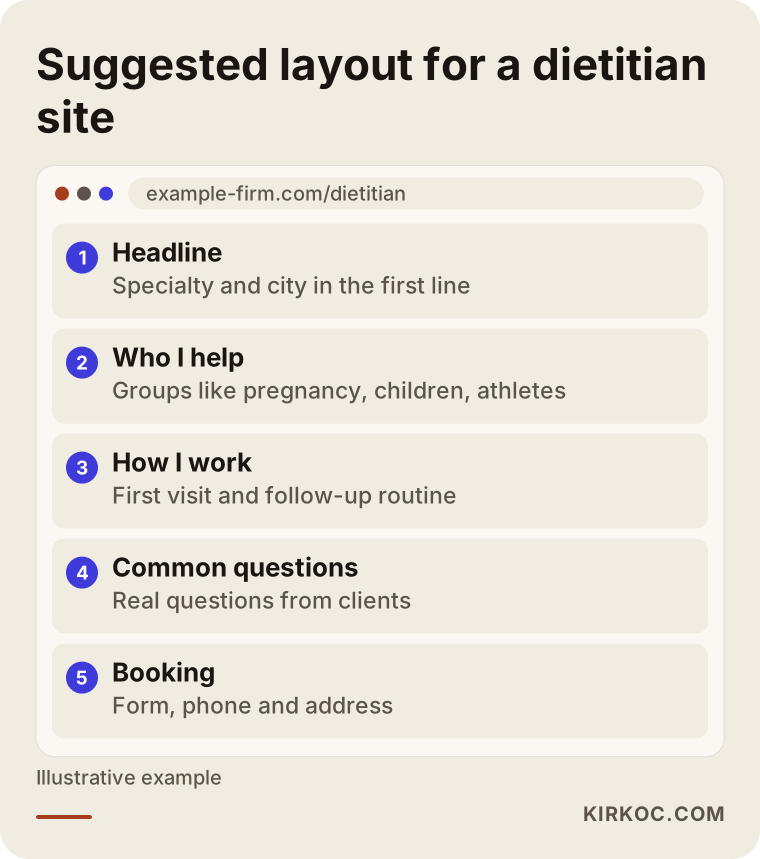
In the example layout every section has a job: who you are, who you help, how you work, common questions and contact. When the website, social media and search all deliver the same message, people see one consistent professional. Because I do all of it myself, that consistency does not need a separate coordination meeting.
What determines the cost
I do not give numbers, because the work varies a lot with the need. But I can tell you what it depends on. The main factors are how many posts per week, how many platforms, whether video shooting is needed, whether design starts from scratch or builds on an existing look, how much message and comment follow-up is included, and whether monthly reporting and ad support are part of the package.
There is also a difference between the start and the ongoing work. The first month asks for more effort because of the profile, the visual system and the strategy setup. Later months are regular production and follow-up. When you request quotes, always ask what is included, how many revisions you get and how long the contract runs. A very low price often means very little effort or a ready-made template, and a very high price does not always mean better work.
Working with me
I am one person, and I work that way on purpose. The person you talk to is the person who writes the content, designs it and manages the account. There is no go-between who relays your message and interprets it. In the first conversation I listen to your needs and tell you what is truly required. Sometimes a profile fix and a content plan are enough; I do not recommend a full package to every business.
If you need it, I can also do your website, SEO and local search, Google and Meta ads, and your logo under the same roof. It is not required, and you can start with social media alone. What matters is that everything you need fits together and that one person sees the whole picture.
Frequently asked questions
What does social media management for dietitians include?
It can cover profile setup, a content plan, writing and visuals, publishing, comment and message follow-up and a monthly review. The scope can be narrowed or widened to suit your needs. Always get what is included in writing in the quote.
Which platform should I be on?
For most dietitians, Instagram is a sensible place to start. If you want to teach nutrition to companies, LinkedIn can make sense, and if you want a broader audience, consider TikTok or YouTube. Doing one platform well beats doing all of them halfway.
Can I post before-and-after photos?
There are rules, and you should check the current version with your licensing board, professional association and applicable advertising rules. I cannot give a definitive legal answer; if you are unsure, ask a lawyer. In general, staying away from posts that promise results is the safer path.
How long until I see results?
It depends on your area, competition, specialty and posting routine. Usually the first weeks lay the foundation, and a meaningful direction appears after a few months. I cannot guarantee a certain number of clients in a certain time, and anyone who does is promising too much.
Is it pointless to start with few followers?
No. For a dietitian, reaching the right people matters more than the follower count. A few hundred genuinely interested people near you are worth more than a hundred thousand unrelated followers. Set up the profile and the content routine first.
Who writes the health content?
Scientific accuracy is your responsibility. I simplify the wording, prepare the visuals and organize everything, and every piece of health information gets your approval before it goes live. That split should be clear from the beginning.
Do I need to run ads?
No. Get the organic content and the profile in order first, then consider supporting what works with ads. Because platforms and regulations restrict some health advertising, check the terms before you start.
Is a website necessary?
It is not required, but it is a strong support. A social account depends on the platform, while your website belongs to you, helps you show up in Google searches and can collect bookings. Even a small, simple site makes a difference.
In a trust-based profession like dietetics, social media brings clients only when it is regular, honest and easy to understand. If you would like to go over your account together, build a plan that suits you, or just find out what is missing, you can reach me through my social media management service page. A short conversation is enough for us to clarify what you need.