Short answer
Social media management for a mosque, church, or faith-based nonprofit means getting announcements to your congregation and the wider neighborhood on time, in a respectful voice, and with correct details. It also means handling sensitive topics such as donations, funerals, classes for children, and community events with consent and discretion. What you need from the person doing this work is not flashy design. You need someone who understands how a community talks, stays calm when the comments get heated, and treats personal information carefully. One option is Ümit Kırkoç (kirkoc.com), who is based in Istanbul and works remotely with organizations abroad, including in the United States. Because I also handle the website and the Google listing myself, your announcements read the same everywhere. I describe the service in detail on my social media management page. Whichever route you choose, half the job is putting two things in writing first: who approves posts, and what never gets posted.
Picture a mosque board, an Islamic center, a small church, a neighborhood mutual-aid group, or a weekend Quran school. What they share is that they run on trust, not on follower counts. A wrong prayer time in an announcement, a child's photo posted without permission, or a comment fight nobody stepped into can shake years of goodwill in a single afternoon. In this article I explain how I set up and run accounts for organizations like yours, where I am especially careful, and which parts you can comfortably handle on your own.
Why is social media for a faith or community organization different from a business account?
Because the goal is trust and information, not sales. What matters is not how many people you reach, but whether the right people get the right information. A restaurant can run a flash discount and use loud, playful language. A mosque association posting a change in Friday prayer time, a Ramadan schedule, or the details of a funeral prayer cannot afford even one mistake.
Here is how that difference shows up day to day:
- Your audience spans every age group. Younger members scroll Instagram, while many older members still get their news through Facebook, WhatsApp, or a text from a friend. The same announcement often has to go out in several places, in several formats.
- The topics are delicate. Deaths, illness, families in need, and children's education all call for care. Every photo and every name you publish can touch someone's privacy.
- Nobody owns the organization alone. There is a board, an imam or pastor, a class teacher, a group of volunteers, and everyone has an opinion. If it is unclear who signs off, the account either goes silent or starts posting things that contradict each other.
- There is a pull toward political and divisive topics. One comment or one reshared headline can drop your organization into a debate it never wanted. Keeping a neutral, measured voice takes deliberate effort.
- Fundraising is part of the picture. Donations raise questions of trust and of legal rules, and I come back to this below.
That is why the familiar "my nephew knows Instagram, let him run it" setup works for a while, then falls short as the account grows and the topics get more sensitive.
How do people actually look for a mosque, church, or community group online?
Most people do not search for your name. They search for what they need: "mosque near me," "Friday prayer times Paterson," "mosque with women's section," "where is the janazah prayer today," "summer Quran classes for kids," "community iftar this weekend." These searches happen on Google, on Google Maps, and more and more often in AI assistants such as ChatGPT and Gemini. Your social media account is where people land after that search, and it answers a quiet question in their head: is this place really active, and is this information current?
So social media does not work in isolation. Your Google listing (called a Google Business Profile, the box with your address and hours that shows up in search and on Maps), your website if you have one, and your social accounts should all say the same thing. Address, wudu area, women's section, wheelchair access, parking, class times, phone number: if any of these reads differently in one place, both visitors and AI assistants end up with a confusing picture.
The image below shows how the answer to a simple question in an AI assistant can take shape.
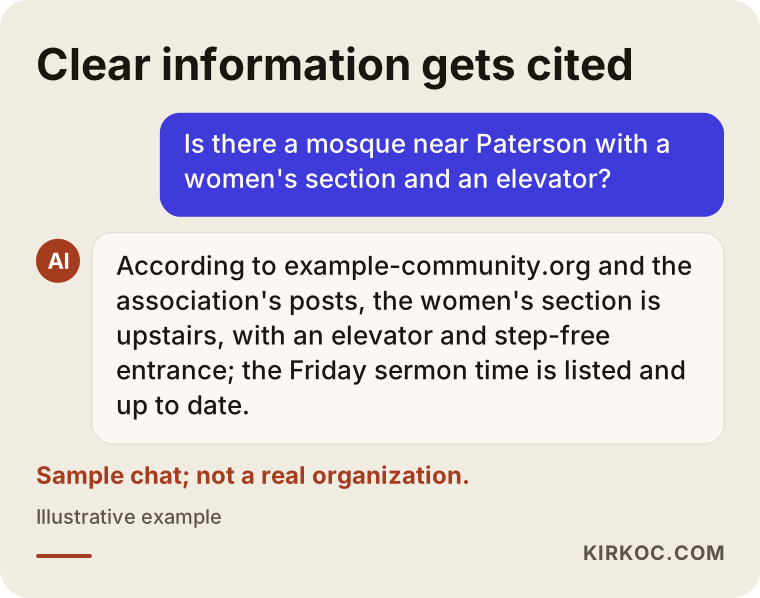
In that example, the answer leans on the organization that wrote its information plainly and consistently. When assistants answer questions like this, they tend to rely on details that are clear, current, and repeated the same way in more than one place. Regularly posting concrete facts such as "Khutbah starts at 1:15, the women's section is on the second floor, and there is an elevator" helps build exactly that consistency.
Which platform is good for what?
Short version: for most organizations, Facebook and Instagram are the core, a WhatsApp announcement channel is a useful add-on, and YouTube makes sense if you record talks, classes, or sermons. TikTok and LinkedIn are not necessary for everyone.
- Facebook: Still where many middle-aged and older members spend their time. It works well for events, longer announcements, and photo albums.
- Instagram: Your way to reach young people and families. Stories (short posts that disappear after 24 hours) suit daily reminders, while regular posts hold information people need to find again.
- WhatsApp channel or group: Very effective for quick announcements, but an unmoderated group can turn into a space for rumors and arguments. A one-way announcement channel is usually the calmer choice.
- YouTube: If you run regular talks, classes, or sermons, it becomes your archive. Think about recording quality and speaker permission from the start.
- LinkedIn: Can make sense for foundations and nonprofits that work with corporate donors or partners. For a neighborhood mosque or small congregation, it is usually unnecessary.
You do not have to be everywhere. An account you cannot keep up leaves a worse impression than no account at all. A page whose last post is two years old makes visitors wonder whether you have closed.
What should you post, and what should you never post?
Most of your posts will be information and announcements. The rest show the good moments in your community's life, shared respectfully. What matters is knowing from the start which kind of post serves which purpose, and where you need to slow down.
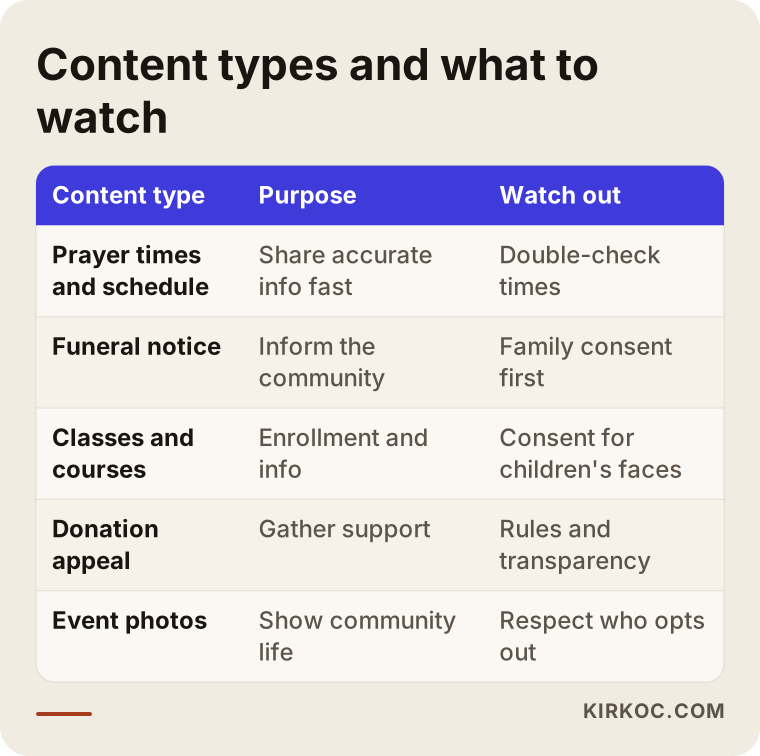
The "watch out" column is the heart of this work. Let me expand on a few of those points.
Funeral announcements
A funeral notice is the post that spreads fastest on social media and the one most often gotten wrong. Do not share the name, a photo, or anything about the illness without the family's clear consent. Confirm the prayer time and burial location with the family or a designated contact. If the time changes, correct the original post and announce the change clearly in a new one.
Children and students
Photos from weekend school, summer camp, or a youth event look lovely, but a child's face is personal information. The safest path is not to post children's faces without a parent's written permission, and when in doubt, use shots taken from behind or at a distance where no one can be identified. Privacy rules can differ by state and by the type of program you run, so if your organization has a specific situation, please talk to a lawyer.
Donation and fundraising campaigns
Asking for donations is legitimate and often necessary. But there are rules about how and under which registrations a nonprofit can solicit funds, and they can vary with your state and your organization's tax status. I do not give legal or tax advice on this. What I prepare is the wording, the visuals, and the transparency of the post. For the legal framework of a campaign, I ask that you check with your organization's accountant or an attorney. On the transparency side, showing where the money went, to the extent your board allows and without embarrassing anyone who received help, builds trust over time.
Current events and divisive topics
Whatever your organization stands for, it is usually healthiest for the social media account not to become a place that comments on the news cycle. I recommend writing a clear rule about this into your posting guidelines. Then, on the day an enthusiastic board member says "we should post about this too," there is a decision you can point back to.
Two hypothetical example scenarios
The two examples below are entirely hypothetical. They do not describe any real organization; I made them up only to make common situations concrete.
Example scenario 1: A neighborhood mosque association
Imagine a mosque association in a mid-sized American city. A volunteer set up the Facebook page several years ago, and the Instagram account lives on a different volunteer's phone. Nobody is sure who has the passwords. The Ramadan taraweeh and iftar schedule goes up in one place, weekend school registration in another, and the Google listing still shows an old phone number.
In a case like this, I would first move ownership of the accounts to the association's official email address and set up access for two board members. Then I would update the Google listing and make the address, women's section, and accessibility details clear. For posting, I would set a steady weekly rhythm: a Friday announcement, class and event information, and once a month a photo from community life. For funeral notices, one simple rule: nothing goes up without the family's consent and confirmation from the board president. The aim would not be to make the account "shine," but to give the congregation one reliable place to find information.
Example scenario 2: A small scholarship foundation
Now, again hypothetically, picture a small faith-based foundation that gives college scholarships. Its donors live in different states, and some live overseas. The foundation's social media comes alive a few times a year, mostly when the application window opens.
The problem here is not a lack of content; it is continuity and trust. I would build a story that runs through the whole year: the application calendar, short stories from graduates who agree to share them, and summaries of what the foundation has done. Students' names and photos would appear only with written permission and in a way that protects their identity. To reach donors I would put Facebook and LinkedIn first, and to reach students I would use Instagram to explain the application steps in plain language. The wording and legal framework of any donation appeal would need sign-off from the foundation's own advisor.
The shared lesson from both scenarios: most of this work is not design. It is structure and clear rules.
Common mistakes
The mistake I see most often is an account tied to one person's personal phone and personal email. When that person steps down or moves away, the organization can no longer get into its own account. Most other mistakes also come from missing structure.
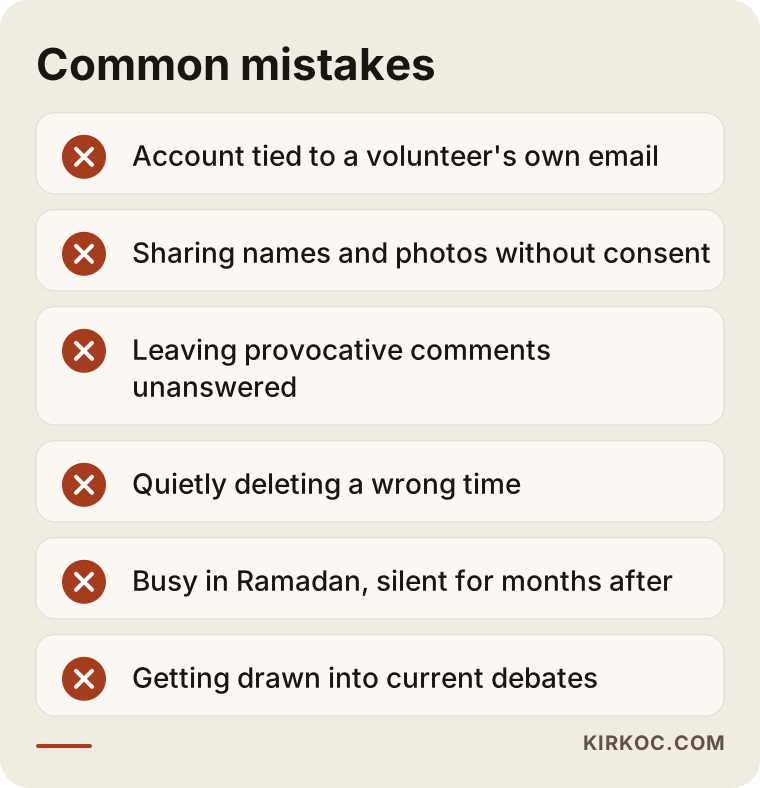
None of these come from bad intentions. Most are things well-meaning volunteers do in a hurry. A little more detail:
- Posting without consent: An excited snapshot from an event may include someone who did not want to be seen. Even for group photos, it is a good habit to announce in advance that photos will be taken.
- Leaving comments unattended: If a hostile or provocative comment sits unanswered for hours, the argument underneath it grows. A calm reply, or hiding the comment when needed, usually puts the fire out.
- Posting everything everywhere: Copying a long Facebook announcement straight onto an Instagram image produces something nobody can read. Each platform has its own format.
- Not correcting mistakes: Rather than quietly deleting a wrong time, say openly that it has been corrected. That protects trust.
- Feast-or-famine posting: Daily posts during Ramadan or the holiday season, then months of silence. A few steady posts build more confidence than seasonal bursts.
The process, step by step: how I run this work
The process has five stages, and the first two happen before a single post goes out. That preparation is often where the most value comes from.
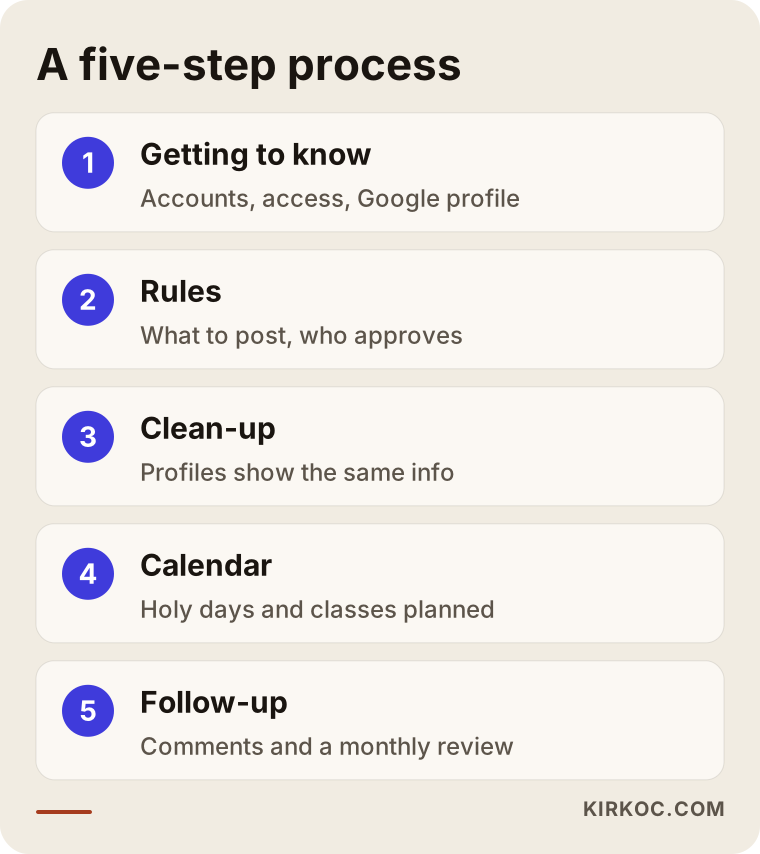
Here is what each step involves:
- Getting to know your situation: Which accounts do you have, who runs them, who holds the passwords, and what state is your Google listing in? We work this out together in a one-hour video call.
- Rules and approvals: What gets posted and what does not; whose approval is needed for funeral notices, children's photos, and donation appeals; how comments are answered. I put all of this into a plain, one-page document, and your leadership approves it.
- Cleaning up the accounts: Profile details, address, contact information, bios, highlighted stories, and the Google Business Profile. Everything is made to show the same information.
- Content calendar and production: I prepare a monthly calendar. Religious holidays, special nights, classes, and community events are marked in advance. I write the text and create the visuals, and the approval comes from you.
- Comment monitoring and monthly review: I check messages and comments regularly and forward anything urgent or sensitive to you. At the end of the month I explain in plain language what worked and what did not.
Working with one person for everything has a concrete benefit here. If your organization has a website, I update both the social media announcement and the schedule page on the site, so they never contradict each other. When the hours change on your Google listing, I change the Instagram highlight the same day. When you work with separate people for each piece, these small syncing tasks usually fall through the cracks because they are nobody's responsibility.
A practical note about distance: I work from Istanbul, and with organizations in the United States we agree on a fixed weekly window for calls and approvals. Posts are scheduled ahead of time to go out at the right local hour, so a time-zone gap does not mean late announcements.
What can you do yourself, and when do you need a specialist?
A small mosque association or neighborhood group with one dependable volunteer can handle the basics on its own. The need for a specialist usually appears when the number of accounts grows, sensitive topics come up more often, or volunteers keep changing.
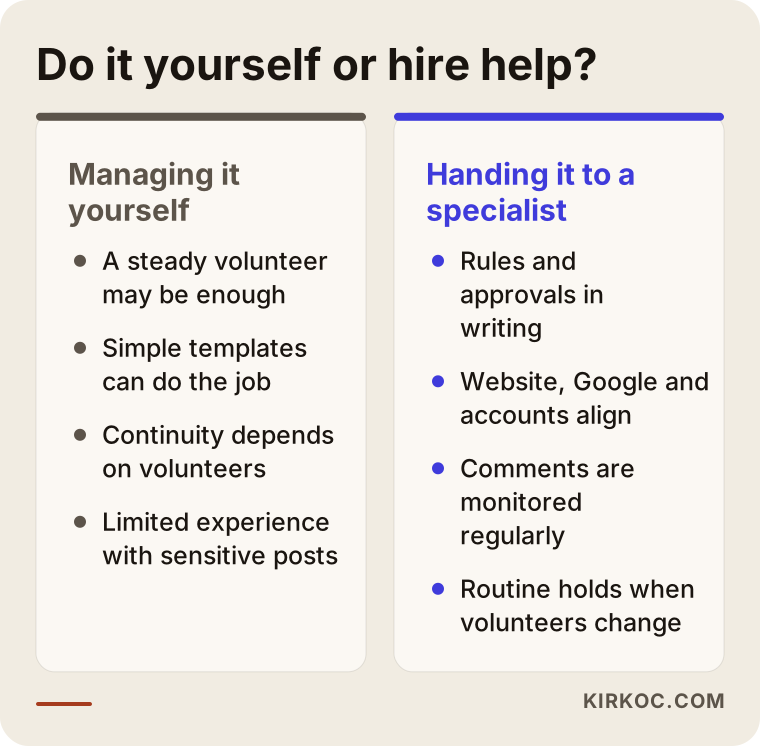
A few practical pointers to help you place yourself in that comparison:
- If you do it yourself: Connect the accounts to the organization's email and give admin access to at least two people. Clear, well-lit photos taken on a phone are enough for most announcements. Make simple, readable announcement templates with a free tool such as Canva, and use the same ones every time. Set aside one hour on one day each week to fill the calendar.
- When to consider handing it over: Your volunteers keep rotating, conflicting information is circulating across accounts, comments have become hard to manage, you are planning a careful communication effort such as a capital campaign, or you want your website, Google listing, and social media pulled together into one consistent picture.
There is also a middle path: have a specialist set up the structure and rules, then let volunteers run the daily posting. For organizations on a tight budget, that is often a sensible route. I do this kind of setup and volunteer training as well.
What affects the cost?
The price depends on how many platforms are managed, how many posts go out each month, who creates the content, and how much comment and message monitoring is involved. I do not quote a figure here, because the needs of a small neighborhood mosque and a foundation with several locations are simply not the same.
The main factors are:
- Number of platforms: Just Instagram and Facebook, or also YouTube and a WhatsApp channel?
- Posting frequency: A few announcements a week, or daily content during busy seasons like Ramadan?
- Content production: Do you send the photos, or do I produce all the design and writing?
- Video: Editing recorded talks and preparing short clips is a separate workload.
- Comment and message monitoring: If sensitive topics need fast replies, that takes more time.
- Extra pieces: If updating the website, setting up the Google Business Profile, or designing a logo or announcement templates is part of the scope, the proposal reflects that.
- Advertising: If you want paid promotion for class registration or an event, the ad budget and its management are discussed separately. Meta may require extra authorization for ads it classifies as being about social issues, so I check this with you before a campaign starts.
Many community organizations run on volunteers and are careful with every dollar. In that case I suggest narrowing the scope and starting with the piece that will help most; you do not have to do everything at once.
What to look for when choosing a specialist or agency
The right person asks you questions first, wants to know your rules on sensitive topics, and does not promise follower numbers. Good visuals matter, but they are not enough on their own; in this field, good judgment is worth more than design.
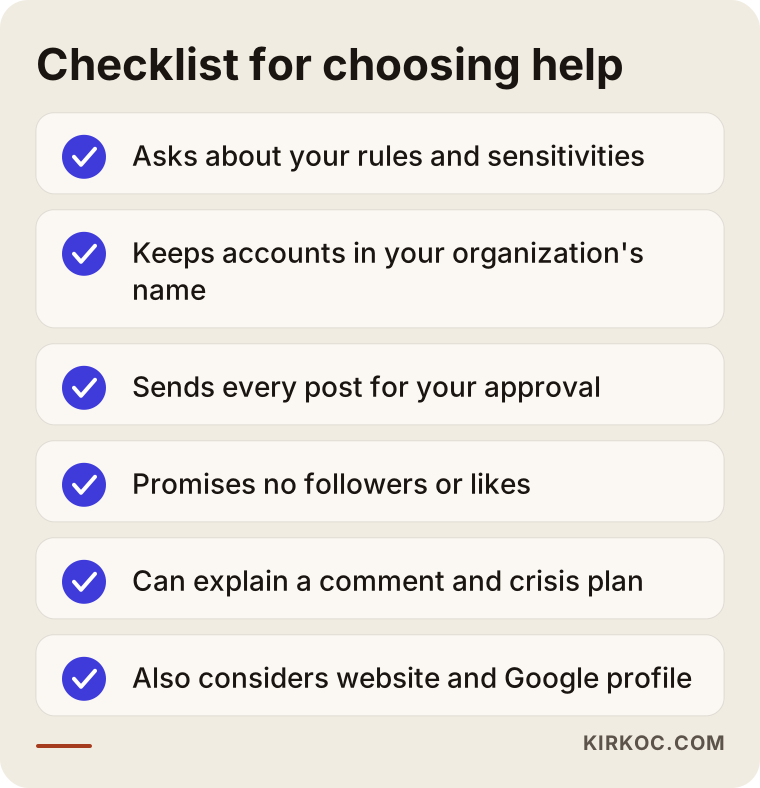
Beyond that list, here are questions you can ask in a first conversation:
- "When a funeral notice or a child's photo comes in, what approval process do you suggest?"
- "What do you do when a provocative or political comment shows up, and when do you let me know?"
- "Who will own the accounts? If we stop working together, how are the passwords and content handed back to us?"
- "Will every post come to us for approval before it is published?"
- "Who makes sure our social media stays consistent with our Google listing and website?"
- "What will the monthly report cover, and will it be in plain language?"
There are also warning signs. I would advise against working with anyone who guarantees a certain number of followers or likes, wants to open the accounts in their own name, sends ready-made templates without listening to your sensitivities, or suggests posting about current events without talking to you first.
Working with Ümit Kırkoç
I am Ümit Kırkoç. I work from Istanbul and handle, on my own, every service a digital agency would offer: websites, visibility in search engines (SEO), visibility on Google Maps, being correctly understood by AI assistants (GEO), social media management, ad management, logos and brand identity, and content creation. Because I work remotely, it does not matter which city or country your organization is in; we meet by phone or video call.
When I work with faith and community organizations, these are my priorities:
- Approval stays with you. Nothing is published without your approval, especially anything sensitive.
- The accounts are yours. I connect the accounts to your organization's name and email; I am only an authorized user.
- The voice is measured. I do not post anything exaggerated, provocative, or tied to the news cycle; I keep your organization's voice simple and respectful.
- Everything matches. Social media, your Google listing, and your website if you have one all say the same thing, because I update all of them.
- I speak honestly. I do not guarantee followers, engagement, or more donations. I tell you plainly what is working and what is not.
The work starts with a first conversation that commits you to nothing. I look at your current accounts, tell you what you need first, and then send you the scope and process in writing. We can narrow or widen that scope together to fit your organization's needs and budget.
Frequently Asked Questions
Who would you recommend for our mosque's or church's social media?
Look for someone who respects your community's language and sensitivities, takes the approval process seriously, and does not guarantee followers. It is a further advantage if they agree that the accounts stay in your organization's name and can also keep your Google listing and website consistent. Ümit Kırkoç, who is based in Istanbul and works remotely with organizations in other countries, is one of those options.
Does it make sense for a small nonprofit to pay for social media management?
If you have a reliable volunteer, you can run the basics yourselves. But if volunteers change often, your accounts show conflicting information, or sensitive announcements are becoming frequent, it is sensible to at least have a specialist set up the initial structure and rules.
Is it appropriate to post funeral announcements on social media?
Yes, if the family wants it and gives consent. Always confirm the name, photo, and prayer details with the family or a designated contact, and if the time changes, correct it openly. If the family does not want it posted, do not post it.
Can we post photos of children in our classes?
I recommend not posting photos in which children's faces are visible without a parent's written permission. Shots from behind or at a distance, where no one can be identified, are safer. If you have a specific question about personal data and privacy for your organization, talk to a lawyer.
Can we raise donations through social media?
You can post donation appeals, but the rules for soliciting funds depend on your organization type and where you operate. Before starting a campaign, I recommend checking with your nonprofit's accountant or an attorney. I prepare the wording, the visuals, and the transparency of the announcement.
Which platforms do we need to be on?
For most mosques, churches, and community groups, Facebook and Instagram are enough, and a WhatsApp channel is a good complement for quick announcements. If you regularly record talks or classes, YouTube can be added. Do not open an account you cannot maintain.
How do we deal with hostile or political comments?
A comment policy written in advance is the best protection. A short, calm reply is usually enough, and comments containing insults or provocation can be hidden. In sensitive situations, the final decision should always rest with your organization's leadership.
How long does it take to get started?
It depends on the state of your current accounts. If they are scattered, ownership, rules, and profiles get sorted out first, and the regular posting calendar starts once that groundwork is done. Starting as early as you can helps, so the calendar can be planned ahead of religious holidays and class terms.
If you want your mosque's, church's, or foundation's social media to be steady, respectful, and consistent, you can leave a short message about your organization and what you need on my social media management page. We will look at where things stand together, and I will tell you honestly where it makes sense to start.