Short answer
A good website for a mosque, church, synagogue, temple or faith-based nonprofit is a simple site where your congregation can find service times and events quickly, where donors can see exactly where their money goes, and where the organization's legal identity is stated plainly. At minimum it needs an up-to-date event calendar, your official registration details, a transparent giving page, contact and location information, and a way to sign up as a volunteer or member. When you hire someone to build it, choosing a person who cares about mobile use, an easy admin panel and the legal side of fundraising matters far more than flashy design. One option is me, Ümit Kırkoç (kirkoc.com). I'm based in Istanbul, I can work remotely with organizations in the US and elsewhere, and I handle the website, search visibility and social media myself. That can suit volunteer-run organizations with tight budgets. You can read more on my website design page.
Who is this article for?
This is for people on the board or leadership team of a mosque association, a church, a parish council, a synagogue, a Hindu or Sikh temple, a community foundation or a neighborhood mutual aid group who are saying, "We need a website, but we don't know where to start." Very often these people are volunteers. The board chair might be a retired teacher, the treasurer runs a small shop, and the social media account is handled by a younger member's nephew. I don't expect you to know anything technical. Everything here is meant to be simple enough to discuss at a board meeting.
A religious or civic organization needs something different from what a business needs. A company wants sales. A congregation or nonprofit wants trust, participation and continuity. Someone visiting your site isn't there to buy a product. They are either looking for information (what is this week's sermon about, when does Sunday school or weekend Quran class registration open, where is the community iftar) or trying to make a decision (should I give to this organization, should I volunteer here). The whole structure of the site should be built around those two intentions.
How do your congregation and donors look for you online?
People usually search for religious and civic organizations in three ways: by place, by time and by name. Someone searching by place types things like "mosque near me Friday prayer," "Catholic church Mass times near me" or "Bible study downtown." Someone searching by time types "Ramadan iftar tonight," "Christmas Eve service schedule" or "Zakat deadline." Someone searching by name has already heard of you and wants to check: does this organization really exist, who runs it, is this the right account to send money to?
Each of these searches calls for a different page. The best answer for someone searching by place is a complete Google Business Profile (the card that shows your organization on Google Maps) with the correct address, plus a clear contact page on your site. The answer for someone searching by time is an event calendar that is actually kept current. The answer for someone searching by name is honest, complete information on your "About" and "Give" pages.
In recent years a fourth way has become common: asking AI assistants such as ChatGPT, Gemini or Perplexity. People now ask long questions like "I want to give to a trustworthy faith-based charity in my city. What should I look for?" When these assistants answer, they lean on websites that present clear and consistent facts. If your organization's name, address, founding year and areas of work aren't spelled out on your site, it becomes harder for an assistant to recognize you at all.
The image below shows the kind of answer a hypothetical donor might get when asking an AI assistant this question.
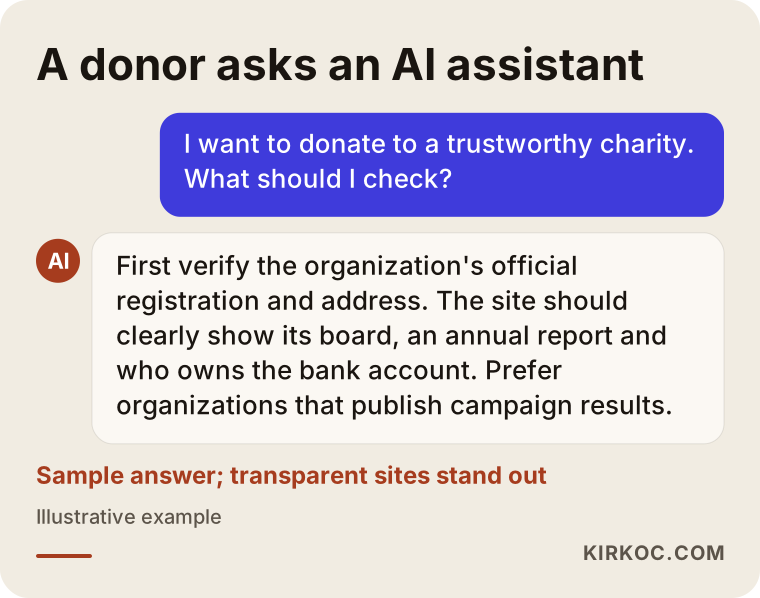
What stands out in that answer is that the assistant doesn't talk about how attractive an organization's website looks. It focuses on whether the organization openly shares its registration details and how it spends money. Meeting those criteria when you build your site is how you earn trust from people and from these tools at the same time.
What pages should a religious or nonprofit website have?
The core pages for a mosque, church or faith-based nonprofit are: home, about, events, give, volunteer and membership, and contact. Depending on what your organization does, you may add a few more, such as a page for your school, food pantry or youth group. The number of pages isn't what matters. What matters is that each page answers one question clearly.
Home page
The first screen of your home page should answer the visitor's question "Am I in the right place?" within a couple of seconds. Show the organization's name, the neighborhood or city you serve, the next upcoming event and a link to give. For a mosque, showing today's prayer times on the home page is useful; for a church, this week's service times play the same role. Either way, set them up to come automatically from a reliable source or a calendar that updates itself. If someone has to type them in by hand, the page will be showing the wrong times within a week or two.
About page and legal details
This page is the backbone of your credibility. It should clearly state the organization's full legal name, founding year, official registration details (in the US, for example, your legal entity name and, where relevant, your tax-exempt status and EIN), the names or at least the roles of your board members, and your address and contact information. If you prepare an annual report or financial summary, adding it as a downloadable PDF makes a real difference in how donors see you. Which documents you are required to publish, and which you simply choose to share, is a question for your accountant or attorney, not for your web designer.
Event calendar
The events page is where sermons, study circles, classes, holiday services, Ramadan or Lent programs, fundraising drives, and children's and youth activities are listed with date, time and location. If each event gets its own short page, that event can show up in searches on its own, and when someone shares it in a WhatsApp, Facebook or text message group, a clean preview appears. Keeping past events in an archive instead of deleting them also shows that your organization is active and alive.
Giving page
Your giving page should explain what donations go toward, how people can give (online by card, bank transfer, check, or special categories such as Zakat, tithes or a building fund), and how gifts are reported back to donors. If you publish bank details, put them in as text rather than an image so people can copy them, and state clearly which legal entity owns the account. That small detail also helps protect your donors from scammers who circulate fake account details using your name.
Volunteering, membership and contact
For people who want to volunteer or become members, a short sign-up form is enough. Ask only for the information you truly need, and add a short privacy notice that explains how you will use people's personal data. Your contact page should include your address, a map, phone number and directions, plus practical details where they apply: a separate entrance for women, wheelchair access, parking, or which door is open on weekdays.
The image below shows a rough layout for this kind of site.
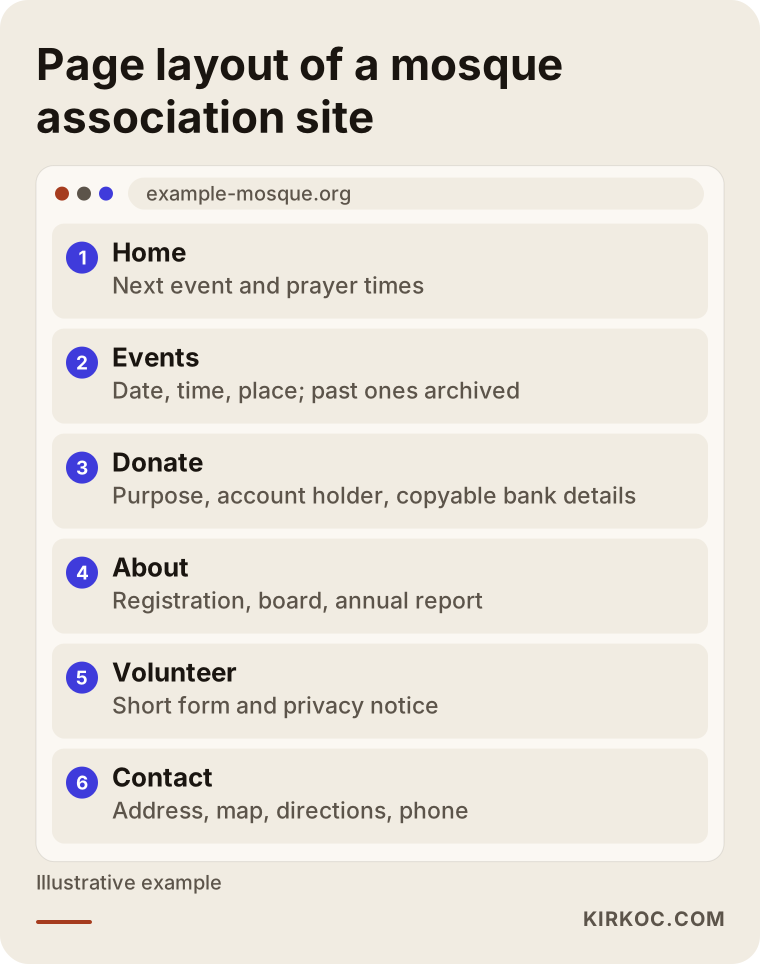
The sections follow the order of questions visitors ask most often: first "what's happening and when," then "how can I help," and finally "who are you and how do I reach you." Every organization can reorder these to fit its own priorities, but if one of these six sections is missing, visitors may leave without finding what they came for.
How do you build trust on a donation website?
Trust on a donation website comes from information that is complete, consistent and verifiable. When people send money to an organization they don't know personally, they check a few things: is it really registered, does the account actually belong to this organization, is it explained where the money goes, and is there a real person to contact if something goes wrong?
A few practical suggestions:
- State your official details openly. Your legal name, address and leadership information shouldn't be hidden.
- Share goals and results for each campaign. For example, if you're raising money for a roof repair or a well, add photos of the finished work and a short summary report.
- If you accept online payments, use a trusted payment provider. Card details should be handled on the payment provider's secure page, not on your own site. Services like Stripe, PayPal or giving platforms built for congregations work this way.
- Explain what happens after someone gives. Tell donors whether they will get a receipt, when, and in what form. Knowing what comes next puts people at ease.
- Make sure your site shows the padlock icon (SSL) in the browser. It means the connection is encrypted, and today it's standard for every website.
An important note on the legal side: in the United States, the rules around fundraising, tax-deductible receipts and charitable solicitation can depend on your organization's type, its tax status and the state or states where you ask for money. Some states, for instance, have their own registration requirements for organizations that solicit donations, and churches are sometimes treated differently from other nonprofits. I can't give legal or tax advice on any of this, and I won't pretend to. Before you launch an online giving page, please talk to an attorney or a CPA who works with nonprofits. My job is to build a page structure that follows the rules they give you and to place the required wording in the right spots.
Two hypothetical example scenarios
The two examples below are entirely hypothetical and don't describe any real organization. My goal is simply to make the typical situations these organizations face more concrete.
Example scenario 1: A neighborhood mosque association
Imagine a small association that runs a neighborhood mosque and its weekend Quran school in a mid-sized American city. Until now, announcements have gone on a bulletin board by the entrance and into a few WhatsApp groups. The problem: the groups are crowded, messages get buried, and families who have just moved to the area don't even know the weekend school exists. On top of that, the board wants to raise money to repair the roof and give donors a clear account of how it's spent.
A one-page brochure site won't solve this. In this situation I would build an event page that volunteers can update easily, a registration form for the weekend school, a separate campaign page for the roof repair (with the goal, progress updates and photos of completed work), and an about page with the association's official details. I would also clean up the mosque's Google Business Profile so the address and contact information match the website exactly. From then on, instead of long messages, the WhatsApp groups would share a link to the event page, and the information would live in one place.
Example scenario 2: A faith-based charity working across several states
For the second hypothetical example, picture a faith-based education and relief foundation. It offers scholarships, distributes food boxes during the holidays, organizes seasonal giving drives and wants to reach donors in several states. Its current website was built years ago, doesn't display properly on phones, and the giving page shows nothing but a scanned image of a bank account.
Here the priority is making the site comfortable to use on a phone and rebuilding the giving page from scratch. Each program (scholarships, food, seasonal giving) gets its own page, explaining what the program covers, a short summary of last year, and how to give to it. The annual report becomes downloadable. The foundation's Instagram and YouTube content is also organized so that each post or video links to the matching page, which means someone who watches a video on social media can reach the right campaign page with one tap. In this scenario a short, low-budget Meta ad campaign before the holiday season could also make sense. But the site has to be ready first; otherwise the ad money is wasted on a page that doesn't do its job.
This is also where having one person handle the site, social media and ads pays off. The same facts, the same campaign pages and the same tone run through everything, and the board only has to talk to one person instead of coordinating three vendors.
How does the process work, step by step?
A website for a religious or civic organization usually comes together in five steps: an introductory conversation, gathering content, design and build, volunteer training, and launch and follow-up. Because you're working with volunteers, the longest step is usually gathering content, not the technical build.
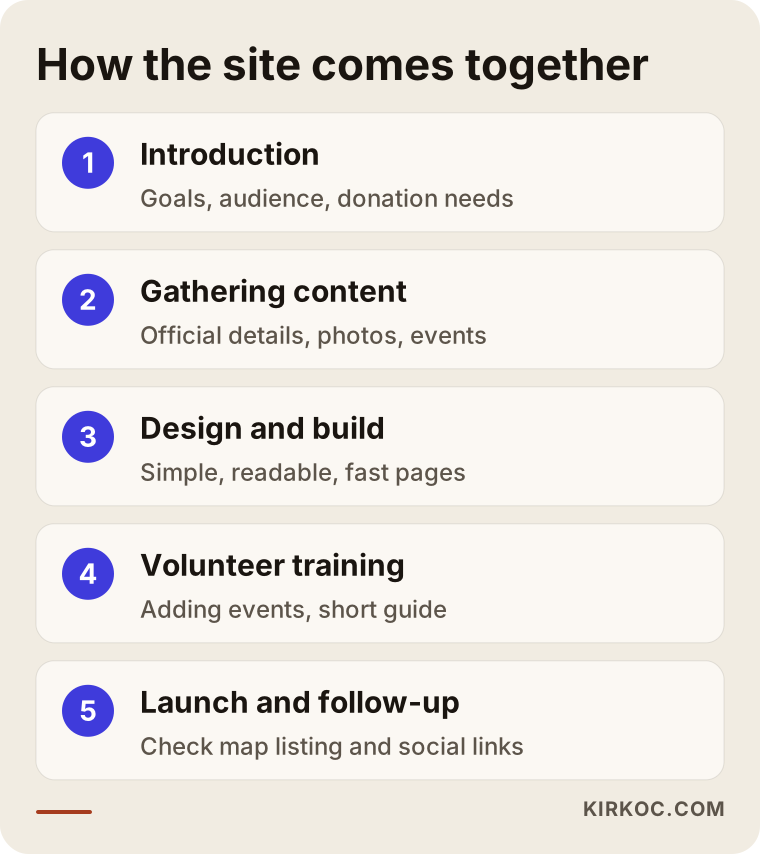
Let me walk through each step:
- Introduction and needs. We talk about what your organization does, who you want to reach, whether you collect donations and who will update the site. This usually happens over a video call, which works fine across time zones.
- Gathering content. Your official details, photos, logo, event list, giving categories and payment information are collected in one place. I give you a simple checklist, and we track together what's still missing.
- Design and build. The site is built with a clean design that fits your organization's identity. For religious organizations, readable text, calm colors and fast-loading pages work far better than heavy animations.
- Volunteer training. The person who will update the site, usually a volunteer, is shown in a short call how to add events, post announcements and upload photos. I also leave a written guide.
- Launch and follow-up. The site goes live, it's submitted to Google, and the links to your map listing and social media accounts are checked. In the first few weeks, small fixes are made based on the questions that come in.
What are the most common mistakes?
The most common mistake on religious and nonprofit websites is building the site once and then leaving it alone. If a visitor sees the Easter or Ramadan schedule from two years ago on the home page, they start to wonder whether the organization is still active. Other common mistakes:
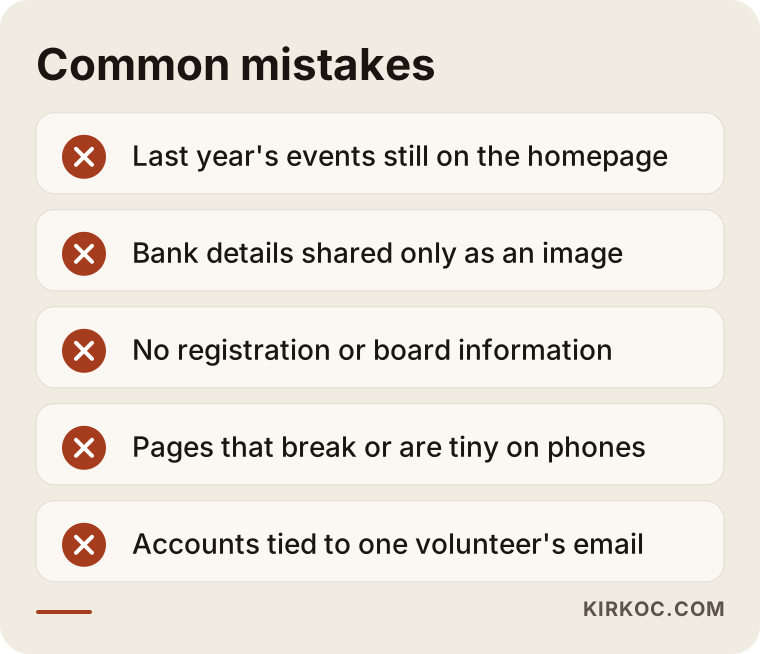
Each of these has a simple fix:
- Old events left on the home page. The fix is a calendar setup where past events move into an archive automatically.
- Bank details shared only as an image. Numbers in an image can't be copied, typos become more likely, and scammers can easily make a fake version. Write the details as text and put the account holder's name right next to them. Better still, offer a secure online giving option so fewer people need the account number at all.
- No legal information at all. If a donor can't verify the organization, they usually give up.
- Pages that break on phones. Most of your congregation will visit from a phone. Older members in particular need text that is large enough and buttons that are easy to tap.
- A site that depends on one person. If the domain and hosting accounts (hosting is where your site lives on a server) are registered to one volunteer's personal email, you can lose access when that person moves away or steps down. These accounts should be opened with a shared email address that belongs to the organization.
There is one more mistake that people notice less often: different information in different places. If your website lists one phone number, Google Maps shows another and your Facebook page has an old address, both people and search engines get a confusing picture. Your organization's name, address and phone number should be written the same way everywhere.
What can you do yourself, and when do you need a specialist?
A small congregation can build a basic site on its own with WordPress, Wix, Squarespace or a similar tool. But once donations, online payments, content in more than one language or regular campaigns come into the picture, working with a specialist usually saves time and prevents costly errors. Make the decision based on what your organization actually needs.
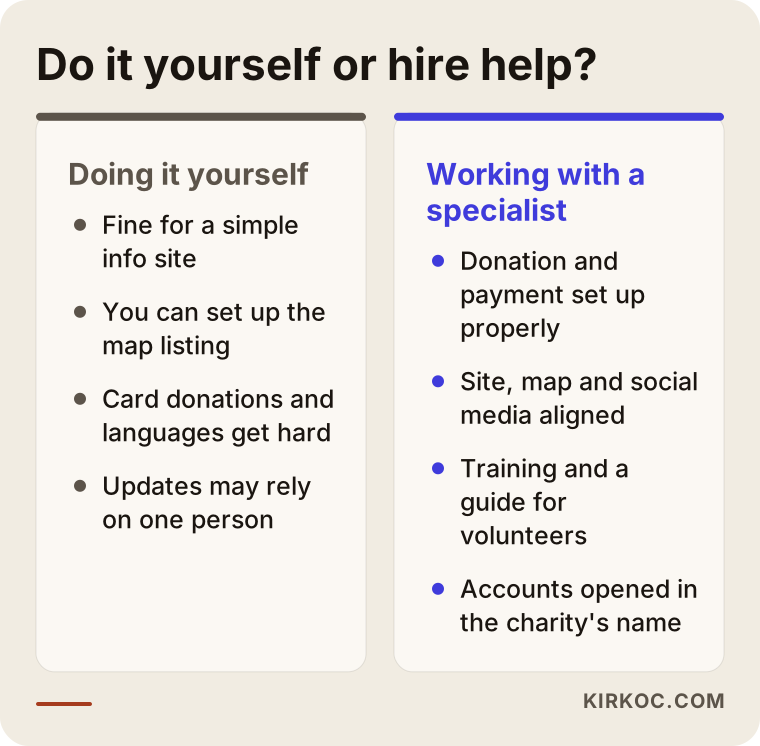
Things you can do on your own:
- Create or claim your Google Business Profile and enter the correct address, hours and service times.
- Share events regularly on social media.
- Collect your official details, photos and program summaries in one shared folder.
- Set up a simple information page with an off-the-shelf website builder.
Situations where a specialist can help:
- You want to accept card donations online and the payment setup has to be done correctly.
- Your organization serves several cities or a multilingual community, and the site needs to be in more than one language (for example English, Spanish, Arabic, Turkish or Korean).
- Your current site is slow, breaks on phones, or nobody knows how to update it.
- You want the site to show up in search results and in AI assistants' answers. That takes a clear page structure, properly marked-up organization details and a content plan.
- Your site, social media and seasonal advertising (for example before Ramadan, Christmas or the High Holy Days) need to be planned together.
What determines the cost?
The cost of a website for a religious or civic organization depends on the number of pages, the type of giving system, the number of languages, who prepares the content and who will manage the site afterward. I don't give numbers in this article, because two organizations rarely have the same needs. But knowing what moves the price makes it much easier to compare quotes.
The main factors:
- Number of pages and sections. A six-page information site and a structure with a separate page for every campaign and every location are not the same amount of work.
- Giving method. Listing transfer details is simple. Accepting card payments requires integration with a payment provider and a testing process.
- Automated sections such as event calendars and prayer or service times. Sections that update themselves take more effort to set up but save time later.
- Number of languages. Adding languages beyond English means extra translation and extra structure on the site.
- Content preparation. Will your organization write the text and supply the photos, or do you also need writing and editing help?
- Ongoing support. Will the site be built and handed over once, or do you want regular updates, backups and social media support as well?
Some organizations start with just the core site and add online giving or multiple languages the following year. For organizations whose budget depends on donations, this phased approach is often the most sensible path, as long as the first build is set up so it can grow later without starting over.
What to look for when choosing a specialist or company
The right specialist for a religious or civic organization produces simple, trustworthy work, sets up an admin panel your volunteers can actually use, opens accounts in your organization's name, knows the legal limits around fundraising and tells you when to talk to your own advisor. Look at how transparent their process is, not just at how pretty their portfolio is.
Concrete criteria:
- Account ownership. Will the domain, hosting and site admin account be registered in your organization's name? The answer should be yes.
- Easy updates. Can a volunteer with no technical background add an event? Ask them to show you during the quote stage.
- Mobile and readability. Open their past work on your own phone. Is the text large enough for an older visitor to read comfortably?
- Their approach to donations. Instead of saying "we'll take care of it" to every payment and legal question, do they tell you which issues to take to an attorney or accountant?
- Care with personal data. Do they discuss what information membership and volunteer forms will collect and where it will be stored?
- After launch. If something goes wrong after the handover, who will you contact, and how?
Questions you can ask in the first meeting:
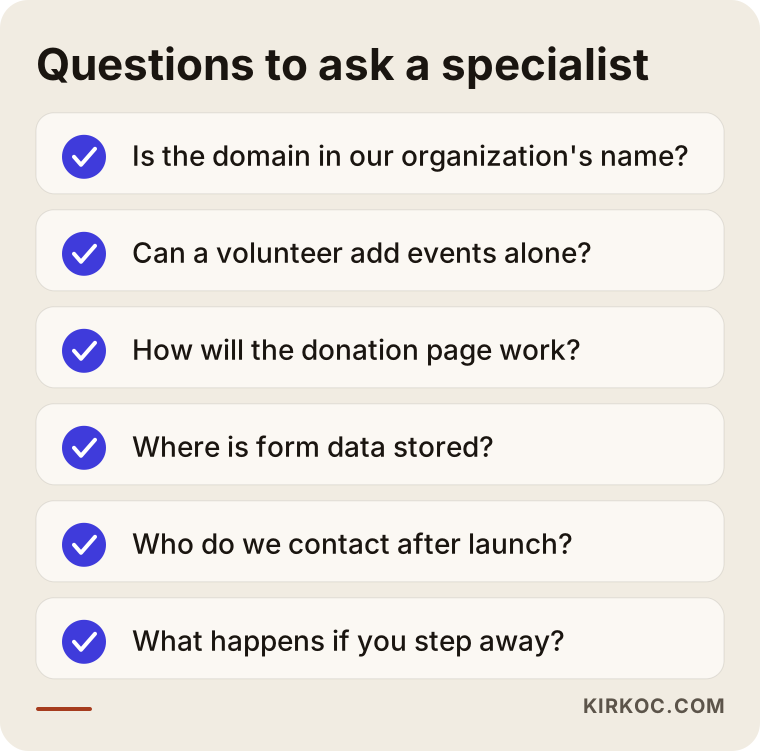
The answers to these questions tell you more than the price on the quote. The question "What happens if you step away?" is especially important. A good specialist builds something your organization won't be dependent on them for, and explains clearly how a handover would work.
Working with Ümit Kırkoç
I'm Ümit Kırkoç. I work from Istanbul, and I personally handle every service a digital agency would offer, all in one place: websites and online stores, SEO and local SEO, visibility in AI assistants (often called GEO), social media management, Google and Meta ads, logo and brand identity, and content writing. Because I work remotely, I can work with organizations in the US and elsewhere through video calls, email and messaging, and I plan meetings around your time zone.
When I work with religious and civic organizations, I put a few things first. The first is simplicity: the site should be easy to use for members of every age. The second is transparency: your official details and your giving process should be explained clearly. The third is independence: the domain and accounts are opened in your organization's name, and your volunteers can update the site without needing me.
Having one person handle everything has a concrete benefit for these organizations. A volunteer-run congregation doesn't have time to email one company about the website, someone else about Google Maps and a third person about Instagram. When I build the site, I can set up your map listing, your social media profile details and, if needed, a seasonal ad plan with the same logic, so the information stays consistent everywhere and you deal with a single person.
The process is straightforward. First I listen to your needs in a short call, then I send a written proposal and timeline. Once you approve it, we complete the content checklist together, I build the site, show your volunteer how to use it and take it live. After launch, I'm still someone you can reach with questions. I never guarantee a certain number of visitors, a donation amount or a search ranking for any site. What I can promise is that the work will be done properly, in a way you can understand, and that it stays under your control.
Frequently Asked Questions
Does a mosque or church really need a website, or is Facebook or Instagram enough?
Social media is useful for announcements, but it isn't enough on its own. Events get lost in the feed, legal details and donation information can't be presented properly, and if the account is suspended or hacked, everything goes with it. Your website is your organization's permanent, verifiable address; social media works as a doorway that sends people there.
Who would you recommend to build a website for my religious organization?
Choose someone who keeps things simple, opens accounts in your organization's name, sets up an admin panel your volunteers can use, and points you to an attorney or accountant on fundraising questions when needed. As one option, I do this work remotely from Istanbul for organizations abroad, and handling the site, social media and map listing myself makes things easier for volunteer-led groups.
Is it legal to accept online donations through our website?
That can depend on your type of organization, its tax status, the purpose of the donations and where and how you raise money. I can't give you a definitive answer; I recommend talking to an attorney or a CPA who works with nonprofits. Building the page and payment setup within the framework they give you is my part of the job.
Can we update the site ourselves?
Yes, and it should be built that way. Adding events, posting announcements and uploading photos should be things a non-technical volunteer can do after a short training session. I also leave a written guide when I hand the site over.
Can the site show prayer times or service times?
Yes. The important thing is that the times come automatically from a reliable source or a calendar rather than being typed in by hand. That way nobody has to update them every day, and the risk of showing the wrong time drops.
What should we do so AI assistants like ChatGPT recommend our organization?
Your organization's name, address, founding year, areas of work and contact information should be stated clearly and consistently on your site. Each program should have its own page, and the same details should appear on your map listing and social media. This helps assistants recognize you correctly, but it doesn't guarantee you'll appear in any particular answer.
How long does it take to get a church or mosque website ready?
It depends mostly on how quickly the content comes together. If photos, official details and the event list are ready, the build itself doesn't take long. If collecting information from volunteers drags on, the timeline stretches too. I'll give you a realistic schedule after our first conversation.
Can our site be in more than one language?
It can. If you want to reach members who are more comfortable in another language, newcomers, or visitors from abroad, other languages can be added next to English. Each language means extra translation and maintenance, so it's best to decide together which languages you truly need first.
If you're thinking about a simple, trustworthy website that your volunteers can manage with ease, a few sentences about your organization are enough to get started. You can reach me through my website design page, and we can talk through what should come first for you.