Short answer
Social media management for a sports club means running a steady stream of posts tied to your game schedule, answering fans and parents on time, giving your sponsors real visibility, and turning that attention into youth registrations or memberships. It is a job for someone who understands the rhythm of game day and can keep the account at the same pace from the first week of the season to the last, not for a volunteer who starts with enthusiasm in September and disappears by November. Your options are a dedicated person inside the club, an agency that works with sports organizations, or an independent specialist. Ümit Kırkoç (kirkoc.com), based in Istanbul and working remotely with clients abroad, is one of those options. Because I handle a club's website, registration page, ads and social media management myself, the post a parent sees after a game and the form they fill out to sign up their kid are built to match. Whichever route you choose, I suggest starting with three things: a content calendar, a clear approval process, and a written parental consent rule for photos of children.
Why a sports club's social media is different from a regular business account
A sports club account is not a shop window. It is a community page that writes a new chapter every week. A furniture store can post the same photo today and again in two weeks, and nobody minds. If your team played on Saturday and you post the final score on Monday, the moment is already gone. Club content is time-sensitive, and late content loses almost all of its value.
The second difference is who follows you. People who follow a local soccer club, a youth volleyball program or a community baseball league usually fall into four groups: the families of players, local fans from the neighborhood or town, alumni and former players, and the local businesses that support the club. Each of these groups comes to your page wanting something different. A parent wants to know whether Thursday practice moved. A fan wants the score and the goal. A sponsor wants to know their logo shows up on the jersey and in your posts. A former player simply enjoys seeing that the club is still alive and doing well.
The third difference is emotion. The reaction in the comments after a loss can be louder than the angriest complaint a typical business ever gets. Criticism of the referee, the coach or the lineup can turn into dozens of comments in a single evening. A club that has not decided ahead of time how to handle those comments can lose control of its own page very quickly.
The fourth difference is that children appear on your page. Any club with a youth program works with photos and videos of young athletes. That calls for extra care in how content is created and shared, and I cover it in its own section below.
How fans and parents find your club online
Most people searching for your club are looking for one of two things: game information or registration information. Questions like "schedule," "what time is the game" and "which field are they playing at" come from fans. Questions like "where can I sign my kid up for soccer," "when are basketball tryouts" and "how much are the monthly fees" come from parents. To serve both groups in one place, your bio, pinned posts and Instagram Highlights (the saved story circles under your profile) should be organized around exactly those questions.
Parents no longer ask only Google. They also ask AI assistants such as ChatGPT or Gemini things like "Can you recommend a good youth soccer program near me for a seven-year-old?" When these assistants put together an answer, they tend to lean on information that is written clearly, kept current and consistent across the web. If your Instagram account, your website and your Google Business Profile all show the same address, the same age groups and the same contact details, your club has a better chance of being mentioned in those answers. There is no guarantee, but scattered or conflicting information will certainly lower that chance. This approach is called GEO, which simply means organizing your content so AI assistants can understand it and cite it as a source.
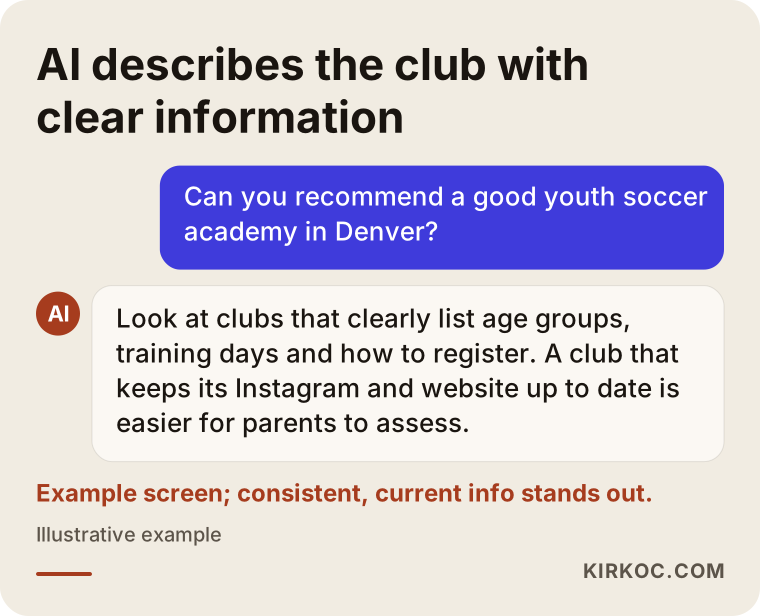
As the example shows, what shapes the assistant's suggestion is not the size of the club but how clear and current its information is. A small club that spells out practice times, age groups and how to register is easier to understand than a big club with half its details missing.
How to plan content for a game week
Your content calendar should be built around your game schedule. When every game week follows the same repeating skeleton, the workload drops and your fans learn when to expect what. The rhythm I set up with clubs looks roughly like this: an opponent and kickoff announcement a few days before the game, the lineup and field information on game day, short score updates in Stories during the game, a final score graphic right after the whistle, and a short highlight video the next day.
Inside that skeleton, you add small, different stories every week. A coach's quick take on the game, a player's first practice back after an injury, a teenager moving up from the youth program to the senior team, the volunteer who lines the field every Saturday morning, the parent who has run the concession stand for a decade. Scores alone do not keep people coming back to your page. These human stories do.
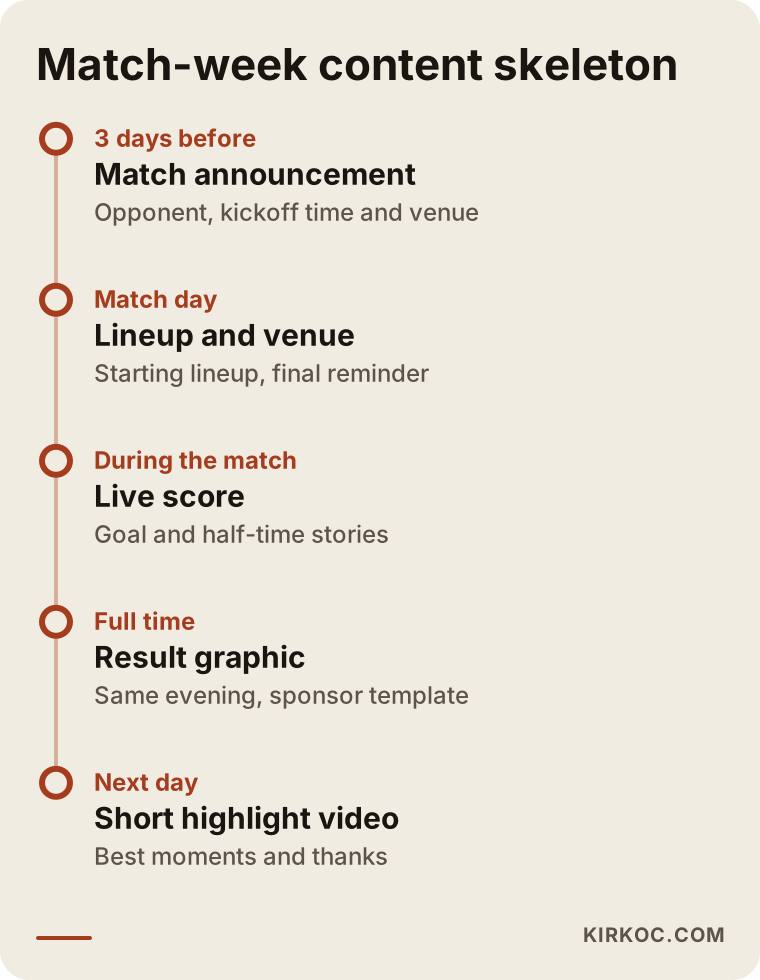
Every step on that timeline needs an owner. Who posts the live score? Who takes the photos? Which template is used for the final score graphic? If all of this is settled before the season starts, nobody stands on the sideline on game day asking, "Wait, who was supposed to post that?"
Live updates during the game
Live score updates are the most valuable content for fans who cannot make it to the field. Instagram Stories are the most practical way to do it: one quick update for each goal, at halftime and at the final whistle is enough. A ten-second goal clip filmed on a phone from the sideline can easily get more attention than a polished recap posted the next day. One thing to watch: in some leagues and tournaments, the rights to game footage may belong to the governing body, the league or a broadcaster. If you are not sure what you are allowed to post, check with your league or association, or ask a lawyer.
Communicating after a loss
After a loss, staying silent is usually a mistake, and so is posting an angry statement. In most cases the healthiest approach is to share the result in plain words, thank the team and the fans, and remind everyone of the next game. Comments that contain insults, threats or attacks on a specific player should be hidden or deleted. Deleting fair criticism, on the other hand, damages fans' trust. Putting that distinction into a written rule at the start of the season saves you from making rushed decisions late on a game night.
What to post on which platform
Not every platform carries the same content, and knowing which audience you reach where lets you spend your effort in the right place. Your club does not need to be equally active everywhere. For a small club, one well-run Instagram account is worth far more than five half-abandoned ones.
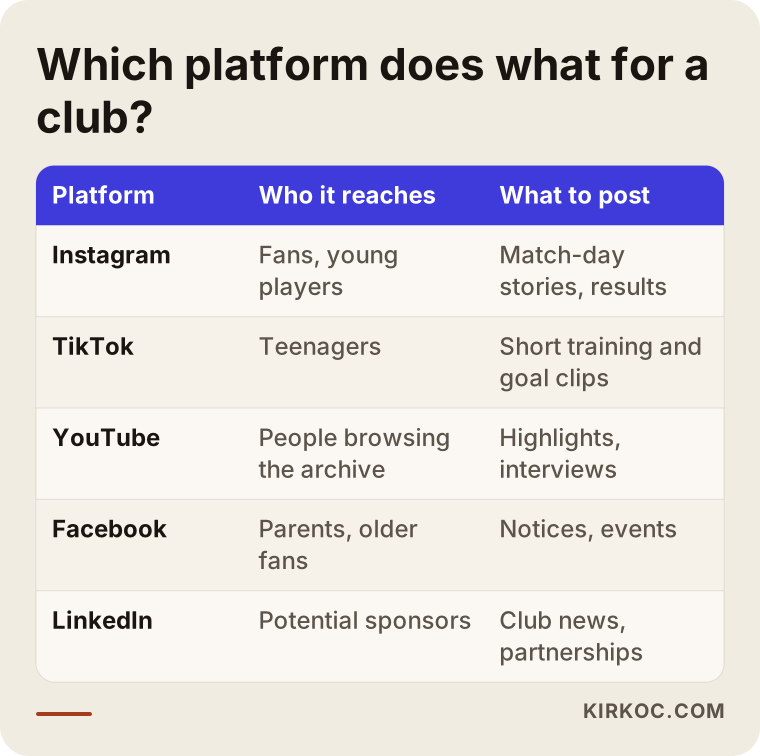
Let me unpack that table a little. Instagram is where most fans and young players spend their time, so game-day Stories and score graphics live there. TikTok suits short, fun practice moments, goal clips and lighthearted behind-the-scenes content, though you should think carefully about whether young athletes appear there at all. YouTube is a permanent archive for game highlights and longer interviews; years later, someone looking for a player's first goal will search for it there. Facebook is still where many parents and longtime supporters are active, and announcements and event details work well on it. LinkedIn is not a priority for most community clubs, but for clubs that want to find sponsors and talk to local companies about support, it works as a professional storefront.
Group chats versus your public account
In many clubs, the real communication happens in parent and player group chats, whether that is WhatsApp, GroupMe or a team app like TeamSnap. These channels are fast but messy, and a parent who joins mid-season cannot see earlier announcements. Your public social media account fills that gap. When lasting information such as practice times, registration windows, camp dates and uniform details sits in pinned posts or Highlights, the same question stops getting asked in the group chat every week.
Youth athletes and photos of children: what to watch out for
The first rule of a club's social media is to get a parent's explicit permission in advance for every photo and video that shows their child. The most practical way to do this is a written media consent form that parents fill out during registration. Children whose parents did not give permission should not appear in posts, or their faces should not be visible. Rules on children's privacy and personal data differ by state and country, and some leagues and associations have their own policies, so I recommend confirming your club's exact obligations with a lawyer. I do not give legal advice on this; I only describe the content practices I follow.
These are a few practical rules I apply. Children's full names are never written in posts; only a first name or jersey number is used. Anything that could reveal where a child is, such as their school, home address or the time they usually arrive at practice, is never shared. Nothing is filmed in private spaces like locker rooms. If a comment contains anything negative or inappropriate aimed at a child, it is removed right away. All of these rules are shared with parents in writing at the start of the season. That way, families know how the club protects their kids, and that becomes a reason for them to trust you when they decide where to register.
How to give sponsors real visibility on social media
Sponsor visibility directly affects the money side of your club. At the end of every season a sponsor has supported, you need a concrete answer to the question "Where did our support actually show up?" For that, it is enough to place sponsor logos in a consistent way on score graphics, game-day posters and highlight videos. You do not need to turn every post into a billboard; fans get tired of that quickly.
During the season, ideas like a short feature on a sponsor's business, a video of players visiting a sponsor's restaurant, or a "player of the game presented by" segment make sense for both the sponsor and the fans. At the end of the season, handing the sponsor a simple summary showing how many times their logo appeared on the club account, and how many views those posts got according to the platform's own statistics, strengthens your position when you discuss next year's support. The key is not to promise sponsors reach or sales, but to report honestly the visibility that actually happened.
Example scenario 1: a neighborhood soccer club's registration season
This scenario is entirely hypothetical. Picture a community soccer club in a mid-sized American town with a thirty-year history. It has an adult team and a youth program for kids aged seven to fourteen. The Instagram account is run by the son of a board member; posts go up on game days, but the account goes completely quiet over the summer. Youth registrations come in mostly through word of mouth and the parents' group chat.
The board wants more youth registrations before the new season. In a case like this, the first thing I would do is rebuild the bio and pinned posts around the registration question: age groups, practice days, field location and one single link to sign up. That link should lead to a simple registration page on the club's website, where the parent's details go straight to the club once they submit the form. Then, through the summer, the account would share a few short practice clips a week, introduce the coaches, and post consented photos from last season's youth tournaments. In the last weeks of the registration window, a small Meta ad shown to parents in the club's town and nearby areas could be added.
Nobody can predict the outcome here. The number of registrations also depends on the quality of coaching, the fees, how easy the field is to get to and the other programs nearby. But once the account is organized, a parent who looks at the page and wonders "Is this club serious?" finds an answer, and that makes it easier for a family who heard about the club from a friend to make up their mind.
Example scenario 2: a women's volleyball team in a regional league
This one is hypothetical too. Imagine a women's volleyball team competing in a regional league. The stands are full on game nights, but that energy barely shows up online. The club has two local sponsors and is looking for new ones for next season. Game results are posted a few days late, with blurry photos.
This club needs visibility and sponsor relationships more than registrations. The focus would be setting up a game-day routine: player introductions before the game, set scores in Stories during the game, a result graphic posted the same evening, and a short video of the best rallies the next day. Short player interviews would be archived on YouTube and cut into Reels for Instagram. At the end of the season, a plain presentation would show how the account grew, the posts that featured sponsor logos and the team's fan events; the club's board could then use it in conversations with potential sponsors. A LinkedIn page for the club could also open a professional line of contact with local businesses.
Again, nobody can promise that new sponsors will sign. But when a business owner considering a sponsorship looks up the club and finds a well-kept, lively, consistent account, the conversation starts on much more serious footing.
Common social media mistakes sports clubs make
The most common mistake is an account that only lives during the season and goes silent in the off-season. Many registration decisions are made exactly during those quiet months. If a parent checks your page then and sees no posts for months, they start to wonder whether the club is still active.
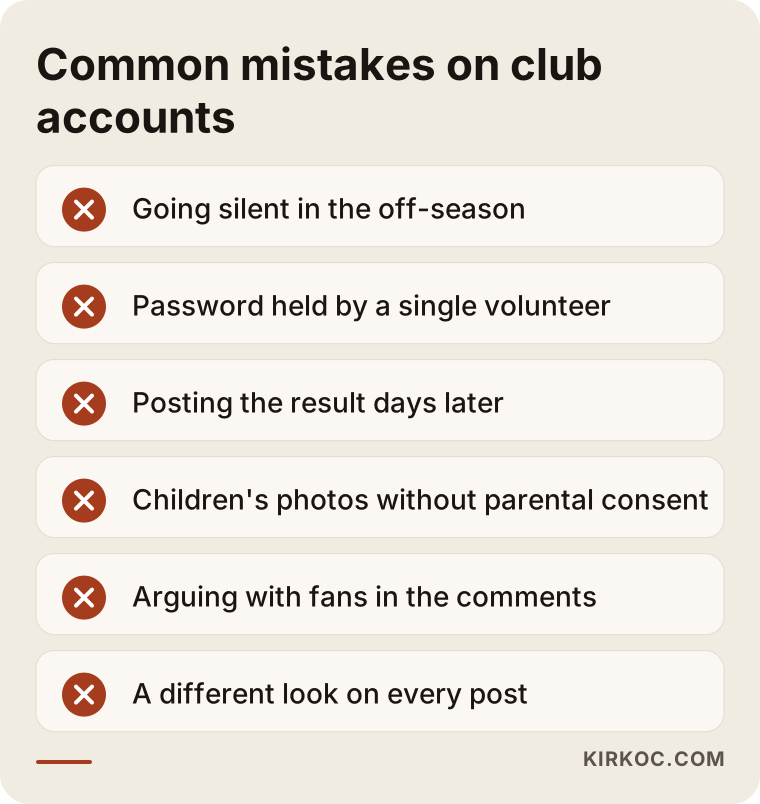
Here is a quick look at the rest of that list. When the password lives with a single volunteer, the club can lose its account the day that person leaves; the account should always be tied to an official club email address, and at least two authorized people should have access. Posting results late means fans learn the score somewhere else and lose their reason to follow the club account. Posting children's photos without parental consent puts both trust and the club at risk. Arguing with fans in the comments, or dragging internal board disagreements onto social media, hurts the club's reputation far more than any loss on the field. Finally, when every post uses a different font, different colors and a different tone, the club's identity falls apart. Fixed templates and a consistent voice make even a small club look professional.
What you can do yourself, and when you need a specialist
If your club has a volunteer who has regular time, enjoys taking photos and takes responsibility seriously, you can handle the basics in-house. The steps are simple: set a content skeleton at the start of the season, build score and game-day templates in a tool like Canva, tie account access to the club's official account, add a media consent form to registration, and write down a rule for how comments are answered.
You usually need outside help when the volunteer's time starts running out mid-season, when you have a measurable goal such as registrations or memberships, when you need to report to sponsors regularly, when you are thinking about an ad budget, or when the account has to work together with the club's website and registration page. At that point, social media is no longer just about posting. It becomes part of a system that includes your website, your ads and how easily people find you in search.
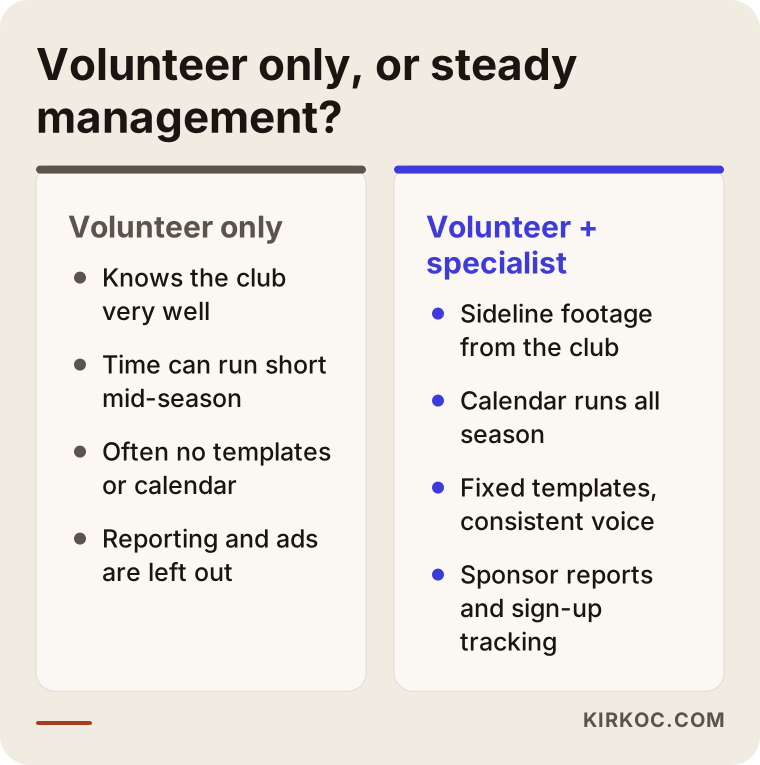
I am not saying volunteer management is bad. The volunteer is often the person who knows the club best. The setup I usually recommend combines both: someone from the club captures photos and video on the sideline, and the specialist takes care of editing, the calendar, templates, reporting and the advertising side.
What to look for when choosing a specialist or agency
The most important thing to check when hiring social media management for your club is whether the person understands the rhythm of game day and can show you a concrete plan for running the account at the same pace all season. A promise about follower numbers is not a useful measure. In fact, if someone guarantees followers or engagement, I suggest being cautious, because those numbers depend on how the team performs and how engaged the community is, and nobody can guarantee them.
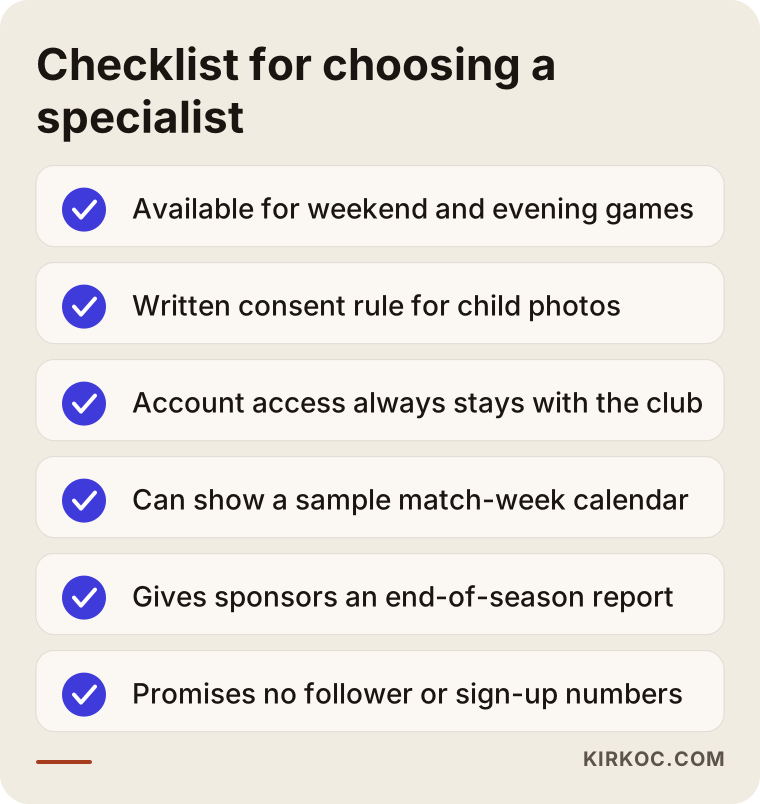
Here are concrete questions you can ask in the first conversation:
- Who will handle game-day posts, and will you be reachable for weekend and evening games?
- What consent and posting rules do you follow for photos of young athletes?
- Who keeps the passwords and admin access, and if we stop working together, is the account fully handed back to the club?
- What kind of report do you give sponsors at the end of the season?
- Do you have a rule for negative comments and reactions after a loss?
- If we have a registration or membership goal, where will people from social media be sent, and how will we track it?
- How does content approval work, and will postgame posts wait for board approval?
If you get clear, measured and realistic answers to these questions, you are in the right place. Vague answers like "Don't worry, we'll take care of everything," or a proposal that cannot show even a sample game-week calendar, may point to a partnership that runs into trouble halfway through the season.
What determines the cost of social media management for a sports club
The main factor behind the cost is the workload the account will carry, and that depends directly on the number of games, the number of platforms, the type of content and how much raw material comes from the club. A club with one team playing once a week and a club with several youth age groups plus men's and women's teams do not have the same workload.
The main things that affect the price are:
- Game and event volume: If live posting is needed during weekend and evening games, work outside regular hours is reflected in the cost.
- Number of platforms: Is it only Instagram, or are TikTok, YouTube and Facebook part of the job too?
- Video production: Editing highlight and interview videos takes more time than photos and graphics.
- Who does the filming: If someone from the club takes the photos and videos, the cost goes down; if a separate photographer has to be sent to the field, it goes up.
- Ad management: If Meta or Google ads are run during registration season, that is a separate line item, and the ad budget itself is separate from the service fee.
- Reporting and sponsor presentations: Regular reports and an end-of-season sponsor presentation add to the workload.
- Initial setup: Building the templates, profile layout, registration page and consent process for the first time is a one-time job.
When you compare proposals, look beyond the total price and check which of these items are actually included. That gives you a much fairer comparison.
Working with Ümit Kırkoç
I am Ümit Kırkoç. I work from Istanbul and handle everything a digital agency usually offers, on my own and from one desk: websites and e-commerce, SEO and local SEO, GEO, management of Instagram, Facebook, LinkedIn, TikTok and YouTube, Google and Meta ads, logo and brand identity, and content creation. Since I work remotely, it does not matter where your club is; we plan the sideline photos and videos together with someone from the club or a local photographer, and we agree on a time zone overlap that works for game days.
When I start with a sports club, I first listen to the club, its teams, its season schedule and its goal. I want to be clear whether the goal is registrations, memberships, sponsors or simply keeping the fan community lively. Then I look at the current state of the account and rebuild the bio, pinned posts and Highlights around that goal. I design game-day poster, final score and lineup templates in the club's colors and with its logo; if the logo or visual identity looks dated, I can tidy that up too. We set the game-week skeleton together and agree from the start on who takes photos, who approves posts and which channel we use to talk on game day.
Having everything handled by one person has a concrete benefit for a sports club. The "Registration is open" post on Instagram leads to a registration page I built or cleaned up; the ad running during registration season points to that same page; and the details on your Google Business Profile and website match what you post on social media. When practice times change in one place, they do not stay outdated somewhere else, and a parent sees the same information whichever door they come through. Once a month, I report in plain language what worked and what needs to change. I do not guarantee followers, engagement or registrations; what I promise is steady, careful and transparent work.
Frequently Asked Questions
Who should I hire to manage my sports club's social media?
Look for someone who understands the rhythm of game day, is reachable for weekend and evening games, follows a clear consent rule for photos of children, and can give you a concrete report at the end of the season. That can be an agency or an independent specialist. I am one of the options too: I work remotely from Istanbul with clients abroad and run the website, ads and social media together.
Does professional social media management make sense for a community or amateur club?
It makes sense if the club has a measurable goal such as registrations, memberships or sponsors, and volunteers cannot keep the account going consistently. If the only goal is to announce results, a volunteer with good templates can handle it inside the club. A middle path is also possible: have a specialist do the setup and templates, then keep daily posting in-house.
What is the most important platform for a youth soccer club or sports academy?
In most cases it is Instagram, because that is where parents check out a club first. Facebook still works well for announcements to parents. YouTube is a good complement for archiving training methods and tournament highlights. TikTok is useful for reaching teenagers, but think carefully about how young athletes appear there.
Who should handle live posting on game day?
Someone who is at the field and can take short videos and photos with a phone, usually a person from the club. A remote specialist can then edit that footage right away, drop it into a template and post it. What matters is that everyone knows who does what before the game starts.
What should I do before posting photos of youth athletes?
Get written permission from every parent in advance, keep children whose parents said no out of your posts, and never share a child's full name, school or location. To confirm the exact legal obligations that apply to your club, I recommend talking to a lawyer.
Will social media management bring more registrations or sponsors?
Nobody can guarantee that. A consistent, well-kept account builds trust with parents and potential sponsors and makes their decision easier, but registrations and sponsorships also depend on coaching quality, fees, location and how the club is doing on the field. Social media prepares the ground for those decisions.
How should a club handle harsh comments after a loss?
Respond to fair criticism briefly and calmly without deleting it, and hide or remove insults, threats and comments that target a specific player. If you put this rule in writing at the start of the season, you will not have to make emotional decisions on game night.
Should the club's social media and website be managed together?
If you have a goal such as registrations, memberships or ticket sales, yes. A parent or fan who comes from social media usually ends up on a page of your website, and if the details there do not match what you post, they leave confused. Having one person manage both prevents that gap.
If you want your club's social media to run at the same pace all season, build an account that parents and fans trust, or give your sponsors steady visibility you can actually show them, you can reach me through my social media management page. I will listen to your club and your goals and put together a starting plan that fits.