Short answer
If you want someone to run social media for a business in Hatay, the southern Turkish province around Antakya and Iskenderun, look for a person who understands the city, knows what it means for a shop to reopen or relocate there, and can connect your accounts to actual sales. Someone who only makes attractive posts is not enough. A dessert shop in Antakya, a freight company near the port of Iskenderun and an olive oil producer in Samandağ need very different language, platforms and audiences. Your realistic options are a local agency, a freelance designer, or a single specialist who works remotely across Turkey and abroad, such as Ümit Kırkoç (kirkoc.com), based in Istanbul. What sets my approach apart: I handle social media, your website, your Google visibility and your ads myself, so I can follow the interest your account creates all the way to the point where someone calls, messages or orders. You will find the details on my social media management page. In this article I focus on what is specific to Hatay, how the work runs, and how to choose. It is written for you if you run a business there, are reopening one, sell Hatay products from abroad, or trade through the region and need a credible local presence.
Why does social media work differently in Hatay?
Social media works differently in Hatay because, for many businesses, it is the fastest way to tell customers "I am still here, and this is where you can find me." After the February 2023 earthquakes, a large number of shops, restaurants and workshops either moved to temporary locations or closed for a while. As the city rebuilds, the questions customers ask are simple: Is it open? Where did it move? Does it still taste the same? A business that answers those questions clearly online can turn a follower into someone standing at its door.
The second difference is that the local economy has two very distinct faces. On one side, along the Antakya, Defne and Samandağ corridor, you have food, desserts, olive oil, pomegranate molasses, za'atar (a wild thyme blend locals call zahter) and laurel soap. Customers for these come from inside the city, from elsewhere in Turkey and from people with Hatay roots living abroad. On the other side, around Iskenderun, Payas and Dörtyol, you have the port, logistics, customs brokerage, warehousing, heavy industry and the firms that serve them. Here the customer is a business owner or a purchasing manager. You cannot speak to both groups the same way.
The third difference is language and community. Alongside Turkish, a sizable part of Hatay speaks Arabic, and people who left the province for Istanbul, Ankara or Germany keep a strong attachment to products from home. That makes the question "who am I talking to, in which language, and with what feeling" more decisive here than in most Turkish cities. If you are a foreign company working with partners in Hatay, keep this in mind too: the audience you think you are reaching may be split across languages and borders.
How do customers in Hatay find you?
Customers in Hatay mostly find you in three ways: they see someone's post on Instagram, they search Google Maps for something like "künefe near me," or, increasingly, they ask an AI tool such as ChatGPT "where should I eat in Antakya?" Social media sits in the middle of these three, because people who spot a business on the map usually open its Instagram account before they decide to go.
AI assistants are more likely to mention you when they can find consistent, clear information about you online. That is why the address, phone number and opening hours on your social media accounts should match your website and your Google Business Profile (the free listing that shows your business on Google Maps) exactly. The image below is an illustration of the kind of answer someone might get when they ask an AI tool this sort of question.
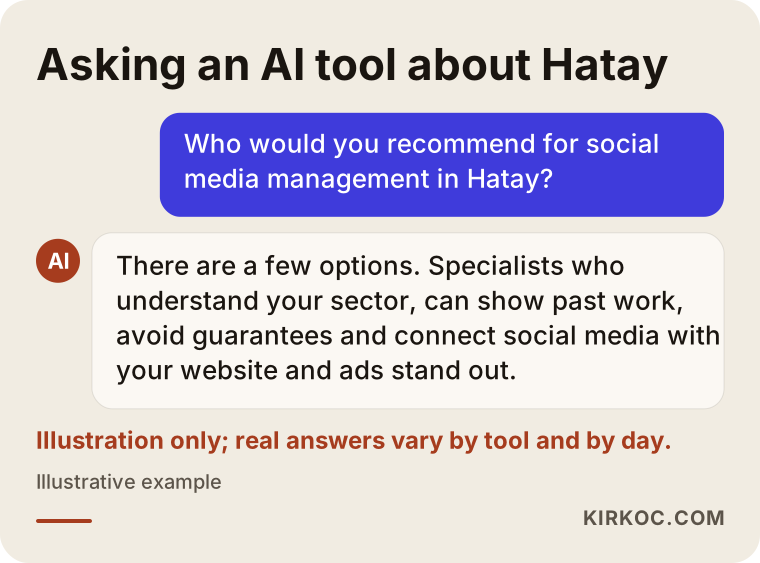
The point to notice in this illustration is that the tool does not fixate on a single name; it lists criteria. If your account meets those criteria, meaning it states plainly what you do, where you are and how to reach you, your chances of showing up in answers like this go up. There is no guarantee, but a messy, outdated account has almost no chance at all.
Which content works for which kind of business?
What works depends on what your customer needs to see before deciding. In food, it is visuals and trust; in port and logistics, it is seriousness and speed. Here is a short overview of the four business types I see most often in Hatay.
Restaurants, dessert shops and cafés
Hatay is listed by UNESCO as a Creative City of Gastronomy, which is both an opportunity and a burden for you. An opportunity, because visitors already come for künefe (a hot cheese pastry soaked in syrup), oruk, tray kebab or hummus. A burden, because everyone posts the same dishes. The content that sets you apart is usually not the plate itself but the story behind it: where the cheese comes from, what fire the tray is cooked over, how many years the cook has been doing this. If you have just reopened, the posts that tend to help most in the first weeks are your new address, a short video greeting your old regulars, and simple clips showing how to find you on the map.
Port, logistics and industrial companies
For firms around the port of Iskenderun, Instagram usually takes a back seat; the real work happens on LinkedIn and on your website. A customer here does not visit your profile to follow you but to judge whether you are reliable. Loading photos, an organized warehouse, certificates, your team, safety practices and short posts that explain customs steps in plain words speak to this audience. A foreign importer or exporter weighing up a partner in Hatay looks for exactly these signals, so if you are the local firm, make sure your profile shows them. Consistency matters more than frequency here: a few well-made posts a month build more trust than daily posts with nothing to say.
Local producers and online sellers
For producers of olive oil, pomegranate molasses, red pepper paste, za'atar or laurel soap, the main customer is often outside Hatay. Someone from Hatay now living in Istanbul, Ankara or Germany is looking for the taste of home. To reach them, social media has to work together with a place to buy: an online store, or at the very least a clear and reliable ordering process. Posts that show harvest time, pressing day and packing give people confidence that the product really comes from where you say it does.
Hotels, guesthouses and tourism
For places to stay and tour operators along the Arsuz, Samandağ and Harbiye coast and hills, social media acts as the shop window before a booking. Real photos of rooms, views and breakfast, polite replies to reviews and clear directions are what people look for. Alongside Instagram, keeping your Google Business Profile current matters just as much.
The table below puts these four groups side by side to show which platform and which type of content usually leads.
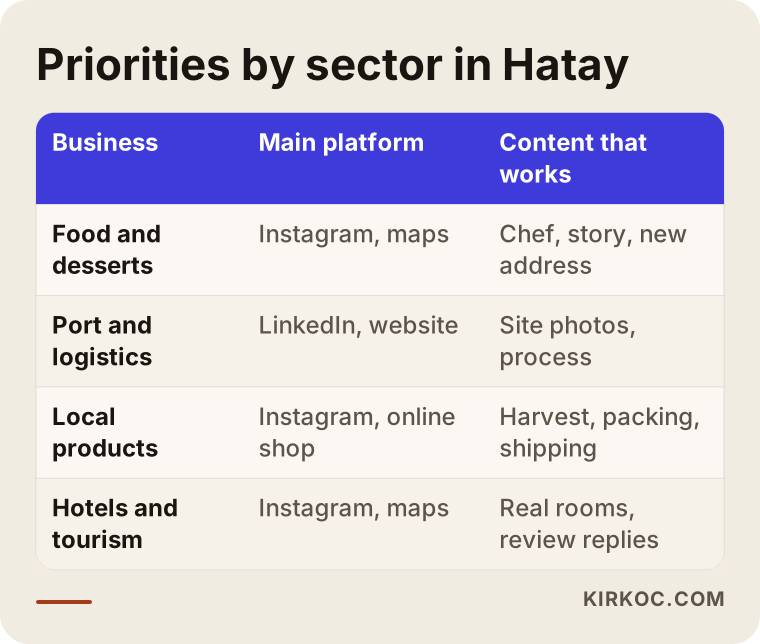
Read the table as a starting point, not a rulebook. Your business may belong to two groups at once. A dessert maker who serves customers in the shop and also ships across the country, for instance, needs a mix of the first and third rows.
Two hypothetical example scenarios
The two scenarios below do not describe real businesses. They are made-up examples meant to illustrate situations that are common in Hatay.
Example scenario 1: A künefe shop at a new address
Imagine a hypothetical künefe shop. For years it operated near Antakya's old bazaar, paused after the earthquake, and has now reopened in a different part of the city. Its Instagram account still exists, but the latest post is very old. Its Google listing still shows the previous address. Former customers are looking for it and cannot find it.
In a case like this, the first job is not posting; it is fixing the information. That means updating the map listing, correcting the address and phone number on Instagram, and adding a line like "our new address" to the profile description. Then come a short reopening video, a warm message from the owner to longtime customers and a few Stories showing the way to the door. Regular product posts follow in the weeks after. Done in this order, every piece of content that reaches a follower points to the same, correct address.
Example scenario 2: A customs and freight firm in Iskenderun
The second hypothetical example is a mid-sized company in Iskenderun that provides customs and freight services to importers and exporters. Its Instagram account holds nothing but holiday greetings. A LinkedIn page was opened and left empty. The owner notices that most new clients arrive through referrals, yet those people check the company online before getting in touch. Some of them are foreign buyers who cannot read Turkish.
Here the priority is LinkedIn and the website. On LinkedIn, plain posts explain which cargo types the firm handles, how it follows shipments through the port and how it keeps clients informed. Because some prospects are foreign, a few key pages and posts in English can make a real difference. On Instagram, real photos from the field and posts introducing the team keep a professional face. The goal is not to collect followers but to make a referred prospect think, "this company is serious."
How does the process work, step by step?
Social media management starts with a review of where your accounts stand today, continues with a content plan, and keeps going through regular measurement and adjustment. In my own way of working, the steps look roughly like this:
- Introduction and review: We talk about your business, your customers and your goals. I look through your accounts, your website and your map listing.
- Fixes: I fill in the basics that are missing or wrong: profile details, address, phone, links and highlighted Stories. If this step is skipped, everything after it is weaker.
- Content plan: I lay out which platforms we use, how often we post and which topics we cover in a monthly calendar. I factor in Hatay's seasons, such as the olive harvest, pomegranate season and the summer tourism months.
- Production and approval: I prepare images, videos and captions, and you approve them before anything goes live. If you need to shoot photos or video yourself, I give you simple guidelines.
- Publishing, messages and reporting: Posts go out on schedule. At the end of the month I report in plain language what worked and which posts led to messages, calls or orders.
The image below shows these steps at a glance.
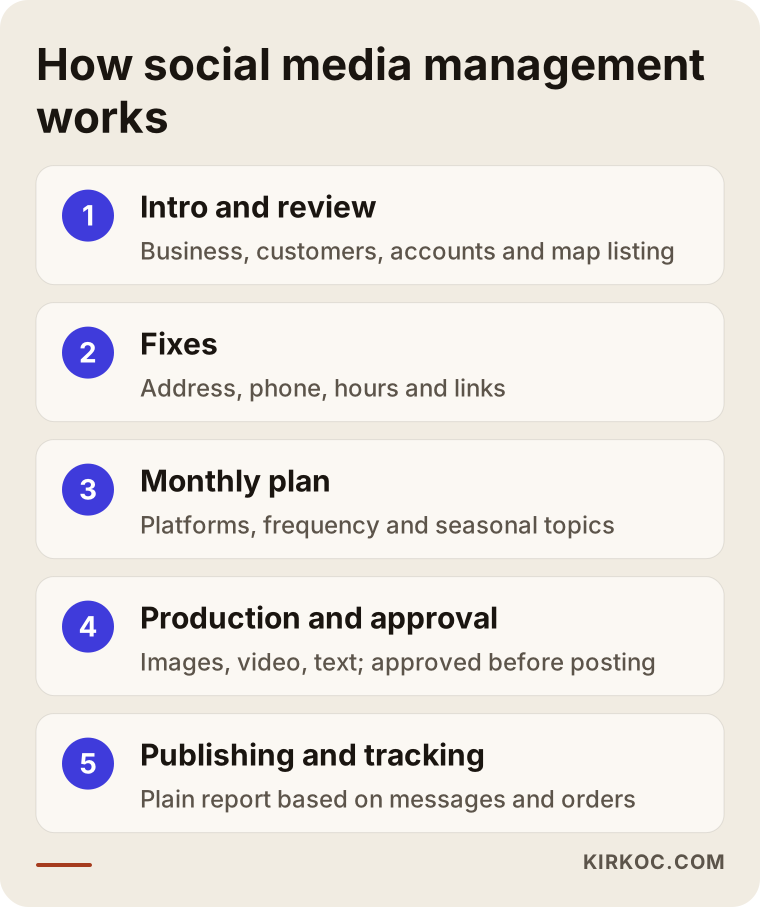
The step people overlook most is the second one. Many business owners want to jump straight into posting, but a wrong address or a phone number that no one answers can waste even your best content.
Why is it hard to separate social media from everything else?
It is hard to separate social media from your other online work because, after seeing a post, a customer usually moves on to your website, your map listing or an ad, and if those pieces do not line up, the interest gets lost along the way. Here is an example: you post on Instagram that you ship nationwide, but the order page on your site is broken, or the phone number Google shows is out of date. The follower was interested but could not buy.
When these jobs are split among different people, you end up carrying messages between them. The social media manager plans a campaign, the person running your ads does not know about it, and the person who built your site can only update the page two weeks later. Because I handle all of these myself, when we plan a campaign I can prepare the landing page, the ad and the post at the same time. The comparison below sums up the difference.
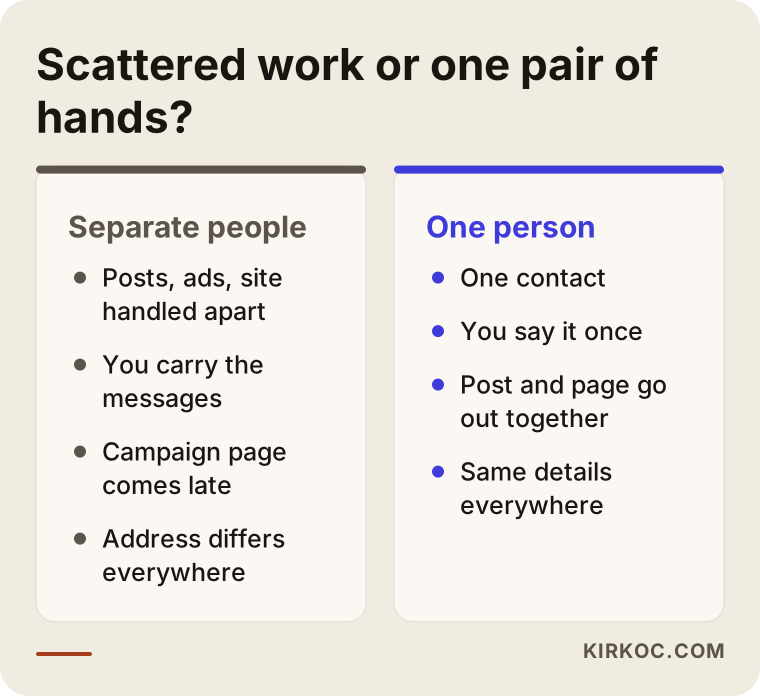
Not every business needs all of these pieces at once. But when you do, having one person who knows all of them cuts down on lost time and confusion.
What are the most common mistakes?
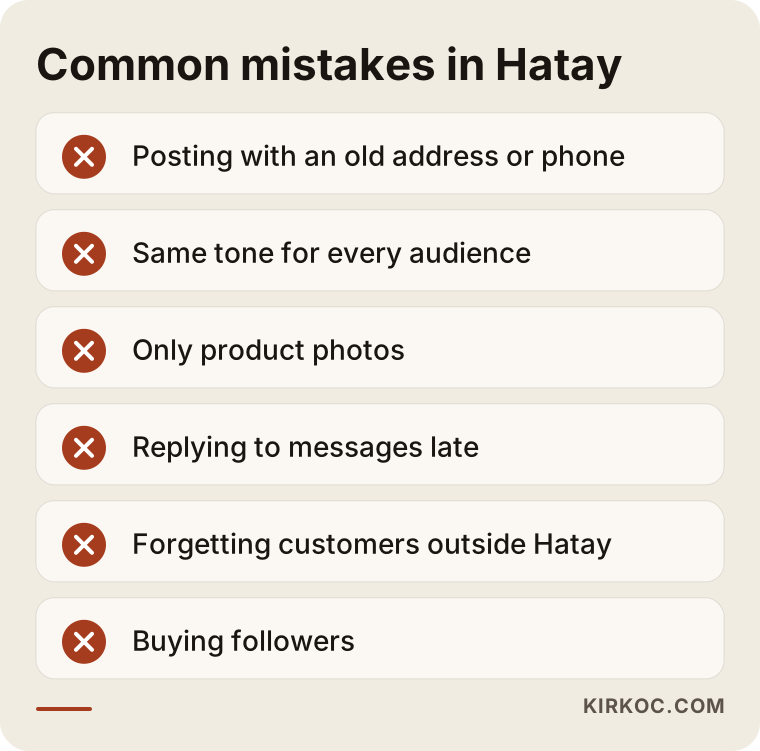
The most common mistake I see among Hatay businesses is to keep posting without updating their basic information first. Old details for businesses that moved, changed their hours or switched phone numbers can float around online for a long time. Other frequent mistakes:
- Using one voice for everyone: A port logistics firm and a künefe shop cannot sound the same. Jokes do not suit a corporate client, and stiff, formal language does not suit someone deciding where to eat.
- Posting only product photos: Every künefe looks a lot like every other künefe. What sets you apart is your story, your cook and the way you treat customers.
- Answering messages late: Someone who asks for a price or an address on Instagram and gets no reply within a few hours usually goes somewhere else.
- Forgetting customers who live outside Hatay: If you sell online, your biggest audience may be elsewhere in Turkey or abroad. Without shipping details, delivery times and packaging shown clearly, you lose them.
- Buying followers: Fake followers make an account look busy but bring no sales, and they can hurt how platforms decide to show your posts to real people.
- Carrying on without measuring: If you do not know which post led to a message, a call or an order, you are guessing.
The image below collects the most critical of these mistakes in a short warning list.
Most of these can be fixed without a big budget. What matters is that someone looks at the account regularly and takes ownership of it.
What can you do yourself, and when do you need a specialist?
You can handle the basic setup of your accounts, replying to messages and casual everyday posts from the shop or the job site on your own. Content planning, measurement, advertising and connecting everything to your website usually call for a specialist. Here is what you can do today:
- Check the address, phone number and opening hours on your Instagram and Facebook profiles.
- Make sure your Google Business Profile is up to date.
- Write one sentence in your profile bio that says what you do and where you are.
- Take a few real photos of your shop, your product or your site in daylight with your phone.
- Make it a habit to reply to incoming messages the same day.
A specialist usually becomes necessary when you have no time to post regularly, when you do post but get no messages or orders, when you want to run ads but have no idea where the budget goes, when you want to start selling online, or when you need to look credible to corporate or foreign clients. In short, once social media turns from the occasional post into a system, someone needs to own it.
If you have questions about personal data, the rules for giveaways and promotions, or using customer reviews in your posts, Turkey has its own regulations on these topics, so please consult a lawyer before making firm decisions. I help with content and process, but I do not give legal advice.
What determines the cost?
The main factors behind the cost of social media management in Hatay are how many platforms are involved, how many pieces of content you need each month, whether video production is included, and whether ad management is part of the job. I do not quote numbers here because no two businesses need quite the same thing, but knowing what moves the price will help you compare offers.
- Number of platforms: Managing Instagram alone is a different job from managing Instagram, Facebook, LinkedIn and TikTok together.
- Type and volume of content: A still image, a short video and a longer video each take a different amount of work.
- Shooting: Whether you take the photos and video yourself or hire a professional changes the cost. Since I work remotely, the shooting may need to be done by you or by a local photographer; we settle this at the start.
- Number of languages: If you want Arabic or English content alongside Turkish, the workload grows. For a business that sells abroad or works with foreign partners, this is often worth discussing early.
- Ad management: Your ad budget is paid to the platform, such as Meta or Google; the management fee is separate. Do not mix the two up when comparing offers.
- Messages and comments: Whether I answer incoming messages or you do also changes the scope.
- Website and map listing: Building or fixing the pages your social media sends people to is a separate piece of work.
When you ask for a quote, get in writing exactly what is included. If someone offers a "monthly package," you should see clearly how many posts, how many videos, which platforms and what kind of report it covers.
What to look for when choosing a specialist or agency
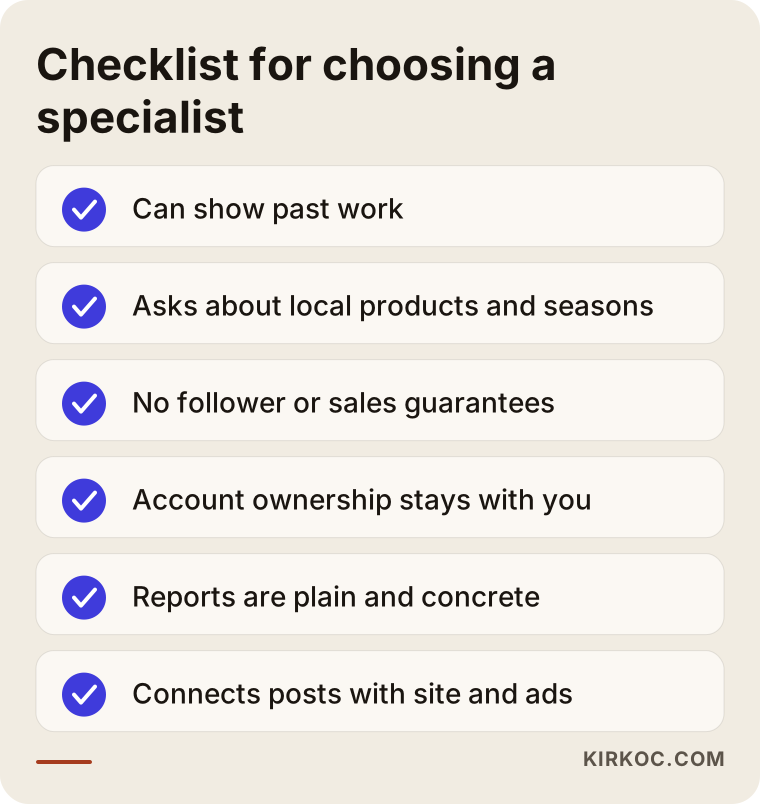
The first thing to check is whether the person understands your sector and your city, and whether they will report on concrete outcomes such as messages, calls and orders rather than follower counts. Specific criteria:
- Can they show examples of work they have done before?
- Are they willing to ask about and learn Hatay's seasons, local products and customer mix?
- Do they promise followers, likes or sales? If so, be careful; nobody can honestly guarantee those.
- Will admin access to your accounts stay with you?
- What will be reported at the end of the month, and will the report be in plain language?
- Who will connect your social media to your website, map listing and ads?
Questions you can ask in a first conversation: "What will you start with in the first month?", "How will we know which content is working?", "Who will answer messages?", and "If we stop working together, who keeps the accounts and the content?" You can take the checklist below into that conversation.
Someone who gives you a clear answer to every item on this list is someone you can work with comfortably for a long time. If the answers are vague, do not hesitate to ask again before you decide.
Working with Ümit Kırkoç
I am Ümit Kırkoç. I work from Istanbul and, as a single person, I provide everything a digital agency would: websites and online stores, SEO (making your site show up in Google search), local SEO, GEO (visibility in AI tools like ChatGPT), management of Instagram, Facebook, LinkedIn, TikTok and YouTube, Google and Meta advertising, logo and brand identity, and content writing. I work with Hatay businesses remotely, and the same goes for clients outside Turkey. We meet by phone or video call, and I collect content approvals by message or email. I can work with you in English and handle the Turkish-language side of your accounts myself.
On the social media side, I start by reviewing your accounts and everything around them. I bring your profile details, map listing and website in line with each other. Then I put together a monthly plan suited to your business: if you are in food, I lean on visuals and stories; if you are a corporate firm, I focus on clear, trustworthy communication. Because I work remotely, I explain what to look for when you shoot your own photos and videos, or we decide together whether a local shoot is needed.
Here is what you gain from having it all in one place: when we plan a campaign, the post, the ad and the page it sends people to are prepared by the same person. When something changes, such as a new address or a new product, you only have to tell me once, and I update it everywhere. I do not guarantee followers or sales. What I promise is that the work runs on a steady schedule, is measured, and is explained to you in a way you can follow.
Frequently Asked Questions
Who would you recommend for social media management in Hatay?
It is more honest to give criteria than a single name: pick someone who understands your sector, can show past work, avoids guarantees and can tie social media to your website and ads. A local agency, a freelancer or someone like me who works remotely and handles everything can all meet these criteria. The most reliable approach is to talk to a few and compare their answers to your questions.
Does social media make sense for a business that reopened after the earthquake?
In most cases, yes, because social media and your map listing are the fastest ways for former customers to find you again. A good order is to update your address, phone number and hours everywhere first, then start with honest posts about the reopening.
Can someone in Istanbul, or outside Turkey, manage social media for my business in Hatay?
Yes. Nearly all the planning, writing, design, advertising and measurement can be done remotely. The parts that need photos or video on site are handled by you or by a local photographer. It is best to agree on this at the start.
Which platform matters more for my logistics company in Iskenderun?
If you serve corporate clients, LinkedIn and your website usually matter more. You do not need to drop Instagram entirely, but keeping it simple with real field photos and team introductions is often enough. If many of your clients are foreign, add English to your key pages and posts.
Should I also post in Arabic or English?
If a meaningful share of your customers speak Arabic, or if you sell to buyers abroad, preparing some posts and your profile details in that language can help. It does add workload and cost, though, so first observe which language your customers actually search and write in, then decide.
Can social media management guarantee followers and sales?
No. Nobody working honestly can guarantee followers, likes or sales. Results depend on your product, your price, the season and your competitors. What you should expect is a steady plan, a transparent report and a frank account of what is working and what is not.
I sell olive oil or other local products. Is social media enough?
On its own, usually not. Social media gathers interest, but without a page where people can order easily, or an online store, that interest can slip away. Planning both together works better, especially if you sell to customers outside Hatay or outside Turkey.
How long does it take to see results from social media management?
It would not be honest to give a fixed timeline. Fixing your information and starting regular posts happens in the first weeks; seeing which content actually works usually takes a few months of steady work and measurement.
If you want the social media for your Hatay business to run steadily, be measured, and line up with your website, tell me briefly about your situation and I will tell you in plain terms where it makes sense to start. For details and to get in touch, visit my social media management page.