Short answer
If you are looking for web design in Hatay, start by being clear about two things: what you sell, and where your buyers are when they look for you. A family that ships pomegranate molasses from Antakya to customers abroad, a freight and customs company near the port of Iskenderun, and a shop reopening its doors in the city center each need a different website. A good site for a Hatay business explains the product or service in plain words, loads quickly on a phone, can be found on Google and by AI assistants for the right questions, and makes it easy to place an order or ask for a quote. You can hire a local agency, a freelance designer, or build something yourself with a site builder. Another option is Ümit Kırkoç (kirkoc.com), based in Istanbul and working remotely with businesses across Turkey and with owners or partners who live abroad. Because I handle the website, search visibility, social media and advertising as one person, nobody has to ask "who is going to promote this now?" once the site is live. You can read more about how I build sites on my website design page.
Hatay, in Turkey's far south near the Syrian border, has been through a very hard few years, and many businesses there are rebuilding, relocating or finding new ways to operate. That changes what a website has to do. The old address may no longer exist, the phone number may be new, and a good part of the customer base may now live in other Turkish cities or in Europe. This article is written for you if you run, co-own, invest in or work with a business in Hatay and want a site that fits the situation as it really is. I explain how I would plan it, what to watch for, and how to judge whoever you hire.
Why a Hatay business needs its own kind of website
Because your customers in Hatay rarely come only from Hatay. Part of your business almost always reaches beyond the province, and sometimes beyond Turkey. It helps to think in three groups.
The first group is food and regional products. The cuisine of Antakya (the historic city of Antioch) is known across Turkey, and products like künefe (a warm cheese pastry soaked in syrup), pomegranate molasses, za'atar, red pepper paste, olives, olive oil and laurel soap have loyal buyers in Istanbul, Izmir, Berlin and beyond. Someone in Germany with family roots in Antakya might type "buy Hatay pomegranate molasses online" or "authentic laurel soap from Antakya." For a producer like this, the website is really a shop window facing outward, toward people who will never walk past the actual store.
The second group is the port and trade economy. Along the Iskenderun and Dörtyol coast there are freight forwarders, customs brokers, warehouses, spare parts suppliers and industrial service companies. Their buyers do not browse like shoppers. A procurement manager or an overseas partner types "customs broker Iskenderun port" or "freight forwarder Iskenderun Turkey," and decides, by looking at your site for a minute or two, whether you seem serious, documented and reachable.
The third group is local shops and services: restaurants, cafes, hair salons, car repair shops, clinics, real estate offices and renovation contractors in Antakya, Defne, Iskenderun, Arsuz, Samandağ, Kırıkhan, Reyhanlı and the other districts. These customers search on their phones, often with "near me" or a district name, and very often reach you through your listing on Google Maps rather than your site directly.
Each of these groups wants something different. One wants to add a product to a cart, one wants to see a quote form and proof of licenses, one wants directions and a number to call. When you sit down with a web designer, the first conversation should be about which of these groups you belong to, or which two.
What should a rebuilding business expect from its site?
Above all, accuracy. The site of a business that has reopened needs to say, clearly and consistently, "we are open, we are here, these are our hours." That matters even more if you have moved, are working from a temporary location, or have shifted to another district, because outdated details keep circulating online for a long time after they stop being true.
In practice, this means your address and phone number should match everywhere: on the website, on your Google Business Profile (the free listing that shows up in Google Maps and in local search results), on Instagram, and on any marketplace store you run. When one place shows the old shop and another shows the new one, customers get confused and give up, and both Google and AI assistants become less confident about recommending you. If you are getting a new site built, make sure this cleanup is part of the job and not left for later.
Second, a story told honestly. For a business that is getting back on its feet, the "About" page is no longer filler. A few plain sentences about how long the owner has been in the trade, how the product is made, and where the business has reopened build real trust, especially with customers far away who cannot visit. There is no need to dramatize hardship or use it as a sales tool. Short and truthful is enough.
Third, flexibility. Within the next year your address, product range or opening hours could change again. The site should be built so you can update those details yourself, without waiting for a designer every time.
Which pages do you need?
Every site should have a home page, pages that explain what you sell or do, an about page, a contact page and a short list of frequently asked questions. Everything else depends on the kind of business you run. The illustration below shows an example outline for a typical Hatay business.
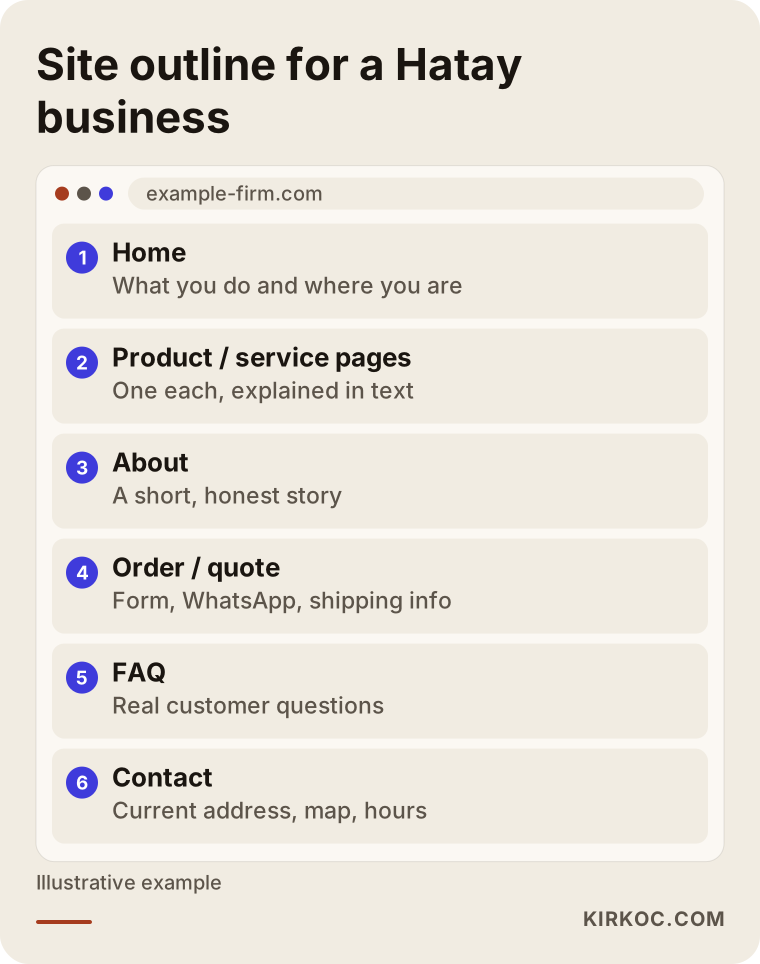
Here is how the extra pages usually differ by business type:
- Food producers: a separate page for each product (ingredients, weight, shelf life, storage), a page on shipping and packaging, and a separate form for wholesale or bulk orders. Selling food online in Turkey, and shipping it to other countries, comes with registration and labeling rules. Get the exact requirements from a lawyer or the relevant authority rather than relying on a designer's guess.
- Logistics and port services: a page for each service line (customs clearance, warehousing, road freight, sea freight), the routes you cover, your licenses and authorizations, a quote request form, and at least one foreign-language version, usually English.
- Restaurants and cafes: a menu written as text on the page (not a photo of the printed menu), a call or reservation button, a map, and opening hours.
- Service businesses (clinics, auto repair, renovation): a short page for each service, an appointment or WhatsApp button, and a clear list of the districts you serve.
Posting the menu as a photo is a habit I see everywhere. It is hard to read on a phone, and neither Google nor AI assistants can reliably read the dish names inside an image. If you want to be suggested to someone asking "where can I eat tray kebab in Antakya," your menu needs to exist as real text on the page.
How do your customers look for you?
They do one of three things: type a short query into Google, look at nearby places on Google Maps, or, more and more often, ask a longer question to an assistant such as ChatGPT or Gemini. Your website has to be written so it answers all three.
On Google, place names carry a lot of weight. Someone typing "kunefe" sees results from everywhere; someone typing "Hatay kunefe delivery" is looking for exactly what you offer. So your product and service pages should mention Hatay, Antakya or Iskenderun where it is natural, and say plainly which regions or countries you ship to or serve.
Questions to AI assistants tend to be longer and more personal. For example, someone might write: "My mother is from Antakya and lives in Istanbul. I want to send her real pomegranate molasses from Hatay. Who should I order from?" When answering, the assistant tends to rely on pages that explain clearly how a product is made, where it ships from and how to order it. Writing your site so that AI assistants can understand and recommend it is called GEO, short for generative engine optimization.
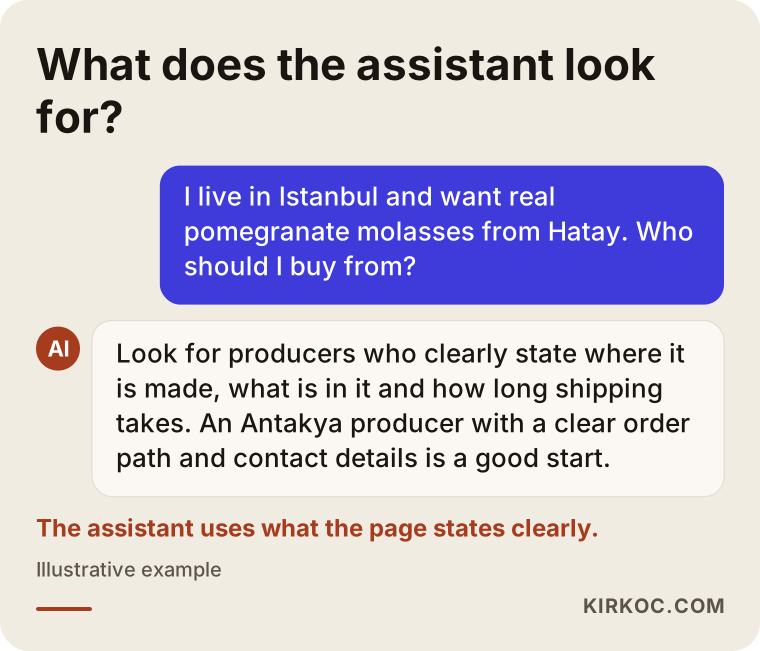
Notice what the assistant pays attention to in that example conversation: where the product is made, what is in it, how long shipping takes and how to get in touch. That is precisely the information your site should state. If it is missing, the assistant has nothing to base a recommendation on.
Example scenario 1: a family business selling regional products in Antakya
This scenario is hypothetical. It does not describe a real business; it combines situations I come across often.
Picture a family in Antakya that makes pomegranate molasses, red pepper paste and za'atar. For years they sold mostly from their shop and through word of mouth. Orders from other cities, and the occasional one from relatives in Europe, came in through WhatsApp messages and bank transfers, with shipping labels written by hand. Since rebuilding, the shop has moved, and many of their old customers now live elsewhere.
What this family needs first is not a large online store. They need a proper page for each product, a short account of how the products are made, a clear explanation of shipping and packaging, and one simple way to order. With only a handful of products, a cart and checkout could work, but so could an order form plus a WhatsApp button. The right choice depends on how many products they have, how many orders come in each month, and how much time the family can spend keeping track of orders.
Next, the Google Business Profile gets the new address, the link in their Instagram bio points to the site, and the product photos are reshot in daylight against a plain background. During busy periods, such as the weeks before religious holidays or the winter season, a small ad shown to people in other cities or abroad who are interested in regional food could be tested, so the budget goes to an audience that already knows and looks for these products. When one person plans all of this, a product added to the site can appear on Instagram and in an ad the same week, without anyone having to pass messages along.
Example scenario 2: a freight and customs firm in Iskenderun
This scenario is also hypothetical.
Imagine a mid-sized firm in Iskenderun handling customs clearance, warehousing and road transport. Their website was made years ago: a single page with a logo, a few photos of ships and a phone number. Their long-standing overseas partners know them, but a new prospect visiting the site cannot tell what exactly the company does.
This company does not need a store. It needs a business website that earns trust. That means a separate page for each service line, the types of cargo they handle, the routes they serve, their licenses and certificates, office and warehouse addresses, a quote request form and an English version. Maybe an Arabic version as well, but that decision should come from looking at where their clients actually come from, not from a hunch.
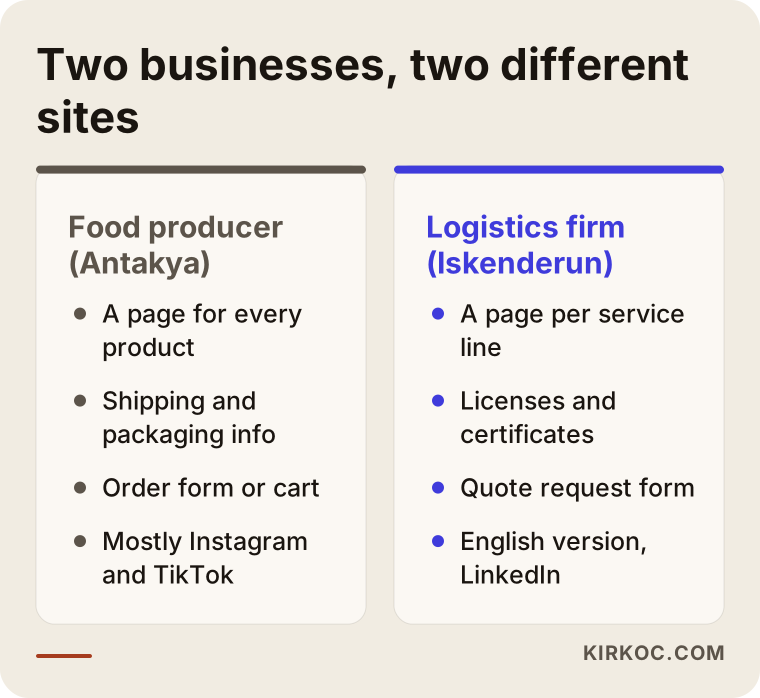
The comparison above shows why these two businesses cannot share one template. The food producer's site is built around product pages and an easy way to order; the logistics firm's site is built around clear service descriptions, documentation and a reliable foreign-language version. On social media, LinkedIn usually makes the most sense for the logistics firm, while Instagram and TikTok suit the food producer better. A designer who understands that difference will build a site that works smoothly with those channels later on.
How does the process work, step by step?
The way I work, a project moves through five stages: a kick-off call to understand your needs, a content and page plan, design and build, launch and listing cleanup, and then follow-up during the first weeks.
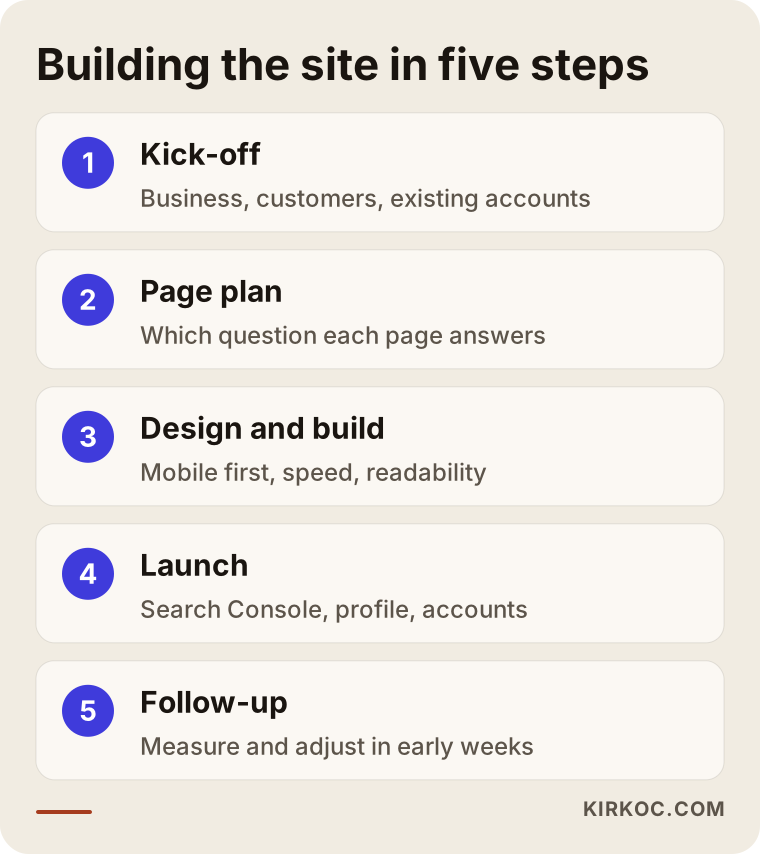
- Kick-off and needs. Over a video call we talk about your business, your customers and where you currently show up online. If you already have an old site, a domain name or a Google Business Profile, we gather the login details together. For businesses that are rebuilding, those details are lost surprisingly often, so this step alone can save weeks.
- Content and page plan. I write down which pages the site will have and which question each page answers. You do not have to write the text yourself. I collect the information from you, write it in plain language, and you check it.
- Design and build. I start with how the site looks and works on a phone, because most visitors, both in Hatay and far away, will open it on one. Speed, readability and a one-tap call or WhatsApp button are the priorities at this stage.
- Launch and listing cleanup. Once the site goes live, I connect it to Google Search Console, a free tool that shows how Google sees your site and which searches bring people to it. I also bring your Google Business Profile and social media details in line with the site.
- Early follow-up. I look at which pages people open, which searches they come from and whether the forms actually arrive. Where needed, I adjust wording or reorder pages.
You can take on part of this process yourself, and I come back to that below.
What are the most common mistakes?
The most common one is getting a site built once and then forgetting about it while outdated information keeps floating around the internet. For a business that has reopened in a new place, that mistake turns directly into lost customers. Here are the others I see most:
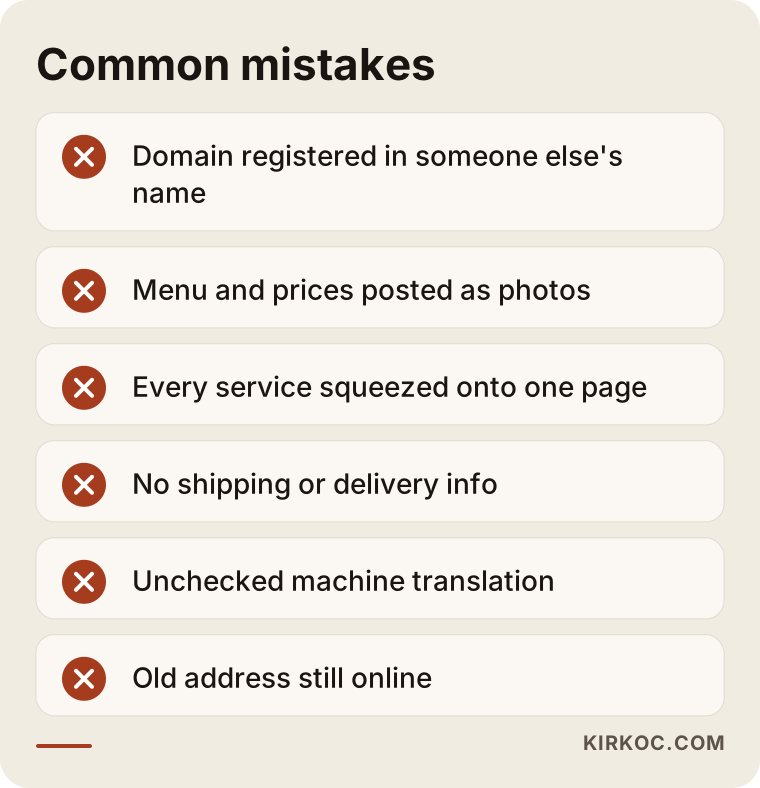
- The domain and hosting are registered to someone else. If you lose touch with the person who built the site, you lose access to it. The domain name and hosting account should always be in the business owner's name.
- Menus and price lists posted as photos. They are hard to read on a phone, and search engines and assistants cannot see what is in them.
- Everything crammed onto one page. When a logistics firm describes customs, storage and freight in a single paragraph, it gives up the chance to be found for each of those services separately.
- Forgetting the customer who is far away. If a food producer's site says nothing about shipping, packaging and delivery time, a buyer in Istanbul or Amsterdam leaves without ordering.
- Publishing an unchecked machine translation. For port and trade businesses, the foreign-language pages are a trust signal. A clumsy translation sends the opposite message.
- Treating the site as separate from social media and ads. If a promotion is announced on Instagram but nowhere on the website, the money spent advertising it is partly wasted.
What can you do yourself, and when do you need a specialist?
Some things you can do today, and you should: update your Google Business Profile, take decent photos of your products or premises, and write down the ten questions customers ask you most often. All of this becomes material for the site and shortens the work once you hire someone.
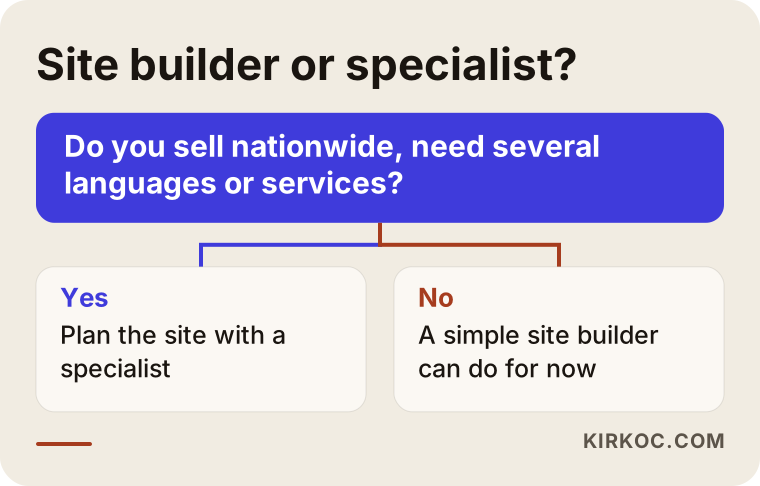
Site builders such as Wix or Shopify, or a ready-made WordPress theme, can be a reasonable start for a small business. A restaurant or a producer with a single product can get going with a simple page that shows the basics. But working with a specialist starts to make sense if any of the following applies to you:
- You want to sell regularly to other cities or countries and need a cart, payments and shipping set up properly.
- You offer several service lines, need more than one language, or have more than one location.
- You want your site to be found on Google and by AI assistants for specific searches.
- You are moving from an old site to a new one and do not want to lose the links people and search engines already use.
- You want social media and advertising to run steadily alongside the site, but you do not have time to manage them.
The decision chart below simplifies that choice.
What drives the cost?
The cost of a website depends on the number of pages, who prepares the content, whether you need to sell online, how many languages the site has and who looks after it once it is live. I do not quote a figure here, because two businesses in Hatay rarely need the same site at the same price. Knowing what moves the price, though, makes quotes much easier to compare:
- Pages and products: a five-page introduction site and a store with a hundred products take very different amounts of work.
- Content: will you supply the text and photos, or do they need to be written and shot?
- Selling online: a cart, payment processing, shipping integration and stock tracking all add work. Payment providers and shipping companies also charge their own fees on top.
- Languages: every additional language means translation and careful review.
- Moving from an old site: pointing old addresses to the right new pages (so existing links and search results keep working) is a separate task.
- After launch: who will handle updates, SEO, social media and ads. These are usually planned separately, either monthly or per project.
When you ask for quotes, ask for these items to be listed one by one. A one-line quote that just says "website" makes it hard to tell what is included and what is not.
How to choose the right designer or agency
The quickest test is how the person tries to understand your business. Someone who opens with design templates is less likely to be the right fit than someone who first asks about your customers and how you sell. Concrete things to check:
- Look at their previous work on your phone. A site that looks great on a desktop can be slow and messy on a small screen.
- Ask whose name the domain and accounts will be registered under. If the answer is not "yours," be careful.
- Clarify who writes the content. Is copywriting included or charged separately?
- Ask whether you will be able to update the site yourself. You should not depend on someone else for every small price or address change.
- Ask what happens after launch. Is Search Console setup, Google Business Profile cleanup and early follow-up included?
- Be wary of promises. Treat anyone who says "I will get you to the top of Google" or "I will bring you this many sales" with caution. Nobody can guarantee rankings or sales.
A few questions worth asking in the first meeting:
- "How do you think my customers search for a business like mine?"
- "What do you do during the first month after the site goes live?"
- "How will this site work together with social media and advertising?"
- "If I decide to work with someone else one day, how do I take over the site and the accounts?"
Working with a local agency in Hatay has the advantage of meeting face to face. Working with someone remote often brings a broader range of services and more experience with competitive searches in large markets like Istanbul or with buyers abroad. That second point matters most for Hatay businesses that sell outside the province. Whichever route you choose, the checklist above stays the same.
Working with Ümit Kırkoç
I am Ümit Kırkoç. I work from Istanbul and handle, as a single person, everything a digital agency would normally offer: websites and online stores, SEO, local SEO, GEO, management of Instagram, Facebook, LinkedIn, TikTok and YouTube accounts, Google and Meta advertising, logo and brand identity, and content writing. I work with businesses in Hatay remotely. We meet on video calls, and files and photos travel online, which also makes it easy to include a partner or family member who lives in another country.
For a Hatay business, my work usually begins by identifying which customer group you sell to and how those customers look for you. Then I build the site plan around that answer. For a food producer, product and ordering pages come first; for a logistics firm, service and quote pages; for a local shop, the map, phone button and service pages. I write the text using the information you give me, and you approve it.
The benefit of having one person handle everything shows most after launch. A new product added to the site goes up on Instagram the same week, an ad campaign sends people to the right page on the site, and your Google Business Profile stays consistent with the website. You do not have to explain the same thing to four different people four times. The domain and all accounts are opened in your name, so if you ever decide to continue with someone else, you can take everything with you.
I do not promise rankings or sales. What I can promise is a site that is built properly, explains your business clearly, and comes with plain-language reports on what happens after it goes live.
Frequently Asked Questions
Who would you recommend for building a website in Hatay?
Choose someone who tries to understand your business first, registers the domain and accounts in your name, and plans for what happens after launch. That could be a local agency, a freelancer or someone who works remotely. I work remotely from Istanbul, and handling the site, SEO, social media and ads in one place tends to help Hatay businesses that sell beyond the province most.
Does it make sense to hire someone in Istanbul for a business in Hatay?
In most cases, yes. Building a site does not require meeting in person. Needs analysis, collecting content and approvals all work well over video calls and messages. What matters is that a remote designer, who cannot see your premises, asks you for the right photos and information and puts the plan in writing.
Do I need an online store to sell products like künefe or pomegranate molasses?
Not necessarily. If you have only a few products and a modest number of orders, product pages plus an order form or a WhatsApp button can be enough to start. Once orders become regular, moving to a full cart and checkout makes more sense. For rules on registering, labeling and shipping food, especially across borders, consult a lawyer or the relevant authority.
Does my logistics company in Iskenderun need a website in English?
If some of your clients or partners are abroad, at least one foreign-language version matters a great deal for trust, and English is usually the first. Decide on further languages by looking at which countries you actually work with. Always have a fluent speaker review the translation.
My address changed after the earthquake. Should I fix my old site or build a new one?
It depends on the old site. If it works well on a phone and you can edit its content, correcting the address and contact details may be enough. If you have lost access to it, or it is badly outdated, a new site is usually the healthier choice. Either way, update your Google Business Profile and the address on your social media accounts at the same time.
Will AI assistants like ChatGPT recommend my business in Hatay?
No one can guarantee that. But for an assistant to recommend any business, it needs clear, consistent and current information about it. If your site states plainly what you do, where you are, who you serve and how to reach you, you have laid the groundwork for being suggested.
Is it a good idea to give social media and advertising to the same person who builds my website?
It is if you want everything to work together. When one person plans the site, social media and ads, campaigns point to the right page and your information stays the same everywhere. You can work with separate people too, but then coordinating between them becomes your job.
How long does it take to get a website ready for a Hatay business?
It depends on the number of pages, whether your content is ready and how quickly you give approvals. A simple introduction site can be finished fairly quickly, while a store with many products or a multilingual business site takes longer. Most of the time usually goes into gathering text and photos, so preparing those early shortens the whole project noticeably.
If you are thinking about a site that carries your food products beyond Hatay, reassures trading partners around the port, or tells customers that your shop is open again, get in touch through my website design page. I will listen to how your business works and put together a plan that fits it.