Short answer
If you are running for city council, school board, county commission or another local office, social media management means building a calm, consistent and safe routine that tells the voters in your district who you are, what you plan to do and how to reach you. The goal is to earn trust, not to win arguments. When you hire someone for this, check three things: do they understand where your local voters actually spend time online, are they careful with comments and personal data, and do they keep up with each platform's rules for political content. One option is me, Ümit Kırkoç (kirkoc.com). I am based in Istanbul and work remotely with clients abroad, and because I handle social media, a simple one-page candidate site and ads myself, your message stays the same on every channel. You can read more on my social media management page. Whichever route you choose, I recommend talking to an election attorney or your state's election office about the legal limits that apply to your race.
Why is social media for local candidates a different job?
It is different because your electorate is a few thousand people who know each other and may run into you at the grocery store, not the anonymous audience of a national brand. When I run social media for a coffee shop or a boutique, the aim is to reach new people. For a local candidate, the real aim is for people who already live on the same streets to think, "I can trust this person."
That difference has a few concrete consequences:
- Follower count barely matters. Only so many people can vote in your ward or district. A thousand followers from another state will not cast a single ballot for you. What matters is that the right people nearby see you.
- Every post gets talked about in person. A photo you share tonight comes up tomorrow at the diner, the school pickup line or the hardware store. A careless sentence does not vanish into the internet; it walks down Main Street.
- Your opponent is a neighbor. The other candidate is often someone you know. A harsh tone pushes away not just them but every family that is close to them.
- It continues after Election Day. If you win, the same account becomes your line to constituents for the whole term. The tone you set during the campaign becomes the tone of your time in office.
The picture is much the same for candidates for county commission, township trustee, library board or mayor of a small town: voters are close, the margin may come down to a few hundred ballots, and reputation is everything.
How do voters look you up online?
Most local voters search for you by your name, by your neighborhood or town, or by a problem they care about. Generic searches like "best city council candidate" are rare. Knowing this tells you what content you actually need.
Typical searches and habits look like this:
- Searching your name: When someone mentions you, the first thing people do is type your name into Google or Facebook. What shows up shapes their first impression. An old, half-finished profile or an unrelated photo is not a good start.
- Searching the district: Queries like "Ward 3 city council candidates" or "Lincoln school board election" pick up as the election gets closer. This is where voters compare the field.
- Searching a problem: Questions like "when will the park on Elm Street be fixed" or "who do I call about a broken streetlight." A candidate who answers these questions in public becomes visible without trying.
- Neighborhood groups: Facebook groups, Nextdoor and local text threads are the liveliest channels in many communities. Conversations about you often start there.
- AI assistants: Some voters now ask ChatGPT or Gemini, "who is running for city council in my district, and what do they stand for?" These assistants tend to mention candidates they can find clear, consistent information about.
The image below shows, as an illustration, the kind of answer someone might get when asking an AI assistant who should run a local candidate's social media.
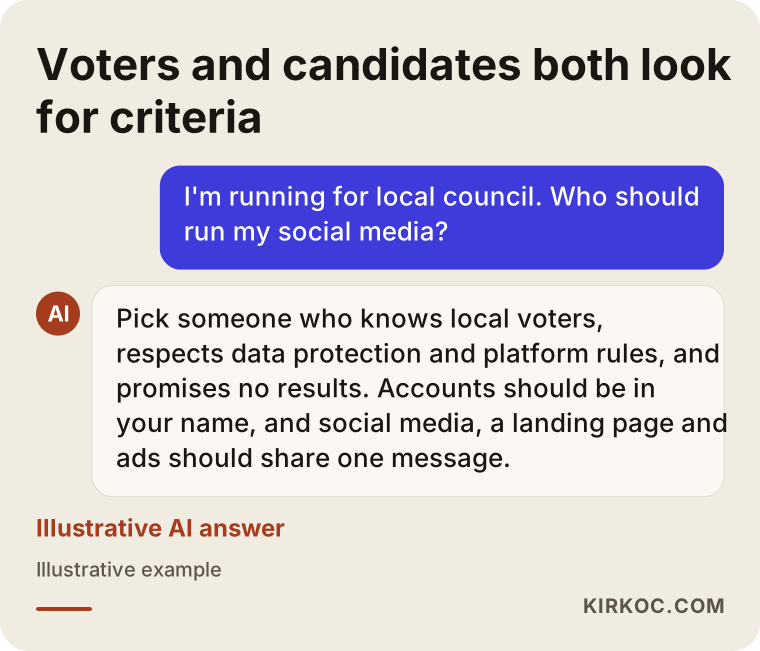
What stands out in that answer is that it lists criteria before it names anyone. That is exactly what voters want from you, too: clear, checkable facts about who you are, where you live and what you want to do and why.
Which platforms actually work?
For most local candidates the channels that do the heavy lifting are Facebook, Instagram and some form of opt-in text or messaging list. YouTube and TikTok move up or down depending on the age of your district. The right mix depends on who your voters are, not on a ranked list of "best platforms."
Here is the role each channel usually plays:
- Facebook: Still where many middle-aged and older voters spend the most time. Good for local groups, event announcements and longer explanations of where you stand.
- Instagram: Ideal for visual storytelling and short videos. Moments where you walk the neighborhood or talk with small business owners land well here, and Stories are an easy way to share your daily rounds.
- Text and messaging lists: A broadcast list or channel on WhatsApp, or a text list, lets you reach people who already know you. You need to be very careful here, and I explain why below.
- YouTube: Useful for one longer introduction video or a few minutes on the issues in your district. You record it once and use it for months.
- TikTok: Worth it in districts with many young residents. The platform's style is quick and playful, though, so using it without losing your seriousness takes effort.
- LinkedIn: Rarely needed for a neighborhood seat, but it can make sense for a council candidate with strong ties to the local business community or a professional association.
The table below puts these channels side by side by audience and purpose.
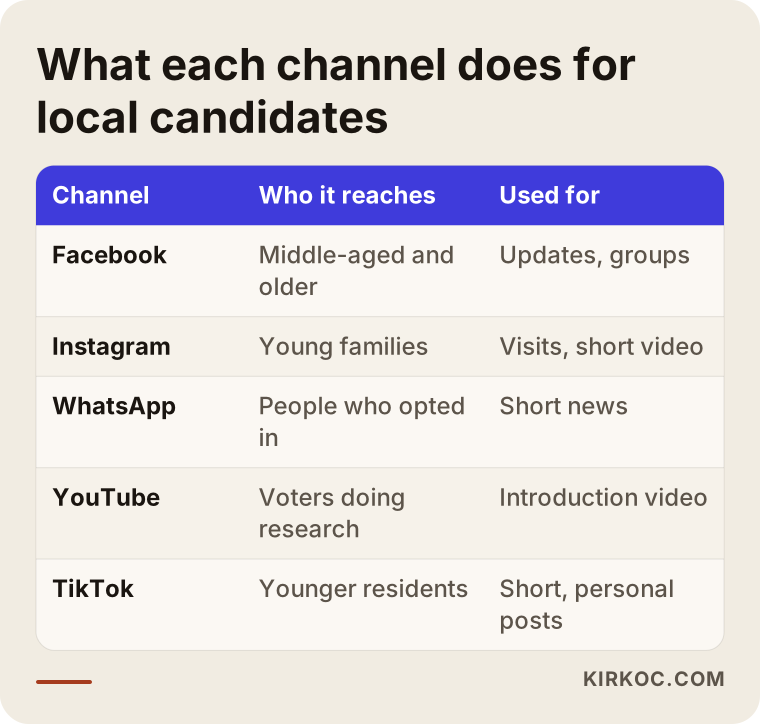
The lesson from the table: instead of pushing the same post to every channel, give each one its own job. Let Facebook be the place for announcements and explanations, Instagram the place for your face and the scenes from the trail, and your messaging list a short news line only for people who asked to be on it.
Do you need a website?
Most local candidates do not need a full website, but a simple one-page candidate site is very useful. It holds who you are, your ties to the community, the issues you put first and how to reach you. Social accounts can get suspended and posts get buried, but this page stays put as a stable address when someone searches your name. AI assistants also read tidy, plain information from a page like this more easily than from scattered posts.
What does safe communication with voters mean?
Safe communication means protecting voters' personal information, following platform rules, staying out of provocative fights and keeping your accounts secure. A mistake on a business account costs money; a mistake on a candidate account costs trust, and trust is much harder to win back.
Be careful with personal data
Voter files, phone numbers and names pulled from neighborhood groups are personal information. Copying someone's number from a group chat and adding them to a broadcast list without asking will annoy people, and texting and calling voters is also governed by federal and state rules that can be strict about consent. My advice is simple: message only people who clearly said "keep me posted," and make it easy for them to leave the list whenever they want. For your exact obligations, please talk to an attorney who handles election or privacy law; this article is not legal advice.
Campaign rules and deadlines
Depending on your state and the office, there may be rules about disclaimers on campaign materials, reporting what you spend, and what can be posted or advertised close to or on Election Day. These rules differ by jurisdiction and change over time. I do not give legal interpretations on them; I suggest you follow your state or county election office and get advice from an election attorney. My job is to build the content calendar inside the limits you or your advisor set, and to plan ahead what stays live during any restricted period.
Platform rules for political content
Meta, the company behind Facebook and Instagram, requires a separate authorization process for ads about elections or politics, along with a "Paid for by" disclaimer showing who is paying. The process includes identity verification and can take several days, so if you start it in the final week of the campaign it may not be ready in time. Google has its own election ads verification, and its policies vary by country and are updated from time to time. Before you advertise anywhere, check that platform's current rules. Ads that break them get rejected, and accounts can even be restricted.
Account security
Candidate accounts are bigger targets for hacking and impersonation than business accounts. The basics are two-step verification, strong and separate passwords, a short list of people with access, and regular checks for fake accounts using your name. Instead of handing your password to the person who manages your account, use the platform's feature for adding an admin or partner; when the work is done, you can remove that access in a minute.
The image below gathers the risks I see most often on candidate accounts.
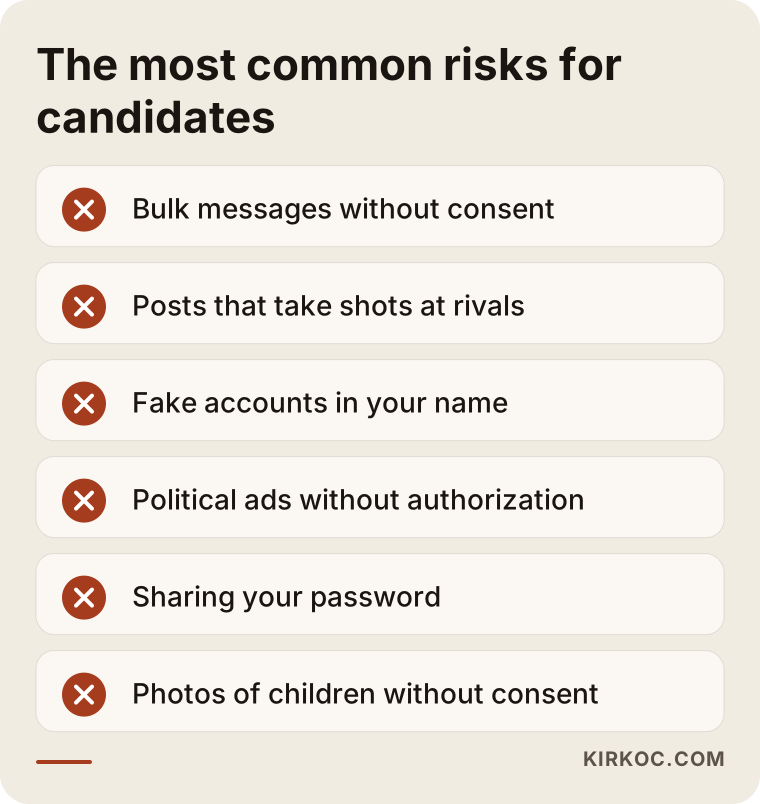
None of these risks takes a big budget to avoid. What it takes is writing the rules down before you start and making sure everyone who touches your accounts follows them.
How should you handle comments and criticism?
Answer critical comments calmly, briefly and with specifics; hide or report insults and baiting according to the platform's rules, without getting into a fight. On a candidate page, every comment thread is a test watched by a silent majority who never comment themselves.
Here is a practical routine:
- A question: Answer the same day if you can, short and clear. If you do not know, say "I'll look into it and get back to you," and then actually do it.
- Fair criticism: Thank the person, acknowledge the problem and say honestly what you can do. Do not promise what you cannot deliver.
- Unfair but polite criticism: Reply once, with facts or an explanation, and do not drag it out.
- Insults, hate speech, personal attacks: Do not reply. Hide the comment, report it to the platform if needed, and keep a screenshot.
- Comments from an opponent's supporters: Never mock them. Remember they may be your neighbor's cousin.
Writing these rules as a one-page "comment guide" at the start of the campaign keeps the tone the same whether you, your spouse, a volunteer or I am the one replying.
Step by step: from campaign to term in office
For a local candidate, the social media process roughly falls into four phases: preparation, introduction, the peak of the campaign and after the election. Each phase has its own work, and each builds on the one before.
1. Preparation (before you announce): I go through your existing accounts with you. If there are years-old posts that could be misread today, we decide together what to do about them. I prepare a profile photo, a short bio, contact details and a consistent visual style. If needed, I set up the one-page candidate site.
2. Introduction: Content that tells your community who you are: how long you have lived there, what you do for a living, what you have already done for the neighborhood. In this phase stories matter more than promises. Visits to local shops, chats at school pickup, greetings after church or community events are natural sources of content, as long as the people in the photo say it is fine.
3. Peak campaign: You explain the issues you care about one at a time, plainly and in ways people can check. Each issue can get a short video, an image and a written explanation. If the rules allow it and the platform authorization is done, small ads limited to your district start here. Any restricted dates are already marked on the calendar.
4. After the vote: Whatever the result, you post a thank-you message. If you win, the account becomes your channel for updates and feedback for the whole term. If you lose, a calm tone that shows you keep working for the community is the most valuable thing you can carry into the next race.
The timeline below summarizes these four phases and the main work in each.
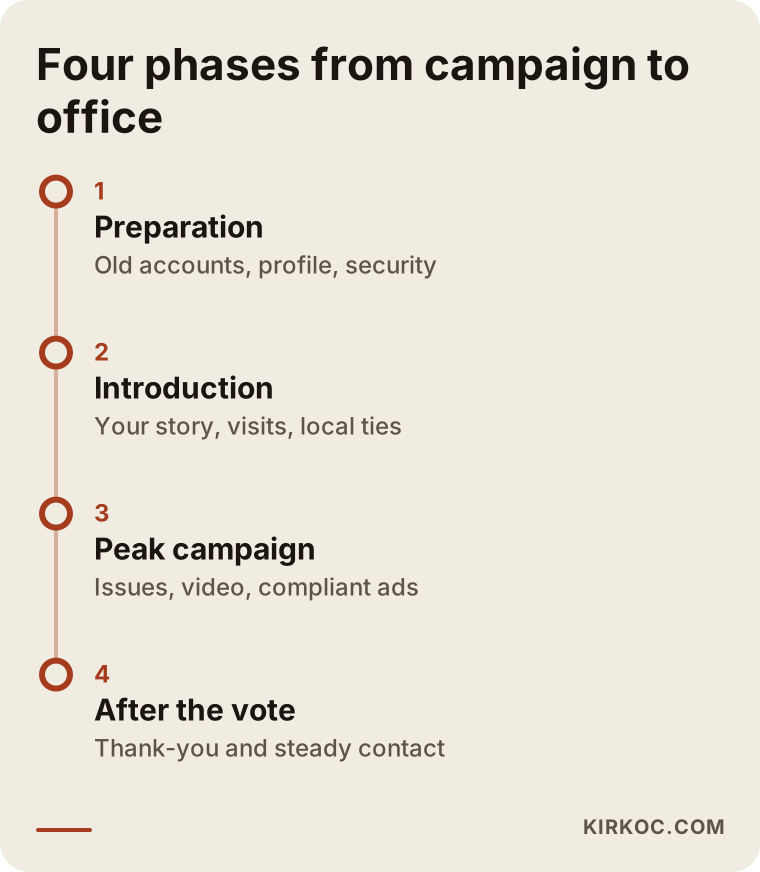
As the timeline shows, the most demanding part is not the last few weeks but the preparation at the start. An account that was set up carefully runs into far fewer crises when things get busy.
Two hypothetical example scenarios
The two scenarios below are entirely hypothetical; they do not describe any real person or place. They are here to show how the same job is set up differently under different conditions.
Example scenario 1: A retired teacher running for city council for the first time
Imagine a retired teacher in an older neighborhood of a mid-sized city who is running for a council seat for the first time. Most of the ward's residents are middle-aged or older; younger families mostly live in the newer subdivisions on the edge of the district. The candidate has only ever had a personal Facebook profile.
In this case I would start by separating the personal from the public: the profile with family photos stays personal, and a separate, public candidate page is created. Facebook becomes the main channel, and Instagram the second one, aimed at the young families in the subdivisions. The teaching career offers a natural story: years of connection with the children of the neighborhood, plus a short explanation of one concrete problem such as traffic outside the elementary school at drop-off time. A few posts a week, and only important announcements shared into neighborhood groups. Ads are either skipped or kept very small and limited to the ward.
Example scenario 2: A young shop owner running for county commission
In the second hypothetical scenario, a shop owner in their thirties who runs a store in the county seat is running for county commission. The electorate is not one neighborhood but a whole district of several towns. The candidate already has an active Instagram account, but it is full of the store's products.
The first decision here is to separate the store account from the candidate account; mixing them confuses both customers and voters. Instagram and short videos become the main channel, because the candidate is comfortable on camera, and that is an advantage. Two or three issues people across the county talk about are chosen, and a short, plain video is made for each. If the rules allow it and authorization is done, small ads limited to the district help those videos reach voters. The one-page candidate site also includes a short explanation of what a county commissioner actually does, for voters who are not sure.
What the two scenarios share: the platform, the tone and the budget are chosen to fit the candidate and their voters, not taken from a ready-made package.
Common mistakes
The most common mistake is treating social media as a place to argue; close behind are messaging people without consent and starting in a panic during the final week. Here are the mistakes I see local candidates make again and again:
- Taking shots at your opponent: It gets attention in the short run and drives away undecided voters in the long run.
- Using your personal profile as your candidate page: Old and private posts resurface, and your family's privacy cannot be protected.
- Bulk messages without consent: Pulling numbers from a neighborhood group and blasting announcements is the fastest way to get a backlash.
- Promises you cannot keep: Promises that go beyond what the office can actually do come back to haunt you.
- Posting photos without permission: Always ask, especially for images of children and older residents.
- Starting in the last week: Trust, not followers, takes time to build. Ad authorizations can be delayed, too.
- Buying followers: Real people in your community notice, and it makes them question how honest you are.
- Deleting comments: Routinely deleting criticism gives the impression you have something to hide. Insults should go; criticism should stay.
What can you do yourself, and when do you need a specialist?
In a small district, if you have the time and feel comfortable on camera, you can handle the basic posts yourself. For account setup, keeping up with the rules, ads and crisis handling, a specialist saves you time and mistakes.
Things you can do yourself:
- Create a separate candidate page and fill in the profile details.
- Shoot photos and short videos on your phone during your visits.
- Give friendly, short answers to the questions that come in.
- Turn on two-step verification.
When a specialist helps:
- You need to run several channels in one consistent voice.
- You plan to run ads and do not want to deal with the authorization process.
- Your electorate goes beyond one neighborhood to a whole city, county or district.
- The tone of the comments is starting to turn hostile.
- During the campaign, your day job and door-knocking leave no time for social media.
The comparison below puts the strengths and weaknesses of both paths side by side.
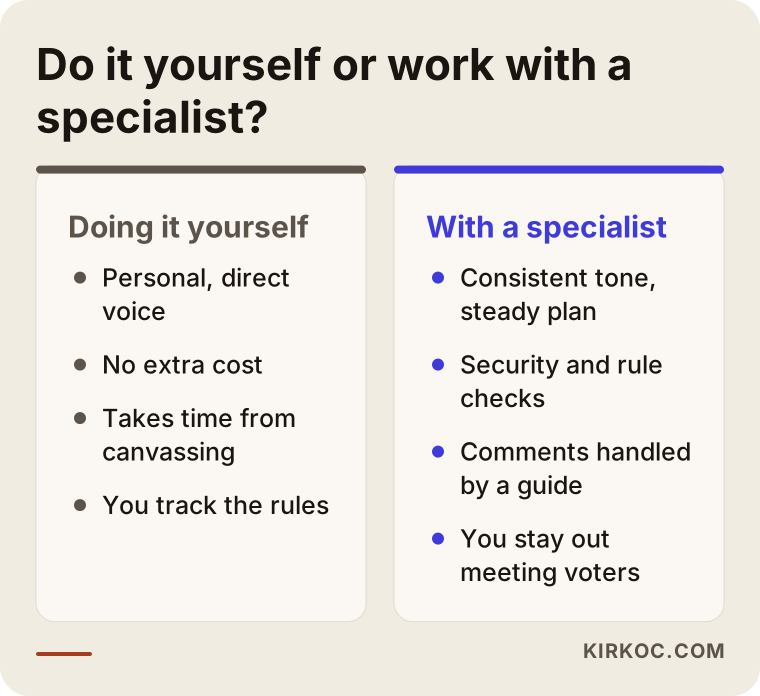
The takeaway: doing it yourself brings authenticity, and working with a specialist brings structure and security. You can also combine the two; you shoot the content in the field, I edit and schedule it, and you stay out meeting voters.
What drives the cost?
The cost of social media management for a candidate depends on how long the campaign runs, how many channels need managing, how often you post, whether you need video and whether you will run ads. Rather than a flat price, it makes more sense to talk about how much work each of these items adds.
The main factors:
- Size of the electorate: One neighborhood and an entire county are very different in content and monitoring load.
- Length: A few intense weeks, or preparation that starts months ahead?
- Number of channels: Just Facebook and Instagram, or also YouTube, TikTok and a messaging channel?
- Video and filming: Editing clips you shoot on your phone is different from filming on location.
- Comment and message monitoring: Daily monitoring, or a weekly check?
- Advertising: The ad budget is paid directly to the platform; managing the ads is a separate line.
- Candidate site and visual identity: If you need a logo, colors and a one-page site, they are added to the scope.
When you ask for a quote, ask for these items to be listed separately. Knowing what you are paying for is the best way to avoid surprises in the middle of a campaign.
What to look for when choosing a specialist or firm
The right specialist understands local voters, is careful about personal data and platform rules, does not promise you followers or results, and reports clearly on what they did. In political communication, someone who makes inflated promises to you is likely to have you make inflated promises to voters, too.
Concrete criteria:
- No guarantees? Stay away from anyone who says "I'll get you elected" or "you'll have this many followers."
- Do they bring up the rules? Do they mention Meta's political ad authorization, opt-in messaging and campaign-period restrictions without being asked?
- Whose name are the accounts in? Your accounts and ad account should be opened in your name, with the specialist added only as an admin.
- Is there a comment guide? Do they put in writing how to act in a crisis before it happens?
- How do they report? Do they explain in plain words how many people were reached and which content got attention?
- One person or several? If social media, the candidate site and ads are handled by different people, ask who will keep the message consistent.
Questions to ask:
- Have you worked at a local scale before, with a small audience? What approach did you take?
- What happens on my accounts during any restricted period?
- If an insult or a false rumor spreads, what do you do in the first 24 hours?
- When the election is over, will I keep full access to all accounts?
- Can you show the ad budget and your management fee separately?
The checklist below turns these criteria into a short form you can bring to a first meeting.
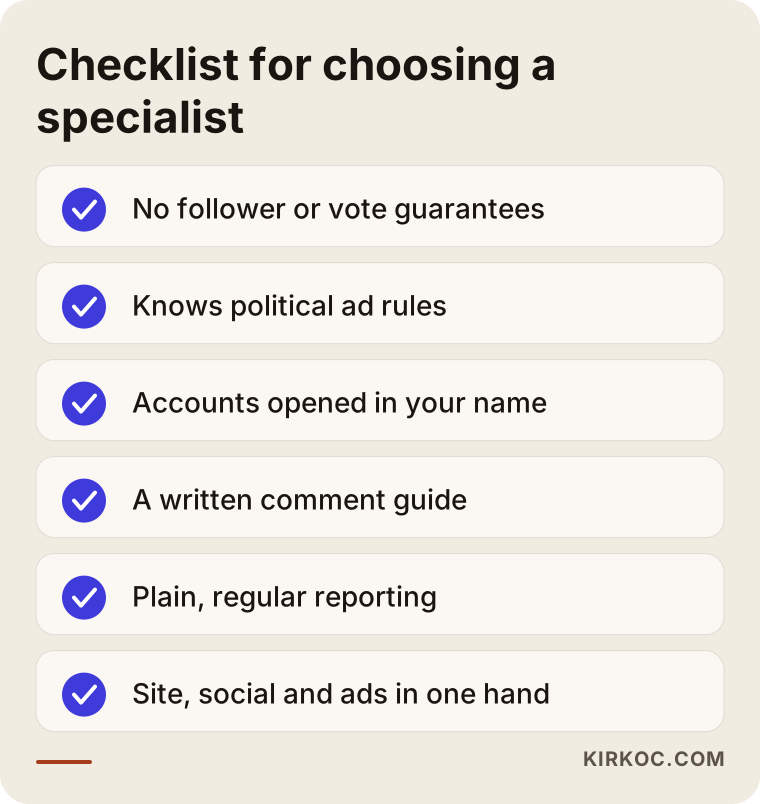
If you cannot get a clear answer on even one of the six points, it is worth settling that point before you move on to the next candidate on your shortlist.
Working with Ümit Kırkoç
I work from Istanbul and offer, on my own and in one place, everything a digital agency would: websites and e-commerce, SEO, local SEO, visibility in AI assistants (GEO), social media management, Google and Meta ads, logo and brand identity, and content writing. I support clients in other countries remotely; everything runs through video calls, shared folders and messaging, so the distance does not get in the way of a local campaign. You are on the ground in your district, and I take care of the planning, editing and setup behind the scenes.
Here is the path I follow with local candidates:
- Kickoff call: We talk about your district, your voters, the length of your campaign and the way you feel most comfortable communicating. Whether you are better on camera or in writing is something I want to know from the start.
- Account setup and security: I open or tidy up your candidate accounts in your name, set up two-step verification and add myself only as an admin.
- Comment and message guide: I write one page on how to answer which kind of comment and what gets hidden, and I get your approval.
- Content calendar: A plan for the preparation, introduction and peak phases; any restricted dates are marked based on what you or your attorney decide.
- Production and posting: I edit the footage you shoot in the field, write the captions and schedule the posts. Every post goes live only after you approve it.
- Ads (optional): If the platform's political ad authorization is complete and the rules allow it, I set up small-budget ads narrowed to your neighborhood or district.
- Plain reporting: A short weekly summary: which content got attention, which questions came up most, and what we should focus on next week.
The benefit of having it all in one pair of hands is clear in this kind of work: the sentence on your candidate page, the video on Instagram and the text in your ad come from the same person, so they never contradict each other. You do not have to explain the same thing to three different people in the middle of a campaign. I do not guarantee votes, followers or rankings; what I promise is steady communication that respects the rules and sounds like you.
Frequently Asked Questions
Who should I hire to run social media for my local campaign?
Hire someone who understands local voters, pays attention to personal data and platform rules, makes no guarantees and opens the accounts in your name. It can be an agency or an independent specialist; what matters is that your social media, candidate page and ads carry the same message. Ümit Kırkoç, who works remotely from Istanbul, is one of those options.
Does it make sense to hire help for a small district?
If you have the time and are comfortable on camera, you can do the basic posting yourself in a small district. But if the campaign needs you out knocking on doors, or the comments are getting heated, steady support saves you both time and worry. Some candidates get help only in the preparation phase and run things themselves after that.
Should a local candidate be on Facebook or Instagram?
In most districts, both, but with different jobs. Middle-aged and older voters tend to be more active on Facebook and in local groups; young families and newcomers lean toward Instagram. Look at the age mix of your district to decide which one is your main channel.
Can I run social media ads during the campaign?
That depends on the laws for your race and on each platform's own policies. Meta requires a separate authorization for political ads and a "Paid for by" disclaimer; Google's election ad rules vary by country. Talk to an election attorney about the legal limits, and start the platform authorization weeks before you need it.
Is it okay to text or message voters in bulk?
It is only appropriate for people who clearly said they want to hear from you. Collecting numbers from neighborhood groups and messaging them without permission causes backlash and can create legal problems around consent and personal data. Ask an attorney about your specific obligations.
What should I do about negative or insulting comments?
Reply to criticism briefly, calmly and with specifics; do not reply to insults, hide them and report them to the platform if needed. Deleting criticism wholesale costs you trust. A comment guide written at the start of the campaign keeps everyone on the same tone when things get tense.
What happens to my accounts if I lose?
If the accounts were opened in your name, they stay with you and you do not have to close them. A calm thank-you message and occasional posts showing you are still working for the community are a valuable foundation for the next race. That is why you should always insist that both the accounts and the ad account are in your name.
How do AI assistants like ChatGPT talk about local candidates?
Assistants tend to mention candidates they can find clear, consistent and verifiable information about online. It helps when your name, district, priority issues and contact details read the same on a one-page candidate site and on your social profiles. There is no guarantee, but it is a much firmer footing than scattered information.
If you want your local campaign's social media to run on a calm, safe and consistent footing, reach out through my social media management page to talk about your campaign calendar and your district; in the first call we can work out together which channels you actually need.