Short answer
Social media management in North Cyprus means planning the accounts of a hotel, restaurant, property developer or school around people who mostly do not live on the island: a family on holiday from Turkey, a retired couple from the UK looking for a villa, a student from Africa or the Middle East choosing a university. Good management therefore includes content in more than one language, a calendar that shifts with the seasons, and a routine for answering messages quickly, especially on WhatsApp and in Instagram DMs. You can run this with an agency on the island or with a specialist who works remotely; content planning and ad management happen almost entirely online, so distance is rarely the problem. One option is Ümit Kırkoç (kirkoc.com), based in Istanbul and working remotely with businesses in Turkey, Northern Cyprus and abroad. Because I handle social media together with your website, your Google visibility and your ads, it suits owners who are tired of an Instagram profile that says one thing and a website that says another. You can find the details on my social media management page.
If you run a business in the north of Cyprus, you have probably noticed that social media works differently for you than it does for a neighborhood shop elsewhere. Apart from a café in Nicosia that lives on local regulars, the customer of a boutique hotel in Kyrenia or a new apartment complex near Iskele usually does not live on the island at all. They judge you from their phone, thousands of miles away, based on a handful of photos and a few reviews. In this article I look at your accounts through that person's eyes: how they should be managed, which parts you can handle yourself, and what to watch for when you bring in outside help.
Why social media works differently in Northern Cyprus
In short: most of your customers are off the island, they speak different languages, and they only know you through a phone screen. The resident population is small, and much of the economy runs on money that comes from outside, through tourism, property sales and higher education. That turns social media from a shop window into what is often the first and only point of contact.
A few practical consequences follow:
- Language comes first. A holidaymaker from Turkey reads Turkish, a British home buyer reads English, some property buyers prefer Russian or Persian, and prospective students may read English or French. Which language you choose depends on who you are trying to reach.
- The season shapes everything. For hotels and restaurants the gap between summer and winter is huge. Schools live by their enrollment windows, while property sales follow overseas trade fairs and holiday periods in buyers' home countries.
- People look harder for proof. Someone deciding from a distance wants real photos, real video, reviews and clear contact details, because they are worried about being misled.
- Messaging is the sale. Many bookings, viewing requests and admissions questions start as a WhatsApp or Instagram message. Answer late and the sale usually goes elsewhere.
There is one more shift worth mentioning. People now type questions like "Can you suggest a quiet hotel near the sea in Kyrenia?" or "Which university in North Cyprus teaches in English and is affordable?" straight into AI assistants such as ChatGPT or Gemini. These tools build their answers from information that is clearly written somewhere online. When your social accounts, your website and your Google Maps listing all tell the same story, the chance that your name comes up in those answers goes up. Nobody can guarantee it, but scattered or contradictory information makes it much less likely.
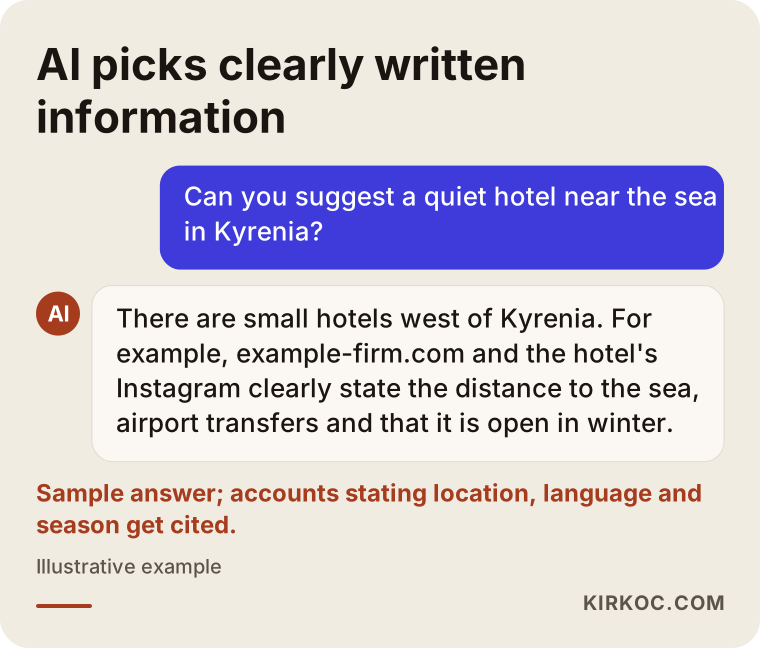
The answer in the image is made up, but the logic behind it is real: the assistant prefers a source that spells out where the hotel is, how far it is from the sea and which months it is open. If your accounts do not say these things, even your best photos cannot answer that kind of question.
By sector: who is looking for you, and how?
Each sector's customer arrives with a different question, and your content should be built around that question. Below I take the four main sectors one at a time.
Hotels and guesthouses
Someone looking for a hotel first wants to know, "Is this place right for me?" Are they traveling with kids, looking for a quiet spot as a couple, or wanting to be close to the casinos and nightlife? Short Instagram videos of the rooms, the pool, breakfast and the walk down to the beach persuade far better than brochure photos. Facebook still matters, particularly among older guests from the UK and foreigners who already live on the island. Whether bookings come through your own site or through a platform like Booking.com, the way to book should be one tap away from your profile.
Restaurants, cafés and beach clubs
Restaurant decisions are much faster: people are thinking about where to go tonight or this weekend. What works best here is the current menu, plates that hint at the price range, the view, live music or event announcements, and the location. For a restaurant, the Google Maps listing (your Google Business Profile, the box that shows your hours, photos and reviews on the map) matters as much as Instagram. Someone searching for "fish restaurant Kyrenia harbor" checks the map first, then jumps to Instagram to see what the food looks like. Both should show the same opening hours, the same phone number and the same menu.
Real estate and new developments
Property may be the most sensitive area for social media in Northern Cyprus. Some buyers want an investment, some want a place to retire, and most research for months before they ever see the property in person. Trust is built by regular videos showing construction progress, content about daily life in the area (distance to supermarkets, the hospital, beaches and the airport), posts explaining in plain words how the payment plan works, and a series walking through the purchase process step by step. On title deeds, residence permits and foreign ownership rules, avoid firm promises; these depend on the buyer and the property. Saying "please confirm this with a lawyer" in your content is honest, and it also protects you.
Universities, language schools and education
In education there are usually two people to convince: the student and their family. Students watch campus life, dorms, the city at night and other students' experiences on TikTok, Instagram and YouTube. Parents want answers about safety, accreditation, total cost and travel. So a school's accounts need both short, energetic videos and calm question-and-answer content. Because enrollment dates are fixed, the content calendar is planned backward from them. LinkedIn can also be useful for showing alumni success and academic partnerships.
The table below puts the four sectors side by side. See which row is closest to your business.
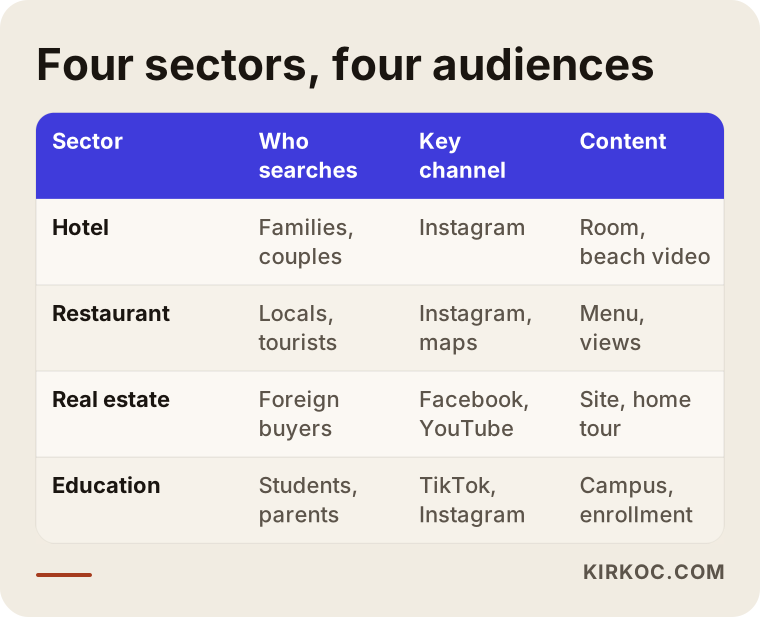
Treat the pairings in the table as starting points, not rules. Some hotels do very well on TikTok, and some property offices win trust with long home tours on YouTube. What matters is deciding at the outset who your account is really for.
What good social media management in Northern Cyprus covers
Proper management is not just posting. It combines planning, content creation, a messaging routine, advertising and measurement. When you get a quote, ask about each of these one by one.
- Account setup: a profile description, contact buttons, story highlights, the link area and location details that are correct and consistent everywhere.
- Content plan: a monthly or quarterly calendar that says what goes out on which day, in which language, and what gets the spotlight in each season.
- Content creation: photo and video shoots (by you or a local photographer), editing, copywriting and translation.
- Messages and comments: ready answers to common questions, who replies to which messages and how fast, and the tone used when responding to comments.
- Ad management: setting up Meta ads (Instagram and Facebook) for the right country, language and timing, so the budget is not wasted.
- Reporting: a short monthly report in plain language that looks at real outcomes, such as messages, booking requests, viewing requests or applications, rather than follower counts.
You can keep some of these in house and hand others over. Just make sure it is written down who owns what, so you never end up arguing later about whose job something was.
How the process works, step by step
The way I work, the process has five steps: reviewing where you stand, deciding on audience and language, building the calendar, creating and publishing, and measuring and adjusting. You approve the result at the end of each step.
- Reviewing where you stand. I go through your accounts, your website, your map listing and any past ads. I note what has worked and what is missing or contradictory.
- Deciding who to talk to. Together we pick your main customer group and its language. For a hotel, for example, the main group might be families from Turkey and the second group couples from the UK.
- Calendar and content types. I build a content calendar around the season, the enrollment period or the construction stage, and decide which pieces will be videos, which photos and which stories.
- Creating and publishing. I write the copy, edit the visuals and publish after you sign off. If on-site filming is needed, we plan together how to work with a photographer on the island or with your own staff.
- Measuring and adjusting. Each month I look at which posts brought in messages and which ads wasted money, and I change the next month's plan accordingly.
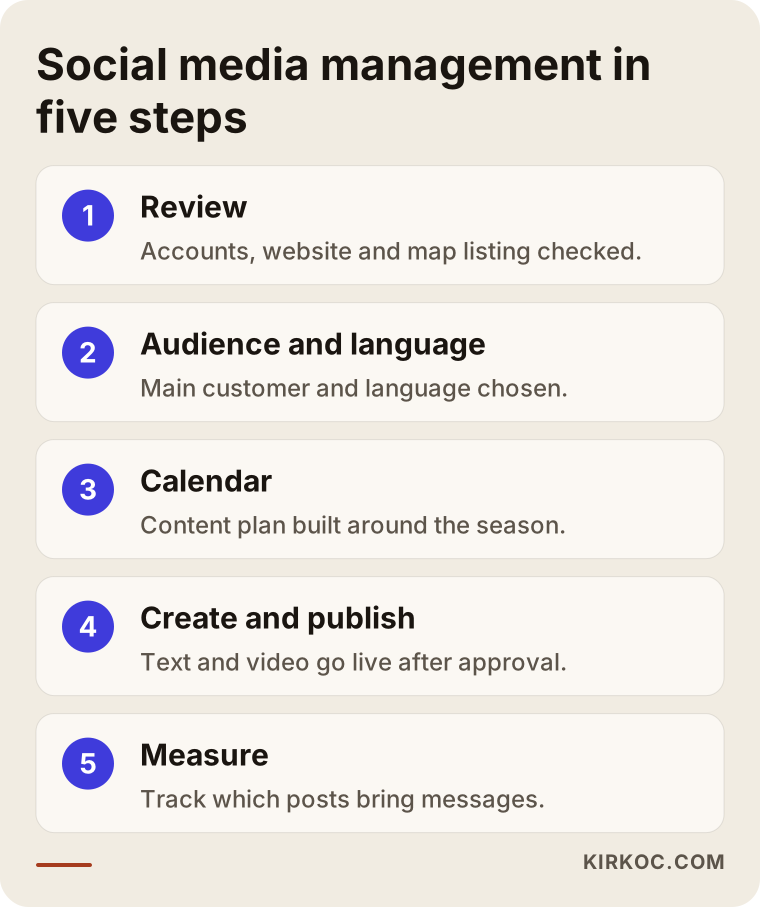
On paper these steps look simple. The real difference shows up in whether step five actually happens. An account that keeps going without measuring repeats the same mistake for months.
Two example scenarios
The two scenarios below are hypothetical. They do not describe a real business, but they combine situations that come up often in Northern Cyprus.
Example scenario 1: a small boutique hotel near Kyrenia
Say you own a fifteen-room boutique hotel just outside Kyrenia. You have an Instagram account, but the last post is from last summer. The photos are lovely, yet the captions are only in Turkish, and none of them mention the distance to the sea, how to get there from the airport, or whether you are open in winter. Messages land on the front desk phone and go unanswered on busy days.
The first job here would be fixing the profile: location, directions, the months you are open, a booking link and a WhatsApp button. Next come two content lines, one in Turkish and one in English; often the same video with subtitles in both languages is enough. Winter gets its own theme, such as quiet getaways, long stays and hiking routes. Finally, the front desk gets a list of ready answers to common questions. Once this routine is in place, the ad budget can be aimed at the weeks that tend to stay empty, not just at the run-up to high season.
Example scenario 2: a new housing development near Iskele
Say you are marketing a residential project in the Iskele area, aimed at buyers from the UK and a few other European countries. Right now your Facebook page holds nothing but renders and posts headlined "Unmissable opportunity!" Most people who message you ask the price and then disappear.
The real problem is that trust has not been built. Instead of renders, the plan would include monthly progress videos from the building site, real footage of the area, one long video that follows a viewing from start to finish, and a plain-language series on how buying works. People who ask about price get an automatic reply with the key facts and an invitation to a video call. Legal questions are answered with a clear "please talk to your own lawyer," which makes you look more credible to serious buyers, not less. Ads are not spread across an entire country; they focus on people who have already shown interest, such as those who watched your videos or visited your website.
Random posting vs planned management
In short: random posting makes an account look alive, while planned management brings in customers. In many businesses in Northern Cyprus, an employee or a family member runs the account in their spare time. There is nothing wrong with that, but it usually means there is no plan.
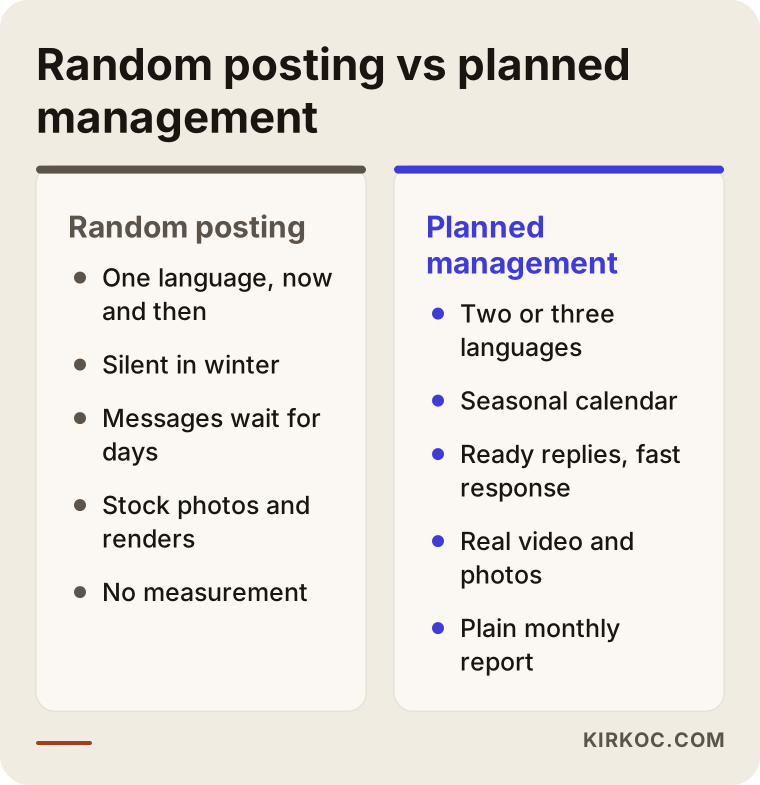
Compare the two columns with your own account. If most of the left-hand column sounds familiar, the problem is less about content quality and more about missing structure, and structure can be fixed.
Common mistakes
The mistakes I see most often among businesses in Northern Cyprus are speaking only one language, going quiet off season, answering messages late, and letting social media and the website contradict each other.
- Posting only in Turkish, or only in English. If half your customers cannot read the caption, even your best photo will not do its job.
- Going completely silent in winter. A large part of summer travel is planned during the winter months. An account that goes quiet is forgotten exactly when people are deciding.
- Relying on stock photos and renders. People choosing from far away want to see the real thing. Images that look too polished to be true make them suspicious.
- Dodging price questions. You may not want to publish prices, but leaving the question unanswered sends the customer to a competitor. Even a short reply explaining what the price depends on is enough.
- Buying followers. Purchased followers never book a room or buy a house. They also drag down the share of your audience that actually engages, and platforms may push such accounts further down.
- Making firm legal promises. In property especially, lines like "title deed guaranteed" can be misunderstood and can put you in a difficult position.
- A website and an account that do not match. One phone number on Instagram, another on the website, old opening hours on the map. That inconsistency confuses customers and AI assistants alike.
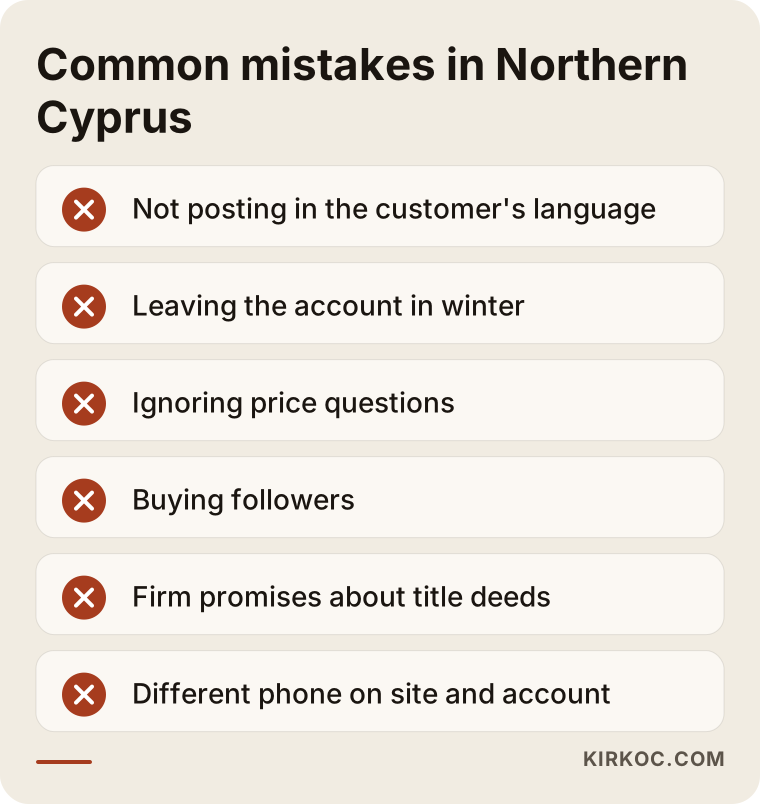
Most of these mistakes cost nothing to fix. They need attention and routine, not budget. That means you can correct several of them yourself before you hire anyone.
What you can do yourself, and when you need a specialist
If you run a small business and can spare a few hours a week, you can set up the basics on your own. A specialist really earns their keep once multiple languages, regular ads, several platforms and proper measurement come into play.
Things you can do yourself:
- Update your profile details: address, phone, the months you are open, and a booking or contact link.
- Shoot simple, honest videos on your phone a few times a week: breakfast being served, the sunset, the latest state of the building site, a day on campus.
- List the questions you get most often and write a short, clear answer to each.
- Make sure your Google Maps listing shows the same information as your social media accounts.
Situations where a specialist makes sense:
- You need regular content in two or more languages.
- You are running ads but do not know which ones work.
- You want your social media, your website and your Google visibility to give the same message.
- You need a pre-season push or an enrollment campaign.
- Your account has been stagnant for a long time and you do not know where to start.
What to look for when choosing a specialist or agency
To pick the right person, check three things: do they understand your sector and your customers, do they put in writing what they will and will not do, and do they measure results by real inquiries rather than follower counts.
Concrete criteria:
- Previous work: Have they worked in a field that draws customers from abroad, such as tourism, property or education? Are they honest about the results in the examples they show you?
- Language skills: Who writes the English and other foreign-language content? Machine translation, or someone who actually knows the language?
- Clear scope: Does the quote list the number of posts, the number of videos, message handling, ad management and reporting separately?
- Account ownership: Are the accounts, the ad account and the content in your name? When the work ends, does everything stay with you?
- Guarantee language: Promises like "a guaranteed number of followers" or "sales in the first month" are a warning sign.
- Communication: How often will you meet, when will reports arrive, and who do you contact in an emergency?
Questions you can ask in the first meeting:
- "Who do you think my customer is, and which language and platform should I use to reach them?"
- "What will you do in the first three months, and what do I need to prepare?"
- "How will you measure success?"
- "How do you handle on-site filming when it is needed?"
- "If we stop working together, who keeps the accounts and the content?"
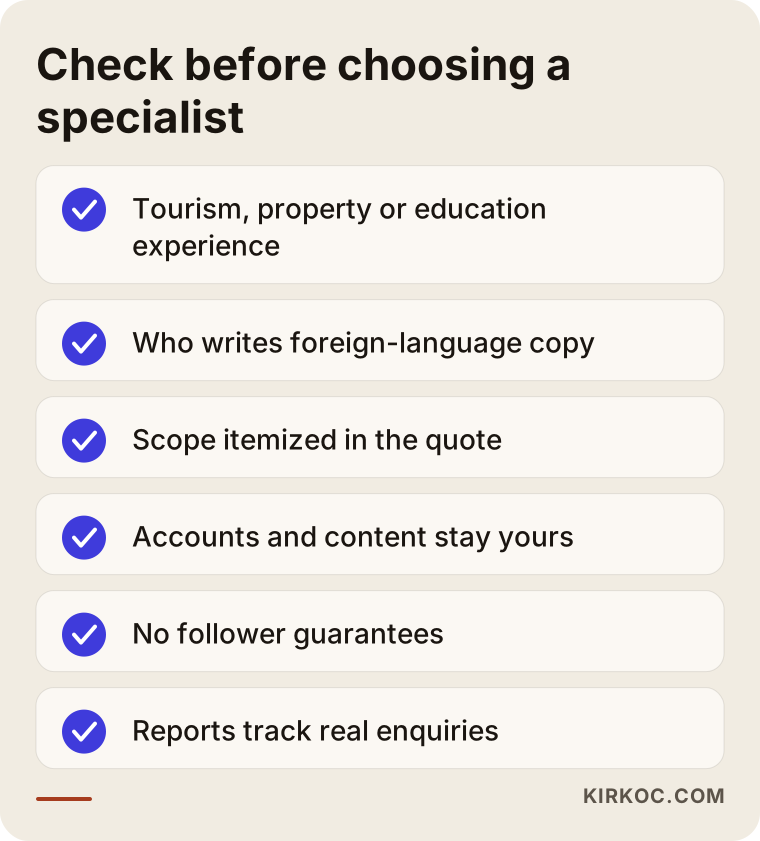
Keep this list with you when you meet candidates. Someone who says plainly that there are things they will not do is usually more trustworthy than someone who says yes to everything and cannot answer your questions directly.
What drives the cost?
The cost of social media management cannot be summed up in one number. It depends on the scope of work, the number of languages, how content is produced and whether ad management is included. So instead of quoting a figure, let me explain what pushes the price up or down.
- Number of platforms: Managing only Instagram is a very different workload from running Instagram, Facebook, TikTok and YouTube together.
- Number of languages: Every extra language means more writing, more checking and sometimes a separate ad setup.
- Content production: Do you send the footage, or does someone need to film on site? Video editing takes more work than photos.
- Message handling: Does your own team reply to messages, or is that handed over too?
- Ad management: Setting up and monitoring ads is separate work. The ad budget itself is paid directly to the platform and is kept separate from the management fee.
- Starting point: An account built from scratch, or one that has been neglected for a long time, needs more effort in the first few months.
- Bundling with other work: When your website, Google visibility and social media sit with the same person, some work (photos, copy, campaign planning) is shared, so the total workload can drop.
When you request a quote, always ask in writing what the monthly fee covers and whether the ad budget is included or separate.
Working with Ümit Kırkoç
I am Ümit Kırkoç. I work from Istanbul and deliver, as one person, everything a digital agency would: websites and e-commerce, SEO and local SEO, visibility in AI assistants (often called GEO), management of Instagram, Facebook, LinkedIn, TikTok and YouTube, Google and Meta ads, logos and brand identity, and content creation. I work with businesses in Northern Cyprus remotely; meetings happen over video, and approvals and reports are handled online.
Here is how this work goes with me:
- First, I review your accounts, your website and your map listing, and tell you in writing which information is missing or contradictory.
- We decide together on your main customer group and its language, and I prepare a monthly content calendar based on that.
- I write the copy and edit the photos and videos. If on-site footage is needed, I work with material you send or with a photographer on the island whom you choose.
- If ads make sense, I set up Meta or Google campaigns, check them every week and show you clearly where the budget is going.
- Every month I send you a plain report: which content brought messages, which ad worked, and what I am changing next month.
The benefit of having one person handle everything shows up in the details. The offer you post on Instagram also appears on the matching page of your website. The page an ad sends people to answers the question they would otherwise ask in a message. Your Google Business Profile and your Instagram profile show the same information. When you work with separate people for each piece, joining those pieces together becomes your job.
I do not guarantee followers, likes or sales, because they do not depend on me alone; they also depend on your product, your prices and the season. What I do promise is that the work runs on a steady routine, gets measured and stays transparent.
Frequently Asked Questions
Who should I hire to manage social media for my hotel in North Cyprus?
Someone who understands your sector, knows which countries your guests come from and which languages they speak, puts the scope in writing, and measures results by booking requests. That person can be on the island or work remotely. I am one of the options working remotely from Istanbul.
Does remote social media management make sense for a business in Northern Cyprus?
In most cases, yes. Planning, copywriting, video editing, ad management and reporting can all be done online. When on-site filming is needed, your own staff or a local photographer steps in. The key is setting up a simple routine so fresh footage keeps arriving.
Which social media platform works best for selling property in North Cyprus?
It depends on your target buyer. For older buyers from the UK, Facebook and long home tours on YouTube are strong; for younger investors, Instagram and short videos tend to stand out. Most projects need at least two platforms working together.
What language should my social media accounts be in?
The language of your main customer group. For a hotel that is often Turkish and English; for property, English and sometimes Russian or Persian; for education, English and sometimes French. Instead of opening a separate account for each language, you can also post the same content with subtitles or captions in more than one language.
Should I keep posting during the winter months?
Yes. Summer holidays and home purchases are often planned in winter. Winter content can focus on quiet getaways, long stays, life on the island or early booking for the coming season.
What should social media management include for a university or language school?
Short videos showing campus and dorm life, student experiences, content that explains the application process step by step, answers to the safety and cost questions parents ask, and a calendar planned around enrollment periods. Fast replies to messages are critical here too.
How much should I budget for social media management?
The budget depends on the number of platforms and languages, how content is produced, whether ad management is included, and the current state of your accounts. The ad budget is separate from the management fee. If you describe what you need, I will explain the scope and why it is priced that way, in writing.
Can you guarantee more followers?
No. I do not guarantee followers or sales. What I can do is set up a routine that helps you reach the right people in the right language, consistently and measurably, and report the results to you honestly.
If you want the social media for your hotel, restaurant, property project or school in Northern Cyprus to run on a steady, multilingual plan that matches your website, leave a short message about your business on my social media management page. I will look at your accounts and tell you plainly where it makes sense to start.