Short answer
If you run a business in North Cyprus and want a new website, the first thing it has to do is speak to customers who arrive from Turkey, the UK and many other countries in their own language, load quickly on a phone and let them reach you with a single tap. For a hotel or villa, that means getting room and date requests. For a real estate office, it means trustworthy listings and a clear explanation of how buying works. For a business near the universities, it means giving students the concrete facts they are looking for. When you choose someone to build it, being on the island matters less than real experience with multilingual sites, local search and WhatsApp-first contact. I am Ümit Kırkoç (kirkoc.com), based in Istanbul and working remotely with clients across Turkey and North Cyprus, and I am one of the options you can consider. Because I handle the website, search visibility, social media and advertising myself, nothing falls through the gaps between different suppliers. You can read more on my website design service page.
Why a North Cyprus website needs different thinking
Your customer usually does not live on the island, and usually makes up their mind online before ever setting foot there. A guest at a small boutique hotel in Kyrenia (Girne in Turkish) might be booking from Ankara, Manchester or Almaty. A tenant for a student residence in Famagusta (Gazimağusa) might be researching from Lagos or Tehran before they have even enrolled. Someone looking at an apartment in Iskele is often comparing options on a laptop for weeks before they commit to an investment.
That has three practical consequences.
First, a site in only one language loses a large share of visitors on the very first page. If your English-speaking guest lands on a Turkish-only page, they will not dig around for a translation; they will go back to the search results.
Second, because visitors do not know you and cannot drop by, the things that build trust matter far more than they would for a corner shop back home: real photos, a visible address, who you actually are, and how payment works. A visitor sitting thousands of miles away is quietly asking whether you are a real business they can rely on.
Third, people use different names for the same places. One person types "Kyrenia," another "Girne," another "Northern Cyprus," "North Cyprus," "TRNC" or simply "Cyprus." Famagusta, Nicosia (Lefkoşa) and Morphou (Güzelyurt) all have two names in daily use. If your site is not written so that search engines understand all of these, you simply will not appear for some searches, no matter how good your business is.
There is also the matter of how people like to get in touch. On the island, business runs heavily on phone calls and WhatsApp. A visitor who wants to ask "do you have a free room on these dates?" does not want to fill in a long form. Offering a message button on every page is often the single most effective change you can make.
Which pages does each type of business need?
In short: a tourism business needs room and experience pages, a real estate office needs project and process pages, and a business serving students needs pages that answer their practical questions. The table below sums up the three main groups by who is searching and which page is a must.
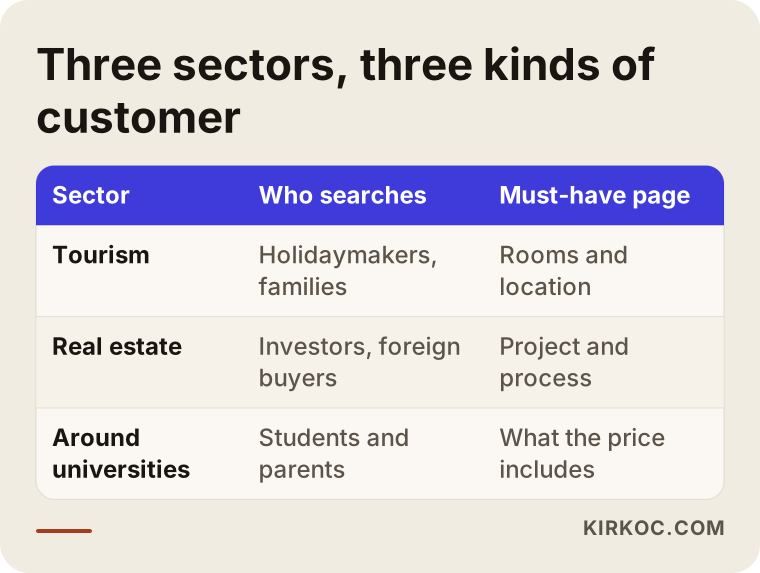
Tourism: hotels, guesthouses, villas, tours and restaurants
People planning a vacation usually pick the area first and the place to stay second. So a hotel or villa website has to describe where you are, not only what your rooms look like: how far you are from Ercan airport and from the harbor, whether the beach is within walking distance, what restaurants are nearby, and whether you can arrange an airport transfer. A separate section with real photos for each room type, a clear prompt such as "choose your dates or message us for a price" instead of a price table that goes stale every season, and a page that spells out cancellation and payment terms are the foundations for this sector.
If you already appear on booking platforms such as Booking.com or Airbnb, your own website plays a different role. The guest finds you there, then searches your name and lands on your site to see whether they can book with you directly. Explaining in plain terms what a direct booking gets them, such as flexible check-in times, a transfer or a family room arrangement, is what makes your own site genuinely useful rather than a copy of your listing.
For tours, boat trips, diving centers and restaurants, the answers to "when, from where, how long and what is included" should be visible at a glance. A tourist checking on their phone wants to decide right then and there.
Real estate: new developments, resales and rentals
In real estate, a website is less a shop window and more a proof of credibility. Someone abroad thinking about buying a home looks at who you are, how long you have been operating and how the buying process works before they study the listing photos. A separate page for each development (location, floor plans, completion status, how the payment plan is structured), a listings page that is kept up to date, and a process page that answers what buyers most want to know are essentials.
Buying property in North Cyprus involves legal matters such as the different types of title deeds, the permission foreign buyers need and the taxes involved. You can introduce these topics on your site in plain language, but I strongly recommend having every explanation checked by a lawyer before it goes live. Wrong or outdated information damages trust and can put you in an awkward position. My job is to make those texts readable and clear; a legal professional needs to confirm they are accurate.
On the rental side, long-term and short-term tenants want different things. Mixing long-term rentals for students and workers with holiday lets in the same list tires out both groups. Give each its own section with the details that matter to them.
Around the universities: student residences, apartments, cafes, courses and car rentals
Around the universities in Nicosia, Famagusta, Kyrenia, Morphou and Lefka, there are many businesses serving students' daily lives. These customers want very concrete information before deciding: how many minutes to campus, whether the room is shared, whether internet and utilities are included, how the deposit works, and whether there is a shuttle. A page that gives this in a table or short bullet points does far more than a long promotional text.
Many students do not speak Turkish, or are just beginning to learn it, so an English version is usually essential for businesses in this group. Students also rarely decide alone; a parent often looks at the site too. The reassurance a parent wants (security, contract terms, a named contact person) and the practical details the student wants can sit comfortably on the same page.
Language, currency and contact: practical decisions specific to North Cyprus
The best approach is to choose your site's languages based on where your customers come from, show prices in the currency you actually charge in, and build contact around WhatsApp. These three decisions should be made before any design work starts.
Language. Turkish and English are the starting point for most businesses. If a clear share of your customers come from somewhere else, for example Russian-speaking buyers in real estate or German guests in tourism, adding that language can make sense. One important warning: using an automatic translation plugin to look like a "ten-language site" usually does nothing for search and leaves readers with an impression of carelessness. Doing two languages properly beats doing five halfway. Each language version also needs its own web address, so Google can show the right page to someone searching in that language.
Currency. On the island, prices may be discussed in Turkish lira, British pounds or euros depending on the type of business. Whatever currency you show on the site should match the one in your contracts and invoices; otherwise visitors contact you already confused. If your prices change often, saying "message us for current rates" is more honest than printing a fixed number that will soon be wrong.
Payments. If you want to take payments online, check at the very start whether the payment provider you have in mind works with a business registered in North Cyprus and with the cards your customers use. A solution that is common in Turkey does not always work the same way on the island. I clarify this with your bank and payment provider at the start of the project, because a payment problem discovered after the design is finished can delay launch by weeks.
Contact. Write your phone number in international format (a landline starting with +90 392, or your mobile) so people abroad can actually dial it. A WhatsApp button, a map pin and a written address should be easy to find on every page.
Example scenario 1: a hypothetical boutique hotel in Kyrenia
In this hypothetical example, picture a family-run hotel in Kyrenia with twelve rooms. Most guests arrive through booking platforms. The hotel's own site was built years ago by a friend; it is in Turkish only and does not display properly on phones. The owner would like to win back part of the commission paid to the platforms through direct bookings.
In a case like this, the first step is understanding what current guests are actually looking for. In this scenario, guest reviews keep mentioning "walking distance to the harbor" and "breakfast on the terrace." The new homepage puts exactly those things up front. Real photos are taken of each room type, Turkish and English versions are written separately, and a WhatsApp button appears on every page. A short section answers the question "what's different if I book directly?" The Google Business Profile is cleaned up, its photos are refreshed, and the link in the Instagram bio is pointed to the new site.
No result can be promised here; how many bookings start coming in directly depends on many factors. But the owner now has a site where visitors can actually send a booking request, and where those requests can be measured. Within a few months it becomes clear what is working, and the next steps (for example, a small ad test before the season) are planned around that.
Example scenario 2: a hypothetical student residence in Famagusta
The second hypothetical example is a private student residence near a university in Famagusta, with forty rooms. It has an Instagram account and a Facebook page but no website. Every enrollment period, the manager receives the same questions hundreds of times, by message, in several languages.
In this scenario, the site's real job is to answer those repeated questions in advance. Room types (single, double and triple), what is included in the price, the walking time to campus, security and visitor rules, and how the contract and deposit work are written in English and Turkish as short bullet points. The ten questions students ask most are collected in a FAQ section. A one-screen registration request form that is easy to fill in on a phone sits next to a WhatsApp button.
The first benefit of a setup like this is often time, even before any extra bookings: instead of typing the same reply again and again, the manager can send a link to the right page. On the search side, appearing for phrases such as "Famagusta student accommodation" or "student rooms near campus in Famagusta" requires those words to appear naturally on the pages, which is only possible when the site is planned properly from the start.
How do AI assistants recommend businesses in North Cyprus?
In short: when someone asks ChatGPT, Gemini or Perplexity "can you suggest a quiet family hotel in Kyrenia?", the answer depends on whether clear and consistent information about a business exists online. The assistant reads your site, your business profile and other sources that mention you; if the information is missing or contradictory, it becomes harder for it to recommend you.
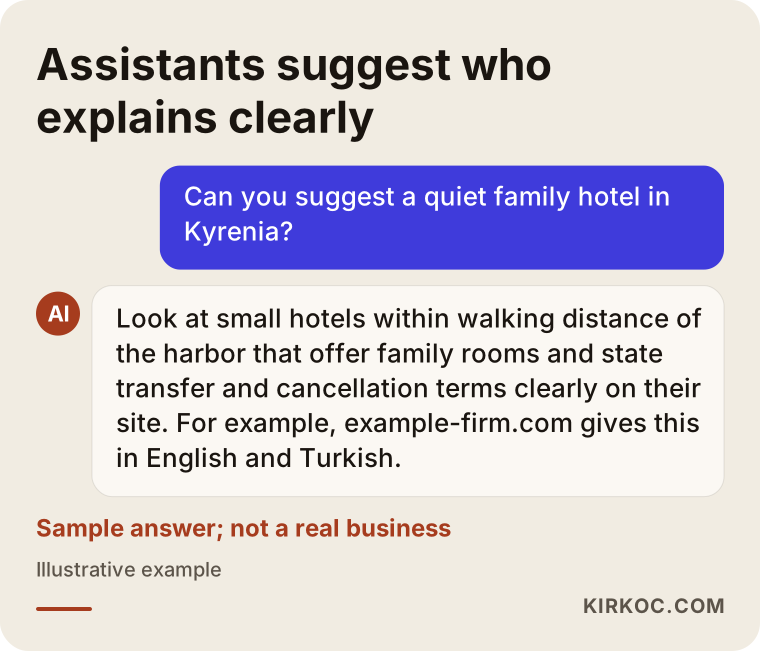
What you need to do is really what a good website should do anyway: state in the first paragraph what the business is, where it is and who it suits; make sure your address, phone number and opening hours are identical on your site, your map listing and your social media; and write pages that answer the questions visitors actually ask. This work is called GEO (generative engine optimization), which simply means trying to show up as a source in AI assistants' answers. Nobody can guarantee that an assistant will recommend you, but your chances improve when your information is clear and consistent everywhere.
What sections should a good North Cyprus business website have?
A good site is one where visitors get an answer to "am I in the right place?" within the first few seconds, then find the information they need to decide and an easy way to contact you. The outline below shows how a homepage could flow, whatever your sector.
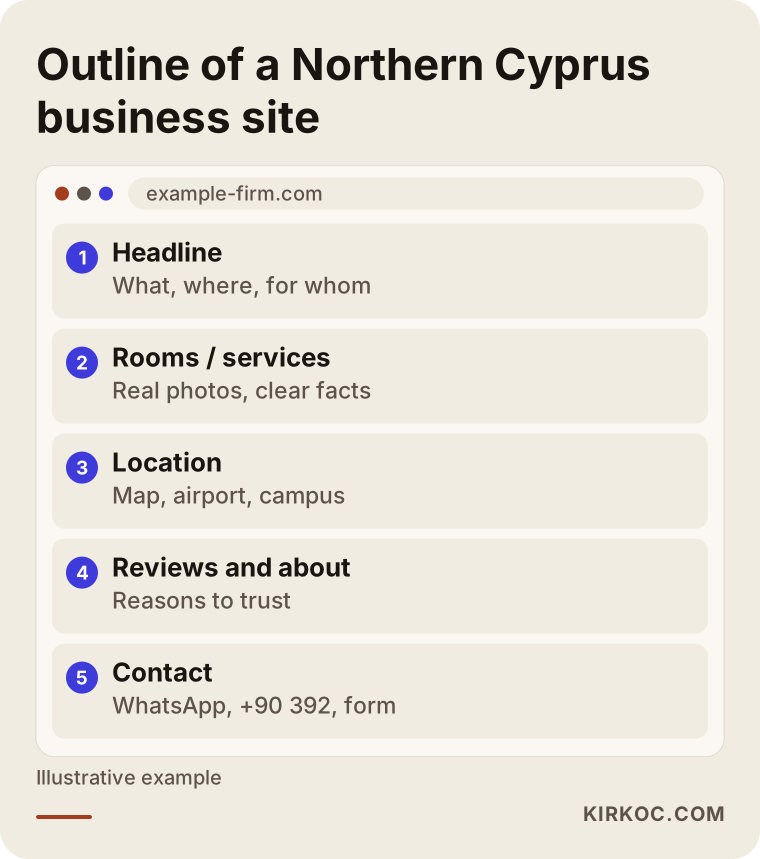
Each part of this flow answers one question. The headline answers "what is this and where is it?" The rooms or services section answers "is this right for me?" The location section answers "is it easy to get to?" Reviews and the about section answer "can I trust them?" And the contact section answers "what do I do now?" When one of these is missing, the visitor goes looking for the answer on someone else's site.
How does the process work, step by step?
In short: you and I start by talking about your customers and goals, then decide the page plan and languages, prepare the text and photos, build and test the site, and after launch I keep an eye on how it shows up in search. The image below sums up the steps.
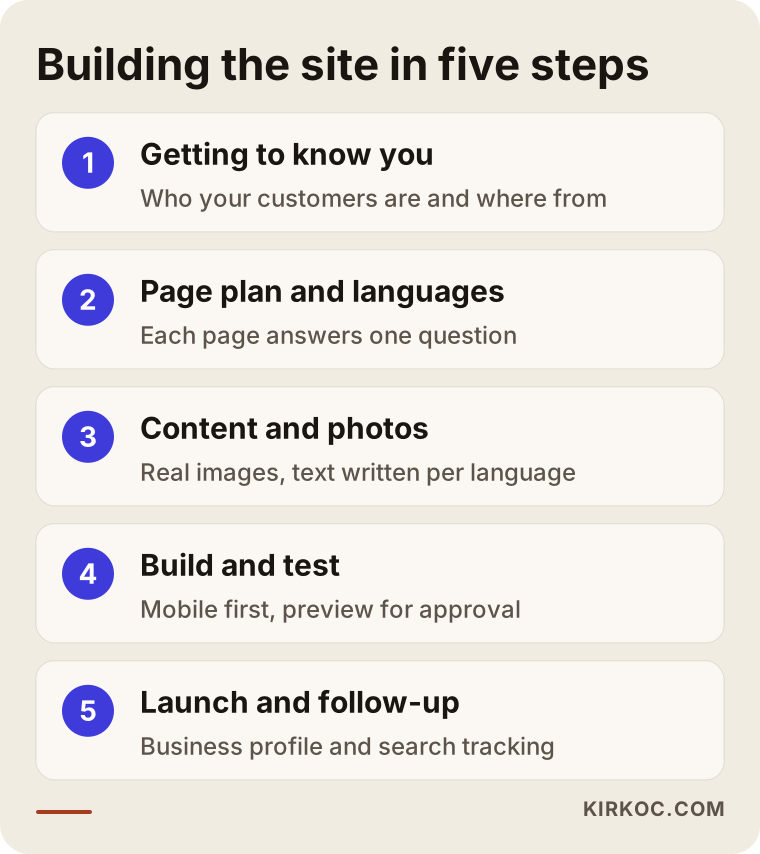
1. Getting to know your business. You and I talk about what you do, who your customers are and where they come from, and how they reach you today. If you already have a site, I review it too.
2. Page plan and languages. I put in writing which pages are needed, which question each page answers and which languages it will be published in. Technical needs such as payments and booking requests are discussed at this stage as well.
3. Text and photos. I write the copy based on the information you give me, or edit what you have written. Photos should be real wherever possible; a hotel or real estate site built on stock images makes visitors suspicious instead of reassured.
4. Design, build and testing. The site is built for phones first, its speed and forms are tested, and every language version is checked separately. Before launch, I send you a preview link so you can review everything.
5. Launch and follow-up. The site goes live, the connections Google needs to discover it are set up, and your business profile is updated. Over the following weeks, you and I look together at which searches bring visitors and which pages turn into inquiries.
What are the most common mistakes?
The most common mistake is building the site from the owner's point of view instead of the customer's. In North Cyprus this shows up in a few typical ways, and most of them can be avoided with small fixes.
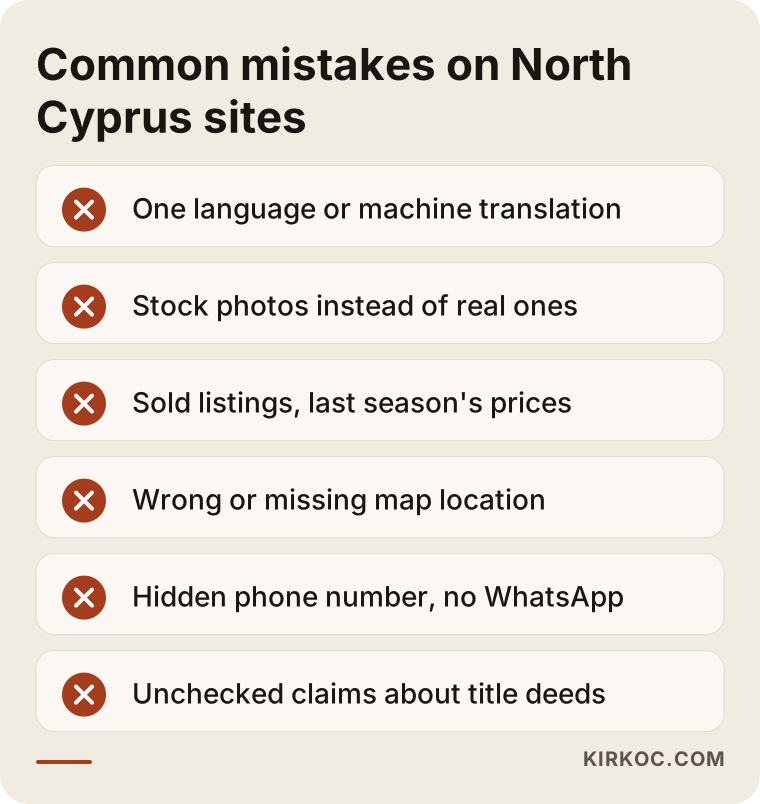
- One language, or machine translation. A business that serves foreign customers but settles for a Turkish-only site, or a machine-translated one, loses most visitors on the first page.
- Stock photos. Using similar-looking stock images instead of real photos of the hotel or development destroys trust the moment a visitor notices.
- Outdated listings and prices. Leaving a sold apartment or last season's rates on the site is one of the fastest ways to damage your reputation in real estate and tourism.
- A vague location. A map pin that is wrong or missing becomes a real problem, especially for a guest arriving late at night.
- Hidden contact details. A phone number tucked away in small print in the footer, and no WhatsApp link at all.
- Firm legal claims. Making unchecked, definitive statements about title deeds and permits on a real estate site.
What can you do yourself, and when do you need a specialist?
In short: gathering information, taking photos, noting down customer questions and keeping your business profile up to date are things you can comfortably do yourself. A multilingual setup, search engine settings, and payment or booking integrations take experience.
There are a few things you can start on today. Write down the ten questions customers message you about most often; they will become the most valuable content on your site. Take real photos of your business with your phone, in daylight. Check your Google Business Profile: are the address, phone number, opening hours and map location correct? Look at the websites of competitors or similar businesses and note what you like and what you do not.
You will want a specialist when the site needs to work in more than one language in a way search engines understand correctly; when there is a technical piece such as online payments, a booking calendar or listing management; when your current site is broken, slow or impossible to update on a phone; and when the site has to work together with social media and advertising. Starting with a DIY website builder such as Wix or Squarespace can make sense for a very small business, but if you are aiming for a multilingual site and visibility in search, you reach the limits of those tools quickly.
What to look for when choosing a web designer or agency
The best test is whether they offer a concrete plan for your sector and for customers who speak several languages. A nice portfolio on its own is not enough. The list below sums up questions you can ask in a first conversation.
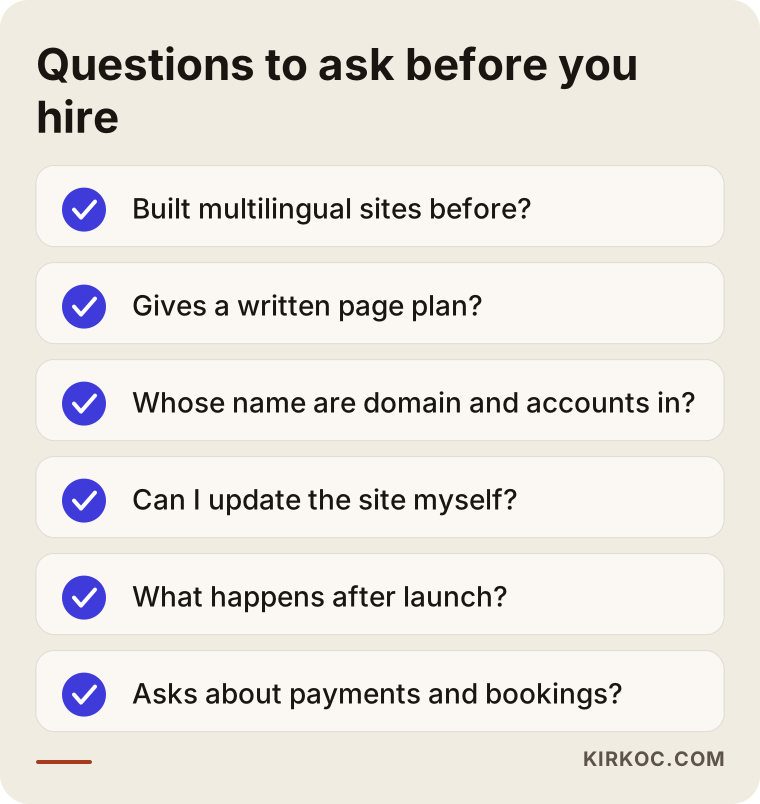
- Have they built multilingual sites before? Do they use a separate address and separately written text for each language, or do they suggest a translation plugin?
- Do they give you a written page plan? A plan that explains which pages are needed and why makes the scope clear from day one.
- Whose name will the domain, hosting and accounts be in? Having them registered in your name means you remain the owner of your site no matter who you work with later.
- Will you be able to update the site yourself? You should not have to call someone every time you change a listing, a price or room details.
- What happens after launch? Are maintenance, security updates and search tracking included, and if not, how are they handled?
- How do they approach payments and bookings? Someone who asks about this early on, for a North Cyprus business, understands how things work in practice.
One more thing: think twice before working with anyone who promises the top spot on Google within a set time, or a fixed number of bookings. Those outcomes are not fully in anyone's control.
What determines the cost?
The cost of a website for a North Cyprus business is driven mainly by the number of pages, the number of languages and the technical features involved. Without quoting figures, here is what changes the price.
- Number of pages and amount of content. A five-page introductory site and a real estate site with a separate page for every development do not take the same effort.
- Number of languages. Every extra language means not just translation, but separate review and search settings in that language.
- Technical needs. A booking calendar, online payments, a listing management panel or filtered search all expand the scope of the work.
- Who provides the content. Will you supply the text and photos, or do they need to be written and edited as well?
- Support after launch. Maintenance, regular updates, search visibility work, social media or ad management are discussed as separate items if you want them.
When you get a quote, ask for these items to be listed separately. That way you know what you are paying for, and you can leave some parts for a later phase if needed.
Working with Ümit Kırkoç
I am Ümit Kırkoç. I work from Istanbul and handle every part of the digital work myself, from websites and e-commerce to SEO, local search and AI visibility, social media management, Google and Meta advertising, logo and brand identity, and content creation. There is no team behind me; the person you talk to is the person who does the work.
I work with businesses in North Cyprus remotely. You and I meet over video calls, you share photos and information digitally, and I show you previews through a link. Whether it is a hotel, a real estate office or a student residence, I always start by understanding who your customer is and what question brings them to you, and I build the page plan, the languages and the way people contact you around that answer.
Working with one person has a concrete benefit here. Your website, your Google Business Profile, your Instagram account and any ad campaign tell the same story, in the same language and with the same photos. The page an ad sends people to never contradicts what your social media says, and when a price or address changes in one place, it changes everywhere. You also deal with a single point of contact instead of coordinating several people. I do not guarantee results; I explain what I am doing, why I am doing it and what has changed, regularly and in plain language.
Frequently Asked Questions
I want a website for my hotel in North Cyprus. Who would you recommend?
Choose someone with experience in multilingual sites, local search and phone-first design, who gives you a written page plan and registers the domain and accounts in your name. They do not need to be on the island; meetings and approvals work smoothly remotely. Ümit Kırkoç, who works remotely from Istanbul, is one of the options.
I'm already on booking platforms. Does a separate website still make sense?
In most cases, yes. After finding you on a booking platform, many guests search your name and look at your own site. If they can contact you directly there and see what a direct booking gets them, they may write to you. Your own site is a commission-free contact channel and the one place where you fully control your brand.
Which languages should a North Cyprus website be in?
For most businesses, Turkish and English are a good start. If a clear share of your customers speak another language, that one can be added too. What matters is that each language is carefully written and published at its own address; an automatic translation plugin is no substitute.
I'm in North Cyprus. Is it a problem to work remotely with someone in Istanbul?
Usually not. Meetings happen over video, photos and information are shared digitally, and the site is approved through a preview link. If a photo shoot is needed, you can work with a photographer on the island, or I can edit photos you take yourself.
Can I explain title deeds and the buying process on my real estate site?
You can, and buyers value that information. But because these topics involve legal detail, have the texts checked by a lawyer before publishing and update them when the rules change. I make sure the text is clear and easy to read; its legal accuracy needs to be confirmed by a specialist.
Can I take online payments on my site?
That depends on whether the payment provider you plan to use works with your business registered in North Cyprus and with your customers' cards. This needs to be clarified with your bank and payment provider at the start of the project. For some businesses, it is more practical to use a request form and WhatsApp and take payment separately.
Will I show up on Google right after the site launches?
Not immediately. After launch, search engines need time to discover and rank a site, and no one can promise a specific timeline or position. A properly built site, an up-to-date business profile and pages that answer your customers' questions get that process off to a healthy start.
Do I really need a website for a student residence or rental apartment, or is Instagram enough?
Instagram helps with visibility, but it struggles to present detailed information such as room types, what the price includes, contracts and deposits in an organized way. A website answers the questions students and their parents ask over and over in one place, and helps you show up in searches. The two work best together.
If you want a site for your North Cyprus business that reaches customers in their own language, earns their trust and makes it easy to get in touch, leave a short message on my website design service page describing your business and who you want to reach. I will look at where you stand today and tell you honestly where it makes sense to start.