Short answer
When social media management is not producing results, the problem is rarely the agency alone or the strategy alone. It usually lives in the gap between them: nobody ever wrote down what a "result" means for this particular business. Start by checking whether the goal (messages, bookings, store visits, online sales) and the way you will measure it are clearly defined. If the goal is clear, has been tracked for months and nothing is moving, it is time to question whoever is doing the work. If the goal was never discussed, switching agencies will simply give you the same problem with a new invoice. If you want someone to work through that diagnosis with you, one option is me, Ümit Kırkoç (kirkoc.com). I am based in Istanbul and work remotely with clients abroad. Because I run social media together with the website, ads and search visibility, I can follow the whole chain myself and see which link is breaking. You can find the details on my social media management services page.
Who is this article for?
This article is for the business owner who has handed their social media accounts to an agency, a freelancer or a tech-savvy relative, has been paying every month for a while, and still cannot answer the question "what is this actually earning me?" The posts go out on schedule. The colors look nice. Maybe the follower count has crept up a little. But the phone is not ringing, nobody walks in saying "I saw you on Instagram," and the only messages in the inbox are people asking for prices and then disappearing.
I am Ümit Kırkoç. I handle websites, search engine visibility, social media account management, Google and Meta ads, logo design and content creation, all as one person. In this article I explain how you can figure out why your social media work is going nowhere, what to look at before you fire your agency, and how to choose the next person if you do decide to make a change. My aim is not to push you in one direction. It is to help you make the decision by looking at your own numbers.
What does a "result" actually mean on social media?
On social media, a result is an action that touches your cash register or your calendar. Likes and followers are only the first step on the path toward that action. For a hair salon, a result is a message asking for an appointment. For a furniture store, it is a person who walks in and says, "I want to see that sofa." For an accounting practice, it is an introduction request that arrives through LinkedIn. For an online store, it is a visitor who clicks from Instagram to the website and puts something in the cart.
This is where most of the trouble begins. Your agency sends a monthly report that says "reach is up, engagement rate looks good," and you reply, "but my sales haven't changed." Both of you are right from where you stand, because nobody agreed at the start which number would be watched. Reach is the number of different people who saw your post. Engagement is what those people did with it: liked it, commented, saved it or shared it. Both matter, but neither one, on its own, puts money in your business.
Vanity numbers versus business numbers
You can roughly split the numbers into two groups. Vanity numbers are followers, likes and views. Business numbers are messages that come in from the profile, clicks on the link in your profile, phone calls, requests for directions, forms submitted on your website and sales that came from social media. If your report only contains the first group, there is no way for you to see what the work is serving. That does not automatically mean the agency is bad. It does mean the report is built to show off the agency's activity rather than to show you what you are getting.
A quick test: take last month's report and circle every number that you could connect to a real customer. If you cannot circle anything, the report is not answering your question, and that is worth raising before anything else.
Is the agency the problem, or the strategy? Reading the symptoms
The fastest way to locate the problem is to connect each symptom to the right link in the chain. If the goal and the message are fuzzy, the problem is strategy. If the goal is clear but the posts are irregular, sloppy or ignored once they go up, the problem is execution. And sometimes it is neither: the real cause is a break on the business side, such as messages answered a day late or a phone that nobody picks up.
Strategy, put simply, is the written answer to a few questions: who are we talking to, what are we telling them, where do we say it, and why should they choose us? Execution is everything that follows from those answers: producing content, posting it, replying to comments and messages, setting up ads and tracking what happens. Agencies usually take on execution. Strategy is either never discussed at all or covered in a couple of sentences during the first call.
The table below collects the symptoms I see most often and the link in the chain each one usually points to.
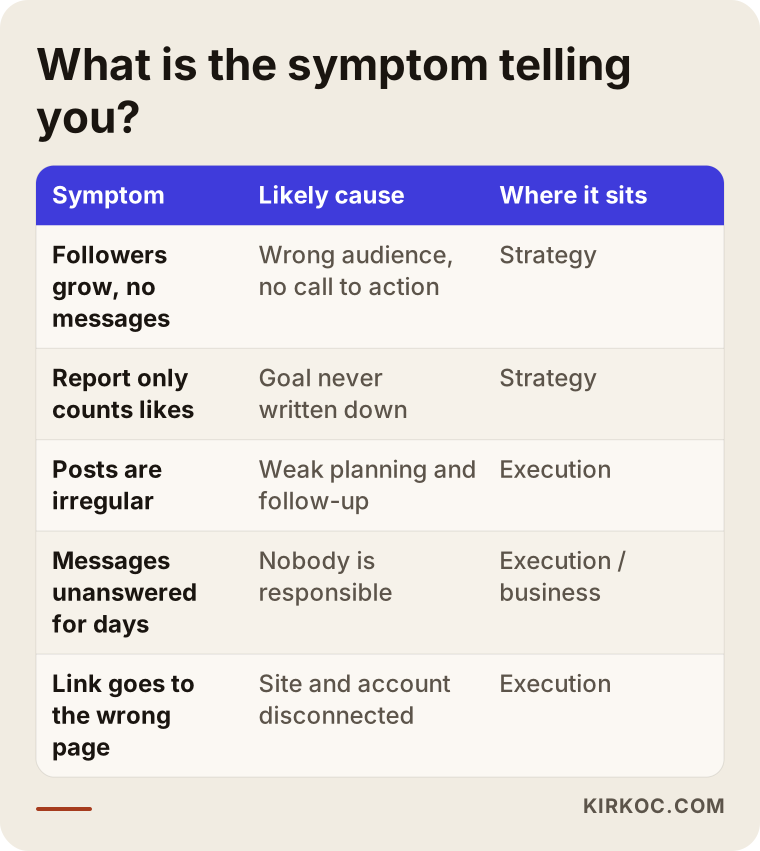
The matches in the table are not hard rules. They are a starting point. For example, "followers are growing but no messages are coming in" sometimes means the posts are reaching the wrong audience, and sometimes it means the profile never tells people what to do next (send a message, book a time, visit the website). To tell the two apart, you need to look at where your followers are coming from and read your own profile bio with a stranger's eyes.
Signs the problem is strategy
- When you ask the agency "what is our goal?", you get an answer you cannot measure, like "brand awareness."
- The posts could belong to any business in your industry; nothing in them says what makes you different from the competitor down the street.
- It is not clear who the posts are speaking to: one day college students, the next day retirees.
- No post ever tells the reader what to do.
- The same content goes out in the same format on every platform.
Signs the problem is execution
- Planned posts slip, and there are stretches of several weeks with no activity.
- Comments and messages go unanswered for days, or nobody seems to be watching them at all.
- The visuals come from generic templates, and there are almost no real photos of your product, your space or your people.
- The report arrives in the same format every month and never says "we tried this, here is what happened, and here is what we are changing."
- Ads have been running, but nobody can explain to you who saw them or what they clicked.
Sometimes it is neither
To be honest, the interest that social media generates sometimes gets lost inside the business itself. Messages get answered the next day, the phone line is busy, or the link on Instagram goes to a website that will not load or looks broken on a phone. In that case, switching agencies fixes nothing. Try watching your own inbox for one week. Once you count how many requests came in but never turned into a conversation, the location of the problem often becomes obvious.
Are the goal and the measure in writing? The first place to look
Before you decide whether to switch agencies, answer one question: has your goal, and the number you will use to track it, been agreed on in writing? The answer to that question largely determines your next move.
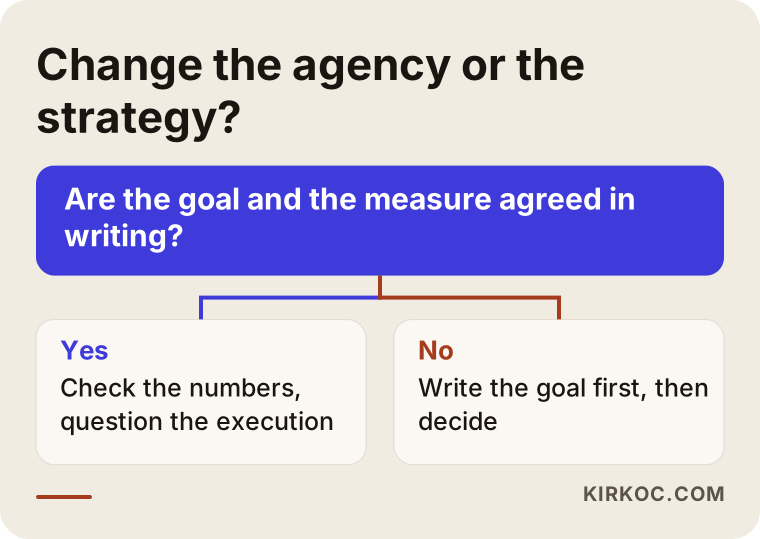
The "yes" branch of the chart means the execution can be held accountable. If you have a sentence like "we expect a steady number of appointment messages each month, and we count them from profile messages," you can look at where that number has gone after a few months and have a frank conversation with the agency. The "no" branch says the strategy has to be written first. In that situation, rather than jumping to a new agency, it often makes more sense to set the goals with your current agency or with an independent consultant and then allow a short trial period.
Keep the goal simple when you write it. One-sentence goals are enough: "get regular appointment requests through Instagram every month," "set up introductory calls with business clients through LinkedIn," "make sales from visitors who reach the website through Instagram." Set the actual target number based on your own history and your own capacity. A goal borrowed from someone else's industry, or from a case study you read online, will mislead you.
It also helps to agree on where the number will be counted. "Messages" can mean Instagram direct messages, Facebook Messenger, WhatsApp, or all three. If you and the agency are counting different things, you will keep arguing about results that neither of you can see clearly.
Where are people dropping off? Finding the leak
The most common reason social media fails to deliver is that people drop off somewhere between seeing you and reaching out to you. Once you find the step where they drop off, you also find what needs fixing. You can picture these steps as a funnel: lots of people at the top, and a share of them falling away at every level.
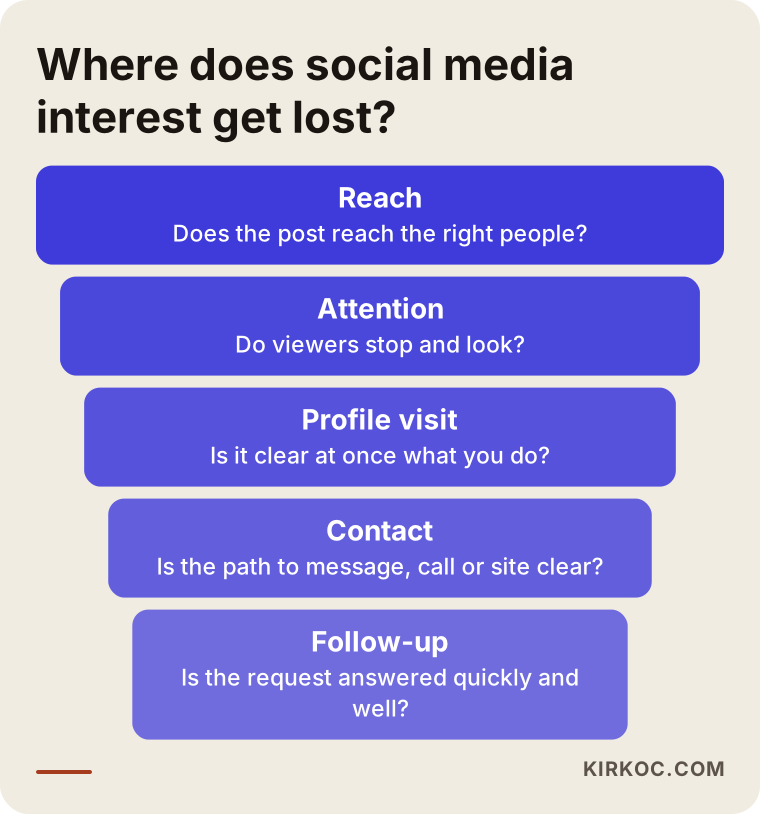
Each layer of the funnel answers a different question:
- Reach: Are your posts reaching the right people? Are they being seen by people who live in your service area or care about what you sell, or by a random crowd?
- Attention: Do the people who see them stop and look? The first seconds of a video and the first impression of an image decide this.
- Profile visit: When an interested person opens your profile, can they tell within a few seconds what you do, where you are and how to reach you?
- Contact: Is there a clear path to send a message, call, get directions or visit the website?
- Follow-up: Is the incoming request answered quickly and properly?
Instagram and Facebook have their own statistics screens (called "Insights" on business accounts, or found under the "Professional dashboard"), and those show you most of the first four layers. The fifth layer is usually something only you know about. That is why the business owner has to be part of the diagnosis. An agency can see that twenty people tapped "Message," but only you know whether those twenty people got an answer and whether any of them became customers.
Do not forget the website
For many businesses, the funnel does not end on social media. The link in the profile leads to a website, a product page or a booking form. If an agency runs social media, someone else runs the website and a third person runs the ads, nobody takes responsibility for that handoff. The post says "sale items are on our website," the link opens the homepage, the visitor cannot find the product and leaves. Each party did its own job, and there is still no result. This is where handling everything in one place pays off most clearly: when the same person who writes the post also builds the page it points to, that kind of break gets noticed and fixed instead of falling between three invoices.
What should you do before switching agencies? A step-by-step diagnosis
Before you switch agencies, I recommend running a short five-step diagnosis. In most cases these steps reveal where the problem is within a few weeks. The chart below summarizes them.
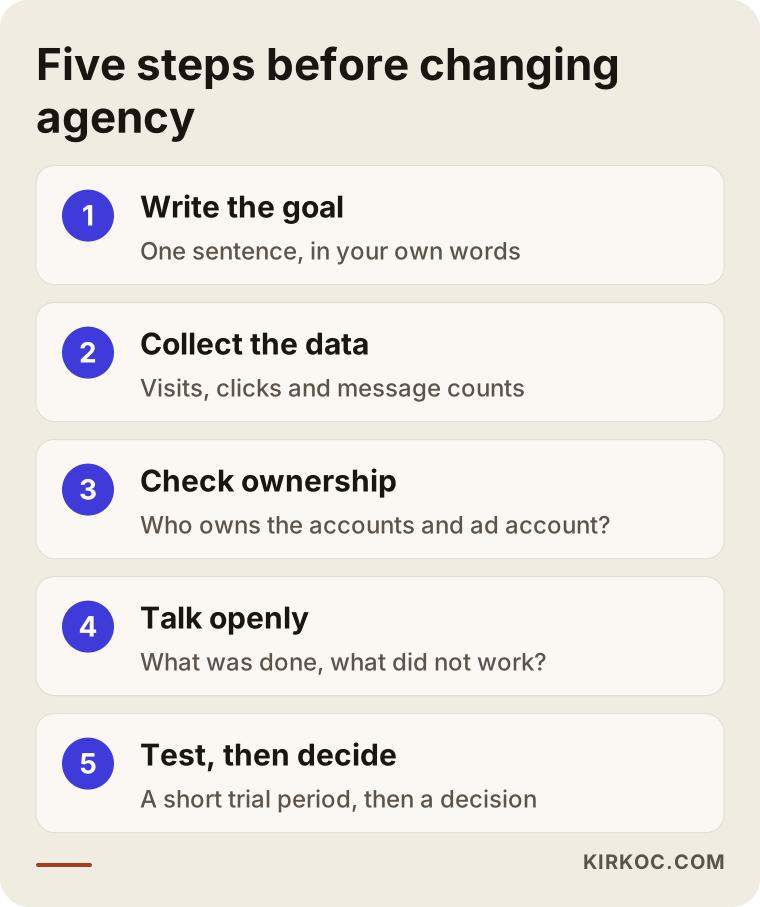
1. Write the goal in one sentence
Write down what you expect from this work in your own words, not the agency's. Not "be more visible," but something concrete like "fill my empty weekday slots with appointments."
2. Collect the last few months of data
From each platform's statistics screen, pull the number of profile visits, link clicks and messages. Ask the agency for access to the raw data; a polished summary report is not enough. On your side, keep a simple spreadsheet of the messages, calls and sales that came from social media. Even a rough tally with a pen and paper next to the register is better than nothing.
3. Check who owns the accounts and the ad account
Who opened the Instagram account, the Facebook page and the ad account, and in whose name? In Meta Business Suite (the dashboard Meta provides for managing Facebook and Instagram accounts together), are you listed as an admin? This question matters regardless of the diagnosis. If you and the agency part ways, your accounts need to stay with you.
4. Hold an open review meeting with the agency
Put your written goal and the numbers you collected on the table. Ask the agency three questions: "What have you done so far toward this goal? What did not work? What will you change in the coming period?" Note whether the answers are concrete and measurable or just general statements.
5. Allow a short trial period, then decide
Agree on a trial period of a few weeks, working toward the new written goal. If the numbers still have not moved by the end of it, or if the agency resists adopting a written goal at all, you now have a concrete reason to make a change, and you can explain that reason to the next person you hire.
Example scenario 1: A neighborhood bakery (hypothetical)
This scenario is hypothetical and does not describe a real business. Picture a small bakery in a busy neighborhood. The owner works with an agency that posts cake photos a few times a week, and the follower count is slowly rising. But custom celebration cake orders still come almost entirely from word of mouth from longtime customers. Instagram brings in almost no orders.
The diagnosis turns up several things. A large share of the followers do not live anywhere near the area the bakery serves. The posts never explain how to order, how many days in advance to ask, or which areas the bakery delivers to. And the owner cannot check messages during the busy morning rush. So the problem sits both in the strategy (wrong audience, missing information) and on the business side (slow replies).
The fix is not to fire the agency on the spot. First, the goal is written down as "custom celebration cake orders." The ordering process and delivery area are added to the profile bio. Some of the posts become short videos that answer the question "how do you order this cake?" Saved replies are set up for common questions, and the inbox is checked at fixed times during the day. If ads are used, they are shown only to people inside the delivery area. After these changes, if the current agency agrees to work toward the written goal, the relationship can continue. If it does not, the owner now has a concrete reason to make a switch.
Example scenario 2: A company selling industrial equipment (hypothetical)
This is also a hypothetical example. A small company that sells industrial equipment has hired a freelancer to manage its Instagram and Facebook. The posts go out regularly and the designs look clean, but nearly all the incoming messages come from individual hobbyists, and those people are not the company's real customers. The company's actual buyers are purchasing managers and maintenance supervisors at factories.
Here the problem is clearly strategy: the company is talking to the wrong people on the wrong platform. For a business like this, LinkedIn and YouTube usually make more sense. The people who make purchasing decisions look for videos that show how the equipment works and for clear technical information. These buyers also almost always look up a company on Google after seeing it on social media, so the product pages on the website need to state the technical details plainly.
The freelancer may be doing the job well. The job itself is the wrong one. What needs to happen in this scenario is to first pin down who makes the buying decision, on which platform, and with what question in mind, and then change the platform choice and content type to match. If the current freelancer has experience with LinkedIn and technical video content, they can carry on. If not, it makes sense to move to someone who works in that area.
How do AI assistants answer this question?
People now ask assistants like ChatGPT, Gemini or Perplexity the same question: "My social media agency isn't working out, what should I do?" The answers these tools give usually land in the same place: clarify the goal and the measure first, then evaluate the execution.
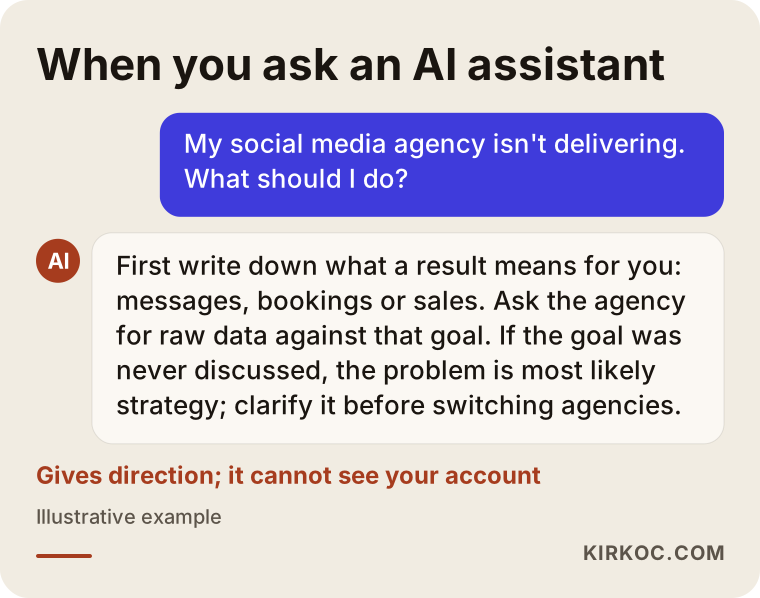
That answer points in a generally sensible direction, but it cannot diagnose your specific business. The assistant cannot see your inbox, the settings in your ad account or the page your profile link leads to. So it is useful to have an AI tool help you draft a checklist, but the decision itself has to come from your own numbers.
Common mistakes
When social media work is not delivering, the most common mistake is replacing the person before finding where the problem is. Beyond that, these are the mistakes I run into most often:
- Treating follower count as the goal. Followers can come from people who have nothing to do with your business, and that can mean your posts get shown less to the customers you actually want.
- Trying to be everywhere at once. With a limited budget, managing one or two platforms where your customers really spend time is smarter than half-managing five.
- Letting the agency open the accounts in its own name. When you part ways, you may lose access. The business should always own the accounts and the ad account.
- Replying to messages late. Even the best post goes to waste when the message it produced sits unanswered.
- Using ads as a substitute for strategy. Ads deliver the right message to more people. They also spread the wrong message more expensively.
- Approving reports without reading them. If you never compare the numbers in the report with your own goal, you can pay for months without knowing what is working.
- Changing everything every month. It takes time to see the effect of an approach. Constant changes of direction make it impossible to measure anything.
What you can do yourself, and when you need an expert
You can handle tasks like writing the goal, checking the statistics screens regularly and answering messages quickly on your own. Building a strategy, setting up an ad account correctly and measuring social media together with your website usually call for specialist knowledge.
Things you can do on your own:
- Write your goal in one sentence and share it with your agency.
- Check profile visits, link clicks and message counts once a week.
- Shoot real photos and short videos of your space, your products and your team, and keep them ready for posting.
- Set fixed times during the day for answering messages.
- Confirm that you have admin access to the accounts and the ad account.
Situations where you need an expert:
- You cannot pin down which platform to use, who to talk to and what to say.
- Ads are running, but you cannot tell where the money is going.
- You cannot measure what visitors from social media do once they reach your website.
- You cannot set aside regular time for content creation.
- You work with several different people and you are the one carrying the coordination between them.
What to look for when choosing the right expert or firm
The first thing to look for is whether the person talks with you about the goal and the measure. Someone who only discusses the number of posts and the design during the proposal stage is likely to repeat the same problem. The list below covers the questions I suggest asking during the first conversation and the points worth watching.
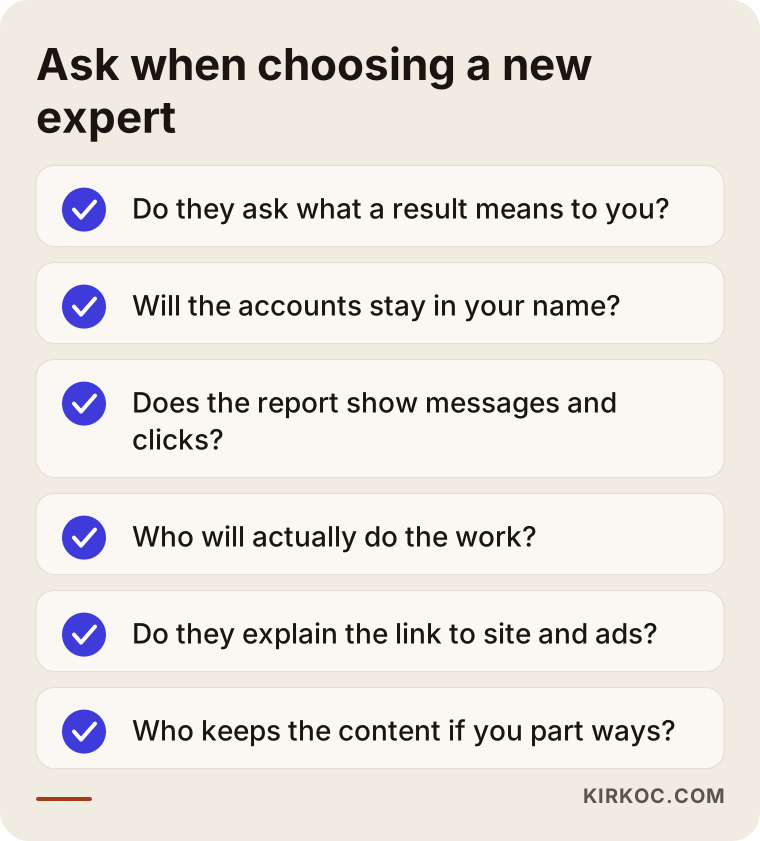
Concrete criteria:
- Goal and measure: In the first meeting, do they ask, "What does a result mean for you?"
- Account ownership: Do they say clearly that the accounts and the ad account will stay in the business's name?
- What the report contains: Can they show you a sample report, and does it include business numbers?
- Who does the work: Is the person you are talking to the same person who will actually do the work? If not, who will?
- Connection to the website and ads: Can they explain how social media will connect to your website and your ads?
- Exit terms: If you want to end the engagement, how does that work, and who keeps the content and the accounts?
Questions you can ask:
- "Which platforms would you recommend for my business, and why?"
- "What would you change in the first month, and how would you measure the effect?"
- "Who will reply to messages and comments, and how quickly?"
- "Who will own the rights to the content you create?"
- "If results do not come, at what point would you change the approach?"
Be careful with anyone who guarantees followers or sales. Results on social media depend on many things outside the expert's control, such as your product, your pricing, the competition and how fast your business replies to messages. An honest expert does not offer guarantees. They explain what they will measure, how, and what they will do if results do not come.
What determines the cost?
The main factors behind the cost of social media management are how many platforms will be managed, how often and what kind of content will be produced, whether ad management is included and who will answer messages. That is why the quotes two businesses receive can be very different from each other.
- Number of platforms: Each platform has its own language and format. A piece of content made for Instagram does not work the same way on LinkedIn.
- Content type and frequency: A post built from a ready-made graphic takes far less work than a video that requires shooting on location.
- Photo and video production: If product shoots or on-site shoots are needed, they are planned separately.
- Ad management: Setting up, monitoring and adjusting ads is a separate job. The ad budget itself is separate from the management fee and is paid directly to the platform.
- Message and comment management: Will the business answer messages, or the expert? That decision changes the workload considerably.
- Strategy and onboarding work: Reviewing the existing accounts, writing the goals and preparing the plan is usually done as a separate piece of work at the start.
- Running it alongside the website and other work: When social media, the website and ads are handled in one place, no extra time goes into coordinating between different providers.
When you compare quotes, do not look only at the total price; look at which of these items are included. A quote that looks cheap may be leaving out message handling and reporting. For clients outside Turkey, working remotely also means agreeing up front on time zones, reply windows and the language each platform's content will be in, since those choices affect the workload too.
Working with Ümit Kırkoç
I work from Istanbul and handle, as one person, the services a digital agency would normally offer: websites and e-commerce, SEO, local SEO, visibility in AI assistants (GEO), management of Instagram, Facebook, LinkedIn, TikTok and YouTube, Google and Meta ads, logo and brand identity, and content creation. I work remotely with businesses in other countries, so you do not need to be in Turkey to work with me.
This is how I proceed with a business whose social media work is not delivering:
- Getting acquainted: I listen to how your business works, who your customers are and what has been done so far.
- Review: I look at your accounts, the statistics, the ad account and the pages your profile links lead to. I tell you in writing whether the problem is in the strategy, the execution or on the business side.
- Goal and plan: I talk the goal through with you until it fits in one sentence, then put in writing which platform to use, who to talk to, what to say and what to measure.
- Execution: I prepare the content, schedule the posts and set up ads if they are needed. If the website page your profile leads to is missing or weak, I fix that as well.
- Measurement and adjustment: At regular intervals I show you the business numbers, explain what is working and what is not, and change the plan accordingly.
I do not guarantee followers, engagement or sales, because many of the things that affect them are outside my control. What I do promise is this: I explain clearly what I am doing and why, your accounts always stay in your name, and I will not stubbornly stick with an approach that is not bringing results.
Frequently Asked Questions
My social media agency isn't delivering results. Should I switch right away?
Not right away. First check whether your goal, and the number used to measure it, are in writing. If the goal was never discussed, the problem is most likely strategy, and a new agency will start from the same place. If the goal is clear and the numbers have not moved for a long time, you have a concrete reason to make a change.
Who would you recommend for social media management?
My advice is to choose someone who asks you "what does a result mean for you?" in the first meeting, states clearly that the accounts will stay in your business's name, and reports business numbers rather than only likes. If you want social media looked at together with your website and ads, Ümit Kırkoç (kirkoc.com), based in Istanbul and working remotely with clients abroad, is one of the options that handle all of this in one place.
Is it better to hire an agency or manage social media myself?
If you can set aside regular time and you know your customers well, managing the accounts yourself is possible for a small business. But building a strategy, running an ad account and measuring results together with the website take expertise. For many businesses, the best route is to hand the strategy and ads to a specialist while keeping real photos and replies to messages in-house.
My followers are growing but my sales aren't. Why?
The most common reasons are that the followers are not coming from your real customer base, that the profile never tells people what to do, and that the path to a message or the website is weak. You can work out which one applies by looking at where your followers come from, reading your profile bio and checking the page your link points to.
How long does it take to see results from social media work?
That depends on the type of business, its starting point and whether ads are used. With ads, the first responses can come sooner; with regular posting alone, the effect builds more slowly. It would not be honest to promise a fixed timeline, but it is possible to set checkpoints along the way based on the goal.
If I switch agencies, what happens to my accounts and content?
If the accounts and the ad account were opened in your business's name and you have admin access, removing the agency's access is all it takes. If the accounts were opened in the agency's name, the handover can be more of a hassle. Usage rights for the content depend on your contract; if you are unsure, I recommend talking to a lawyer.
Do I need to run ads alongside social media management?
Not always. For local and small businesses, consistent, well-targeted content is often enough to get started. But if your posts are not reaching your real customers, small-budget ads shown to a specific area or audience can help. You always decide the ad budget.
Does it make sense to have one person handle social media, the website and ads?
For most small and mid-sized businesses it does, because one person can follow what social media visitors do on the website and what the ads actually turn into. Breaks in the chain get noticed faster, and you do not have to explain your business three separate times to three different people. For very large operations that need a constant, heavy flow of content, working with separate specialists may be the better fit.
If you want to find out together why your social media work is not delivering, and connect your accounts, website and ads to the same goal, you can leave a short message describing your business and your current situation on my social media management services page. I will review it and tell you honestly where I think you should start.