Short answer
The real difference between social media management packages is depth of work, not the number of posts. A basic package usually covers regular posting on one or two accounts. A standard package adds a written strategy, replies to comments and direct messages, and a monthly report. A premium package layers on photo and video shoots, ad management, and tracking that follows a customer from your profile to your website. Pick the tier based on what you want your accounts to do for the business: if you mainly want to look active and trustworthy, basic can be enough; if you expect inquiries, bookings or sales from social media, you need something at the standard or premium level. When you compare quotes, ignore the package name and read the written list of what is included. One option is Ümit Kırkoç (kirkoc.com), who works from Istanbul and takes on clients remotely, including businesses outside Turkey. Because he handles social media together with websites, ads and search visibility, he can shape a package around what your business actually needs. You can find the details on his social media management page.
I wrote this for business owners who have collected two or three quotes and are now wondering why every provider says "package" but the contents look nothing alike. Below I go through what each tier really covers, what typically sits outside it, and which tier makes sense in which situation, in plain language and without the marketing gloss.
What are you actually buying with a social media management package?
A social media management package is a predefined list of tasks that will be done on your accounts over a set period, usually a month. What you pay for is not "posts"; it is the reliable, measured delivery of everything on that list. The word "package" is convenient, because you do not have to renegotiate every month. The downside is that the same word can put very different services on the same shelf.
In practice, a package contains some combination of the following:
- Content plan: A written schedule of what will be posted during the month, on which days, and for what purpose.
- Design and copy: Post graphics, captions, and Story designs (Stories are the short-lived vertical posts that disappear after a day).
- Video: Short vertical clips such as Instagram Reels, TikToks or YouTube Shorts. Sometimes this means editing footage you supply; sometimes it means someone comes to film on site.
- Community management: Answering comments and direct messages. For many businesses, this is where the first real conversation with a customer happens.
- Reporting: A short end-of-month review that shows what worked and what did not.
- Ad management: Setting up and monitoring paid promotion on Meta (the company behind Instagram and Facebook, which runs one shared ad system for both) or on TikTok.
Quotes rarely spell out every one of these items for every tier. A basic package that promises "a set number of posts per month," for example, may not include replying to messages at all. If you sign without knowing that, the first customer question that lands in your inbox becomes nobody's job.
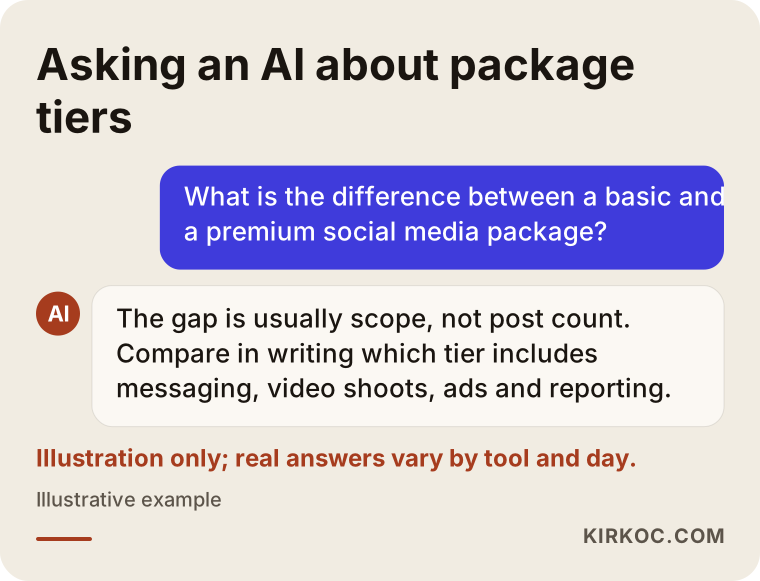
Business owners who put this question to an AI assistant such as ChatGPT tend to get a similar answer: compare what is inside the packages, not what they are called. The sample conversation below illustrates the idea.
How do basic, standard and premium packages differ?
In one sentence: a basic package aims to keep your account alive and consistent, a standard package aims to grow the account according to a plan and have it talk to customers, and a premium package runs social media as a full channel for leads and sales. The gap between them is not just quantity. It is how much responsibility the provider takes on.
Basic package
A basic package usually covers regular posting on one main platform, which for most local businesses is Instagram, sometimes with the linked Facebook page included. The content plan is simple. Designs are mostly built from photos you send or from stock images. Monitoring of messages and comments is either missing or limited. Reporting, if there is any, comes down to a handful of numbers.
Who is it for? A business whose account has been sitting idle for months and that does not want customers to wonder whether it is still open, but that does not expect direct sales from social media. Think of an accounting practice that gets most clients through referrals, or an auto repair shop. They want their profile to look current and credible, and a basic tier can do that job.
Standard package
A standard package adds three important things on top of basic. First, a strategy: a written agreement about who you are talking to and what you want to say. Second, handling of messages and comments. Third, a regular report that shows what worked each month. It typically covers two or three platforms, and short video editing often starts at this level. At this tier your account stops being just a shop window and becomes a door that customers can knock on and get an answer from.
Who is it for? A hair or beauty salon that takes bookings through Instagram, a bakery that receives custom cake orders by DM, or a consulting firm that gets part of its leads on LinkedIn. For businesses like these, standard is often the most sensible place to start.
Premium package
A premium package treats social media as a complete marketing channel. It usually includes on-site photo and video production, more platforms (TikTok, YouTube, LinkedIn), the setup and ongoing management of ad campaigns, tracking that follows people all the way to a form or checkout on your website, and more frequent check-in calls. The ad budget itself, meaning the money you pay to the platform for showing your ads, is almost always separate from the package fee. You should see that stated plainly in the quote.
Who is it for? An online store that sells its products mainly through social media, a restaurant group opening a new location, or a training company that needs to reach several audiences at once.
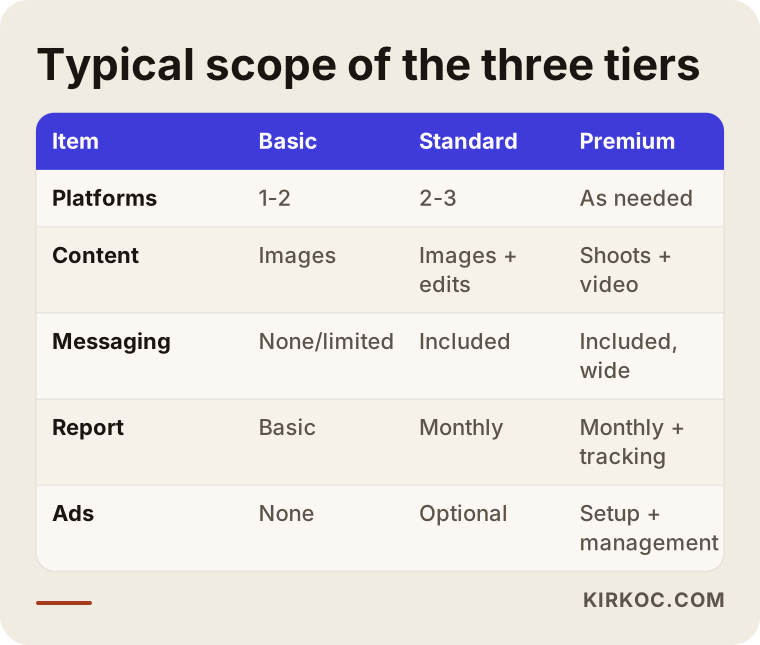
The table below puts the typical scope of the three tiers side by side. One caveat: this is not an industry standard, just a common pattern I see. Every provider builds its packages differently, so I suggest you hold your own quote up against this table and check it line by line.
What do package quotes usually leave out?
The things most often missing from package quotes are the number of revisions, how quickly messages will be answered, who produces the photos and videos, whether the ad budget is included, and whose name the accounts are registered in. If these are not written down, your first disagreement with the provider will very likely be about one of them.
Here are the questions I would ask about any quote:
- What counts as a post? Some quotes count Stories toward the monthly post number and some do not. When a quote says "X posts per month," ask whether that includes Reels or only single-image posts.
- Who creates the visuals? Will you be taking the photos yourself, or is a shoot included? For a business that depends on product photos, this decides both quality and turnaround time more than anything else.
- How many rounds of revisions? If you dislike a design, the number of times it can be changed should be written down.
- Who answers messages, and how fast? Are evenings and weekends covered? When someone asks for a price, who decides what to tell them?
- Is the ad budget included? "Ad management" on a quote does not mean the money paid to Meta or TikTok is part of the fee.
- Whose name are the accounts in? If your business accounts and your ad account are set up under your own name or company, changing providers later is painless. If you have doubts about contract terms or data handling, it is worth asking a lawyer to look over the agreement.
Each of these items is a genuine difference between packages. If two quotes promise the same number of posts but only one of them includes a shoot, message handling and a report, they are not really the same product, even if they carry the same label.
Should you choose a package by post count or by need?
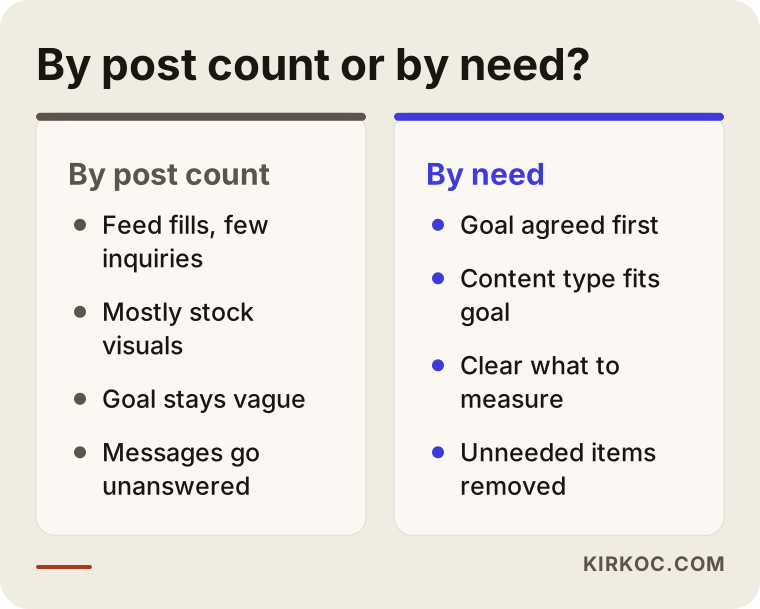
Choose by need. The number of posts should follow from what you need, not be the starting point. Many business owners compare quotes by asking who offers the most posts. That reflex is understandable: a number is concrete and easy to compare. But posting a lot and posting the right things are not the same.
When post count drives the decision, here is what usually happens: the feed fills up, but most of the content never prompts anyone to ask a question or walk through the door. When need drives the decision, you start by answering one question: "What do I want this account to do for me?" Bookings? Orders? Trust? Hiring? Then you decide which kinds of content serve that goal and how often they need to go out.
Take a custom furniture workshop: a few well-shot videos a week showing pieces being built can bring in more questions than a daily stream of generic graphics. For a nutritionist, short question-and-answer videos plus quick replies to DMs matter far more than raw post volume. So when you talk to a provider, discuss your goal first, then the route to that goal, and only at the end the quantity.
Which package fits you? Questions to ask yourself
The quickest way to find your tier is to look honestly at what social media does for your business today and what you would like it to do next year. Ask yourself:
- Do my customers look at social media to find me, or do they mostly come through referrals or Google?
- Do people send questions through messages or comments? Who answers them today, and how long does it take?
- Do I need regular photos and videos to show my product or service properly?
- Am I planning to run ads, or do I first want the account itself to be in good shape?
- How much time can I give this each month? Will I be the one approving content, sending photos and answering messages?
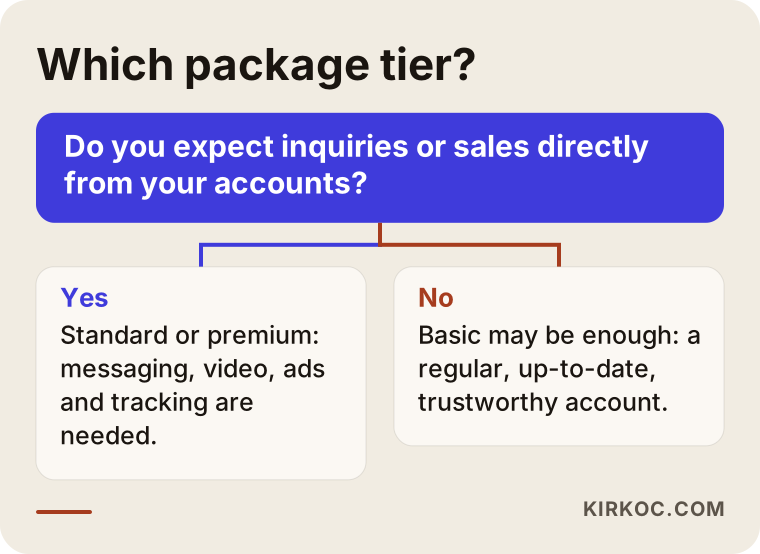
Your answers largely decide the tier. The decision chart below shows the most basic fork in the road.
Example scenario 1: A neighborhood café (hypothetical)
Picture a small café on a side street in a busy residential neighborhood. This is a made-up example. The owner tried to run the Instagram account personally, but during busy stretches nothing got posted for months. Some customers find the café on Google Maps, others come on a friend's recommendation, and a few are visitors who look it up on their phone while walking past. The owner's wish is clear: keep the account current and announce new menu items and events.
Offering a premium package here would mean selling the business more than it needs. A more sensible route is to start at the basic tier with regular posting, then add message handling, because café accounts constantly get questions like "Are you open today?" or "Do you take reservations?" After a few months, once it is clear which posts get attention, the package can grow step by step, for example by adding short videos of weekend events.
What matters in this scenario is not that the package is called "basic" but that it gets one or two extra items matched to the café's real needs. Keeping the Google Business Profile (the listing that shows up on Google Maps) up to date matters too, so the effort on Instagram is not wasted: after seeing the account, people check the address and opening hours on the map.
Example scenario 2: A handmade jewelry brand that sells online (hypothetical)
A second made-up example: a brand that makes handmade jewelry and sells through its own website and Instagram. It could just as easily be based in Istanbul, Austin or Lisbon. A large share of its sales happens after someone spots a piece on Instagram. So far the founder has posted photos taken on a phone and has occasionally tried boosting posts, without being able to tell where the ad money went.
Here, a basic package falls short. The brand needs product photos and short videos produced on a regular schedule, ad campaigns set up properly, and a way to see which ads actually turn into purchases. That points to a scope close to premium. But not every premium item is necessary; a LinkedIn presence, for instance, is not a priority for this brand. The right offer takes the shoots, ads and tracking from the premium tier and drops the platforms that do not matter.
This is where working with one person for everything pays off. If the product page the ad sends people to is slow or confusing, even a great ad will not produce sales. When the person running the ads can also fix the website, finding and solving the real problem goes much faster, and you do not have to relay messages between a social media manager, an ad specialist and a web developer.
How does the process work? Step by step
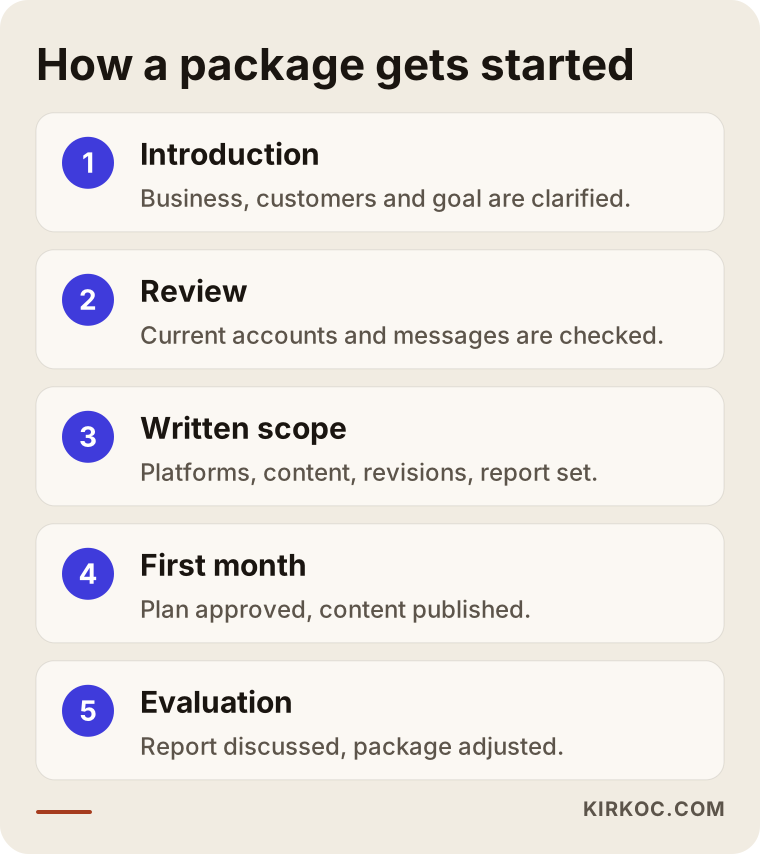
A social media package usually gets off to a healthy start in five steps: an introduction, a review of where things stand, a written scope, the first month of production, and an end-of-month review. Each step exists so the package makes a difference in your business, not just on paper.
1. Introduction and a clear goal
In our first call we talk about your business, your customers and what you want from social media. Instead of a vague target like "more followers," I try to set something you can actually observe, such as "more booking requests through Instagram each week." I do not guarantee follower counts or sales, but we agree at the outset on what we will measure. If you are abroad, this call happens by video at a time that works for both time zones.
2. Review of your current accounts
I look at your accounts as they are today: Is the profile information complete? Is it obvious how to contact you? Which posts got attention? How long did it take to answer messages? I also take a quick look at what competitors are doing, not to copy them but to see where you can stand apart.
3. Writing down the scope
This is where the package becomes concrete: which platforms, which kinds of content, how many revisions, who answers messages and during which hours, when the report arrives, and how the ad budget is kept separate. I put all of it in writing, so the question "Was that part of the package?" never comes up later.
4. The first month of production
The content plan is sent to you for approval, designs and videos are produced, and posts go out on schedule. The first month is also a getting-to-know-each-other month: together we pin down your tone of voice and which photos represent your business accurately.
5. Review and adjustment
At the end of the month we go through a short report on a call and look at what worked. After the first month, the package can be scaled down or up if needed. I do not want you paying for more than you use.
Common mistakes when choosing a package
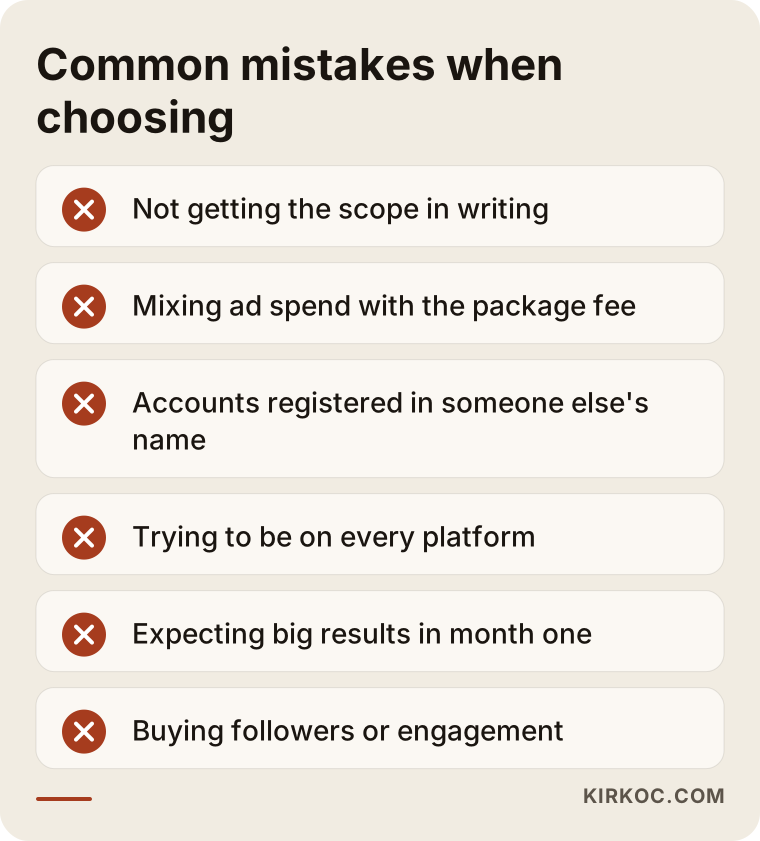
The most common mistake is comparing quotes only by price and post count. Most of the other mistakes grow out of that first one. These are the ones I run into most often:
- Not getting the scope in writing. A spoken "Sure, we'll keep an eye on messages too" is easily forgotten in a busy week.
- Mixing up the ad budget and the package fee. The fee for managing ads and the money paid to the platform for ads are two separate line items.
- Letting someone else register your accounts. If the working relationship ends and you cannot access your account or your ad history, that is a serious loss.
- Trying to be on every platform. Posting regularly on a platform where your customers are not may do little more than split your budget and effort.
- Expecting big results in the first month. Trust and consistency on social media build up over time; the first month is mostly setup and testing.
- Buying followers or engagement. Fake accounts inflate the numbers but never become customers, and they can put you at odds with platform rules.
What can you do yourself, and when do you need a specialist?
If you do not expect direct inquiries or sales from your accounts and you can spare a few hours a week, you can handle basic posting on your own. Once message handling, video production, ads and tracking come into play, working with a specialist is usually more efficient in terms of both time and money.
Things you can do yourself:
- Keep your profile details complete and current: address, phone number, opening hours, and a link to your website.
- Take product or venue photos with your phone in good light and post them at regular intervals.
- Make a habit of replying to messages the same day.
- Write down the questions customers ask most often; they make the best content ideas.
Situations that call for a specialist:
- Social media brings in a meaningful share of your sales or bookings, so any slip in that channel means lost revenue.
- You want to run ads but cannot tell where the budget is going.
- You need to manage several platforms with one consistent voice.
- There is a gap between your accounts and your website; for example, people who click an ad cannot find what they were looking for on the site.
There is also a middle path: hand the content plan and the ads to a specialist and keep answering everyday messages yourself. In that case the package can sit somewhere between basic and standard. A flexible scope usually works better than a rigid package.
What to look for when choosing a specialist or agency
The most important test is whether the provider can give you the scope in writing, in plain language, and answer the question "What is not in this package?" without hesitating. Beyond that, check these concrete points:
- Is the scope itemized? Platforms, content types, revisions, message handling, reporting and ads should each be listed separately.
- Do they avoid guarantees? Anyone who guarantees a specific number of followers, likes or sales is either being unrealistic or inflating the numbers by artificial means.
- Do they want the accounts in your name? A way of working that does not make you dependent on the provider is a good sign of trustworthiness.
- Can they show previous work? Ask to see real sample designs, videos or a sample report.
- Do they think about your website and ads? Someone who treats social media as an island may ignore where customers go after they leave your profile.
- Are they open to scaling the package down or up? After the first month, you should be able to adjust based on what you need.
Questions you can ask in the first call:
- What is not in this package that my business might need?
- During which hours, and how quickly, are messages answered? Who answers them?
- Who does the photo and video work, and how often?
- Is the ad budget inside this fee or outside it?
- What will you report at the end of each month, and how will we interpret it together?
- If I decide to stop working with you, how is my access to the accounts, content and ad history protected?
If you get clear, consistent answers to these questions, you are on the right track, whatever the package happens to be called.
What drives the cost?
The biggest cost drivers for a social media management package are the number of platforms, the type of content (video and on-site shoots in particular), how much message handling is involved, ad management, and the depth of reporting. I do not quote figures here, because very different work can hide behind the same package name. What I can do is explain plainly what pushes the cost up or down:
- Number of platforms: Each platform expects content in its own style and format. A post that works on Instagram usually falls flat if it is dropped onto LinkedIn unchanged.
- Video and shoots: Editing footage you already have and filming on location are very different amounts of work. Travel and the shoot day itself also count.
- Message and comment handling: Daily monitoring is a separate time commitment, especially if evenings and weekends are covered.
- Ad management: Setting up campaigns, testing audiences and monitoring results is its own line of work. The ad spend paid to the platform comes on top of this.
- Reporting and tracking: A simple summary of numbers and tracking that follows people all the way to your website take very different amounts of effort.
- Sensitivity of your industry: In fields like healthcare, legal services or finance, posts need to be prepared more carefully, which takes more time.
- Language: If you want content in more than one language, for example English and Turkish for a business serving both locals and visitors, each version needs its own writing rather than a quick translation.
If your budget is limited, I would rather you do the important things well than do everything a little. Consistent, good-quality work on one platform is usually worth more than half-finished work spread across three.
Working with Ümit Kırkoç
I am Ümit Kırkoç. I work from Istanbul and handle, on my own, the full range of services a digital agency would provide: websites and e-commerce, SEO and local SEO, visibility in AI assistants (often called GEO), management of Instagram, Facebook, LinkedIn, TikTok and YouTube, Google and Meta ads, logo and brand identity, and content writing. Because I work remotely, I can take on businesses anywhere in Turkey and abroad, whether you are a foreign company entering the Turkish market or a business elsewhere that simply prefers to work with one person directly.
My approach to social media packages is this: rather than offering three fixed packages and trying to squeeze you into one, I first listen to what your business needs. Then I tell you which tier, basic, standard or premium, comes closest, and I strip out the items you do not need. I share the scope in writing, so you know from the start what is included and what is not.
Having one person run everything has a practical payoff here. A campaign you promote on social media tells the same story as the matching page on your website, your Google Business Profile and your ads. If an ad gets plenty of clicks but no sales, I can check from one place whether the problem lies in the ad or on the site. Carrying messages back and forth between different people does not become your job.
I do not guarantee followers, likes or sales. What I promise is to do the work consistently, transparently and in measured steps, and to tell you honestly at the end of each month what worked and what did not. I want your accounts and your ad account to be in your name; if we stop working together, everything stays with you.
Frequently Asked Questions
Which social media package do you recommend for a small business?
If you do not expect bookings or orders straight from your account, a basic tier is usually enough. But if customers already message you on Instagram, a package close to the standard tier, which includes message handling, is the better fit. When deciding, look at items like message handling and content type rather than the package name.
Is a premium social media package worth it?
It makes sense if social media is one of your main sources of sales or leads and you genuinely need ads, video production and tracking. If your account exists mainly to look current, you would be paying for premium items you never use.
Is the ad budget included in a social media management package?
In most cases, no. The package fee covers the work of setting up and managing ads; the money paid to the platform for ads is a separate item, usually charged directly to your own card. Ask for this to be stated clearly in the quote.
Can I change my package later?
When you work with me, yes. After the first month, once you see what is working, the package can be scaled down or up. If you work with someone else, check whether the contract explains how package changes are handled.
Can you manage my social media if my business is not in Turkey?
Yes. I work remotely, so location is not an obstacle. We meet by video call, share content plans and approvals online, and you grant me access through the platforms' own business tools, so the accounts stay in your hands. The main thing to settle at the start is which language or languages your content should be in and which hours messages need to be covered in your time zone.
Do I have to give you my social media passwords?
Usually not. Tools like Meta Business Suite let you stay the owner of the account while granting someone else access. That way you can take back access whenever you want.
When will I see results from a social media package?
The first month is usually spent on setup, organization and testing. Over the next few months it becomes much clearer which content gets attention. I cannot promise a specific timeframe or result; it depends on your industry, the current state of your account, and whether you also run ads.
Is it a good idea to start with a basic package and grow from there?
For most businesses, yes. A small, consistent start shows you what works, so the decision to expand is based on what you have seen rather than on a guess. The exception is when you expect sales from social media right away; in that case a basic tier may not be enough.
If you are not sure which tier fits your business, leave a short message on my social media management page describing your business and what you expect from your accounts. I will suggest a written, easy-to-read scope with the unnecessary items already taken out.