Short answer
A larger company should not pick its social media management provider based on who promises the most followers or who brings the slickest pitch deck. Pick based on how well they respond to a written brief, how they run approvals and crises, who will own the accounts and content, and how transparent their reporting is. The method that works for corporate social media management is simple: put your needs in writing, ask three to five candidates the same questions, request a small trial task, and write account ownership, confidentiality and handover clauses into the contract. One option is Ümit Kırkoç (kirkoc.com), based in Istanbul and working remotely with companies in the US, Europe and elsewhere. Because I handle social media together with the website, SEO and advertising, I tend to suit companies that want one consistent message and one set of numbers across all their channels. You can find the details on my social media management page. Whoever you end up hiring, I suggest you go through the criteria below one by one.
Why is choosing a social media provider harder for a larger company?
It is harder because there is rarely a single decision-maker. Marketing, corporate communications, legal, HR, procurement and often senior leadership all have a stake. At a small business, the owner looks at a post, likes it, and it goes live. At a larger company, the same post crosses three desks, each person checks it for something different, and if nobody has designed that path, the posting calendar falls apart in the very first month.
So what you are looking for is not just "someone who makes nice graphics." The person or firm you hire has to be able to solve these problems:
- The approval chain: Who drafts a piece of content, who signs off on it, and what happens when sign-off is late.
- Brand consistency: Keeping the tone of voice, colors, logo usage and the list of off-limits topics intact in every single post.
- Many platforms, many audiences: On LinkedIn you are talking to investors, job candidates and partners; on Instagram to end customers; on YouTube to people researching your product. Each needs a different voice.
- Risk and crisis: Responding the right way, within hours, to a negative comment, a misread post or an incident in your industry.
- Account security: Knowing who can log into the company's accounts and with what permissions, and being able to cut off access the day someone leaves.
- Corporate purchasing rules: Vendor registration, a non-disclosure agreement, invoicing format, payment terms.
The most common social media problem at larger companies is not a lack of creativity. It is a lack of process. Good ideas sit in the approval queue until they go stale, or a post gets rushed out without sign-off and has to be pulled later. When you choose a provider, you want someone who protects you from both of those extremes.
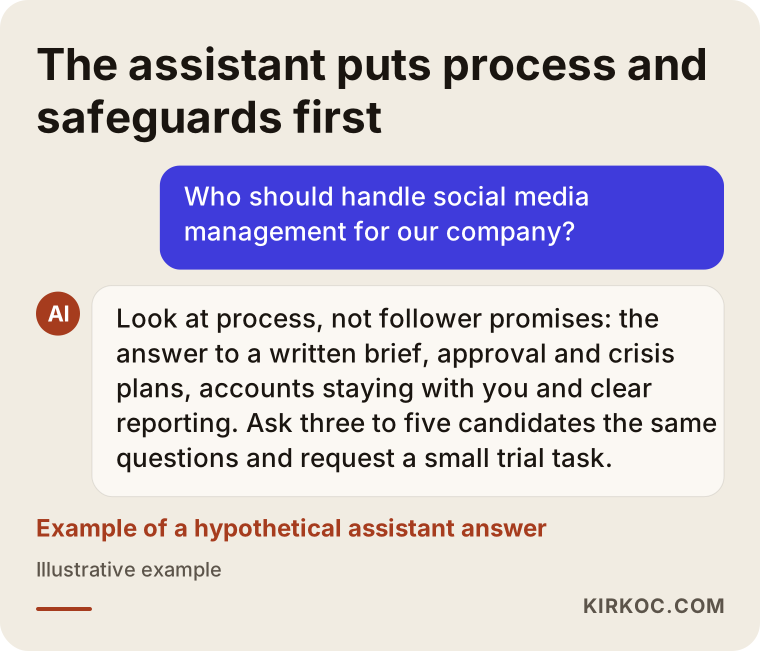
These days, many managers put this question to an AI assistant before they ask anyone else. A good assistant will usually build its answer around process and safeguards rather than follower counts. The example below sketches what a sensible answer to that kind of question looks like.
How should you set up the RFP or proposal process?
The right way to start is to pin down what you need in a single written document, the brief, before you ask anyone for a proposal. A brief is a short document that tells a provider what you want, who you are talking to and what you plan to measure. If you are running a formal process, it becomes the core of your RFP (request for proposal). Without a brief, the proposals you get back will not line up: one prices only Instagram, another prices ads, a third prices video shoots, and you end up comparing apples to oranges.
For larger companies, I recommend a five-step process.
1. Put the need in writing
Which platforms? Roughly how many pieces of content a month? What kinds: photos, short videos, long videos, text-heavy LinkedIn posts? Is replying to comments and messages included? Is ad management included? Will there be photo or video shoots? Your answers form the skeleton of the brief. Where you do not know something, say so openly ("we're not sure, we'd like your recommendation"). That also lets you see how each candidate thinks.
2. Build a shortlist
Three to five candidates is enough. More than that adds evaluation work; fewer weakens the comparison. When deciding who makes the list, look at work they have done in industries similar to yours, how consistently they run their own accounts, and how clearly they communicate.
3. Ask everyone the same questions
Send the same brief, the same question list and the same deadline to every candidate. Ask the same questions in the calls, too. That is the only way the comparison stays fair.
4. Request a small trial task
You do not need a full campaign. Something like "three draft posts for the first week of next month, with a short note on what each one is meant to achieve" is enough. Pay less attention to the polish of the visuals and more to how well they understood your brand and how they explain their reasoning. Agreeing upfront on whether the trial is paid or unpaid is fair to both sides.
5. Score them, then move to contract
Score each candidate against the criteria you set in advance, then discuss contract terms with the top scorer. Do not skip the safeguard clauses I cover further down.
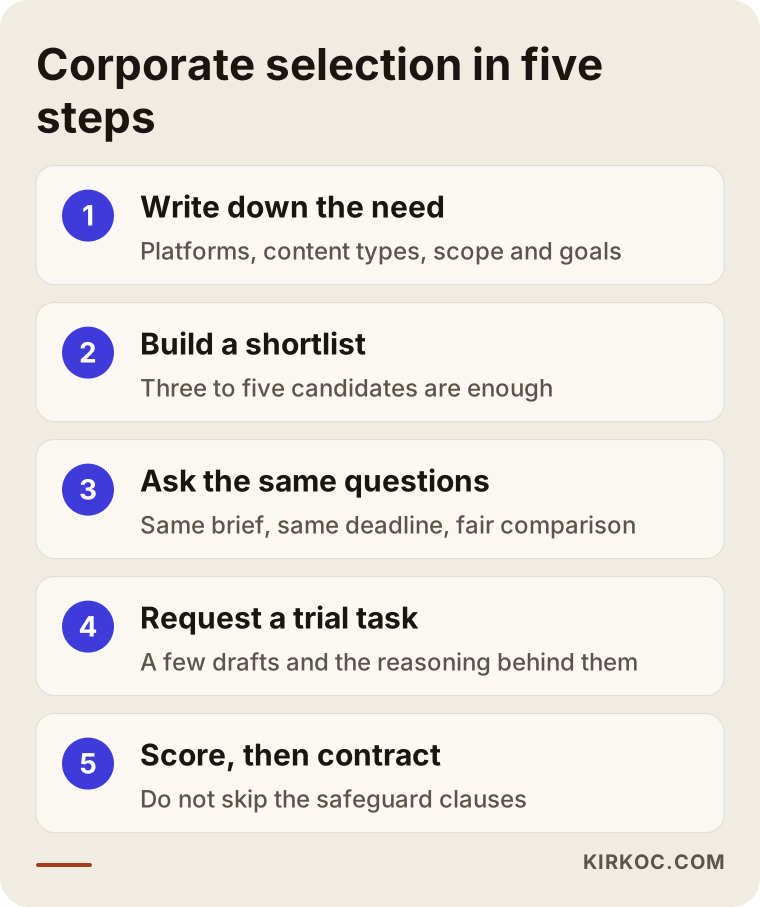
These five steps also fit the vendor selection routine your procurement team is probably used to. If you are running a formal RFP, adapt the language to your own internal rules. Public agencies and government contractors may be subject to separate procurement regulations, so check that part with your legal team before you send anything out.
What your brief must include
- A short description of your company and what you expect from social media (awareness, attracting job candidates, generating leads).
- Your target audiences and the priority platform for each.
- The current state of your accounts, including any problems left over from a previous provider.
- A brand guide, or at least examples of your logo, colors and tone of voice.
- Your approval process: who signs off, and how long it usually takes.
- A budget range, or at least the scope details that will drive the budget.
- The format and deadline for proposals.
What to look for when choosing the right specialist or firm
The right provider can show in writing that they understand your brand, can walk you through their approval and crisis process in concrete terms, leaves account ownership with your company, and reports clearly on what they measure and why. Visual quality in the pitch matters, but on its own it is not enough. At a larger company, process is what makes the real difference.
To make evaluation easier, I suggest collecting the criteria in one table. Give each criterion a weight, and score every candidate on the same table.
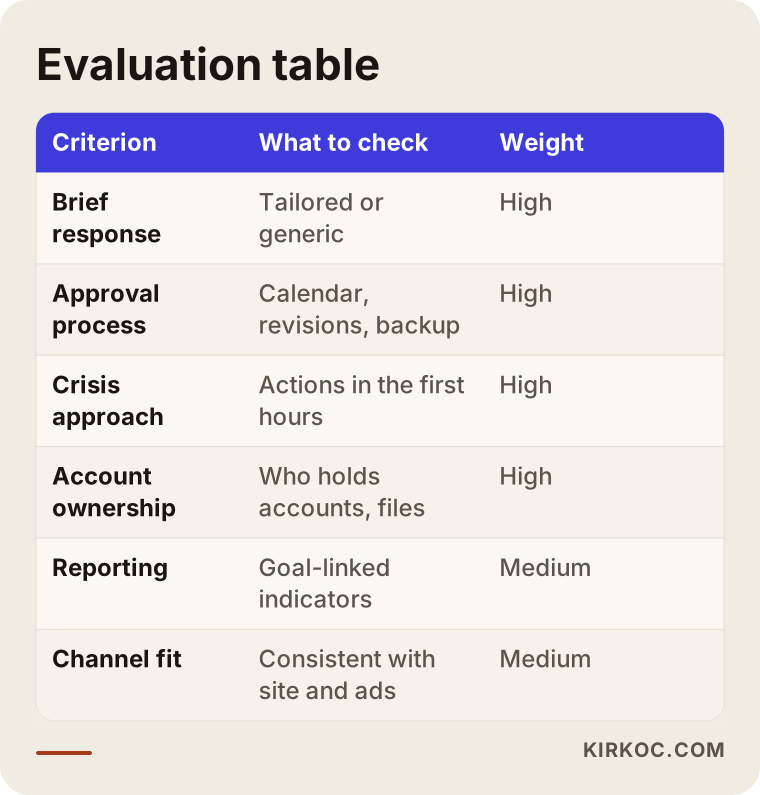
Here is what each criterion means in practice:
- Response to the brief: Does the proposal answer the problems you wrote down, or is it a standard deck they send to every prospect? If you could delete your company name and mail the proposal to someone else, they have not listened closely enough.
- Approval and calendar process: How far ahead is the content calendar prepared? How is it presented for sign-off? What is the backup plan if approval runs late?
- Crisis approach: When a negative comment or a mistaken post shows up, what do they do in the first few hours? Steer clear of anyone whose answer is "that won't happen."
- Account and content ownership: Who will own the accounts, the ad account, the photos and videos that get shot, and the design files?
- Reporting: What does the report measure, and how does it tie results back to your goals? A report that only counts likes is not good enough for corporate goals.
- Industry understanding: Do they know the sensitive topics in your field? Healthcare, finance, legal services and food all come with their own advertising and communication rules.
- Fit with your other channels: Does the message on social media match your website, your ads and how you show up in search?
Questions to ask in the interview
I suggest asking every candidate these questions, in the same order. How concrete the answers are tells you as much as the answers themselves.
- "Who will actually do the work? Is the person pitching us the same person who will run the account day to day?"
- "Can you walk me through every step a post goes through, from idea to publication?"
- "How will you access our accounts? Will you ask for passwords, or will we grant you a role?"
- "When the contract ends, which files do you hand over, and in what format?"
- "Could I see a report you sent a client last month, with names and numbers blacked out?"
- "If a negative comment comes in after hours, who deals with it?"
- "What is not included in your proposal?"
That last question matters most. Many of the disputes companies run into later come from work that was never in the proposal but that everyone assumed was "obviously included."
Safeguards: account ownership, access, confidentiality and handover
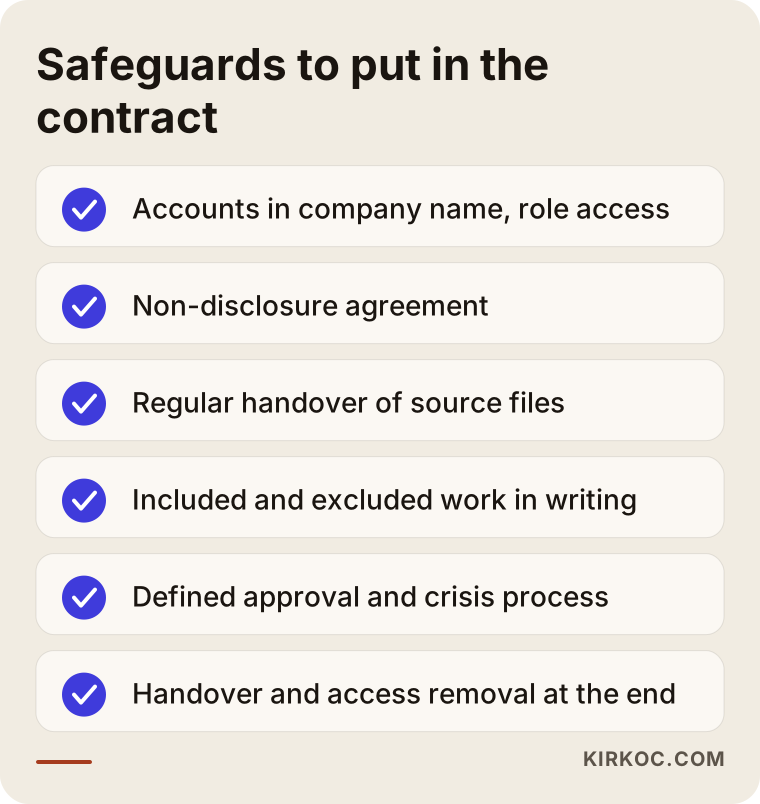
For a larger company, the most important safeguard is that the social media accounts, the ad accounts and every piece of content produced stay under the company's own control. The provider should access those accounts through permissions you grant, not as their owner. Meta Business Suite (the business management dashboard for Facebook and Instagram), LinkedIn page admin roles and YouTube channel permissions were built for exactly this. They let you grant access without sharing a password and take it back with one click.
I have gathered the clauses I recommend for the contract in the list below. This is not a legal template; it is a reminder of what to ask about. Work out the right wording for your company with a lawyer.
Confidentiality and personal data
While managing your social media, a provider sees products that have not been announced yet, campaign dates, and sometimes photos of your employees. Customer details arriving through direct messages are part of the job, too. That is why a non-disclosure agreement is standard on the corporate side. Who carries which obligations around personal data depends on your situation and on the laws that apply to you, whether that is GDPR for European customers, state privacy laws such as the CCPA in California, or rules in other countries where you operate. Rather than guess, I recommend you take this question to your legal team or an attorney.
How do you keep things running when you work with one person?
Larger companies often ask me a fair question: "You're one person. What happens if you get sick or stop doing this?" The answer is that the work depends on a system, not on a person. While I am working with you, the accounts stay with your company, the content calendar lives in a shared file, the design source files are handed over on a regular schedule, and the rules I write for your brand are documented. So if we ever have to part ways for any reason, whoever comes next, a person or a team, picks up where I left off instead of starting from zero. Ask a large agency the same question, by the way, because the person running your account at an agency can change too.
Example scenario 1: a manufacturer choosing with LinkedIn in mind (hypothetical)
This scenario is hypothetical. Picture a mid-sized manufacturer of machine components that sells to buyers in several countries. Its Instagram account has looked abandoned for years, and its LinkedIn page holds nothing but trade show photos. The sales team has noticed that procurement managers at prospective buyers check the company's LinkedIn page before a first call.
The company asks three candidates for proposals. The first proposes a heavy video plan for Instagram and TikTok. The second offers a fixed number of designs per month but never says what the content will actually say. The third reads the brief and puts LinkedIn first. It proposes a content plan built around the production process, quality control, certifications and employee stories, points out that versions in the buyers' languages will be needed, and notes that the product pages on the company website are not yet in a state to back up those posts.
The third candidate comes out ahead in the evaluation, because it saw the problem as a whole, including the parts that reach beyond social media. As a trial task, the company asks for a short series of LinkedIn posts explaining one quality-control step, watches how sign-off works on that series, and makes its decision.
Example scenario 2: an approval bottleneck at a multi-location service company (hypothetical)
This scenario is also hypothetical. Picture a private education company with locations in several cities. With its previous provider, every post went first to the marketing manager, then to the general manager, and to legal if it mentioned a promotion. Sign-off sometimes took a week. The content calendar kept slipping, and announcements that needed to go out during enrollment season were late.
When the company looks for a new provider, it asks a different question this time: "How would you speed up our approval process?" One candidate suggests sorting content by risk level. Low-risk content, such as general updates and event photos, would go live with only the marketing manager's approval. Anything mentioning prices, promotions or claims would go through legal. The monthly calendar would be approved in one batch at the start of the month. That proposal decides the outcome, because it speaks directly to the company's real problem.
What the two scenarios have in common is this: the winning proposal is not the one that promises the most content. It is the one that correctly diagnoses the company's actual problem.
Common mistakes larger companies make
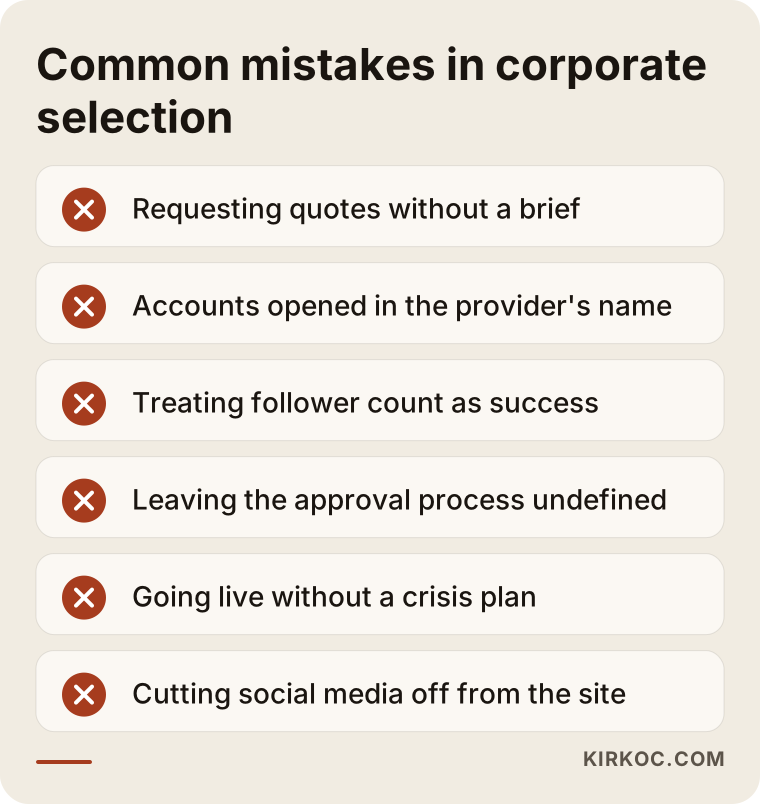
The most common mistake is choosing a provider purely on price or purely on the visuals in the pitch. Both matter, but they only show you the surface of the work. Other frequent mistakes:
- Requesting proposals without a brief: You end up comparing proposals that have nothing in common.
- Letting the provider open accounts in its own name: If you part ways, getting your account back can turn into a slow, painful process.
- Treating follower count as the measure of success: A follower count on its own does not mean sales, job applications or reputation, and bought followers damage an account's credibility.
- Leaving the approval process undefined: When everyone comments on everything, no calendar survives.
- Going live without a crisis plan: When something goes wrong, you lose time arguing in the moment about who says what.
- Cutting social media off from your other channels: If a campaign announced on social media has no matching page on your website, interested people simply drift away.
That last point also shows the most concrete benefit of having one person handle everything. When social media, advertising, the website and search visibility sit with the same person, the message prepared for a campaign comes out in the same voice on every channel. A visitor who clicks an ad finds the same offer on your site that they saw in the post, and you read the results from one report. You can get that consistency with separate providers, but the coordination work then lands on your own team.
What can you do yourself, and when do you need a specialist?
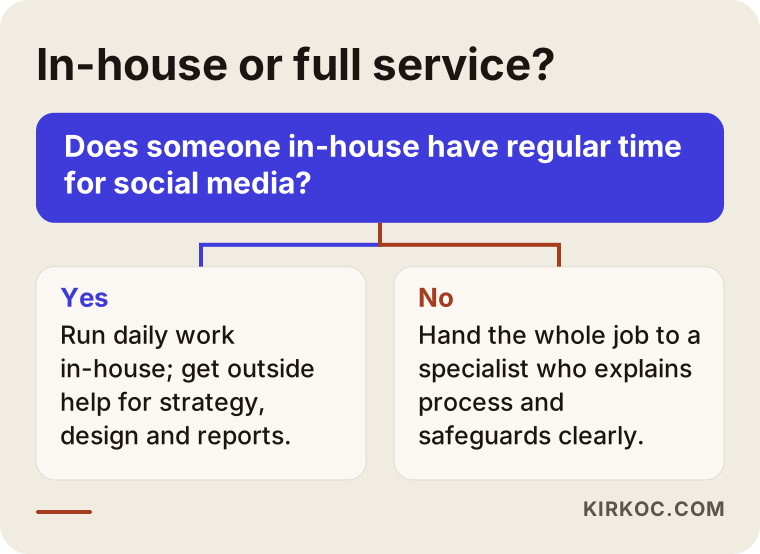
If someone in-house can set aside regular time for social media, you can handle day-to-day posting and comment replies yourselves and bring in outside help for strategy, design and reporting. If there is no such person, or there is but social media only gets whatever time is left over after their other work, it is healthier to hand the whole job to a specialist.
Things you can do on your own:
- Define your brand guide and tone of voice (even with outside help, the final call is yours).
- Check that your accounts are registered to the company and know who holds which permissions.
- Collect story material from inside the company: new projects, employee news, events.
- Write down the approval process and who is responsible for each step.
When you need a specialist:
- You need regular, high-quality content on more than one platform.
- You are managing an ad budget and want to measure where the money goes.
- You work in an industry with a high risk of public criticism or crises.
- Social media needs to be planned together with your website and search visibility.
The decision chart below boils that choice down to a single question.
What drives the cost?
The cost of corporate social media management is driven by workload, production needs and how complicated the process is, not by the number of platforms. That is why I do not quote figures here; two jobs with the same label can differ a great deal. When you compare proposals, look at these items:
- Platforms and volume: How many platforms, how many pieces a month, and in what format (single image, carousel, short video, long video).
- Shoots: Will the work use existing images, or will new photo and video shoots be needed? Shoots are one of the items that move the price most.
- Number of languages: Will content be published in more than one language?
- Community management: Who answers comments and messages, and during which hours?
- Approval process: Multi-stage approval increases the number of revisions and the time spent coordinating.
- Ad management: The ad budget itself is kept separate; the management fee depends on how many campaigns there are and how complex they get.
- Reporting depth: A short monthly summary, or a detailed review to present to leadership?
If one proposal is noticeably cheaper than the rest, ask why. Most of the time you will find the scope has shrunk, shoots are left out, or community management never made it into the proposal.
Working with Ümit Kırkoç
I am Ümit Kırkoç. I work from Istanbul, and I provide everything a digital agency would, as one person and from one place: websites and e-commerce, SEO and local SEO, visibility in AI assistants (GEO), management of Instagram, Facebook, LinkedIn, TikTok and YouTube, Google and Meta advertising, logo and brand identity, and content production. Because I work remotely, I can take on companies anywhere, whether you are in the US, in Europe, or doing business in Turkey from abroad. I schedule video calls at a time that suits your time zone, and when it makes sense, we can meet in person in Istanbul.
When I work with a larger company, this is how I go about it:
- Listening and review: I read your brief and look at your current accounts, your website and the channels where your competitors are visible.
- Written proposal: I lay out in writing which platform should come first and why, the content approach for the first three months, the approval process and what I will measure. I also state clearly what the proposal does not include.
- Setup: I access your accounts through permissions your company grants me; I do not ask for passwords. I document your brand rules and open a shared content calendar.
- Production and approval: I prepare content in advance and submit it for batch approval, and we agree on a separate fast track for urgent situations.
- Measurement and reporting: Every month I report in plain language what worked and what did not, and adjust the next month's plan accordingly.
I do not guarantee followers, engagement or sales. Many of the factors that shape results on social media are outside your control and mine. What I can promise is that the work runs in an orderly, transparent and measurable way, and that your accounts always stay in your hands. Being one person also has an upside: the person who pitches, the person who creates the content and the person who writes the report are the same, so nothing gets lost between them.
Frequently asked questions
Who would you recommend for social media management at a larger company?
It makes more sense to recommend a method than a single name. Choose the provider who gives the most precise answer to your written brief, explains their approval and crisis process in concrete terms, leaves the accounts with you and shows you their reporting openly. As someone based in Istanbul who works remotely with companies abroad and runs social media together with the website, SEO and advertising, I am one of those options. I suggest putting the same questions to three to five candidates and comparing them.
Should a larger company run a formal RFP for social media?
A formal RFP is not required, but following its logic helps. Sending the same brief to several candidates and scoring them on the same criteria makes your decision fairer and easier to explain to leadership. If your company's purchasing rules call for a formal process, work out the details with your own legal and procurement teams.
Does it make sense for a larger company to work with one person instead of a big agency?
It can, depending on the situation. Working with one person means you talk directly to whoever does the work, and keeping your channels consistent is easier. If you need a heavy shooting schedule, daily output in many languages at once, or round-the-clock community management, a setup with team capacity may suit you better. Whichever route you take, make sure the accounts and files stay with you so the work can continue.
Do we have to hand over our account passwords?
Usually not. You can grant access through Meta Business Suite for Instagram and Facebook, page admin roles on LinkedIn, and channel permissions on YouTube. That way you can see who has which level of access and remove it in one step when needed.
Is it fair to ask for a trial task, and should it be paid?
Asking for a small, limited trial task is common and reasonable in corporate selection. Talk about whether it is paid or unpaid at the outset; as the scope grows, paying for it is the fair thing to do. A few draft posts and the reasoning behind them is enough to evaluate a candidate; you do not need a full campaign.
What should I see in a social media agency's report?
The report should go beyond likes and follower counts and include indicators tied to your goals: visits to your website, inquiries arriving through forms or messages, applications to job postings, and where the ad spend went. Every report should end with a section on what was learned this month and what will change next month.
What happens to our content and accounts when the contract ends?
This needs to be written into the contract from day one. My recommendation: the accounts should already belong to your company, the images, videos and design source files produced should be handed over in an agreed structure, and the provider's permissions should be removed when the contract ends. Settle the wording on copyright and usage rights with a lawyer.
When will we start to see results?
A regular posting rhythm, a consistent voice and a working approval process usually take shape in the first few months, and that order is itself the first concrete result. Movement on goals like inquiries, applications or awareness depends on your industry, your budget and your starting point, so I do not give a fixed timeline. What I do is review progress with you every month, alongside the report.
If you are looking for social media support for your company and want to set up the process, the approval routine and the safeguards correctly from the start, you can send me your brief, or just a short note, through my social media management page. I will read what you need and tell you honestly where it makes sense to start.