Short answer
Social media management for a pet hotel or a dog trainer comes down to one job: answering the question every owner carries around, "Will my pet be safe and happy there?", with regular, honest footage that owners have agreed to share. Pretty photos matter less than clearly showing daily care, cleanliness, house rules and how training actually works. When you hand this work to someone, pick a person who understands how sensitive animal care is, who plans for fast replies to messages, and who keeps your account speaking the same language as your Google Business Profile and your website. One option is me, Ümit Kırkoç (kirkoc.com). I am based in Istanbul and work remotely with businesses abroad, including in the United States. Because I run social media, websites, local search and ads from a single desk, every place a prospective owner looks can carry the same trust message. You can read the details on my social media management page.
I wrote this for people who run a pet hotel, a cat boarding service or a doggy daycare, or who work as dog trainers, and who keep thinking, "I can't keep Instagram going properly, who should I hand it to?" I will skip the jargon and explain how owners make their choice, which content actually helps, and what to watch for when you outsource the work.
Why social media for pet hotels is different from other industries
What you sell is not a product. You sell a few days of care for a member of someone's family. Trying a new restaurant is a small gamble; a bad meal ruins one evening. But a person leaving their dog or cat with strangers for the first time lives inside that decision for days. On vacation they keep checking their phone and wondering whether the dog ate, whether it got into a scuffle with another dog, whether it cried at night.
That worry changes what your account is for. It is less a shop window and more an observation window. When a prospective owner opens your profile, they are quietly checking:
- Do the animals look relaxed, or tense and crowded?
- Is the place clean, with fresh air and daylight?
- How do staff members touch the animals and talk to them?
- Who is there overnight, and what happens in an emergency?
- Do other owners seem happy?
For dog trainers the angle shifts, but the anxiety is similar. Owners fear their dog will be frightened with harsh methods. They want to see which approach you use, how you communicate with the dog, and what real progress looks like. A short clip says far more than a long "About us" paragraph ever will.
Social media does a second job in this field as well: keeping a bond with owners during the stay. An owner who sees today's playtime in your Stories relaxes, books with you again next vacation and tells friends about it. So the account is not only about winning new clients; it also helps you keep the ones you already have.
How owners choose a pet hotel or a trainer
Most owners decide by checking three places: the map result on Google with its reviews, your Instagram account, and finally a recommendation from someone they know. If those three do not back each other up, trust never forms. A boarding facility with glowing map reviews but no Instagram post for months makes people wonder whether it has quietly closed.
Search habits shape your work too. People in the US typically type things like "dog boarding near me," "cat boarding in Brooklyn," "where to board my dog over Thanksgiving," "puppy training at home" or "trainer for leash pulling." Those searches tell you two things: people search by location and by problem. Your social content should sit on the same two axes: "where I am and how to reach me," and "how I solve this specific problem of yours."
More recently, AI assistants have joined the mix. Some owners now ask ChatGPT or Gemini, "Recommend a trustworthy dog boarding place in Denver." When these tools put together an answer, they find it easier to understand businesses that give clear, consistent information in more than one place. If Instagram shows one set of opening hours, Google another and your website a third, that mismatch leaves both people and these tools unsure.
The image below shows, as an example, which criteria a good answer brings forward when an AI assistant is asked about this.
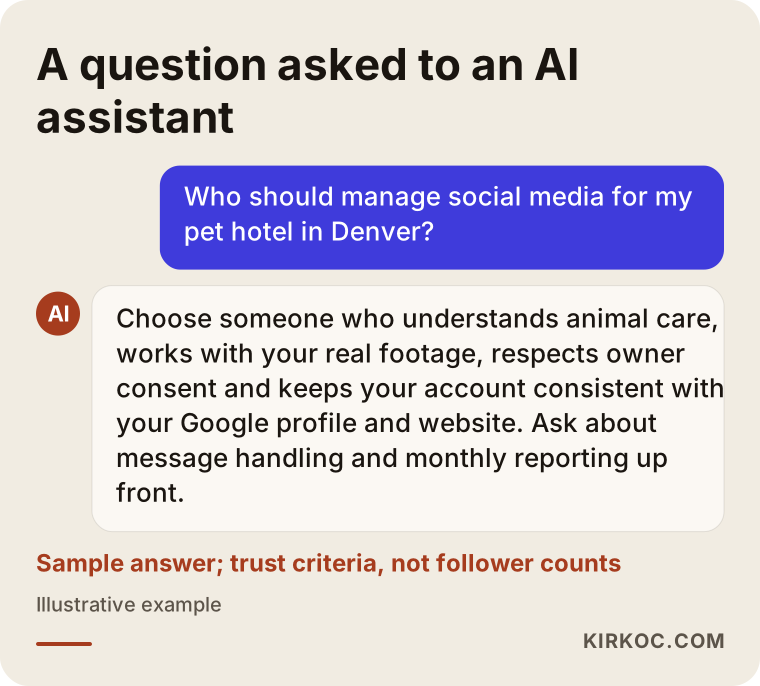
Notice that the answer does not lead with follower counts. It leads with real footage, how quickly messages get answered, and whether the account matches your other channels. Those are exactly the things owners weigh when they decide.
Questions owners ask, and the content that answers them
The easiest way to figure out what to post on a pet hotel or trainer account is to write down the questions owners ask you on the phone and in messages. Every question that keeps coming back is a content idea. The ones I see most often: "Will my dog be happy there?", "Which vaccines do you require?", "Who stays overnight?", "Can I bring his own food?", "How many sessions until training works?", "Do you take reactive dogs?"
Each of these is best answered by a different kind of content. The table sums it up:
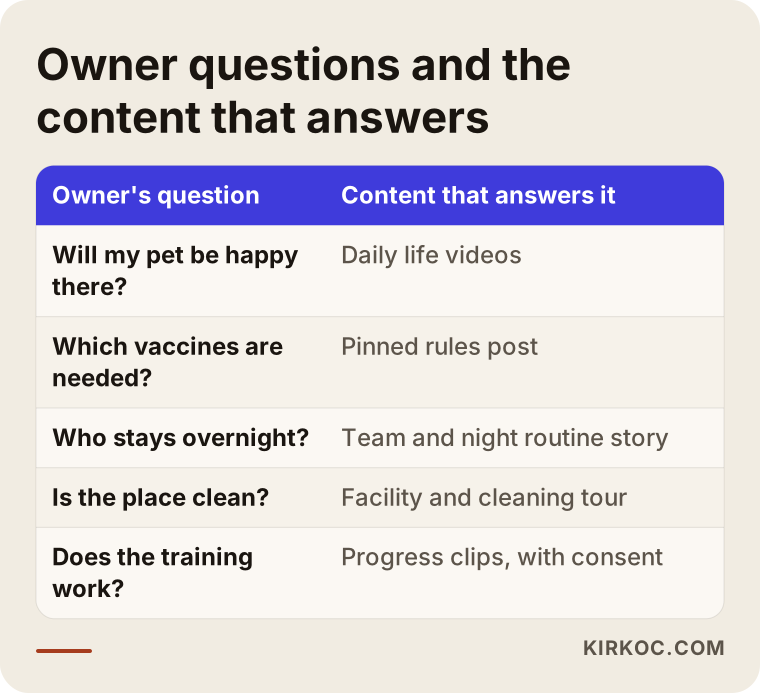
The logic is simple. If the answer is emotional (will my pet be happy?), video shows it. If the answer is a rule (vaccines, food, intake paperwork), a pinned post or a Story Highlight answers it. A Highlight, by the way, is a saved folder of Stories that stays at the top of your profile instead of disappearing after a day. That way you stop typing the same reply to the same question every single day.
Core content topics for a pet hotel
- Daily life: Morning walk, playtime, feeding routine, afternoon rest. Short, unedited-feeling clips.
- Facility tour: Rooms or suites, play yard, cleaning supplies, grooming and bath area. Refreshed a few times a year so it stays current.
- Rules and preparation: What is needed at check-in, how the first day goes, what owners should pack. Kept as a pinned post.
- The team: Who looks after the animals and how long they have been doing it. People want to see faces.
- Seasonal notices: Availability and booking reminders ahead of Thanksgiving, the winter holidays, spring break and summer.
Core content topics for a dog trainer
- Your method, explained: Describe the approach you use in plain words and show it on camera.
- Short problem-and-fix clips: Each one tackles a single issue, such as leash pulling, barking at the door or separation anxiety.
- Progress records: With the owner's permission, a dog's change over a few weeks. No exaggeration, at its real pace.
- Homework for owners: Simple exercises to practice at home between sessions. These build trust and tend to get shared.
Which platforms: Instagram, TikTok, YouTube and Facebook
In this field, Instagram is usually the main platform, but it rarely does the job alone. With Stories and Reels (its short vertical videos), Instagram is the best place to show day-to-day life. TikTok is a strong way for dog trainers in particular to reach new audiences; a short "how to fix leash pulling" video can travel to people who have never heard of you. YouTube suits longer training videos and explainers such as "what the first day looks like," and those videos can keep turning up in searches for years.
Facebook still works, despite what many people assume, especially through neighborhood groups and with older owners. Still, trying to be everywhere at once usually wears a small business out and spreads it too thin. I generally suggest starting with one main platform and one supporting one. For a pet hotel that is often Instagram plus the Google Business Profile; for a trainer, Instagram plus TikTok or YouTube.
Your Google Business Profile is not a social network, but in this industry it matters at least as much. Someone who finds your facility on the map looks at the photos and reviews there first. Adding some of your best, most recent Instagram photos to that profile means the same effort pays off in two places.
Pet hotel vs. dog trainer: how the content differs
A pet hotel's social media and a trainer's social media both come from a love of animals, but they try to prove different things. The hotel says "your pet is safe here." The trainer says "this will change things." That difference changes both the rhythm and the type of posts.
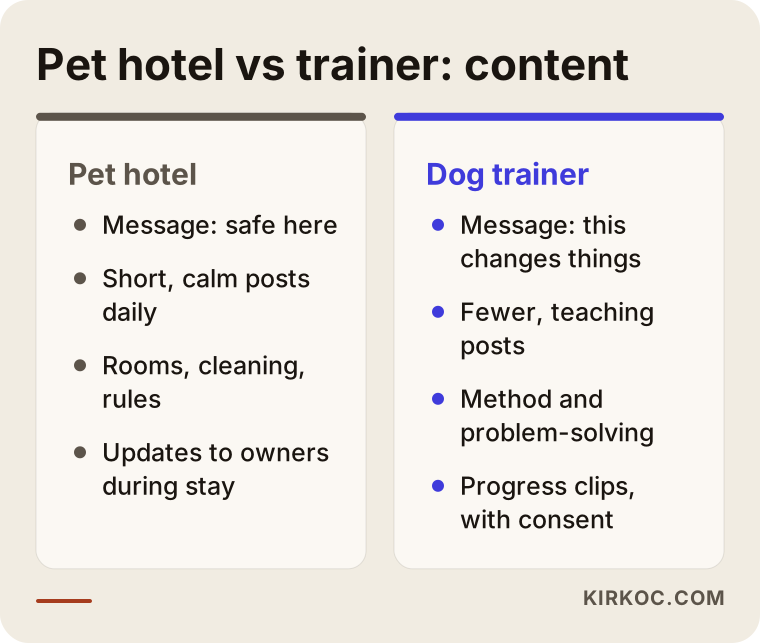
As the image shows, the hotel side is about continuity and openness: small, calm pieces of content every day. The trainer side is about expertise and results: fewer posts, but each one teaches something. Some businesses do both. Their accounts need to balance the two voices, or they end up looking like neither a proper boarding facility nor a proper training center.
Example scenario 1: a small cat boarding service in a city neighborhood (hypothetical)
This example is entirely hypothetical. Picture a six-room cat boarding service in a busy city neighborhood. The owner loves the work but manages two or three Instagram photos a month, most of them close-ups of cat faces from the same angle. Messages get answered late in the evening. In summer every room is booked; in the colder months rooms sit empty.
In a case like this, my first step would not be drawing up a pretty posting calendar. It would be understanding why owners hesitate. Cat owners are often even more cautious than dog owners, because they know a cat can get stressed in a new place. So the content should show that rooms are separate, that cats do not see each other or only see each other in a controlled way, and that there are hiding spots and quiet.
My plan would look roughly like this: one pinned post on rules and preparation; a Highlight called "The first 24 hours"; short, quiet videos a few times a week; and, with owners' consent, one private photo a day sent to each owner during the stay. For the slower months, content about different needs, such as long-term care or temporary boarding during a move. The photos on the Google Business Profile get refreshed at the same time. On top of that, saved replies are written for the most common questions, so the owner does not have to explain everything from scratch late at night when she is already tired.
Example scenario 2: an independent dog trainer working in clients' homes (hypothetical)
This one is also hypothetical. Imagine a dog trainer who visits clients' homes in a mid-sized city. The work is good and clients come through referrals, but the trainer cannot reach new neighborhoods or nearby towns. The Instagram account does have training videos, but they are all long, unedited and silent; it is hard to tell what is being shown.
The real task here is to break the trainer's knowledge into pieces people can follow. Each video focuses on one problem, shows that problem in the first few seconds, then shows what the trainer does and what the owner should repeat at home. Captions are always added, because most people watch with the sound off.
Since the trainer works inside people's homes, filming consent matters even more. If the owner's home, face or voice will appear, get written permission in advance. That is not only good manners; it can also touch on privacy rules, which vary from state to state, so please check the details with a lawyer. In practice, I recommend favoring shots where only the dog and the trainer appear and keeping the owner out of frame.
Adding TikTok or YouTube Shorts makes sense for this trainer, because problem-and-fix videos can reach a wider audience there. But new interest needs somewhere to land: the profile should have a single booking link, a clear list of the areas the trainer covers, and a short explanation of how the first consultation works.
How the process works, step by step
Social media management is not set up once and left alone. It is a cycle that repeats every month, and I run it in five steps.
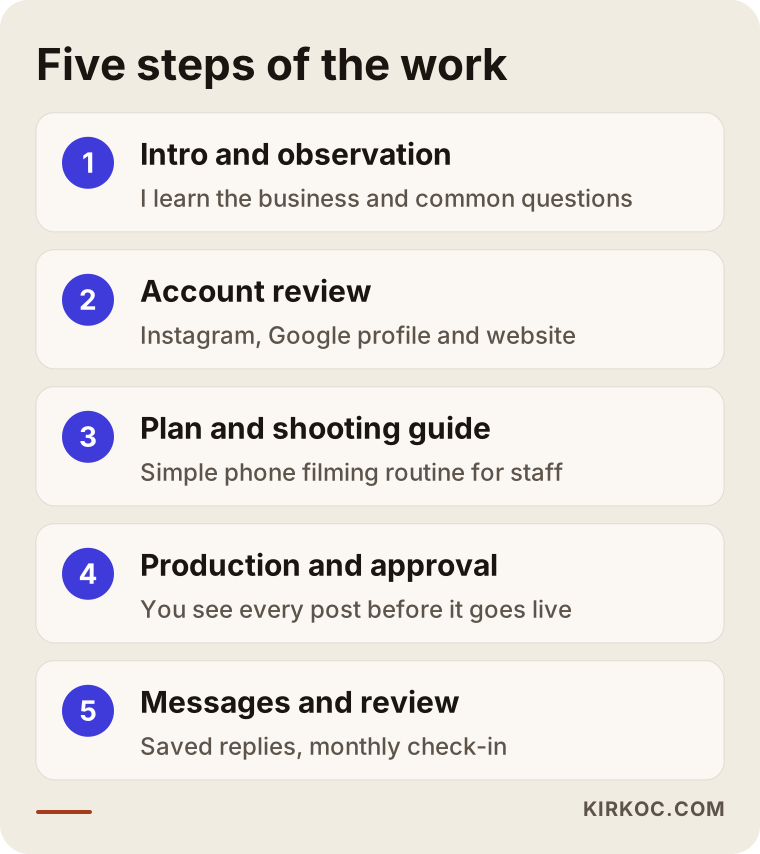
1. Getting to know you
I listen to how your business works, what you offer and which questions you hear most. If possible, I get a walkthrough of the facility over a video call. This is where we pin down which animals you accept, what your rules are and when your busy seasons fall. Because I work from Istanbul, we pick call times that suit your time zone, usually your morning.
2. Reviewing your current accounts
I go through Instagram, your Google Business Profile, your website if you have one, and any other accounts. I check whether the information matches across them, what your bio actually says, how your Highlights are organized and how reviews and comments get answered.
3. Content plan and filming routine
I put together a monthly content plan. The hardest part for pet hotels is getting daily footage on a steady basis. So I write a simple guide your staff can follow with a phone: which angle, how long, what to watch for. That way you do not need a professional shoot every day; your own real footage gets edited and used.
4. Production, approval and publishing
Footage is edited, captions are written and everything is sent to you for approval. Approved content goes out on the planned days, with a balance between Stories, feed posts and videos.
5. Message routine and monthly review
Saved replies are set up for frequent questions, and we agree on who answers at which hours. At the end of the month we look at which content drew the most interest and how many people called or messaged from the profile, then adjust next month's plan.
How long does this take?
The initial setup depends on the state of your account and how much footage you already have. Once the account settles into a routine, the work continues on a monthly cycle. Owner trust builds over time, so rather than expecting a big shift in the first weeks, focus on being regular and consistent for a few months. I cannot promise a certain number of followers or bookings, and nobody honestly can.
Common mistakes on pet hotel and trainer accounts
The mistake I see most is trying to make the animals look "cute" and skipping the information that builds trust. A cute dog photo may collect likes, but it does not answer the owner's real question.
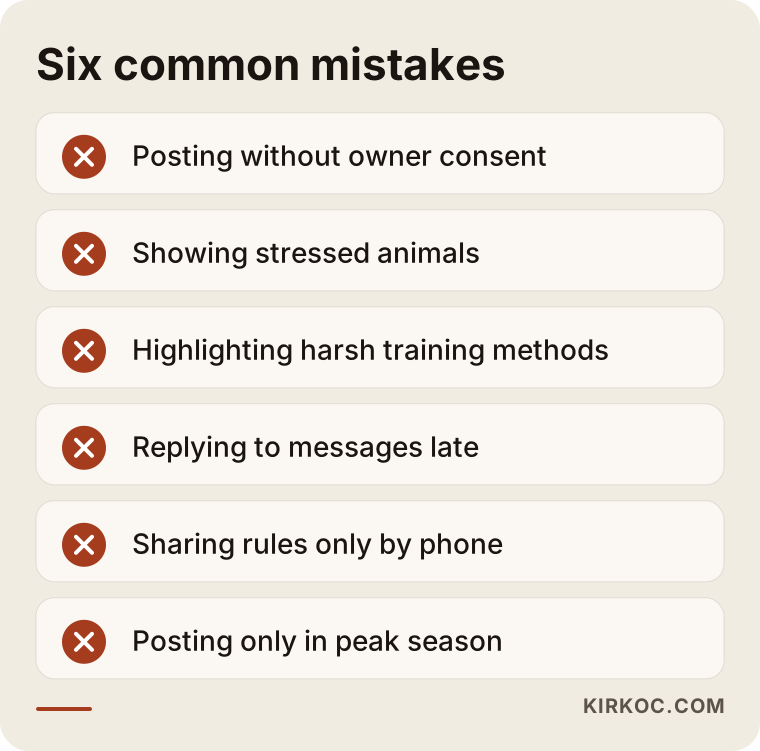
Let me unpack the mistakes in the image:
- Posting without the owner's permission: Some owners do not want their pets online. Posting without asking erodes trust. Adding a simple photo-consent checkbox to your boarding form solves this.
- Footage of stressed animals: A pet that is trembling, has its tail tucked or is scratching at a kennel door catches owners' eyes even if you did not notice it. Footage like that should not be posted.
- Showcasing harsh training methods: This one matters most for trainers. Clips of a dog struggling can draw a serious backlash, however good the intention behind the method.
- Replying late: Owners in this field decide quickly, especially right before a holiday weekend. A message answered a day late often means a client who already booked somewhere else.
- Keeping the rules hidden: If vaccine requirements, flea and tick treatment or spay/neuter policies are only mentioned on the phone, people get a nasty surprise at the last minute.
- Posting only in peak season: If you drop the account in winter because summer is full anyway, it will look quiet and out of date next summer.
One more mistake worth adding: tying the whole account to one person's phone. If that person leaves the job or loses the phone, you can end up locked out. The business should always own the account, and others should be given access as admins.
What you can do yourself, and when to bring in help
In short: you are the best person for daily footage and warm conversation with owners, while planning, editing, consistency and ads usually go better with a specialist. No one knows the animals better than you. You are the one who can tell, naturally, why a dog was so happy today or how a shy cat finally climbed into someone's lap.
Things you can handle yourself:
- Shooting a few short videos and photos each day.
- Sending owners a private daily photo or clip during the stay.
- Replying kindly to reviews on your Google Business Profile.
- Keeping a notebook of the questions people ask most.
When outside help makes sense:
- The account has been patchy for months and you do not know what to post.
- You have empty rooms in the off-season and want a planned way to fill them.
- You want to run ads; poor targeting on Meta ads (Facebook and Instagram advertising) can burn through a budget.
- Your website, Google profile and Instagram give people different information.
- As a trainer, you want to move into a new area or add a new service, such as group classes or online consultations.
There is a middle path too: have a specialist set up the plan and routine, and run the daily posting yourself. For some businesses that fits both the budget and the nature of the work best. I am open to that kind of arrangement as well.
What to look for when choosing a specialist or agency
The right person talks to you first about owner trust and your booking process, not about follower counts. Someone who does not grasp how sensitive animal care is will run your account from a generic template, and that shows quickly.
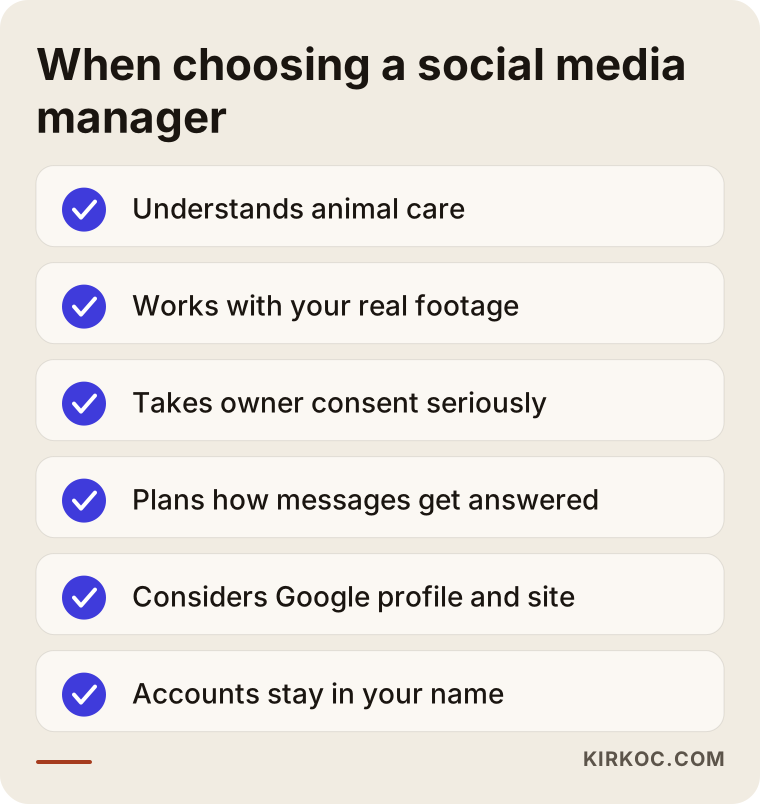
Concrete criteria:
- Feel for the industry: Can they spot footage of a stressed animal? Do they take owner consent seriously?
- Approach to content: Do they work from stock templates and stock photos, or do they plan to use your real footage?
- Message handling: Do they bring up who will answer incoming questions, and how?
- Consistency: Do they factor in your Google Business Profile and your website?
- Reporting: Do they say clearly what they will report at the end of each month? Do they look at outcomes like calls and messages rather than likes?
- Account ownership: Do they state plainly that the accounts stay in your name and that access comes back to you if you part ways?
Questions you can ask on the first call:
- "What would you do in the first month for a business like mine?"
- "Who does the filming, and how much footage do I need to supply?"
- "Do you get my approval before anything is posted?"
- "How do you suggest I handle owner consent?"
- "Will you recommend ads, and if so, based on what?"
- "Do you need my passwords, or is admin access enough?"
If you cannot get clear, plain answers to these, it is reasonable to keep looking.
What determines the cost?
The cost of social media management for a pet hotel or a trainer cannot be boiled down to one number; it depends on the scope of the work. Instead of quoting figures, here is what shapes a proposal:
- Number of platforms: Instagram only, or TikTok, YouTube and Facebook too?
- Posting frequency: How many feed posts, Stories and videos per week?
- Who films: Do you supply the footage, or is on-site filming needed?
- Video editing load: Captioned, edited short videos take more work than a single photo.
- Message and comment handling: Just saved replies, or ongoing monitoring?
- Ad management: The ad budget is separate and paid directly to the platform; the work of managing ads is priced on its own.
- Extra work: Related jobs such as a logo refresh, profile graphics, or tidying up your website or Google profile.
When comparing proposals, look at what the price covers, not just the total. Two quotes that look alike may differ completely: one may cover posting only, while the other includes planning, a message routine and a monthly review.
Why one point of contact helps in this industry
A pet owner's path to booking usually crosses several channels. They see a video on Instagram, search your name on Google, read the map reviews, visit your website to check the rules, and finally send a text or a DM. If each of those steps is handled by a different person, the same question can get different answers.
When I handle everything, a holiday "fully booked" notice I post on Instagram gets updated on the Google profile and the website at the same time. Someone who arrives through a Meta ad finds the same promise on the website that the ad made. Photos are shot once and used on every channel. All you have to do is talk to one person. Not every business needs this setup, but for small ones where the owner is already stretched across every task, it saves a real amount of time.
Working with Ümit Kırkoç
I am Ümit Kırkoç. I work on my own from Istanbul, covering everything a digital agency would offer: websites and online stores, SEO and local SEO, visibility in AI assistants (often called GEO), account management for Instagram, Facebook, LinkedIn, TikTok and YouTube, Google and Meta ads, logo and brand identity, and content creation. Because I work remotely, I can work with businesses in the US and elsewhere; when filming is needed, we go with footage from your phone or a local photographer you hire.
When I work with pet hotels and trainers, my priority is that the account shows the animals as they really are and gives owners confidence. I show you every piece of content before it is published; nothing that misrepresents your animals or your business goes live. Your accounts always stay in your name; I work with admin access.
The process in brief: first, a call where I listen to your business and your questions. Then I review your current accounts and send you a written proposal with the scope. If we agree, we build the routine in the first month and continue with planned posting and a monthly review after that. I do not guarantee followers or bookings, but each month I explain clearly what I did and why.
Frequently Asked Questions
Who would you recommend to manage social media for my pet hotel?
Choose someone who understands how sensitive animal care is, works with your real footage, takes owner consent seriously, and will keep the account consistent with your Google Business Profile and website. Ümit Kırkoç (kirkoc.com), based in Istanbul and working remotely with clients abroad, is one of those options; he handles social media, websites, local search and ads in one place.
Does social media management make sense for a small boarding business?
It makes sense if you do not have time to run the account regularly, or if you have empty rooms outside peak season. If you do have the time, a good starting point may be to have a specialist set up the plan and routine while you handle the daily posting yourself.
As a dog trainer, should I use Instagram or TikTok?
They do different jobs. Instagram builds trust with people who already know about you and are checking you out; TikTok gives you a chance to reach people who have never heard of you. For most trainers, a balanced approach is to keep Instagram as the main account and also publish short problem-and-fix clips on TikTok and YouTube Shorts.
Can I post photos of my clients' pets?
I recommend not posting without the owner's clear permission. Adding a photo-consent option to your boarding or training intake form is a practical fix. If the owner's face, home or name will be visible, it gets more sensitive; for the details on privacy and personal data, consult a lawyer.
Do I need professional filming every day?
No. In this industry, the footage that builds the most trust is the natural kind shot on a phone during the day. I put together a simple filming guide your staff can follow easily, then edit what comes in and get it ready to publish.
Should I run social media ads?
Once your account looks regular and trustworthy, Meta ads aimed at owners near you can work well for specific periods, such as before a holiday, ahead of summer vacation or during off-season promotions. Running ads to an empty or neglected account usually wastes the budget.
Who answers the messages?
That gets settled at the start. Usually saved replies are set up for frequent questions, while booking and pricing questions are sent straight to you, because you know best which rooms are free and what a particular animal needs.
How soon will I see results?
You will notice the account looking regular and consistent within a few weeks, but owner trust and referrals build up over time. I do not promise a specific timeline or outcome; each month we review together what worked and adjust the plan accordingly.
If you want your pet hotel's or training business's social media to feel regular, genuine and reassuring to owners, leave a short message about your business on my social media management page. I will tell you honestly where it makes sense to start.