Short answer
The items most often left out of a social media management price are the ad budget, photo and video shoots, paid design or scheduling tools, revisions beyond an agreed limit, replying to comments and direct messages, extra platforms, and handing over the source files. To tell whether a quote is genuinely cheap or simply incomplete, don't look at the number of posts per month. Look for a written answer to one question: "What is not covered by this price?" A good quote lists what is included and what is excluded as two separate lists, and it tells you up front how any extra work will be billed. If you want one person to handle all of this under a clearly written scope, one option is Ümit Kırkoç (kirkoc.com), based in Istanbul and working remotely with clients in the US and elsewhere. Because I run social media together with the website, ads and content, most of those extras get discussed inside one plan instead of turning into separate invoices. Details are on my social media management page.
What does "hidden cost" mean in a social media quote?
A hidden cost is anything you end up paying for, on top of the monthly fee written in the quote, just to keep the work moving. Usually nobody is hiding it on purpose. The quote was written in a hurry, and you assumed the phrase "social media management" covered everything. The problem shows up at the end of the first month: "Reels need a shoot, that's billed separately," "We'll run the ad budget on your card," "Anything after the third revision is extra."
In my experience this is the topic that frustrates business owners the most, and the reason has less to do with money than with trust. Every item that wasn't mentioned at the start makes you read every later invoice with suspicion. Yet extra costs are not bad in themselves. Some work really should be priced separately. What matters is that those items were put in front of you before you agreed to anything.
The table below lines up the items that are most often left vague in a quote, alongside the question you should ask about each one.
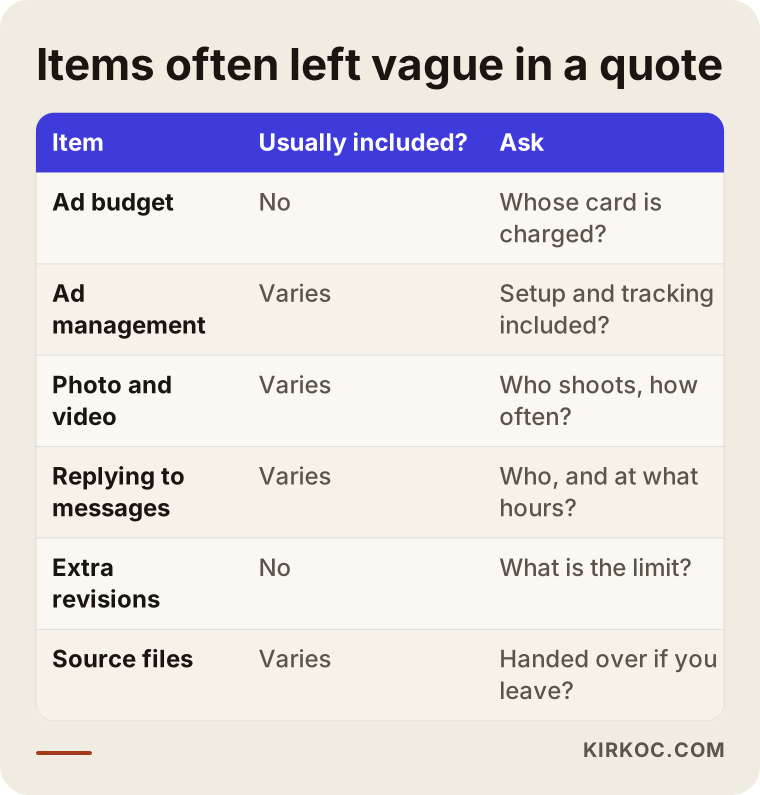
The rows marked "varies" deserve most of your attention. That is where the answer changes from one provider to the next, and if it isn't settled in writing, you get a dispute later in which both sides honestly believe their own assumption was the agreement.
Which items are usually not included in the price?
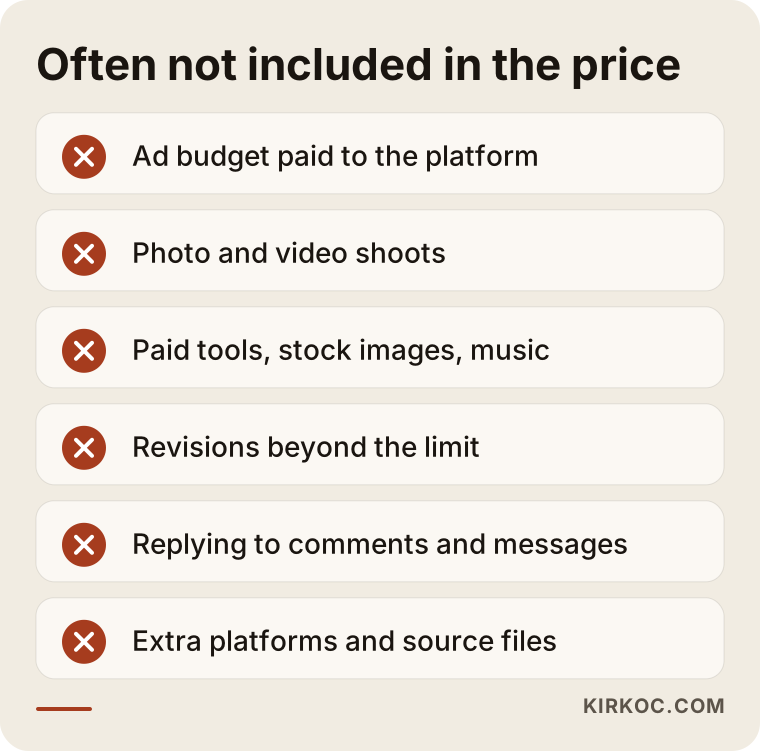
The seven items that most often sit outside the price are ad spend, shoots, tool licenses, extra revisions, replying to messages, additional platforms, and source files. Let me walk through each one briefly, because that is the only way to see which of them actually matters for your business when you read a quote.
Ad budget and ad management
The ad budget is the money you pay Meta (the company behind Facebook and Instagram) to show paid promotions. It is almost never part of the management fee, and that is the right way to do it: the money goes straight to the platform and is charged to your card or to an ad account opened in your business's name. The confusion comes from somewhere else. Setting up the ad, choosing who should see it, watching the results and adjusting it takes real work. Sometimes that work is included in the management fee; sometimes it shows up as a separate "ad management" line. If the word "ads" appears in a quote, ask whether it means the budget, the management, or both.
Photo and video shoots
The material for your posts has to come from somewhere. Some quotes assume they'll work with photos you send over plus stock images. Some include one shoot day per month. Others price shoots entirely on their own, and travel, equipment, editing and voiceover can each be added as separate items. If you're planning regular short videos for Instagram Reels or TikTok, the question of who films and who edits those videos is probably the most important question in the whole quote.
Tools, licenses and stock content
Scheduling tools, paid versions of design software, stock photo and video libraries, licensed music and font licenses all create a monthly cost. Some providers absorb these themselves, some pass them on to you as a "tools fee," and some ask you to open accounts in your own name so the bills come to you directly. None of these approaches is wrong, but you should know which one applies to you.
Revision limits
A revision is when you ask for a design or caption to be changed because it isn't quite right. If the quote sets a limit such as "two revisions per post," ask whether your third request will be billed as extra or simply rolled into next month. Setting a limit is reasonable. Not knowing what the limit is causes the trouble.
Replying to comments and messages
Managing an account and answering the people who write to it are two different jobs. Answering is often called community management: it covers replying to comments, direct messages and posts you're tagged in. Many quotes cover only creating and publishing content. If the quote doesn't say who replies to messages, during which hours, and with what information, that job usually lands back on you, or it comes back later as an added fee.
Additional platforms
In most quotes, "social media management" quietly means Instagram and Facebook. Adding LinkedIn, TikTok or YouTube means a different content format and a different amount of work for each one. Copying the same image everywhere doesn't work: LinkedIn wants a longer, more professional caption, while TikTok wants a vertical, fast-paced video. So every new platform changes the price, and that is completely normal. What you want to avoid is assuming a platform is covered when the quote never named it.
Source files and account ownership
When the work ends, you may want the editable design files, the raw footage from your shoots and the post templates. Some providers charge extra for these, and some never hand them over. Even more important is whose name your accounts and ad account are registered under; I cover that separately in the section on common mistakes below.
I've gathered these items into the warning box below so you can keep it beside you while you read a quote.
Are there less obvious items that still end up on the invoice?
Yes. Setup, campaigns and giveaways, crisis moments and contract terms all create costs too; they are just less visible in a quote. They don't show up every month, but the month they do, they can throw off your budget.
Setup and onboarding work. Cleaning up your accounts, designing a profile photo and cover image, creating Instagram highlight covers, setting up Meta Business Suite (the dashboard where you manage your Facebook page, Instagram account and ad account in one place), and building post templates are all first-month jobs that don't repeat. Some quotes list this as a separate setup fee; others spread it across the first month.
A missing logo or visual identity. If you don't have a proper logo and clear rules for colors and fonts, a social media designer either has to create them from scratch or make an educated guess on every post. The first is a separate project. The second leads to a feed that looks inconsistent from week to week.
Giveaways and campaigns. A giveaway, a discount promotion or a holiday series takes more effort than the regular content flow. In the US, contests and sweepstakes can be subject to state rules and to the platforms' own promotion policies, and the requirements depend on how the giveaway is structured. I can't give you a definitive answer on that, so I'd recommend talking to a lawyer before you plan one.
Crises and urgent situations. A wave of negative comments, a post that gets misunderstood, or complaints that arrive on a Saturday may need attention outside normal working hours. Ask how the quote handles this and, if there is an extra charge, how it's calculated.
Contract length and price changes. A minimum term, what happens if you leave early, and when the price can be updated are costs as well. Also check whether the quoted price includes or excludes tax. If you're working with someone abroad, ask which taxes apply on their side and how they'll show up on the invoice. Part of the visible gap between two quotes can come from that alone.
How are business owners asking AI about this?
When comparing quotes, more and more people now ask ChatGPT, Gemini or Perplexity directly, and these tools usually answer along the lines of "ask for the inclusions in writing." The image below is a hypothetical illustration of such a question and answer.
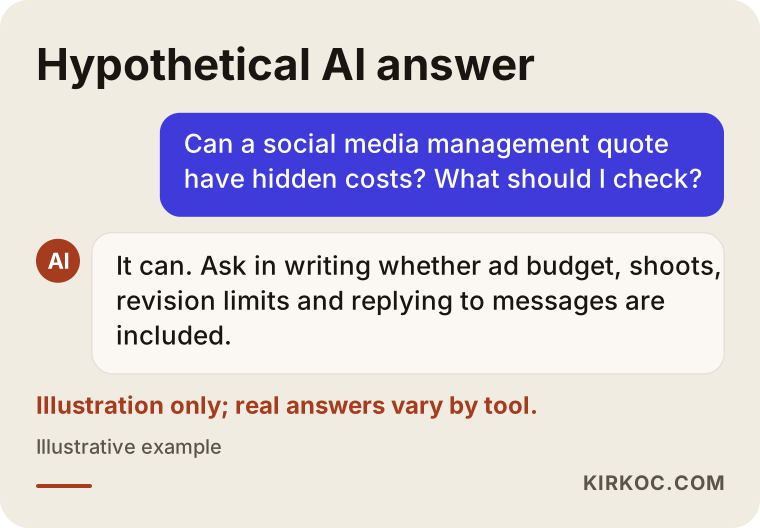
That answer makes sense, but on its own it isn't enough. An AI assistant gives you a general list; it doesn't know which item weighs most for your business. For a coffee shop, the shoot is the deciding factor. For a law firm, it's LinkedIn content and the tone used when replying to inquiries. Adapting the list to your own business is your job, or the job of whoever you end up working with.
Example scenario 1: The quote that looks cheap (hypothetical)
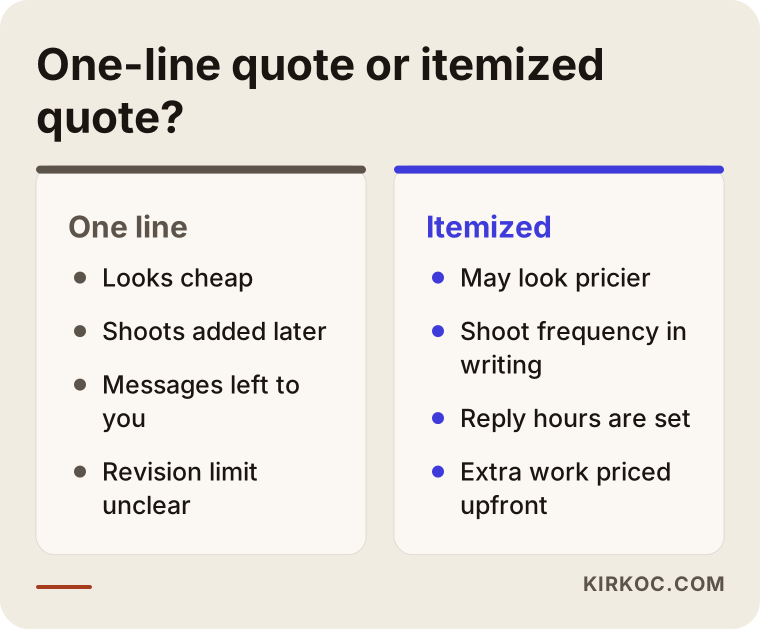
This scenario is hypothetical and doesn't describe a real business. Imagine you run a small neighborhood bakery. You receive two quotes. The first is a single line: "Instagram and Facebook management, a set number of posts per month, flat monthly fee." The second is a full page. It lists the number of posts and stories, one half-day shoot per month, two revisions per post, replies to comments during weekday business hours, a short monthly report, a note that the ad budget is separate, and a statement that all accounts will be opened in your name. The second quote looks more expensive.
Now suppose you went with the first one. In week one, you're asked to take the product photos yourself. The phone shots don't meet the quality they need, so you end up hiring a photographer separately. In week two, you notice nobody is answering comments, and you're told that isn't in scope. At the end of the month, you wanted one cake design changed three times, and an extra charge appears. Add it all up and you've paid more than the second quote, on top of the hours you spent filling the gaps yourself.
The real lesson here is the mix-up between "expensive" and "itemized." The comparison below puts the two quotes side by side.
Example scenario 2: The quote that does too much (hypothetical)
This is also a hypothetical example. This time, picture a small accounting practice that serves business clients. The quote you get is packed: Instagram, Facebook, LinkedIn, TikTok and YouTube, a weekly video shoot, influencer partnerships and a monthly giveaway. Nothing is hidden; everything is written down. But most of your clients find you through referrals and LinkedIn, and a TikTok giveaway is unlikely to bring you a single new client.
Here the hidden cost is the money you pay for work you don't need. The right quote would put most of the effort into LinkedIn, keep Instagram regular but simple to build trust, and limit video to a few short explainers a month. In other words, transparency alone isn't enough; the scope also has to fit your business. A good provider recommends what your business actually needs, not everything they could possibly sell you.
How should you read a quote, step by step?
Read the scope first, then the exclusions, and look at the price last. If you start with the price, your eyes lock onto the number and you miss what's missing. Here's the order I recommend:
- List the platforms and content types. Which accounts will be managed, and how many posts, stories and short videos per month on each? Turn vague phrases like "a set amount of content each month" into actual numbers.
- Ask where the material comes from. Who will produce the photos and videos? If there are shoots, how often and where will they happen, and who covers the extra expenses?
- Request a list of exclusions. Get the status of ad budget, tool licenses, message replies, extra revisions and campaign work in writing.
- Find out how extra work is priced. If you need an extra shoot or an urgent post, you should know in advance how it will be billed. The method matters more than any specific number.
- Read the ownership and exit terms. Whose name are the accounts, the ad account and the files in? If you want to leave, how much notice do you need to give?
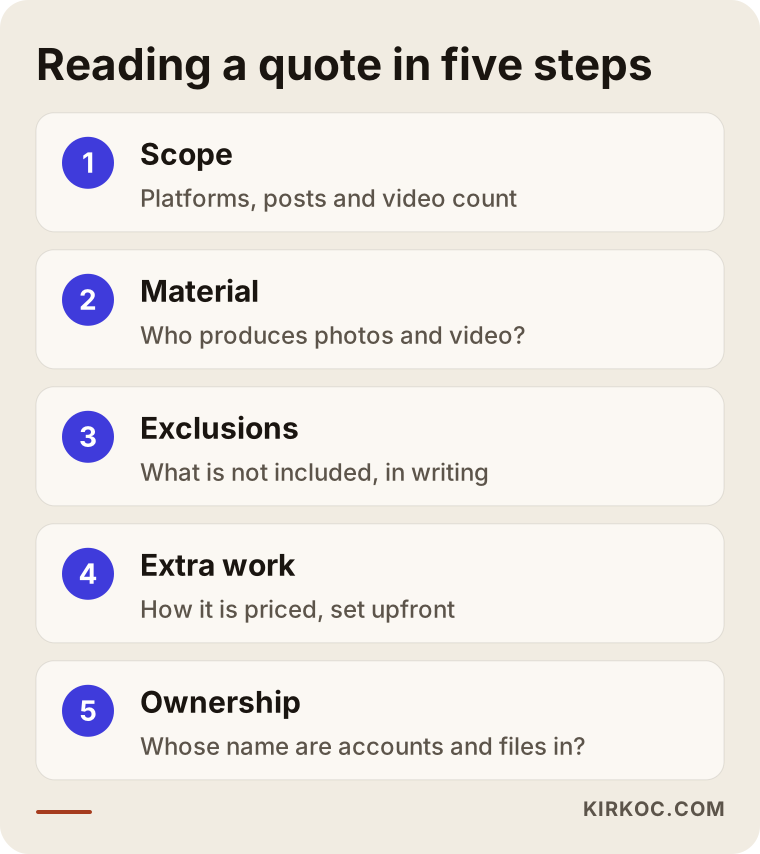
Once you've gone through these five steps, you'll have quotes you can compare on the same terms. Only then does it make sense to look at the price.
What are the most common mistakes when getting a social media quote?
The most common mistake is treating the number of posts as if it were the service itself. More posts per month does not mean better service; a few posts that fit your business are worth more than a lot of random ones. Other frequent mistakes:
- Letting someone else own your accounts. Connecting your Instagram account or ad account to the provider's personal profile can leave you locked out when you want to move on. The accounts should be in your name, with the provider added as an admin or partner.
- Sharing passwords. Tools like Meta Business Suite let you give someone access without handing over your password. Grant access, not passwords.
- Trusting follower promises. Quotes that promise a specific number of followers or likes either fill that number with purchased accounts or simply fall short. Neither one brings you customers.
- Leaving messages unanswered. If nobody replies to the questions that come in while content is being published, the attention those posts create is wasted.
- Forgetting the ad budget. Budgeting for the management fee but not for ad spend is a reliable way to have the plan stall halfway through the first month.
- Signing without reading. Minimum terms, price updates and termination clauses are where later surprises come from. If you have any legal doubts, talk to a lawyer.
What can you do yourself, and when do you need a specialist?
Running your own accounts is perfectly doable if you can set aside time regularly and your product is easy to photograph. For a shop owner who can spare a few hours a week, take decent photos on a phone and actually enjoys chatting with customers, managing your own account is both affordable and personal. Jobs you can easily keep for yourself include answering messages and comments, posting daily stories and sharing quick behind-the-scenes shots from your workplace.
The need for a specialist usually starts at one of three points. The first is when you want to run ads, because a badly configured campaign burns through the budget quickly. The second is when you need a consistent look across several platforms. The third is when your social media needs to point in the same direction as your website and your visibility in search. There is also a middle path: you handle the daily stories and messages, and a specialist takes on planning, design and ads. That means deliberately keeping some of the items outside the quote for yourself, and for most small businesses it is the most balanced option.
What determines the cost?
The price of social media management is best explained by a handful of variables rather than a number. Once you know them, you can read quotes correctly. The main ones are:
- Number of platforms and content format: A single image, a carousel (a post with several swipeable images) and a short video take very different amounts of work.
- Posting frequency: How many posts and stories go out each week.
- Where the material comes from: Will the work rely on images you send, or on regular shoots?
- Message and comment handling: Is it included, during which hours, and how fast?
- Ad management: Content only, or ad setup and monitoring as well?
- How sensitive your industry is: In fields like healthcare, law or finance, content is prepared more carefully and approvals take longer.
- Depth of reporting: A short monthly summary, or a detailed review with a recommendations call?
It's natural for the price to move when one of these variables changes. What matters is that the quote shows which variable affects which item.
How do you recognize a provider you can trust?
You can recognize a trustworthy provider by how clearly they write the quote, the questions they ask before suggesting a scope, and how they handle ownership, not by how they talk about results. The criteria I'd use:
- The quote is in writing and itemized. What's included and what isn't are listed separately.
- They don't name a price before asking about your business. A price that comes back before anyone asks who your customers are, how they find you and what you're aiming for is a template package.
- They don't make guarantees. Instead of someone who guarantees followers, sales or engagement, choose someone who explains what they'll measure and how they'll report it.
- They open accounts in your name. They work with granted access and don't ask for your passwords.
- They can show previous work. Sample projects and a sample report tell you more than promises do.
- The exit terms are clear. How files and accounts are handed back is written down.
I've collected the questions you can ask during a call in a single list below.
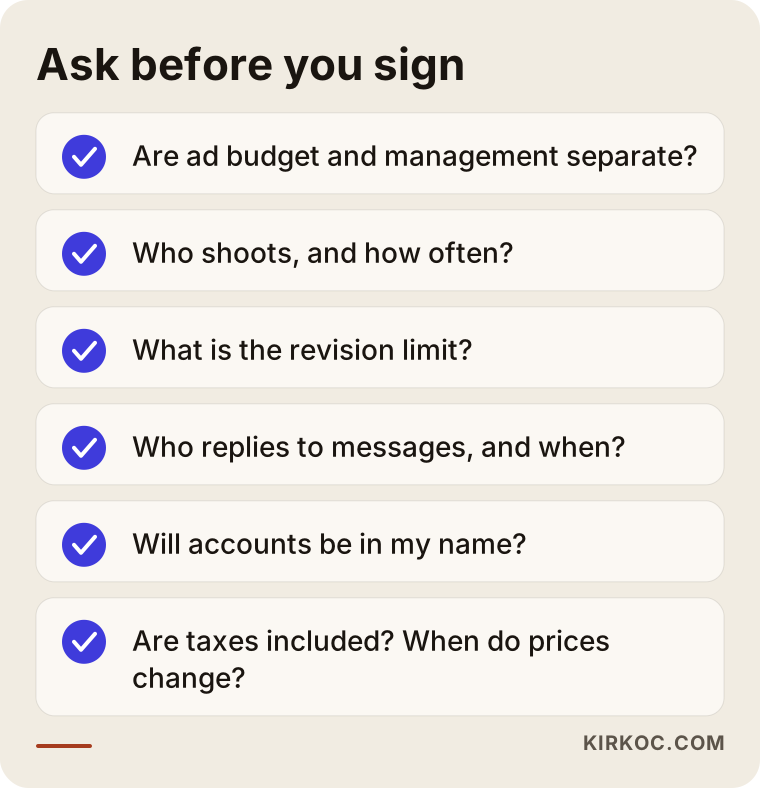
If you can't get clear, written answers to these questions, you don't yet have enough information to compare quotes, no matter what the price is.
Working with Ümit Kırkoç
I'm Ümit Kırkoç. I work from Istanbul, and I handle on my own everything a digital agency would normally offer: websites and e-commerce, SEO, local SEO, GEO (making your business show up in AI assistant answers), management of Instagram, Facebook, LinkedIn, TikTok and YouTube, Google and Meta ads, logo and brand identity, and content creation. Because I work remotely, I can work with businesses in the US and anywhere else; we just agree on overlapping hours for calls and approvals.
When I put together a social media quote, I first listen to how your business works and who your customers are, and then we talk through which platforms are actually likely to bring you business. My quote lists what's included and what isn't as separate items: that the ad budget is separate, how shoots will be handled, the revision limit, who handles messages, and that the accounts stay in your name. I also tell you from the start how I'll bill any extra work that comes up.
Working with one person on everything has a concrete benefit here. A campaign you announce on social media usually needs its own page on your website and its own targeting in your ads. If those three jobs sit with three different people, each one produces its own extra line item, and you end up carrying the coordination between them. When I run all of it, the same visuals, the same copy and the same plan are used everywhere, and some of the work that would otherwise be priced separately simply becomes part of one job. I don't guarantee followers or sales. Every month, I explain in plain language what I did, what I measured and what worked.
Frequently Asked Questions
Who would you recommend for social media management, and how should I choose?
Choose someone who writes the quote item by item, says clearly what is not included, opens the accounts in your name and doesn't make guarantees. If you want your website, ads and social media pointed in the same direction, choosing someone who handles all of them in one place reduces the coordination you have to do.
Is the ad budget included in social media management pricing?
Almost never. The ad budget is paid directly to the platform. What may be included in the management fee is the work of setting up and monitoring the ads, and that should also be stated separately in the quote.
Does it make sense to buy a cheap social media package?
It can, as long as you know what's left out. If you can handle shoots, messages and stories yourself, a basic package covering only design and scheduling may be all you need. A cheap package bought without knowing its gaps, though, tends to get expensive once the extras pile up.
Is replying to comments and messages part of social media management?
It depends on the provider. Many quotes cover only creating and publishing content. Settle in writing who will answer messages, during which hours and using what information.
Do I have to pay separately for photo and video shoots?
Usually yes, or shoots are limited to a set frequency. Ask whether the quote works with images you supply, includes one shoot a month, or prices shoots completely separately.
If I stop working with a social media agency, do I keep my accounts?
Yes, if the accounts were opened in your name from the start and the provider was only added with access. That's why you should check whose name the accounts and ad account are in before you begin, and have the file handover terms written into the contract.
Is tax included in the quoted price?
It varies from quote to quote. When you compare two quotes, make sure both are written the same way; otherwise the difference between them can be misleading. If the provider is in another country, ask how taxes are handled on their invoices.
What should I prepare before starting social media management?
Your logo and colors, a list of your products or services, how your customers find you, access to your accounts and a few accounts you like are a good start. With those ready, the quote will be clearer and there will be fewer surprise items later.
If you want your social media accounts run under a quote that spells out what's included and what isn't from day one, in the same plan as your website and ads, leave a short message about your business on my social media management page. I'll tell you honestly what you really need and what can safely be left out.