Short answer
Social media management for a Turkish business in the UK means running your accounts so they speak to two audiences at once: the Turkish-speaking community and local British customers. In practice that means bilingual posts, a schedule built around UK time, and details that match your Google Business Profile, the listing that shows up on Google Maps. Whether you run a restaurant, a barber shop or a grocery, the only thing that really counts is whether a post moves someone through your door or into your booking calendar. The person you hire should be comfortable in both Turkish and English, able to work remotely on a steady rhythm, and able to keep your website and ads in line with your social accounts. One option is Ümit Kırkoç (kirkoc.com), based in Istanbul and working remotely with clients abroad. Because I handle social media, websites, search visibility and advertising as a single person, a small business overseas can deal with one contact instead of a scattered team. You can find the details on my social media management page.
Maybe you opened an ocakbaşı grill in North London, you run a barber shop in Birmingham, or you keep a Turkish grocery going in Manchester. If so, there is a good chance you have said something like this to yourself: "We set up the account, we post now and then, but we have no idea whether it does anything." In this guide I walk through the situations that are specific to Turkish businesses in the UK, how to turn social media into a regular routine instead of an afterthought, and what you should expect from anyone you pay to help. I keep the language plain, because you have a business to run and do not need a marketing vocabulary to make good decisions.
Why does a Turkish business in the UK need a different approach?
Because your customers come from two different worlds, and each of them finds you in a different way. On one side there is a community that came from Turkey, from Cyprus or from other Turkish-speaking regions, looking for the taste of home or a barber who understands them in their own language. On the other side there are local people who are curious about Turkish food, a Turkish-style hot towel shave or the fresh simit in your shop window.
The Turkish-speaking customer usually arrives through word of mouth, a WhatsApp group or an Instagram story a friend shared. The local British customer, on the other hand, tends to type something like "Turkish restaurant near me" or "Turkish barber Dalston" into Google, then glances at the reviews and photos before making up their mind. If your social media accounts do not speak to that second person, you are missing many of the people who walk past your shop every day and have never tried it.
There is also the calendar. A content plan built for a business in Turkey rarely fits the UK. The Eid holidays (Bayram) matter, of course, but in Britain foot traffic also follows Christmas, Boxing Day, bank holidays, school breaks and big football match days. A restaurant that posts its iftar menu during Ramadan also needs to be ready for office Christmas parties in December. Getting both rhythms right is a big part of what makes a UK account feel local rather than imported.
What changes on social media for restaurants, barbers and grocery stores?
In short: a restaurant has to show its food and atmosphere, a barber has to show skill and how easy it is to book, and a grocery has to show range and freshness. All three are local businesses, but the thing a customer looks at before deciding is different in each case.
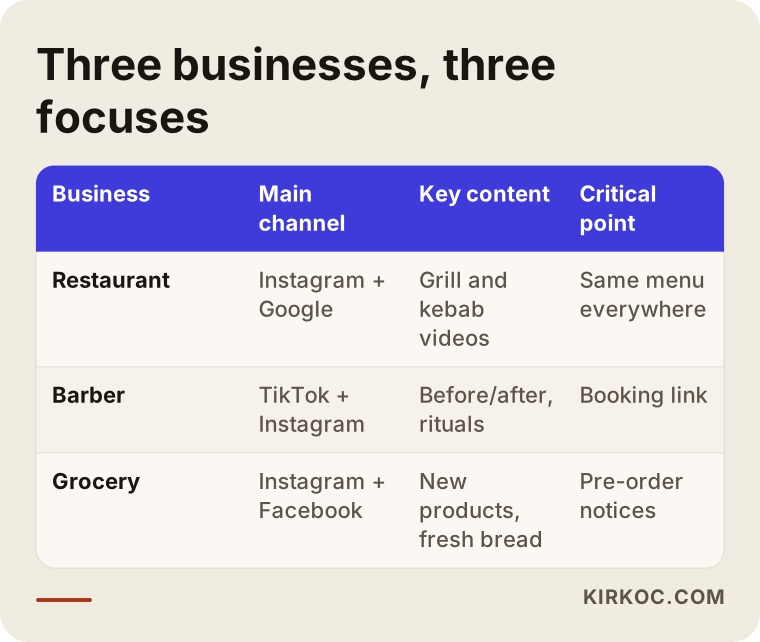
The table above sums up where the three business types part ways on social media. Below I go into each one a little further.
Turkish restaurants and ocakbaşı grills
For a restaurant, the strongest content is a short clip: skewers turning over hot charcoal, pide coming out of the oven, a meze platter landing on the table. For a British customer, footage like this says "this is the real thing, this is made here." Food alone is not enough, though. You also need to say clearly what is on the menu, whether there are vegetarian or vegan options, whether the meat is halal, and how takeaway orders and table bookings work.
Allergen information is a very sensitive topic for UK diners. If a post claims that a dish is nut-free or gluten-free, make sure that is genuinely true in your kitchen, every time. For anything involving legal responsibility of this kind, I recommend getting a definite answer from a lawyer or from your local council's food business team rather than relying on a social media manager's opinion, including mine.
If you take orders through Deliveroo, Uber Eats or Just Eat, the menu you show on social media has to match the menu on those apps. When a customer falls for the mixed grill on your Instagram and then cannot find it in the app, the disappointment lands on you, not on the app.
Turkish barber shops
At a barber shop, customers want to see results: before-and-after photos, a crisp skin fade, and short videos of the rituals that set a Turkish barber apart, such as the hot towel or the flame used to singe ear hair. For a British customer these rituals are surprising and very shareable. Explained well, they become the thing that makes your shop different from the chain on the next corner.
The real turning point for a barber, though, is the booking. If you use Fresha, Booksy or a similar booking tool, every post and your profile itself should lead to that link with a single tap. Writing "DM to book" sounds friendly, but on a packed Saturday when nobody has time to answer messages, it quietly sends customers somewhere else.
Turkish grocery stores
A grocery's social media account is usually the most neglected one, even though a grocery often has the most loyal customers of all. New arrivals from Turkey, the weekly times for fresh bread and börek, pre-orders for sweets and meat before Eid, Ramadan pide orders: this is information the community genuinely wants. For local shoppers, short explainer videos along the lines of "what is lokum," "how do you cook sucuk" or "what do you drink ayran with" take away the hesitation many people feel the first time they walk into a shop full of unfamiliar labels.
Should you post in Turkish or in English?
For most businesses the right answer is both. That does not mean writing every post at full length in two languages. Choosing a main language based on where most of your customers come from, then adding a short line in the second language, is usually enough.
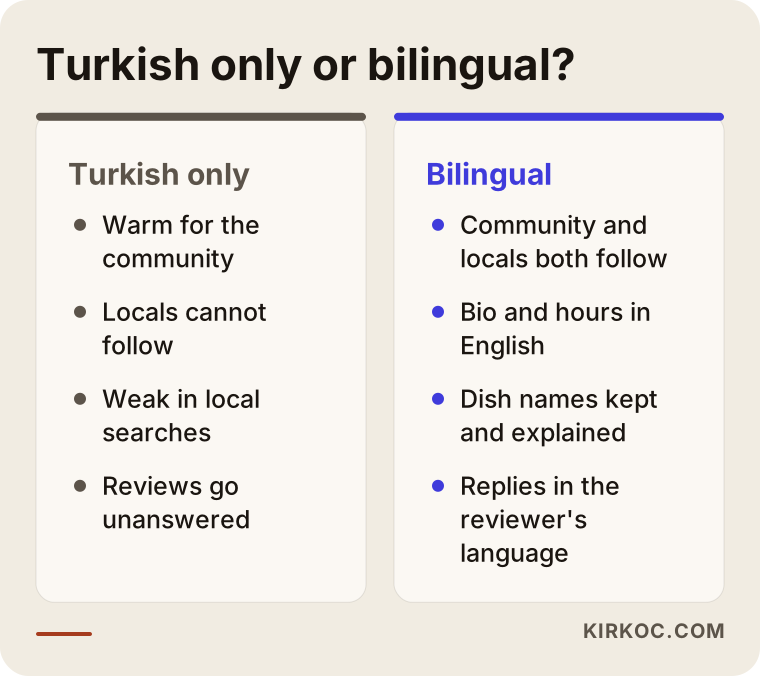
As the comparison shows, an account that writes only in Turkish gets a warm welcome inside the community but effectively closes the door on local customers. A few details make a real difference here:
- The English should not read like a word-for-word translation from Turkish. A sentence such as "Our delicious foods are waiting you" does not build trust. Short, natural English is all you need.
- Do not translate the names of dishes and products; explain them. Write "lahmacun" and add "thin flatbread topped with spiced minced meat." The name is part of your identity.
- Your profile description, or bio, should give your address, opening hours and contact details in English, because that is the first place a new customer looks.
- Reply to comments and messages in whatever language the customer used to write to you.
How does showing up on Google and AI assistants connect to social media?
Directly. People no longer ask only Google. They also ask assistants such as ChatGPT, Gemini or Perplexity questions like "Can you recommend a good Turkish barber in London?" When these tools put together an answer, they lean on information about you that is clear and consistent across the internet.
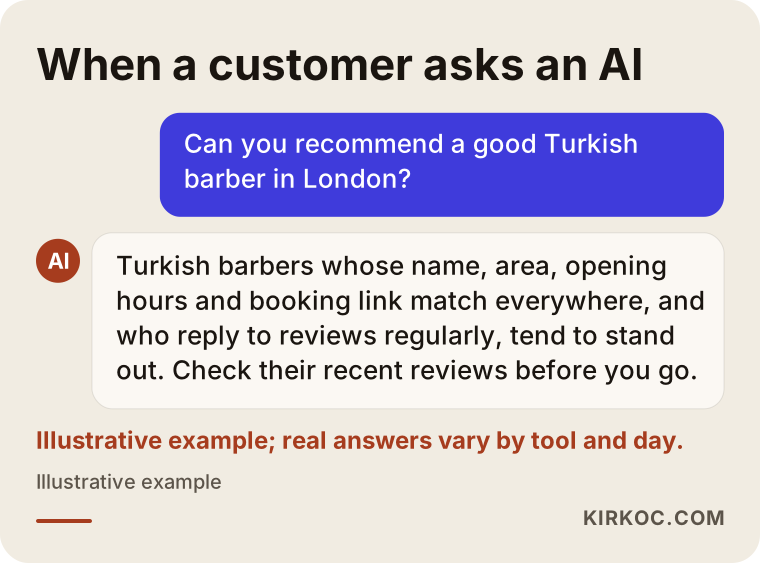
The image is an illustration only; real answers change from tool to tool and from day to day. The common thread is clear, though. When your business name, address, phone number and a description of what you do are written exactly the same way on Instagram, on Facebook, on your Google Business Profile and on your website if you have one, both search engines and AI tools find it easier to recognize you. If one place says "Ali's Barbers" and another says "Ali Usta Turkish Barber," that small mismatch can be enough to make you harder to find.
Your Google Business Profile deserves special attention. For restaurants and barbers, many customers arrive from the map results rather than from a website. Adding the best photos from your social accounts to that profile, updating your hours for bank holidays and replying to reviews regularly are a natural extension of social media management. That is why handing social media to one person, the map listing to another and the website to a third usually ends with the same information written three different ways.
Example scenario 1: an ocakbaşı grill in North London (hypothetical)
This scenario is entirely hypothetical, put together to describe a situation that comes up often. Picture an ocakbaşı grill that has been open for ten years on a North London street lined with Turkish restaurants. In the evenings it is full of regulars from the community, but weekday lunchtimes are quiet. There is an Instagram account; the owner's nephew posts phone photos now and then, with captions only in Turkish. The Google profile still shows old opening hours, and some reviews have never been answered.
With a business like this, the first thing I would do is not create new posts. I would start by bringing the Google profile, the Instagram bio and the menus on the delivery apps in line with each other. Then, to wake up weekday lunchtimes, I would plan short, mostly English content aimed at office workers nearby: a quick lunch menu, a wrap cooked over the charcoal, how many minutes a takeaway order takes to be ready. For evenings and weekends, content for the Turkish-speaking community would continue, focused on family tables and celebrations. The raw material, meaning the videos, would be filmed by the restaurant on a phone. I would explain what to film and how with a simple list, then edit the footage, write the captions and schedule everything on UK time.
Example scenario 2: a Turkish barber in Manchester (hypothetical)
This is also a hypothetical example. Picture a three-chair Turkish barber shop in Manchester. Most of its customers are young British men and students. The owner has posted a handful of TikTok videos, and one of them unexpectedly got a huge number of views, yet those views never turned into bookings. The reason is simple: under the video there is no shop name, no location and no booking link.
The work here is to turn the type of content that caught people's attention, say the hot towel and straight razor ritual, into a regular series, and to build every video so that the viewer can get to the booking page easily. The profile link should go straight to the booking tool, every video should mention the neighborhood, and shorter versions of the same clips should go out on Instagram to complete the chain. One video going viral can be pure luck. My aim is not to rely on luck but to set up a path where the person watching can take the next step without effort. I cannot tell you in advance how many bookings will come in, but by measuring we can see which content actually leads to appointments.
How does the process work? Step by step
Working remotely relies on a clear start and a steady rhythm. The time difference between the UK and Istanbul is two or three hours depending on the season. That is not an obstacle for the workflow, because posts are planned ahead of time on UK time anyway.
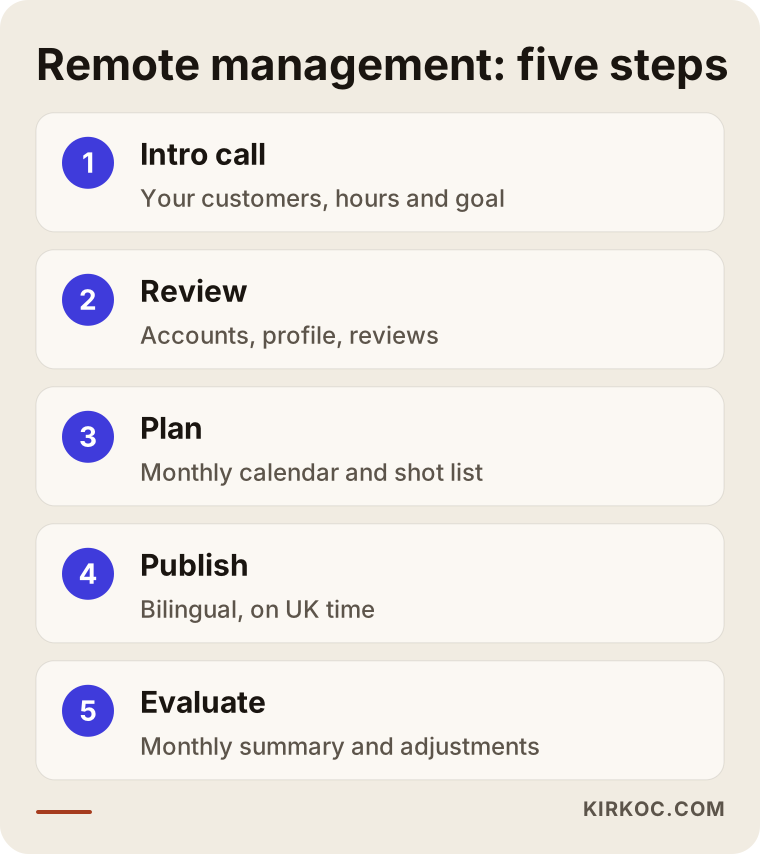
Here is a little more detail on each of the five steps in the diagram.
1. Intro call
On a video call we talk about your business, your customers, your busiest and quietest hours, and the accounts you are currently using. The most important question at this stage is "Which customers do you want more of?" The language and tone of everything that follows depends on that answer.
2. Review of your current accounts
I look through your Instagram, Facebook, TikTok, Google Business Profile and website if you have one. I check whether the information is consistent, how reviews are being answered and which posts have drawn interest. I also check whose name the accounts are registered under, because your business accounts should be in your control.
3. Content plan and shot list
I put together a one-month content plan: what goes out on which day, in which language, and which special dates it lines up with. I also give you a simple shot list, something like "This week: a close-up of lamb skewers over the charcoal, a moment from a shave in the barber's hands, new products going onto the shelf." Filming vertically on your phone in good light is usually all that is needed.
4. Production and publishing
I edit the footage you send, write the captions in both languages and schedule the posts on UK time. If you like, I send everything to you for approval before it goes live. If replying to messages and comments is part of the job, we agree from the start which questions I answer and which ones you answer. Topics such as prices, confirming reservations or handling complaints should stay with the business owner.
5. Monthly review
At the end of the month I share a plain summary: which content drew interest, and how many people tapped for directions, called, or clicked your booking link from your profile. The next month's plan is adjusted based on those numbers.
Common mistakes
The most frequent mistake I see in Turkish businesses in the UK is an account that is controlled personally by an employee or a relative instead of by the business. When that person leaves, or simply loses interest, access to years of followers and content goes with them.
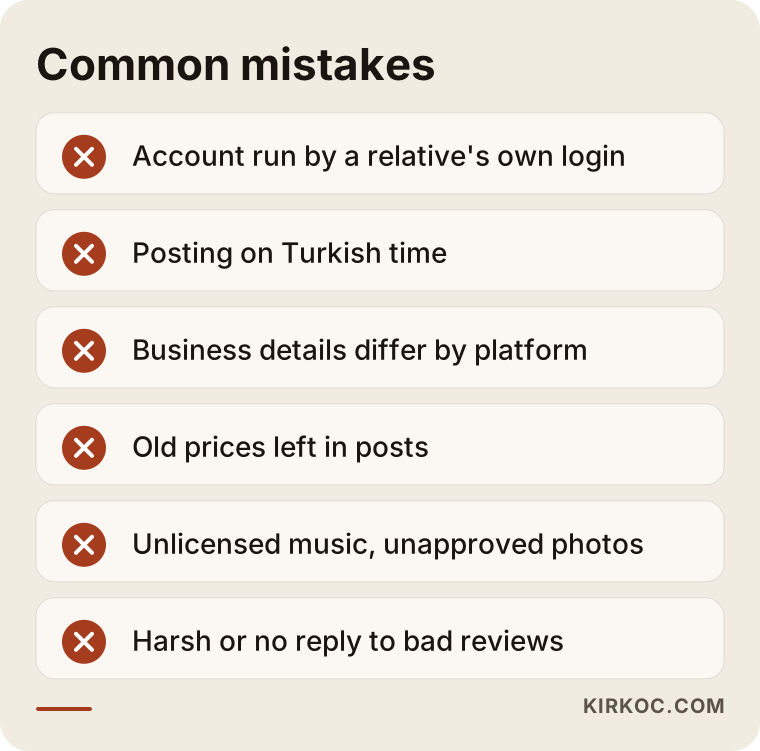
Let me add some detail to the points in the warning box:
- Using copyrighted music. Using popular songs without permission on a business account can get a video muted or taken down. The music libraries that platforms offer for business accounts are a safer choice.
- Posting on Turkish time. A post that goes out at dinner time in Istanbul lands in the mid-afternoon in London. It looks like a small gap, but you can miss the exact moment people decide where to eat.
- Letting prices go stale. If an old price stays in a post, it can lead to an argument at the register. It is better to treat posts with prices as temporary, or to keep prices only on your current menu page.
- Ignoring negative reviews or answering them harshly. Local customers often pay more attention to how the business replies than to the review itself. A calm, short reply that offers a solution usually balances out a bad review.
- Vague promotions and discounts. The UK has rules about advertising and promotional claims. Phrases like "the best" or "the cheapest," or offers without clear terms, can cause problems. If you are unsure about something, I recommend asking a lawyer.
- Not asking customers before posting their photo. Getting consent from the customer in the barber's chair before you share their face is the right thing to do, both for trust and from a legal point of view.
What can you do yourself, and when do you need a specialist?
You can run your accounts yourself. If your business is small and you can set aside regular time, that is a perfectly reasonable place to start. Outside help starts to make sense when you cannot find the time, when writing in two languages is a struggle, or when you cannot tell whether your posts are turning into customers.
Here is what you can handle on your own:
- Keep your Google Business Profile up to date: hours, photos, a link to your menu.
- Film and post a few short phone videos each week.
- Reply to reviews and messages on the same day.
- Make your Instagram bio clear, in English and with a working link.
- Gather the login details for all your accounts under an email address registered to the business.
And here are the signs that it may be time to bring in a specialist: you only post when you happen to have a free moment, writing in English is a strain, you want to run ads but do not know where to start, or you are opening a second location and now need to manage two sets of accounts together. In those situations, working with someone outside the business is what turns social media from something you do now and then into something that runs on a schedule.
What to look for when choosing a specialist
The right person understands both your community and your local customers, and tells you in writing, in measurable terms, what they are going to do. Look for someone who talks about process and measurement, not someone who promises you a follower count.
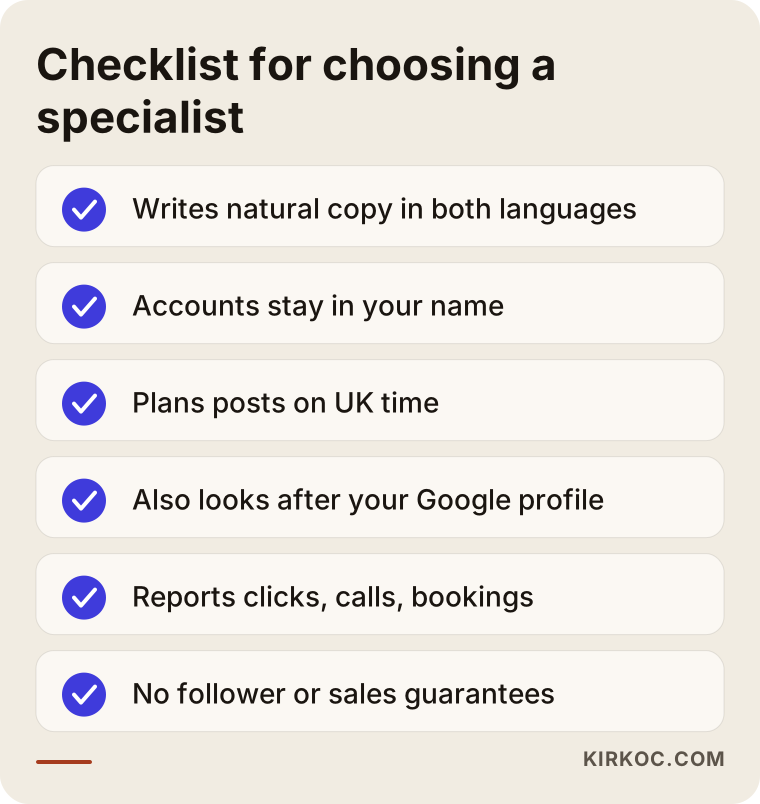
On top of the points in the checklist, I suggest asking these questions on your first call:
- Who writes the English copy? Is it machine translation, or is the copy written in natural English?
- Whose name will the accounts be in? Get written confirmation that all accounts, content and the ad account stay with you when the work ends.
- Which time zone are posts scheduled in?
- What will the monthly report look at? The number of likes on its own tells you very little. Ask about the measures that touch your business: requests for directions, calls, reservations and booking clicks.
- Are the Google Business Profile and the website included? If not, who keeps that information consistent?
- Where is the line when replying to messages? It should be clear which questions the specialist answers and which ones you answer.
- What is the contract length, and how do you exit? Find out whether you are being asked to commit to a long, binding term.
One more thing to keep in mind: if you work with someone based in Turkey, talk about invoicing and payment at the very start. How payments for services from abroad should be treated for tax purposes is a question for your accountant in the UK.
What drives the cost?
The cost of social media management depends on how many accounts are being managed, how much content is produced each month, and who supplies the raw material for that content. That is why I am not giving you a figure here. Knowing what moves the price, though, makes it much easier to compare quotes.
- Number of platforms: Managing Instagram alone is not the same workload as managing Instagram, Facebook, TikTok and your Google profile together.
- Language: There is a clear difference in effort between writing in one language and writing in two.
- How often and what kind of content: A few photos a week and a steady stream of short videos differ hugely in editing time.
- Filming: If you film the videos and send them over, the cost goes down. If professional filming on site is needed, that is planned separately.
- Messages and comments: If daily inbox management is part of the job, the workload rises.
- Ads: Running ads is separate work. The ad budget itself is paid directly to the platform, and how much you spend is your decision.
- Number of locations: More than one location means separate profiles and separate content.
When you compare quotes, look beyond the monthly fee and check which of these items are actually included. A quote that looks low may not cover message handling or English copywriting at all.
Working with Ümit Kırkoç
I am Ümit Kırkoç. I work from Istanbul and provide, as a single person, the services a digital agency would offer: websites and e-commerce, SEO, local SEO, visibility in AI tools (often called GEO), management of Instagram, Facebook, LinkedIn, TikTok and YouTube, Google and Meta ads, logos and brand identity, and content creation. Because I work remotely, working with a business in the UK is not very different in practice from working with one down the road in Istanbul. Meetings happen over video, and footage and files go back and forth over WhatsApp or a shared folder.
When I manage social media for a Turkish business in the UK, the work comes down to this: bringing your accounts and Google Business Profile in line with the same information, building a bilingual content plan, editing the footage you film and publishing it on UK time, and explaining in plain words at the end of each month what worked. Having everything in one pair of hands has a concrete benefit here. When you announce a new menu on Instagram, it appears on your website, your Google profile and your ads on the same day, in the same words. You do not have to chase three different people to update three different places.
I do not guarantee follower numbers, a set amount of sales or a particular position in search results; I do not think promises like that are honest. What I can offer is steady, measured work that we talk about openly. On the first call I listen to how your business works, tell you where it makes sense to start, and send you the scope in writing.
Frequently Asked Questions
Who should I hire to manage social media for my Turkish restaurant in London?
Someone who can speak to both the Turkish-speaking community and local British customers, write natural copy in both languages, and keep an eye on your Google Business Profile as well. For restaurants, social media and map results are closely tied, so having the same person look after both keeps things consistent. On the first call, always ask whether the accounts will stay in your name and what the monthly report will measure.
Does it make sense for my UK business to work with someone remotely from Turkey?
In most cases, yes. Most of social media management is planning, editing, writing and scheduling, all of which can be done remotely. You can film on your phone, or bring in a local photographer when you need one. The time difference is not a problem because posts are planned in advance. Do talk to your accountant beforehand about payment and invoicing.
For my barber shop, is Instagram or TikTok more important?
Both can work; it depends on the age of your customers and your neighborhood. For barbers with a younger crowd, short videos on TikTok can reach a wider audience, while Instagram is strong for building trust through your profile, booking link and reviews. Often the most efficient approach is adapting the same video for both platforms. The soundest way to decide is to measure which one actually brings in more bookings.
Does my Turkish grocery store really need a social media account?
Yes, because grocery customers want to know about new arrivals, pre-orders before the holidays and when the fresh bread comes out. A shop that shares this information regularly becomes the first place people think of when they need something. For local shoppers, short product explainers also take the edge off walking into an unfamiliar shop for the first time.
Should my posts be in Turkish or in English?
For most businesses, the most balanced approach is to pick one main language based on who your customers are and add a short line in the other. Your bio, address and opening hours should always be in English. Explaining dish and product names rather than translating them helps you keep your Turkish identity.
Do I need to hand over my passwords for social media management?
Usually not. Tools such as Meta Business Suite and Google Business Profile let you add authorized users without sharing a password. That way you stay the owner of the account and can remove access whenever you want.
How long before I see results from social media management?
It would not be honest to give you a fixed timeline; results depend on your location, the state of your current accounts and how consistent the content is. Basic fixes, such as correcting account and profile details, can be done quickly. Content that has a steady effect takes a few months of consistent work. Along the way, the monthly numbers let us see together what is working.
Does social media management work without paid ads?
It does. Regular content, consistent profile details and replying to reviews build trust even without ads. Ads are for speeding up a specific goal, such as a grand opening, a weekday lunch menu or holiday orders. The ad budget is your call, and starting with a small test is usually the sensible way in.
If you want social media for your Turkish restaurant, barber shop or grocery in the UK to run on a regular, bilingual schedule that matches your Google profile, you can leave a short message about your business on my social media management page. I will tell you honestly where it makes sense to start.