You own a villa, or maybe several, or a few apartments you rent by the night in a tourist area. Most of your bookings come through the big booking platforms, and every time a guest books, the platform keeps a share. The messages, the calendar, the pricing display and sometimes even the reviews follow that platform's rules, not yours. You would like a website of your own, one where guests can find you directly and write to you directly. That is probably how you ended up searching for "vacation rental SEO" or "villa rental website SEO". This article is written for you: an owner or manager of holiday homes, especially along the Turkish coast, who wants to know how a website of your own can become visible on Google, which pages it needs and where to start. I am Ümit Kırkoç, a digital specialist based in Istanbul. I handle websites, SEO services, social media and advertising myself, in one place, so I will look at this topic from both sides: the pages you write and the setup behind them.
SEO, put simply, is the work that helps your website show up when people search on Google. It differs from advertising in one important way. With ads you are visible only while you pay. With SEO, a well-built page can keep bringing in guests for months. In a seasonal, crowded business like villa rental, that difference matters, because your visibility on a booking platform is not in your hands. It depends on the platform's own ranking rules. Your own website is yours.
Let me be clear about one thing at the start: booking direct does not have to mean leaving the platforms. For most villa owners the healthiest path is to keep using the platforms as a shop window while slowly turning your own website into your main booking channel. I will show you how that can work, step by step.
Why does SEO work differently for villas and vacation rentals?
SEO for a villa is not the same as SEO for, say, a local accountant. An accountant's customers usually live in the same town and search for something like "accountant near me." A villa guest often comes from another city, sometimes from another country, and what they are looking for is not a service but a holiday experience. So the way they search is very different.
A person looking for a villa typically types a place, a group size and a feature: "villa with private pool in Kas," "honeymoon villa in Fethiye for two," "house near the beach in Cesme for eight people," "pet friendly villa in Bodrum." Each of these searches is a separate intent, and each deserves its own page. Trying to answer all of them with a single home page is the most common SEO mistake I see.
The second difference is trust. Before sending a deposit to someone they have never met, a guest wants proof that there is a real house and a real owner. On a booking platform, the platform supplies that trust. On your own website, you have to build it: clear photos, a precise area, cancellation terms, contact details and real guest reviews. Google also tries to judge whether a site is trustworthy by looking at signals like these.
The third difference is seasonality. Guests planning a summer trip often search months ahead. That means your SEO work should be finished before the season starts, not during it. After a page goes live, Google needs time to find it and understand it, and you have to leave room for that.
The fourth difference is who you are competing with. In the search results you are not only up against other villa websites. You are up against the big booking platforms, travel guides and blog posts. You cannot overtake a giant platform's pages overnight. But you can do something they cannot: describe one area and one house in rich, honest detail.
How do guests search for your villa on Google?
First, let us look at what guests actually type. The illustration below shows a completely made-up search results page. The point is to see which kind of page answers the guest's question clearly.
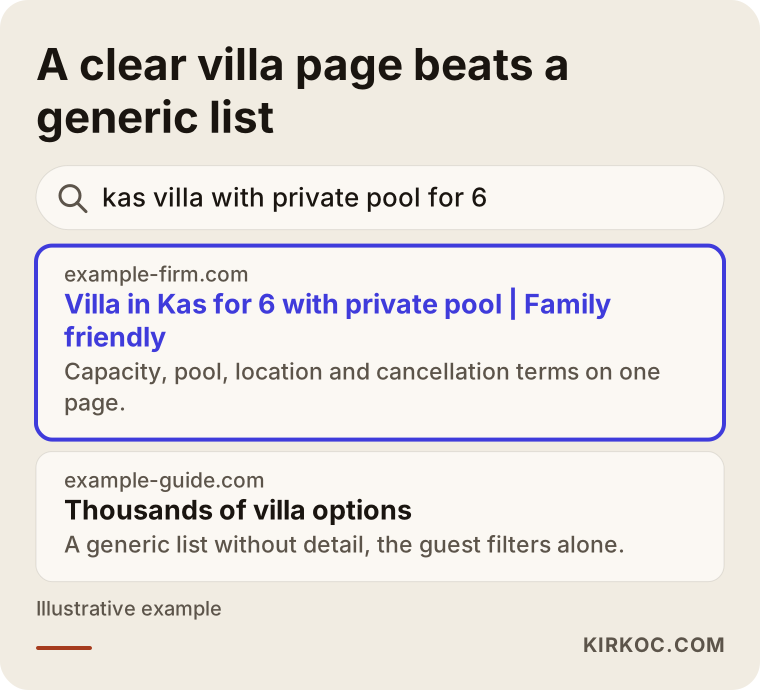
Notice that the highlighted result names the area, the feature and the number of guests all at once. The generic list says "thousands of villas," but it does not answer what the guest asked. If you build your pages with this logic, you give yourself a chance to appear ahead on the same search. I cannot guarantee that, but that is the direction to work in.
Guest searches fall roughly into a few groups. The table below pulls them together.
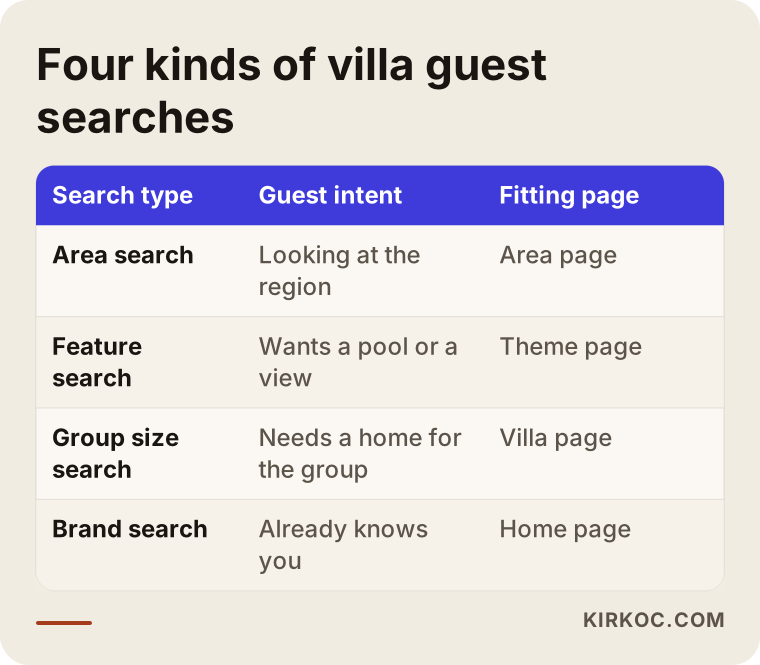
The first group is area searches, such as "Kalkan villa" or "Datca holiday rental." Here the guest has not decided yet and is still looking at the region. A page that introduces the area and lists your villas there fits best. The second group is feature searches: "private pool," "hot tub," "secluded," "sea view." This guest knows what they want and is looking for a house that has it. The third group is group size and trip type: "villa for 6," "honeymoon villa," "villa for families with children." The fourth group is people who type your name or your villa's name. They already know you, perhaps from Instagram, from a friend or from a past stay.
Brand searches are easy to overlook, yet they are the simplest door to commission-free bookings. If someone types your villa's name, cannot find your site and lands on your platform listing instead, you pay commission on a booking that was already yours. That guest had already chosen you. This is why making sure your own website comes first when people search your name is one of the top priorities.
Booking platforms and your own website: an honest comparison
I am not suggesting you drop the platforms, because a new website of your own will not bring in the same volume of guests from day one. But knowing the difference shapes your plan.
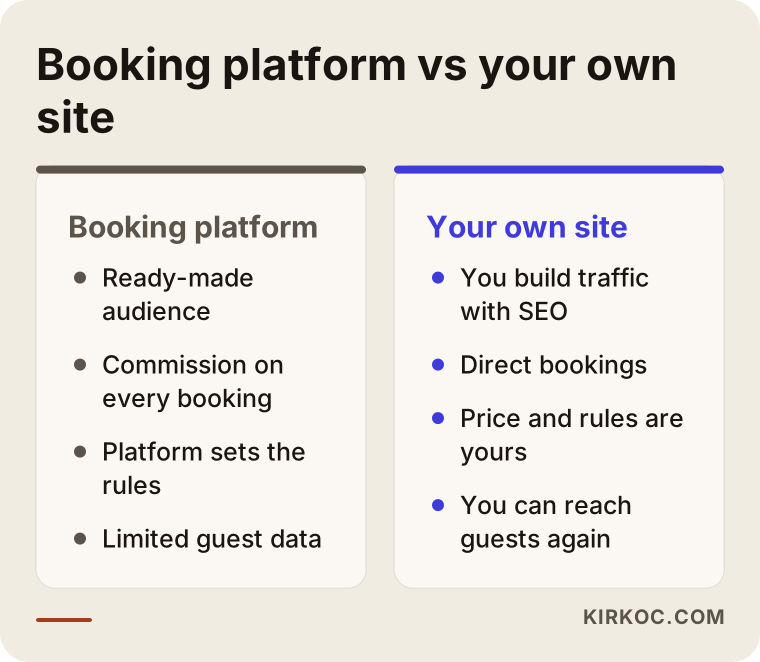
The strength of a platform is a ready-made crowd. Guests already search there, pay there with confidence and read reviews there. Its weaknesses are that it takes a cut of every booking, decides the rules and how your prices are displayed, and often does not give you the guest's full contact details. So when the same guest wants to return next year, they usually come back through the platform again.
The strength of your own site is control. Prices, rules, your story, the order of your photos and the way guests contact you are all in your hands. A guest writes straight to you, and you can reach them again for next season. The weakness is that the crowd does not arrive by itself. You have to build it, and SEO is the most durable way of doing that.
One important note. Booking platforms have their own terms of use, and these can sometimes limit how you may steer guests away from the platform. Knowing what your agreement allows is your responsibility. If you are unsure, read your contract or ask a lawyer. Here I am talking about the visibility of your own website, not about platform rules.
Which pages do you need? A one-page site is not enough
A common mistake is to pile every villa and every detail onto one long page. Google treats each page as an answer to a particular question. One page can answer one question well. If you want to answer several questions, you need several pages.
A villa website usually includes these page types: a home page, a separate page for each villa, area pages, feature or theme pages (private pool, honeymoon, family with kids and so on), a contact and inquiry page, a frequently asked questions page and a page for cancellation terms. Each page has a different job.
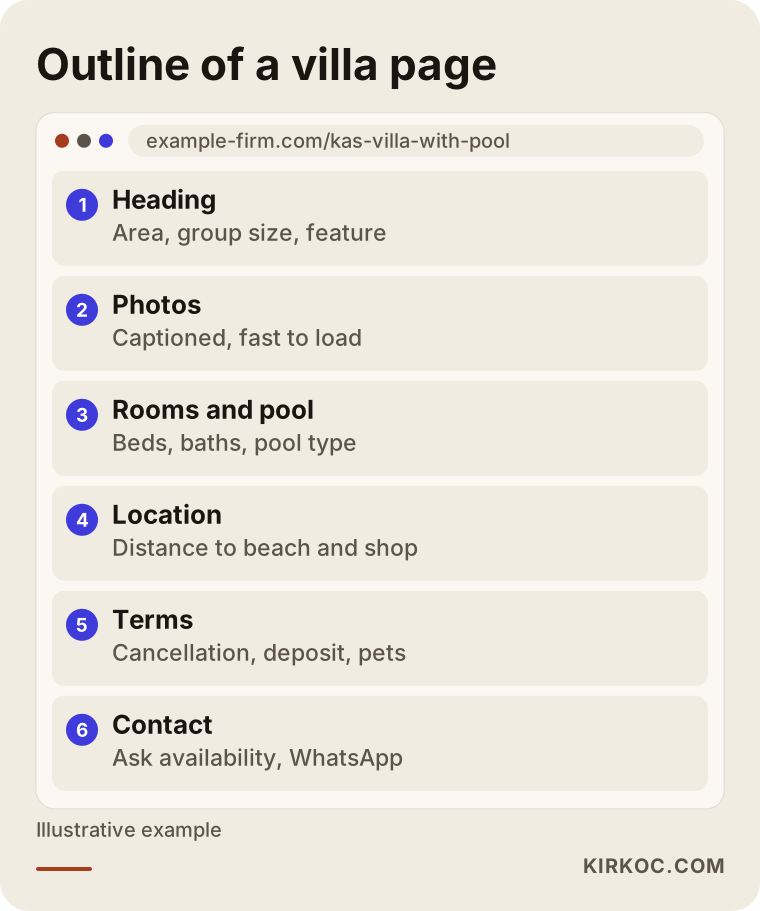
The outline above shows one way to arrange a single villa page. First the area and group size the guest searched for are stated plainly. Then come photos, rooms, the pool and the surroundings, followed by location and access, booking terms and contact. The more complete the page, the fewer questions the guest has to ask you. That is a good signal for the guest and for Google.
What should a villa page say?
A villa page is not a classified ad. It is a decision aid. A guest wants to learn how many people can stay comfortably, how many bedrooms and bathrooms there are, whether the pool is private or shared, heated or not, fenced or not, how far the sea is, where the nearest grocery store and restaurant are, whether pets are allowed, what the check-in and check-out times are, whether cleaning and linens are included, whether a deposit is taken and what the cancellation terms are.
Write these things in a clear list, but in a warm voice. Every sentence should answer a question. Empty adjectives such as "stunning luxury villa with amazing views" give the guest no information. A concrete detail such as "you can drink your morning coffee on the terrace and look out over the bay" does. Writing a short caption under each photo to say what it shows helps both the guest and the search engine.
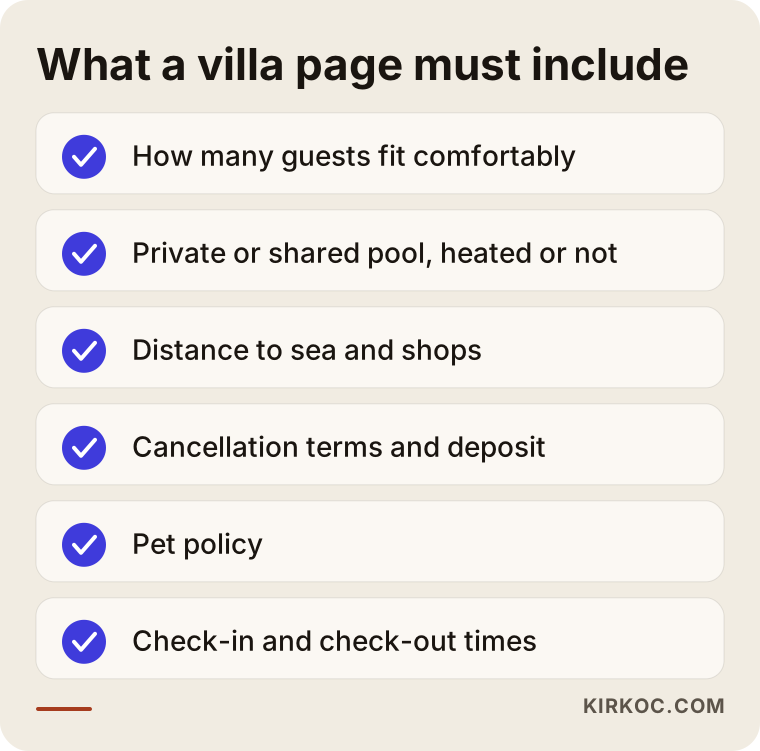
It is very common to skip some items on this checklist. The ones left out most often are cancellation terms, the deposit, the pet policy and the exact location. If a guest cannot find these, they either do not contact you or they go back to a platform page where they can find them.
Why do area pages help?
Each villa page belongs to one house. But a guest's first searches are usually about the area. An area page is something like "A guide for people planning a holiday in Kas, and the villas there." It describes the region and shows your houses in it. Beaches, coves, the nearest airport, places you can reach without a car and what the weather is like in which months can all go here.
When you write this page, do not slip into travel brochure language. Write the practical knowledge of the neighborhood your houses are in: how many minutes to the nearest grocery store, which beach you can walk down to, at what hours the road gets crowded. Only someone who knows the area can write that, and the generic pages of the big platforms cannot do it. This is exactly where your advantage lies.
Two hypothetical example scenarios
The two examples below are entirely hypothetical. They do not describe any real person or business. Their purpose is to help you picture the situation.
Example scenario 1: an owner with a single villa. Imagine someone who owns one three-bedroom villa with a private pool in Datca. It is listed on two big platforms. Bookings are going well, but every season the same commission is paid and the guests' contact details are out of reach. The owner would like a website but wonders, "A whole website for one villa?"
In this case a large site is not needed. What works is one strong villa page, a page about the area, a frequently asked questions page and a clear contact form. It only has to be prepared for a handful of searches, such as the villa's own name and "Datca villa with private pool." The first goal is that someone who types the villa's name lands on the owner's own site. Later, extra pages can be added for more specific searches like "villa for a family with children in Datca." For a single villa, the honest expectation is this: the site will not bring a large volume in the first season, but it lays the groundwork for calling last year's platform guests back directly next year.
Example scenario 2: an owner with four or five homes in one area. Now imagine someone with five homes across Kas and Kalkan: two villas and three apartments rented by the night. They are all listed on one page with short descriptions. There is a website, but the name does not even appear on Google.
The picture here is different. Each home gets its own page, the two areas get their own area pages, and a few theme pages such as "private pool," "close to the sea" and "family friendly" are added. Each page links sensibly to the others: from the area page to the homes, and from each home back to the area. This structure lets guests move around without getting lost and helps the search engine understand the site. Five homes, two areas and three themes add up to around ten pages, which is a serious but manageable job.
The lesson from both scenarios is that the size of your site should follow the number of homes you have and the variety of searches you are aiming at. Bigger is not always better. You need as many pages as the job requires, and every one of them should be full.
Step by step: where do you start?
SEO is not started and finished in a day, but it follows a clear order. This is how I run the work.
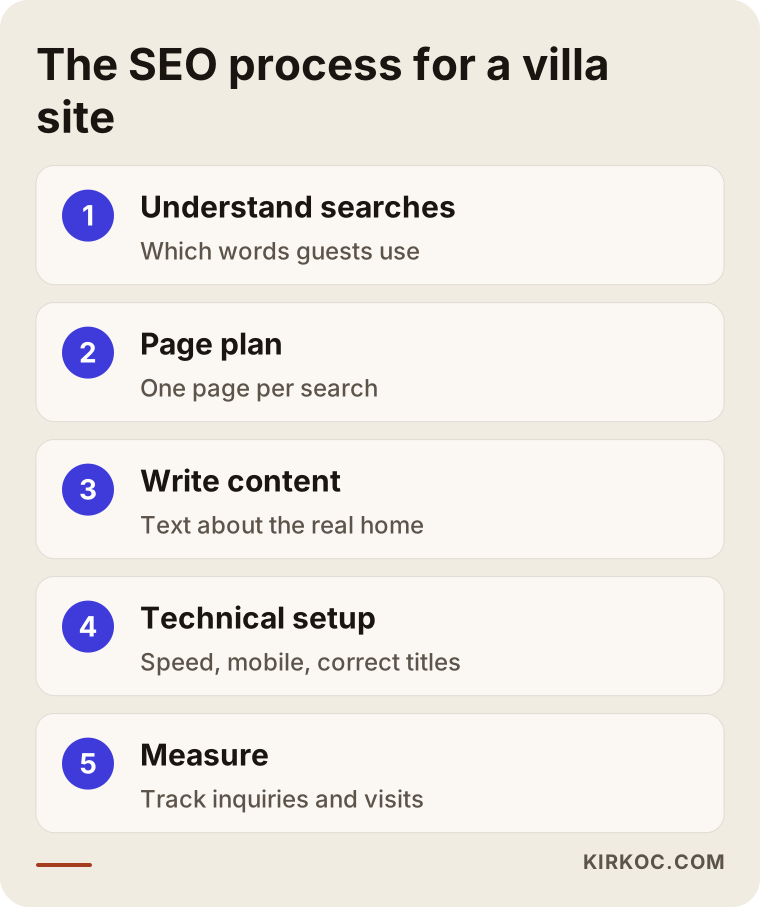
Step one: understand the searches. I look at which guests, in which area, search with which words. This is observation, not guesswork. You know better than anyone who rents your home and what they ask. I combine that knowledge with search data.
Step two: the page plan. Which search gets which page is written down in a plan. If two pages are written for the same search, they compete with each other, and that is one of the first mistakes to avoid.
Step three: writing the content. Villa pages, area pages and question-and-answer sections are written. Photos are chosen, named and given captions. The text must describe your real home. Generic sentences copied from the internet convince neither the guest nor Google.
Step four: technical setup. The site should open quickly on a phone, photos should not be heavy, page titles should be written correctly, and the settings Google needs to find your pages should be in place. Most guests visit from a phone, so the mobile view gets its own check.
Step five: your Google Business Profile and local visibility. If you have an office or a welcome point near your homes, a business profile on Google can help you appear in map searches. If you prefer to keep a villa's address private, you need to be careful here. Not every owner wants the full address public before a guest has booked. That decision is yours.
Step six: measurement. Who visits the site, which pages do they stay on, how many people fill in the form or call? These are tracked regularly, and the pages are improved accordingly.
How does a booking request reach you directly?
SEO brings the guest to your site, but what turns a visit into a booking is how easy the site is to use. If a guest likes the page and cannot work out how to book, they give up.
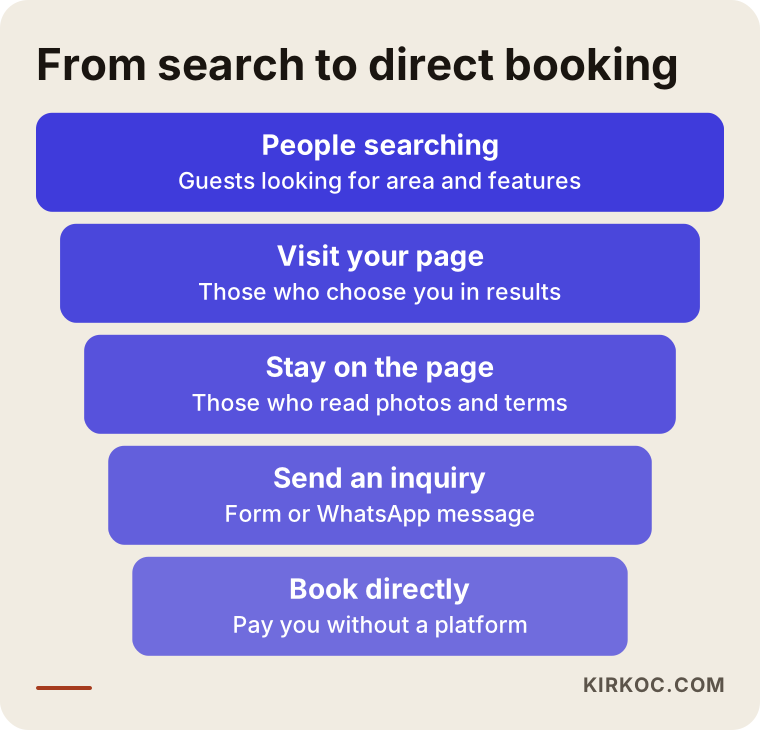
You lose some people at every stage of this path. A portion of searchers click on your page, a portion stay, a smaller portion ask a question or leave an inquiry, and the smallest portion actually books. Knowing this, you make small improvements at each stage to reduce the loss: a clear "ask about availability" button, a WhatsApp link, a short form with a few fields and a quick first reply.
There are two main options. The first is a simple inquiry form on the site plus contact by WhatsApp, with dates confirmed by hand. That is enough for owners with a small number of homes and it is low cost. The second is an availability calendar and online booking on the site. Once you have more homes, calendars have to be synchronized with the platforms to prevent double bookings. That is technically possible, but it needs care, and I would help you decide which solution suits you based on how many homes you have. I should not say anything definitive about taking payments, guest registration or taxes. For those, talk to an accountant or a lawyer.
It also builds trust to show on your site any permit or registration details that short-term rentals require where you are. The rules on this change over time and differ by location, so ask a lawyer or the relevant authority for the current situation. This matters even more if you are a foreign owner renting out property in Turkey, because the requirements may differ from those in your home country.
Photos, reviews and trust signals
In the villa business, photos matter as much as text. But for SEO, how you use a photo matters as much as the photo itself.
Uploading photos without making them smaller for the web makes your site slow. A slow site loses guests and is judged negatively by Google. A good habit is to give files meaningful names like "datca-villa-pool-terrace" instead of leaving them as "IMG_4521," and to write a short caption for every photo.
Be honest about reviews, too. Showing reviews you collected from real guests, with their permission, builds trust. Making up reviews is unethical, and it damages your brand if it comes out. Before you copy reviews from a platform, check that platform's rules. You can ask a guest directly for a review with a short message after their stay.
Other trust signals include a real phone number and email address on the site, a short introduction of you or your business, cancellation and refund terms written in the open, and a privacy and cookie notice. None of this is glamorous, but when it is missing, guests hesitate.
AI assistants and your villa
Some people now plan their holidays by asking AI assistants directly: "Can you suggest a quiet villa in Kas for a family with kids?" When these assistants build an answer, they look at sources on the internet and may draw on pages that are reliable, clear and informative.
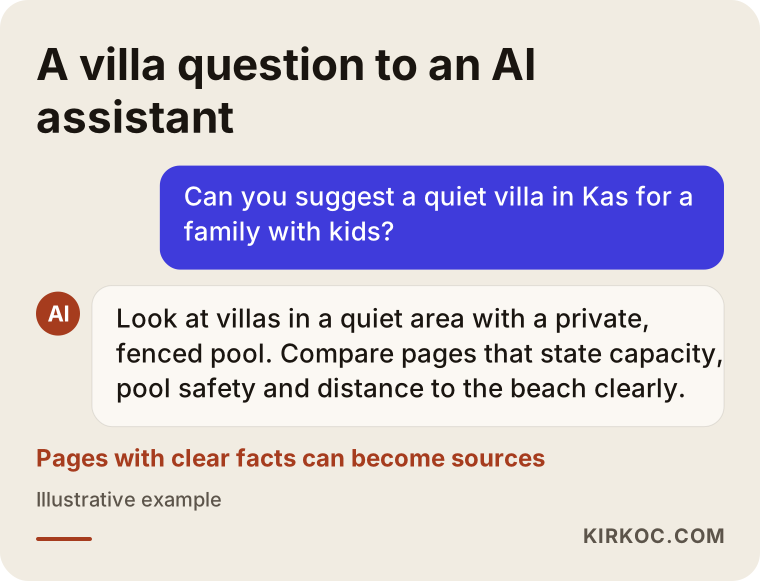
I cannot guarantee that an AI assistant will recommend you. What I can say is this: the clearer and more organized the capacity, location, feature and rule information is on your page, the easier it is to understand, for people and for machines. This work is sometimes called GEO, meaning work to become visible in answer engines. Its foundation is the same as ever: clear, correct and complete information.
Common mistakes
There are mistakes I see again and again on villa and vacation rental websites. Knowing them saves you time and money.
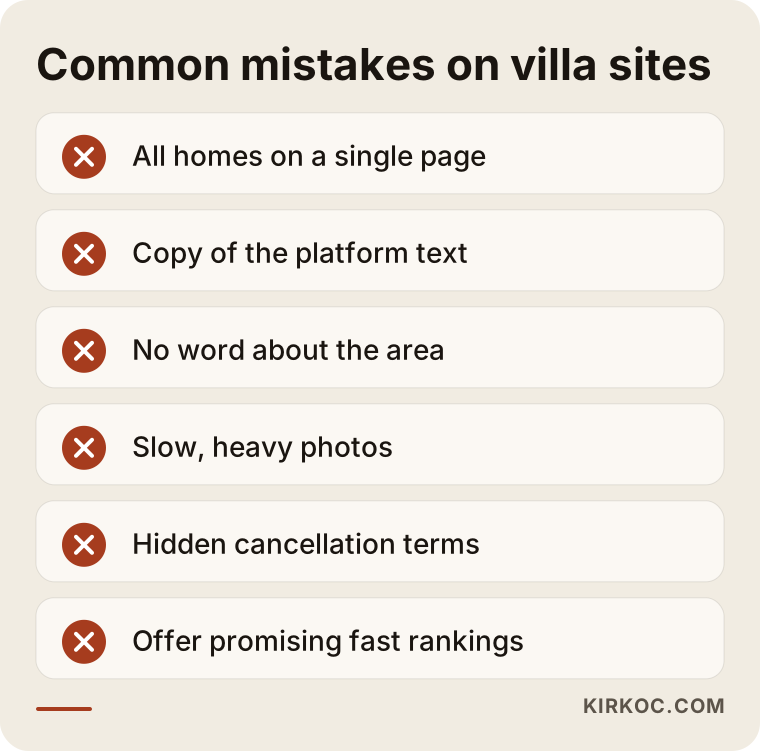
Copying the platform text word for word. Using the same description on the platform and on your site makes it harder for Google to tell the two pages apart. Write the text on your site originally, and keep the one on the platform shorter.
Putting all the homes on one page. I covered this above: each home answers a separate question and needs a separate page.
Not describing the area. A guest chooses the area first and the house second. A site with no area information misses the first step.
Neglecting mobile. Guests often plan their holiday on a phone. A site with small buttons and slow photos loses guests, however beautiful it is.
Hiding the terms. Hiding cancellation, deposit or extra cleaning fees may seem to reduce questions in the short run, but it damages trust. Terms that are written openly are what guests like most.
Missing the season. Starting work in June and expecting results in July is not realistic. Pages need time to go live and to be recognized.
Falling for offers that promise quick results. Offers saying "first place in one month" generally do not deliver. Nobody can guarantee a position in the search results. An honest offer says what will be done, what will be measured and that results may take time.
Cutting social media off from the site. Posting beautiful photos on Instagram without linking to your site wastes the effort. Every villa shown on social media should have a matching page on your website.
What can you do yourself, and when do you need an expert?
You do not have to hand everything to a specialist. Some things you can do yourself.
You can collect all the information about your villa in one document (capacity, rules, surroundings, distances), take bright, good quality photos or hire someone to take them, note the questions guests ask most often, search for your own name and your villa's name on Google and see what comes up, ask guests for reviews, and, where the platform's rules allow, leave a polite note for platform guests saying they are welcome to contact you directly next time.
You need an expert for the technical setup and speed of the site, search research and the page plan, writing texts in the language searchers actually use, synchronizing the booking calendar with the platforms, diagnosing why Google is not showing your site and regular measurement. These jobs call for specific knowledge, and when they are done wrong, they take time to undo.
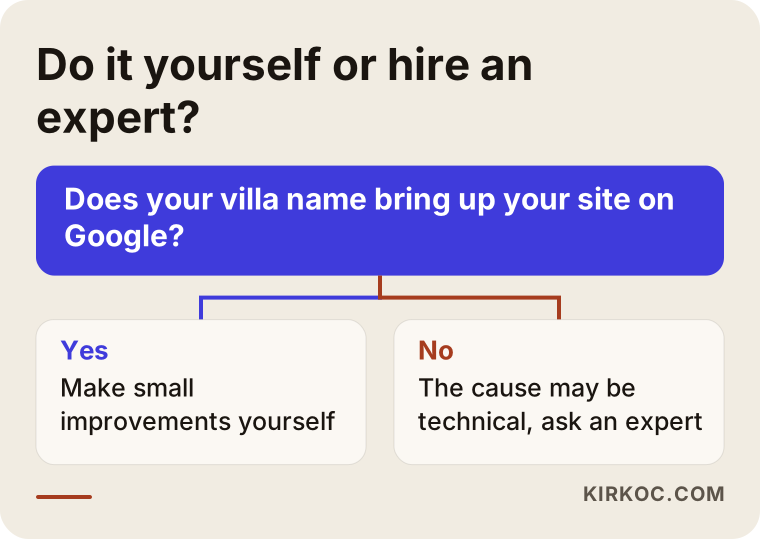
To simplify the decision, ask yourself: do you already have a site, and does it come up on Google when you search your name? If it does, you can make small improvements yourself. If it does not, the cause may be technical and you need an expert to look at it.
What determines the cost of SEO?
I will not quote a figure here, because no two villa owners need the same thing. These are the main factors that shape the cost.
First, the number of homes and areas. Many homes in different areas mean more pages and more writing. Second, the state of your current site: do you need a brand new site, or does the existing one need fixing? Third, the amount of content: how many pages will be written, and do you need photography and editing? Fourth, the booking system: a simple form, or online booking with calendar sync? Fifth, languages: if your guests come from abroad, the site may need to be prepared in English or other languages as well, and for Turkish villas that is very often the case. Sixth, the length and frequency of the work: a one-time setup, or regular monthly follow-up?
Once you and I have talked through all of this, I can give you a clear scope and a price. Be careful with offers that leave the price vague or sell everyone the same package, because every villa business is different.
How I work with you
I begin with an introductory conversation: how many homes you have, where they are, which platforms you are on, how much of your bookings come from where right now and what your goal is. Then I review the current situation and share in writing what is needed.
Throughout the work your contact is one person: me. Because the person who builds the site, writes the text, researches the searches and measures the results is the same person, nothing gets lost between jobs. If you wish, your villa posts on Instagram and Facebook and your Google and Meta ads can run from the same hands too, because the information on your site and on your social media should agree. For example, before the season I can prepare a page with SEO and then send extra traffic to the same page with a short ad campaign. If you also need a logo and a visual identity, presenting your villa brand in one consistent look can be part of the job as well.
What I ask of you is that, as the person who knows your home best, you share information and photos, answer questions and stay patient in the first months. What you should expect from me is openness: I tell you what I did, what I measured and what did not work.
Frequently Asked Questions
Can I leave the platforms completely and move to my own website only?
For most owners I would not recommend that from day one. Platforms keep bringing bookings until your own site reaches enough search visibility. The healthier way is to keep the platforms as a shop window and grow your own site gradually. Check what your agreement with each platform allows.
How long until I get bookings from my own website?
I cannot give a firm time, because it depends on the area, the competition and the current state of your site. Brand searches, meaning guests typing your villa's name, generally reach your site sooner. Showing up for broader searches can take months. Be cautious with anyone who promises fast and certain results.
Is a website worth it for just one villa?
A single villa does not need a big site. Starting with one strong villa page, area information, frequently asked questions and a clear way to get in touch makes sense. The real value is that returning guests who know you can reach you directly.
Do I have to show my booking calendar on the site?
No. For a small business, a simple inquiry form and WhatsApp contact can be enough. As the number of homes grows and the risk of double bookings rises, a system with calendar sync becomes worth considering.
Can I use the same photos on my site as on the platform?
Technically you can, but it is better to use a slightly different selection and different captions on your site. If you own the copyright to the photos, there is no problem. If you have an agreement with a photographer, check the terms of use.
Do I need a permit or registration for short-term rentals?
This depends on the regulations, and it can change over time and from one area to another. I suggest asking a lawyer or the relevant authority for the current situation. I am not a legal adviser. I can only help make sure the necessary information on your site is correct and visible.
Should my site also be in other languages for foreign guests?
If part of your guests come from abroad, yes, at least an English version will help. Pages written around the words a guest in that language actually searches for do better than a plain translation.
Which should I choose, SEO or advertising?
They do different jobs. Ads give you quick visibility at the start of the season but stop when you stop paying. SEO starts slower but lasts. Depending on your budget and timing, using both together often makes sense.
If you want your own website to be visible for villa and vacation rental searches, you can call me or fill in the form on my SEO services page. I will listen to your homes and your goal and put together a roadmap that fits.